1058 OPTICS LETTERS / Vol. 21, No. 14 / July 15, 1996
Effects of intracavity dispersion on the starting dynamics of
continuous-wave passively mode-locked
Ti:sapphire
yDDI lasers
Jia-Min Shieh, Hwa-Ming Twu, and Ci-Ling Pan
Institute of Electro-Optical Engineering, National Chiao Tung University, Hsinchu, Taiwan 30010 Received January 29, 1996
Through analysis of transient autocorrelation traces, we show that intracavity dispersion significantly affects the number of initially oscillating modes as well as the buildup of passive mode locking in picosecond and femtosecond lasers. 1996 Optical Society of America
In the past few years, a number of studies have analyzed theoretically both steady-state operation and self-starting conditions for passively mode-locked solid-state lasers.1 – 5
These studies have focused on the mode-locking threshold and parameters of the initial f luctuation necessary to initiate mode-locking. Quan-titatively, an initial f luctuation will evolve into a steady-state mode-locked pulse if and only if1,6
kPs0d . 1
lnsmid
Tr
Tc
. (1)
In inequality (1), k is the mode-locking strength
parameter. Ps0d is the power of the slowly varying
average background radiation in the cavity. It is re-lated to the peak intensity of the initial f luctuation,
ps0d ø Ps0d lnsmid, where mi represents the
num-ber of initially oscillating modes. Tr and Tc are the
round-trip time of the cavity and the effective mode-correlation time, respectively. The latter is def ined by the inverse 3-dB full width of the f irst beat note of the free-running laser, Dn3dB. It is commonly as-sumed that the frequency-pulling effect that is due to intracavity dispersion does not significantly affect the buildup of passive mode locking. This assumption is, however, based on a guess as to the characteris-tic duration of the initial mode-beating f luctuations in the free-running laser, ti Trymi. In the
litera-ture ti is usually estimated to be of the order of 10 ps
or longer. To our knowledge, neither ti nor mi was
determined experimentally previously. On the other hand, modulation instability resulting from the inter-play of self-phase modulation and negative dispersion can increase ps0d and facilitate the startup. This was confirmed for a Michelson additive-pulse mode-locked Nd:phosphate glass laser. Krausz et al.6
showed that the intracavity threshold power for startup of this laser is Pthø 0.6 W and Pth 0.2 W for positive and nega-tive group-delay dispersion, respecnega-tively.
In this Letter we show that intracavity dispersion significantly affects the number of initially oscillating modes as well as the buildup of passive mode locking in picosecond and femtosecond Ti:sapphireyDDI lasers. This is achieved through analysis of transient autocor-relation traces Gstdd and of the spectra of the laser
out-put as a function of delay time td with respect to the
laser onset. During the pulse-formation stage, Gstdd
exhibits a coherent spike residing on a broad shoulder. The width of the spike corresponds to the coherence time of the laser,7
Dtø 1yDv, where Dv is the laser
oscillating bandwidth. It also reveals the unclean ap-pearance of the laser output, that is, a burst of light with numerous picosecond substructures on it.7 – 9
The width of the shoulder, on the other hand, corresponds to the number of phase-locked modes at a particular delay time. As the laser evolves to the steady state, the contrast ratio (R is the peak-to-shoulder-height ra-tio) of the transient autocorrelation trace evolves from 2:1 to 2:0. The former ratio corresponds to that of a multimode randomly phased cw laser. The latter cor-responds to that of a completely mode-locked laser.
Our cw passively mode-locked Ti:sapphireyDDI laser sl 770 nmd generates ,150-fs pulses at 79.4 MHz with intracavity dispersion-compensating SF10 prism pairs.10
Without the prisms, the steady-state laser pulse widths are in the range of 5– 15 ps. This cor-responds to saturable absorber dye concentrations in the range of 2 3 1025 to 1023M. The laser employs a six-mirror cavity with 15-cm radius-of-curvature folding mirrors around a 2-cm Brewster-angle-cut
Ti:sapphire crystal. It was aligned such that the
Kerr-lens strength was weak sk , 1028 W21d and
would not self-start without the absorber dye jet. The transient autocorrelation trace Gstdd and the spectrum
of the laser output at a delay time of td with respect
to the laser onset were measured with the time-gating technique.11,12
In Fig. 1 we show Gstdd at a delay of td 5 ms
(, 380 round trips) for the dispersion-compensated
cavity (steady-state pulse width t , 150 fs) and the
cavity with the prism pair removed st ø 10 psd.
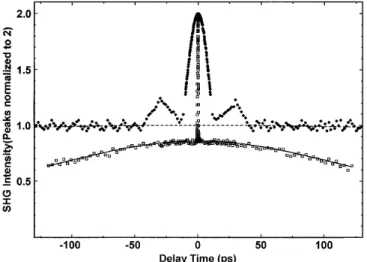
In Fig. 2 we show Gstdd at a delay of td 30 ms
(, 2300 round trips) for the above two
configura-tions. The widths of the coherent spikes in Fig. 1
are Dt , 1 ps and 25 ps for the femtosecond and the
picosecond cavities, respectively. The number of
initially oscillating modes is then mi , 25, 000 for the
dispersion-compensated cavity and 1000 for the cavity without the prism pair. In comparison, we f ind that Dt, 1.3 ps, or mi , 19, 000, for a partially
compen-sated cavity with a steady-state pulse width t, 230 fs. The absorber dye concentrations, on the other hand,
July 15, 1996 / Vol. 21, No. 14 / OPTICS LETTERS 1059
Fig. 1. Transient autocorrelation traces for the laser at td 5 ms after the laser onset. The open squares and f illed circles are experimental data points for the laser with and without prisms, respectively. The solid, short-dashed, and long-dashed curves are curve-fitting results for full width at half-maximum (FWHM) 880 ps, peak 0.99, with prisms; FWHM 2000 ps, peak 1, no prisms; and FWHM 25 ps, respectively. The inset shows curve f itting of the coherent spike of the trace corresponding to the femtosecond laser.
do not affect tc or mi appreciably. Because the weak
Kerr-lens strength is the same for all the laser conf igu-rations that we studied, clearly cavity dispersion is the dominant parameter that determines the number of initially oscillating modes. The secondary spikes lo-cated at approximately a 25-ps delay from the coherent spike peaks shown in Figs. 1 and 2 were due to the mutual correlation between side clusters of longitudi-nal modes. We also observed secondary spikes for a similar picosecond laser at somewhat higher absorber dye concentrationss3 3 1024Md.12
The broad shoulder of Gstdd shown in Figs. 1 and
2, on which the coherent spikes ride, is related to the number of phase-locked modes at td. At td 5 ms and
td 30 ms, the shoulder widths were both ,2000 ps,
corresponding to nine phase-locked modes for the picosecond laser configuration. The peak heights of the shoulders remained equal to 1. For the dispersion-compensated cavity, these widths narrowed from 880 to 400 ps, and the peak heights decreased from 0.95 to 0.86 as the laser evolved from td 5–30 ms. That is,
the number of phase-locked modes increased from,20
to 45. Clearly the pulse-shaping process advanced more rapidly for the cavity with the
dispersion-compensating prisms. The entire buildup process
for our laser in several conf igurations is shown in Fig. 3, which gives the inverse contrast ratio R21as a function of delay time. For the cw laser, with or
with-out prisms, R21 0.5 throughout the buildup; this
value corresponds to that for a multimode randomly
phased cw laser. The value R21 for the partially
compensated cavity falls between curves for the cavity without the prisms and for the cavity with opti-mum dispersion compensation. Furthermore, pulse buildup to the steady state for the latter cavity was much faster, reaching the asymptotic value for the steady-state mode-locked pulses, R21 0, in 130 ms as opposed to 220 ms for the cavity without prisms.
It is instructive to evaluate the initial pulse-shortening force power round trip, s 1yteffdteffydn, for different laser configurations. Here teff tssspvy
pvssd2ysp2vyp2vssd is the effective pulse width of the laser output at a given delay time.13
The
parame-ters pv and p2v are transient fundamental and
second-harmonic-generated laser power, respectively, and tss, pvss, and p2vss are steady-state values of the laser pulse width, fundamental, and second-harmonic generated power, respectively. We have also calcu-lated the transient pulse width, fundamental, and
second-harmonic-generated power by numerically
solving Haus’s master equation of mode locking14 in a manner similar to that of K ¨artner and Keller.15
For the initial field envelope, however, we assume a Gaussian distribution of randomly phased modes, the
Fig. 2. Transient autocorrelation traces for the laser at td 30 ms after the laser onset. The open squares and f illed circles are experimental data points for the laser with and without prisms. The solid curve and the dashed line are curve-f itting results for the shoulders of the autocorrelation traces for the above two cases, respectively. For the solid curve, FWHM 400 ps and peak 0.86, and for the dashed line, FWHM 2000 ps and peak 1.0.
Fig. 3. Inverse contrast ratios R21for the laser in several
configurations are plotted as a function of delay time after the laser onset: solid curve, with prisms; short-dashed curve, cw (with or without prisms); long-dashed curve, without prisms;m, partially compensated. The shapes are data points.
1060 OPTICS LETTERS / Vol. 21, No. 14 / July 15, 1996
number of which was experimentally determined from the coherent spikes of the transient autocorrelation traces. At an absorber concentration of 5 3 1025M, we calculated that s 26.0 3 1025 for the picosec-ond cavity sD 1250 fs2d and s 21.0 3 1024 for the dispersion-compensated cavity sD 23000 fs2d. This is consistent with our experimental obser-vations described above. On the other hand, the Kerr-lens strength is the same for both conf
igu-rations, k ø 2.0 3 1028W21. The corresponding
pulse-shortening force sk 22.0 3 1026. In
com-parison, we estimate that k 1.0 3 1027W21 and
sk 21.0 3 1025 for a self-starting Kerr-lens mode-locked Ti:sapphire laser.16
Signif icantly, this is comparable in magnitude with the dispersion-related
pulse-shortening force. Following Agrawal17
and Krausz et al.6
we note that, for the modulation insta-bility that is necessary to initiate self-starting, the optimum group-delay dispersion for the cavity must be jDoptj 2f Ps0dyDni2. With the self-phase
modu-lation strength f 2.0 3 1026W21, Ps0d 10 W, the free-running laser line width Dni 6.0 3 1011s21, and
jDoptj 100 fs2. This is substantially smaller than the group-delay dispersion in our femtosecond cav-ity. Nonetheless, the dispersion effect on the starting dynamics was already observable in this study. State-of-the-art Kerr-lens mode-locked Ti:sapphire lasers,18 however, employ a cavity with near-zero second- and third-order dispersion. We therefore predict that dispersion will play a significant role in the starting dynamics of this class of lasers.
In summary, we show that intracavity dispersion is the dominant physical parameter that determines the number of initially oscillating modes in a pas-sively mode-locked Ti:sapphire laser. Our results also suggest that dispersion, probably in combination with self-phase modulation, plays an important role as a pulse-shortening force in the starting dynamics.
We acknowledge a helpful discussion with Y. Lai. This research was partially supported by the National Science Council of the Republic of China under grant NSC84-221-E-009-032.
References
1. F. Krausz, T. Brabec, and Ch. Spielmann, Opt. Lett. 16, 235 (1991).
2. H. A. Haus and E. P. Ippen, Opt. Lett. 16, 1331 (1991). 3. J. Hermann, J. Opt. Soc. Am. B 11, 496 (1994). 4. S. Chen and J. Wang, Opt. Lett. 16, 1689 (1991). 5. C.-J. Chen, P. K. A. Wai, and C. R. Menyuk, Opt. Lett.
20, 350 (1995).
6. F. Krausz, M. E. Fermann, T. Brabec, P. F. Curley, M. Hofer, M. H. Ober, C. Spielmann, E. Wintner, and A. J. Schmidt, IEEE J. Quantum Electron. 23, 2097 (1992). 7. D. J. Bradley and G. H. C. New, Proc. IEEE 62, 313
(1974).
8. H. A. Pike and M. Hercher, J. Appl. Phys. 41, 4562 (1970).
9. M. A. Duguay, J. W. Hansen, and S. L. Shapiro, IEEE J. Quantum Electron. QE-6, 49 (1970).
10. C.-L. Pan, C.-D. Hwang, J.-C. Kuo, J.-M. Shieh, and K.-H. Wu, Opt. Lett. 17, 1445 (1992).
11. J.-C. Kuo, J.-M. Shieh, C.-D. Hwang, C.-S. Chang, and C.-L. Pan, Opt. Lett. 17, 334 (1992).
12. N.-W. Pu, J.-M. Shieh, Y. Lai, and C.-L. Pan, Opt. Lett. 20, 163 (1995).
13. Y. C. Chen and J. M. Liu, Appl. Phys. Lett. 47, 602 (1985).
14. H. A. Haus, J. Appl. Phys. 46, 3049 (1975).
15. F. X. K ¨artner and U. Keller, Opt. Lett. 20, 16 (1995). 16. J.-M. Shieh, F. Ganikhanov, K.-H. Lin, W.-F. Hsieh,
and C.-L. Pan, J. Opt. Soc. Am. B 12, 945 (1995). 17. G. P. Agrawal, Nonlinear Fiber Optics (Academic, New
York, 1989).
18. J. Zhou, G. Taft, C.-P. Huang, M. M. Murnane, and H. C. Kapteyn, Opt. Lett. 19, 1149 (1994).