Dynamics of the Laguerre Gaussian TEM
0,l*
mode in a solid-state laser
Y. F. Chen*Department of Electrophysics, National Chiao Tung University, 1001 TA Hsueh Road, Hsinchu, Taiwan 30050, Republic of China
Y. P. Lan
Institute of Electro-Optical Engineering, National Chiao Tung University, Hsinchu, Taiwan 30050, Republic of China
共Received 21 November 2000; published 10 May 2001兲
The dynamics of a solid-state laser sustaining the oscillation of the Laguerre–Gaussian TEM0,l* mode is theoretically and experimentally studied. The results of investigations of the existence conditions of self-modulation, chaotic, frequency locking, and self-pulsing regimes are given. The experimental results, obtained using a diode-pumped solid-state laser, are well confirmed by the theoretical model. From the observations of the locking phenomena of the first-order family, we also confirm the theoretical predictions that the locking occurs as a subcritical bifurcation in a solid-state laser.
DOI: 10.1103/PhysRevA.63.063807 PACS number共s兲: 42.60.Mi, 42.65.Sf
I. INTRODUCTION
The recent rapid progress of diode-pumped microchip la-sers has driven a renaissance of solid-state laser physics re-search and led to phenomena关1兴. Fiber delivery of the pump power enables us to keep the laser resonator apart from the pump source, so that the laser resonator can be isolated from disturbances of the pump sources. In previous works, the high-order Hermite-Gaussian modes have been systemati-cally generated by a fiber-coupled diode end-pumped Nd:yttrium-aluminum-garnet 共YAG兲 laser 关2,3兴. The high-order Laguerre–Gaussian共LG兲 TEMp,l mode exhibits inter-esting physics and has the potential for technological appli-cations, where p and l are the radial and azimuthal indices of the LG mode关4兴. Recently, we developed a technique for the generation of the cylindrical symmetry LG modes with p⫽0 and specified values of l in a fiber-coupled diode end-pumped solid-state laser. The key novelty is to produce a doughnut-shaped pump profile by defocusing a standard fiber-coupled diode. The experimental results demonstrate that the stable transverse-mode pattern near the pump thresh-old is usually a LG TEM0,l mode with the distribution
cos2l 共or sin2l) in azimuthal angle, having 2l nodes in azimuth. Even though the geometry is cylindrical symmetry, there is still certain astigmatism in the cavity due to the thermal lensing effect and anisotropic properties of the gain medium. This is the reason why sine or cosine LG modes, instead of doughnut modes, were generated near the pump threshold. A similar high-order LG TEM0,l mode has been
reported in electrically pumped关5兴 and optically pumped 关6兴 vertical-cavity surface-emitting semiconductor lasers
共VCSEL’s兲. However, the main difficulty of the emission of
high-order LG modes in VCSEL’s is that the processed wa-fer is in need of extraordinary homogeneity.
Slightly above the pump threshold in our laser setup, a
LG TEM0,l* or TEM0,*⫺l mode, having a circle of constant intensity in the radial direction, can be generated by the su-perposition of two like TEM0,lmodes, one rotated/2 about
the optical axis relative to the other. In recent years, the TEM0,l* modes have attracted a great deal of interest in the mechanical and optical effects because they possess well-defined angular momentum along the optical axis when l is not zero关7兴. These modes are also important in laser cooling and trapping experiment关8兴. Therefore, it is of great interest to study the generation of the LG TEM0,l* modes.
Astigmatism-induced splitting of the two like mode fre-quencies has a significant influence on laser dynamics. Tem-poral instabilities and chaotic emission caused by the nonlin-ear interaction of transverse modes in a class-A laser have been reported by Tamm 关9兴 who experimentally confirmed the existence of ‘‘cooperative frequency locking’’ state 关10兴 for the nearly degenerate TEM0,1 and TEM1,0 modes of a
helium-neon laser. However, the dynamic characteristics of a solid-state laser are those of an oscillator with an inertial
共noninstantaneous兲 nonlinearity. In the case of such
oscilla-tors the perturbations exhibit oscillatory relaxation. Because of relaxation oscillations, the two-mode locking in class-B laser occurs as a subcritical bifurcation 关11–13兴, differently from class-A laser where the locking is a supercritical bifur-cation. Not much has been done so far to observe this differ-ence.
In this paper, we perform theoretical and experimental investigations of the relaxation oscillations in a LG TEM0,l* mode solid-state laser for the standing-wave states and the traveling-wave states. Theoretical analysis shows that the re-laxation oscillations play an important role not only in lock-ing processes, but also under conditions of stationary states. On the other hand, a rich set of dynamical behaviors, such as periodic and quasiperiodic self-modulation, chaotic pulsing, and frequency locking, was experimentally observed in the generated TEM0,l* hybrid mode. It was found that the experi-mental data exhibit a general satisfactory agreement with theoretical predictions.
*Author to whom correspondence should be addressed. FAX: 共886-35兲 729134. E-mail address: [email protected]
E⫽
冑
2l!兵
1关共cos l兲⌿
c共t兲exp共⫺ict兲
⫹共sin l兲⌿s共t兲exp共⫺ist兲兴其exp
冉
⫺2
2
冊
⫹c.c., 共1兲 where⫽&r/w; r is the polar radius, w is the beam radius, is the azimuthal angle,⌿c and⌿s are the amplitudes of the LG TEM0,l cosine and sine modes, respectively, andc ands are the frequencies of the LG TEM0,lcosine and sine modes. The exponential factors that govern the wave front curvature are omitted because they are unimportant for the present analysis. In the LG doughnut mode basis, expression
共1兲 can be rewritten as E⫽
冑
1 2l!再
1关⌿ ⫹共t兲exp共il兲⫹⌿⫺共t兲exp共⫺il兲兴 ⫻exp冋
⫺i共c⫹s兲t 2册冎
exp冉
⫺ 2 2冊
⫹c.c., 共2兲 where ⌿⫾⫽⌿cexp冉
i ⍀t2
冊
⫿i⌿sexp冉
⫺i⍀t
2
冊
共3兲and
⍀⫽c⫺s. 共4兲 The LG modes with the amplitudes ⌿⫾ are conveniently denoted by TEM0,l* and TEM0,*⫺l. It can be easily demon-strated that there is a linear coupling between the TEM0,l* and TEM0,*⫺lmodes because of astigmatism-induced splitting
be-tween the frequencies of the LG TEM0,l cosine and sine
modes. Using the Maxwell–Bloch system of equations and following the derivation of the previous works 关15,16兴, we obtain the following system of equations:
TEM0,l cosine and sine modes, such that if ⫽0, then R
⫽⍀/(2
冑
␥储);F⫾1exp关⫾il⫺(2/2)兴 are the amplitudesof the TEM0,*⫾l, N0 and N2 are the zeroth and second
angu-lar harmonics of the population inversion described in Ref.
关16兴, ⌬ is the dimensionless detuning from the line center in
the absence of frequency splitting, ␥⫽
冑
␥储/(), is the excess of the pumping rate above the threshold, normalized to, andis the dimensionless time. The system of Eq.共5兲 is similar to the system describing generation of counter-propagating wave 共CPW兲 in a bidirectional ring class-B la-ser, as discussed in Refs.关17–19兴.The vector field defined by Eq.共5兲 is invariant under the transform F⫾→F⫾exp(i), where is arbitrary constant. It is therefore convenient to introduce the new set of variables that are invariant under this transformation关16兴:
x0⫽N0, x1⫽2 Re共N2兲, x2⫽2 Im共N2兲,
x3⫽兩F⫹兩兩F⫺兩cos, x4⫽兩F4兩兩F⫺兩sin,
x5⫽兩F⫹兩2⫺兩F⫺兩2, x6⫽兩F⫹兩2⫹兩F⫺兩2,
⫽arg共F⫹兲⫺arg共F⫺兲. 共6兲
In terms of the new set of variables, the system of Eq.共5兲 can be expressed in the form
x˙0⫽1⫺␥x0⫺x6, x˙1⫽⫺␥x1⫺x3, x˙2⫽⫺␥x2⫹x4, x˙3⫽⫺共2R sin兲x6⫹x6x1⫹⌬x5x2⫹2x3x0, 共7兲 x˙4⫽共2R cos兲x5⫺x6x2⫹⌬x5x1⫹2x4x0, x˙5⫽⫺共2R cos兲x4⫹2x5x0⫺⌬共x4x1⫹x3x2兲, x˙6⫽⫺共2R sin兲x3⫹2x6x0⫺x4x2⫹x3x1.
In the following, we use Eq. 共7兲 to simulate the behavior of the laser. This set of seven coupled nonlinear equations is numerically integrated using a fourth-order Runge-Kutta al-gorithm.
We assume the frequency of the TEM0,lmode is in reso-nance with the frequency of a laser transition, i.e., ⌬⫽0. This allows for a simple demonstration for the dynamics of the LG TEM0,*⫾l modes in a solid-state laser. At first we consider the steady-state solutions. A pair of solutions of the
standing-wave type, corresponding to simultaneous genera-tion of the TEM0,*⫾l modes, is 兩F⫹兩2⫽兩F⫺兩2. The total
in-tensity of the radiation generated by a laser under these con-ditions is a LG TEM0,lmode with the distribution cos2l共or
sin2l) in azimuthal angle, having 2l nodes in azimuth. In addition, there are four traveling-wave solutions. A stable pair of traveling-wave solutions is 兩F⫹兩⫽0,兩F⫺兩⫽0 and, correspondingly, 兩F⫹兩⫽0,兩F⫺兩⫽0. They will be called the traveling waves TW⫹ and TW⫺, respectively. Another pair of traveling-wave solutions is兩F⫹兩⬎兩F⫺兩 and 兩F⫹兩⬍兩F⫺兩, where兩F⫾兩⫽0; they will be called the traveling waves TW1 and TW2, respectively.
We investigated numerically the stability of the steady-state solutions. Typically, the parameter ␥ is very small in FIG. 1. Theoretical results obtained from the numerical
calcula-tions with R⫽9.0 and⫽0 for several detection angles for l⫽1 in the stable self-modulation regimes.
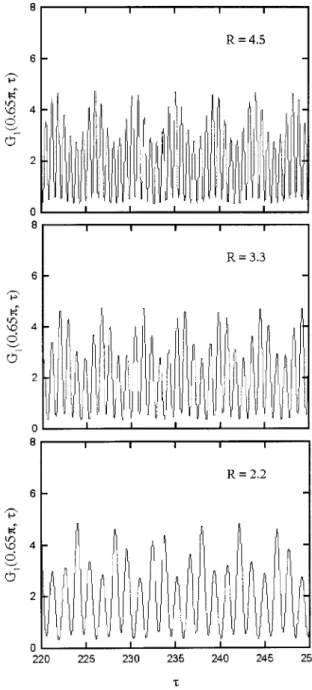
FIG. 2. Theoretical results obtained from the numerical calcula-tions with⫽0 for several values of R for a fixed detection angle for l⫽1 in the stable self-modulation regimes.
class-B lasers. In the all calculations we used␥⫽0.0033 for our diode-pumped Nd:YVO4 laser in which ␥储⬇104s⫺1,
⬇109s⫺1, and ⬇1.0. The calculation results show that
when the frequency difference R cosexceeds considerably the normalized relaxation frequency r/(2
冑
␥储), i.e., ⍀Ⰷr, the solutions TW1 and TW2 exhibit stable relaxation oscillations modulated at the beat frequency. Herer is the well-known relaxation frequency of a single-mode class-B
laser: r/
冑
␥储⫽冑
2⫺␥2/4关12,14,19兴. The calculationre-sults show that the intensities 兩F⫹兩2 and 兩F⫺兩2 are in an-tiphase at the modulation frequency共beat frequency兲, while they are in phase at the relaxation frequency; the total inten-sity 兩F⫹兩2⫹兩F
⫺兩2 exhibits pure relaxation oscillations. The
intensity distribution in a transverse section of a TEM0,l
mode is given by I共,,t兲⫽1 l! 2lexp共⫺2兲g l共,t兲, 共8兲 where gl共,t兲⫽兩F⫹兩2⫹兩F⫺兩2⫹2兩F⫹兩兩F⫺兩cos共2l⫹兲. 共9兲 Since兩F⫹兩兩F⫺兩⫽0 and the phase difference is a function of time for the self-modulation regimes, the modulation FIG. 3. Theoretical results obtained from the numerical
calcula-tion with R⫽0.5 and⫽0 for illustrating the chaotic oscillations.
FIG. 4. Theoretical results obtained from the numerical calcula-tion with R⫽0.1 and ⫽0 for illustrating the frequency-locked state.
FIG. 5. Theoretical results obtained from the numerical calcula-tion with R⫽15 and⫽0 for illustrating the self-pulsing oscilla-tions.
FIG. 6. Schematic of a fiber-coupled diode end-pumped laser; a typical beam profile of a fiber-coupled laser diode away from the focal plane.
depth depends on the position. To demonstrate the spa-tiotemporal dynamics, we define the accumulative intensity as
Gl共o,t兲⫽
冕
0
o
gl共,t兲d, 共10兲
where o represents the detection angle. Figure 1 shows a typical result obtained from the numerical calculation for l
⫽1 with R⫽9.0 and ⫽0. It can be seen that the
modula-tion depth of the intensity strongly depends on the detecmodula-tion angle. Note that the modulation frequency will disappear in the total intensity兩F⫹兩2⫹兩F
⫺兩2. Figure 2 shows the
calcu-lation results obtained with different values of R and ⫽0 for a fixed detection angle in the self-modulation region. It can be found that the self-modulation is stable as long as the beat frequency exceeds considerably the relaxation fre-quency
In addition to the stable self-modulation regimes, the in-teraction between self-modulation and relaxation oscillations gives rise to the appearance of chaotic oscillations. The cal-culation results indicate that when the frequency difference R cos is between r/(4
冑
␥储) and r/(2冑
␥储), i.e.,r/2⬍⍀⬍r, the intensities 兩F⫹兩2, 兩F⫺兩2, and the total intensity兩F⫹兩2⫹兩F
⫺兩2exhibits chaotic oscillations. One
ex-ample illustrating the chaotic oscillations was shown in Fig. 3. The result was obtained from the numerical calculation with R⫽0.5 and⫽0. The analysis shows that the buildup of the relaxation oscillation is the mechanism of the appear-ance of dynamic chaos in LG TEM0,*⫾l mode solid-state la-sers. A similar self-stochastic regime was also studied nu-merically and observed experimentally in a self-contained solid-state ring laser关20兴.
When the frequency difference R cosis reduced below the critical value r/(4
冑
␥储), i.e., ⍀⬍r/2, the self-modulation regime no longer exists; the solutions TW⫹and TW⫺are stable. The solutions TW⫹and TW⫺represent the frequency-locked transverse modes. In class-B lasers the locking occurs at a significantly smaller mode frequency dif-ference, ⍀⬍r/2. Thus it is more difficult to obtain fre-quency locking in class-B than in class-A lasers. The relax-ation oscillrelax-ation plays an important role not only in transient processes, but also under conditions of steady operation of a solid-state laser 共class-B laser兲. In the regime of frequency locking, the intensity exhibits relaxation oscillations, as shown in Fig. 4. Note that the time characteristic of the in-FIG. 7. Beam profiles with different LG TEM0,lmode distributions, measured with the CCD camera, in the 14 positions.A. Experimental arrangement
Figure 6 shows the schematic of a fiber-coupled laser di-ode end-pumped Nd:YVO4 laser considered in this paper.
We used a plano-concave cavity that consists of one planar Nd:YVO4 surface, high-reflection coated at 1064 nm and
high-transmission coated at 809 nm for the pump light to enter the laser crystal, and a spherical output mirror. The second surface of the Nd:YVO4 crystal 共1 mm length兲 is
antireflection coated at 1064 nm. A mirror with the reflec-tance of R⫽97% and the radius of curvature of 25 cm was used in the resonator to couple the output power. For a 1-cm resonator length, the waist of the fundamental mode was around 0.24 nm. The fiber-coupled laser diode 共Coherent, F-81-800C-100兲 has a 0.1 mm of core diameter and was focused into the Nd:YVO4 crystal by using a focusing lens
with 0.57 magnification.
For a multimode fiber-coupled diode laser passing through a focusing lens, the profile at the focal plane is like a top-hat distribution; however, away from the focal plane it is like a doughnut-shaped distribution, as depicted in Fig. 6. With this property, we can defocus a standard fiber-coupled diode to result in a good overlap with the high-order LG TEM0,lmode and generate it purely. From the characteristics
of the pump beam profile, the radius of maximum pump intensity amplitude can be approximately described by rp(z)⫽p兩z⫺zo兩, where p is the far-field half-angle, the point z⫽0 is taken to be at the incident surface of the gain medium, and zois the focal position of the pump beam in the laser crystal. The average radius of maximum pump intensity inside the gain medium, rpa, is calculated by
兰0
Lr
p(z)e⫺␣zdz/兰0
Le⫺␣zdz, where␣ is the absorption coef-ficient at the pump wavelength and L is the length of the laser crystal. Carrying out the integration and using e⫺␣L
→0, the average radius of maximum pump intensity is given
by rpa⫽p关zo⫹(2e⫺␣z1⫺1)/␣兴.
For a single LG TEM0,l mode, the normalized cavity
mode distribution is given by
S0,l共r,,z兲⫽ 4 共1⫹␦0,l兲l! 1 o 2 L共cos 2l兲
冉
2r 2 o 2冊
l ⫻exp冉
⫺2r 2 o 2冊
, 共11兲where the z-dependent variation in s0,l(r,,z) is neglected
and the spot radii of the laser beamois approximated to be constant along the laser axis in the laser crystal. From Eq.
共11兲, the radius of maximum mode intensity amplitude is
trivially r0,l⫽o
冑
l/2. Since the cavity mode with the biggest overlap with the gain structure has the minimum threshold, we can obtain LG TEM0,lmode output by adjusting the focalposition zoto achieve rpa⫽r0,lfor the best overlap. Figure 7
shows the experimental results for the output beam profiles with different transverse-mode distributions, measured with the charge-coupled device camera 共Coherent, Beam-Code兲, in the 14 positions. The relation between transverse modes and pump positions is consistent with the prediction of pump-to-mode matching.
B. Dynamics of the TEM0,l* modes
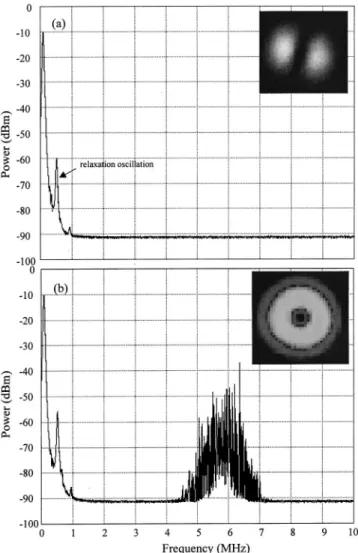
Typically, the free-running one-mode class-B laser dis-plays relaxation oscillations, as shown in Fig. 8共a兲. Relax-ation oscillRelax-ations play an important role in the dynamics of FIG. 8. 共a兲 Power intensity spectrum of laser emission for one TEM0,lmode.共b兲 Spectrum recorded when the laser simultaneously oscillates in the two first-order transverse modes, showing the mode-beating intensity modulation. Vertical scale: 10 dB/div; hori-zontal scale: 1 MHz/div.
two-mode class-B lasers. With a pump power slightly larger than the pump threshold, the laser operated in a LG TEM0,l* doughnut mode that is a linear combination of two like TEM0,lmodes, one rotated/2 about the optical axis relative
to the other. Since astigmatism lifts the degeneracy of the two like LG TEM0,l modes, a perfectly circular pattern is
usually an ‘‘unlocked doughnut’’ as can be confirmed by observation of a beat signal shown in Fig. 8共b兲. The spa-tiotemporal dynamics of the unlocked doughnut could be observed by changing the position of the detector. It was found the modulation depth strongly depends on the position of the detector. Figure 9 shows the experimental results for
different modulation depths observed in different positions. It is difficult to identify the relative position of the detector on the laser beam precisely because the detection area is very small. Even so, these results are in good agreement with the theoretical predictions shown in Fig. 1.
From the state of the perfectly circular pattern, the fre-quency difference between the two nearly degenerate modes can be decreased by a slight adjustment of the output cou-pler, as shown in Fig. 10. These results agree fairly well with the theoretical analysis presented in Fig. 2. Further decreas-ing the frequency difference, the appearance of chaotic gen-eration regimes was observed, as shown in Fig. 11共a兲. This result confirms the fact that there is a chaotic set of solutions when the frequency difference is of the order of magnitude of the relaxation frequency, as depicted in Fig. 3. Decreasing the frequency difference smaller than the locking threshold, it eventually happens that the two likely modes lock to the same frequency, as shown in Figs. 11共b兲. We observed that the locking state has a strong tendency to jump to the states of chaotic pulsing by small perturbation. The bistable region of coexistence between locked and unlocked modes was ob-served, which confirms the fact that the locking in the FIG. 9. Experimental results of the time characteristics for the
stable self-modulation oscillations. Different modulation depths were obtained by changing the position of the detector.
FIG. 10. Experimental results of the time characteristics for the stable self-modulation oscillations. Different modulation frequen-cies were obtained by slightly adjusting the output mirror.
class-B laser is a subcritical bifurcation, differently from class-A laser 关11,12兴. In the vicinity of the locking point, slightly adjusting the output coupler frequently may lead to a very stable regular self-pulsing operation of the laser, as shown in Fig. 11共c兲. Note that there are two obvious inten-sity maxima superposed on the background of the doughnut intensity distribution in the self-pulsing operation; this result indicates the loss difference between two like modes is sig-nificant. We also found that the regular self-pulsing state can hold for several hours, like a passively Q-switched laser. Besides, it is striking to notice that the repetition rate of the self-pulsing is slightly below the relaxation oscillation fre-quency. Moreover, we observed experimentally that the rep-etition rate increases with the pumping rate of the laser. These results definitely prove that this self-pulsed regime is due both to the frequency locking of the two nearly degen-erate modes, and the existence of relaxation oscillations, i.e., to the fact that the population inversion cannot be eliminated adiabatically in class-B lasers 关11,12兴. Once again, the fact
that the self-pulsed regime is experimentally obtained only in the vicinity of the locking point is consistent with the theo-retical prediction. Furthermore, we also found a similar dy-namical behavior like TEM0,l* mode for other higher TEM0,l*
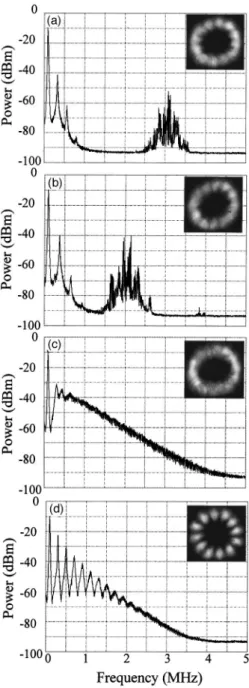
modes, as shown in Fig. 12.
Finally, it is worthwhile to mention that the present dy-namics of transverse modes are strongly analogous to results obtained recently in the case of two polarization modes of a solid-state laser, in which Brunel et al.关21兴 observed similar dynamics, such as self-modulation, self-pulsing, and phase locking. Brunel et al. used two intracavity quarter-wave plates to result in a frequency difference between the x and y polarization directions; they used an uncoated silica etalon to FIG. 11.共a兲 Power spectrum for the self-chaotic oscillations. 共b兲
Power spectrum for the frequency-locked state.共c兲 Power spectrum for the self-pulsing oscillations. 1 MHz/div. Average transverse in-tensity distribution and time dependence are shown in the insets.
FIG. 12. Power spectra of laser emission for TEM0,6* mode. Spectra 共a兲–共d兲 show the transition from self-modulation state 共a兲 and 共b兲 to chaotic pulsing 共c兲 and the bifurcation of the locking to regular self-pulsing共d兲. Vertical scale: 10 dB/div; horizontal scale: 0.5 MHz/div.
introduce a linear loss anisotropy. Similar to the present self-modulation regime, they found that when the loss difference is small and the frequency difference is slightly larger than the relaxation frequency of the laser, a usual beat note is observed between the two polarization modes. On the other hand, they also found that the introduction of a crossed loss anisotropy creating a locking region for two polarization states of a monomode solid-state laser leads to the self-pulsing regime. Similar to the present result, the self-self-pulsing behavior is physically attributed to the nonlinear interaction between two degenerate modes in the gain medium of lasers where the photon lifetime in the cavity is much shorter than the population inversion lifetime共class-B lasers兲. Moreover, Brunel et al. also found the phase locking between two po-larization states in a solid-state laser to be a subcritical bifur-cation. Although Brunel et al. did not investigate the chaotic regime sufficiently thoroughly, they were really aware of the existence of regions of chaotic behavior from preliminary theoretical and experimental observations.
IV. CONCLUSIONS
A detailed account has been given of self-modulation and relaxation oscillations in LG TEM0,l* mode solid-state laser.
The bifurcation mechanisms of excitation of self-modulation, chaotic, locking, and self-pulsing regimes have been investi-gated theoretically. It was found that the relaxation oscilla-tion plays an important role not only in transient processes, but also under conditions of steady operation of a class-B laser. In addition, the buildup of the relaxation oscillation is the mechanism of the appearance of dynamic chaos in LG TEM0,l* mode solid-state lasers. Furthermore, the introduc-tion of a loss difference in the locking region has led to the self-pulsing regimes. From the observations of the locking phenomena of the first-order family, the experimental results agree very well with the theoretical predictions. It was also confirmed that the locking occurs as a subcritical bifurcation and a region of coexistence of locked and unlocked states exists.
ACKNOWLEDGMENT
The authors thank the National Science Council of the Republic of China for their financial support of this research under Contract No. NSC-89-2112-M-009-059.
关1兴 K. Otsuka, P. Mandel, and E. A. Viktorov, Phys. Rev. A 56, 3226共1997兲.
关2兴 H. Laabs and B. Ozygus, Opt. Laser Technol. 28, 213 共1996兲. 关3兴 Y. F. Chen, T. M. Huang, C. F. Kao, C. L. Wang, and S. C.
Wang, IEEE J. Quantum Electron. 33, 1025共1997兲.
关4兴 L. Dijaloshinski and M. Orenstein, Opt. Lett. 23, 364 共1998兲. 关5兴 Q. Deng, H. Deng, and D. G. Deppe, Opt. Lett. 22, 463 共1997兲. 关6兴 S. F. Pereira, M. B. Willemsen, M. P. Van Exter, and J. P.
Woerdman, Appl. Phys. Lett. 73, 2239共1998兲.
关7兴 L. Allen, M. W. Beijersbergen, R. J. C. Spreeuw, and J. P. Woerdman, Phys. Rev. A 45, 8185共1992兲.
关8兴 J. W. Tabosa and D. V. Petrov, Phys. Rev. Lett. 83, 4967 共1999兲.
关9兴 C. Tamm, Phys. Rev. A 38, 3960 共1988兲.
关10兴 L. A. Lugiato, C. Oldano, and L. M. Narducci, J. Opt. Soc. Am. B 5, 879共1988兲.
关11兴 G. Slekys, C. O. Weiss, D. Y. Tang, and M. F. H. Tarroja, J. Opt. Soc. Am. B 11, 2089共1994兲.
关12兴 K. Staliunas, M. F. H. Tarroja, and C. O. Weiss, Opt. Com-mun. 102, 69共1993兲.
关13兴 F. Prati, L. Zucchetti, and G. Molteni, Phys. Rev. A 51, 4093 共1995兲.
关14兴 M. Brambilla, M. Cattaneo, L. A. Lugiato, R. Pirovano, F. Prati, A. J. Kent, G. L. Oppo, A. B. Coates, C. O. Weiss, C. Green, E. J. D’Angelo, and J. R. Tredicce, Phys. Rev. A 49, 1427共1994兲.
关15兴 D. V. Skryabin, A. G. Vladimirov, and A. M. Radin, Quantum Electron. 27, 892共1997兲.
关16兴 A. G. Vladimirov and D. V. Skryabin, Quantum Electron. 27, 887共1997兲.
关17兴 P. A. Khandokhin and Ya. I. Khanin, J. Opt. Soc. Am. B 2, 225共1985兲.
关18兴 N. V. Kravtsov and E. G. Lariontsev, Quantum Electron. 24, 841共1994兲.
关19兴 A. G. Vladimirov, Opt. Commun. 149, 67 共1998兲.
关20兴 P. A. Khandokhin and Ya. I. Khanin, Kvant. Elektron. 共Mos-cow兲 15, 1993 共1998兲 关Sov. J. Quantum Electron. 18, 1248 共1988兲兴.
关21兴 M. Brunel, O. Emile, M. Alouini, A. L. Floch, and F. Bretenaker, Phys. Rev. A 59, 831共1999兲.