行政院國家科學委員會專題研究計畫 期末報告
建立品牌心理擁有感的一個整合模式與實證分析:多層級
與長期性研究(第 3 年)
計 畫 類 別 : 個別型 計 畫 編 號 : NSC 98-2410-H-004-047-MY3 執 行 期 間 : 100 年 08 月 01 日至 102 年 01 月 31 日 執 行 單 位 : 國立政治大學企業管理學系 計 畫 主 持 人 : 韓志翔 計畫參與人員: 碩士級-專任助理人員:鍾鳳瑜 碩士級-專任助理人員:何品儀 碩士級-專任助理人員:高勝昌 碩士級-專任助理人員:江旭新 公 開 資 訊 : 本計畫涉及專利或其他智慧財產權,2 年後可公開查詢中 華 民 國 102 年 04 月 30 日
中 文 摘 要 : 品牌文化不只強化內部員工向心力、認同感,對外在的利害 關係人也具有明確的象徵,代表了公司的價值、規範以及所 展現出來的所有人為事物,不只在競爭激烈的環境中代表了 與競爭者的差異,在徵才選才的同時,認同品牌文化的員工 也會被吸引,不只減少了社會化的磨合期,也創造了員工的 品牌心理擁有感與品牌公民行為。由此可知,品牌心理擁有 感之重要性。此篇論文之目的乃是探討品牌心理擁有感之前 因與結果因素,從文獻得知,品牌心理擁有感之前因因素為 公司品牌管理,結果因素為品牌公民行為。本研究採取了兩 個步驟,以探討品牌心理擁有感之前因與結果因素,本研究 首先進行了公司品牌管理、品牌心理擁有感與品牌公民行為 之量表發展,其次,本研究探索了公司品牌管理、品牌心理 擁有感、品牌公民行為與品牌權益之跨層次關係。 中文關鍵詞: 品牌文化、品牌心理擁有感、品牌公民行為
英 文 摘 要 : This study emphasizes on the effects of the branding culture on employees' brand-related attitudes and behaviors. Under the influence of the branding
culture, employees make decisions and implement tasks with the brand as their first concern, which is shown by the possession of the sense of brand psychological ownership and the brand citizenship behaviors
performed when interacting with the customers. Therefore, the analytical results prove that this study finds evidences to bridge the gap.
英文關鍵詞: branding culture 、brand psychological ownership、 brand-related behaviors
1
The Investigation of Multilevel Relationships among Branding Culture, Brand Psychological Ownership, Brand Citizenship Behavior and
Customer-based Brand Equity
Introduction
Successful service organizations stress the role of brand management to deliver a
consistent and distinctive customer brand experience. The branding culture which is
the pattern of brand values helps employees understand brand-related activities and
thus provide them norms for behavior in the interactive service process. As market
orientation is regarded as the organizational culture which collects values from the
market, the branding culture is the effective culture which collects values both from
markets and organizational members. Naver and Slater (1998) argue that “If a market
orientation were simply a set of activities completely disassociated from the
underlying belief system of an organization, then whatever an organization’s culture,
a market orientation could easily be implanted by the organization at any time.”
Homburg and Pflesser (2000) argue that the organization with market-oriented culture
can make employees produce market-oriented behaviors and improve market
performance. As an organization which adopts market-oriented culture can make
employees produce market-oriented behavior (Kohli and Jaworski, 1990), this
research asserts that an organization can make employees realize brand values by
shaping the brand culture. Extended from the perspective, the organization can
establish values of branding culture, and transmit brand values to frontline employees.
Consumers who interact with frontline employees experience not only the benefits of
intangible products but also the benefits of service attitude. Therefore, branding
2
conceptualize market-oriented culture as the four-component construct which include
market-oriented basic values, market-oriented norms, market-oriented artifacts, and
market-oriented behaviors. According to prior research, researchers seldom explore
the components of the branding culture, revealing a critical research gap.
Aaker (1996) asserted that critical stakeholders perceive credibility when brand
values are consistent with the values of organizational culture. From the perspective
of resource-based view of strategy, the distinctive cultural characteristics make the
organization sustainable to the competitive advantages (Martin and Hetrick, 2006). This is the reason that internal branding seeks to develop a common value-based ethos
which attach to the vision of the brand culture (Mosley, 2007). Corporate branding
practices include transmitting the brand-related vision, culture and image (Hatch and
Schulz 2003) can affect the cognitive-affective sentiments of employees. That is, an
organization can utilize the branding culture to induce their employees to develop
positive cognitive-affective associations with respect to the brand thus producing
positive brand cognition. Mayhew, Ashkanasy, Bramble, and Gardner (2007) argue
that employees with psychological ownership have the feeling of possession toward
the organization. The relationship between the organization and employees is affected
by many factors, which include culture, climate, attitudes of senior managers, goal,
vision, and image. Organ (1988) argues that organizational members who accept the
values, norms, and artifacts of the culture produce organizational citizenship behavior,
thus contributing to the organizational performance. Extended from the perspective,
this research argues that branding culture contributes to brand psychological
ownership and brand citizenship behavior. However, researchers seldom explore the
relationships between branding culture, brand psychological ownership and brand
citizenship behavior, indicating another critical research gap.
3
branding culture which includes shared brand values, norms for the brand, and
artifacts of the brand can strengthen employees’ cognition and customers’
identification. The second construct, brand psychological ownership, indicates that the
psychological state that makes employees feel the ownership of the brand and produce
positive brand attitudes. The third construct, brand citizenship behavior, represents
that employees with brand-oriented altruistic spirit can live the brand and display
positive brand behavior. Literature has shown that researchers have seldom explored the multilevel relationships among branding culture, brand psychological ownership,
and brand citizenship behavior, revealing a critical research gap.
Since the branding phenomena can be observed in two levels, hierarchical linear
modeling approach is utilized as the main analytical method. This research collected
multilevel data from employees and employers from 18 franchise organizations in
order to prove hypotheses proposed by this research.
Literature Review and Hypotheses Development
Branding Culture and Brand Psychological Ownership
Building on the theory of organizational behavior, organizational culture
contributes to employees’ cognitions. Schein (1992) indicates that organizational
members who identify organizational practices not only foster organizational
identification but also dedicate their efforts to the organization. This helps
organizational members get consensus in the allocation of rights and position.
Excellent organizational culture makes organizational members produce high
identification, and makes members be proud of their participation. Organizational
culture with the open and harmonious atmosphere can make members feel they are
4
acquisition and cognition which turns employees’ personal characteristics into a part
of psychological contracts. The values of organizational culture make organizational
members generate organizational identification which promotes good interaction with
organizational members and makes them experience the enhancement of self-worth.
The organizational culture makes employees’ mental cognitions transformed, like
having connection with organizational targets and being proud of being organizational
members, which have connection with psychological ownership characteristics.
Homburg et al. (2000) argue that the organization can adopt organizational practices
to makes employees perceive norms, values and artifacts of market-oriented culture.
As for the organization which focuses on brand strategies, branding culture can
contributes to employees’ brand-related cognitions.
Pierce, Kostova and Dirks (2001) define psychological ownership as the sense of psychological ownership for tangible or intangible target and have the state of feeling
that the target is “mine”. The origin of psychological ownership mainly derives from
three basic human needs: (1) self-space: individuals want to have their own
proprietary home or space, which is the description of the sense of belonging (Ardrey,
1996; Porteous, 1976). (2) needs of efficacy and fulfillment: individuals who are
attracted by people, things and objects in their surroundings hope to have the power of
control and satisfaction. For example, a bag with luxurious brand will make
individuals produce the sense of pride and superiority, which symbolizes their status
and power. (3) self-identity: by the memories and experiences, psychological
ownership helps individuals look for the need and realize their feelings, showing a
unique self-value and identity (Dittmar, 1992). When the target and individuals are
more closely correlated, the target becomes a part of individuals’ extension and makes
individuals produce psychological ownership toward the target. Therefore, this study
5
of possession, thus producing brand psychological ownership.
Mayhew et al. (2007) argue that organizational psychological ownership focuses
on the connection between the organization and organizational members. Many
factors which may affect these connection included culture, climate, attitudes of
senior managers, goal, vision, and image. Extended from these perspectives, this
study argues that branding culture makes employees feel at home and have sense of
belonging toward the brand. The brand value makes employees feel they have the
sense of pride and superiority to control the brand. That is, the branding culture makes
employees produce feelings of self-identity, and take brand-related standard as their
own standards, thus generating brand psychological ownership. Therefore, hypothesis
1 is proposed.
Hypothesis 1: Branding culture positively affects brand psychological ownership.
Branding Culture and Brand Citizenship Behavior
Organ (1988) proposes that a close relationship exists between organizational
culture and organizational citizenship behavior. Organizational members who accept
the values, norms, and artifacts of the culture produce extra-role behavior, thus
contributing to the organizational performance. As for the teamwork, members who
accept values of the team may display good external behavior, and present the
citizenship behavior. As for the newcomers, organizational culture which includes
values, norms, and shared beliefs transmit to newcomers through organizational
members in the process of socialization. The process decides the newcomers how to
perceive, to think, make the decisions, and produce behaviors. Moorman and Blakely
6
culture are related to organizational citizenship behavior. Therefore, organizational
culture is regarded as a major premise of enhancing organizational citizenship
behavior. That is, the impact of organizational culture on organizational members is
fulfilled through the process of socialization. Organizational members are glad to
work beyond job requirements and not to care about whether it’s rewarded or not. The
invisible help can help members display more extra-role behavior. Employees who
perceive the fit between organizational values and personal values display
organizational citizenship behavior easily (Hoffman and Woehr, 2006), indicating the
importance impact of cultural values on organizational citizenship behavior.
Building on the perspectives of organizational behavior, the organization can
strengthen employees’ brand identification through brand communication, such as the
transmission of brand belief, brand values, and brand norms (Hatch and Schulz, 2003).
When an organization effectively communicates with employees about the cores of
branding culture, employees may display brand-related extra-role behavior. This
research argues that the organization can utilize the branding culture to communicate
the values, norms, and artifacts in order to make employees identify the brand and
display brand citizenship behavior. Thus, hypothesis 2 is proposed.
Hypothesis 2: Branding culture positively affects brand citizenship behavior.
Brand Psychological Ownership and Brand Citizenship Behavior
Psychological ownership, which originates from the sense of belonging, fulfills
individual’s need and makes individuals feel that this place is owned by them (Van
Dyne and Pierce, 2004). The sense of belonging refers to the rights for organizational
7
organization commitment. As a result, when the level of psychological ownership is
higher, the level of organization commitment is higher as well. Employees with
psychological ownership perceive a positive attitude towards their targets, which
make employees feel the value of self-existence and identify the organization (Van
Dyne et al., 2004), thus contributing to employees’ positive behavior. When
employees recognize that the organization can satisfy their needs, they make
contributions to the organization by positive and proactive behaviors in exchange.
From empirical evidence, Lepine, Erez, and Johnson (2002) find that organizational
commitment and job satisfaction contribute to organizational citizenship behavior.
That is, psychological ownership makes employees work beyond the job
acquirements, which is regarded as organization citizenship behavior, including helping colleagues, participating in relative activities, and training new employees in
the initiative, etc. Employees who feel a sense of belonging, the effectiveness of
interaction, and self-identity are more willing to be responsible to the organization
and to perform organization citizenship behavior.
Mayhew et al. (2007) argue that psychological ownership may encourage
employees to enhance their self-confidence, and motivate them for better performance.
That is, psychological ownership can encourage employees to do more than what their
roles acquired (Mayhew et al., 2007). From empirical evidences, psychological
ownership is the antecedent of organization commitment (Van Dyne et al., 2004),
which makes employees produce organizational citizenship behavior (Podsakoff,
MacKenzie, Paine, and Bachrach, 2000). Extended from theory of organizational
behavior, this study argues that the corporate brand which satisfies the relative needs
of employees on the brand makes employees produce a sense of belonging, the
effectiveness of interaction, and self-identity of the brand, and then perceive the sense
8
brand-related activities to perform brand citizenship behavior. Burmann et al. (2005)
argue that brand commitment can make employees become conscious with the brand
characteristics and brand identity. This study argues that brand psychological
ownership is the antecedent of brand commitment and contributes to brand citizenship
behavior. The empirical evidence proves that employees with brand psychological
ownership show brand-related altruistic spirit which finally transfer into brand
citizenship behavior (Chiang, 2010). This study hypothesizes that employees with
brand psychological ownership are willing to perform brand citizenship behavior.
Thus, hypothesis 3 is proposed.
Hypothesis 3: Brand psychological ownership positively affects brand citizenship behavior.
Brand Citizenship Behavior and Customer-based Brand Equity
Brand citizenship behavior represents that employees live the brand, display
brand-oriented voluntary behavior and then enhance the brand strength (Burmann et
al., 2005; Chang, Chiang and Han, 2012). Employees who exhibit brand citizenship
behavior transmit brand information (e.g., brand values and images) toward customers
and enhance customers’ brand mindsets, such as brand awareness, perceived quality,
brand attachments, and brand loyalty (Kim, Jin-Sun and Kim). Keller and Lehmann
(2001) argue that the first category of brand equity (i.e., customer mind-set) can
measure brand equity through customer-based sources, such as customers’
attachments, association, awareness, attitudes, and loyalties (Ailawadi, Lehmann and
Neslin, 2003). That is, customers with positive perception have positive attitudes (e.g.,
9
charged by the corporation (Ailawadi et al., 2003). From empirical evidence (Chiang,
2010), brand citizenship behavior positively contributes to customer-based brand
equity. Therefore, hypothesis 4 is proposed.
Hypothesis 4: Brand citizenship behavior positively affects customer-based brand equity.
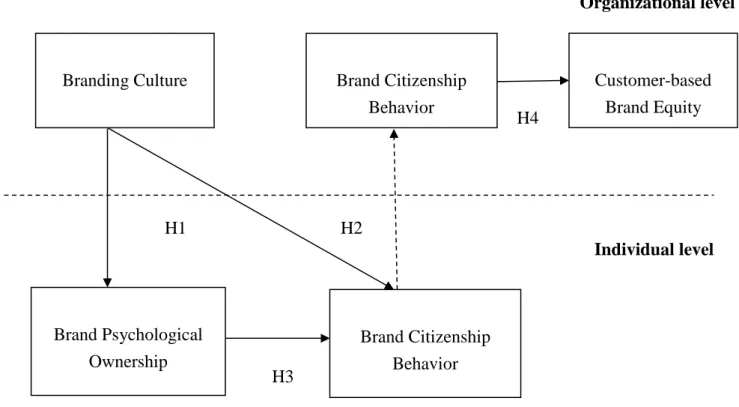
According the above-mentioned argument, the research framework is presented as
figure 1. Brand Psychological Ownership Branding Culture Organizational level H1 H3 H2
Figure 1. Research framework Brand Citizenship Behavior Individual level Brand Citizenship Behavior Customer-based Brand Equity H4
10 Method
Measurements
Branding Culture. Extended from perspectives of market-oriented culture (Homburg and Pflesser, 2000), concepts of branding culture are formed. This research obtained a
46-item scale of branding culture was composed of values, norms, and artifacts.
Example items include “Our company transmits the brand values toward employees”,
and “We often have inter-functional information exchange of brand values between
departments of our company”. Measurement items of branding culture are represented
in Table 1 of Appendix. All items will be measured via a six-point Likert scale (1 =
strongly disagree, 6 = strongly agree). The Cronbach’s alpha of the branding culture is
0.98.
Brand Psychological Ownership. A 15-item scale adopted from Chiang (2010) was utilized to measure brand psychological ownership. Example items include “I feel I
have influence on the corporate brand”, “I feel that I can successfully respond
customers’ feedbacks to the company”, and “I feel the corporate brand is like my
brand”. Measurement items of brand psychological ownership are represented in
Table 2 of Appendix. All items will be measured via a six-point Likert scale (1 =
strongly disagree, 6 = strongly agree). The Cronbach’s alpha of brand psychological
ownership is 0.97.
Brand Citizenship Behavior. A 12-item scale adopted from Chiang (2010) was utilized to measure brand citizenship behavior. Example items brand citizenship
behavior include “I regard customers as my family and solve their problems as I do
mine”, “I solve problems of customers voluntarily to foster brand value”, and “I
voluntarily help newcomers to foster service quality and brand value”. Measurement
items of brand citizenship behavior are represented in Table 2 of Appendix. All items
11
agree). The Cronbach’s alpha of brand citizenship behavior is 0.96.
Customer-based Brand Equity. A 9-item scale was modified from Yoo and Donthu (2001) to measure customer-based brand equity. Example items of customer-based
brand equity include “I consider myself to be loyal to the store brand”, “The store
brand would be my first choice”, and “I will not buy other brands if the store brand is
available”. Measurement items of customer-based brand equity are represented in
Table 2 of Appendix. All items will be measured via a six-point Likert scale (1 =
strongly disagree, 6 = strongly agree). The Cronbach’s alpha of customer-based brand
equity is 0.78.
Samples and Data Collection
This study collected data from questionnaires distributed to store managers and
frontline employees of franchise organizations in Taiwan. The organization-level
questionnaires measure branding culture from the perspective of the store manager.
The individual-level questionnaires measure the perception and behavior of frontline
employees, including brand psychological ownership and brand citizenship behavior.
The questionnaires of brand equity measure the perceptions of customers. Since the
branding phenomena can be observed in two levels, hierarchical linear modeling
approach is utilized as the main analytical method. The multilevel data were collected
from 612 employees, 205 supervisors and 572 customers from 18 franchise
organizations in Taiwan.
Table 1 reports the means, standard deviations and correlations. The means from
high to low are branding culture, brand psychological ownership, and brand
citizenship behavior. In the individual-level, brand psychological ownership is
positively related to brand citizenship behavior (r=0.78, P<0.01). In the organizational
level, brand psychological ownership is positively related to brand citizenship
12
result, this research further investigates the multilevel relationships.
Table 1 Means, Standard Deviations, and Correlations
***P< 0.01, ** P<0.05, *P<0.1
Results
Hypotheses Examination
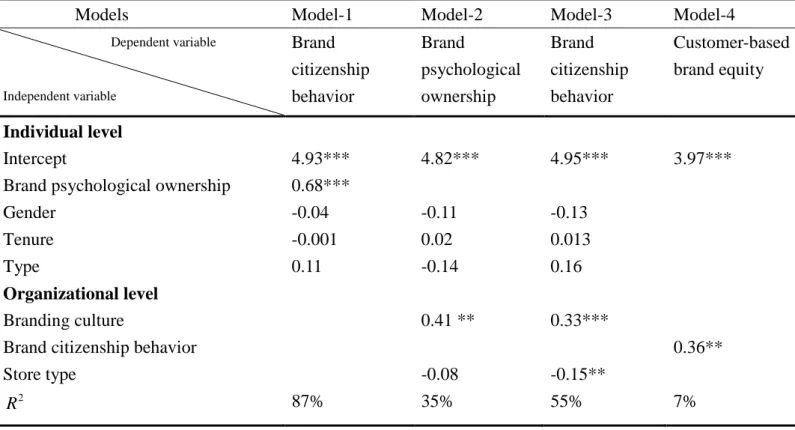
Multilevel results are reported in Table 2. In multilevel analyses, branding
culture positively affect brand psychological ownership (0.41, P<0.05) and brand
citizenship behavior (0.33, P<0.01), indicating that H1 and H2 are supported. In individual-level analyses, brand psychological ownership positively affects brand
citizenship behavior (0.68, P<0.01), indicating that H3 is supported. As for the
customer outcome, organization-level brand citizenship behavior positively affects
customer-based brand equity (0.36, P<0.05), representing that H4 is supported. Based
Model-1~3, the result reveals that brand psychological ownership mediates the
relationship between branding culture and brand citizenship behavior.
Individual level Means S.D. (1) (2) (3) (4) (5) (1)Brand psychological ownership 4.92 0.68 1 (2)Brand citizenship behavior 4.75 0.77 0.78*** 1 (3)Gender 0.66 0.47 -0.06 -0.054 1 (4)Tenure 4.39 3.37 0.70 0.084* 0.019 1 (5)Type 1.96 0.32 -0.001 0.072 0.102* 0.122*** 1 Organizational level Means S.D. (1) (2) (3) (4) (5) (1) Brand psychological ownership 4.98 0.21 1 (2)Brand citizenship behavior 4.81 0.28 0.889*** 1 (3)Branding culture 4.96 0.36 0.441** 0.429** 1
13
Table 2 Hierarchical Linear Modeling Results of the Proposed Model
***P< 0.01, ** P<0.05, *P<0.1
Implication
The results reveal that hypotheses 1-4 are all supported. As for the influence of
branding culture on brand psychological ownership, branding culture has a positive
influence on employees’ brand psychological ownership, which imply that the
influence of branding culture on employees are significant and employees identify
with the culture, when employees have a sense of brand psychological ownership.
Take Madenform Group as an example, the senior manager mentions that the
employees in the organization do not consider the organization to be theirs, but the
brand itself is. The individual-level results show that brand psychological ownership
positively affect brand citizenship behavior, implying that employees who identify
with the brand and possess the sense of brand psychological ownership display brand
citizenship behaviors. The multilevel result also indicates that branding culture
Models Model-1 Model-2 Model-3 Model-4
Dependent variable Independent variable Brand citizenship behavior Brand psychological ownership Brand citizenship behavior Customer-based brand equity Individual level Intercept 4.93*** 4.82*** 4.95*** 3.97***
Brand psychological ownership 0.68***
Gender -0.04 -0.11 -0.13
Tenure -0.001 0.02 0.013
Type 0.11 -0.14 0.16
Organizational level
Branding culture 0.41 ** 0.33***
Brand citizenship behavior 0.36**
Store type -0.08 -0.15**
2
14
positively influences brand citizenship behavior. The result reveals that branding
culture can make employees identify with the corporate brand and display brand
citizenship behavior which contributes to the brand image and value. From practical
phenomena of the Landis Group, the managers treat employees as the owner of the
brand to motivate them to identify with the branding culture. Employees who have
brand psychological ownership and display brand citizenship behavior treat customers
as the family. Therefore, brand equity is increased when customers are satisfied.
This study emphasizes on the effects of the branding culture on employees’
brand-related attitudes and behaviors. Under the influence of the branding culture,
employees make decisions and implement tasks with the brand as their first concern,
which is shown by the possession of the sense of brand psychological ownership and
the brand citizenship behaviors performed when interacting with the customers.
Therefore, the analytical results prove that this study finds evidences to bridge the
gap.
Limitation and Future Studies
Several limitations and future studies are noted as follows. First, the data in this
research were collected only from 18 franchise organizations in Taiwan. Therefore,
the generalizability of the results limited. In the future study, the data can be collected
from more franchise organizations, so as to prove the generalizability.
Second, the individual-level data utilized by this study is cross-sectional data,
which may cause the bias of common method variance. Therefore, a future study can
utilize longitudinal data to solve bias of CMV (Schwab, 2005). Third, this research
only investigated the relationships among branding culture, brand psychological
ownership, brand citizenship behavior, and customer-based brand equity. In the future
study, researchers add new constructs, such as brand commitment and customer
15 Reference
Aaker, D. A. (1996), “Measuring brand equity across products and markets,”
California Management Review, 38(3), pp. 102-20.
Ailawadi, K. L., Lehmann, D. R. and Neslin, S. A. (2003), “Revenue premium as an
outcome measure of brand equity,” Journal of Marketing, 67, 1-17.
Ardrey, R. (1996), “The Territorial Lmperative: A personal lnquiry into the animal
origins of property and nations,” New York: Dell.
Burmann, C. and Zeplin, S. (2005), “Building brand commitment: A behavioral
approach to internal brand management,” The Journal of Brand Management,
12(4), pp. 279-300.
Calori, R., and Sarnin, P. (1991), “Corporate culture and economic performance: A
French study,” Organization Studies, 12(1), 49-74.
Chang, A., Chiang, H. H., and Han, T. S. (2012), “A multilevel investigation of
relationships among brand-centered HRM, brand psychological ownership, brand
citizenship behaviors, and customer satisfaction,” European Journal of Marketing,
46(5), 626-662.
Chiang, H. H. (2010), “The antecedents and consequences of brand psychological
ownership: Scale development and multilevel approaches,” Doctoral Dissertation,
National Chengchi University.
Dittmar, H. (1992), “The social psychology of material possessions: To have is to be,”
New York: St. Martin's Press.
Hatch, M. J. and Schulz, M. (2003), “Bring the corporation into corporate branding,”
European Journal of Marketing, 37(7/8), 1041-1064.
Hoffman, B. J., and Woehr, D. J. (2006), “A quantitative review of the relationship
between person-organization fir and behavior outcomes,” Journal of Vocational
16
Homburg, C. and Pflesser, C. (200), “A multiple-layer model of market-oriented
organizational culture: measurement issues and performance outcomes,” Journal
of Marketing Research, 37, pp. 449–462.
Kagan, J. (1958), “The concept of identification,” Psychological Review, 65(5),
296-305.
Kohli, A. K. and Jaworski, B. J. (1990), “Market orientation: The construct, research
propositions and managerial implications,” Journal of Marketing, 54, 1-18.
LePine, J. A., Erez, A., and Johnson, D. E. (2002), “The nature and dimensionality of
organizational citizenship behavior: a critical review and meta-analysis”, Journal
of Applied Psychology, 87, 52–65.
Martin , GMartin , G . and Hetrick , S . ( 2006 ) “Managing corporate brands and
reputations”, in “Corporate Reputations, Branding and People Management”,
Butterworth-Heinemann, Oxford, UK.
Mayhew, M. G., Ashkanasy, N. M., Bramble, T. and Gardner, J. (2007), “A study of
the antecedents and consequences of psychological ownership in organizational
settings,” Journal of Social Psychology, 147, 477-500.
Moorman, R. H., and Blakely, G.L. (1995), “Individualism-collectivism as an
individual difference predictor of organizational citizenship behavior,” Journal of
Organizational Behavior, 16, 127-142.
Mosley, R. W. (2007), “Customer experience, organizational culture, and the
employer brand,” Journal of Brand Management, 15, 123-134.
Narver, J. C., Slater, S. F. and Tietje, B. (1998), “Additional thoughts on measurement
of market orientation: A comment on Deshpande and Farley,” Journal of Market
Focused Management, 2 (1), 233-236.
Organ, D.W. (1988), “Organizational citizenship behavior: The good soldier
17
Pierce, J. L., Kostova T. and Dirks, K. T. (2001), “Toward a theory of psychological
ownership in organizations,” Academy of Management Review, 26(2), 298-310.
Porteous, J. D. (1976), “Home: The territorial core,” Geographical Review, 66,
383-390.
Podsakoff, P. M., MacKenzie, S. B., Paine, J. B., and Bachrach, D. G. (2000),
“Organizational citizenship behaviors: A critical review of the theoretical and
empirical literature and suggestions for future research,” Journal of Management,
26(3), 513-563.
Schein, E. H. (1992), “Organizational culture and leadership,” San Francisco:
Jossey-Bass.
Van Dyne, L. and Pierce, J. L. (2004), “Psychological ownership and feelings of
possession: Three field studies predicting employee attitudes and organizational
citizenship behavior,” Journal of Organizational Behavior, 25, 439–459.
Yoo, B. and Donthu, N. (2001), “Developing and validating a multidimensional
18 Appendix
Table 1 Organization-level Questionnaire – Branding Culture Items of Branding Culture
1. Our company transmits the brand values toward employees.
2. Our company expects that employees can realize the brand vision actively. 3. Our company usually emphasizes the importance of brand creativity. 4. Our company is willing to recruit employees with innovative ideas. 5. In our company, we emphasize the communication of brand values.
6. We often have inter-functional information exchange of brand values between departments of our company.
7. In our company, transmitting brand values toward employees clearly is important. 8. Our company emphasizes the inter-functional cooperation in order to enhance the brand value.
9. Employees all try best to do brand-related jobs.
10. Our company emphasizes that being responsible for the corporate brand is important.
11. Our company emphasizes that employees display behaviors consistent with brand values.
12.Our company emphasizes that employees are satisfied with the corporate brand. 13. Our company emphasizes employees’ feelings and thoughts of the corporate brand.
14. Our company regularly views whether employees achieve the goal and vision of the corporate brand or not.
15.Our company regularly views the market share of the corporate brand.
16.Our company regularly measures customer satisfaction of the corporate brand. 17. Our company is willing to create new-value products or services.
18.Our company recognizes that employees have different thoughts of the corporate brand.
19. In order to enhance the brand value, employees can response to customers flexibly.
20. Our company regularly has brand-related meetings.
21. In our company, employees can discuss brand-related questions in public. 22. The brand-related knowledge can be promoted and stored.
23. The product and service provided by our company are consistent with customer expectations.
19
customer expectations.
25. Our company adopts high-level standard of process in order to enhance the brand value.
26.Our company responses to customers’ brand-related requirement immediately. 27. In order to enhance the brand value, our company expects that customer-related processes are increased in speed continuously.
28.In order to enhance the brand value, our company can response to the dynamic marketimmediately.
29.In order to enhance the brand image and value, employees often participate in the discussion of new products.
30. The departments of our company can suitably provide employees with brand-related information.
31. The coordination of decisions about inter-functional brand-related activities is managed.
32. Our company has the normative indicators the represent the brand value. 33. Customers are attracted by the brand image of our company.
34. In our company, meeting rooms and offices are built in a style that supports brand communication.
35. Our company transmits brand messages through informal communicative channels.
36. Our company rewards employees for their behavior which is consistent with the brand image.
37. Our company arranges brand-related activities in order to exhibit brand spirit. 38. Our company seeks brand-related opinions from customers’ feedbacks. 39.In order to enhance the brand image and value, our company provides customized product or service.
40. Our company trains employees to think about problems from perspectives of customers.
41.Our company trains employees to enhance the brand added value.
42.In order to enhance the brand image and value, our company provides product and service which meets customer exceptions.
43. Our company understands what product or service can contribute tothe brand image and value.
44. Our company frames the brand personality through brand-related activities. 45. Our company frames the brand personality though advertisements.
46.Our company frames the brand personality though interactions with multiple stakeholders.
20
Table 2 Individual-level Questionnaires - BPO and BCB Items of Brand Psychological Ownership
1. I feel I have influence on the corporate brand.
2. I feel that I can successfully transmit the brand value in the process of interacting with customers.
3. I feel that I can successfully respond customers’ feedbacks to the company. 4. I feel that I can successfully advise the company about brand-related thoughts. 5. I feel that realizing values of corporate brand is my responsibility.
6. When others criticize the corporate brand, I may solve the problem according to sources of the problem.
7. I defend the brand image when others criticize it. 8. I feel the corporate brand is like my brand.
9. I feel I am closely linked with the corporate brand. 10. I like the corporate brand.
11. I like the image and personality of the corporate brand a lot. 12. I identify beliefs, values, and norms of the corporate brand. 13. I identify the vision of the corporate brand.
14. I identify activities related to the corporate brand.
15. I feel the success of the corporate brand is like my success. Items of Brand Citizenship Behavior
1. I regard customers as my family and solve their problems as I do mine. 2. I solve problems of customers voluntarily to foster brand value.
3. I voluntarily help newcomers to foster service quality and brand value. 4. I voluntarily participate in brand-related activities.
5. I never complain about inconveniences caused by brand-related activities. 6. I tolerate inconveniencies caused by brand-related activities to satisfy customers and enhance brand value.
7. I am willing to endorse the brand and voluntarily transmit brand value to newcomers or friends.
8. I am willing to endorse the brand and have trust and loyalty toward the brand. 9. I am willing to endlessly enhance brand-related skills.
10. I strengthen my professional knowledge to foster brand value.
11. I voluntarily provide new information and ideas for the brand to enhance brand value.
12. Regardless of positive or negative information, I voluntarily respond to customers’
21
Table 3 Questionnaires of Customer-based Brand Equity
Items of Customer-based Brand Equity 1. I consider myself to be loyal to the store brand.
2. The store brand would be my first choice.
3. I will not buy other brands if the store brand is available. 4. The likely quality of the store brand is extremely high.
5. The likelihood that the store brand would be functional is very high. 6. I can recognize the store brand among other competing brands. 7. I am aware of the store brand.
8. Some characteristics of the store brand come to my mind quickly. 9. I can quickly recall the symbol or logo of the store brand.
國科會補助計畫衍生研發成果推廣資料表
日期:2013/04/08國科會補助計畫
計畫名稱: 建立品牌心理擁有感的一個整合模式與實證分析:多層級與長期性研究 計畫主持人: 韓志翔 計畫編號: 98-2410-H-004-047-MY3 學門領域: 人力資源管理無研發成果推廣資料
98 年度專題研究計畫研究成果彙整表
計畫主持人:韓志翔 計畫編號:98-2410-H-004-047-MY3 計畫名稱:建立品牌心理擁有感的一個整合模式與實證分析:多層級與長期性研究 量化 成果項目 實際已達成 數(被接受 或已發表) 預期總達成 數(含實際已 達成數) 本計畫實 際貢獻百 分比 單位 備 註 ( 質 化 說 明:如 數 個 計 畫 共 同 成 果、成 果 列 為 該 期 刊 之 封 面 故 事 ... 等) 期刊論文 0 0 100% 研究報告/技術報告 0 0 100% 研討會論文 0 0 100% 篇 論文著作 專書 0 0 100% 申請中件數 0 0 100% 專利 已獲得件數 0 0 100% 件 件數 0 0 100% 件 技術移轉 權利金 0 0 100% 千元 碩士生 1 0 100% 博士生 1 0 100% 博士後研究員 0 0 100% 國內 參與計畫人力 (本國籍) 專任助理 4 0 100% 人次 期刊論文 0 0 100% 研究報告/技術報告 0 0 100% 研討會論文 0 0 100% 篇 論文著作 專書 0 0 100% 章/本 申請中件數 0 0 100% 專利 已獲得件數 0 0 100% 件 件數 0 0 100% 件 技術移轉 權利金 0 0 100% 千元 碩士生 0 0 100% 博士生 0 0 100% 博士後研究員 0 0 100% 國外 參與計畫人力 (外國籍) 專任助理 0 0 100% 人次其他成果