Contributions of CuO planes and CuO chains on the transport
2properties of YBa Cu O
2 4 8S. Chatterjee
a, S.S. Weng
a, I.P. Hong
a, C.F. Chang
a, H.D. Yang
a,), J.-Y. Lin
b aDepartment of Physics, National Sun Yat-sen UniÕersity, Kaohsiung 804, Taiwan
b
Institute of Physics, National Chiao Tung UniÕersity, Hsinchu 300, Taiwan
Received 7 September 1998; revised 9 October 1998; accepted 30 November 1998
Abstract
We have investigated the contributions of CuO planes and CuO chains on the transport properties of YBa Cu O by2 2 4 8
Ž . Ž .
measuring the electrical resistivity and thermoelectric power S of Y1yxPr Ba Cux 2 1yyZny 4O , Y8 1yxCa Ba Cu O andx 2 4 8
Ž .
YBa Cu2 1yxGax 4O . Pr reduces the mobile carrier concentration in the CuO planes in YBa Cu O , as a consequence, the8 2 2 4 8
Ž .
superconducting transition temperature is progressively decreased with increasing Pr. The S T data suggest that the metallic behavior at lower temperature of the Pr and Zn doped compounds is contributed by the double CuO chains. On the other
Ž .
hand, the S T behavior of Ca doped samples is opposite to that of the Pr doped samples because the doping of Ca in Y-site
Ž .
introduces holes in the CuO planes. However, the substitution of Ga in Cu 1 -site suppresses the carrier concentration in2
CuO chains and increases the normal-state resistivity revealing the important contribution from CuO chains on the metallic behavior of YBa Cu O and PrBa Cu O . q 1999 Published by Elsevier Science B.V. All rights reserved.2 4 8 2 4 8
Ž .
Keywords: Y1y xPr Ba Cu O ; Thermoelectric power; Cu–O chains; CuO planesx 2 4 8 2
1. Introduction
It is well known that the structure of YBa Cu O2 4 8 ŽY124 is closely related to that of YBa Cu O. 2 3 7yd ŽY123 and the only difference is that the unit cell of. Y124 phase contains double CuO chains instead of a
w x
single CuO chain in Y123 1,2 . On the other hand,
wŽ . x
although Y1y xPr Ba Cu Ox 2 3 7yd Y,Pr 123 series w x
have been studied extensively 3 , there are only very
w x
few reports on Y1y xPr Ba Cu O with x F 0.8 4–6x 2 4 8
because of unsuccessful synthesis of pure
Ž .
PrBa Cu O2 4 8 Pr124 at ambient oxygen pressure.
)
Corresponding author. Fax: q886-7-525-3709; E-mail: [email protected]
Recently, we have successfully synthesized the whole
Ž . wŽ . x
series of Y1y xPr Ba Cu Ox 2 4 8 0 F x F 1 Y,Pr 124 at ambient oxygen pressure and the T suppressionc
Ž .
with Pr is similar to that observed in Y,Pr 123 w3,7–9 . The xx Žthe value of x where the zero
cr
.
resistance temperature disappears value is larger Ž; 0.72 in Y,Pr 124 than that ; 0.55 in Y,Pr 123. Ž . Ž . Ž . w3,9 . It is noted that Horii et al. 10 have reportedx w x the synthesis of Y1y xPr Ba Cu O system over thex 2 4 8
entire Pr concentration range 0 F x F 1 by hot
iso-Ž . Ž .
static pressure HIP technique for x s 0–0.6 and Ž the high pressure pure oxygen gas technique for
.
x s 0.6–1 . Furthermore, the normal-state resistivity
Ž .
in Y,Pr 124 remains in the same order of magnitude throughout the whole series in contrast to a metal– 0921-4534r99r$ - see front matter q 1999 Published by Elsevier Science B.V. All rights reserved.
Ž .
Ž . w x insulator transition observed in Y,Pr 123 3,9 . Thus, it is interesting to investigate how the double CuO
Ž .
chains in Y,Pr 124 affect the normal-state transport properties and the T suppression. More-c
over, in order to achieve the better understanding of the roles of CuO2 planes and CuO chains on the normal-state transport properties, the samples ŽY,Pr Ba. 2ŽCu,Zn O ,.4 8 ŽY,Ca Ba Cu O. 2 4 8 and
Ž .
YBa Cu,Ga O are synthesized and studied.2 4 8 In this paper, special attention is paid to the
Ž .
thermoelectric power TEP . TEP measurements pro-vide not only information complementary to electri-cal resistivity, but they are also a more direct probe to the intrinsic properties of polycrystalline materials like these ceramics. In fact, as a zero current mea-surement, TEP is less sensitive than the electrical resistivity to the grain boundary effects which are always present in granular materials.
2. Experimental
Ž .
The polycrystalline Y1y xPr Ba Cu,Zn O ,x 2 4 8
Ž .
Y1y xCa Ba Cu O and YBa Cux 2 4 8 2 1yxGax 4O were8 prepared by the Nitrate Pyrolysis method as
de-w x
scribed elsewhere 7–9 . All samples were
charac-Ž .
terised by X-ray diffraction including low angle and thermogravimetric analysis. It is found that our sample quality is comparable to those prepared by O -HIP technique and high pressure oxygen gas2
w x
technique 10 . Electrical-resistivity measurements were performed on rectangular specimens cut from sintered pellets employing the standard four-probe technique with silver paint contacts attached to
elec-Ž .
trical leads. The TEP S was measured using the standard dc method with the use of closed cycle cryocooling system. A temperature difference of 1–28 was maintained between the two parallel surfaces of the samples under investigation. To eliminate the effects from the Cu electrodes and reference leads ŽCu wires , the absolute thermopower of Cu was. subtracted from the measured thermoelectric voltage.
3. Results and discussion
Electrical-resistivity data for Y1y xPr Ba -x 2
ŽCu1y yZny 4. O8 Žx s 0–1; y s 0 and 0.02. are
shown in Fig. 1a and b, where the Zn prefers CuO2
w Ž .x w x
plane Cu 2 sites 11 . For y s 0, the room temper-ature resistivity increases with increasing Pr content up to around x ; 0.7 and is nearly constant forcr
x ) 0.7. These are in sharp contrast to those in
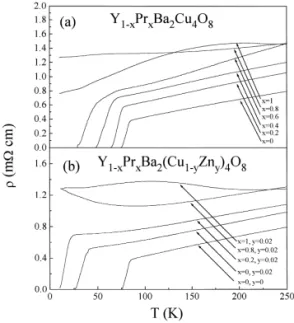
ŽY,Pr 123 where for x ) 0.55 the normal-state resis-. tivity increases rapidly and a metal–insulator transi-tion occurs. In particular, the metallic behavior of Pr124 is completely different from the semiconduct-ing behavior of Pr123. For Y-rich samples with Zn doping, the normal-state behavior remains metallic, but the resistivity increases and T decreases. Forc example, the resistivity and Tc of Y0.8Pr0.2Ba -2 ŽCu0 .9 8Zn0 .0 2 4. O8 are similar to those of Y0.4Pr0.6Ba Cu O . While for Pr-rich samples, no2 4 8
significant effect with Zn doping is found. For exam-ple, the resistivity of Pr124 is almost identical with
Ž .
PrBa Cu2 0.98Zn0.02 4O . It also deserves to mention8
Ž .
that the resistivity slope d rrdT is almost un-changed for both Pr and Zn doping.
Ž .
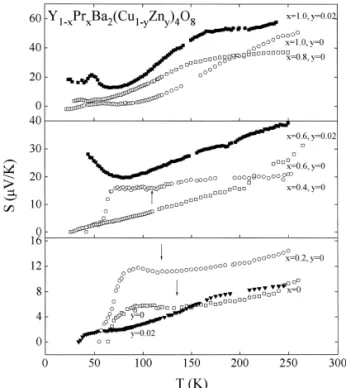
Fig. 2 shows the TEP of the Y,Pr 124 samples with x s 0, 0.2, 0.4, 0.6, 0.8 and 1.0. The TEP data
Ž .
of the end members i.e., x s 0 and x s 1 of the present investigation are similar to those reported
w x
earlier 12–15 . It is found that x s 0 compound shows a minimum in TEP at around 140 K. But with
Ž .
Fig. 1. Temperature variations of electrical resistivity for a
Ž .
Y1y xPr Ba Cu O with x s 0, 0.2, 0.4, 0.6, 0.8 and 1.0 and bx 2 4 8
Ž .
for Y1y xPr Ba Cux 2 1yyZnx 4O8 with x s 0, y s 0 and 0.02;
Fig. 2. Temperature variation of thermoelectric power for
Ž .
Y1y xPr Ba Cux 2 1yyZnx 4O8 with x s 0, y s 0, 0.02; x s 0.2,
y s 0; x s 0.4, y s 0; x s 0.6, y s 0, 0.02; x s 0.8, y s 0; and x s1.0, y s 0, 0.02. Arrows in the Y-rich samples indicate the
temperature where S is a minimum.
Ž .
increasing x, the minimum in S T is shifted to-Ž
wards lower temperature for x s 0.2, the tempera-.
ture is 125 K and for x s 0.4, it is 115 K . Below the Ž .
temperature of S T minimum, the significant contri-bution is from CuO plane and above this the signif-2
icant contribution is from CuO chains. This interpre-tation is based on the fact the plane contribution to the TEP always has a negative slope, while the slope
w x
of the chain contribution is positive 16–19 . For
x s 0.6 sample, S is zero at T ; 25 K and increasesc
Ž . linearly with temperature up to 200 K. The S T slope increases consistently with increase of Pr con-tent for x ) 0.6. The TEP data for Y1y xPr Ba -x 2 ŽCu1y yZny 4. O8 with y s 0.02; x s 0, 0.6 and 1.0 are also shown in Fig. 2. It is found that for Y-rich
Ž .
samples for example, x s 0 , the doping of Zn Ž .
increases the positive slope of the S T curve. But Ž
for the Pr-rich samples for example, x s 0.6 and
. Ž .
1.0 the slope of the S T curve is basically un-changed with Zn doping. At low temperature, a
Ž .
sudden upturn is found in the S T curve when Zn is
Ž .
doped in Pr-rich Y,Pr 124.
Ž .
The transport properties of Y,Pr 124 can be ex-plained on the basis of the fact that Pr reduces the mobile carrier concentration in the CuO planes and2
suppresses the T . It is found from Figs. 1 and 2 thatc
the effect of Zn on the transport properties of Y124 is similar to that of Pr and the value of d rrdT remains the same for the samples with low Pr con-centration as well as for the Zn containing samples. Therefore, it seems that Zn reducesrlocalizes the
Ž
mobile carrier concentration although the total car-.
rier concentration may remain the same in the CuO2 planes. Also in a very recent paper, it has been suggested that the reduction of T in Y124 with Znc
doping is due to the localization which is driven by w x
Zn 20 . However, NMR and some other studies indicate that Zn does not alter carrier concentration w21–23 . It has also been explained that Zn reducesx
T by pair-breaking from isotropic scattering with ac
w x
d-wave order parameter 24 . Therefore, the mecha-nism of T suppression for Zn doped Y124 may notc
be unique. Though the mobile carrier concentration decreases with Pr substitution the normal-state resis-tivity remains in the same order which is due to the presence of fully oxygenated double CuO chains. Due to the reduction of mobile carrier concentration in CuO planes with the increase of Pr content, the2 contributions from CuO chains on the conductivity and TEP become more pronounced. Therefore, with
Ž .
the increase of Pr content, the S T minimum is shifted towards lower temperature and TEP rises more rapidly with the increase of temperature which is the characteristic of the CuO chain. The linear increase of TEP for the x s 0.6 sample clearly indi-cates the large contributions of CuO chains in the whole temperature range. It is obvious from above discussions that the metallic behavior observed for
Ž .
x G 0.8 Fig. 1 even at very low temperature is due
to the presence of metallic double CuO chains. The
Ž .
thermopower behavior in the present Y,Pr 124
dif-Ž . w x Ž .
fers largely from that of Y,Pr 123 25 . The S T in ŽY,Pr 123 exhibits the typical features of the plane.
Ž .
contribution, i.e., an increase of S T to a maximum at a temperature and then an almost linear decrease
w x
of S towards room temperature 26 . This is due to
Ž .
the fact that Y,Pr 123 contains poorly conductive
Ž .
single CuO chain in contrast to Y,Pr 124 which contains fully oxygenated and perfectly ordered
dou-Ž . ble CuO chains. In Y-rich samples, the S T slope
increases with Zn doping, but in the Pr-rich samples the slope remains the same due to the fact that the effect of Pr on CuO2 planes dominates over the effect of Zn. Since the diffusion thermopower and
Ž .
the thermopower due to hopping if present ap-w x
proach zero as T tends to zero 27 , the rapid in-crease in S with Zn doping may not be explained unless it has a large contribution from phonon drag effect. In general, with the increase of resistivity, the
w x
phonon drag effect decreases 28 , which contradicts the present data. Therefore, the actual origin of the
Ž . Ž
S T minimum at low temperature for example, at
.
T ; 78 K for x s 0.6; at T ; 68 K for x s 1 in the
Ž .
Zn doped Y,Pr 124 system is not clear. In the high-T cuprates, it has been shown that the value ofc
S decreases through the partial substitution of Zn for
Cu which is due to the suppression of spin
fluctua-w x
tion or spin correlation 12,29,30 . In the present
Ž .
case, for the Y,Pr 124 system S increases when Zn is substituted for Cu which may be due to the reduction of plane contribution with Pr doping.
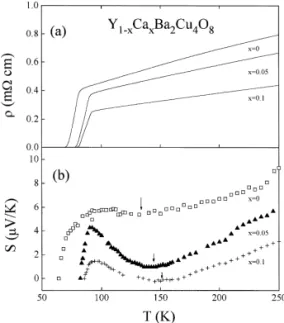
The electrical resistivity and thermoelectric power of Y1y xCa Ba Cu O with x s 0, 0.05 and 0.1 arex 2 4 8 shown in Fig. 3. It is found that with the increase of Ca content, the resistivity decreases and T increases.c
Ž .
It is also found that the S T minimum shifts
to-Ž . Ž .
Fig. 3. Temperature variations of a electrical resistivity and b thermoelectric power for Y1y xCa Ba Cu Ox 2 4 8 with x s 0, 0.05, and 0.1. Arrows indicate the temperature where the S value is a minimum.
Ž .
Fig. 4. The X-ray diffraction patterns for YBa Cu2 1yxGax 4O8
Ž .
with x s 0, 0.02, 0.04, 0.06 and YBa Cu2 0.98Zn0.02 4O8 in the range of 458F 2u F 488.
wards higher temperature and the TEP value de-creases with the increase of Ca content. These are due to the fact that with the increase of Ca content, w x hole concentration in the CuO planes increases 31 .2 This clearly indicates that the effect of transport properties by Ca on the CuO2 plane is opposite to that by Pr in Y124. Our TEP data of Ca-doped Y124 are consistent with those reported by Tallon et al. w12 .x
We have also studied the transport properties of
Ž .
YBa Cu2 1yxGax 4O8 with x s 0, 0.02, 0.04 and 0.06. Fig. 4 shows the X-ray diffraction patterns of these samples in the range 458 F 2u F 508. The
Ž .
diffraction peaks of orthorhombic symmetry at 020 Ž200. are distinguishable in YBa Cu O2 4 8 and
Ž .
YBa Cu2 0.98Zn0.02 4O8 but not resolvable in
Ž .
YBa Cu2 1yxGax 4O which are similar to those in8
Ž .
RBa Cu2 1yxMx 3O7yd for R s Y and Pr; M s Zn
w x
and Ga 11,32 . These results may suggest that the Ga substitutes preferentially for the Cu–O chain wCu 1 site and changes the crystal structure fromŽ . x orthorhombic to tetragonal whereas Zn is more
fa-w Ž . x
vorable for CuO plane Cu 2 site and the structure2
remains orthorhombic. The electrical resistivity and
Ž .
TEP data for YBa Cu2 1yxGax 4O are shown in Fig.8
Ž . Ž .
Fig. 5. Temperature variations of a electrical resistivity and b
Ž .
thermoelectric power for YBa Cu2 1yxGax 4O with x s 0, 0.02,8
0.04 and 0.06.
content, the resistivity increases but the suppression of Tc is much smaller than Zn doped case. The change in resistivity can be attributed to a change of the contribution from the Cu–O chains. It is also noted that the increase of resistivity and the decrease of T is observed to saturate at x G 0.02. This mayc
indicate that the solid solution for YBa -2
ŽCu1y xGax 4.O is around x s 0.02. From the S T8 Ž . data, with the increase of Ga content the negative
Ž .
slope 80 K F T F 200 K increases. This reveals that with the increase of Ga content the chain butions decrease and as a consequence, plane contri-butions become more prominent. Similar effect
w x Ž .
was observed by Zhou et al. 33 in Y1y xCa -x
ŽBa2y xLa Cu Ox. 3 6.96 system and by Bernhard and w x
Tallon 26 in Y1y xCa Ba Cu Ox 2 3 7yd system. There-fore, in the present investigation, with the increase of
Ž . Ž
Zn content, the positive S T slope increases we .
have mentioned above due to the reduction of plane contribution and with the addition of Ga the negative
Ž .
S T slope increases for the reduction of chain
con-tribution.
4. Conclusion
We have studied the resistivity and TEP of
poly-Ž .
c r y s ta llin e Y1 y xP r B ax 2 C u1 y yZ ny 4O ,8
Ž .
Y1y xCa Ba Cu Ox 2 4 8 and YBa Cu2 1yxGax 4O8 to study the contributions of CuO2 planes and CuO chains on the transport properties of Y124. The Pr reduces the mobile carrier concentration on the CuO2
planes. The effect of Zn on the transport properties of Y124 is similar to that of Pr. In contrast, the opposite behavior is found when Ca is doped on Y-site indicating that the Ca introduces holes in the underdoped CuO planes and increases T . The sub-2 c
Ž .
stitution of Ga on the Cu 1 site reduces the chain contribution on the transport properties, thus the
Ž .
resistivity increases and the slope of S T becomes negative. Therefore, the doping of Pr and Zn makes prominent the chain contribution whereas that of Ca and Ga makes prominent the plane contribution. The
Ž .
TEP data of the present Y,Pr 124 are different from
Ž . w x
those of the Y,Pr 123 25 due to the presence of
Ž .
metallic double CuO chains in Y,Pr 124.
Acknowledgements
This work was supported by National Science Council of Republic of China under contract No. NSC87-2112-M110-006.
References
w x1 R.M. Hazen, L.W. Finger, D.E. Morris, Appl. Phys. Lett. 54 Ž1989 1057..
w x2 P. Fischer, J. Karpinski, E. Kalidas, F. Jilek, S. Rusiecki, Ž .
Solid State Commun. 69 1989 531.
w x3 H. Radousky, J. Mater. Res. 7 1992 1917, and referencesŽ .
therein.
w x4 T.H. Meen, Y.C. Chen, M.W. Lin, H.D. Yang, M.F. Tai, Ž .
Jpn. J. Appl. Phys. 31 1992 3825, and references therein.
w x5 M. Kall, A.P. Litvinchuk, P. Berastegui, L.G. Johansson, L. Ž .
Brojesson, M. Kakihana, M. Osada, Phys. Rev. B 53 1996 3590.
w x6 Z. Guo, N. Yamada, K. Gondaira, T. Iri, K. Kohn, Physica C Ž .
220 1994 41.
w x7 C.W. Lin, J.-Y. Lin, H.D. Yang, T.H. Meen, H.L. Tsay, Y.C.
Chen, J.C. Huang, S.R. Sheen, M.K. Wu, Physica C 276
Ž1997 225..
Ž .
Chen, T.H. Meen, T.I. Hsu, H.C. Ku, Phys. Rev. B 56 1997 14280.
w x9 S.S. Weng, I.P. Hong, C.F. Chang, H.L. Tsay, S. Chatterjee,
H.D. Yang, J.-Y. Lin, Communicated, 1998.
w10 S. Horii, Y. Yamada, H. Ikutu, N. Yamada, Y. Kodama, S.x
Katono, Y. Funahashi, S. Morii, A. Matsushita, T.
Mat-Ž .
sumoto, I. Hirabayashi, U. Mizutani, Physica C 302 1988 10.
w11 T.H. Meen, F.L. Juang, W.J. Huang, Y.C. Chen, K.C. Huang,x Ž .
H.D. Yang, Physica C 242 1995 373.
w12 J.L. Tallon, J.R. Cooper, P.S.I.P.N. de Silva, G.V.M.x Ž .
Williams, J.W. Loram, Phys. Rev. Lett. 75 1995 4114.
w13 J.-S. Zhou, J.B. Goodenough, Phys. Rev. B 53x Ž1996.
R11976.
w14 J.-S. Zhou, J.B. Goodenough, B. Dabrowski, K. Rogaki,x Ž .
Phys. Rev. Lett. 77 1996 4253.
w15 I. Terasaki, N. Seiji, S. Adachi, H. Yamauchi, Phys. Rev. Bx Ž .
54 1996 11993.
w16 J.L. Cohn, S.A. Wolf, V. Selvamanickam, K. Salama, Phys.x Ž .
Rev. Lett. 66 1991 1098.
w17 J.R. Cooper, S.D. Obertelli, A. Carrington, J.W. Loram,x Ž .
Phys. Rev. B 44 1991 12086.
w18 S.D. Obertelli, J.R. Cooper, J.L. Tallon, Phys. Rev. B 46x Ž1992 14928..
w19 G.V.M. Williams, M. Staines, J.L. Tallon, R. Meinhold,x
Ž .
Physica C 258 1996 273.
w20 D.N. Basov, B. Dabrowski, T. Timusk, Phys. Rev. Lett. 81x Ž1998 2132..
w21 G.V.M. Williams, J.L. Tallon, R. Meinhold, A. Janossy,x ´ Ž .
Phys. Rev. B 51 1995 16503.
w22 K. Mizuhashi, K. Takenaka, Y. Fukuzumi, S. Uchida, Phys.x Ž .
Rev. B 52 1995 R3884.
w23 Y. Fukuzumi, K. Mizuhashi, K. Takenaka, S. Uchida, Phys.x Ž .
Rev. Lett. 76 1996 684.
w24 J.L. Tallon, C. Bernhard, G.V.M. Williams, J.W. Loram,x Ž .
Phys. Rev. Lett. 79 1997 5294.
w25 A.P. Goncalves, I.C. Santos, E.B. Lopes, R.T. Henriques, M.x Ž .
Almedia, Phys. Rev. B 37 1988 7476.
w26 C. Bernhard, J.L. Tallon, Phys. Rev. B 54 1996 10201.x Ž . w27 B. Movaghar, W. Schirmacher, J. Phys. C 14 1981 859.x Ž . w28 S. Chatterjee, S. Banerjee, B.K. Chaudhuri, N. Froumin, M.x
Ž .
Polak, J. Baram, Phys. Rev. B 54 1996 10143.
w29 M. Sera, T. Nishikawa, M. Sato, J. Phys. Soc. Jpn. 62 1993x Ž .
281.
w30 J. Takeda, T. Nishikawa, M. Sato, Physica C 231 1994 293.x Ž . w31 T. Miyatake, S. Gotoh, N. Koshizuka, S. Tanaka, Naturex
ŽLondon 341 1989 41.. Ž .
w32 H.D. Yang, M.W. Lin, Phys. Rev. B 44 1991 5384.x Ž . w33 J.-S. Zhou, J.P. Zhou, J.B. Goodenough, J.T. Mcdevitt, Phys.x
Ž .