DEPRESSION- AND ANXIETY-LIKE BEHAVIORS OF A RAT MODEL
WITH ABSENCE EPILEPTIC DISCHARGES
F.-Z. SHAW,a,b,c* S.-H. CHUANG,dK.-R. SHIEHdAND Y.-J. WANGe
aInstitute of Cognitive Science, National Cheng Kung University, 1 Uni-versity Road, Tainan 701, Taiwan
bDepartment of Physical Therapy, National Cheng Kung University, Tainan, Taiwan
cBiomimatic Systems Research Center, National Chiao Tung Univer-sity, Hsinchu, Taiwan
d
Institute of Neuroscience, Tzu Chi University, Hualien, Taiwan eDepartment of Anatomy, Tzu Chi University, Hualien, Taiwan
Abstract—Depression and/or anxiety are major comorbidities of epilepsy. However, the contribution of absence epileptic discharges in psychiatric syndromes is inconclusive. This study aimed to clarify the influence of absence seizure in anxiety- and depression-like behaviors using normal Wistar rats and Long-Evans rats with spontaneous spike-wave dis-charges (SWDs). Anxiety-like behaviors were evaluated by the open field (OF) and elevated plus maze (EPM) tests, and depression-like behaviors by the forced swimming (FS) and sucrose consumption (SC) tests. Long-Evans rats displayed significantly higher frequency and longer duration in the open arms of the EPM and in the center zone of the OF than did Wistar rats. Normalized behavioral indexes by movement also were significantly higher in Long-Evans rats. An excess of SWD numbers was associated with lower indexes and worse movement in the two behavioral tests. Ethosuximide eliminated the seizure frequency-dependent relationship and also significantly increased all indexes of the EPM test. Ad-ditionally, Long-Evans rats revealed significantly longer im-mobility in the FS test and lower consumption of sucrose solution in the SC test than did Wistar rats. Meanwhile, no relationship was found between immobility of the FS test and SWD number. Ethosuximide ameliorated depression-like be-havior of Long-Evans rats that was equal to that of Wistar rats. Thus, Long-Evans rats showed seizure frequency–re-lated exacerbation in anxiety-like behavior; and they dis-played a depressive propensity. Our data suggest that gen-eralized SWDs may have distinct influences in anxious and depressive behaviors. © 2009 IBRO. Published by Elsevier Ltd. All rights reserved.
Key words: absence epilepsy, depression, anxiety, spike-wave discharge, ethosuximide.
Epilepsy is characterized by generalized or partial aberrant activity of the brain, and it often affects behavioral and
cognitive functions. Frontal cortex is known to be related to several aspects of functions, such as motor programming and execution, emotional control, etc. Dysfunction in the frontal cortex can result in motor impairment or psychiatric disorders. For instance, anxiety and depression appear in a considerable proportion of patients with frontal lobe epilepsy (Shulman, 2000; Helmstaedter, 2001; Kanner, 2004) or a lesion of the frontal lobe (Starkstein et al., 1987; House et al., 1990; Mathew et al., 2004). Numerous epi-demiological studies have indicated that depression and/or anxiety are major comorbidities of epilepsy (Caplan et al., 2005; Kanner and Balabanov, 2002; Plioplys, 2003), whether and how aberrant activity of the brain results in psychiatric disorders remains largely unknown. Several confounding factors, such as multiple types of epilepsy included in studies and patients taking various antiepileptic drugs, often lead to inconclusive and controversial results (Austin et al., 1992; Ettinger et al., 1998; Oguz et al., 2002; Baki et al., 2004; Adewuya and Ola, 2005). Likewise, antiepileptic drugs can ameliorate or aggravate psychiatric symptoms (Monaco and Cicolin, 1999; Schmitz, 1999). To elucidate the contribution of seizure activity in anxiety and depression, a single type of epilepsy and the situation without antiepileptic drugs are critical. Animal models have been discovered to be an indispensable approach to search the etiology and pathogenesis of neurological or psychiatric disorders (Danober et al., 1998; Crunelli and Leresche, 2002; Nestler et al., 2002). Therefore, animal models with spontaneous epileptic discharges may pro-vide a chance to elucidate the relationship between sei-zure and psychiatric disorders.
Spontaneous spike-wave discharges (SWDs), which are prominent in frontoparietal cortical regions, appear in particular rat strains, such as WAG/Rij, GAERS, and Long-Evans rats (Kaplan, 1985; Danober et al., 1998; Crunelli and Leresche, 2002; Coenen and van Luijtelaar, 2003; Shaw, 2004). Numerous aspects of results in Long-Evans rats, including bilateral synchronous SWDs in coincidence with minor whisker twitching during sudden immobility, SWDs frequently occurring at the transition of vigilance states, unresponsiveness to mild stimuli during SWDs, similarity between spontaneous SWDs and proconvulsant-induced paroxysmal activities, significant reduction of SWD occurrence by anti-absence drugs (ethosuximide (ESM), valproic acid, and diazepam) with dose-dependent manners, etc., have indicated the association between SWDs and typical absence seizures (Shaw, 2004, 2007; Shaw and Liao, 2005; Shaw et al., 2006). The coexistence of anxiety and depression is observed in a portion of subjects with epilepsy (Oguz et al., 2002; Adewuya and *Correspondence to: F.-Z. Shaw, Institute of Cognitive Science,
Na-tional Cheng Kung University, 1 University Road, Tainan 701, Taiwan. Tel:⫹886-620045555; fax: ⫹886-62752029.
E-mail address:[email protected](F.-Z. Shaw).
Abbreviations: CZ, center zone; EPM, elevated plus maze; ESM, ethosuximide; FS, forced swimming; OA, open arm; OF, open field; SC, sucrose consumption; SWD, spike-wave discharge.
0306-4522/09 $ - see front matter © 2009 IBRO. Published by Elsevier Ltd. All rights reserved. doi:10.1016/j.neuroscience.2009.02.053
Ola, 2005), but it is inconclusive in patients with absence epilepsy (Ettinger et al., 1998; Oguz et al., 2002; Baki et al., 2004; Caplan et al., 2005) and rats with spontaneous SWDs (Sarkisova et al., 2003; Jones et al., 2008). To clarify the contribution of SWDs in anxiety- and depres-sion-like behaviors, we used Long-Evans rats with spon-taneous absence epileptic discharges to ask if SWD was related to alteration of anxiety- and depression-like behav-iors. The relationship between the seizure frequency and anxiety- and depression-like behaviors was examined. Moreover, ESM, a first choice anti-absence drug with little psychiatric side effect (Rao et al., 1991; Schmitz, 1999; Reijs et al., 2004), was used to understand the contribution of SWDs in psychiatric disorders.
EXPERIMENTAL PROCEDURES
Animal preparations and recordings
Adult male Long-Evans and Wistar rats were used. Wistar rats were selected as an experimental control because they have been commonly used in previous studies (Sarkisova et al., 2003; Jones et al., 2008). All rats were kept in a sound-attenuated room under a 12-h light/dark cycle (07:00 –19:00 h lights on) with food and water provided ad libitum. The exper-imental procedures were reviewed and approved by the Insti-tutional Animal Care and Use Committee. All experiments com-plied with NIH (USA) recommended guidelines on the ethical use of animals. Detailed experimental and recording proce-dures were described previously (Shaw et al., 2002). Briefly,
the recording electrodes were implanted under pentobarbital anesthesia (60 mg/kg i.p.). Subsequently, the rat was placed in a standard stereotaxic apparatus. In total, six stainless steel screws were driven bilaterally into the skull overlying the frontal (anterior⫹2.0, lateral 2.0 with reference to the bregma), pari-etal (anterior –2.0, lateral 2.0), and occipital (anterior – 6.0, lateral 2.0) regions of the cortex to record cortical field poten-tials. A ground electrode was implanted 2 mm caudal to lambda. Dental cement was applied to fasten the connection socket to the surface of the skull. Following suturing to com-plete the surgery, animals were given an antibiotic (chlortetra-cycline) and housed individually in cages for recovery.
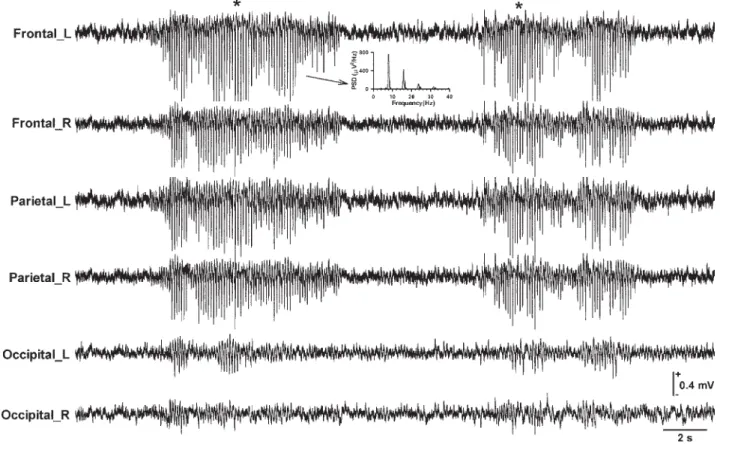
Two weeks after surgery, animals were individually placed in clear acrylic chambers to record brain activities. To allow rats to habituate to the recording apparatus, each rat was placed in the acrylic chamber at least five times (1 h/day) prior to the recording. On the day of the recording, a 30-min period was allowed for the rat to become familiar with the chamber. Mo-nopolar cortical activities recorded from skull electrodes were buffered with field-effect transistors and amplified (Shaw et al., 2002). SWDs were characterized by a barrage of large sharp spike discharges (⬎0.4 mV) with negative polarity which were prominent in the frontal and parietal regions (Fig. 1). SWDs suddenly occurred in coincidence with immobility. SWDs some-times were accompanied by facial/whisker twitching. Whisker twitching behavior occurs at the beginning of a considerable portion of SWDs, particularly for rats with high-frequency occurrence of SWDs (Shaw and Liao, 2005). The power spectra of SWDs dis-played a dominant frequency peak of around 7–12 Hz accompanied by several harmonics. These criteria have been well documented in previous studies (Shaw, 2004, 2007).
Fig. 1. A representative example of spontaneous SWDs. Paroxysmal SWDs (*) were prominent and bilaterally synchronous in the frontal and parietal
cortices with a small extent in the occipital cortex. SWDs oscillated in the range of 7–12 Hz accompanied by several harmonics (inset). PSD, power spectral density.
Behavioral tests
Four behavioral tests, i.e. open field (OF) test, elevated plus maze (EPM) test, forced swimming (FS) test, and sucrose consumption (SC) test, were used to evaluate the anxiety- and depression-like behaviors. The OF and EPM tests were for revealing a possible sign of psychomotor disturbance to an open environment that is characteristic for anxiety. The FS test was used for assessment of immobile duration that is experimental analogue of depressed mood. The SC test is a measure of the “hedonic” state of an animal, or the ability to experience pleasure. Its impairment (a decreased sensitivity to reward, anhedonia) is a fundamental feature of clinical depression. All behavioral activities were taped, digitized, and analyzed (EthoVision, Noldus, Wageningen, The Netherlands).
The apparatus of the OF test was composed of black acrylic plastic. The acrylic box formed a square area (99⫻99 cm) with walls of 25 cm in height. The OF was divided into nine squares (33⫻33 cm). The recording was performed in a room illuminated by a ceiling-sited red fluorescent light (40 W). Dur-ing testDur-ing, each rat was placed in the center zone (CZ) at the beginning. Rats were allowed to explore the maze for 10 min. The frequency of crossing the CZ, the duration in the CZ, and the total movement in the OF were analyzed. Both low number of crossing CZ and short duration in the CZ are validated for characterizing the anxiety (Prut and Belzung, 2003). The two indexes normalized by movement, which is able to reduce the movement-related interference, are also validated for anxiety assessment (Prut and Belzung, 2003).
The EPM was constructed of black polypropylene plastic and elevated 68 cm above the floor. Each maze arm extended 45 cm from the junction area, which measured 10⫻10 cm. The open and closed arms were 10 cm wide, and the closed maze arms had walls extending 25 cm from the junction area. The testing chamber was illuminated by a ceiling-sited red fluorescent light (40 W). During testing, each rat was placed in the central square facing an enclosed arm. Rats were allowed to explore the maze for 10 min. The frequency of entering the open arms (OAs), the duration in the OAs, and the total movement in the maze were analyzed. Arm entries were defined as the placement of all four paws within an arm. Both low frequency of entering the OAs and short duration in the OAs are validated for characterizing the anxiety (Pellow et al., 1985; Rodgers and Dalvi, 1997). The two indexes normalized by movement are also proposed for assessing the anxiety (Pellow et al., 1985).
The FS test (Porsolt et al., 1977; Borsini and Meli, 1988; Cryan et al., 2005) is validated for assessing the depression by long immobile duration. In the initial 15-min habituation session, which was excluded from the data analysis, rats were individually forced to swim in a plastic cylinder (47 cm in height and 38 cm in inside diameter) containing 38 cm of water (25⫾1 °C). At this water depth, rats cannot touch the bottom of the cylinder and cannot modify the effects of the forced swim by developing be-havioral adaptation (Detke and Lucki, 1996). After a period of vigorous swimming, all rats reduced their movements to only those necessary to maintain their head above the water level, with no other displacement. The 5-min test session began 24 h later. The duration of immobilization, including passive swimming, was measured. The criterion for passive swimming was floating verti-cally in the water while making only those movements necessary to keep the head above the water. After the FS test, rats were removed and dried with a towel before being returned to their home cages.
In the SC test, each rat was placed in a test cage, identical to the home cage. The fluid intake (consumption of 20% sucrose solution) was recorded for 15 min. Sucrose intake was measured prior to and following the completion of 15 min trial, the difference equating to the total fluid consumed. Prior to testing, rats were not
food- or water-deprived. Low sucrose intake is validated for being associated with depression (Sarkisova et al., 2003; Jones et al., 2008).
Sequence of experiment 1
Adult male Long-Evans (n⫽39, 9–12 months old, 550–600 g) and Wistar (n⫽15, 9–12 months old, 550–600 g) rats were used. All recordings and behavioral evaluations were performed from 14:00 to 17:00 h to minimize circadian influences. Rats were placed in the recording room 1 week prior to the experiment for adaptation. First, spontaneous cortical activity of 1 h was recorded on 2 consecutive days in all rats. Numbers of spontaneous SWDs acquired in the 2 days were averaged. After the completion of the recording of spontaneous cortical activities, behavioral experiment was performed. All indexes of the OF, EPM, and the FS tests were measured in sequence. The OF test was performed within the same time window (14:00 –17:00 h) in all rats first. After the comple-tion of the OF test, the EPM test was carried out subsequently. The FS test was performed after completion of the other two tests because FS is quite stressful for animals. In the FS test, a 15-min habituation was done on the first day. An FS test of 5 min was carried out to measure the duration of immobilization at the next day.
An additional 10 Long-Evans and nine Wistar rats (6 – 8 months, 490 –530 g) were used in the SC test to evaluate their depression-like behavioral levels. The experiment was carried out from 14:00 to 17:00 h.
Sequence of experiment 2
Adult male Long-Evans (n⫽34, 9–11 months old, 550–600 g) and Wistar (n⫽15, 9–10 months old, 530–570 g) rats were used. All recordings and behavioral evaluations were performed from 14:00 to 17:00 h to minimize circadian influences. Rats were placed in the recording room 1 week prior to the experiment for adaptation. First, spontaneous cortical activity of 1 h was recorded on two consecutive days in all rats. Numbers of spontaneous SWDs acquired in the 2 days were averaged. After the completion of the recording of spontaneous cortical activities, behavioral measure was subsequently performed 30 min after the ESM injection (100 mg/kg i.p.), which has been demonstrated to block all SWDs in previous studies (Gurbanova et al., 2006; Shaw, 2007). All in-dexes of the OF, EPM, and the FS tests were measured in sequence. The OF test was performed within the same time window (14:00 –17:00 h) in all rats first. After the completion of the OF test, the EPM test was carried out 1 week later. The FS test was performed a week after completion of the other two tests.
Additional 20 Long-Evans rats (8 months, 500 –515 g) were used to clarify SWD influence in their depression-like behavioral levels through the FS test. Ten Long-Evans rats received a 0.5 ml ESM injection (100 mg/kg i.p.), and the others 0.5 ml saline (i.p.). The experiment was carried out from 14:00 to 17:00 h.
Sequence of experiment 3
Adult male Long-Evans (n⫽30, 5–6 months old, 480–520 g) and Wistar (n⫽30, 5–6 months old, 510–540 g) rats were used as naive control, i.e. no surgical process for electrode implantation. Behavioral evaluations were performed from 14:00 to 17:00 h to minimize circadian influences. Rats were placed in the recording room 1 week prior to the experiment for adaptation. Anxiety- and depression-like behaviors of 15 Long-Evans rats and 15 Wistar rats were measured followed by a sequence of the OF, EPM, and FS tests. On the other hand, anxiety- and depression-like behav-iors of 15 Long-Evans rats and 15 Wistar rats were measured 30 min after the ESM injection (100 mg/kg i.p.) followed by a se-quence of the OF, EPM, and FS tests.
Statistical analysis
All data are expressed as the mean⫾SEM in the present study. All behavioral indexes in the two rat groups under the behavioral experiments were compared using Student’s t-test or Mann–Whit-ney rank sum test. Linear regression analysis was used to eval-uate the relationships between SWD number and all behavioral scores. ANOVA test was used to evaluate the factors of surgery, strain, and ESM in anxiety- and depression-like behaviors. The significance level for all statistical analyses was set at P⬍0.05.
RESULTS
Experiment 1 comparison under a natural condition Spontaneous SWDs (Fig. 1) were found in 39 Long-Evans rats and prominently appeared in the frontoparietal region with a small extent in the occipital area. SWDs revealed a dominant oscillation frequency of 7–12 Hz accompanied by several harmonics. Average number (96.2⫾16.0), du-ration (3.26⫾0.52 s), and total duration (391.6⫾93.1 s) of SWDs in a 1-h period on two consecutive days were measured. No spontaneous SWD was found in 15 Wistar rats during the 2-day recordings.
OF test
Long-Evans rats revealed significantly higher frequency of crossing the CZ (P⫽0.003) and longer duration in the CZ (P⫽0.014) of the OF than did Wistar rats (Table 1). Long-Evans rats showed significantly shorter moving distance than did Wistar rats (P⫽0.02). Correlations between the fre-quency of crossing the CZ (R2
⫽0.43, P⬍0.001) and the duration occurring in the CZ (R2⫽0.22, P⫽0.003) of the
OF and the total movement were significant in Long-Evans rats. To reduce the influence of the movement in the behavioral indexes of the OF test (Prut and Belzung, 2003), normalized indexes by the movement were com-pared in the two rat groups (Table 1). Both normalized frequency of crossing the CZ (P⬍0.001) and normalized duration in the CZ (P⫽0.009) of the OF in Long-Evans rats were significantly higher than those of Wistar rats.
From the video data, sudden immobility with facial twitching (occurring frequency range from 0 to 5) was
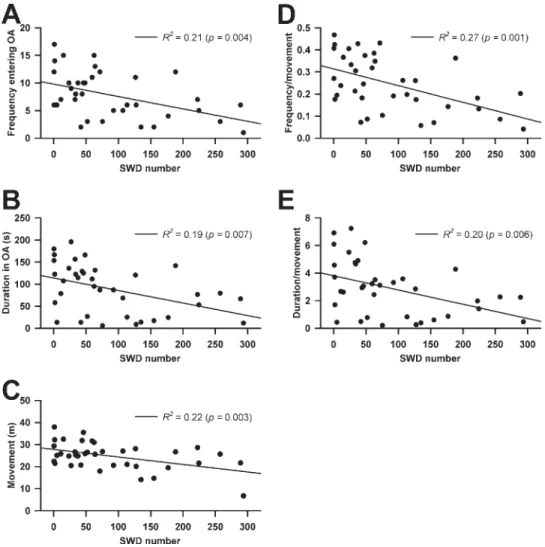
observed in Long-Evans rats, particularly for rats with higher incidence of SWDs. The behavior of whisker twitch-ing occurred when the rat stayed at peripheral area of the OF box. No facial twitching was seen in Wistar rats. The duration of whisker twitching was not easily accurately measured from the video file because the recording of a wide OF resulted in a poor video resolution of perioral region. The frequency of crossing the CZ, the duration in the CZ, and the movement showed significantly negative relationship with SWD number (Fig. 2A–C). The relation-ship between normalized frequency of crossing the CZ and SWD number was approximate to a significant level (P⫽0.052) (Fig. 2D). Normalized duration occurring in the CZ showed significantly negative relationship with SWD number (Fig. 2E).
EPM test
During the EPM test, two Long-Evans rats fell down from the maze. Thus, 37 Long-Evans and 15 Wistar rats were analyzed. Long-Evans rats revealed significantly higher frequency of entering the OAs (P⬍0.001) and longer du-ration in the OAs (P⫽0.006) of the EPM than did Wistar rats (Table 1). Long-Evans rats showed significantly shorter moving distance than did Wistar rats (P⬍0.001). Correlations between the frequency of entering the OAs (R2
⫽0.47, P⬍0.001) and the duration staying in the OAs (R2⫽0.29, P⬍0.001) of the EPM and the total movement
were significant in Long-Evans rats. To reduce the influ-ence of the movement in the behavioral indexes of the EPM (Pellow et al., 1985), normalized indexes by the movement were also compared (Table 1). Both normalized frequency of entering the OAs (P⬍0.001) and normalized duration in the OAs (P⫽0.006) of the EPM test in Long-Evans rats were significantly higher than those of Wistar rats.
From the video data, a few cases of sudden immobility with facial twitching (occurring frequency range from 0 to 3) were observed in Long-Evans rats. The behavior of whis-ker twitching appeared when the rat stayed at closed arms of an EPM. No facial twitching was seen in Wistar rats. The frequency of entering the OAs, the duration staying in the OAs, and the movement showed significantly negative relationship with SWD number (Fig. 3A–C). Both normal-ized frequency of entering the OAs and normalnormal-ized dura-tion staying in the OAs showed significantly negative rela-tionship with SWD number (Fig. 3D, E).
FS test
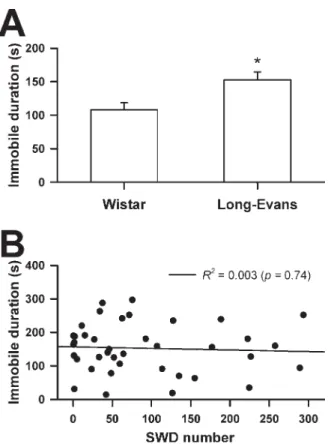
Long-Evans rats showed significantly longer durations of immobilization (152.7⫾11.9 vs. 108.1⫾10.6 s, P⫽0.032) in the FS test than did Wistar rats (Fig. 4A). Moreover, the immobile duration under the FS test was not correlated with SWD number (Fig. 4B). In the video analysis, the behavior of immobility and passive swimming taking place in the 5-min FS test revealed a similar pattern in both Long-Evans and Wistar rats. When rats displayed immo-bilization during the FS test, facial twitching was not ob-served.
Table 1. Comparison of anxious indexes of the OF and EPM tests in Wistar (n⫽15) and Long-Evans (n⫽39) rats
Parameter Wistar Long-Evans P-value
OF test
Frequency crossing the CZ 2.40⫾0.51 4.77⫾0.55 0.003* Duration in the CZ (s) 5.02⫾1.09 11.51⫾1.52 0.014* Movement (m) 42.98⫾0.74 38.31⫾1.44 0.020* Frequency/movement 0.06⫾0.01 0.12⫾0.01 ⬍0.001* Duration/movement 0.12⫾0.03 0.29⫾0.04 0.009* EPM test
Frequency entering the OA 4.00⫾0.29 7.81⫾0.68 ⬍0.001* Duration in the OA (s) 42.86⫾5.14 88.89⫾9.17 0.006* Movement (m) 34.19⫾1.39 24.81⫾1.01 ⬍0.001* Frequency/movement 0.12⫾0.01 0.25⫾0.02 ⬍0.001* Duration/movement 1.26⫾0.16 2.89⫾0.33 0.006* * P⬍0.05.
SC test
Wistar rats showed significantly higher fluid intake (20% sucrose solution) than did Long-Evans rats (6.49⫾1.61 vs. 2.95⫾0.55 ml, P⫽0.044).
Experiment 2 comparison under the ESM injection Average number (76.7⫾12.4), duration (3.21⫾0.39 s), and total duration (322.8⫾64.3 s) of SWDs in a 1-h period on 2 consecutive days were measured in 34 Long-Evans rats. No spontaneous SWD was found in 15 Wistar rats during the 2-day recordings.
OF test
Long-Evans rats revealed significantly higher frequency of crossing the CZ (P⫽0.003) and longer duration in the CZ (P⫽0.017) of the OF test than did Wistar rats 30 min after the ESM injection (Table 2). Long-Evans rats showed no difference in moving distance compared with Wistar rats (P⫽0.64). In addition, both normalized frequency of crossing the CZ (P⫽0.002) and normal-ized duration in the CZ (P⫽0.024) of the OF in
Long-Evans rats were significantly higher than those of Wistar rats.
From the video data, no sudden immobility with facial twitching was observed in Long-Evans and Wistar rats 30 min after the ESM injection. All absolute and normalized anxiety-like behavioral indexes and movement were not correlated with SWD number under the presence of ESM in Long-Evans rats (Fig. 5).
EPM test
During the EPM test, two Long-Evans rats fell down from the maze. Thus, 32 Long-Evans and 15 Wistar rats were analyzed. Long-Evans rats revealed significantly higher frequency of entering the OAs (P⬍0.001) and longer du-ration in the OAs (P⬍0.001) of the EPM test than did Wistar rats 30 min after the ESM injection (Table 2). Long-Evans rats showed no difference in moving distance com-pared with Wistar rats in the presence of the ESM (P⫽0.46). Both normalized frequency of entering the OAs (P⬍0.001) and normalized duration in the OAs (P⬍0.001) of the EPM test in Long-Evans rats were significantly higher than those of Wistar rats.
Fig. 2. Relationship between behavioral indexes of the OF test and SWD number in Long-Evans rats (n⫽39). The frequency crossing the CZ (A),
duration in the CZ (B), movement (C), frequency crossing the CZ normalized by movement (D), and duration in the CZ normalized by movement (E) showed negative relationship with SWD number.
From the video data, no sudden immobility with facial twitching was observed in Long-Evans and Wistar rats under the ESM injection. All absolute and normalized anx-iety-like behavioral indexes and movement were insignifi-cantly correlated with SWD number 30 min after the ESM injection in Long-Evans rats (Fig. 6).
FS test
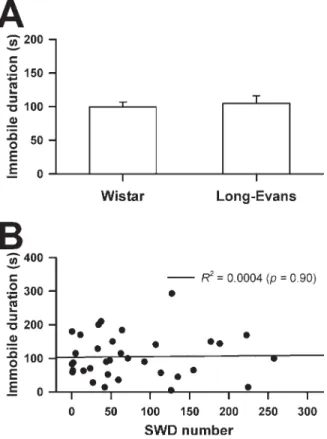
Long-Evans rats showed no difference in immobilization (104.9⫾11.1 vs. 99.6⫾7.0 s, P⫽0.76) in the FS test from that of Wistar rats 30 min after the ESM injection (Fig. 7A). The immobile duration under the FS test showed no cor-relation with SWD number (Fig. 7B). In the video analysis, the behavior of immobility and passive swimming taking place in the 5-min FS test revealed a similar pattern in both Long-Evans and Wistar rats. When rats displayed immo-bilization during the FS test, facial twitching was not ob-served.
To further clarify the effect of ESM in reducing immo-bility of the FS test, 20 Long-Evans rats were used. The immobile duration of Long-Evans rats receiving ESM
(96.3⫾5.0 s, n⫽10) was significantly shorter than that of those receiving saline (137.7⫾8.7 s, n⫽10) (P⬍0.001).
Experiment 3: anxiety- and depression-like behaviors in naive rats
Long-Evans rats revealed significantly higher frequency of crossing the CZ and longer duration in the CZ of the OF test than did Wistar rats in the absence (Table 3) and presence (Table 4) of the ESM. Similar results were also shown in the normalized indexes. The moving distance in Long-Evans rats was significantly shorter than that of Wistar rats under a nature state (P⬍0.001). After ESM injection, the moving distances between Long-Evans and Wistar rats were not significant (P⫽0.38).
Long-Evans rats revealed significantly higher fre-quency of entering the OAs and longer duration in the OAs of the EPM test than did Wistar rats in the absence (Table 3) and presence (Table 4) of the ESM. Long-Evans rats showed significantly shorter moving distance than did Wistar rats (P⬍0.001). Similar results were also shown in the normalized indexes. Under ESM administration,
Long-Fig. 3. Relationship between behavioral indexes of the EPM test and SWD number in Long-Evans rats (n⫽37). The frequency entering the OAs (A),
duration in the OAs (B), movement (C), frequency entering the OAs normalized by movement (D), and duration staying in the OAs normalized by movement (E) showed significantly negative relationship with SWD number.
Evans rats showed no difference in moving distance com-pared to Wistar rats (P⫽0.39).
Long-Evans rats showed significantly longer immobili-zation in the FS test than did Wistar rats under a natural condition (P⫽0.013). Thirty minutes after the ESM injec-tion, the immobility of the FS test between Long-Evans and Wistar rats was not significant (P⫽0.46).
Strain effect was found in all indexes of the OF test (frequency crossing the CZ, F1,166⫽33.39, P⬍0.001; du-ration in the CZ, F1,166⫽26.69, P⬍0.001; normalized fre-quency crossing the CZ, F1,166⫽48.84, P⬍0.001; normal-ized duration in the CZ, F1,166⫽28.05, P⬍0.001), the EPM test (frequency entering the OAs, F1,162⫽66.31, P⬍0.001; duration in the OAs, F1,162⫽48.11, P⬍0.001; normalized frequency entering the OAs, F1,162⫽93.82, P⬍0.001; nor-malized duration in the OAs, F1,162⫽52.65, P⬍0.001), and the FS test (immobility, F1,166⫽9.327, P⫽0.003). The fac-tors of either ESM administration or surgical process had little influence in indexes of the three behavioral tests in Wistar rats. Surgery also showed little influence in all be-havior indexes of Long-Evans rats. However, ESM had significant effect in all indexes of the EPM test in Long-Evans rats (frequency entering the OAs, F1,102⫽65.21, P⬍0.001; duration in the OAs, F1,102⫽41.62, P⬍0.001; normalized frequency entering the OAs, F1,102⫽62.69, P⬍0.001; normalized duration in the OAs, F1,102⫽30.48, P⬍0.001). But ESM had no significant effect in the OF test
in Long-Evans rats. Long-Evans rats displayed a signifi-cant effect in immobilization of the FS test (F1,106⫽10.50, P⫽0.002). All data obtained in this study are summarized inTable 5.
DISCUSSION
The major findings of this study are (1) Long-Evans rats displayed seizure frequency-dependent exacerbation in anxiety-like behavior that was ameliorated by ESM (2). Long-Evans rats revealed a depressive propensity that was reduced by ESM. No seizure frequency–related rela-tionship was found in depression-like behavior (3). Distinct inter-strain responses were found in anxiety- and depres-sion-like behavior. Compared to Wistar rats, Long-Evans rats showed low anxiety but high depression. ESM ame-liorated depression-like behavior of Long-Evans rats as a level of Wistar rats.
Elevated anxiety has been reported in GAERS (Jones et al., 2008) and WAG/Rij rats (Sarkisova et al., 2003). Anxious level is significantly elevated at seizure onset age of GAERS rats (Jones et al., 2008). In this study, we extended the finding that anxious level of Long-Evans rats showed a positive relationship with SWD number, and the relationship was abolished using ESM. These data may suggest an SWD-dependent anxiogenic relationship in rats with spontaneous absence epileptic discharges. On the other hand, anxiety was observed in rats receiving 15–25 kindling stimulation within the amygdala (Helfer et al., 1996), which is an animal model analogous to temporal lobe epilepsy of humans. Moreover, excessive amygdala stimulation results in recurrent convulsive seizure activi-ties, and increase of amygdala stimulation number has been demonstrated to be associated with elevated anxiety (Kalynchuk, 2000). These data may imply a generality of the seizure frequency-dependent anxiogenic response.
The results of two depression-like behavioral tests, i.e. hedonic measure (SC test) and behavioral despair mea-sure (FS test), indicated that Long-Evans rats showed a depressive propensity. High depression-like behavior ob-served in Long-Evans rats is consistent with previous find-Table 2. Comparison of anxious indexes of the OF and EPM tests in Wistar (n⫽15) and Long-Evans (n⫽34) rats 30 min after ESM administration
Parameter Wistar Long-Evans P-value
OF test
Frequency crossing the CZ 2.80⫾0.28 5.38⫾0.53 0.003* Duration in the CZ (s) 5.00⫾0.85 11.80⫾1.77 0.017* Movement (m) 42.07⫾0.86 40.86⫾1.68 0.64 Frequency/movement 0.07⫾0.03 0.13⫾0.01 0.002* Duration/movement 0.12⫾0.02 0.30⫾0.05 0.024* EPM test
Frequency entering the OA 5.13⫾0.65 16.9⫾1.30 ⬍0.001* Duration in the OA (s) 51.46⫾4.92 220.27⫾23.32 ⬍0.001* Movement (m) 30.63⫾1.67 32.11⫾1.10 0.46 Frequency/movement 0.16⫾0.07 0.51⫾0.03 ⬍0.001* Duration/movement 1.68⫾0.13 6.86⫾0.75 ⬍0.001* * P⬍0.05.
Fig. 4. Immobile duration of the FS test in Wistar (n⫽15) and
Long-Evans rats (n⫽39). (A) The immobile duration in Long-Evans rats was significantly higher than that of Wistar rats. (B) The immobile duration and SWD number showed no remarkable relationship. * P⬍0.05 by Student’s t-test.
ings in WAG/Rij and GAERS rats (Sarkisova et al., 2003; Jones et al., 2008). This study provided additional evi-dence about immobility observed in the FS test being not related to SWD number. Additionally, ESM showed a real effect in reducing immobile duration of the FS test in Long-Evans rats, and ESM could restore the immobile behavior of Long-Evans rats as the level of Wistar rats. Accordingly, our data indicate that absence epileptic rats display de-pressive propensity that is not related to seizure frequency. The immobility in the Porsolt FS test can be seen as an actively successful coping strategy to an inescapable sit-uation (West, 1990). Thus, the immobility in the Porsolt FS test may be related to not only “behavioral despair” but also “learned helplessness.” In the present study, we used a modified FS test with a deeper water depth. At this water depth, rats cannot touch the bottom of the cylinder and cannot modify the effects of the FS by developing behav-ioral adaptation (Detke and Lucki, 1996; Cryan et al., 2005). Although the greater water depth produces lower baseline values of immobility, behavioral responses to both serotonergic and noradrenergic antidepressants are augmented (Detke and Lucki, 1996). To further strengthen
a depressive propensity in Long-Evans rats, antidepres-sant may be used.
In the FS test, Long-Evans rats showed a significantly longer immobility than did Wistar rats. Is the depressive mood-related immobility seen in the FS test similar to the sudden cessation of movement often seen in synchrony with SWDs? At least two lines of evidences point out the discrepancy between the two immobile behaviors. First, the behavior of immobilization and passive swimming tak-ing place in the 5-min FS test revealed a similar pattern in both Long-Evans and Wistar rats. No facial twitching was observed when rats displayed immobilization during the FS test. Second, no correlation was found between the immobile duration and SWD number during the FS test. It is partially supported by the phenomenon of no whisker twitching appearing in the FS test. In contrast, significant negative correlation existed between the exploration-re-lated movement and SWD number in the OF and EPM tests. ESM eliminated the relationship. A previous study (Petit-Demouliere et al., 2005) has indicated that immobil-ity observed in the FS test seems not to be related to behavior in the tests used in anxiety models. These results
Fig. 5. Relationship between behavioral indexes of the OF test and SWD number in Long-Evans rats (n⫽34). The frequency crossing the CZ (A),
duration in the CZ (B), movement (C), frequency crossing the CZ normalized by movement (D), and duration in the CZ normalized by movement (E) showed no remarkable relationship with SWD number.
suggest that immobility observed in the FS test is not totally equal to sudden behavioral arrest in synchrony with SWDs.
In both the OF and EPM tests, Jones et al. (2008) claimed the existence of anxiety-like behavior in GAERS rats because of a significant reduction in GAERS locomo-tion only in the first 10 min of exposure to the OF chamber. They argue the reduction of locomotion in the anxiety assessing apparatus being due to psychomotor “freezing” behavior not seizure-related immobility. However, the pos-tulation is not fully supported by our observations here. First, a few cases of sudden immobility were accompanied by whisker twitching behavior during the recording. Numer-ous studies (Nicolelis et al., 1995; Shaw, 2004; Shaw and Liao, 2005) have indicated that whisker twitching appears in 30%– 80% of SWDs. Second, in the two behavioral tests total movement of Long-Evans rats was significantly shorter than that of Wistar rats. Decreased movement during the behavioral tests is also significant in both GAERS and WAG/Rij rats (Vergnes et al., 1991; Sarkisova et al., 2003; Jones et al., 2008). Almost identical significant correlation coefficients were found between the total
movement and SWD number in the two behavioral tests. Additionally, ESM eliminated the relationship between movement and SWD number. The data may indicate a considerable contribution of SWDs in the movement (sei-zure-related arrest). In the present study, we also used normalized indexes to quantify anxious behavior in the OF and EPM tests to reduce possible influence of seizure-related arrest. Significant negative trends were found be-tween normalized indexes of the two behavioral tests and SWD number. Because the movement-related influence should be minimized in normalized behavioral indexes (Pellow et al., 1985; Prut and Belzung, 2003), the intra-strain negative relationship between the normalized in-dexes and SWD number may be associated with psy-chomotor impairment itself.
Long-Evans, WAG/Rij, and GAERS rats display spon-taneous absence-like epileptic activity, and they all show depression-like behavior compared to Wistar rats in the FS test and SC test (Table 5;Sarkisova et al., 2003; Jones et al., 2008). Although the anxiety-like behavior indexes of the OF and EPM tests are comparable in control Wistar rats, obvious differences exist in these three rat strains.
Fig. 6. Relationship between behavioral indexes of the EPM test and SWD number in Long-Evans rats (n⫽32). The frequency entering the OAs (A),
duration in the OAs (B), movement (C), frequency entering the OAs normalized by movement (D), and duration staying in the OAs normalized by movement (E) showed no relationship with SWD number.
WAG/Rij rats showed lower frequency of crossing the CZ of the OF than did Wistar rats, and there was no difference in the frequency of entering OAs of the EPM between WAG/Rij and Wistar rats (Sarkisova et al., 2003). GAERS rats displayed shorter duration staying in the CZ of the OF and lower frequency of entering OAs of the EPM than did Wistar rats (Jones et al., 2008). In contrast, Long-Evans rats showed consistently higher values in both absolute
and normalized behavioral indexes of the OF and EPM tests than did Wistar rats. Additionally, all behavioral in-dexes of the OF and EPM tests in Long-Evans rats re-vealed a significantly negative relationship with SWD num-ber. Effect of ESM in amelioration of anxiety- and depres-sion-like behaviors was significant in the EPM and FS tests. The discrepancies existing in the anxiety-like behav-ioral results of these studies may have arisen from different
Fig. 7. Immobile duration of the FS test in Wistar (n⫽15) and
Long-Evans rats (n⫽34). (A) The immobile duration in Long-Evans rats was not different to that of Wistar rats. (B) The immobile duration and SWD number showed no relationship.
Table 3. Comparison of behavioral indexes of the OF, EPM, and FS
tests in naive Wistar (n⫽15) and Long-Evans (n⫽15) rats
Parameter Wistar Long-Evans P-value
OF test
Frequency crossing the CZ 2.53⫾0.45 4.13⫾0.49 0.022* Duration in the CZ (s) 5.13⫾1.06 10.69⫾2.11 0.026* Movement (m) 42.68⫾0.71 34.16⫾1.86 ⬍0.001* Frequency/movement 0.06⫾0.01 0.12⫾0.02 0.002* Duration/movement 0.12⫾0.03 0.31⫾0.06 0.008* EPM test
Frequency entering the OA 4.07⫾0.32 7.13⫾0.91 0.003* Duration in the OA (s) 43.73⫾4.88 80.27⫾14.66 0.025* Movement (m) 35.49⫾1.92 22.68⫾1.70 ⬍0.001* Frequency/movement 0.12⫾0.00 0.31⫾0.04 ⬍0.001* Duration/movement 1.28⫾0.15 3.40⫾0.60 0.002* FS test Immobility (s) 105.5⫾10.2 172.6⫾23.1 0.013* * P⬍0.05.
Table 4. Comparison of behavioral indexes of the OF, EPM, and FS
tests in naive Wistar (n⫽15) and Long-Evans (n⫽15) rats 30 min after ESM administration
Parameter Wistar Long-Evans P-value
OF test
Frequency crossing the CZ 2.73⫾0.25 6.33⫾1.45 ⬍0.001* Duration in the CZ (s) 5.21⫾0.80 14.75⫾3.16 0.007* Movement (m) 41.17⫾0.97 39.52⫾2.74 0.38 Frequency/movement 0.06⫾0.01 0.17⫾0.02 ⬍0.001* Duration/movement 0.13⫾0.02 0.40⫾0.10 0.009* EPM test
Frequency entering the OA 4.47⫾0.53 16.30⫾1.47 ⬍0.001* Duration in the OA (s) 48.92⫾5.73 178.17⫾19.10 ⬍0.001* Movement (m) 33.43⫾1.27 32.59⫾1.47 0.39 Frequency/movement 0.15⫾0.02 0.50⫾0.04 ⬍0.001* Duration/movement 1.68⫾0.16 5.51⫾0.58 ⬍0.001* FS test Immobility (s) 100.7⫾6.7 116.8⫾20.6 0.46 * P⬍0.05.
Table 5. Summary of anxiety- and depression-like behaviors in
Long-Evans rats
Behavioral test Status Result Inter-strain effect (Long-Evans vs. Wistar)
OF test
Anxiety-like behavior Nature Low Anxiety-like behavior ESM Low EPM test
Anxiety-like behavior Nature Low Anxiety-like behavior ESM Low FS test
Depression-like behavior Nature High Depression-like behavior ESM no. SC test
Depression-like behavior Nature High Intra-strain effect (Long-Evans)
OF test
Relation (anxiety vs. SWD number) Nature Yes (positive) Relation (anxiety vs. SWD number) ESM no. EPM test
Relation (anxiety vs. SWD number) Nature Yes (positive) Relation (anxiety vs. SWD number) ESM no. FS test Relation (depression vs. SWD number) Nature no. Relation (depression vs. SWD number) ESM no. Depression-like behavior ESM vs.
saline Low
apparatus designs (OF test: square vs. circle), recording/ analysis durations (EPM test: 10 vs. 5 min), and/or illumi-nation (dark vs. dim light). Strain variation may also influ-ence psychiatric behaviors of rats (Armario et al., 1995; Tejani-Butt et al., 2003; Ferguson and Gray, 2005). Addi-tionally, very important factors might arise from being as-sociated with intrinsic variations among Long-Evans, GAERS, and WAG/Rij rat strains, for example, the occur-ring frequency of spontaneous SWDs, the distribution of SWD occurrences during wake–sleep states (Danober et al., 1998; Coenen and van Luijtelaar, 2003; Shaw, 2004), the dose response of carbamazepine on SWDs ( Mares-caux et al., 1984; Peeters et al., 1988; Shaw, 2007), and genetic factors (outbred Long-Evans rats vs. inbred WAG/ Rij rats of ⬎130 generations or inbred GAERS rats of 20 – 40 generations and strain differences) (Danober et al., 1998; Coenen and van Luijtelaar, 2003; Gurbanova et al., 2006; Shaw, 2007).
Anxiety and/or depression appear in patients with fron-tal lobe epilepsy (Shulman, 2000; Helmstaedter, 2001; Kanner, 2004) or a lesion of the frontal lobe (Starkstein et al., 1987; House et al., 1990; Mathew et al., 2004). Anxiety and depression may share considerable portions of certain brain networks (Nestler et al., 2002). However, modifica-tions of monoaminergic systems (noradrenergic and sero-tonergic) and the hypothalamic–pituitary–adrenal axis dur-ing anxiety and depression slightly differ (Boyer, 2000). Recently, the rostral anterior cingulated cortex was dem-onstrated to modulate depression- but not anxiety-related behaviors (Bissiere et al., 2006). Anxiety but not depres-sion is seen in rats receiving kindling stimulation within the amygdala (Helfer et al., 1996; Kalynchuk, 2000; Wintink et al., 2003). Moreover, characteristics of anxiety and depres-sion symptoms are quite different, and anxiolytics and antidepressants used in the clinic can differ (Monaco and Cicolin, 1999; Nestler et al., 2002). In this study, we pro-vide additional data on the dissociation between certain aspects of anxious and depressive behaviors with absence epileptic discharges: the inter-strain difference of basal levels and the intra-strain relation between behavioral in-dexes and SWD number. As a result, distinct strategies may be selectively used during the processes of anxiety and depression in the brain, particularly for generalized frontoparietal SWDs.
CONCLUSION
Aberrant SWDs had distinct influences in anxiety- and depression-like behaviors of the rat. SWDs worsened anx-iety-like behavior in Long-Evans rats in a seizure frequen-cy-dependent manner while they showed low anxiety com-pared to Wistar rats. Long-Evans rats displayed high de-pressive behavior that was not related to SWD number. Our animal model may provide an alternative choice to elucidate the operation of anxiety- and depression-related networks. Indeed, spontaneous SWDs appear in a consid-erable proportion of either inbred or outbred rat strains with various occurring frequencies (Kaplan, 1985; Willoughby and Mackenzie, 1992; Jando et al., 1995). According to our
findings, the contribution of aberrant brain activities in be-havioral analyses, particularly for anxiety and depression, should be taken into account.
REFERENCES
Adewuya AO, Ola BA (2005) Prevalence of and risk factors for anxiety and depression disorders in Nigerian adolescents with epilepsy. Epilepsy Behav 6:342–347.
Armario A, Gavalda A, Marti J (1995) Comparison of the behavioral and endocrine response to forced swimming stress in five inbred strains of rats. Psychoneuroendocrinology 20:879 – 890. Austin JK, Risinger MW, Beckett LA (1992) Correlates of behavior
problems in children with epilepsy. Epilepsia 33:1115–1122. Baki O, Erdogan A, Kantarci O, Akisik G, Kayaalp L, Yalcinkaya C
(2004) Anxiety and depression in children with epilepsy and their mothers. Epilepsy Behav 5:958 –964.
Bissiere S, McAllister KH, Olpe HR, Cryan JF (2006) The rostral anterior cingulated cortex modulates depression but not anxiety-related behaviour in the rat. Behav Brain Res 175:195–199. F, Borsini Meli A (1988) Is the forced swimming test a suitable model for
revealing antidepressant activity? Psychopharmacology 94:147–160.
Boyer P (2000) Do anxiety and depression have a common patho-physiological mechanism? Acta Psychol Scand Suppl 406:24 –29. Caplan R, Siddarth P, Gurbani S, Hanson R, Sankar R, Shields WD (2005) Depression and anxiety disorders in pediatric epilepsy. Epilepsia 46:720 –730.
Coenen AML, van Luijtelaar ELJM (2003) Genetic animal models for absence epilepsy: a review of the WAG/Rij strain of rats. Behav Genet 33:635– 655.
Crunelli V, Leresche N (2002) Childhood absence epilepsy: genes, channels, neurons and networks. Nat Rev Neurosci 3:371–382. Cryan JF, Valentino RJ, Lucki I (2005) Assessing substrates
underly-ing the behavioral effects of antidepressants usunderly-ing the modified rat forced swimming test. Neurosci Biobehav Rev 29:547–569. Danober L, Deransart C, Depaulis A, Vergnes M, Marescaux C (1998)
Pathological mechanisms of genetic absence epilepsy in the rat. Prog Neurobiol 55:27–57.
Detke MJ, Lucki I (1996) Detection of serotonergic and noradrenergic antidepressants in the rat forced swimming test: the effects of water depth. Behav Brain Res 73:43– 46.
AB, Ettinger Weisbrot DM, Nolan EE, Gadow KD, Vitale SA, Andriola MR, Lenn NJ, Novak GP, Hermann BP (1998) Symptoms of depression and anxiety in pediatric epilepsy patients. Epilepsia 39:595–599. Ferguson SA, Gray EP (2005) Aging effects on elevated plus maze
behavior in spontaneously hypertensive, Wistar-Kyoto and Spra-gue–Dawley male and female rats. Physiol Behav 85:621– 628. Gurbanova AA, Aker R, Berkman K, Onat FY, van Rijn CM, van
Luijtelaar G (2006) Effect of systemic and intracortical administra-tion of phenytoin in two genetic models of absence epilepsy. Br J Pharmacol 148:1076 –1082.
Helfer V, Deransart C, Marescaux C, Depaulis A (1996) Amygdala kindling in the rat: anxiogenic-like consequences. Neuroscience 73:971–978.
Helmstaedter C (2001) Behavioral aspects of frontal lobe epilepsy. Epilepsy Behav 2:384 –395.
House A, Dennis M, Marlow C, Hawton K, Molyneux A (1990) Mood disorders after stroke and their relation to lesion location: a CT scan study. Brain 113:1113–1129.
Jando G, Carpi D, Kandel A, Urioste R, Horvath Z, Pierre E, Vadi D, Vadasz C, Buzsaki G (1995) Spike-and-wave epilepsy in rats: sex differences and inheritance of physiological traits. Neuroscience 64:301–317.
Jones NC, Salzberg MR, Kumar G, Couper A, Morris MJ, O’Brien TJ (2008) Elevated anxiety and depressive-like behavior in a rat model of genetic generalized epilepsy suggesting common causa-tion. Exp Neurol 209:254 –260.
Kalynchuk LE (2000) Long-term amygdala kindling in rats as a model for the study of interictal emotionality in temporal lobe epilepsy. Neurosci Biobehav Rev 24:691–704.
Kanner AM (2004) Is major depression a neurologic disorder with psychiatric symptoms? Epilepsy Behav 5:636 – 644.
Kanner AM, Balabanov A (2002) Depression and epilepsy. How closely related are they? Neurology 58 (Suppl 5):S27–S39. Kaplan BJ (1985) The epileptic nature of rodent electrocortical
polyspiking is still unproven. Exp Neurol 88:425– 436.
Marescaux C, Micheletti G, Vergnes M, Depaulis A, Rumbach L, Warter JM (1984) A model of chronic spontaneous petit mal-like seizures in the rat: comparison with pentylenetetrazol-induced sei-zures. Epilepsia 25:326 –331.
Mathew SJ, Mao XL, Coplan JD, Smith ELP, Sackeim HA, Gorman JM, Shungu DC (2004) Dorsolateral prefrontal cortical pathology in generalized anxiety disorder: a proton magnetic resonance spec-troscopic imaging study. Am J Psychiatry 161:1119 –1121. Monaco F, Cicolin A (1999) Interactions between anticonvulsant and
psychoactive drugs. Epilepsia 40 (Suppl 10):S71–S76.
Nestler EJ, Barrot M, Di Leone RJ, Eisch AJ, Gold SJ, Monteggia LM (2002) Neurobiology of depression. Neuron 34:13–25.
Nicolelis MAL, Baccala LA, Lin RCS, Chapin JK (1995) Sensorimotor encoding by synchronous neural ensemble activity at multiple lev-els of the somatosensory system. Science 268:1353–1358. Oguz A, Kurul S, Dirik E (2002) Relationship of epilepsy-related factors
to anxiety and depression scores in epileptic children. J Child Neurol 17:37– 40.
Peeters BWMM, Spooren WPJM, van Luijtelaar ELJM, Coenen AML (1988) The WAG/Rij rat model for absence epilepsy: anticonvul-sant drug evaluation. Neurosci Res Commun 2:93–97.
Pellow S, Chopin P, File SE, Briley M (1985) Validation of open: closed arm entries in an elevated plus-maze as a measure of anxiety in the rat. J Neurosci Methods 14:149 –167.
Petit-Demouliere B, Chenu F, Bourin M (2005) Forced swimming test in mice: a review of antidepressant activity. Psychopharmacology 177:245–255.
Plioplys S (2003) Depression in children and adolescents with epi-lepsy. Epilepsy Behav 4:S39 –S45.
Porsolt RD, Pichon ML, Jafre M (1977) Depression: a new model sensitive to the antidepressant treatment. Nature 266:730 –732. Prut L, Belzung C (2003) The open field as a paradigm to measure the
effects of drugs on anxiety-like behaviors: a review. Eur J Phar-macol 463:3–33.
Rao S, Rajesh KR, Joseph T (1991) Effect of antiepileptic drugs valproic acid, carbamazepine, and ethosuximide on exploratory behaviour in mice. Indian J Exp Biol 29:127–130.
Reijs R, Aldenkamp AP, De Krom M (2004) Mood effects of antiepi-leptic drugs. Epilepsy Behav 5:S66 –S76.
Rodgers RJ, Dalvi A (1997) Anxiety, defence and the elevated plus-maze. Neurosci Biobehav Rev 21:801– 810.
Sarkisova KY, Midzianovskaia IS, Kulikov MA (2003) Depressive-like behavioral alterations and c-fos expression in the dopaminergic brain regions in WAG/Rij rats with genetic absence epilepsy. Be-hav Brain Res 144:211–226.
Schmitz B (1999) Psychiatric syndromes related to antiepileptic drugs. Epilepsia 40 (Suppl 10):S65–S70.
Shaw FZ (2004) Is spontaneous high-voltage rhythmic spike discharge in Long Evans rats an absence-like seizure activity? J Neuro-physiol 91:63–77.
Shaw FZ (2007) 7–12 Hz high-voltage rhythmic spike discharges in rats evaluated by antiepileptic drugs and flicker stimulation. J Neu-rophysiol 97:238 –247.
Shaw FZ, Liao YF (2005) Relation between activities of the cortex and vibrissae muscle during high-voltage rhythmic spike discharges in rats. J Neurophysiol 93:2435–2448.
Shaw FZ, Lai CJ, Chiu TH (2002) A low-noise flexible integrated system for recording and analysis of multiple electrical signals during sleep-wake states in rats. J Neurosci Methods 118:77– 87. Shaw FZ, Lee SY, Chiu TH (2006) Modulation of somatosensory evoked potential during wake-sleep states and spike-wave dis-charge in the rat. Sleep 29:285–293.
Shulman MB (2000) The frontal lobes, epilepsy, and behavior. Epi-lepsy Behav 1:384 –395.
Starkstein SE, Robinson RG, Price TR (1987) Comparison of cortical and subcortical lesions in the production of poststroke mood dis-orders. Brain 110:1045–1059.
Tejani-Butt S, Kluczynski J, Pare WP (2003) Strain-dependent modi-fication of behavior following antidepressant treatment. Prog Neu-ropsychopharmacol Biol Psychiatry 27:7–14.
M, Vergnes Marescaux C, Boehrer A, Depaulis A (1991) Are rats with genetic absence epilepsy behaviorally impaired? Epilepsy Res 9:97–104.
West AP (1990) Neurobehavioral studies of forced swimming: the role of learning and memory in the forced swim test. Prog Neuropsy-chpharmacol Biol Psychiatry 14:863– 877.
Willoughby JO, Mackenzie L (1992) Nonconvulsive electrocortico-graphic paraxysms (absence epilepsy) in rat strains. Lab Anim Sci 42:551–554.
Wintink AJ, Young NA, Davis AC, Gregus A, Kalynchuk LE (2003) Kindling-induced emotional behavior in male and female rats. Be-hav Neurosci 117:632– 640.
(Accepted 26 February 2009) (Available online 6 March 2009)