Manufacturing and Mechanical Property Evaluations of CF /PLA
Biocomposites
Ching-Wen Lou
1, b, Jo-Mei Liao
2, Zheng-Ian Lin
2and Jia-Horng Lin
2, 3, 4,a1Institute of Biomedical Engineering and Materials Science, Central Taiwan University of Science and Technology, Taichung 40601, Taiwan, R.O.C.
2Laboratory of Fiber Application and Manufacturing, Department of Fiber and Composite Materials, Feng Chia University, Taichung City 40724, Taiwan, R.O.C.
3School of Chinese Medicine, China Medical University, Taichung 40402, Taiwan, R.O.C. 4Department of Fashion Design, Asia University, Taichung 41354, Taiwan, R.O.C.
a[email protected], b [email protected]
Keywords: polylactic acid (PLA), carbon fiber (CF), biocomposites.
Abstract. This study uses carbon fibers (CF) to reinforce polylactic acid (PLA) matrices to form
CF/PLA biocomposites. Tensile test, flexural test, and impact test are performed on biocomposites to evaluate their mechanical properties. The results of tests show that an increment of the CF content results in an increase in tensile strength, flexural strength, flexural modulus, and impact strength. The combination of 15 wt% CF provides the resulting biocomposites with a 72 % increase in tensile strength, a 322 % increase in flexural modulus, and a 96 % increase in impact strength.
Introduction
PLA is an emerging engineering plastic with low impact resistance, low heat distortion temperature, and low flexibility. Comparing to other commonly used engineering plastics, PLA has a relatively restricted range of application. However, due to PLA’s high modulus, light weight, biodegradation, and environmentally friendly feature [1-2], PLA only needs to improve its mechanical properties to make biodegradable, lightweight, and high strength composites. In this study, the reinforcement is CF, a well-known reinforcement that has been commonly used in engineering technology [3], due to its excellent mechanical strength, high elastic modulus, low density, and flame resistance. This study aims to combine the high strength CF to improve the mechanical properties of PLA matrices, so as to make eco-friendly biocomposites with high strength and high mechanical properties.
Experimental Materials
PLA (2003D, Cargill Dow, Nature Works LLC, U.S.) has a melt flow rate (MRF) of 6 g/10 min (210 ˚C, 2.16 kg). CF (Toray Industries, Inc., Japan) has a length of 0.62 cm.
5, 10, and 15 wt% CF are separately added to PLA fibers, and made into master batches on a single-screw extruder, in which the temperatures of three feeder hopper are 180 ˚C, 190 ˚C, and 200 ˚C, the temperature of the die is 190 ˚C, and the rotary speed of the single-screw is 20 rpm. The master batches are dried at 80 ˚C in an oven for 4 hours. The heat offered by the feeder hopper of the single-screw extruder remove the moisture from the master batches, which are then made into standard samples on an injection molding machine, the three feeder hopper of which have a temperature of 180 ˚C, 190 ˚C, and 200 ˚C, and the nozzle of which has a temperature of 190 ˚C. The tensile strength, impact strength, and flexural strength of the standard samples are finally evaluated.
Test
Tensile Test
An Instron 5566 (Instron, U.S.) measures the tensile strength of the standard samples as specified in test standard of ASTM D638. Five samples of each specification have a size of 115 mm×20 mm×3.2 mm. The distance between the grips is 65 mm and the stretching rate is 2 mm/min.
Flexural Test
The flexural strength of the five standard samples of each specification is evaluated with an Instron 5566 (Instron, U.S.) as specified in the test standard of ASTM D790. The span between two clamps is 51.2 mm. The samples are 127 mm×12.7 mm×3.2 mm.
Izod Notched Impact Test
The notched impact test is performed on standard samples of 63.5 mm×12.7 mm×3.2mm with an Izod impact tester (CPI, Atlas Electric Devices, U.S.) as specified in test standard of ASTM D256. Five samples of each specification are taken and samples are cut with a 2.5 mm long V-shape notch.
Results and Discussion Tensile Properties
Figure 1 shows that the tensile strength of pure PLA matrices is 69.5 MPa, which increases as a result of the combination of CF. The greater the CF content, the greater the tensile strength of the biocomposites. In particular, a 15 wt% of CF results in an optimal tensile strength of 120 MPa, which is greater than that of pure PLA matrices by 72 %. Such a result is due to the high strength of CF. Figure 1 also shows that the variations in elongation at yield are insignificant. Elongation at yield depends on the mechanical properties of the matrices, and is not significantly correlated to CF.
pure PLA 5wt% 10wt% 15wt% 50 60 70 80 90 100 110 120 130 4 5 6 7 8 9 10 11 12 13 14 Tensile strength (MPa) Different content of carbon fiber
T en si le s tr en g th ( M P a ) E lo n g a ti o n ( % )
Figure 1. Tensile strength and elongation of CF/PLA biocomposites as related to various CF contents.
Flexural Strength
Figure 2 shows the flexural strength of the CF/PLA biocomposites made with different CF contents, which increases from 123 MPa (0 wt% of CF) to 163 MPa (15 wt% of CF). A 15 wt% of CF is able to increase flexural strength by 32.8 %. Such a result is ascribed to the high strength of CF, which helps to increase the flexural strength of the resulting CF/PLA biocomposites. The results of test also show that flexural modulus is proportional to the amount of CF, and increases from 3490 MPa(0 wt% of CF)to 11603 MPa (15 wt% of CF), i.e., a 232 % increase. Because CF possesses high flexural modulus, the flexural modulus increases as a result of increasing amount of CF. pure PLA 5wt% 10wt% 15wt% 2000 4000 6000 8000 10000 12000 14000 0 20 40 60 80 100 120 140 160 180 Flexural m odulus(Mpa) Flexural strengh(Mpa)
different content of carbon fiber
Fl ex u ra l s tr e n gh (M p a) Fl ex u ra l m o d u lu s( M p a)
Figure 2. Flexural strength and flexural modulus of CF/PLA biocomposites as related to various CF contents.
Impact Strength
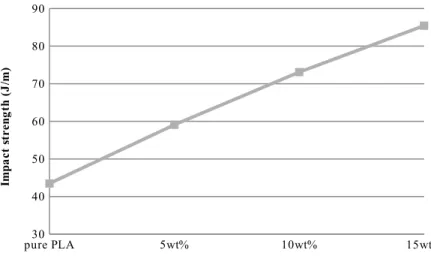
Figure 3 shows that the impact strength of CF/PLA biocomposites inceases with an increment of the CF content. When CF is at 15 wt%, the resulting CF/PLA biocomposites yield impact strength of 85.45 J/m, which is 96 % greater than that of pure PLA matrices (43.5 J/m). When the biocomposites are fractured, the energy of the force is absorbed by the breakage or pull-out of CF,
and thus the impact strength of the biocomposites increases as a result of an increment of CF content. pure PLA30 5wt% 10wt% 15wt% 40 50 60 70 80 90
Different content of carbon fiber
Im p a ct s tr en g th ( J /m )
Figure 3. Impact strength of CF/PLA biocomposites as related to various CF contents.
Conclusion
This study adds carbon fibers as reinforcement to PLA matrices to form CF/PLA biocomposites. The high strength and high modulus provided by CF improve the mechanical properties of the PLA matrices. Comparing to the mechanical properties of pure PLA matrices, the combination of 15 wt % of CF increases the tensile strength from 69.5 MPa to 120 MPa, increases the flexural modulus from 3490 MPa to 11603 MPa, and increases impact strength from 43.5 J/m to 85.5 J/m. The test results indicate that the combination of CF can considerably fortify the mechanical properties of PLA matrices by improving their flexibility, bending resistance, and impact strength. As a result, this study successfully prepares CF/PLA biocomposites with high strength and good mechanical properties.
Acknowledgement
The authors would especially like to thank National Science Council of the Taiwan, for financially supporting this research under Contract NSC 102-2621-M-166-001.
References
[1] T.H. Nam, S. Ogihara, N.H. Tung and S. Kobayashi: Compos. Part B-Eng. Vol. 42 (2011), p. 1648.
[2] A.K. Bledzki, A. Jaszkiewicz and D. Scherze: Compos. Part A-Appl. S. Vol. 40(2009), p. 404.