Soft x-ray absorption spectroscopy studies of doped Pr-containing cuprates
J. M. Chen,1,*S. J. Liu,2C. F. Chang,2J.-Y. Lin,3 Y. S. Gou,2and H. D. Yang41
Synchrotron Radiation Research Center (SRRC), Hsinchu, Taiwan, Republic of China
2Department of Electrophysics, National Chiao Tung University, Hsinchu, Taiwan, Republic of China 3Institute of Physics, National Chiao Tung University, Hsinchu, Taiwan, Republic of China 4Department of Physics, National Sun Yat-Sen University, Kaohsiung, Taiwan, Republic of China
共Received 3 September 2002; published 6 January 2003兲
Using high-resolution O K-edge x-ray absorption near-edge-structure共XANES兲 spectroscopy, unoccupied states of the YxPr1⫺xBa2Cu3O7(x⫽0 – 1) thin films and polycrystalline Pr1⫺xCaxBa2Cu3O7 (x⫽0 – 0.3) as well as R0.8Pr0.2Ba2Cu3O7 samples (R⫽Tm, Dy, Gd, and Sm兲 are investigated. In YxPr1⫺xBa2Cu3O7, hole numbers in the CuO2planes decrease significantly with increasing Pr doping level. Hole carriers generated via Ca doping in Pr1⫺xCaxBa2Cu3O7are directed predominantly into both the Zhang-Rice and Fehrenbacher-Rice 共FR兲 states, while those in the CuO3 ribbons remain almost unchanged with Ca substitution. In
R0.8Pr0.2Ba2Cu3O7, the hole content in the CuO2planes decreases monotonically with increasing ionic size of the R3⫹ions, confirming the hole depletion effect based on the Pr 4 f – O 2 p hybridization. We demonstrate the spectroscopic evidence of the existence of the FR states. The present XANES results provide a deeper under-standing of the nature of hybridization and the origin of the ionic size effect.
DOI: 10.1103/PhysRevB.67.014502 PACS number共s兲: 74.62.Dh, 74.25.Jb, 74.72.Bk, 78.70.Dm
I. INTRODUCTION
One of the most controversial puzzles in the field of
high-Tc cuprates is the absence of superconductivity in
PrBa2Cu3O7 共Pr123兲. In YxPr1⫺xBa2Cu3O7, Tc decreases monotonically with increasing Pr doping level, and super-conductivity is completely quenched for a Pr content greater than 0.55.1In the RxPr1⫺xBa2Cu3O7 series共R is a rare-earth element except for Ce, Tb, or Pm兲, Tc decreases with
in-creasing ionic radius of the R ions at a fixed Pr concentration.2Furthermore, the Pr moments in PrBa2Cu3O7 order antiferromagnetically with a Neel temperature of 17 K.3This is in contrast to the other RBa2Cu3O7compounds in which the rare-earth moments order at lower temperature
共⬍2.5 K兲. In spite of many experimental and theoretical
in-vestigations being undertaken, the mechanism of supercon-ductivity suppression in PrBa2Cu3O7 is still the subject of controversial discussion.
Many models were proposed to explain the unique prop-erties of Pr123 and related Pr-doped cuprates. These models include hole-filling,4 hole localization,5 percolation,6 mag-netic pair breaking,4,7 hybridization,8 –10 disorder on the Ba site,11 hole transfer from planes to chains,12 etc. Among them, the existence of the Pr 4 fz(x2⫺y2)-O 2p hybridized
states proposed by Fehrenbacher and Rice 共FR兲 is widely considered to the most promising model, as it can explain many experimental results.8 Based on this model, in PrBa2Cu3O7, the hole carriers are localized in a hybridized state at the Pr sites with a mixture of 4 f2L 共⫹3兲 and 4 f1
共⫹4兲 configurations.8 Here L is a ligand hole in the O 2 p orbitals around the Pr sites, distributed over the eight nearest oxygen sites. They also proposed that the extra valence in addition to⫹3 for the Pr ion may not be detectable by some optical measurements.
Many efforts have been devoted to converting the Pr123 samples into superconductors. One common way to recover the superconductivity is to introduce additional holes into the
CuO2 planes and thus induce superconductivity. It has been shown that Ca doping into the Y1⫺xCaxBa2Cu3O7⫺ysamples leads to a substantial increase of hole numbers in the CuO2 planes and thus induces the superconductivity with Tc
⬃46 K for x⫽0.2 and y⫽0.98.13,14
However, no supercon-ductivity has been found in any bulk Pr1⫺xCaxBa2Cu3O7 samples for x⭐0.4. Recently, superconductivity around 90 K in Pr123 was reported in some low-temperature pulsed-laser deposited thin films and oxygen-annealed traveling-solvent floating-zone 共TSFZ兲 grown single crystals.15,16 Tc of the
TSFZ Pr123 samples can be enhanced from 85 to 105 K under pressure.15 In addition, superconductivity in sintered-polycrystalline Pr123 has also been reported.17These results are in contrast to earlier works. However, these reports are still debatable due to the lack of reproducibity of data and the existence of an anomalously long c axis for the structure of the superconducting Pr123 samples.15In order to account for the peculiar properties of superconducting Pr123, the possi-bility of superconductivity due to the FR states in Pr123 was recently proposed.18 In addition, the FR model cannot ex-plain the R dependence on the suppression of Tc in
RxPr1⫺xBa2Cu3O7. Thus further experiments are needed to provide a deeper understanding of the nature of hybridization and the origin of the ionic size effect.
There is a general consensus that the hole states play a pivotal role for superconductivity in the p-type cuprate su-perconductors. Therefore, an understanding of the unoccu-pied electronic states near the Fermi level of cuprate super-conductors is a crucial step toward unveiling the mechanism of superconductivity. Soft x-ray absorption spectroscopy us-ing synchrotron radiation has been widely applied to probe the unoccupied states in materials and molecules. In particu-lar, polarization-dependent x-ray absorption measurements are able to provide detailed information about the orbital character of hole states in the p-type cuprates.19,20 In this study, utilizing high-resolution O K-edge x-ray absorption
near-edge-structure共XANES兲 spectra, unoccupied electronic states near the Fermi level of the YxPr1⫺xBa2Cu3O7 (x
⫽0 – 1) thin films and polycrystalline Pr1⫺xCaxBa2Cu3O7 (x⫽0 – 0.3) as well as R0.8Pr0.2Ba2Cu3O7 samples (R
⫽Tm, Dy, Gd, and Sm兲 have been investigated. We
demon-strate the spectroscopic evidence of the existence of FR states. The present XANES results help in understanding some recently controversial findings of Pr-doped cuprates, and shed light on the origin of the ionic size effect.
II. EXPERIMENTS
The detailed procedures for the preparation of samples were reported elsewhere.21,22 In brief, polycrystalline Pr1⫺xCaxBa2Cu3O7 (x⫽0 – 0.3) and R0.8Pr0.2Ba2Cu3O7 samples were prepared by the standard solid-state reaction method. YxPr1⫺xBa2Cu3O7 (x⫽0 – 1) thin films, with a thickness of ⬃4000 Å, were deposited on the SrTiO3 sub-strates by pulsed laser deposition. As checked by x-ray dif-fraction, all the samples under study are single phase and the thin films are highly preferentially oriented with the c axis perpendicular to the surface of the thin films.
X-ray absorption measurements were performed at the 6-m high-energy spherical grating monochromator beamline of the Synchrotron Radiation Research Center 共SRRC兲 in Taiwan. The x-ray absorption spectra were recorded by the x-ray-fluorescence yield mode using a microchannel plate detector. In contrast to the electron-yield measurement, the x-ray-fluorescence yield measurement is a bulk-sensitive technique with a probing depth of thousands of Å. The ab-sorption spectra were corrected for the energy-dependent in-cident photon intensity as well as for self-absorption effects and normalized to tabulated cross sections in the energy range of 600– 620 eV. The photon energy was calibrated us-ing the known O K-edge absorption peaks of CuO. The en-ergy resolution of the monochromator was set to⬃0.2 eV for the O K-edge energy range. The linear polarization of the monochromatic beam is estimated to be greater than 95%. In order to obtain E储c spectra, the polarized x-ray absorption
spectra were recorded with different incidence angles of
⫽0°, 45°, 60° and 75° with respect to the surface normal.
The absorption spectrum for ⫽0° corresponds to the nor-mal incidence geometry where the electric-field vector E of the linearly polarized synchrotron light is parallel to the ab plane of the thin film. According to I()⫽IE储absin2()
⫹IE储ocos2(), the E储c absorption spectrum can be deduced.
III. RESULTS AND DISCUSSION
In Fig. 1, polarized O K-edge x-ray absorption spectra of the YxPr1⫺xBa2Cu3O7 (x⫽0 – 1) thin films for E储ab and
E储c polarization are depicted. The O 1s x-ray-absorption
spectra of the YxPr1⫺xBa2Cu3O7 thin films can be divided into two regions. The low-energy pre-edge peaks are attrib-uted to transitions from the O 1s core electrons into the hole states with mainly O 2 p character on the oxygen sites. The strong rise in the spectral weight of the absorption spectra above 533 eV may be due to continuum absorption of the Ba 4d, Cu 4s, or Cu 4 p states hybridized with O 2 p states.23
The x-ray absorption spectra, with energies beyond 540 eV for all the thin films, under study exhibit very similar fea-tures and are independent of Pr substitution 共not shown兲. According to dipole selection rules, for E储ab, only the
un-occupied electronic states with O 2 pxy symmetry are
acces-sible for the O 1s transition, and, in the E储c case, the empty
O 2 pz states are probed. It is well established that, for E储ab
spectra in Fig. 1共a兲, the absorption feature at ⬃528.4 eV in YBa2Cu3O7共Y123兲 is ascribed to the hole states in the CuO2 planes 关i.e., Zhang-Rice 共ZR兲 states兴, while the shoulder at
⬃527.8 eV corresponds to the unoccupied states in the CuO
chain.23The absorption peak at⬃529.5 eV is associated with an upper Hubbard band共UHB兲 with major Cu 3d character. Feature B shows an increase in intensity with increasing Pr concentration and is assigned to the Pr 5d states.24
Upon Pr substitution, the spectral weight of the ZR states is strongly reduced, while the UHB intensity is significantly enhanced at the same time. This change is attributed to the well-known transfer of spectral weight from the ZR states to the UHB due to strong correlation effects in the CuO2 planes. As noted from Fig. 1, the peak positions of the UHB and feature B are shifted to lower energies with increasing Pr doping level. This implies that the O 1s core level along with Fermi level is shifted to higher energies with increasing Pr concentration.25
For the E储c spectra in Fig. 1共b兲, the absorption peak at ⬃527.8 eV in Y123 is assigned to O 2pz hole states in the FIG. 1. Polarized O K-edge x-ray absorption spectra of the
YxPr1⫺xBa2Cu3O7 (x⫽0 – 1) thin films for 共a兲 E储ab and共b兲 E储c
polarizations. For comparison, the absorption spectrum of Pr123 is plotted as a dashed curve. The additional FR band is observed, as indicated by the hatched lines.
apical oxygen sites.23 Upon Pr substitution, an observed in-crease in the spectral weight indicates the existence of addi-tional small band around 527.8 –529.5 eV, as indicated by hatched lines. If this additional band is attributed to hole transfer from planes and chains to the apical oxygen sites, the reduction of hole carriers within the CuO2 planes and CuO chain in Fig. 1共a兲 should be approximately equal to the increase of hole numbers in the apical oxygen sites in Fig. 1共b兲, assuming that the O 1s absorption cross section for the hole states in the apical oxygen sites is equal to that in the CuO2 planes 共and CuO chain兲. In contrast, the increase of peak intensity at ⬃527.8 eV in Fig. 1共b兲 is significantly smaller than the reduction of the spectral weight in the ZR states and CuO chain in Fig. 1共a兲 for a fixed Pr content. The additional spectral weight in the E储c spectra of YxPr1⫺xBa2Cu3O7 is thus ascribed to the Pr 4 f – O 2 p hy-bridized states, otherwise known as the FR states for lack of another model.25,26 Especially noteworthy is that this band lies in almost the same energy range as the ZR states ob-served for the E储ab spectra below the UHB. Accordingly,
the substitution of Y by Pr in YxPr1⫺xBa2Cu3O7 triggers a transfer of hole carriers from the ZR states to energetically favored FR states, as evidenced in Fig. 1共a兲. It is clear that without the polarization-dependent XANES spectroscopy, there is no way to distinguish between the FR and ZR states. The experimental results provide the spectroscopic evidence in support of the FR model.
Figure 2共a兲 shows the O K-edge absorption spectra of Pr1⫺xCaxBa2Cu3O7 (x⫽0 – 0.3). For comparison, the ab-sorption spectra of the polycrystalline YBa2Cu3O7 and Y0.6Pr0.4Ba2Cu3O7 samples are also included. As discussed, the absorption feature around 527.8 eV corresponds to the unoccupied states in the CuO3ribbons. It is clearly seen from Fig. 2共a兲 that Ca doping leads to a significant increase in the spectral weight of the pre-edge peak at ⬃528.4 eV, indicat-ing an increase in hole numbers. It is intriguindicat-ing to compare the absorption spectra of Pr0.8Ca0.2Ba2Cu3O7 and Y0.6Pr0.4Ba2Cu3O7. As noted, the peak intensity at ⬃528.4 eV in Pr0.8Ca0.2Ba2Cu3O7 is comparable to that in Y0.6Pr0.4Ba2Cu3O7, while the former shows a much higher
intensity in the UHB than the latter. It should be pointed out that the former is not superconducting, while the latter ex-hibits a Tc of ⬃45 K. As demonstrated, an increase of hole carriers in the ZR states would be accompanied by a decrease of the spectral weight in the UHB. On the other hand, since the O 2 porbital is not hybridized with the Cu 3d states, it is presumed that the FR states have no correlation with the UHB.25Thus the experimental results clearly infer that some of the Ca-doped holes in Pr1⫺xCaxBa2Cu3O7 reside on the FR states, and the other part of the doped holes are intro-duced into the ZR states at the expense of the UHB. The observed increase of the Pr valence in Pr1⫺xCaxBa2Cu3O7 with Ca substitution can be interpreted in terms of additional doped holes into the FR states.27
The Ca-doped holes in Pr1⫺xCaxBa2Cu3O7, introduced into both the ZR and FR states, also suggest that the low-energy states of the ZR band overlap with the high-low-energy states of the FR band, as demonstrated in Fig. 1. This obser-vation naturally explains why 20% Ca doping is not enough to induce Pr123 into being superconducting, as well as ex-plaining why Pr0.7Ca0.3Ba2Cu3O7 is still not superconduct-ing, even though it has an amount of hole carriers compa-rable to Y123 关see Fig. 2共a兲兴. If all Ca-doped holes were directed into ZR states, Pr0.7Ca0.3Ba2Cu3O7 would probably be a superconductor. However, the share of additional Ca-doped hole carriers with FR states leads only to the brink of superconductivity, up to 50% Ca doped into Pr123.
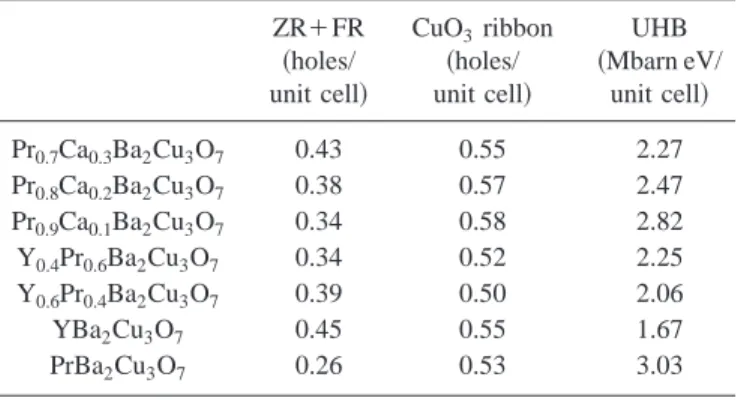
To quantify the results in Fig. 2共a兲 the spectral weight of the pre-edge peaks was analyzed by fitting with Gaussian functions. In order to define the peak widths for those three peaks, the results from related single crystals were referenced.13,25The energy shift of the UHB upon hole dop-ing was also taken into consideration. The obtained hole dis-tributions are consistent with those obtained from corre-sponding single crystals in the literature.13,25 The resultant hole distributions and the spectral weight of the UHB for several compounds are shown in Figs. 2共b兲–2共d兲, and listed in Table I. As noted from Fig. 2共b兲, hole carriers in the CuO3 ribbons remain almost unchanged with Ca substitution. Simi-lar results were observed in the Ca-doped Y123 system.13 FIG. 2. 共a兲 O K-edge x-ray absorption spectra of Pr1⫺xCaxBa2Cu3O7(x⫽0 – 0.3), together with
spectra of YBa2Cu3O7 and Y0.6Pr0.4Ba2Cu3O7
for comparison. Integrated cross section of the共b兲 CuO3ribbons,共b兲 ZR⫹FR states, and 共d兲 upper
Hubbard band共UHB兲 as a function of Ca doping
共x兲 in Pr1⫺xCaxBa2Cu3O7. The solid curves are
Accordingly, hole carriers induced by Ca doping in Pr1⫺xCaxBa2Cu3O7 are directed predominantly into the FR and ZR states 关Fig. 2共c兲兴 at the expense of the UHB 关Fig. 2共d兲兴. Based on the theoretical calculations in Ref. 8 and Table I, it is estimated that at least 30% of Ca-doped holes in Pr0.7Ca0.3Ba2Cu3O7 are introduced into FR states.
In Fig. 3, the O K-edge x-ray absorption spectra of
R0.8Pr0.2Ba2Cu3O7 for R⫽Tm, Dy, Gd, and Sm, are repro-duced. As shown, the spectral weight of the pre-edge peak at
⬃528.4 eV decreases monotonically with increasing ionic
size of the R3⫹ ions. In contrast, the peak intensity at
⬃527.8 eV, corresponding to hole carriers in the CuO3 rib-bons, is nearly the same for all of the samples.
Simulta-neously, an increase of the spectral weight in the UHB at
⬃529.5 eV is observed from smaller to larger ionic radii of
the rare-earth hosts (rSm⬎rGd⬎rDy⬎rTm). This confirms that hole carriers are reduced mainly from the ZR states, not from the FR states. From the Hall measurements in
R0.8Pr0.2Ba2Cu3O7, the Hall number共mobile hole兲 decreases roughly linearly with increasing the R3⫹ ionic radius at a constant temperature,28in accordance with the present obser-vation.
It has been demonstrated that the extent of the Pr 4 f – O 2 p hybridization in Pr-doped cuprates is deter-mined predominantly to the Pr-O共2,3兲 bond length as well as O共2,3兲-Pr-O共2,3兲 bond angle and the energy-level difference between the Fermi level EF and the Pr 4 f level (Ef).29–31
The larger ionic size of the R ions in RxPr1⫺xBa2Cu3O7 gives rise to strong steric effects, leading to a distortion of the local environment around the rare-earth ions. For ex-ample, x-ray-diffraction studies showed that an increase of
c-axis lattice constant from 11.689 Å for Tm0.8Pr0.2Ba2Cu3O7 to 11.746 Å for Sm0.8Pr0.2Ba2Cu3O7 is less than that of the ionic radius from 0.871 Å for Tm3⫹ to 0.964 Å for Sm3⫹共Ref. 32兲. This trend is generally valid for the whole series of R0.8Pr0.2Ba2Cu3O7.28The lattice thus un-dergoes a monotonic compression with a larger ionic radius of the rare-earth hosts. This implies that the separation between the Pr ions and CuO2planes in Sm0.8Pr0.2Ba2Cu3O7 is less than that in Tm0.8Pr0.2Ba2Cu3O7. It is thus expected that the hybridization between the Pr 4 f states and O 2 p orbitals in Sm0.8Pr0.2Ba2Cu3O7 is more pronounced than that in Tm0.8Pr0.2Ba2Cu3O7. This result may be associated with the increase of the Pr 4 f – O 2 p hybridization in
RxPr1⫺xBa2Cu3O7 with an enlargement of the R3⫹ ionic radius.
Based on the concept of the Pr-CuO2 hybridization, Liechtenstein and Mazin calculated the electronic structure of RxPr1⫺xBa2Cu3O7 using an ab initio local-density ap-proximation plus a Hubbard parameter and the Coulomb cor-relation in the Pr 4 f shell.33 They found that, in Pr123, an additional hole-depleting band forms, which crosses the Fermi level and consequently grabs the mobile holes from the ZR states. Upon doping different rare-earth elements in
RxPr1⫺xBa2Cu3O7, the position of this hole-depleting band shifts with the ionic size of the R3⫹ions. In other words, the energy of the hole-depleting band共or FR states兲 may depend on the extent of the Pr 4 f – O 2 p hybridization.34 Smaller ions on the R site in RxPr1⫺xBa2Cu3O7 reduce the extent of the Pr 4 f – O 2 p hybridization 共as discussed above兲, leading to the lowering in position of the hole-depletion band共or FR states兲 relative to the ZR band. Accordingly, for smaller R3⫹ ions in RxPr1⫺xBa2Cu3O7, the resultant hole depletion is mitigated and the hole content in the ZR states is higher. The monotonic reduction of hole numbers in the CuO2 planes with increasing ionic radius of the R3⫹ ions in
R0.8Pr0.2Ba2Cu3O7 provides clear evidence in support of hole-depletion effect based on the Pr 4 f – O 2 p hybridization.35,36Accordingly, the variations of the super-conducting properties in R0.8Pr0.2Ba2Cu3O7 may originate from the difference in the hybridization strength which is TABLE I. The normalized hole distributions and spectral weight
of the UHB for various related compounds. We fix the number of holes in Y123 to one as in Ref. 13.
ZR⫹FR 共holes/ unit cell兲 CuO3ribbon 共holes/ unit cell兲 UHB 共Mbarn eV/ unit cell兲 Pr0.7Ca0.3Ba2Cu3O7 0.43 0.55 2.27 Pr0.8Ca0.2Ba2Cu3O7 0.38 0.57 2.47 Pr0.9Ca0.1Ba2Cu3O7 0.34 0.58 2.82 Y0.4Pr0.6Ba2Cu3O7 0.34 0.52 2.25 Y0.6Pr0.4Ba2Cu3O7 0.39 0.50 2.06 YBa2Cu3O7 0.45 0.55 1.67 PrBa2Cu3O7 0.26 0.53 3.03
FIG. 3. O K-edge x-ray absorption spectra of R0.8Pr0.2Ba2Cu3O7
caused by the local structural changes associated with differ-ent ionic radius of the R ions. The presdiffer-ent results shed light on the origin of the ion size effect.
Our results also have implications on the recently reported superconductivity in Pr0.5Ca0.5Ba2Cu3O7 and the TSFZ Pr123 single crystals. It has been shown that Pr0.5Ca0.5Ba2Cu3O7 exhibits a Tc of ⬃52 K in the
ortho-rhombic phase, while it has a Tc⬃97 K in the tetragonal
phase.37As compared to the orthorhombic phase, the tetrag-onal Pr0.5Ca0.5Ba2Cu3O7 phase exhibits a longer c-axis lat-tice constant, which may reduce the extent of the Pr 4 f – O 2 p hybridization. Accordingly, more Ca-doped holes in the tetragonal Pr0.5Ca0.5Ba2Cu3O7phase are directed into the ZR states, which lead to a higher Tcvalue.
Further-more, it has been proposed that one possible mechanism for rendering the TSFZ Pr123 samples superconducting is due to Ba doping on the Pr sites.16The O K-edge absorption spectra of the Ba-rich Pr1⫺xBa2⫹xCu3O7 crystals show a slight in-crease of the hole carriers in the ZR states,26 similar to the results for Ca doping in Pr1⫺xCaxBa2Cu3O7 presented above. Correspondingly, the additional holes in the ZR states may induce the TSFZ Pr123 samples to become supercon-ducting. On the other hand, an anomalously long c-axis lat-tice constant for the structure of superconducting Pr123 was reported.15As demonstrated, the extent of the Pr-CuO2 hy-bridization is very sensitive to the local structural changes around the rare-earth hosts. The enlarged lattice in the TSFZ Pr123 samples gives rise to a longer Pr-CuO2 distance, as well as a smaller O共2,3兲-Pr-O共2,3兲 bond angle, and thus re-duces the extent of hybridization significantly. This might lead to the localized FR states being pushed below the Fermi
level, and accordingly to a transfer of the doped holes from the FR states back to the ZR states, generating a metallic and superconducting sample.
IV. CONCLUSION
We have studied the unoccupied states of some doped Pr-containing cuprates by O K-edge x-ray absorption spec-troscopy. In YxPr1⫺xBa2Cu3O7, hole numbers in the CuO2 planes decrease significantly with increasing Pr doping level, which are caused by the transfer of hole carriers from the ZR states to the localized FR states. Hole carriers generated via Ca doping in Pr1⫺xCaxBa2Cu3O7 are directed predominantly into both the ZR and FR states, while those in the CuO3 ribbons remain almost unchanged with Ca substitution. In
R0.8Pr0.2Ba2Cu3O7, the hole concentration in the CuO2 planes decreases monotonically with increasing ionic size of the R3⫹ ions, confirming the hole depletion effect arising from the hybridization of the O 2 p orbitals and Pr 4 fz(x2⫺y2) states. Although these measurements do not
con-stitute proof of FR states, the observations demonstrate clear evidence of their existence. The present XANES results help understand some recently controversial findings of Pr-doped cuprates and shed light on the origin of the ionic size effect.
ACKNOWLEDGMENTS
We thank the SRRC staff for their technical support. This work was supported by the SRRC and the National Science Council of the Republic of China 共Grant No. NSC 89-2113-M-213-013兲.
*Author to whom correspondence should be addressed
1L. Soderholm, K. Zhang, D. G. Hinks, M. A. Beno, J. D. Jor-gensen, C. U. Segre, and I. K. Schuller, Nature共London兲 328, 604共1987兲.
2W. Y. Guan, Y. H. Xu, S. R. Sheen, Y. C. Chen, J. Y. T. Wei, H. F. Lai, M. K. Wu, and J. C. Ho, Phys. Rev. B 49, 15 993共1994兲. 3K. Nehrke, M. W. Pieper, and T. Wolf, Phys. Rev. B 53, 229
共1996兲; K. Nehrke and M. W. Pieper, Phys. Rev. Lett. 76, 1936 共1996兲.
4J. J. Neumeier, T. Bjornholm, M. B. Maple, and I. K. Schuller, Phys. Rev. Lett. 63, 2516共1989兲.
5J. Fink, N. Nu¨cker, H. Romberg, M. Alexander, M. B. Maple, J. J. Neumeier, and J. W. Allen, Phys. Rev. B 42, 4823共1990兲. 6C. Infante, M. K. El Mousky, R. Dayal, M. Husain, S. A. Siddiqi,
and P. Ganguly, Physica C 167, 640共1990兲.
7J. L. Peng, P. Klavins, R. N. Shelton, H. B. Radousky, P. A. Hahn, and L. Bernardez, Phys. Rev. B 40, 4517共1989兲.
8R. Fehrenbacher and T. M. Rice, Phys. Rev. Lett. 70, 3471 共1993兲.
9J. B. Torrance and R. M. Metzger, Phys. Rev. Lett. 63, 1515 共1989兲.
10
A. P. Goncalves, I. C. Santos, E. B. Lopes, R. T. Henriques, and M. Almeida, Phys. Rev. B 37, 7476共1988兲.
11H. A. Blackstead and J. D. Dow, Phys. Rev. B 50, 10 350共1994兲. 12D. Khomskii, J. Supercond. 6, 69共1993兲.
13M. Merz, N. Nu¨cker, P. Schweiss, S. Schuppler, C. T. Chen, V.
Chakarian, J. Freeland, Y. D. Idzerda, M. Kla¨ser, G. Mu¨ller-Vogt, and Th. Wolf, Phys. Rev. Lett. 80, 5192共1998兲.
14
J. L. Tallon, C. Bernhard, H. Shaked, R. L. Hitterman, and J. D. Jorgensen, Phys. Rev. B 51, 12 911共1995兲.
15Z. Zou, J. Ye, K. Oka, and Y. Nishihara, Phys. Rev. Lett. 80, 1074 共1998兲.
16H. A. Blackstead, J. D. Dow, D. B. Chrisey, J. S. Horwitz, M. A. Black, P. J. McGinn, A. E. Klunzinger, and D. B. Pulling, Phys. Rev. B 54, 6122共1996兲.
17F. M. Araujo-Moreira, P. N. Lisboa-Filho, S. M. Zanetti, E. R. Leite, and W. A. Ortiz, Physica B 284–288, 1033共2000兲. 18I. I. Mazin, Phys. Rev. B 60, 92共1999兲.
19J. Fink, N. Nu¨cker, E. Pellegrin, H. Romberg, M. Alexander, and M. Knupfer, J. Electron Spectrosc. Relat. Phenom. 66, 395 共1994兲.
20C. T. Chen, F. Sette, Y. Ma, M. S. Hybertsen, E. B. Stechel, W. M. C. Foulkes, M. Schluter, S. W. Cheong, A. S. Cooper, L. W. Rupp, Jr., B. Batlogg, Y. L. Soo, Z. H. Ming, A. Krol, and Y. H. Kao, Phys. Rev. Lett. 66, 104共1991兲.
21H. D. Yang, P. F. Chen, C. R. Hsu, C. W. Lee, C. L. Li, and C. C. Peng, Phys. Rev. B 43, 10 568共1989兲.
22
I. P. Hong, Y. J. Lin, J. M. Chen, S. Chatterjee, S. J. Lin, and H. D. Yang, Europhys. Lett. 58, 126共2002兲.
23N. Nu¨cker, E. Pellegrin, P. Schweiss, J. Fink, S. L. Molodtsov, C. T. Simmons, G. Kaindl, W. Frentrup, A. Erb, and G. Mu¨ller-Vogt, Phys. Rev. B 51, 8529共1995兲.
24Z. Hu, R. Meier, C. Schu¨ßbler-Langeheine, E. Weschke, G. Kaindl, I. Felner, M. Merz, N. Nu¨cker, S. Schuppler, and A. Erb, Phys. Rev. B 60, 1460共1999兲.
25
M. Merz, N. Nu¨cker, E. Pellegrin, P. Schweiss, S. Schuppler, M. Kielwein, M. Knupfer, M. S. Golden, J. Fink, C. T. Chen, V. Chakarian, Y. U. Idzerda, and A. Erb, Phys. Rev. B 55, 9160 共1997兲.
26M. Merz, S. Gerhold, N. Nu¨cker, C. A. Kuntscher, B. Burbulla, P. Schweiss, S. Schuppler, V. Chakarian, J. Freeland, Y. U. Idzerda, M. Kla¨ser, G. Mu¨ller-Vogt, and Th. Wolf, Phys. Rev. B 60, 9317 共1999兲.
27U. Staub, L. Soderholm, S. R. Wasserman, A. G. O. Conner, M. J. Kramer, B. D. Patterson, M. Shi, and M. Knapp, Phys. Rev. B 61, 1548共2000兲.
28J. C. Chen, Y. Xu, M. K. Wu, and W. Guan, Phys. Rev. B 53, 5839共1996兲.
29H. M. Luo, B. N. Lin, Y. H. Lin, H. C. Chiang, Y. Y. Hsu, T. I. Hsu, T. J. Lee, H. C. Ku, C. H. Lin, H.-C. I. Kao, J. B. Shi, J. C.
Ho, C. H. Chang, S. R. Hwang, and W.-H. Li, Phys. Rev. B 61, 14 825共2000兲.
30M. Muroi and R. Street, Physica C 301, 277共1998兲.
31J. J. Neumeier, M. B. Maple, and M. S. Torikachcili, Physica C 156, 574共1988兲.
32Handbook of Chemistry and Physics of Rare Earths, edited by K. A. Gschneider and LeRoy Eyring共North-Holland, Amsterdam, 1979兲, Vol. 2, p. 22.
33A. I. Liechtenstein and I. I. Mazin, Phys. Rev. Lett. 74, 1000 共1995兲.
34
G. Cao, H. Song, and Q. Zhang, Physica C 282–287, 761共1997兲. 35J. M. Chen, P. Nachimuthu, J. Y. Lin, I. P. Hong, C. F. Chang, and
H. D. Yang, Chem. Phys. Lett. 337, 85共2001兲.
36J. M. Chen, R. S. Liu, M. J. Kramer, K. W. Dennis, and R. W. McCallum, Chem. Phys. Lett. 294, 209共1998兲.
37Y. S. Yao, Y. F. Xiong, J. W. Li, F. Wu, Z. X. Zhao, D. Jin, and J. L. Luo, Physica C 282–287, 49共1997兲.