
A High-Payload Image Hiding Method Using Two-Way Block Matching
6
0
0
全文
(2) military and commercial applications, a large amount of communication by a site tends to expose its position and value. Moreover, due to physical constraints and security concerns, the bandwidth of a communication channel where stego-images are used tends to be low. In this paper, we develop an image hiding method from the viewpoint of first considering the payload parameter. The proposed method applies a block-matching procedure to search for the highest-similarity block from a series of numbered candidate blocks generated from the cover image, and embeds the indexing information in imperceptible areas of the cover image. Owing to the resulting smaller size of the stego-image, this method makes the important image more secure.. II. STEGANOGRAPHIC SCHEME A two-way block-matching scheme is proposed to embed a relatively large important image into a relatively small cover image. In the proposed method, the entire important image is first divided into multiple image blocks, and each block is represented using two base-difference forms: an {odd_base + odd_difference} form and a {even_base + even_difference} form. For each block, we search for the odd difference block with the highest similarity from a set of numbered odd candidate blocks, and for the even difference block with the highest similarity from a set of numbered even candidate blocks. The best-matching block is defined as the highest-similarity odd difference block if the distance between the odd_difference and its corresponding highest-similarity odd difference block is smaller than the distance between the even_difference and its corresponding highest-similarity even difference block, and as the highest-similarity even difference block otherwise. Finally, the odd_base (or even_base) and its best-matching index of each important block are recorded in the LSB planes of the cover image using a hop embedding scheme. The proposed method is detailed below. Consider an important image IM of size hIM wIM , and a cover image CO of size hCO wCO , where both CO and IM are k-bit images. Our aim is to embed IM in the q (2 or 3) LSB planes of CO. We divide the important image into multiple nonoverlapping blocks of size m n . Without loss of generality, for the r-th block Br {b11 , b12 ,..., bmn } with block mean r , the odd/even base OBr / EBr of Br is defined to be the corresponding odd/even integer closest to r , respectively. Br can be represented using a base-difference form:. OB ODIFFr , or Br r EBr EDIFFr ,. (1). ODIFFr {odiff ij } {bij OBr }, 1 i m, 1 j n, EDIFFr {ediff ij } {bij EBr }, 1 i m, 1 j n. . (2). Where. In the base-difference form, we search for the index oind r of the highest-similarity block of. ODIFFr. by. comparing. it. with. 2 t 1. odd. candidate blocks {OCand1 , OCand 2 ,, OCand 2t 1 } . Similarly, the index eind r of the highest-similarity block of EDIFFr is evaluated by comparing it with. 2 t 1. even candidate {ECand1 , ECand 2 ,, ECand 2t 1 } :. oind r arg min{Dist (ODIFFr , OCand j )}, j t 0 j 2 1, eind r arg min{Dist ( EDIFFr , ECand j )}, j t 0 j 2 1. . blocks. (3). The distance measure between two blocks in this paper is. 1 Dist ( P, S ) ( pij s ij ) 2 , m n 1i m , 1j n. (4). where pij and sij are pixels in blocks P and S, respectively. The best base-difference representation of Br is then evaluated using. OBr OCand oind r if Dist(OB r OCand oind r ,Br ) Br Dist(EB r ECand eind r , B r ), EB ECand otherwise. eind r r. (5). The following procedure is applied to generate the 2 t 1 odd/even candidate blocks. A candidate image CAND is generated by replacing the q LSB planes of CO with its (q+1)-to-2q LSB planes. We.
(3) repeatedly take an m n block, say D {d 11 , d 12 ,..., d mn } with block mean D , from CAND sequentially, and generate two difference blocks PD( D ) { pd ij } and ND( D ) {nd ij } from D using. pd ij d ij D , 1 i m, 1 j n,. (6). nd ij D d ij , 1 i m, 1 j n.. (7). If the distances between the current generated PD(D)/ND(D) and z (a user-defined threshold) previous built odd/even candidate blocks are all greater than a threshold , the current generated PD(D)/ND(D) is assigned to be a new odd/even candidate block. The above process repeats until 2 t 1 odd/even candidate blocks are generated. Note that if the current scan on CAND is insufficient to generate the desired 2 t 1 odd/even candidate blocks, the pixels of CAND are circular shifted right/down one pixel, and the shifted CAND is scanned to continue the generation of the odd/even candidate blocks. The block-matching method described above determines the most-similar block for each important image block, but the error between an important image block and its best-matching block may still be sufficiently large to cause serious degradation to the important image. To reduce the degradation, some not-well-matched blocks are embedded directly in the cover image. Since the total storage of the q LSB planes of CO is q hCO wCO bits, and the block bases and indexes occupy ( k t ) (hIM wIM ) /(m n ) bits, the remaining space in the q LSB planes that can be used to hold those not-well-matched blocks is q hCO wCO ( k t ) ( hIM wIM ) /(m n ) bits. Each block occupies m n k bits, and hence the number of not-well-matched blocks that can be embedded is. q hCO wCO ( k t ) (hIM wIM ) /(m n ) . (8) m n k After determining the number of not-well-matched blocks that should be embedded in the cover image, the important image blocks with the largest errors between them and their respective best-matching blocks are embedded directly in CO with their best-matching indexes set to 2 t 1 . To reduce the amount of data to be hidden in CO, the bases, indexes, and not-well-matched blocks are encoded using a Huffman coding scheme.. Finally, we embed parameters hIM , wIM , k, q, t, z, m, n, and , the Huffman table, and the Huffman coding output stream in the q LSBs of CO using the following three-pass-hop embedding scheme in order to scatter the data over the LSBs and further increase the security of the embedded data. The three-pass-hop embedding scheme uses a pseudorandom number sequence r1 , r2 ,, rhCO wCO ,. 0 ri q for i 1, 2,..., hCO wCO , in the embedding process. The pixels of the cover image is scanned from left to right, and from top to bottom in each pass. In the first pass, we sequentially take ri , i 1, 2,..., hCO wCO , bits of the important data and embed them in the ri ( 0, 1,..., ri 1 ) LSBs of the i-th pixel of the cover image. In the second pass, if ri mod 2 1 , q ri bits of important data are fetched. and. embedded. in. the. q ri. ( ri , ri 1 ,...,[ q 1] ) not-yet-embedded LSBs of the i-th pixel of the cover image; otherwise, the pixel is skipped. If there are still important data to be embedded at the end of the second pass, the remaining bits are sequentially embedded in these unused q LSBs of the cover image by a third pass. The following steps are applied to extract the important image from the stego-image: 1. Extract parameters hIM , wIM , k, q, t, z, m, n, and , and the Huffman table, and apply the inverse hop scheme to extract the Huffman codes from the LSBs of the stego-image. 2. Decode the Huffman codes to obtain the block bases and indexes, and not-well-matched blocks. 3. Applying the candidate-block-generating procedure presented in the embedding process to generate 2 t 1 odd candidate blocks and 2 t 1 even candidate blocks from the stego-image instead of the cover image. 4. Repeat taking the next sequential index, say ind i , that is not yet processed, and execute the following substeps until the entire important image is extracted: 3a. If ind i 2 t 1 and the corresponding base baseindi is odd, add the ind i -th odd candidate block to baseindi. and. assign it to a new block of the important image. 3b. If ind i 2 t 1 and the corresponding base baseindi is even, add the ind i -th even candidate block to baseindi. and. assign it to a new block of the important.
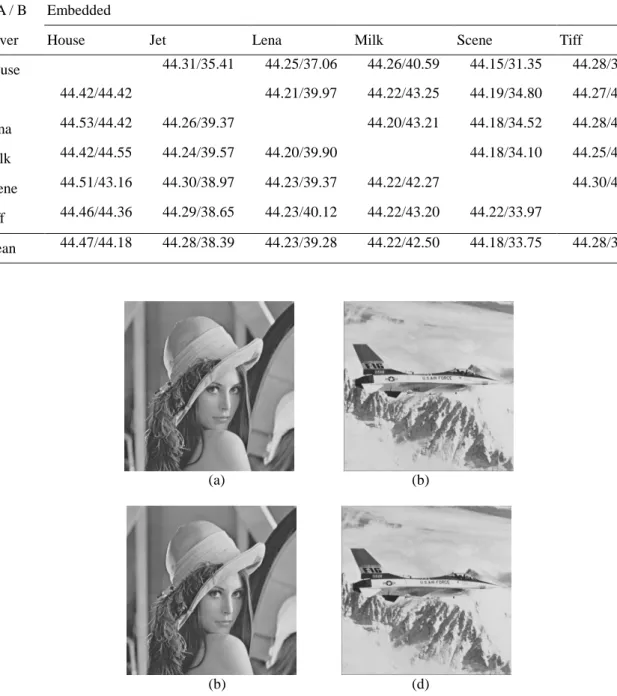
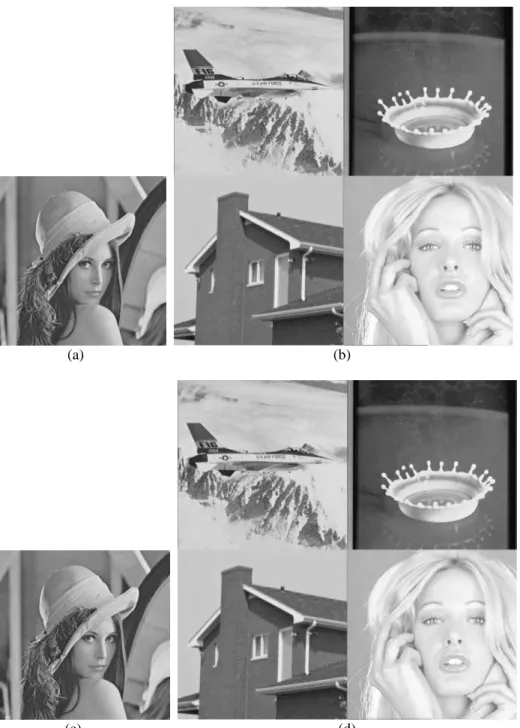
(4) image. 3c. If ind i 2 t 1 , take the next not-well-matched block and used it as the reconstructed block for the current position of the important image. Note that in steps 3a and 3b, reconstructed pixels greater than 255 and less than 0 are set to 255 and 0, respectively.. III. EXPERIMENTAL RESULTS Two experiments were conducted to test the efficacy of the method described in this paper. In the first experiment, we hid an important image in a cover image of the same size using the following parameters: q 2 , t 16 , z = 3, 32 , and a block size of 4 4 . Figure 1 shows an example of this test using the cover image “ Lena”( Fi g .1( a ) )and the important image “ Jet”( Fi g .1( b)), both of which are of size 512 512 pixels. The stego-image and the extracted important image are shown in Fig. 1(c) and 1(d), respectively. The peak signal-to-noise ratio (PSNR) between Fig. 1(a) and 1(c) is 44.22 dB, and between Fig. 1(b) and 1(d) it is 39.36 dB. From Fig. 1(c), we can see that the quality of the stego-image is high, and unintended observers will not be aware of the existence of the hidden important image. Indeed, it is impossible to distinguish between Fig. 1(c) and 1(a) or between Fig. 1(d) and 1(b) using the naked eye, which indicates that the value and normal usage of the important image are preserved. Table 1 summarizes the PSNR values of this experiment. The high values of the PSNR indicate that both the stego-image and the extracted important image are of acceptable quality. In the second experiment, we attempted to hide an important image that was four times larger than the cover image using the following parameters: q 3 , t 16 , z = 3, 32 , and a block size of. 4 8 . Figure 2 shows the results of this experiment, where Fig. 2(a) is the cover image “ Lena”of size 512 512 pixels, and Fig. 2(b) is the important image of size 1024 1024 pixels generated by tiling four images together into a single image. The stego-image and the extracted image are shown in Fig. 2(c) and 2(d), respectively. The PSNR between Fig. 2(a) and 2(c) is 37.93 dB, and between Fig. 2(b) and 2(d) it is 32.41 dB. In this high-payload embedding test, we can see that both the stego-image and the extracted image are still of high quality, and. would be considered applications.. acceptable. in. many. IV. CONCLUSION This paper presents a high-payload image hiding method. Carefully design of the two-way block-matching procedure and the hop embedding scheme has resulted in both the stego-image and extracted important image being of high quality. The high hiding capacity enables users to send relatively large secret images in an environment where the size of the cover image is relatively small. For example, photographers who work in enemy areas could use this method to hide spy photographs in incurious landscape photographs, and transfer these stego-photographs in a more secure and efficient way.. REFERENCES [1]. [2]. [3]. [4]. [5]. [6]. [7]. [8]. W. Bender, D. Gruhl, N. Morimoto, and A. Liu, “ Techniques for data hiding,”IBM Syst. J., vol. 35, pp. 313–336, 1996. L. M. Marvel, C. G. Boncenet, Jr., and C. T. Retter, “ Spread spectrum image hiding,”IEEE Trans. Image Process., vol. 8, pp. 1075– 1083, 1999. F. A. P. Petitcolas, R. J. Anderson, and M. G. Kuhn, “ Information hiding—a survey,”Proc. IEEE, vol. 87, pp. 1062–1078, 1999. R. Z. Wang, C. F. Lin, and J. C. Lin, “ Image hiding by optimal LSB substitution and genetic algorithm,” Pattern Recognit., vol. 34, pp. 671–683, 2001. C. C. Thien and J. C. Lin, “ A simple and high-hiding capacity method for hiding digit-by-digit data in images based on modulus function,” Pattern Recognit., vol. 36, pp. 2875–2881, 2003. C. K. Chan and L. M. Cheng, “ Hiding data in images by simple LSB substitution,”Pattern Recognit., vol. 37, pp. 469–474, 2004. Y. K. Lee and L. H. Cheng, “ High capacity image steganographic model,” IEE Proc. Vision, Image, and Signal Process., vol. 16, pp. 288–294, 2000. X. Zhang and S. Wang, “ Hiding using multiple-base notational system and human vision sensitivity,”IEEE Signal Process. Lett., vol. 12, pp. 67–70, 2005..
(5) Table 1. The PSNR (A) between the stego-image and cover image and (B) between the extracted important image and original important image, in the first experiment. (unit: dB) A/ B Cover. Embedded House. Jet. Lena. 44.31/35.41. House. Milk. Scene. Tiff. 44.25/37.06. 44.26/40.59. 44.15/31.35. 44.28/37.93. 44.21/39.97. 44.22/43.25. 44.19/34.80. 44.27/40.32. 44.20/43.21. 44.18/34.52. 44.28/40.77. 44.18/34.10. 44.25/40.38. Jet. 44.42/44.42. Lena. 44.53/44.42. 44.26/39.37. Milk. 44.42/44.55. 44.24/39.57. 44.20/39.90. Scene. 44.51/43.16. 44.30/38.97. 44.23/39.37. 44.22/42.27. Tiff. 44.46/44.36. 44.29/38.65. 44.23/40.12. 44.22/43.20. 44.22/33.97. Mean. 44.47/44.18. 44.28/38.39. 44.23/39.28. 44.22/42.50. 44.18/33.75. (a). (b). (b). (d). 44.30/40.02. 44.28/39.88. Fig. 1. An example of hiding an important image in a cover image of the same size: (a) cover image, (b) important image, (c) stego-image, (d) extracted important image..
(6) (a). (c). (b). (d). Fig. 2. An example of hiding an important image that is four times larger than the cover image: (a) cover image, (b) important image, (c) stego-image, (d) extracted important image..
(7)
數據
相關文件
The TRG consists of two components: a basic component which is an annual recurrent cash grant provided to schools for the appointment of supply teachers to cover approved
According to the Heisenberg uncertainty principle, if the observed region has size L, an estimate of an individual Fourier mode with wavevector q will be a weighted average of
Heal the World Michael Jackson You Raise Me Up Secret Garden Climb Every Mountain Rodgers & Hammerstein You are My Hiding Place Selah. God Will Make a Way
(It is also acceptable to have either just an image region or just a text region.) The layout and ordering of the slides is specified in a language called SMIL.. SMIL is covered in
Milk and cream, in powder, granule or other solid form, of a fat content, by weight, exceeding 1.5%, not containing added sugar or other sweetening matter.
In this research, we use conventional RGB (Red, Green, Blue) images as input data. The conventional RGB image is demosaiced from raw image by using the color interpolation
First, we discuss practical use of SVM as an example to see how users apply a machine learning method Second, we discuss design considerations for a good machine learning package..
T transforms S into a region R in the xy-plane called the image of S, consisting of the images of all points in S.... So we begin by finding the images of the sides
