Hydrogenic impurity in multilayered quantum wires
Cheng-Ying Hsieh and Der-San Chuu
Citation: Journal of Applied Physics 89, 2241 (2001); doi: 10.1063/1.1326467
View online: http://dx.doi.org/10.1063/1.1326467
View Table of Contents: http://scitation.aip.org/content/aip/journal/jap/89/4?ver=pdfcov
Published by the AIP Publishing
Articles you may be interested in
Off-center donor impurity in multilayered quantum wires
J. Appl. Phys. 91, 2326 (2002); 10.1063/1.1433186
Electron-confined longitudinal optical phonon interaction and strong magnetic field effects on the binding energy in GaAs quantum wells
J. Appl. Phys. 91, 2093 (2002); 10.1063/1.1430532
The effect of a spatially dependent effective mass on hydrogenic impurity binding energy in a finite parabolic quantum well with a magnetic field
J. Appl. Phys. 88, 2588 (2000); 10.1063/1.1286244
Electric field effects on the states of a donor impurity in rectangular cross-section vacuum/GaAs/vacuum quantum-well wires
J. Appl. Phys. 84, 1421 (1998); 10.1063/1.368176
The binding energies of shallow donor impurities in GaAs quantum-well wires under applied electric fields
J. Appl. Phys. 81, 7890 (1997); 10.1063/1.365362
Hydrogenic impurity in multilayered quantum wires
Cheng-Ying Hsieh and Der-San Chuua)
Deh Yu College of Nursing and Management, Keelung 203, Taiwan and Department of Electrophysics, National Chiao Tung University, Hsinchu 300, Taiwan
共Received 9 May 2000; accepted for publication 25 September 2000兲
The binding energy of the ground state of a hydrogenic impurity located at the center of a multilayered quantum wire 共MLQW兲 is studied within the framework of the effective-mass approximation. The MLQW consists of a core wire 共GaAs兲 coated by a cylindrical shell (Ga1⫺xAlxAs) and then embedded in the bulk (Ga1⫺yAlyAs). The calculation was performed by
using a trial wave function. To make a comparison, the ground and excited states (1s, 2 p, and 3d states兲 binding energies of a hydrogenic impurity located at the center of a single-layered quantum wire共QW兲 are also calculated. It is found for small wire radius, the ground-state binding energy of the hydrogenic impurity located at the center of a MLQW behaves very differently from that of a single-layered QW. © 2001 American Institute of Physics. 关DOI: 10.1063/1.1326467兴
I. INTRODUCTION
The progress in epitaxial growth and microfabrication techniques in recent years has motivated studies of low-dimensional semiconductor structures such as two-dimensional quantum wells 共QWs兲, one-dimensional quantum-well wires 共QWWs兲, and zero-dimensional quan-tum dots共QDs兲.1–8Since Bastard’s9pioneering works in the study of the binding energy of a hydrogenic impurity within an infinite potential-well structure, many theoretical works have been devoted to the study of the properties of impurity states in various confining systems.9–25 The binding energy of the ground state of a hydrogenic impurity Eb in D
dimen-sion is given by26Eb⫽关2/D⫺1兴2Ry, where Ry is the
effec-tive Rydberg. The physical properties of electrons in quan-tum wires are very different from those in the bulk. As a consequence of the confinement, energy levels are discrete. The existence of these atomic-like states may be utilized in future lasers where laser properties can be tailored by proper choices of well and barrier materials as well as size and shape of the wire.27,28The change in impurity binding ener-gies due to the confinement effect has been observed in photoluminescence15,29–31 and Raman-scattering32,33 experi-ments on the impurities in the quantum wells.
Recently, GaAs-Ga1⫺xAlxAs structures have been the
subject of research for the following technological reasons:34
共1兲 GaAs and Ga1⫺xAlxAs both possess a direct-gap band
structure, 共2兲 single-crystal heterostructures of GaAs and Ga1⫺xAlxAs are possible because the lattice constants of
GaAs and Ga1⫺xAlxAs are nearly identical, so that they are
closely lattice matched, and, therefore, 共3兲 abrupt spatial transitions in the energy gap are possible. However, in all of previous calculations it has been assumed that the Ga1⫺xAlxAs layers are thick enough to confine the wave
functions so that they do not leak out the wells. But super-lattices were made with layer thickness ranging from a few monolayers to about 400 Å. And most attention has been
focused on systems with aluminum concentration x of Ga1⫺xAlxAs less than 0.45. In this concentration range the
band gap is direct at the ⌫ point. The spreading of the im-purity envelope wave functions depends on the potential bar-rier height as well as the barbar-rier thickness. Thus, the previous calculations with single-layered approximation are not ad-equate for thin supperlattices, or even for moderately thick superlattices but with small aluminum concentration. The first attempt to use more than a single quantum well was done by Chaudhuri,35 who used three quantum wells in his variational calculation of the ground-state energy of the do-nor electron with respect to the lowest subband level. Lane and Greene36calculated the binding energies and probability distributions of shallow donor states in multiple-well GaAs-Ga1⫺xAlxAs heterostructure. Many authors37–40 used colloidal chemistry techniques and wet chemistry to prepare the CdS/HgS/CdS multiple well in which a shell of HgS is embedded in a CdS quantum dot, forming a ‘‘quantum-dot quantum well’’共QDQW兲. The homogeneous absorption and fluorescence spectra of the QDQW were investigated. Nu-merous studies on organic light-emitting diodes共LEDs兲 have used these structures as the emitting and charge-transport species.41–43 In this work, we calculate the ground-state binding energy of the hydrogenic impurity located at the center of the multilayered quantum wire by using the effective-mass approximation. Our system is constructed as a core wire made of GaAs surrounded by a cylinder shell of Ga1⫺xAlxAs and then embedded in the bulk of Ga1⫺yAlyAs.
The barrier height V between GaAs and Ga1⫺xAlxAs can be obtained44 as 0.8729x eV from a fixed ratio Q⫽0.7 of the band-gap discontinuity ⌬Eg⫽1.247x eV. In this article, the
effective atomic units are used so that all energies are mea-sured in the units of the effective Rydberg共Ry兲 and all dis-tances are measured in the units of effective Bohr radius a0*. The Ry and a0* can be determined by e4/2ប22 and
ប2/e2, where and are the electronic effective mass and the dielectric constant of GaAs material which are equal to 0.067meand 13.18, respectively. And Ry and a0*are equal to 5.2 meV and 104 Å, respectively. In this work, the effective-mass difference between GaAs and Ga1⫺xAlxAs
a兲Author to whom correspondence should be addressed; electronic mail:
2241
0021-8979/2001/89(4)/2241/5/$18.00 © 2001 American Institute of Physics [This article is copyrighted as indicated in the article. Reuse of AIP content is subject to the terms at: http://scitation.aip.org/termsconditions. Downloaded to ] IP:
material has been ignored. The polarization and image charge effects may be significant in the multilayered system if there is a large dielectric discontinuity between the core wire and the surrounding medium. However, this is not the case for the GaAs–Ga1⫺xAlxAs system共the dielectric
con-stant of Ga1⫺xAlxAs is 13.18⫺3.12x). Thus, they are safely
to be ignored.
Brown and Spector10have calculated the single-layered quantum wire with their trial function and many authors have employed their trial function in the calculations. But the trial function of Brown is only suitable for the single-layered quantum wire and ground state. Bryant13 has calculated 1s, 2 p-state binding energies by the variational method in the single-layered quantum wire. However, the result of Bryant does not agree with the limiting value in some cases. In this article, we calculate the ground-state binding energy of an impurity located at the center of a multilayered quantum wire
共MLQW兲, and the ground- and excited-state binding energies
of an impurity located at the center of a single-layered quan-tum wire. We proposed a trial function which is modified from the result of Brown and Spector. Our calculation shows that the state energies we obtained are in better agreement with the correct limiting values in some special cases than the previous results.
II. THEORY
The Hamiltonian of a hydrogenic impurity located at the center of the MLQW is written as
H⫽⫺ ប 2 2ⵜ 2⫺ e 2 共2⫹z2兲1/2⫹V共兲, 共1兲 where V共兲⫽
再
0 , if⬍a 共GaAs兲, V2, if a⭐⬍b 共Ga1⫺xAlxAs兲, V3, if⭓b 共Ga1⫺yAlyAs兲, 共2兲assuming the trial function of the eigenstates of the Hamil-tonian in the absence of impurity is in the following form:
⌿1共,,z兲⫽N1Jl共␣nl兲n⫺1eikzeil, if⬎a, ⌿2共,,z兲⫽关N21Il共nl兲⫹N22Kl共nl兲兴n⫺1eikzeil, if a⭐⬍b, 共3兲 ⌿3共,,z兲⫽N3Kl共␥nl兲n⫺1eikzeil, if⭓b, where ␣nl⫽
冑
2Enlk ប2 ⫺k 2, 共4兲 nl⫽冑
2共V2⫺Enlk兲 ប2 ⫺k 2⫽冑
V 2⫺␣nl 2 , 共5兲 ␥nl⫽冑
2共V3⫺Enlk兲 ប2 ⫺k 2⫽冑
V 3⫺␣nl 2 , 共6兲and Jlis an ordinary Bessel function of order l, and Iland Kl
are the modified Bessel functions of the first and second kind, respectively, of order l. Since the wave functions must be continuous at ⫽a and⫽b, then, the relations of N1,
N21, N22, and N3 can be obtained as
N1⫽N21Il共
冑
V2⫺␣nl 2a兲⫹N 22Kl共冑
V2⫺␣nl 2a兲 Jl共␣nla兲 , 共7兲 N3⫽ N21Il共冑
V2⫺␣nl 2 b兲⫹N22Kl共冑
V2⫺␣nl 2 b兲 Kl共␣nlb兲 . 共8兲If we set N22⫽N and N21⫽NN2, then the wave function becomes ⌿1共兲⫽N N2Il共
冑
V2⫺␣nl 2 a兲⫹Kl共冑
V2⫺␣nl 2 a兲 Jl共␣nla兲 ⫻n⫺1J l共␣nl兲, ⌿2共兲⫽N关N2Il共冑
V2⫺␣nl 2兲⫹K l共冑
V2⫺␣nl 2兲兴n⫺1, 共9兲 ⌿3共兲⫽N N2Il共冑
V2⫺␣nl 2 b兲⫹Kl共冑
V2⫺␣nl 2 b兲 Kl共冑
V3⫺␣nl2b兲 ⫻Kl共冑
V3⫺␣nl 2兲n⫺1.Furthermore, the derivative of the wave function is continu-ous at⫽a, thus,
N2⫽Kl
⬘
共冑
V2⫺␣nl 2a兲J l共␣nla兲⫺Kl共冑
V2⫺␣nl 2a兲J l⬘
共␣nla兲 Il共冑
V2⫺␣nl 2a兲J l⬘
共␣nla兲⫺Il⬘
共冑
V2⫺␣nl2a兲Jl共␣nla兲 . 共10兲And the trial function of the eigenstates of the impurity sys-tem can then be assumed as
⌿i1共兲⫽N
冋
Kl⬘
共冑
V2⫺␣nl 2 a兲Jl共␣nla兲⫺Kl共冑
V2⫺␣nl 2 a兲Jl⬘
共␣nla兲 Il共冑
V2⫺␣nl 2 a兲Jl⬘
共␣nla兲⫺Il⬘
共冑
V2⫺␣nl 2 a兲Jl共␣nla兲 Il共冑
V2⫺␣nl2a兲⫹Kl共冑
V2⫺␣nl2a兲册
⫻Jl共␣nl兲 Jl共␣nla兲 n⫺1e⫺冑2⫹z2, 共11兲 ⌿i2共兲⫽N冋
Kl⬘
共冑
V2⫺␣nl 2 a兲Jl共␣nla兲⫺Kl共冑
V2⫺␣nl 2 a兲Jl⬘
共␣nla兲 Il共冑
V2⫺␣nl 2 a兲Jl⬘
共␣nla兲⫺Il⬘
共冑
V2⫺␣nl 2 a兲Jl共␣nla兲 Il共冑
V2⫺␣nl 2 兲⫹Kl共冑
V2⫺␣nl 2 兲册
n⫺1e⫺冑2⫹z2, 共12兲2242 J. Appl. Phys., Vol. 89, No. 4, 15 February 2001 C.-Y. Hsieh and D.-S. Chuu
⌿i3共兲⫽N
冋
Kl⬘
共冑
V2⫺␣nl 2 a兲Jl共␣nla兲⫺Kl共冑
V2⫺␣nl 2 a兲Jl⬘
共␣nla兲 Il共冑
V2⫺␣nl 2 a兲Jl⬘
共␣nla兲⫺Il⬘
共冑
V2⫺␣nl 2 a兲Jl共␣nla兲 Il共冑
V2⫺␣nl2b兲⫹Kl共冑
V2⫺␣nl 2b兲册
⫻Kl共冑
V3⫺␣nl 2兲 Kl共冑
V3⫺␣nl 2 b兲 n⫺1e⫺冑2⫹z2, 共13兲where N is the normalization constant, and␣nlis the nth root
satisfying the boundary condition
⌿2共兲
冏
⫽b⫽ ⌿3共r兲 冏
⫽b, 共14兲 and N⫺2⫽⫺d共G⫹H⫹M 兲 d , 共15兲 with G⫽冕
0 a ⌿1 2 共兲K0共2兲d, 共16兲 H⫽冕
a b ⌿2 2共 兲K0共2兲d, 共17兲 M⫽冕
b ⬁ ⌿3 2共 兲K0共2兲d. 共18兲The binding energy Eb of the hydrogenic impurity is defined
conventionally, as the energy difference between the energy of the system without the impurity and the energy of the system with the impurity; i.e.,
Eb⫽⫺2⫺
4共G⫹H⫹M 兲
d共G⫹H⫹M 兲
d
. 共19兲
In Eq. 共19兲 the energy and length are expressed in Rydberg and Bohr radius of the wire material, respectively. For the single-layered quantum-wire model, it is only to set a⫽b and V2⫽V3.
III. RESULTS AND DISCUSSIONS
To make a comparison, we first set V2⫽V3⫽V, which is equivalent to considering the case of a single-layer quantum wire. If one plots the probability density兩⌿(r,z)兩2 of lower-lying states of a hydrogenic impurity located at the center of a single-layered GaAs quantum wire surrounded by Ga1⫺xAlxAs with x⫽0.1, the results will show that only the
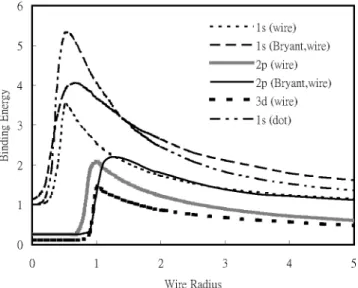
probability density of the 1s state is almost concentrated in the well with radius兩a兩⫽1a0*. The leakage probability den-sity is increased as n increases, where n is the principal quan-tum number. This shows that the leaking effect is prominent for the large principal quantum number for a fixed wire ra-dius. Figure 1 shows the calculated binding energy of 1s, 2 p, and 3d states with x⫽0.1. For comparison, the previous result of Bryant13 is also presented together. One can note that for a single-layered quantum wire with very large wire
radius, the impurity behaves just like a three-dimensional free-hydrogen atom, thus its level energies of a hydrogenic impurity will approach the three-dimensional value (1/n2) Ry. If the wire radius decreases, the confinement effect en-hances the binding energy more prominently. Thus, the bind-ing energy of the impurity increases monotonically with the wire radius. However, as the wire radius is further decreased, the state energy of the impurity may become higher than the confining barrier. Meanwhile, the kinetic energy of the con-fined electron becomes larger by the uncertainty principle, and thus increases the probability of the electron leaking out-side the well. The electron behaves like a three-dimensional
共3D兲 electron after a certain characteristic wire radius and is
only weakly perturbed by the potential well. Therefore, the level energies resume (1/n2) Ry again. Our results show some discrepancies from that of Bryant.13 However, our re-sults are more consistent with the correct limiting value as the radius approaches zero or infinity. Thus, our results are better than that of Bryant and agree better with the corre-sponding value of a free atom in 3D. The binding energy of 2 p state obtained by Bryant approaches 1 Ry as the radius approaches infinity, which disagrees with the corresponding value of a free atom in the case of 3D. In Fig. 1, we also compare the confinement of the wire and dot,45 and our re-sult shows the confinement in the QD is stronger. We also calculate the 1s-, 2 p-, 3d-state binding energies of the hy-drogenic impurity in the quantum wire with infinite potential barriers. The binding energies were found to approach the corresponding limiting values关(1/n2) Ry兴 of a free atom in 3D as the wire radius approaches infinity. As the radius de-creases from infinity, the binding energies increase and ap-proach infinity, which agrees with the previous results.17,18
Figure 2 shows the ground-state binding energy of a hy-drogenic impurity located at the center of a multilayered quantum wire (GaAs-Ga1⫺xAlxAs-Ga1⫺yAlyAs) as a func-tion of core wire radius for different shell thicknesses with the Al concentration x⫽0.2, y⫽0.1. In Fig. 2, the curve of
b⫺a⫽⬁ is the same as the case of the single-layered
quan-tum wire with the Al concentration x⫽0.1. Comparing the case of the single-layered QW with the multilayered QW, one can find that their binding energies are very different for small wire radius. This is due to the different leakage prob-ability of the electron in the single-layered and multilayered QWS. For a small single-layered QW, the electron leaks to the barrier (Ga1⫺xAlxAs), and the impurity atom behaves
just like a free-hydrogen atom, thus, the binding energy ap-proaches 1 Ry. For the MLQW, the electron tunnels to the bulk region (Ga1⫺yAlyAs) and still behaves like a confined
electron as the core radius approaches zero. Figure 3 shows [This article is copyrighted as indicated in the article. Reuse of AIP content is subject to the terms at: http://scitation.aip.org/termsconditions. Downloaded to ] IP:
the binding energy decreases from 1 to 0 Ry as the total wire radius is increased. This is because the distance between the ion and the electron is increased as the total wire radius is increased, thus decreasing the binding between the electron and the impurity ion.
For small core wire radius, the electron tunnels to the bulk region for Al concentration x⫽0.2 and y⫽0.1. But, when the electron begins to leak out of the well and tunnels to the shell or bulk region, the leakage probability depends on the core wire radius and the difference of the Al concen-tration between the shell and bulk materials. As shown in Fig. 4, as y increases from 0.01 to 0.2, the binding energy increases from 0.671 to 1.007 Ry for a⫽0.1a0*and increases
from 0.625 to 2.404 Ry for a⫽0.2a0*. For smaller core wire radius (a⫽0.1a0*), the electron tunnels completely to the bulk region. For a⫽0.2a0*, the electron tunnels to the bulk region for y⬍0.16 and the electron tunnels to the shell re-gion as y⬎0.16.
IV. CONCLUSION
We successfully propose a trial function for calculating the level energies of hydrogenic impurity located at the cen-ter of a single-layered quantum wire and multilayered quan-tum wire. Our results are satisfactory and reasonable com-pared with the previous result obtained by Bryant.13 FIG. 1. 1s-, 2 p-, and 3d-state binding energy of a hydrogenic impurity in
a single-layered quantum wire and 1s-state binding energy of a hydrogenic impurity in quantum dot with the Ga1⫺xAlxAs of aluminum concentration
x⫽0.1, and the previous result of Bryan 共Ref. 13兲.
FIG. 2. Ground-state binding energy of a hydrogenic impurity located at the center of a multilayered quantum wire as a function of core wire radius for the different shell thicknesses b⫺a⫽0.5,1,1.5,⬁a0*with the Al
concentra-tion x⫽0.2, y⫽0.1.
FIG. 4. Ground-state binding energy of a hydrogenic impurity located at the center of a multilayered quantum wire as a function of Al concentration of bulk material y with x⫽0.2 and b⫺a⫽0.5a0* for a⫽0.1a0* and a
⫽0.2a0*, respectively.
FIG. 3. Ground-state binding energy of a hydrogenic impurity located at the center of a multilayered quantum wire as a function of total wire radius with core wire radius a⫽0.1a0*and the Al concentration x⫽0.2, y⫽0.1.
2244 J. Appl. Phys., Vol. 89, No. 4, 15 February 2001 C.-Y. Hsieh and D.-S. Chuu
ACKNOWLEDGMENTS
This work is supported partially by Deh Yu College of Nursing and Management and partially supported under Grant No. NSC 89-2112-M009-038 by the National Science Council, Taiwan.
1
T. Fukui, S. Ando, and Y. Tokura, Appl. Phys. Lett. 58, 2018共1991兲.
2H. Fang, R. Zeller, and P. J. Stiles, Appl. Phys. Lett. 55, 1433共1989兲. 3T. P. Smith, K. Y. Lee, C. M. Knoedler, J. M. Hong, and D. P. Kern, Phys.
Rev. B 38, 2172共1988兲.
4
M. A. Reed, J. N. Randall, R. J. Aggarwal, R. J. Matyi, T. M. Moore, and A. E. Wetsel, Phys. Rev. Lett. 60, 535共1988兲.
5Q. Ye, R. Tsu, and E. H. Hicollian, Phys. Rev. B 44, 1806共1991兲. 6M. Lopez, N. Tanaka, I. Matsuyama, and T. Ishikawa, Appl. Phys. Lett.
68, 658共1996兲.
7
G. Yusa and H. Sakaki, Superlattices Microstruct. 25, 247共1999兲.
8K. Nomoto, T. Suzuki, K. Taira, and I. Hase, Phys. Rev. B 55, 2523
共1997兲.
9G. Bastard, Phys. Rev. B 24, 4714共1981兲. 10
J. W. Brown and H. N. Spector, J. Appl. Phys. 59, 1179共1986兲.
11
N. P. Montenegro, J. Lopez-Gondar, and L. E. Oliveira, Phys. Rev. B 43,
1824共1991兲.
12W. T. Masselink, Y. C. Chang, and H. Morkoc, Phys. Rev. B 28, 7373
共1983兲.
13
G. W. Bryant, Phys. Rev. B 31, 7812共1985兲.
14G. W. Bryant, Phys. Rev. B 29, 6632共1984兲.
15R. C. Miller, A. C. Gossard, W. T. Tsang, and O. Manteanu, Phys. Rev. B
25, 3871共1982兲.
16S. V. Branis, G. Li, and K. K. Bajaj, Phys. Rev. B 47, 1316共1993兲. 17
D. S. Chuu, C. M. Hsiao, and W. N. Mei, Phys. Rev. B 46, 3898共1992兲.
18C. M. Hsiao, W. N. Mei, and D. S. Chuu, Solid State Commun. 81, 807
共1992兲.
19S. V. Nair, L. M. Ramaniah, and K. C. Rustagi, Phys. Rev. B 45, 5969
共1992兲.
20
G. T. Einevoll and Y. C. Chang, Phys. Rev. B 40, 9683共1989兲.
21A. Kumar, S. E. Laux, and F. Stern, Phys. Rev. B 42, 5166共1990兲.
22N. Porras-Montenegro and S. T. P-Merchancano, Phys. Rev. B 46, 9780
共1992兲.
23J. L. Zhu, J. H. Zhao, W. H. Duan, and B. L. Gu, Phys. Rev. B 46, 7546
共1992兲.
24J. L. Zhu, J. J. Xiong, and B. L. Gu, Phys. Rev. B 41, 6001共1990兲. 25J. L. Zhu and X. Chen, Phys. Rev. B 50, 4497共1994兲.
26
X. F. He, Phys. Rev. B 43, 2063共1991兲.
27T. Arakawa, M. Nishioka, Y. Ngamune, and Y. Arakawa, Appl. Phys.
Lett. 64, 2200共1994兲.
28
N. S. Mansour, Yu. M. Sireko, K. W. Kim, and M. A. Littlejohn, Appl. Phys. Lett. 69, 360共1996兲.
29K. Kash, A. Scherer, J. M. Worlock, H. G. Graighead, and M. C.
Tama-rgo, Appl. Phys. Lett. 49, 1043共1986兲.
30
B. J. Skromme, R. Bhat, and M. A. Koza, Solid State Commun. 66, 543
共1988兲.
31H. Temkin, G. J. Dolan, M. B. Panish, and S. N. G. Chu, Appl. Phys. Lett.
50, 413共1987兲.
32
B. V. Shanabrook, J. Comas, T. A. Perry, and R. Merlin, Phys. Rev. B 29,
7096共1984兲.
33D. Gammon, R. Merlin, W. T. Maselink, and H. Morkoc, Phys. Rev. B 33,
2919共1986兲.
34
V. Narayamurti, Phys. Today 37, 24共1984兲.
35
S. Chaudhuri, Phys. Rev. B 28, 4480共1983兲.
36P. Lane and R. L. Greene, Phys. Rev. B 33, 5871共1986兲.
37D. Schooss, A. Mews, A. Eychmuller, and H. Weller, Phys. Rev. B 49,
17072共1994兲.
38
A. Eychuller, A. Mews, and H. Weller, Chem. Phys. Lett. 208, 59共1993兲.
39A. Mews, A. Eychuller, M. Giersig, D. Schooss, and H. Weller, J. Phys.
Chem. 98, 934共1994兲.
40A. Mews, A. V. Kadavaich, U. Banin, and A. P. Alivisatos, Phys. Rev. B
53, R13242共1996兲.
41
J. Kido, K. Hongawa, K. Okuyama, and K. Nagai, Appl. Phys. Lett. 63,
2627共1993兲.
42B. Hu, Z. Yang, and F. E. Karasz, J. Appl. Phys. 76, 2419共1994兲. 43B. O. Dabbousi, M. G. Bawendi, O. Onitsuka, and M. F. Rubner, Appl.
Phys. Lett. 66, 1316共1995兲.
44
S. Adachi, J. Appl. Phys. 58, R1共1985兲.
45C. Y. Hsieh, Chin. J. Phys.共Taipei兲 38, 478 共2000兲.