國
立
交
通
大
學
應用數學系
碩
士
論
文
在推廣的 Vasicek 模型下的可違約債定價
Price Default Bonds Under The Generalized Vasicek Model
研 究 生:張嘉文
指導教授:許元春 教授
在推廣的 Vasicek 模型下的可違約債定價
學生:
張嘉文
指導教授
:許元春
國立交通大學應用數學學系﹙研究所﹚碩士班
摘
要
本論文將以推廣的 Vasicek 模型假設利率以及可違約債違約的彈性,
再用 ITO’s Formula 來對可違約債作定價,求出推廣的 Vasicek 的各
項參數,藉此來對各筆可違約債的評價,給一些數量化的解釋,以期
往後能夠找出更合適的數據,給出一個公司合理的信用評等。
Price Default Bonds
Under The Generalized Vasicek Model
student:
Chia-Wen Chang
Advisors:Dr.
Yuan-Chung Sheu
Department﹙Institute﹚of
Applied Mathematics
National Chiao Tung University
ABSTRACT
In this paper, we will use the technique of the Ito’s Formula to price the
defaultbond. The interest rate model is a special case of the generalized
Vasicek model. In addition, we will also introduce a way to grade the
default bonds.
誌
謝
研究所這幾年承蒙指導教授許老師元春諄諄不捨,耐心指導,獲
益良多,當完兵後希望自己也能進步,繼續向許老師請教;在學期間,
受到李章益學長以及張明淇學長的大力幫助跟細心講解,跟李孟育學
長請教 Matlab 程式,以及陳偉國、莊晉國、陳與庭、蔡明耀、胡世
謙、林詩珊、蕭雅駿等同儕提攜討論,只能以感激不盡來形容;希望
有朝一日,也能幫助以上這些一起熬過這幾年的好朋友。
iii
目
錄
中文提要
………
i
英文提要
………
ii
誌謝
………
iii
目錄
………
iv
圖目錄
………
v
一、
緒論………
1
二、
無套利機會下,以 PDE 求價格的論證………
3
2.1
舉例………
4
2.2
推廣的 Vasicek 利率模型………
5
三、
對可違約債定價的理論與假設………
6
四、
程式模擬及市場實證………
9
五、
結論與可改進的建議………
13
參考文獻
………
14
iv
圖 目 錄
圖一
彈性
λ
及獲利率 r 為獨立情況下估計的 的比較
b
n11
圖二
彈性
λ
及獲利率 r 為獨立情況下估計的
σ
n的比較
11
圖三
彈性
λ
及獲利率 r 為相關情況下估計的 的比較
b
n12
圖四
彈性
λ
及獲利率 r 為相關情況下估計的
σ
n的比較
12
圖五
實例:負的獲利率是很常見的
13
v
PRICE DEFAULT BONDS
UNDER THE GENERALIZED VASICEK MODEL
CHIA-WEN CHANG
Abstract. In this paper, we will use the technique of the Ito’s Formula to price the default bond. The interest rate model is a special case of the gener-alized Vasicek model. In addition, we will also introduce a way to grade the default bonds.
1. Introduction
Bonds plays a very important roles in finance, whether in practice or in theory. As we consider a strategy to invest in some financial markets, we will always assume that there exists a risk-less interest rate such that we can invest the capital to it. In practice, investors usually carry out this procedure by depositing their capital in some large-scale banks. But if we hope that our strategy can be beyond reproach, then the interest rates we invest should be risk-less as possible. Hence, the treasury bonds may be the best choice for investors because the writer of these instruments is the government, Because if this reason, the treasury bonds is usually also called the default-free bond and the risk-less interest rate we earned is the discount rate. However, although the treasury bonds can be viewed as risk-less, yet, this does not mean that we can predict how much interest we earn from the bonds until the maturity because of the unpredictable changing of the bond price. This implies that as we research the phenomenon in other financial markets, the assumption that the risk-less interest rate is predictable or even constant is unreasonable if the real data of the interest rates is the discounted rates of the treasury bond in empirical studies. More and more studies have concerned the randomness of the default-free bond such that we can release the constraint if the predictable risk-less interest rate when investigating other financial markets. Recently most people have deeply believed that the mean-reverting is one of the characteristics in the literature of the inter-est rate. O. Vasicek(1997) assume that the discounted rates follows an Ornstein-Uhlenbeck process
drt= a(¯r − rt)dt + σdWt
(1.1)
where Wtis the Wiener process. In this models, O. Vasicek derive the closed form of
the bond price. In addition, F. Jamshidian(1989) has showed that the exact solution of the European call option on a U-maturity zero-coupon bond, with strike price K and expiry T ≤ U, at time t equals
Ct= P (t, U )N (h1(t, T )) − KP (t, T )N (h2(t, T ))
(1.2)
Key words and phrases. defaultable bond, pricing defaultable bond, vasicek model, extended vasicek model.
2 CHIA-WEN CHANG
where N (·) is the distribution function of the standard normal random variable and h1,2(t, T ) = log P (t, U )/P (t, T ) − log K ±12v2 U(t, T ) v2 U(t, T ) (1.3) v2U(t, T ) = v 2 U(t, T ) 2a3 (1 − e −2a(T −t))(1 − e−a(U −T ))2 (1.4)
Besides, R.R. Chen(1992) has also derived the analytical solution of the futures on default-free discounted bonds and the options on the futures. To overcome the shortcoming of the negative rate in the Vasicek model, Cox J. C., J. E. Ingersoll, and S. A. Ross(1985) suggest that the interest rate follows a square-root process
drt= a(¯r − rt)dt + σ
√ rtdWt
(1.5)
and obtain the solution of the discounted bond.
In addition to the phenomenon of the mean-reverting, researchers also admit the effect of the term structure of the interest rate. J. Hull and A. White(1990) bring up a general interest rate model which is called the Hull-White model. They assume that the interest rates follow
drt= [θ(t) + a(t)(b − r)]dt + σ(t)rβdWt
(1.6)
where θ(t) is the factor correlated to the term structure. If β is zero, the model is called the generalized Vasicek model and called the generalized CIR model if β is 1
2.
In the pricing aspect, J. Hull and A. White(2000) use a recombing trinomial tree to estimate the parameter functions which are all piecewise linear and continuous and calibrated ti market prices of the traded instruments.
In the literature of the bonds, people also concern with the price of the default-able bond. Pricing defaultdefault-able bonds is similar to price the default-free bonds. The core is still to describe the dynamics of the corresponding discounted rate. But the most difference from the default-free bond is that when we invest in the default bond, we will exposure to the default risk. Therefore, we can understand that the corresponding discounted rate will be greater than the one corresponding to the free bonds and the difference between the two rates is the default-risk-premium. This implies that if we want to price the defaultable bonds, we may be need to add additional assumption about the risk premium. Philipp J. Sch¨onbucher(2001) constructs two trinomial trees to describe the behavior of the risk-less rate and the risk premium under the assumption that the two terms are both follow the Vasicek model, and then combine the two tree together. Both the construction of the two trinomial trees are similar to the one in J. Hull and A. White(2000). As the tree has be constructed, then we can calculate the related derivative price numerically by simulations.
In this paper, we use the similar technique of the tree construction to price the credit derivatives like J. Hull and A. White(2000) and Sch¨onbucher(2001). The basic model we introduce is based on the generalized Vasicek model. Hence, our result can be viewed as the extension of Sch¨onbucher(2001). The remainders are organized as: in section II, we will review some results about the diffusion process. This part includes the derivation of the partial differential equation correlated the interest rate instruments. In section III, we will specify the theory and the assump-tions in pricing credit derivatives. In section IV, we will illustrate the empirical
PRICE DEFAULT BONDS UNDER THE GENERALIZED VASICEK MODEL 3
studies. The summary is in the last section.
2. Partial Differential Equation Derived by the No-Arbitrage Argument
In this section, we till briefly review the theory of the bond price when the dis-counted rate follows a continuous Markov process.
Let (Ω, {Ft}, P) be a probability space, and B(t,s) be the price at time t of a
zero-coupon bond maturing at time s, t ≤ s, with unit maturity value which is denoted as
B(t, s) = EP[e−Rtsr(u)du|Ft]
(2.1)
Assume the discounted interest rate follows a continuous Markov process drt= f (rt, t)dt + σ(rt, t)dWt
(2.2)
where Wtis a Wiener process under P. If the price B(t,s) is completely determined
by the assessment of the segment tτ, t ≤ τ ≤ s and the market is efficient, then by
Itˆo’s lemma
dB(t, s) = B(t, s)µ(t, s)dt − B(t, s)ρ(t, s)dWt
(2.3)
where the parameter functions are
µ(t, s) = µ(t, s, r) = 1 B(t, s, r)[Bt(t, s, r) + f Br(t, s, r) + 1 2Brr(t, s, r)] (2.4) ρ(t, s) = ρ(t, s, r) = − 1 B(t, s, r)ρBr(t, s, r) (2.5)
Now consider an investor who at time t issues an amount V1 of a bond with
maturity date s1, and simultaneously buys an amount V2 of a bond maturing at
time s2. Let V = V2− V1, then
dV = (V2µ(t, s2) − V1µ(t, s1))dt − (V2ρ(t, s2) − V1ρ(t, s1))dWt (2.6) If we choose V1 = V ρ(t, s2)/(ρ(t, s1) − ρ(t, s2)) (2.7) V2 = V ρ(t, s1)/(ρ(t, s1) − ρ(t, s2)) (2.8) then dV = V (µ(t, s2)ρ(t, s1) − µ(t, s1)ρ(t, s2)(ρ(t, s1) − ρ(t, s2))−1dt (2.9)
In addition, we assume that a loan of amount V at the discounted rate will increase in value by the increment
dV = V r(t)dt (2.10)
Compare (2.9) and (2.10), we can find that if we assume that the market is no-arbitrage, then
(µ(t, s2)ρ(t, s1) − µ(t, s1)ρ(t, s2))(ρ(t, s1) − ρ(t, s2))−1 = r(t)
(2.11)
which implies that
µ(t, s1) − r(t)
ρ(t, s1)
= µ(t, s2) − r(t) ρ(t, s2)
4 CHIA-WEN CHANG
It is worthy to note that the ratio (2.12) is independent to the maturities s1and
s2. Let
λ(t) =µ(t, s) − r(t)
ρ(t, s) s ≥ t,
(2.13)
then λ(t, r) is called the market price of risk. Writing (2.13) as µ(t, s, r) − r = λ(t, r)σ(t, s, r),
(2.14)
and substituting for µ, σ from (2.4) and (2.5), we can find that the bond price must satisfy ∂B ∂t + (f + λρ) + 1 2ρ 2∂2B ∂r2 − rB = 0 (2.15)
subject to the boundary condition
P (s, s, r) = 1 (2.16)
2.1. Example
. Vasicek(1977) considers the case that
drt= a(b − rt)dt + σdWt
(2.17)
where a, b and σ are positive constants. Under the assumption that the market price of risk λ(t, r) = λ which is a constant, the price of the bond has an analytic solution. B(t, s, r) = exp[1 a(1 − e −a(s−t))(R(∞) − r) − (s − t)R(∞) (2.18) −σ 2 4a3(1 − e −a(s−t)2 )] where R(∞) = b + σλ/a −1 2σ 2/a2 (2.19)
can be explained as the yield for the bond with ∞-maturity.
Cox.J. C., J. E. Ingersoll and S. A. Ross(1985) consider another diffusion process which is called CIR model,
drt= a(b − rt)dt + σ
√ rtdWt
(2.20)
The most difference from the Vasicek model is that the interest rate in CIR model will not be negative, but one in the Vasicek model is not. In addition, the bond price is
B(t, s, r) = A(t, s)e−B(t,s)r (2.21)
PRICE DEFAULT BONDS UNDER THE GENERALIZED VASICEK MODEL 5 where A(t, s) = 2γe [(a+λ+γ)(s−t)]/2 (γ + a + λ)(eγ(s−t)− 1) + 2γ B(t, s) = 2(e λ(s−t)− 1) (γ + a + λ)(eγ(s−t)− 1) + 2γ γ = ((a + λ)2+ 2σ2)12
2.2. The Generalized Vasicek Model
. J. Hull and A. White(1990) propose the interest-rate model drt= [θ(t) − a(t)rt]dt + σ(t)rtβdWt
(2.22)
where θ(t), a(t) and σ(t) are deterministic functions depending ont. In particular, the Vasicek model and the CIR model are only the special form under this frame-work. If we set β = 0, then the model is called the generalized Vasicek model. The most contribution in the Hull and White model is that they introduce the effect of the term structure into the interest rate model which is correlated to θ(t).
Definition 2.1 (Affine Term Structure). If the discounted bond price are given by
B(t, s) = B(r, t, s) = eA(t,s)−B(t,s)r (2.23)
for all admissible r ∈ R, t0 ≤ t ≤ s ≤ T∗, with deterministic functions A(t,s) and
B(t,s), we call M an interest-rate market with affine term structure (ATS) or, cor-responding, the interest-rate market a short rate model with ATS.
Next, we will give a sufficient condition that the interest-rate market with ATS under the martingale measure.
Lemma 2.2 (Models with ATS). Let stochastic differential equation for the short rate r under the equivalent martingale measure Q be given by
drt= α(r, t)dt + σ(r, t)dWt (2.24) with α(r, t) = θ(t) − a(t)r (2.25) σ(r, t) =pb(t) + c(t) (2.26)
for all admissible (r, t) ∈ R × [t0, s] and deterministic function θ : [t0, s] → R and
a, b, c : [t0, s] → [0, ∞) such that σ > 0 on R × [t0, s]. Then M is an interest-rate
market with Affine term structure where A and B are solutions of the system of PDEs At(t, s) − θ(t)B(t, s) + 1 2b(t)B 2(t, s) = 0, A(s.s) = 0 (2.27) 1 + Bt(t, s) − a(t)B(t, s) − 1 2c(t)B 2(t, s) = 0, B(s, s) = 0 (2.28)
6 CHIA-WEN CHANG
Corollary 2.3 Under the martingale measure, the generalized Vasicek Model is an interest-rate market with ATS, and
At(t, s) − θ(t)B(t, s) + 1 2σ 2 (t)B2(t, s) = 0, A(s.s) = 0 (2.29) 1 + Bt(t, s) − a(t)B(t, s) − 1 2a(t)B 2 (t, s) = 0, B(s, s) = 0 (2.30)
The result is the same as J. Hull and A. White(1990) that they derived it from the equation (2.15) subjected to the equation (2.16).
To solve this generalized Vasicek model explicitly, let g(t) =Rt
0a(u)du, by It¨o’s
formula, we have
d(eg(t)rt) = eg(t)(a(t)dt + σ(t)dW
t),
(2.31)
which implies that
rt= e−g(t)(r0+ Z t 0 eg(u)θ(u)du + Z t 0 eg(u)σ(u)dWu) (2.32)
3. Theory and Assumption In Pricing Defaultable Bonds
Assume that (Ω, F .Ft, Q) is the risk-neutral probability space under the
mea-sure Q. We assume that the risk-less short rates is rtand the pure discount bond
price with 2-face value, completely determined by the assessment of the segment rτ, t ≤ τ ≤ s, is
B(t, T ) = EQ[e−RtTrudu|Ft]
(3.1)
Similarly, assume that the bond holder predicts to receive 1 dollar from the default-able bond at time t. Then the defaultdefault-able zero coupon price is
¯
B(t, T ) = EQ[e−RtT¯rudu|Ft]
(3.2)
where ¯r is called the defaultable short rate which is the only one factor determining ¯
B(t, T ).
Assumption 3.1 The defaultable bond price follows the fractional recovery model with factor q, that is, if τi is the i-th default time and the maturity of the
bond is T, then at time T, the value received by the bond holder will become Q(T ) = (1 − q)NT
(3.3)
where NT = maxi|τi≤ T .
Assumption 3.2 The process of the default times, N, follows a Cox pro-cess with intensity λ where λ is a non-negative adapted stochastic propro-cess with Rt
0λsds < ∞, ∀t > 0, that is, conditional on λtt>0, Nt is a time-inhomogenous
Poisson process with intensity λt.
Under the assumption (3.1) and (3.2), we know that ¯
B(t, T ) = Q(t)EQ[e−RT t r¯udu|F
t]
PRICE DEFAULT BONDS UNDER THE GENERALIZED VASICEK MODEL 7
In addition, we can rewrite 3.4 as ¯ B(t, T ) = Q(t)B(t, T ) ˜P (t, T ) (3.5) where e P (t, T ) = 1 Q(t) ¯ B(t, T ) B(t, T ) (3.6)
Let ρt= ¯rt− rtbe the risk-premium part. If ρ is independent to r, then we have
˜
P (t, T ) = B(t, T )−1EQ[e−RtT¯rudu|Ft]
(3.7)
= EQ[e−RtTρudu|F
t]
In the general case, we can change the measure Q to PT such that
dPT
dQ = e
−RT t rudu.
(3.8)
Then, by the Bayes’ formula, we have e
P (t, T ) = EPT[e−RtTρudu|Ft]
(3.9)
Hence, eP (t, T ) is still the conditional expectation of e−RtTρudu. The only difference
is it is under another measure.
Assumption 3.3 Under the martingale measure Q. Assume that given a time partition [0 = t0, t1, ..., tn= T∗,
(1) the risk-less discounted rate follows
drt= (a(t) − b(t)rt)dt + σ(t)dWt
(3.10)
(2) the default intensity λ follows
dλt= (aλ(t) − bλ(t)rt)dt + σλ(t)dWt (3.11) where aλ(t) = Σn−1i=1χ[ti−1,ti]a λ i + χ[tn−1,tn]a λ n (3.12) bλ(t) = Σn−1i=1χ[ti−1,ti]b λ i + χ[tn−1,tn]b λ n (3.13) σλ(t) = Σn−1i=1χ[ti−1,ti]σ λ i + χ[tn−1,tn]σ λ n (3.14) (3) ρt= − log(1 − q)λt
The models of the risk-less discounted rate and the intensity are special cases of the generalized Vasicek model. The parameter functions are all step functions. On the other hand, it is a general form of the Vasicek model. In this model, M.C. Chang and Y.C. Sheu(2006) have derived the exact solution of the pure discounted bond, the bond option and the bond futures options.
This result is an extension of Sth¨onbucker’s model. And it is more free to avoid problems like the volatility smile, since we use large number of parameters to es-timate, the best solution will fit better than one parameter’s smile. In fact, the estimated parameters will change at different time. This is an excitingly informa-tion, we improve the constant parameters of Vasicek model to the step case which could change with time. Notice that the exact solution to the bond price here is
8 CHIA-WEN CHANG
depending on the risk-less discounted rate. And we choose the treasury bond of American.
The solution to the equation 3.11 is rtn= rt0e −Pn i=1bi∆ti+ n X i=1 aiNi(ti−1, ti)e− Pn j=i+1bj∆tj (3.15) + n X i=1 σi Z ti ti−1 e−bi(ti−u)−Pnj=i+1bj∆tjdWu where ∆ti = ti− ti−1 (3.16) Ni(s, t) = Z t s e−bi(s−u)du = 1 bi (1 − e−bi(t−s)) (3.17) In addition, Z tn t0 rudu = rt0H(1, n) + Z tn t0 J (u; 1, n)du + Z tn t0 K(u; 1, n)dWu (3.18) where H(p, q) = q X i=p e−Pi−1j=pbj∆tjN i(ti−1, tj) (3.19) I(p, q) = q−1 X i=p [aiNi(ti−1, ti) q X j=i+1 e−Pj−1k=i+1bk∆tkNj(tj−1,tj] (3.20) J (t; p, q) = q X i=p χ[ti−1,ti)(t)aiNi(t, ti) (3.21) K(t; p, q) = q X i=p χ[ti−1,ti)(t)σi(Ni(t, ti) (3.22) +e−bi(ti−t) q X j=i+1 e−Pj−1k=i+1bk∆tkNj(tj−1,tj))
Theorem 3.4 (Estimate Zero Coupon Bond Price) For t0≤ t ≤ tn. The
zero-coupon bond prices follow the stochastic differential equation dP (t, U ) = P (t, U )(rtdt − K(t; 1, n)dWt (3.23) (3.24) In addition, P (t0, U ) = exp{ 1 2 Z tn t0 K2(u; 1, n)du (3.25) − Z tn t0
PRICE DEFAULT BONDS UNDER THE GENERALIZED VASICEK MODEL 9
Then we can get
Q(t) = B(0, t)B(t, T ) B(0, T ) (3.26)
From the defaultable bond price, if intensity λ is independent with the discounted rate rt, we have Q(t) = B(0, t)B(t, T ) B(0, T ) (3.27) = exp{−H(1, n)λtq − I(1, n)q − q Z tn t0 J (u; 1, n)du +1 2 Z tn t0 K2(u; 1, n)} (3.28)
If intensity λ is dependent with the discounted rate rt, we have
B(0, t)B(t, T ) B(0, T ) = exp{−H(1, n)λtq − I(1, n)q − q Z tn t0 J (u; 1, n)du (3.29) +1 2 Z tn t0 K2(u; 1, n) + ρq Z tn t0
K(u; 1, n)K(u; 1, n)du}
Now, we should first: Evaluate the implied parameters of the risk-less discounted rate via the bond and others derivative. And second: Evaluate the implied param-eters of the intensity via the defaultable bond.
4. Simulation and Empirical Research
First, we choose several American treasury notes, and use the extended Sth¨onbucker’s model
drt= (a(t) − b(t)rt)dt + σ(t)dWt
Since this model have the closed form of bond, we can estimate the most fitted parameters ar(t), br(t), σr(t).
Then by (3.27) and (3.29) with these parameters, we can estimate the most fitted parameters aλ(t), bλ(t), σλ(t) with the same model
dλt = (ar(t) − br(t)rt)dt + σr(t)dWtr
dWtrdWtλ = ρdt
Consider the conditional distribution at each time period [tn−1, tn),
rn|rn−1∼ N (rn−1e−b r n∆tn+a r n br n (1 − e−brn∆tn),σ r2 n 2br n (1 − e−2brn∆tn)) (4.1) λn|λn−1∼ N (λn−1e−b λ n∆tn+a λ n bλ n (1 − e−bλn∆tn),σ λ2 n 2bλ n (1 − e−2bλn∆tn)) (4.2)
Each parameter of (3.29) has its economics meaning, λn−1e−b
λ n∆tn + a λ n bλ n(1 −
e−bλn∆tn) is the mean of default intensity, bλ is the Default Recovery Rate, σλ
is the Uncertainty Range of the Default, q is the lose quota. We can recognize a defaultable bond by this parameters. So we choose each credit rating of corporation
10 CHIA-WEN CHANG
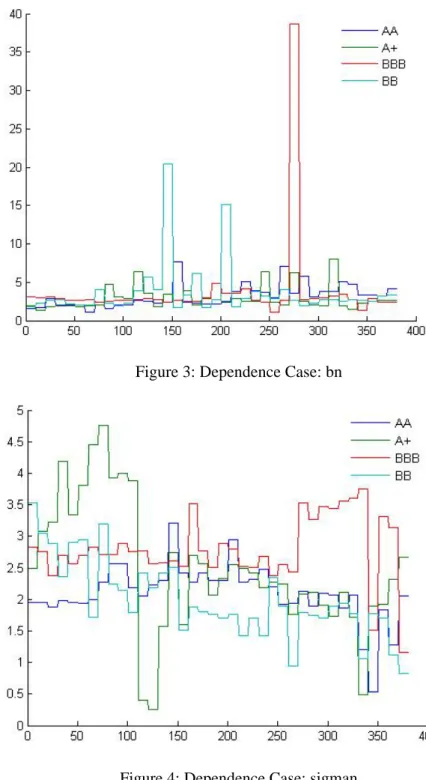
bond, and look for whether these parameters can show some informations of thier ratings. We choose a famous corporation Berkshire for rating AAA, City Group Bank for AA+, American Express for A, Maxican Government Bond for BBB and Brazil Government Bond for BB. The rating’s rating is AAA > AA+ > AA > AA− > A > BBB > BB > B.
11
For the case of intensity
λ
independent with discounted rate r,
Figure 1: Independence Case: bn
This figure shows that people think about bn’s at different time in future, bn express the
recovery rate of a defaultable bond. So if a corporation has higher bn, means that it’s restoring
force at high risk. AAA is always on the upper level, and A+ performs a best hibit.
Figure 2: Independence Case: sigman
Sigman shows the change size of a defaultable bond at time n, we expect a good bond with
consistence route, so we hope it’s sigman is small. Besides AA has higher instable. AAA keep the
lowest level, A+ is about the middle, and so on.
For the case of intensity
λ
dependent with discounted rate r, we use two Brownian
motion
to solve their correlation in estimating parameters, and we get
12
Figure 3: Dependence Case: bn
Figure 4: Dependence Case: sigman
Although BB and BBB have a few higher bn in future, they have also high sigman at those
times.
13
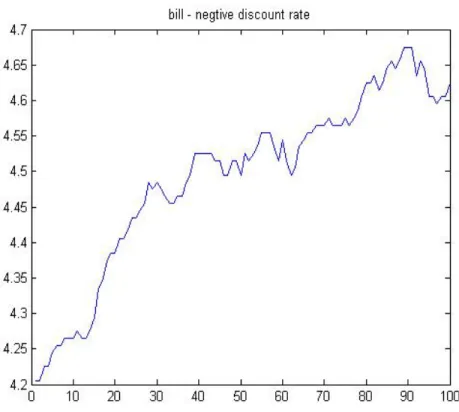
Figure 5: An American Treasury Bill’s Daily Return Rate
There’s large number of negative discounted rate appeared.
5. Conclusion and Development
This model is an general case of Philipp J. Schonbucher (20022003) in pricing defaultable
derivative. The parameters of extended Vasicek model are always assume to be constant
functions in the past, we generalize each to be step function. And we provide method to rate the
corporate bond.
And there are still much to be encouraged. An shortcoming is the intensity model: COX
process is nonnegative, this says that when corporate default, it can’t redeem the false. But we
couldn’t know defaultable bond default besides maturity and the days who pays interest rate to us,
so they must have chance to redeem such defaults.
In this paper, we use the fractional recovery model. But, does it suitable? Some may find more
suitable methods.
Although many people think about interest rate must be nonnegative, so they choose CIR to
replace Vasicek. But we use here is the discounted rate of each bond, there exists many negative
discounted rate, so we choose Vasicek model is also reasonable. And we should improve it more
hardly in the future.
14
References
[1] O. Vasicek, ”An Equilibrim Characterization of the Term Structure,” Journal of Financial Economics, Vol.5 (1997), 177188.
[2] F. Jamshidian, ”An Exact Bond Option Formula,” The Journal of Finance, Vol.44 No.1 (Mar.,1989), 205209.
[3] J. Hull; A. White, ”Pricing InterestRateDerivative Securities,” The Review of Financial Studies, Vol.3 No.4 (1990), 573592.
[4] Cox,J. C.,J. E. Ingersoll, and S. A. Ross, ”A Theory of the Term Structure of Interest Rates,” Econometrica, Vol.53 No.2 (Mar.,1985), 385408.
[5] Rudi Zagst, ”InterestRate Management.”
[6] J. Hull; A. White, ”The General HulWhite Model and Super Calibrationn.” (Aug.,2000)
[7] Philipp J. Schonbucher, ”Tree Implementation of Credit Spread Model for Credit Derivatives”, Journal of Computation (2001) 138
[8] MingChi Chang, YuanChung Sheu, ”Approximate to Derivative Price in the Generalized Vasicek Model,” NCTU Applied Math. Department Working Paper, (May.,2006)