ABSTRACT: Blends of poly ( oxybenzoate- p -ethylene terephthalate ) ( POB-PET ) and polyarylate were confirmed to be a partially miscible system by differential scanning calorimetry. When 60 / 40 POB-PET / PAr blend was annealed at high temperature ( above 2707C) for several minutes, the ester–ester interchange (transesterification) in the blend took place immediately, as evidenced by Fourier Transformed infrared analy-ses. The analysis of the blend annealed at 2907C by1H-13C nuclear magnetic resonance disclosed that there were four new diads appearing in 15 min and an additional one produced in 60 min during the heat treatment. The miscibility between POB-PET and polyarylate increased with the mol concentration of these new diads judging from differential scanning calorimetry. The evolution of the concentration of the diad ethyl-ene glycol-isophthalate during the annealing can be described by a second-order reac-tion. The activation energy of forming the diad ethylene glycol-isophthalate was 26.5 kcal /mol, and the preexponential factor for the transesterification reaction is 3.7 1 108 min01.q 1998 John Wiley & Sons, Inc. J Polym Sci B: Polym Phys 36: 1959–1969, 1998 Keywords: miscibility; transesterification; kinetics; polyarylate; liquid crystalline co-polyesters
INTRODUCTION
coil amorphous polymers.5,6Phase separation oc-curred when the TLCP blends were subject to high stress and high temperature.7
Thermotropic liquid crystalline polymers ( TLCP )
have drawn much research attention since their For a reduction in phase separation and better interfacial adhesion in TLCP composites, partial arrival. TLCP contained rigid-rod-type chemical
structures, and therefore had high mechanical miscibility is needed. In our laboratory, we have studied the miscibility in blends of liquid crystalline and thermal properties. Due its high raw material
cost, TLCP were frequently melt blended with en- poly(oxybenzoate-p-ethylene terephthalate) (POB-PET) and polycarbonate (PC)8,9
and found that gineering plastics to form fibril structure to
rein-force the engineering plastics in situ.1 – 4
In this they are miscible due to intensive ester–ester inter-change (transesterification). In another case, we respect, TLCP blends can form organic / organic
composites. The compatibility between the TLCP found partial miscibility existing in blends of POB-PET/polyetherimide (PEI).10In adding POB-PET
and the matrix polymer seemed the most critical
one in deciding the mechanical properties of these to the originally immiscible TLCP and amorphous PC or PEI has been found to enhance the interfacial composites because most failures appeared at the
interfaces. However, due to its stiff structure, adhesion between the TLCP and PC or PEI.10,11
The mechanical properties of ternary blends of poly(oxy-TLCP were usually immiscible with
flexible-benzoate-p-naphthalate) (Vectra), POB-PET, and PC11
or PEI10
were always higher than that of their Correspondence to: K.-H. Wei
corresponding binary blends of Vectra/PC and
Vec-Journal of Polymer Science: Part B: Polymer Physics, Vol. 36, 1959 – 1969 ( 1998 )
q 1998 John Wiley & Sons, Inc. CCC 0887-6266/98 / 111959-11 tra/PEI.
For polyarylate ( PAr ) , it is an amorphous poly- rate of 207C per min. At 2907C, the samples were annealed for 30 s. Subsequently, the samples were mer, and has a high glass transition temperature
of 1997C. We are interested in the miscibility in quenched down to 257C. The samples were heated again from 25 to 3007C at the same heating rate. blends of POB-PET and polyarylate for its
appli-cation to in situ composites. Previously, Porter’s The X-ray diffraction analysis of the solution blend of 60 / 40 POB-PET / PAr annealed at 2907C group12
reported the miscibility of blends of
POB-PET and PAr, and found that POB-POB-PET and PAr for different time was carried out in a D5000 dif-fraction meter ( Siemens Corp., Germany ) oper-were partially miscible by differential scanning
calorimetry and polarizing optical microscopy. ated at 40 KV and 30 mA. CuKa radiation was used. The chemical structure change resulting They concluded that there was transesterification
between POB-PET and PAr, but gave no detailed from transesterification was identified by Fourier Transformed infrared ( FTIR ) and Nuclear Mag-mechanism on transesterification.
Transesterifi-cation between copolyesters has been well ana- netic Resonance ( NMR ) spectroscopy. POB-PET does not dissolve in chloroform. Only PAr and its lyzed in blends of polyethylene terephthalate and
polyethylenesebacate13and in blends of bisphenol derivatives can be dissolved in chloroform. The
ester exchange between POB-PET and PAr can, A polycarbonate and polybutylene
terephthal-ate14
with nuclear magnetic resonance. therefore, be confirmed by examining the chemi-cal structure change of PAr in the blends. POB-In this article, we will attempt to analyze the
chemical structure change in both polymers dur- PET / PAr blends were extracted with chloroform first, and then the solution containing micropar-ing transesterification with Nuclear Magnetic
Resonance spectroscopy. Additionally, the kinet- ticles was filtered with a syringe containing a 0.5-micron pore-size filter. The soluble portion was ics of the transesterification in the blend will be
discussed. This result will bring us a quantitative used for FTIR analysis. A Bomem MB100 FTIR was used for this measurement. For NMR analy-understanding on the relationship between
misci-bility and transesterification. sis, freshly prepared and annealed blends of POB-PET / PAr were completely dissolved in a mixed solvent of deuterated chloroform and deuterated trifluoacetic acid at volume ratio of 60 / 40.
Two-EXPERIMENTAL
dimensional1
H-13
C Heteronuclear Multiple Bond Correlation ( HMBC ) analysis on these blends was Poly ( oxybenzoate- p -ethylene terephthalate ) at a
molar ratio of 60 / 40 ( POB-PET ) was provided by conducted on a Bruker DMX-600 spectrometer to identify the new resonance peaks resulted from Unitika Corp., Japan. Polyarylate ( PAr ) with a
1 : 1 isophthalate/terephthalate ratio (trade name the new structures evolved during transesterifi-cation.
U-100 ) was also supplied by Unitika. The intrin-sic viscosities of POB-PET and PAr are 0.466 dL / g and 0.652 dL / g, respectively. The solution blend
of POB-PET / PAr was prepared by dissolving 2 g
RESULTS AND DISCUSSION
of the polymers at the proper weight ratio in a 100 cm3
mixed solvent of 50 / 50 phenol / tetrachlo- The DSC curves and the chemical structures of POB-PET and PAr are shown in Figure 1. The roethane by weight. The temperature of the
sol-vent was maintained at 557C. The solution was glass transition temperatures ( Tg) of POB-PET and PAr are located at 62.2 and 198.77C, respec-precipitated in a 10-fold volume of methanol after
the solution became one phase for 1 h. The precipi- tively. The miscibility in solution blends of POB-PET and PAr was studied through the difference tated polymers were washed four times in hot
methanol. The blend was dried in a vacuum oven in their glass transition temperature ( Tg) in the blends. The Tgs of solution blends of POB-PET / at 1007C for 4 days before thermal analysis. The
thermal gravimetric analysis of the dried blends PAr at different compositions are displayed in Figure 2. In Figure 2, the low Tg 1was exhibited showed no appreciable weight loss up to 3007C,
indicating a complete removal of the solvent. by POB-PET, and the high Tg 2 stood for PAr. There were two distinctive Tgs when the weight The thermal analysis of the blend at different
temperature for different annealing time was car- fraction of PAr is less than or equal to 0.6 in the blend. The Tg 1was almost independent of the con-ried out with a Dupont 2910 differential scanning
calorimetry ( DSC ) . For DSC analysis, the sam- centration of PAr in these compositions, and the
Tg 2 increased with the concentration of PAr in ples were heated up from 30 to 2907C, at a heating
Figure 1. The chemical structures and the DSC curves of poly ( oxybenzoate- p -ethylene terephthalate ) and polyarylate.
Figure 3. The miscibility diagram of the 60 / 40 POB-PET / PAr blend annealed at different temperatures for these blends. A totally immiscible binary polymer
10 min. blend prepared by the solution method will
be-come completely phase separated when the blend
is heated up to the melt state. The amorphous the two T
gs will shift toward each other. In the phases of the completely phase-separated blend case of the POB-PET / PAr blend, the T
g 2 contrib-will display two glass transition temperatures uted by PAr followed the above argument. How-contributed from each component, and the two Tgs ever, owing to the stiff segment of POB and the are independent of the relative weight fraction of partial crystallinity of the PET segment in the each polymer. If there is a slight miscibility in the POB-PET copolymer, the T
g 1contributed by the binary blends, the Tg of each component will be PET segment was not affected by the presence of affected by the existence of the partially miscible the partially miscible region. From this behavior, region. As the partially miscible region increases, one can infer that there is partial miscibility ex-isted between POB-PET and PAr. This result is similar to Porter’s result.12
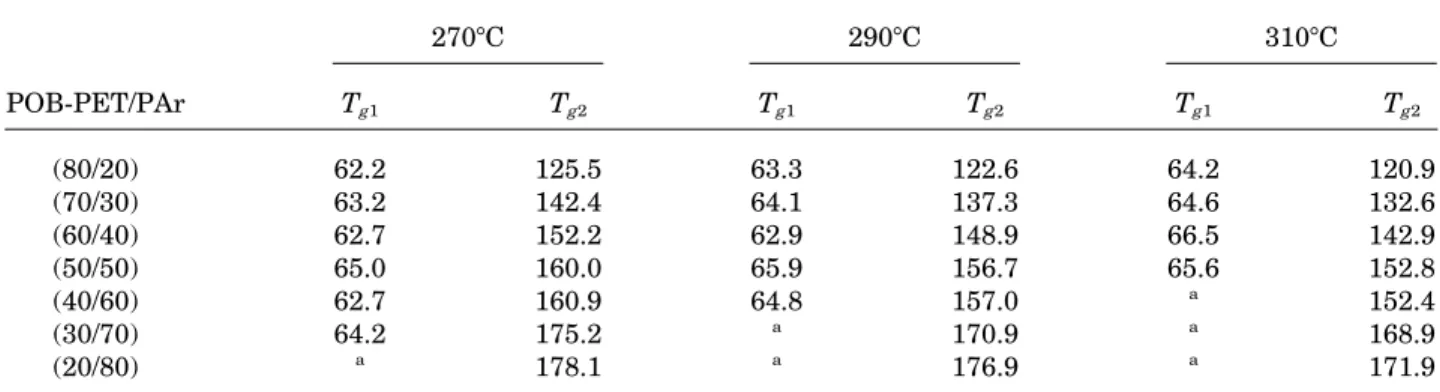
The miscibility dia-gram of POB-PET / PAr blends annealed at differ-ent temperatures for 10 min is presdiffer-ented in Fig-ure 3. In FigFig-ure 3, after being annealed at 2707C, the POB-PET / PAr blend is partially miscible when the weight fraction of PAr is between 0.2 and 0.7. In the case of the weight fraction of PAr being more than 0.8 or less than 0.1, the POB-PET / PAr blends become miscible. Compared to the thermal analysis result of the freshly pre-pared POB-PET / PAr blend, there was a small de-crease in the miscibility region that might be caused by thermodynamics-induced phase sepa-ration. However, as the annealing temperature increased to 3107C, the miscible composition in the POB-PET / PAr blend increased as shown in Figure 3. This behavior indicated that there might be some reaction involved in the annealing pro-cess. The glass transition temperatures ( Tgs ) of the annealed POB-PET / PAr blend are given in
Figure 2. The glass transition temperature of blends
Table I. The Tgs of Solution Blends of POB-PET/PAr at Different Compositions Annealed at Different Temperature for 10 Min
2707C 2907C 3107C POB-PET/PAr Tg1 Tg2 Tg1 Tg2 Tg1 Tg2 (80/20) 62.2 125.5 63.3 122.6 64.2 120.9 (70/30) 63.2 142.4 64.1 137.3 64.6 132.6 (60/40) 62.7 152.2 62.9 148.9 66.5 142.9 (50/50) 65.0 160.0 65.9 156.7 65.6 152.8 (40/60) 62.7 160.9 64.8 157.0 a 152.4 (30/70) 64.2 175.2 a 170.9 a 168.9 (20/80) a 178.1 a 176.9 a 171.9 aNot existing.
When the 60 / 40 POB-PET / PAr blend was an- blend [ see Fig. 5 ( a ) ] . The DSC result of this blend nealed at 2907C in vacuum, the Tg 2decreased with also indicated that it is a partial miscible blend. the annealing time, as shown in Figure 4. In spe- The morphology of the 60 / 40 POB-PET / PAr cific, the Tg 2dropped from 165 to 1537C in 10 min, blend becomes more homogeneous as the anneal-and became stabilized at 1457C after 90 min an- ing time increased, shown in Figure 5 ( b ) and ( c ) . nealing. The Tg 1increased only slightly. The drop From the DSC and the POM result of the 60 / 40 in Tg 2increased with the annealing temperature, POB-PET / PAr blend, we concluded that the as demonstrated in Figure 4. The fresh 60 / 40 change in the domain morphology of the blend POB-PET / PAr blend was prepared from a solu- seemed dominated mostly by the reaction during tion precipitated process, and therefore contained annealing. The phase separation in the blend a small amount of inhomogenity as displayed in caused by thermodynamics is relatively small in the polarized optical micrograph ( POM ) of the this case.
The X-ray diffraction result of the annealed 60 / 40 POB-PET / PAr blend was displayed in Figure 6. In curve ( a ) of Figure 6, the wide-angle X-ray diffraction pattern of POB-PET is characterized by a sharp diffraction peak at 2uÅ 19.57 with a shoulder at 2u Å 28.27 and one relatively weak broad peak at 2uÅ 43.37. The POB sequences of
the POB-PET copolyesters apparently adopt the crystal structures of the parent homopolymer, po-ly ( oxybenzoate ) .15
As the blend was annealed at 2907C, the 28.27 peak disappeared after 15 min, and the 19.57 peak decreased with annealing time steeply, as shown in curves ( b ) , ( c ) , ( d ) , ( e ) , and ( f ) of Figure 6. This indicated that the crystal structure of POB-PET has been reduced due to the reaction with PAr.
The FTIR spectra of PAr and POB-PET are dis-played in Figure 7. As indicated in Figure 7, the aryl ester absorbency peaks appeared at 1739 and 1070 cm01for PAr, and there was an alkyl ester
absorbency peak at 1715 cm01other than the two
aryl peaks at 1739 and 1064 cm01for POB-PET. Figure 4. The glass transition temperatures
contrib-The annealed 60 / 40 POB-PET / PAr blends were uted by PAr in the blend of 60 / 40 POB-PET / PAr
an-extracted with chloroform, and the suspensions nealed at different temperature in vacuum for different
Figure 6. The wide-angle X-ray diffraction curves of ( a ) POB-PET, ( b ) 60 / 40 POB-PET / PAr blend freshly prepared, ( c ) annealed for 15 min, ( d ) annealed for 30 min, ( e ) annealed for 60 min, ( f ) annealed for 90 min at 2907C.
1716 cm01 in the FTIR spectra of the extracted
blend after 15 min annealing indicated that the alkyl ester has been attached to the PAr mole-cules. This particular alkyl ester peak also grew with the annealing time. This is initial and direct evidence that transesterification indeed took place.
Further study on the change in the chemical structures of POB-PET and PAr was carried out with NMR. Because the annealing of the blend
Figure 5. The polarized optical micrographs of the 60 / 40 POB-PET / PAr blend annealed at 2907C for (a) 0 min, ( b ) 15 min, ( c ) 60 min.
FTIR spectra of the resulting solutions were illus-trated in Figure 8. POB-PET does not dissolve in chloroform. There was no additional peak ap-pearing other than the main peaks of PAr for the chloroform-extracted solution out of freshly
pre-pared 60 / 40 POB-PET / PAr blend, as displayed in Figure 7. The FTIR spectra of polyarylate and POB-PET.
nance peaks of the freshly prepared 60 / 40 POB-PET / PAr blend indicated that the blend is a me-chanical mixing of two polymers. Upon annealing the 60 / 40 POB-PET / PAr blend at 2907C for 15 min, a small new crosspeak appeared at 7.17 – 121.9 ppm ( 5 * peak ) and the other new crosspeak showed up at 7.73 – 130.6 ppm ( 13 * * peak ) in the
1
H-13
C spectra of the blend simultaneously, as in-dicated in Figure 10 ( b ) . Then, the first and the second new crosspeaks grew substantially and the second new crosspeak became independent from its neighboring peaks after 60 min annealing, as shown in Figure 10 ( c ) . The first new crosspeak is near the aromatic H5. From reading the relative
position of 1H to13C and from a previous model
compound study,16 we knew the first new peak
was the bisphenol-A segment attached to the POB segment, and the second new peak was the ethyl-ene glycol segment attached to the isophthalate segment. Hence, we deduced that the 5 * and the
Figure 8. The FTIR spectra of chloroform-soluble portions of 60 / 40 POB-PET / PAr ( a ) freshly prepared, ( b ) annealed for 15 min, ( c ) annealed for 30 min, ( d ) annealed for 90 min at 2907C.
was carried out in vacuum, the hydrolysis of the copolyesters was reduced to a minimum. More-over, the degree of polymerization is high enough to neglect chain end reactions. Therefore, we con-centrate on ester – ester interchange. The diad codes used in analyzing ester – ester interchange and the protons and13
C in the chemical structures of POB-PET and PAr were assigned in Figure 9 for NMR identification. The1
H-13
C HMBC NMR spectra of two aromatic portions of the completely dissolved fresh and the 60 / 40 POB-PET / PAr blend annealed at 2907C were chosen for compari-son. The first aromatic region is in between 7.1 and 7.9 ppm of 1H and in between 118 and 134
ppm of13
C-NMR spectra. The second aromatic re-gion is in between 8.3 and 8.7 ppm of 1
H and in between 130 and 140 ppm of13
C-NMR spectra. The first aromatic regions of the1
H-13
C-NMR
spectra of the 60 / 40 POB-PET / PAr blend are Figure 9. The diad and the proton and the13C codes assigned in POB-PET and PAr structures.
reso-Figure 10. The 600 MHz1H-13C NMR spectra of the first aromatic region of 60 / 40 POB-PET / PAr ( a ) freshly prepared, ( b ) annealed for 15 min, ( c ) annealed for 60 min at 2907C, new crosspeaks marked by I and II.
13 * * new peaks in the first region were caused
{( A20 A3){ / { ( B10 B22){ ` k
k =
a 0 x b 0 x
by the hybrid structures ( new diads ) bisphenol A oxybenzoate and ethylene glycol-isophthalate,
respectively. {( A
2 0 B1){ / { ( A30 B22){
x x
By the same method, we can examine the sec-ond region. The secsec-ond region of the freshly
pre-pared blend is shown in Figure 11 ( a ) . We identi- where a and b are the initial mol fraction of PET fied the third and the fourth new crosspeaks at segment in POB-PET and the initial mol fraction 8.37 – 131.8 ppm ( 9 * * peaks ) and at 8.46 – 131.8 of the portion of bisphenol A isophthalate in poly-ppm ( 9 * peak ) , as shown in Figure 11 ( b ) after arylate, respectively. The mol fraction of A
2B1and
15 min annealing. These two new peaks were A
3B22 is x . The codes used in the above
mecha-caused by the diad ethylene glycol – terephthalate nism are given in Figure 9.
and oxybenzoate – terephthalate, respectively. Assuming a second-order reversible reaction as When the annealing time increased to 60 min, Murano and Yamadera13
did, we can write other than the growing third and fourth peak, an
additional new peak appeared at 8.61 – 137.1 ppm dx
dt Å k ( a 0 x ) ( b 0 x ) 0 k*x
2
( 1 ) ( 12 * peak ) , as indicated in Figure 11 ( c ) . The fifth
new peak is caused by diad oxybenzoate –
isoph-thalate. In summary, there were four new struc- Because the copolyester is random at equilibrium, tures appearing as a result of ester – ester inter- we have x
e Å ab , and a / b Å 1. Therefore, we change in heating the POB-PET / PAr blend at can get
2907C for 15 min in vacuum. The fifth new
struc-ture showed up in the blend when the heating k Å k* ( 2 ) time was increased to 60 min.
The quantitative analysis on the concentration Putting eq. ( 2 ) into eq. ( 1 ) , we obtained of the above five new structures resulted from the
60 / 40 POB-PET / PAr cannot be carried out except dx
dt Å k ( ab 0 x ) ( 3 )
diad ethylene glycol – isophthalate ( 13 * * peak ) , as shown in Figure 12. This is because only the 13 * * peak can be separated independently from
Integrating eq. ( 3 ) , we can get a simple kinetic the surrounding peaks in the proton NMR
spec-expression, tra. The concentration of the diad ethylene glycol –
isophthalate can be calculated by the initial
POB-PET and PAr concentration and the diad probabil- 1
( b 0 a ) ln
H
a ( b 0 x )
b ( a 0 x )
J
Å kt ( 4 )ity following the method as described in the previ-ous article.7
In Figure 13, the new diad ethylene
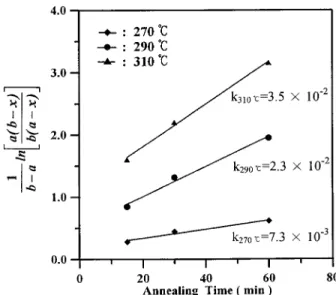
glycol – isophthalate increased sharply with an- In Figure 14, eq. ( 4 ) was plotted, and the slopes nealing time in the first 15 min, and then in- of those lines are the rate constants at different creased moderately near 60 min annealing time. temperatures. We can fit the reaction constants This behavior is in synchronization to that of the into the Arrhenius expression
glass transition temperatures ( Tg 2) in the 60 / 40
POB-PET / PAr blend, as shown in Figure 4. ln k Å ln A 0 Ea/ RT ( 5 ) Therefore, it indicated that upon heating the
mis-cibility enhancement between POB-PET and poly- where R is the gas constant ( R Å 1.987 cal / ( mol arylate was probably due to the ester – ester inter- K ) ) , Eais the activation energy, A is the preex-change. In specific, the presence of small mol frac- ponential factor, and T is the absolute tempera-tion ( about 1% ) of new diad can enhance the ture. We plotted eq. ( 5 ) in Figure 15, and ob-miscibility in POB-PET / PAr blend greatly by low- tained the activation energy of 26.5 kcal /mol. ering the glass transition temperature of PAr by The preexponential factor for this ester – ester about 107C. interchange is 3.7 1 108
min01.
The ester – ester interchange mechanism of pro- The intrinsic viscosity of the 60 / 40 POB-PET / ducing diad ethylene glycol – isophthalate can be PAr blend decreased sharply with the annealing time initially, as illustrated in Figure 16. The expressed in the following.
Figure 11. The 600 MHz1H-13C NMR spectra of the second aromatic region of 60 / 40 POB-PET / PAr ( a ) freshly prepared, ( b ) annealed for 15 min, ( c ) annealed for 60 min at 2907C, new crosspeaks marked by III, IV, and V.
Figure 14. The kinetics of forming diad ethylene gly-Figure 12. The partial proton NMR spectra of 60 / 40 col-isophthalate during transesterification in 60 / 40 POB-PET / PAr ( a ) freshly prepared, ( b ) annealed for POB-PET / PAr blend.
15 min, ( c ) annealed for 30 min, ( d ) annealed for 60 min at 2907C.
pened. The decrease in intrinsic viscosity can also be caused by the change in the molecular decrease in the intrinsic viscosity of the
POB-weight distribution. A complete transesterifica-PET / PAr blend during the annealing was
tion would reduce the distribution of the molec-caused, in fact, by simultaneous chain
degrada-ular chain length to Flory’s most probable distri-tion and transesterificadistri-tion. The unavoidable
bution ( Mw/ Mn Å 2 ) . Hence, the crucial reduc-decarboxylation of the unstable oxyethylene –
tion in the intrinsic viscosity of the annealed carbonate diad ( give off CO2) must have
hap-blend most likely came from decarboxylation and transesterification.
Figure 15. The activation energy obtained from the Arrhenius expression in forming diad ethylene glycol-Figure 13. The evolution of the mol fraction of the
diad ethylene glycol-isophthalate upon annealing 60 / isophthalate during transesterification in 60 / 40 POB-PET / PAr blend.
1. G. Kiss, Polym. Eng. Sci., 27, 410 ( 1987 ) .
2. R. A. Weiss, W. Huh, and L. Nicolais, Polym. Eng.
Sci., 27, 684 ( 1987 ) .
3. W. Brostow, Polymer, 31, 979 ( 1990 ) .
4. H. J. O’Donnell and D. G. Baird, Polymer, 36, 311 ( 1995 ) .
5. P. J. Flory, Macromolecules, 11, 1138 ( 1978 ) . 6. M. Ballauff, Polym. Adv. Technol., 1, 109 ( 1990 ) . Figure 16. The change in the intrinsic viscosity of
7. P. Tang, J. A. Reimer, and M. M. Denn, Macromole-the 60 / 40 POB-PET / PAr blend with Macromole-the annealing time
cules, 26, 4269 ( 1993 ) .
at different temperature.
8. K. F. Su and K. H. Wei, J. Appl. Polym. Sci., 56, 79 ( 1995 ) .
9. K. H. Wei and J. C. Ho, Macromolecules, 30, 1587
CONCLUSIONS
( 1997 ) .10. K. H. Wei and H. L. Tyan, Polymer, to appear. The ester – ester interchange in POB-PET and po- 11. K. H. Wei, J. L. Hwang, and H. L. Tyan, Polymer,
37, 2087 ( 1996 ) .
lyarylate is a very fast process at high
tempera-12. L. H. Wang and R. S. Porter, J. Polym. Sci., Polym. ture even in vacuum. When the 60 / 40 POB-PET /
Phys. Ed., 31, 1067 ( 1993 ) .
polyarylate blend was annealed at 2907C for 15
13. R. Yamadera and M. J. Murano, J. Polym. Sci., min, there were four new hybrid structures (
di-Part A-1, 5, 2259 ( 1967 ) .
ads ) produced as a result of transesterification.
14. J. Devaux, P. Godard, and P. J. Mercier, J. Polym. They are bisphenol-A – oxybenzoate, ethylene
gly-Sci., Polym. Phys. Ed., 20, 1875 ( 1982 ) .
col – isophthalate, ethylene glycol – terephthalate
15. J. Blackwell, G. Lieser, and G. A. Gutierrez, Macro-and oxybenzoate – terephthalate. In an hour, an molecules, 16, 1418 ( 1983 ) .
additional new diad, oxybenzoate – isophthalate, 16. K. H. Wei, H. J. Jang, and J. C. Ho, Polymer, 38,
was produced. 3521 ( 1997 ) .
The evolution of the concentration of the diad 17. C. V. Vinogradov and A. Y. Malkin, Rheology of
Polymers, Springer Verlag, New York, 1980, p. 154.