
24
Ceramic
Processing Research
Process and property characterization of La-Al-B-O/Al
2O
3glass ceramic
composites
Chih-Lung Chen, Wen-Cheng J. Wei* and S.F. Wanga Institute of Mat. Sci. & Eng., National Taiwan University, ROC
aDept. Mat. & Min. Res. Eng, National Taipei University of Tech., ROC
A LAB glass with a composition of 10 mol% La2O3 + 10 mol% Al2O3 + 80% B2O3 made into a composite with 30-50% Al2O3
filler was prepared and investigated. Processing optimization and several engineering properties used for microwave substrates are reported, including densification, interaction with Ag electrodes, dielectric properties as a function of frequency, acid dissolution and microstructure. The glass ceramic composite, i.e. L30A, without lead and alkali, can be densified by two-step sintering to a density better than 99% with minimal glass residue. The densified composite does not react with Ag up to 950oC
in 1 h, and does not dissolve in an acid solution (pH=3.5) in 2 h. The dielectric constant and loss are in the range of 5.6-5.9 and 1.4×10⁻³-5.5×10⁻³, respectively. The coefficient of thermal expansion (CTE) and thermal conductivity of the composite
are reported.
Key words: LAB, glass-ceramics, composite, microwave, dielectric, acid dissolution, CTE, thermal conductivity.
Introduction
Several low firing-temperature (< 1000oC), lead-free glass-ceramic materials [1-13] have been studied for co-firing electronic applications. There are several critical issues relating to the applications of glass-ceramic substrates, as discussed in the literature [12, 13]. The primary issue is to consider the interaction between the glass-ceramic and an electrode, e.g. Ag, during sintering, as applying to low-temperature cofir-ed ceramic (LTCC) laminatcofir-ed layers. The second issue is the value and variation of the density and microwave properties, such as the dielectric constant (k), dielectric loss (tan δ). When a glass is partially transformed into crystal phases, not only complete densification should be attained, but also suitable crystallization must be achieved after heat-treatment for a LTCC application. Otherwise, any glass-ceramic materials containing porosity or with a low degree of crystalline phases would result in relatively poor dielectric properties. However, the addition of a glass phase could greatly lower the sintering temperature of a ceramic filler, and benefit the densification of composite matrix. The last consideration relates to the evaporation of a low melting constituent, e.g. B2O3, during sintering, and dissolution of alkaline-based glass in aqueous solution. Our previous studies [13, 14] have reported one La-Al-B-O (LAB) glass ceramic system. The processing
window of the LAB glasses was determined after having been melted at 1350oC for 1 h in air. [13] Thermal analysis, wetting measurement showed that the initial shrinkage temperature of the LAB glasses could be as low as around 700oC. [14] One glass composition (L2 glass) with a composition of La2O3 10 mol%, Al2O3 10 mol%, B2O3 80 mol% showed the most suitable sintering and wetting behavior on an Al2O3 surface. Therefore, it was chosen as the glass precursor in this study. Afterwards, two crystal phases, including equi-axed grains (LaBO3) and flaky crystals (LaAl2B3O9) were identified as being formed at temperatures between 750oC to 950oC. It was also reported that the compositions of the LAB glasses (L1-L5) showed little deviation, ca. ≤3% of B2O3, from the batched compositions. The reduction of B2O3 was due to the evaporation during high-temperature (1350oC) melting.
As a consequence, the objectives of the present work were set to clarify the properties for applications as a microwave substrate. We tended to rule out the uncer-tainty of Ag migration and its influence on the LAB-Al2O3 glass-ceramic (LAB-A) composites. Also, the dielectric constants at MHz ranges reduced with the formation of crystalline phases (LaBO3 and LaAl2B3O9). The reduction of the dielectric loss and dielectric constant would benefit applications at the higher fre-quency range. Finally, the dissolution of LAB glass and LAB/Al2O3 glass-ceramic composite in acid solution was tested for the assurance of room temperature processing in contact with any acidic chemicals.
*Corresponding author: Tel : +886-2-2336-1317 Fax: +886-2-2363-4562 E-mail: [email protected]
Experimental
Materials and Preparation steps
L2 glass powder, prepared as in the previous report, [14] was mixed with various mass% of α-Al2O3 filler (A32, 99.5% pure, α-phase, average size 1.04 μm, Sumitomo Chemical Corp., Tokyo, Japan). The prepa-ration of LAB/Al2O3 green tape was started by a colloidal processing, followed by tape casting and drying. methyl ethyl ketone (MEK) and ethanol in azeotropic composition were used as a solvent mixture. The solid consisting of the slurry was controlled at 40 vol%. The mixture “L30A” means a L2 glass mixed with 30 mass% of Al2O3 fillers.
One Ag paste (DuPont 6145, conductive paste, USA) was used and the microstructure is shown in Fig. 1. The viscosity of the paste was between 120-200 Pa·s, and the paste contained a few percent of glass particles. The LAB glass, L30A bulk and L30A tape specimens with a thick Ag layer were binder-burn-out first, then sintered at various temperatures (750-1000oC) for different holding periods. The heating rate was set in 5oC/min or 10oC/min, sintering in air and cooling in the furnace.
Characterization
– Microstructural observation
The composite samples were mounted, cut, ground and polished along the interface Ag/glass ceramics. The samples were then coated with a thin layer of Au or carbon to improve electrical conductivity for micro-scopical observation. The morphologies of polished samples were analyzed by scanning electron micro-scopy (SEM, Philips XL30, Philips Co., USA) equipp-ed with an X-ray energy dispersive spectroscopy (EDS,
DX-4, EDAX Co., USA) and field-emission SEM (Leo Instrument 1530, England).
– Thermal Analysis
The sintering behavior was measured by using a thermal mechanical analyzer (TMA, SETSYS TMA 16/18, SETRAM. Co., France).
– X-ray Diffraction Analysis
The phase identification of calcined glass samples and tapes was investigated by an X-ray diffractometer (Philips PW1830, Philips Instrument, Netherlands, XRD) using Cu Kα radiation. The scan speed was 3o/ min and each step was 0.04o.
– Measurement of Dielectric Properties
A RF impedance analyzer (HP-4291B RF impedance/ material analyzer, Agilent, USA) was used to measure the dielectric characteristics of various specimens. Cylindrical rod sample with a thickness of 3.0 mm and a diameter of 10.0 mm was prepared for the measure-ments. The dielectric properties, including dielectric constant (e) and dielectric loss (tan δ) were measured at three frequency ranges, including 10 MHz, 100 MHz, and 1 GHz.
– Coefficient of Thermal Conductivity (CTE) and
Thermal Conductivity
Bulk samples of the composition L30A, which had been prepared were sintered at 800 °C/1 h to 850 °C/10 min in air for the test of CTE. The CTE was measured between 25 °C-500 °C using a dilatometer (Model TA 2490, Netzsch Instruments, Paoli, PA). An instrument (Hot Disk AB, Bridge system, Sweden) was used to measure the thermal conductivity of the sintered samples. Cylindrical rod sample with a thickness of 5.0 mm and a diameter of 2.0 cm was placed between two parallel metal probes of Cu.
– Dissolving Test
This dissolution test of B2O3 content from the sintered L2 glass and L30A samples (sintered at 800oC/1 h and 850oC/10 min) was conducted in de-ionized water and acid solution. The chip-like samples with a mass around 500 mg were immersed in 10 g de-ionized water (pH ~6.4), and aged for 24 h to 72 h at room temperature. After aging, the testing samples were dried for 4 h and measured for mass loss. The other test replaced the water bath by an acidic solution, which was diluted from an HCl solution (99%, EP grade, Showa Chemical Co., Japan) with de-ionized water to a concentration of 0.1 M and showed a pH value of ca. 3.5. The pH value of the solutions was measured by a pH-meter (MODEL SP-7, SENTEX, Taiwan).
Results and Discussion
Optimal Densification
Previous data [14] showed that the amount of glass present in a LAB system was the primary control factor for the densification of LAB-A glass ceramics. A high
Fig. 1. Dilatometric sintering curves of the binder-burn-out Ag
powder heat treated to 1000oC and holding for 10 min in air.
sintered density, > 98%, could be achieved for the formulation with 70 mass% L2 glass by sintering at 850oC for 1 h. However, the microstructural charac-terization revealed that a small amount (~2%) of porosity was still retained in the matrix. Therefore, in order to reach better densification, the sintering of the L30A glass-ceramic composite needs to be optimized by modifying the sintering schedule.
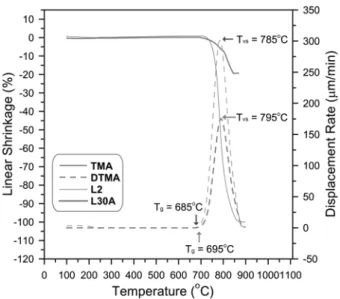
A detailed investigation by TMA for understanding the behavior of glass viscous flow has been conducted and the data are shown in Fig. 2. It is possible to sinter the glass composites without the growth of the crystalline phase within the temperature range between To (starting temperature of crystal growth) and Tg (glass transition temperature). It was noted the temperature difference (ΔT) was 100oC for L2 glass and L30A composite. In addition, the onset temperature (685oC) of Tg of a viscous L2 glass was close to that (695oC) of the L30A. The Tg of L30A shifted about 10oC to a higher temperature due to the Al2O3 filler addition. The maximum sintering rate of the glass and the composites took place at the temperature (Tvs) of 785oC and 795oC, respectively. Consequently, the optimal viscous sintering of L30A could be chosen at 800oC.
The relative densities of the L30A composites from different heat-treatments are shown in Table 1 and Fig. 3. The bulk density data revealed that the L30A showed the best sinterability among these series. In comparison, the density was improved to 98.6% as sintering at 800oC; namely, nearly no porosity was observed for the heat-treatment at 800oC for 4 h.
As a consideration of devitrification of a dense matrix, the heat-treatment at 850oC for 10 min, i.e. the condition “5” shown in Fig. 3, is the optimum schedule for L30A which is able to achieve 99.5% relative density. In addition, a longer heat-treatment at
850oC, i.e. the condition “6”, shows a density lower than the previous cases (“3”, “4”, or “5”). Longer holding time at 850oC for the composites causes
Fig. 2. TMA and DTMA curves of L2 glass and L30A
glass-ceramic composite tested at a heating rate of 10oC/min. The
sample was sintered under a 0.98 kPa compressive stress.
Table 1. Sintered and dielectric properties of various LAB/Al2O3
and pure L2 glass samples tested at different frequency ranges Specimen Heat-Treatments densityBulk
(g/cm3) k tan δ (1/Q, *10−3) Testing frequency (MHz) L2 Glass − 3.45 6.78 10.3 10 6.79 21.6 100 6.69 26.1 1000 L30A 800oC/1h 3.54 (98.6%) 6.08 3.8 10 6.01 3.6 100 5.83 5.9 1000 L40A 800oC/1h 3.15 (86.3%) 5.51 6.7 10 5.44 6.8 100 5.06 9.4 1000 L50A 800oC/1h 2.91 (78.6%) 4.09 11.8 10 4.01 10.2 100 3.53 16.2 1000 L30A 1h-850800oC/oC/ 10 min (99.4%)3.56 5.91 1.4 10 5.82 3.2 100 5.61 5.5 1000 L40A 1h-850800oC/oC/ 10 min (92.8%)3.39 5.03 4.5 10 4.99 4.0 100 4.78 8.8 1000 L50A 800 oC/ 1h-850oC/ 10 min (82.2%)3.04 3.85 8.6 10 3.94 9.8 100 3.61 14.3 1000
Fig. 3. Relative density with respect to the holding time by
different heat-treatments of LAB glass with 30 mass% Al2O3 filler
(L30A), Two comparable cases (L40A and L50A) are included. The sintering density (marked in “O” open circles) of three composites were directly sintered at 850oC for 30 min.
crystallization,*1 but impedes the densification. The heat-treatment “5” (800oC/1 h-850oC/10 min) with a crystallization for 10 min is sufficient and appropriate for the L30A glass-ceramic composite to reach full density and sufficient crystallization.
Cofiring of L30A and Ag Layer
The sintering behavior of a binder-burn-out (BBO) Ag powder was measured and shown in Fig. 1, which showed a starting point for sintering at about 485oC, and had a linear shrinkage of about 22% on sintering to 800oC. The inserted SEM image revealed the Ag powder after BBO step is pure Ag with a small amount of glass filler. The Ag powder had a bimodal size distribution.
In order to understand the reaction between L30A and Ag during sintering, the L30A/Ag powder mixture was heat-treated at 750oC, 850oC, and 950oC, respec-tively, for 1 h. The XRD spectra (Fig. 4) showed that the L30A was in the original state at 750oC, while an additional phase was identified to be the Ag (JCPD file, #04-0783). For the mixtures heated to 850oC and 950oC, except LaBO
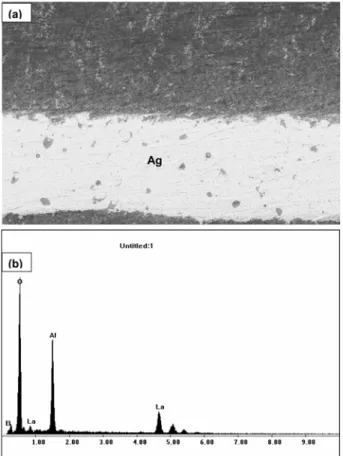
3 (850oC) and LaAl2B3O9 (950 oC), no new compound was formed after the treatment. A cross-section of a laminate L30A-Ag composite is shown in Fig. 5(a). The microstructure appears with a Ag layer of about 20 μm, and the interface between L30A (darker region) and Ag (the brightest layer).
Also, the EDS spectrum [Fig. 5(b)] shows that no Ag peak intensity is detected about 10 μm from the Ag layer. This implies that no Ag diffused into the L30A composite at 850oC in 30 min.
Dielectric Properties of LAB/Al
2O
3Composite
Several die-pressed LAB/Al2O3 cylinder specimens were sintered at 800oC for 1 h, or 800oC/1 h-850oC/10 min in air. Table 1 and Fig. 6 list the results of the sintered density and dielectric properties of various L2/ Al2O3 (LAB-A) glass-ceramic composites. There was a tendency that the dielectric constant decreased slightly as the content of Al2O3 filler increased, and the dielectric loss (tan δ) increased as the content of Al2O3 filler increased, as sintering at 800oC for 1 h. Also, pure L2 glass as a reference was also tested, and showed a relatively high dielectric constant and loss.LaBO3 is the major phase which crystallizes at 850oC. In order to compare the influence of LaBO
3, the above samples in a dense state were heat-treated at 850oC for 10 min. The results are shown in Fig. 7. The tendency of Al2O3 addition is similar to the results in Fig. 6. However, the dielectric loss obviously reduced to lower values after the crystallization of LaBO3 as the k value was similar. Considering the LAB-A samples,
1The details of crystallization kinetics are reported in our next article
which has been submitted to J. Europ. Ceram. Soc.
Fig. 4. XRD spectra of the L30A glass-ceramic composite
(powder mixture) cofired with the Ag-paste at different temperatures for 1 h in air.
Fig. 5. (a) SEM micrograph of L30A/Ag laminate layers and (b)
EDS spectrum of the area 10 μm next to the interface. The sample
had been heat-treated at 850oC for 30 min in air. The Ag layer had
a thickness of ca. 20 μm, and contained small amount of glass
the tan δ value increased as the content of Al2O3 increased due to the residual porosity. Herein the disadvantages of Al2O3 additions are noted, retarding densification and increasing the overall dielectric constant. The L30A glass-ceramic composite appears to have a lower dielectric constant (5.6-5.9) and tan δ value (1.4 to 5.5×10⁻³) in the test range of 10-1000 MHz. The composite is applicable as a low k substrate for microwave applications.
CTE, Thermal Conductivity and Dissolving Test
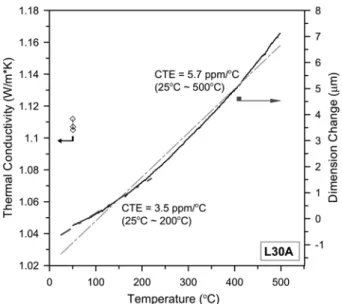
The thermal conductivity and coefficient of thermal expansion (CTE) for the L30A glass-ceramic com-posite are shown in Fig. 7. The average thermal conductivity of the L30A composite by three testing measurements was 1.11 W/m*K. Besides, the L30A composite presented a CTE value of 5.7 ppm/K from 50oC to 500oC and 3.5 ppm/K from 25oC to 200oC,
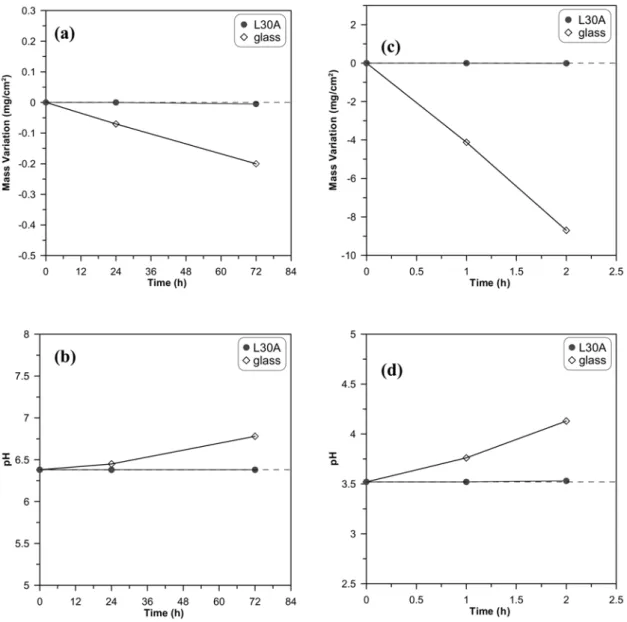
which is close to that of a Si chip (4 ppm/K). The mismatch between the L30A substrate and a Si chip is minimal. The values are acceptable and suitable for a substrate material used for microwave applications [3]. Figure 8 shows the dissolution results for sintered L2 glass and L30A composite. The samples showed distinct dissolution results, of which the L30A had no apparent mass loss and a very small pH variation in D.I. water and acid solution (pH = 3.5). However, the pH value changed from 3.5 to 4.2 [Fig. 8(c)] as the glass was tested in the acid solution. The mass loss of the L2 glass was nearly 9 mg/cm2 on testing in an acidic condition, which was almost 45 times higher than the testing result in the neutral aqueous solution.
In a recent report by Gaillardet and Allegre [15], boron ions were said to exist in sea-water as a boric B(OH)3 and the borate B(OH)4− species. The relative proportion of two species is dependent on the pH of solution. The pH value in the solution increases because of the [B(OH)4−], which means the pH value of the test solution changes with the dissolution of borate glass. Besides, the L30A sample is dense and nearly completely crystallized. Very little glass left in the composite is very important for a resistance to aqueous and acidic solutions used in a dissolution test. For applications of the boron-containing formulation, e.g. L30A, the component has a reasonable resistance to a high humidity environment as well.
Conclusions
One LAB (10%La2O3-10%Al2O3-B2O3) glass (L2) made into a composite with Al2O3 was densified by optimizing the sintering conditions so to reach densities better than 99% T.D., and gave excellent dielectric
Fig. 6. Relationship between dielectric constant (solid line) and
dielectric loss (dotted line) as a function of testing frequency of various LAB-A composites and L2 glass. The samples had been sintered at (a) 800oC for 1 h. (b) 850oC for 10 min in air.
Fig. 7. Thermal conductivity and dimensional change of the L30A
glass-ceramic composite (800oC for 1 h, 850oC for 10 min in air)
properties for microwave applications. The followings are asummary of the properties of the LAB glass and the composites.
The LAB-A composite was cofired with Ag to temperatures as high as 950oC. No new compound could be found between the L30A and Ag layer. The interface also showed good bonding and dense features after cofiring.
The dielectric constant of the LAB/Al2O3 glass-ceramic composite is in the range of 5.6 to 5.9, which decreases as the content of the Al2O3 filler increases, due to the residual porosity. In addition, the CTE and thermal conductivity of the L30A composite showed 5.7 ppm/K between 25oC to 500oC and 1.1 W/m*K, respectively. The L30A glass-ceramic composite show-ed acceptable acid resistance. However, the L2 glass showed an apparent dissolution in D.I. water and in the acid solution.
Acknowledgements
The authors would like to thank Professor A. Roosen for valuable discussions, and the tape casting facility offered by Department of Materials Science, Univer-sity. of Erlangen-Nuremberg, Germany. The financial support by NSC 92-2911-I-002-011 in Taiwan is also appreciated.
References
1. J.I. Steinberg, S.J. Horowitz, and R.J. Bacher, pp. 31-39 in Advances in Ceramic, Edited by J.B. Blum and W.R. Cannon, Vol. 19, Am. Ceram. Soc., Westerville, OH, 1986. 2. J.U. Knickerbocker, Am. Ceram. Soc. Bull. 67[4] (1988)
752-58.
3. R.R. Tummala, J. Am. Ceram. Soc. 74 (1991) 895-908. 4. S. Sridaran and M. Tomozawa, J. Mat. Sci. 27 (1993)
6747-54.
Fig. 8. (a) and (c) Mass variation as a function of aging time for the L2 glass and L30A glass-ceramic composites; (b) and (d) pH variation
5. S.H. Knickerbocker, A.H. Kumar, and L.W. Herron, Am. Ceram. Soc. Bull. 72[1] (1993) 90-95.
6. Y.M. Sung, J. Mat. Sci. 31 (1996) 5421-27.
7. T.K. Gupta and J.H. Jean, J. Mater. Res. 11[1] (1996) 243-63.
8. C.R. Chang and J.H. Jean, J. Am. Ceram. Soc. 82[7] (1999) 1725-32.
9. M.D. Mathews, A.K. Tyagi, and P.N. Moorthy, Thermo-chimica Acta 320[1-2] (1998) 89-95.
10. S.M. Yan, and M.F. Jose, Materials Letters 47 (2001) 833-36.
11. O. Dernovsek, A. Naeini, G. Preu, W. Wersing, M. Eberstein, and W.A. Schiller, J. Europ. Ceram. Soc. 21 (2001) 1693-97.
12. Y. Wang, G. Zhang, and J. Ma, Mat. Sci. and Eng. B94 (2002) 48-53.
13. W.C.J. Wei, C.L. Chen, and A. Roosen, Key Engineering Materials 2005.
14. C.L. Chen, W.C.J. Wei, and A. Roosen J. Europ. Ceram. Soc. (in press)
15. J. Gaillardet and C.J. Allegre, Earth and Planetary Science Letters 136 (1995) 665-76.

![TraditionalMLCalgorithmsmainlytacklethebatchMLCproblem,wheretheinputdataarepresentedinabatch[24,28].Nevertheless,inmanyMLCapplicationssuchase-mailcategorization[22],multi-labelexamplesarriveasastream.Onlineanalysisistherefore dimensionreducermotivatedbyma](data:image/gif;base64,R0lGODlhAQABAIAAAP///wAAACH5BAEAAAAALAAAAAABAAEAAAICRAEAOw==)