• 沒有找到結果。

FDG Uptake in Sacroiliac Joint Due to Osteitis Condensans Ilii Shown on PET/CT in a Patient With Breast Cancer

N/A
N/A
Protected

Academic year: 2021

Share "FDG Uptake in Sacroiliac Joint Due to Osteitis Condensans Ilii Shown on PET/CT in a Patient With Breast Cancer"

Copied!
3
0
0

加載中.... (立即查看全文)

全文

(1)

I

NTERESTING

I

MAGE

FDG Uptake in Sacroiliac Joint Due to Osteitis Condensans Ilii

Shown on PET/CT in a Patient With Breast Cancer

The Value of Coregistered CT in Avoiding Misinterpretation

Yang-Cheng Lee, MD,* Kuan-Yung Chen, MD,† Jainn-Shiun Chiu, MD,‡ Chia-Hung Kao, MD,§

and Guang-Uei Hung, MD*§

Abstract: A 56-year-old woman with breast cancer underwent FDG PET/CT

at follow-up. The PET images showed increased FDG uptake along right sacroiliac joint. The coregistered CT images showed diffuse sclerosis around the sacroiliac joints, but no bony destruction, periarticular erosion, or joint space narrowing. She had been complaining of intermittent lower back pain since her last pregnancy. The radiologic pictures and history of postpartum back pain were considered as typical characteristics for osteitis condensans ilii. This case reminds us that careful inspection of the coregistered CT images is important to avoid potential misinterpretation because of osteitis condensans ilii.

Key Words: false-positive, sacroiliac joint, osteitis condensans ilii, FDG,

PET/CT

(Clin Nucl Med 2012;37: e121– e123)

REFERENCES

1. Wong CL, Mansberg R. Solitary plasmacytoma of bone: an unusual cause of severe sacral pain in a young man. Clin Nucl Med. 2005;30:612– 624. 2. Halac¸ M, Mut SS, So¨nmezoglu K, et al. Avoidance of misinterpretation of an

FDG positive sacral insufficiency fracture using PET/CT scans in a patient with endometrial cancer: a case report. Clin Nucl Med. 2007;32:779 –781. 3. Patel CN, Smith JT, Rankine JJ, et al. F-18 FDG PET/CT can help differentiate

SAPHO syndrome from suspected metastatic bone disease. Clin Nucl Med. 2009;34:254 –257.

4. Thompson M. Osteitis condensans ilii and its differentiation from ankylosing spondylitis. Ann Rheum Dis. 1954;13:147–156.

5. Percy JS, Russell AS, Lentle VS. Letter: Osteitis condensans ilii. Lancet. 1975;1:1191–1192.

6. Olivieri I, Ferri S, Barozzi L. Osteitis condensans ilii. Br J Rheumatol. 1996;35:295–297.

7. Loneragan R, Archer K, Perry A, et al. Scintigraphy in osteitis condensans ilii.

Clin Nucl Med. 2004;29:320 –321.

8. Hsu HK, Huang CK, Bai YL, et al. False-positive bony FDG accumulations due to fractures in a patient with lung cancer: the value of integrated infor-mation of PET/CT. Ann Nucl Med Sci. 2009;22:183–187.

Received for publication December 13, 2009; revision accepted January 21, 2012. From the *Department of Hemato-oncology, Tainan Municipal Hospital, Tainan, Taiwan; Departments of †Radiology and ‡Nuclear Medicine, Chang Bing Show Chwan Memorial Hospital, Changhua, Taiwan; and §Department of Biomedical Imaging and Radiological Science, China Medical University, Taichung, Taiwan.

Conflicts of interest and sources of funding: none declared.

Reprints: Guang-Uei Hung, MD, Department of Nuclear Medicine, Chang Bing Show Chwan Memorial Hospital, 6 Lukon Road, Lukong Town, Changhua Shien, Taiwan 505, Taiwan. Email: [email protected].

Copyright © 2012 by Lippincott Williams & Wilkins ISSN: 0363-9762/12/3705-0121

(2)

FIGURE 2. The patient was followed up with radiography

shortly after FDG PET/CT. The image showed increased

densities around the iliac sides of bilateral sacroiliac joints,

more remarkable for right side (arrow), which was

characteristic of osteitis condensans ilii.

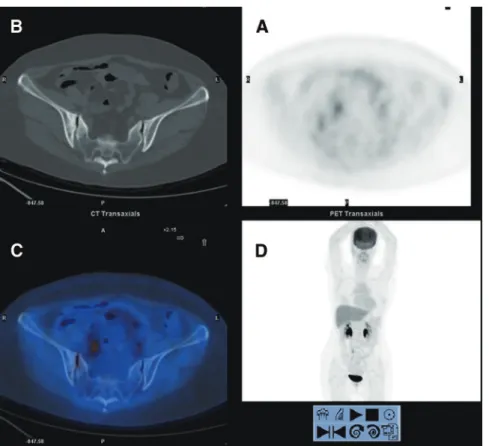
FIGURE 1. The transaxial PET (A), CT

(B), fused PET/CT (C), and maximum

intensity projection (MIP) (D) images

revealed focally increased FDG uptake

around right sacroiliac joint with a

maximum standardized uptake value of

4.41 at 1 hour (arrow), which might be

secondary to bony metastasis, primary

skeletal malignancy,

1

insufficiency

fracture,

2

or sacroiliitis.

3

The coregistered

CT images revealed diffuse sclerosis

around the iliac sides of bilateral

sacroiliac joints, more severe for right

side (arrow), but no finding of

suggesting metastasis, such as bony

destruction or erosion. In addition, there

was no joint space narrowing,

periarticular erosion, or osteoporosis,

which was characteristic of sacroiliitis.

Lee et al

Clinical Nuclear Medicine • Volume 37, Number 5, May 2012

(3)

FIGURE 3. The patient underwent FDG

PET/CT again at 2-year follow-up. The

transaxial PET (A), CT (B), fused PET/CT

(C), and MIP (D) images revealed only

mild FDG uptake in right sacroiliac joint

with a maximum standardized uptake

value of 2.17, showing significant

resolution of FDG activity compared with

previous study. No apparent change was

noted for the diffuse sclerosis shown on

the CT images. Considering both the

radiologic findings and patient’s history

of postpartum back pain, the skeletal

abnormalities were characterized as

osteitis condensans ilii (OCI).

4 – 6

It has

been reported that OCI might result in

an increased uptake in the sacroiliac

joints on

99m

Tc methyl-diphosphonate

(MDP) bone scintigraphy.

7

To the best

of our knowledge, this is the first report

demonstrating false-positive FDG uptake

because of OCI on PET, and the

coregistered CT image can help avoid

potential misinterpretation.

8

Clinical Nuclear Medicine • Volume 37, Number 5, May 2012

FDG-Avidity Due to Osteitis Condensans Ilii

數據

FIGURE 2. The patient was followed up with radiography shortly after FDG PET/CT. The image showed increased densities around the iliac sides of bilateral sacroiliac joints, more remarkable for right side (arrow), which was characteristic of osteitis conden
FIGURE 3. The patient underwent FDG PET/CT again at 2-year follow-up. The transaxial PET (A), CT (B), fused PET/CT (C), and MIP (D) images revealed only mild FDG uptake in right sacroiliac joint with a maximum standardized uptake value of 2.17, showing sig

參考文獻

相關文件

 Breast cancer in females and lung cancer in males are the most common malignant tumors metastasizing to the oral mucosa..  Metastatic lesion was the first sign of the

Two common surgical procedures, one of particular relevance to the dental practitioner, may result in damage to the chorda tympani (CT) nerve, which mediates taste perception on

 The second mode was found in case 2, case 3, and case 4: the bony window on CT scans showed ossification lesions around the condyle, and the bone cortex was destroyed, MRI

3D CT scan revealed depressed fracture involving the frontal bone on the right side, right parietal bone, and right superior orbital margin, right lamina papyracea.. The frontal

★ The main complaint of the patient in this case was the difficulty in swallowing due to the volumetric increase in the base of the tongue, which is one of the indications

A sixty-year-old female patient came to the Department of Oral and Maxillofacial Surgery, Faculty of Dental Medicine, Cairo University, complaining of bilateral swellings in

Our case highlights an enigmatic presentation of oral submucous fibrosis and its coexistence with oral cancer presenting with unusual neurological disturbance of the inferior

原文題目(出處): A Rare Report of Two Cases: Ancient Schwannoma of Infratemporal Fossa and Verocay Schwannoma of Buccal Mucosa(Annals of Maxillofacial Surgery 2017;7;140-2)