A Low-Cost, Architecture Design with Efficient Data Arrangement
and Memory Configuration for
MPEG-2 Audio Decoder
Tsung-Han Tsai, Liang- Gee Chen,Sheng-Chieh Huang,Hao-Chieh Chang,
Departmenit
ofElectrical Engineering, National Taiwan University, Taiwan, R.
0.
C.
Email: hanovideo. ee.ntu. edu.tw
ABSTRACT
The paper deslcribes a low-cost MPEG-2 audio decoder with a modified fast algorithm for decoding. In the modified decoding scheme, the computation amount of the bottleneck module can be reduced into one-forths of the original one. Also, the ma-
jor memory storage only requires half size of the s-
tandard synthesis subband filterbank. The decoder is developed for the approaches of simplicity and low-cost architectui:e design, with the techniques of intelligent d a t a arrangement and memory configu- ration.
extension of the existing standard t o lower sampling frequencies and lower bit rates. Besides, backward compatibility is the key aspects t o ensure the exist- ing two channel decoders will still be able t o decode compatible stereo information from five multichan- nel signals. This implies the provision of compati- bility matrices, using adequate inverse matrix coeffi- cients. Figure 1 describes the operation of MPEG-2 audio codec and the coding relationship among the five audio channels (L, R, C, LS, RS), the two basic channels (TO, T1) and the three extended channels (T2, T3, T4).
1. Introduction 3. The Modified Fast Algorithm for Decoding
The I S 0 MPEG,-2 audio standard has develope- d a world-wide standard audio coding algorith- m , which can significant reduce the requirements of transmission ba:ndwidth and data storage with low distortion. W.ith the recent advances in VL-
SI and ATM networking technology, the low-cost MPEG-2 audio decoder in real-time system be- comes more and more essential for multimedia ap- plications. This paper presents a low-cost MPEG-2 audio decoder, which is capable of decoding MPEG- 2 standard multichannel audio bitstream for Layer I
and I1 with a modi:fied decoding scheme. The mod- ified decoding scheme takes the advantages of low- cost computation and low memory requirements.
This
paper is also intended t o show an efficient da-t a arrangement and memory configuration for low complexity and high efficiency applications.
2. MPEG-2 Audio Coding
The MPEG-2 audio coding standard is an exten- sion of MPEG-1. Emphasis of the new activity is
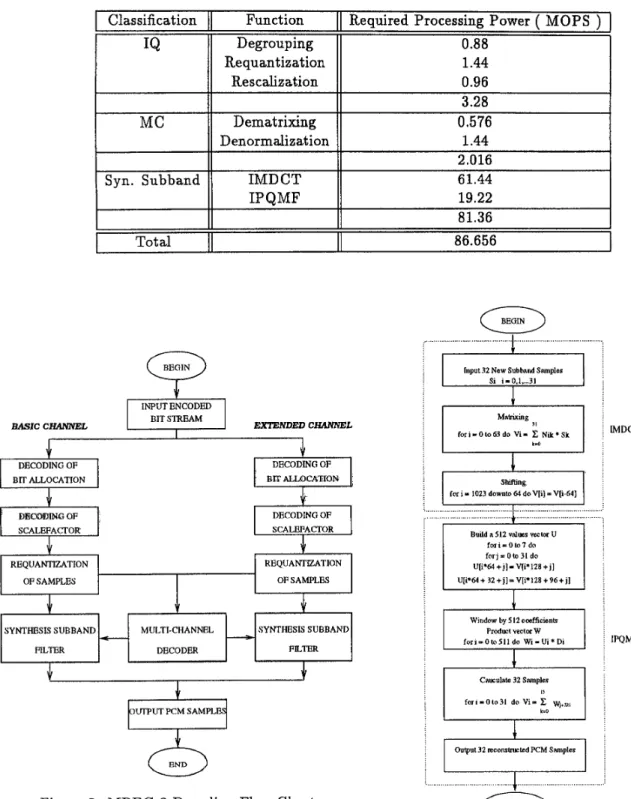
The MPEG-2 decoding flow chart is shown in Figure 2. Also, within the synthesis subband fil-
ter, the inverse Modified Discrete Cosine Transform (IMDCT), inverse Pseudo Quadrature Mirror Filter (IPQMF) will be further realized as shown in Figure
3. According to the computation power analysis for
MPEG-2 audio decoding in Table 1, the most com- putation load highly depends on the realization of IMDCT module.
First, the original inverse MDCT of a sequence
S ( k ) is defined as following [l]: (16
+
i)(2k+
1 ) ~ 31 =c
cos[ 64 l * s k(1)
k=Oi
= O , l ,...
63 Ic = 0,1, ... 31Taking the advantage of the symmetric proper- ties, the inverse MDCT standard function of Equa- tion (1) can be leaded into a new formula with a
on multichannel and multilingual audio and on w - @ u c t i o n of computation amount as following:
divided into five individual memory banks. Each bank matches an audio channel data. The bank can
*
/&,1-k] be decomposed further into 32 blocks. Each blockcontains 16 audio samples.
(2) According t o the proposed algorithm and the memory configuration, only 512 clocks is needed for the computation of the IMDCT transform. Also, the IPQMF takes 512 clocks for a cycle. These make
modules with high efficiency and as shown in Fig-
with
can be reduced Only to 512 word- two blocks. In the meantime, the IPQMF module blocks. The
for IPQMF can be realized by
Figure 7. These imply two pointers address the s-
tarting and ending blocks to realize a circular buffer access for the IPQMF shifting.
15 (32 + i ) ( 2 k
' I T ] *
[ s k+
( 64v;
= C C O S [ k=O i = 0 , 1 ,...
31k
= 0 , 1 , ... 15The proposed modified
requires about the pipeline processing with IMDCT and IPQMF 1/4 amount of multiplier-accumulate computation
quired size for the RAM buffer in which the QMF CT are written into synthesis window
data
s per channel, instead of the original size of 1024
words per channel. Table 2 shows the comparisons memory data
rithms for the computation complexity and memo- ry requirement
Of the Is' suggestion method' Moreover' the re- ure 6. In each cycle, the data processed from IMD-
reads the data from buffer with
between the Original and proposed decoding algo- the dedicated address generator and illustrated in
4. A r c h i t e c t u r e D e s i g n
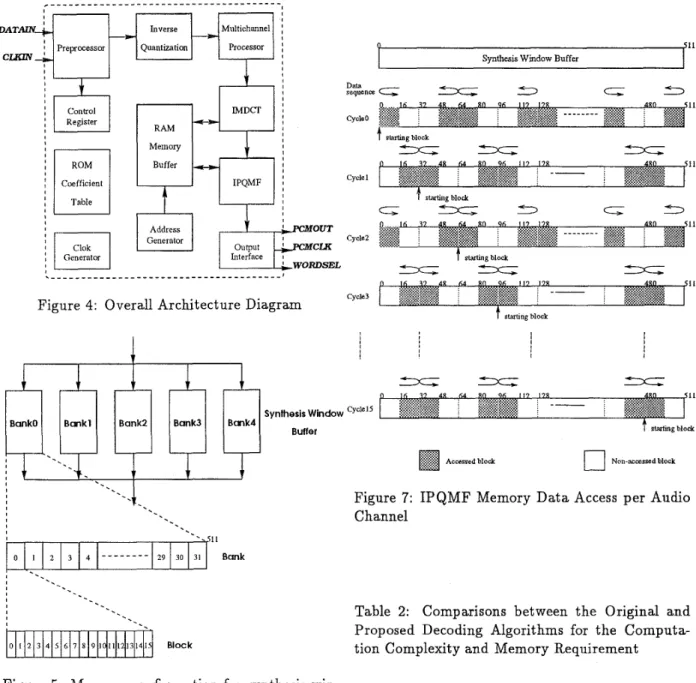
Figure 4 describes the overall architecture dia- gram of our proposed design. It includes 5 prima- ry modules called: preprocessor, inverse quantiza- tion, multichannel processor, IMDCT module and
er information from audio bit-stream (DATAIN), ciency design is realized. then extracts multichannel processing modes and
some control informations t o store in control reg- ister. Inverse quantization module processes the inverse quantization function to get the quantized samples. These samples are fed into multichannel
processor t o reconstruct five channel samples. The
synthesis subband filterbank, viewed as the most computation load, can be performed in two pipeline stage of IMDCT and IPQMF for high throughput consideration. These two modules mainly contain
a multiplier-accumulator (MAC) respectively. Fi-
6. Conclusions
We have described a low-cost MPEG-2 audio de- coder. Based on our modified fast algorithm for de- coding and efficient data arrangement and memory
IPQMF module* The preprocessor interprets head- configuration, the goal for low-cost and high effi-
R e f e r e n c e s
MPEG, "ISO CD 11172-3: coding of moving pictures and associated audio for digital storage media at up to about 1.5 Mb/s", Nov 1991.
[2] MPEG, "IS0 CD 13818-3: coding of moving pictures and associated audio for digital storage media at up to about 1.5 Mb/s", Nov 1994. [ 1 ~
nally the output interface performs the parallel-to-
serial operation t o get the five PCM audio channel L'
f
c
Lb
samples with some word select signals (WORDSEL) L5
and the associated PCM clock signal (PCMCLK). R1 n*
M P E G Z C i C o D f R MPIG-2 ENCODER
5 . Efficient Data A r r a n g e m e n t and Memory C o n f i g u r a t i o n
The synthesis window buffer takes the important role in synthesis subband process. Thus we take the efficient memory configuration for synthesis window buffer as shown in Figure 5. This buffer can k - 6 6
Figure 1: Backward Compatible for MPEG-2 Audio Codec
Table 1: Required Computation Power (MOPS) for MPEG-2 Decoding Function Degrouping Requantization Rescalization
D
ematrixing Denormalization IMDCT IPQMFI s i f i c a t i o n Required Processing Power
(
MOPS)
0.88 1.44 0.96 3.28 0.576 1.44 2.016 61.44 19.22 81.36 86.656 I& SYNTHESIS SUBBAND FILTER
kMC
MULTI-CHANNEL SYNTHESIS SUBBAND
c-
-
DECODER FILTER
1
5
SubbandBASIC CHANNEL EXTENDED CHANNEL
DECODING OF BIT ALLOCATION
c
c
DBCWItaG OF SCALEFACTOR REQUANTIZATION OF SAMPLES-
DECODING OF REQUANTIZATION W P U T PCM SAMPLEk
z
j
Figure 2: MPEG-2 Decoding Flow Chart
Input 32 New Subband Samples
I I I for]
-
0 lo 31 do U[i*64 +jl-VIi*l28 + jl1
Cawulate 32 Samples forl-Olo31 do Vi- z w ~ + ~ ~ IPQMFFigure 3: Synthesis Subband Flow Chart
I
Svnthesis Window BufferI
Bank0 Bank1 Bank2 Bank3 Bcnk4
Buffer
'.
t skulingblock=
cx_ 0 I 2 3 4 5 6 7 8 9 1 I l l 131415 11 Cycle I Block Function IMDCT I --.t.,..
Item Original Proposed Ratio MAC transform 1 4 Per 2048 512 Buffer Size IPQMF Per channel
Figure 5: Memory configuration for synthesis win-
dow buffer 1 2
-
1024 512 tim ! 11 , Cycle15 t skulingblotu
Non-accessed blockFigure 7: IPQMF Memory Data Access per Audio Channel
Table 2: Comparisons between the Original and Proposed Decoding Algorithms for the Computa- tion Complexity and Memory Requirement
Figure 6: Pipeline processing for IMDCT and IPQMF