VOLUME83, NUMBER4 P H Y S I C A L R E V I E W L E T T E R S 26 JULY1999
Anisotropic Peak Effect due to Structural Phase Transition in the Vortex Lattice
Baruch Rosenstein and Anton Knigavko Electrophysics Department, National Chiao Tung University,
Hsinchu, Taiwan 30050, Republic of China (Received 23 February 1999)
It is shown that the recently observed new peak effect in YBCO could be explained by the softening of the vortex lattice due to a structural phase transition in the vortex lattice. At this transition square lattice transforms into a distorted hexagonal one. While conventional peak effect is associated with the softening of shear modes (elastic modulus c66 vanishes) at melting, in this case the relevant mode is
“squash” mode (c11 1 c222 2c12vanishes). PACS numbers: 74.60.Jg, 74.20.De, 74.25.Dw
The conventional peak effect, a sudden increase of the critical current, has been observed in great variety of both low- [1] and high-Tc [2] superconductors. In
conven-tional superconductors the peak effect was theoretically explained a long time ago by Larkin and Ovchinnikov [3], while in high-Tc superconductors like untwinned
YBa2Cu3O72d (YBCO) it is generally believed that the
peak is due to the softening of the shear mode just before the first order melting transition of the vortex lattice (VL) takes place [4]. Recently however another peak in the critical current in YBCO has been discovered on a line almost parallel to the T axis starting from the melting line at H ⬃ 9 T and continuing to lower temperatures (Fig. 1). First it appeared only as a “fishtail” in magnetization hys-teresis loops [5], but recently a direct measurement of the critical current [6] clearly established a line presumably corresponding to some transition in the vortex matter (circles in Fig. 1).
Independently from these findings recent theoretical ad-vances indicate that in YBCO there could exist a structural phase transition (SPT) in the VL. Starting from certain microscopic models Ginzburg-Landau (GL) theory for the d 1 s wave superconductor on a square crystal lattice was constructed and the VL solution was studied [7]. The the-ory was simplified [8,9] so that it included just one, critical, order parameter and allowed easier derivation of essen-tial VL properties. In all cases analysis of the mixed state shows that a “distorted” hexagonal VL stable at lower mag-netic fields transforms into a square VL oriented at the angle q 苷 45±relative to the crystallographic关100兴 axis at higher fields. Experimentally, only a significantly dis-torted hexagonal phase has been observed in YBCO so far by means of scanning tunneling microscopy (STM) [10] and small-angle neutron scattering (SANS) [11,12]. Measurements, however, were performed at relatively low magnetic fields. A possible location of the SPT line can be inferred using the known theoretical dependence of the VL shape on a magnetic field [9]. In borocarbide super-conductors, an analogous SPT was firmly established by SANS and STM experiments [13] and the GL formalism had been proven adequate [14,15].
In this note we show that SPT in the VL manifests it-self as an anisotropic peak in the critical current. Thus we propose that the second line of peaks in the critical current of untwinned YBCO [6] could be explained by the softening of the “squash” elastic mode of VL (using terminology of [16]) on the line of SPT. We find that the characteristic size of vortex bundles depends on the orien-tation and we predict that the peak current oriented along 关100兴 and 关010兴 axes is larger than that oriented along 关110兴 and关1¯10兴 by a factor of p2. These features can distin-guish our scenario from another one in which a transition (or crossover) from the topologically ordered (Bragg) glass to vortex glass or pinned liquid was proposed [17].
We start with a description of SPT in VL and an estimate of its location on the phase diagram of untwinned YBCO. Qualitatively, anisotropy of the gap functions in both the d-wave (the dominant component) and the s-wave channels leads to an asymmetric four lobe shape of vortex cores [7]. This, in turn, causes VL to prefer the square arrangement. We employ a simple one field (d-wave) formulation of GL theory for fourfold symmetric
FIG. 1. Phase diagram of untwinned YBCO after Ref. [6] with solid circles being positions of the additional peak in the critical current. The dashed line is a possible location of the phase transition line from the distorted hexagonal lattice to the square lattice. Taking account of fluctuations would transform the phase transition line, as shown by the solid line.
VOLUME83, NUMBER4 P H Y S I C A L R E V I E W L E T T E R S 26 JULY1999 superconductors [8,9], F关c兴 苷 h¯ 2 2mab jD cj2 1 h¯ 2 2mc j=zcj22 ajcj21 b 2 jcj 4 1 ´j共Dy2 2 Dx2兲cj2. (1) Here Di ⬅ =i 2 i共eⴱ兾c兲Ai, i苷 x, y is the covariant
derivative, and eⴱ is the charge of the Cooper pair. The material parameter ´ quantifies deviations from the exact rotational symmetry. We assume that the magnetic field is in the c direction and is constant (far enough from Hc1, this
is a good approximation since k ¿1). At a certain value of ´ there is a phase transition from distorted hexagonal (point symmetry group D2h) to a more symmetric square
lattice (D4h). It is important for the calculation of the
elastic moduli to consider the VL of a most general form (see inset in Fig. 2). An elementary cell is specified by vectors a and b with an angle q between them. Angle w defines the orientation of VL relative to the crystal-lographic 关100兴 axis. Because of the flux quantization condition the relation ab sinq 苷 2p holds. One solves the linearized GL equation perturbatively in the dimen-sionless anisotropy parameter h ⬅ ´mabeⴱH and obtains
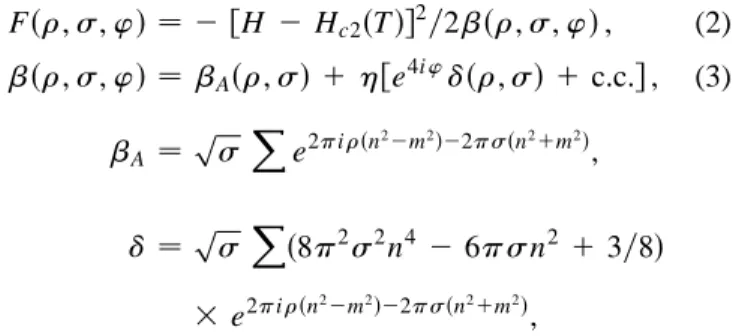
F共r, s, w兲 苷 2 关H 2 Hc2共T兲兴2兾2b共r, s, w兲 , (2) b共r, s, w兲 苷 bA共r, s兲 1 h关e4iwd共r, s兲 1 c.c.兴 , (3) bA 苷 p s Xe2pir共n22m2兲22ps共n21m2兲, d 苷ps X共8p2s2n42 6psn21 3兾8兲 3 e2pir共n22m2兲22ps共n21m2兲,
where b ⬅ 具jcj4典兾具jcj2典2 is the generalized Abrikosov
geometrical parameter, r⬅ 共b兾a兲 cosq and s ⬅ 共b兾a兲 sinq. The summation runs over all the integers or half integers m and n. To find the VL structure the energy
FIG. 2. Dependence of shear modulus c66 and squash
modu-lus csq 苷 c111 c22 2 2c12on parameter h which controls the
strength of the fourfold symmetric term in the free energy. Squash modulus vanishes at the phase transition point. Inset: Most general form of VL.
of Eq. (2) is minimized analytically over w and numeri-cally over r and s. At the minima r always equals to 1兾2 while the value of s depends on h and we denote it ass below. It was established [9,14] that the transition¯ occurs at hc 苷 0.0238. For every h , hc there are two
degenerate minima (one of them has w苷 0) which correspond to VL related by the p兾2 rotation around the c axis. On the mean field level the phase transition is of the second order with mean field critical exponents. For example, we calculated the dependence of the angle q 苷 arctan共2 ¯s兲 on h close to the transition point and found that q 苷 3.3共hc 2 h兲1兾2. These analytical results
were corroborated and extended by numerical simulations [15]. This is in agreement with the general result that perturbation theory in the GL model is valid far beyond its naive range of validity extending as far as to Hc2兾10 [18].
The line of STP in VL (dashed line in Fig. 1) is paral-lel to the T axis and goes at certain HSPT 苷 hc兾共´mabeⴱ兲.
Using q 苷 53.5 6 .5±at H 苷 2 T from Ref. [11] we es-timate that for the sample of Ref. [6] HSPT ⯝ 6 T. Since
the SANS experiment sample had twinning planes which prefer the square lattice, the actual line in an untwinned sample is roughly at the correct place and we just fit the data with a straight line at 9 T. Although a convincing estimate can be made only after similar measurements are performed on the same sample, the order of magnitude is correct. In some theoretical works the SPT line is slightly tilted (in a positive or negative direction) [9,14,15]. This is the effect of yet another four derivative term ´0j共D2
x 1
D2
y兲cj2. This term is rotationally symmetric and simply
modifies Hc2. The tilt angle is very small, of the order of
hc⬃ 1022.
Using thermodynamic arguments we calculate all the relevant nondispersive elastic moduli from Eqs. (2) and (3). The dispersive tilt modulus c44 [19] is not changed
significantly compared to the usual case without the asym-metry term, the last term of Eq. (1). In order to obtain all “in-plane” elastic moduli of the flux line lattice we first choose a particular form of distortion and then express the excess free energy corresponding to this distortion in terms of elastic moduli. Distortions of the lattice can be described by the displacement vector ui with i, j 苷 x, y.
Symmetric combinations of derivatives are denoted by uij ⬅ 共1兾2兲 共≠jui 1 ≠iuj兲, while the antisymmetric one
describing rigid rotations around the c direction is vxy ⬅
共1兾2兲 共≠yux 2 ≠xuy兲. The distortion energy of a deformed
two dimensional lattice is Fdist 苷 Fel 1 Frot with Frot 苷
z uxyvxy 1共1兾2兲z0vxy2 and Fel 苷 c11 2 u 2 xx 1 c22 2 u 2 yy 1 c12uxxuyy 1 2c66u2xy. (4)
Since the compression modulus is very large near the phase transition compared to all others and will not play a role in what follows, we assume that the magnetic flux through the elementary cell of the lattice is constant. This means that the area of the unit cell has to remain fixed: uxx 1 uyy 苷 0. Subject to this restriction it is
VOLUME83, NUMBER4 P H Y S I C A L R E V I E W L E T T E R S 26 JULY1999 possible to obtain the following two combinations of the
four elastic moduli: the shear c66 and the squash csq ⬅
c11 1 c22 2 2c12 in addition to z and z0. We used the
following infinitesimal displacements: u苷 m共6y ˆex 1
x ˆey兲, u 苷 m共x ˆex 2 y ˆey兲, u 苷 my ˆex, u苷 mx ˆey, and
obtained csq 苷 F0bss共2s兲2, c66 苷 F0brrs2 1 z兾4,
and z 苷 z0 苷 32hF0jdj, where F0 苷 dF兾db and sub-scripts of b denote partial derivatives. The right-hand sides of the above equations are evaluated at equilibrium values s 苷 ¯s and r 苷 1兾2 on both sides of the SPT line. Note that the rotation modulus z is proportional to the anisotropy parameter h. Calculated shear and squash moduli are presented in Fig. 2. The dependence of shear modulus on anisotropy is weak. On the other hand, the squash modulus vanishes on the SPT line linearly in jh 2 hcj but with different coefficients above and below the
transition point, csq 苷 ( 8.7j1 2 hh cj关H 2 Hc2共T兲兴 2, h c , h , 5.5j1 2 hhcj关H 2 Hc2共T兲兴2, hc . h . (5)
This is similar to the behavior of the soft moduli at structural phase transitions in solids.
The softening of the VL due to the vanishing of the squash modulus should lead to some peculiarities of those properties of the superconductor that depend on the elas-ticity of the VL. Below we argue that a peak in the critical current should appear once one crosses the transition line. To determine critical current jcwe follow the “dynamical
approach” [19,20] and write down the equation of motion for VL, sB2 c2 ≠u ≠t 苷 2 dFel du 2 dFpin du 1 1 c j 3 B, (6) where Fel is given by Eq. (4) and s is the normal state
conductivity. Equation (6) is solved perturbatively in the pinning energy Fpin 苷
R
d3r ´共r兲. The change of en-ergy due to pinning ´共r兲 depends on both the disorder potential and the vortex form factor; see [19]. One es-timates its correlator asRd3r具´共r兲´共0兲典eiK?r 苷 共2pF
0兾
B兲e2j2K2 ⬅ 共2pF0兾B兲W共K兲 [4], where K is a reciprocal
lattice vector. The second order correction to the flux flow velocity v0苷 共c兾sB2兲j 3 B is 2Dv v0 苷 pB F0 X K Z d3k 共2p兲3 W共K兲K2Kk2 P共k兲2 1共jBKk c 兲2 , (7) P共k兲 ⬅ c44kz21 c66共kx22 ky2兲21 csqk2xk2y k2 x 1 ky2 , (8)
where Kk 苷 K ? v0兾y0. In Eqs. (7) and (8) the fact that
the compression modulus is much larger than the other moduli was used. Let the current j flow at an angle u relative to the关100兴 axis. Since Kj ⬃ 1 and W共K兲 falls off exponentially we retain in the sum only the nearest
neighbors in the square lattice with Kk 苷 cos共u 6 p兾4兲,
2Dv v0 苷 2W共0兲 √ 2pB F0 !7兾4 共 jBc44c66csq兾c兲21兾2f共u兲 ,
f共u兲 苷 j cos共u 1 p兾4兲j3兾2 1 j cos共u 2 p兾4兲j3兾2. (9) The angular dependence is fourfold symmetric. To evalu-ate the critical current the condition Dv 苷 2v0is used,
jc共u兲 苷 4cW共0兲2共2pBF 0 兲 7兾2 Bc44c66csq f共u兲2. (10) Therefore the critical current along the crystallographic 关100兴 or 关010兴 axes is larger by a factor ofp2 compared to the one along 关110兴 or 关1¯10兴. For untwinned YBCO one estimates [4] W共0兲 苷 U02Bj2np, where np is point
pinning centers density and U0 is the depth of an
individual pinning potential. As in the melting peak effect [20] the effect of thermal depinning can be taken into account by an additional factor共1 1 T兾Tdp兲211兾2 where
Tdp is the depinning temperature. The case of “small
bundles” where the dispersion of c44 is important can be
treated analogously [4,19]. Because of different slopes of the moduli csqas a function of h 2 hc[see Eq. (5)] the
peak shape is asymmetric provided the general1兾B trend is eliminated, jcB⬃ 8 < : 1 8.7共B2Bstr兲, B , Bstr, 1 5.5共Bstr2B兲, B . Bstr. (11)
Of course the cutoff is understood when the character-istic size of the correlation volume (the Larkin domain) is no longer large compared to the distance between vortices. In this case the elasticity theory becomes inapplicable. To determine the applicability region of the elasticity theory we calculate the correlation length which is the most im-portant characteristic of the mixed state in the collective pinning theory. It is deduced from the displacement cor-relator 具u2共r兲典 ⬅ 具关u共r兲 2 u共0兲兴2典 苷 2W共0兲R d3k
共2p兲3关1 2 cos共k ? r兲兴Gij共k兲Gij共2k兲 [19] where Gij共k兲 is the elastic
Green’s function. In the present case we have具u2共r兲典 苷 2W共0兲R共2p兲d3k3关1 2 cos共k ? r兲兴P共k兲22 where P共k兲 is de-fined in Eq. (8). To determine the correlation length in a certain direction ofbn within the collective pinning theory one writes具u2共Rnˆnˆ兲典 苷 j2. The correlator in the c
direc-tion does not change compared to the case of the hexagonal lattice, 具u2共Rc兲典 苷 2W共0兲Rc兾共p3兾2c66c44兲, while in the
a-b plane it depends on the angle f that ˆnmakes with the crystallographic direction 关100兴: 具u2共R
f兲典 苷 关W共0兲Rf兾
p2csqc 1兾2 66 c
1兾2
44 兴 ˜f共f兲. The function ˜f共f兲 calculated
nu-merically is close to that of Eq. (9). The results are sig-nificantly different compared to the case of the peak effect associated with the VL melting where c66 vanishes and
具u2共R ab兲典 苷 W共0兲Rab兾共2p2c 3兾2 66 c 1兾2 44 兲. We see that 1兾csq
replaces1兾c66. In the present situation the Larkin domain
VOLUME83, NUMBER4 P H Y S I C A L R E V I E W L E T T E R S 26 JULY1999 is not only asymmetric with respect to a, b versus c
di-rections. Because of the particular orientation of the soft modes destroying the square lattice the correlation length becomes asymmetric within the a-b plane as well,
Rc 苷 p3兾2c66c44j2 2W共0兲 , Rf 苷 csqc 1兾2 66 c 1兾2 44 j2 W共0兲f共f兲 . Now we supplement the dynamical approach calculation of jc with a simpler and more intuitive derivation from
the correlation volume. The critical current in the certain direction u with respect to the crystal is determined by equating the Lorentz force to the pinning force. The pinning energy for the relaxed lattice is linked to the in-plane elastic energy due to the displacement of the order j in the direction u 1 p兾2 caused by the Lorentz force [19]. The elastic energy is Uc共u兲 ⬃ csq共j兾Ru1p兾2兲2Vc
where Vcis the correlation volume. Therefore the critical
current obtained from the balance of the Lorentz force and the pinning force is jc共u兲 苷 共c兾B兲Uc共u兲兾共jVc兲 ⬃
csqj0共j兾Ra兲2f共u 1 p兾2兲2where j0 苷 cHc兾共3
p
6 pl兲 is the depairing current. This agrees with the dynamical approach result.
There are two types of excitations near the transition. The first one is highly anisotropic: soft modes which are transverse waves propagating in关110兴 and 关1¯10兴 directions. The second one is domain walls similar to those in Ising magnets. The transition in our case is of the group — subgroup type. Such transitions are generally continuous (second order). One can use the standard methods [21] to write the GL theory in terms of the order parameter F ⬅ q 2 p兾4. Using the expression for the energy as a function of an angle Eq. (2) we obtain
F 苷 关2a共h 2 hc兲F2 1共b兾2兲F4兴 关H 2 Hc2共T兲兴2
with a 苷 7.0 and b 苷 1.2. It would be very interesting to directly observe the soft modes by excitation using ac current or other means.
Near the melting line the fluctuations become important. Experimental results [6] show that near the melting line the second peak line sharply turns down. On the basis of the present considerations it can be qualitatively understood. The reason is the symmetry breaking pattern. Liquid is a state in which both the continuous translation symmetry and the fourfold symmetry are unbroken. In the solid the translation symmetry is spontaneously broken down to its discrete subgroup, while the fourfold symmetry is still intact. Finally in the distorted hexagonal phase both symmetries are broken. The thermal fluctuations favor the square lattice, so first the fourfold symmetry is restored. On the basis of symmetry considerations alone it is impossible to determine whether the line should follow the melting line; see the solid line in Fig. 1 or that there exists a triple point. The phenomenon is somewhat remi-niscent of that of Alexander and McTague’s [22] in solids. To summarize the structural phase transition in the vortex lattice of YBCO or borocarbide superconductors
leads to an anisotropic peak effect via the vanishing of squash elastic modulus. We calculated the value of the peak in the critical current and its shape. The second order transition is accompanied by soft modes.
The authors are grateful to A. Kasatkin for valuable remarks. One of the authors (B. R.) is very grateful to L. Bulaevsky for discussions and to D. Huse for correspondence. The work was supported by a grant from the NSC of Taiwan.
[1] W. DeSorbo, Rev. Mod. Phys. 36, 90 (1964); K. Ghosh et al., Phys. Rev. Lett. 76, 4600 (1996); M. J. Higgins and S. Bhattacharya, Physica (Amsterdam) 257C, 232 (1996). [2] G. D’Anna et al., Europhys. Lett. 25, 225 (1994); W. K.
Kwok et al., Phys. Rev. Lett. 73, 2614 (1994); J. A. Fendrich et al., ibid. 77, 2073 (1996).
[3] A. I. Larkin and Yu. N. Ovchinnikov, J. Low. Temp. Phys. 34, 409 (1979).
[4] A. I. Larkin, M. C. Marchetti, and V. M. Vinokur, Phys. Rev. Lett. 75, 2992 (1995).
[5] K. Deligiannis, Phys. Rev. Lett. 79, 2121 (1997); H. Kup-fer et al., Phys. Rev. B 58, 2886 (1998); N. Kobayashi et al., Physica (Amsterdam) 246B – 247B, 433 (1998). [6] G. W. Crabtree et al., in Physics of Vortex State, edited by
S. Bose and R. Kossowski, NATO ASI (Kluwer Academic Publishers, Dordrecht, The Netherlands, to be published). [7] Y. Ren, J. H. Xu, and C. S. Ting, Phys. Rev. Lett. 74, 3680
(1995); A. J. Berlinsky et al., ibid. 75, 2200 (1995). [8] M. Franz, I. Affleck, and M. H. S. Amin, Phys. Rev. Lett.
79, 1555 (1997); I. Affleck, M. Franz, and M. H. S. Amin, Phys. Rev. B 55, R704 (1997).
[9] D. Chang et al., Phys. Rev. Lett. 80, 145 (1998); Phys. Rev. B 57, 7955 (1998).
[10] I. Maggio-Aprile et al., Phys. Rev. Lett. 75, 2754 (1995). [11] B. Keimer et al., Phys. Rev. Lett. 73, 3459 (1994);
J. Appl. Phys. 76, 6778 (1994).
[12] M. Yethiraj et al., Phys. Rev. Lett. 70, 857 (1993); S. T. Johnson et al., Phys. Rev. Lett. 82, 2792 (1998).
[13] U. Yaron et al., Nature (London) 282, 236 (1996); M. R. Eskildsen et al., Phys. Rev. Lett. 78, 1968 (1997). [14] Y. De Wilde et al., Phys. Rev. Lett. 78, 4273 (1997);
V. G. Kogan et al., ibid. 79, 741 (1997); V. G. Kogan et al., Phys. Rev. B 55, R8693 (1997).
[15] K. Park and D. A. Huse, Phys. Rev. B 58, 9427 (1998). [16] V. G. Kogan and L. J. Campbell, Phys. Rev. Lett. 62, 1552
(1989).
[17] T. Giamarchi and P. Le Doussal, Phys. Rev. B 52, 1242 (1995); 55, 6577 (1997); A. van Otterlo et al., Phys. Rev. Lett. 81, 1497 (1998); D. Ertas and D. R. Nelson, Physica (Amsterdam) 272C, 79 (1996).
[18] D. Li and B. Rosenstein, e-print cond-mat/9902294. [19] G. Blatter et al., Rev. Mod. Phys. 66, 1125 (1994). [20] A. I. Larkin and Yu. N. Ovchinnikov, Sov. Phys. JETP 38,
854 (1974); M. V. Feigel’man and V. M. Vinokur, Phys. Rev. B 41, 8986 (1990).
[21] J.-C. Toledano and P. Toledano, The Landau Theory of Phase Transitions (World Scientific, Singapore, 1987). [22] S. Alexander and J. McTague, Phys. Rev. Lett. 41, 702
(1978).
![FIG. 1. Phase diagram of untwinned YBCO after Ref. [6] with solid circles being positions of the additional peak in the critical current](https://thumb-ap.123doks.com/thumbv2/9libinfo/7503498.116682/1.918.473.837.747.976/phase-diagram-untwinned-circles-positions-additional-critical-current.webp)