DOI: 10.1007/s00340-004-1515-5 Appl. Phys. B 78, 685–687 (2004)
Rapi
d
communi
cati
on
Lasers and Optics
Applied Physics B
y.f. chen
Compact efficient self-frequency Raman
conversion in diode-pumped passively
Q-switched Nd
:GdVO
4
laser
Department of Electrophysics, National Chiao Tung University, Hsinchu, Taiwan
Received: 16 January 2004
Published online: 6 April 2004 • © Springer-Verlag 2004
ABSTRACT I report the first demonstration of the generation of efficient sub-nanosecond self-stimulated Raman pulses by a diode-pumped passively Q-switched Nd:GdVO4/Cr4+:YAG laser. The conversion efficiency for the average power is 7% from pump diode input to self-Raman output and the slope efficiency is up to 14%. At an incident pump power of 2.0 W, the pulse duration, pulse energy, and peak power for the Stokes wavelength of 1175.6 nm were found to be 750 ps, 6.3 µJ, and 8.4 kW, respectively, with a pulse-repetition rate of 22 kHz.
PACS42.55.Ye; 42.55.Xi; 42.60.Gd
As one of the most promising laser materials, neodymium-doped gadolin-ium orthovanadate (Nd:GdVO4) has been receiving considerable attention due to its high absorption coefficient and large thermal conductivity [1– 4]. In recent years, a GdVO4 crystal was predicted [5] to be a promising material suitable for stimulated Ra-man scattering (SRS), which is a well-known method of frequency conver-sion based on a third-order nonlin-ear optical process [6–9]. Therefore, a GdVO4 crystal is a very attractive self-SRS laser medium based on com-binations of its stimulated emission and SRS properties. Even so, a self-Raman laser based on Nd:GdVO4 has not been demonstrated in the available literature.
In this work I report, for the first time to my knowledge, the generation of efficient sub-nanosecond self-stim-ulated Raman pulses by a diode-pumped passively Q-switched Nd:GdVO4 laser. At an incident pump power of 2.0 W, the pulse duration, pulse energy, and peak power for the Stokes wavelength of 1175.6 nm were found to be 750 ps,
u Fax: +886-35-729-134, E-mail: [email protected]
6.3 µJ, and 8.4 kW, respectively, with a pulse-repetition rate of 22 kHz.
One important novelty in the present experiment is that a c-cut Nd:GdVO4 crystal was used to enhance the per-formance of passive Q-switching for ef-ficient Raman conversion. The GdVO4 crystal belongs to the group of oxide compounds crystallizing in a zircon structure with tetragonal space group. The four-fold-symmetry axis is the crys-tallographic c axis. Perpendicular to this axis are the two indistinguishable a and b axes. The uniaxial Nd:GdVO4 crys-tal shows strong polarization-dependent fluorescence emission due to the an-isotropic crystal field. In a Nd:GdVO4 crystal, the stimulated emission cross section parallel to the c axis,σ||, is sev-eral times higher than that orthogonal to the c axis, σ⊥, for the emission wave-length at 1.06 µm. The conventional Nd: GdVO4 crystal is cut along the a axis, i.e. a-cut, to use the stimulated emission cross section ofσ||, due to the fact that a larger stimulated emission cross sec-tion leads to a lower pumping threshold for cw laser operation. For a passively Q-switched laser, a small stimulated
emission cross section is usually ben-eficial to the criterion that the satura-tion in the absorber must occur before the gain saturation in the laser crystal (the second threshold condition) [10– 13]. When a Nd:GdVO4 crystal is cut along the c axis, i.e. c-cut, the effect-ive stimulated emission cross section is σ⊥ instead of σ||. Therefore, the c-cut Nd:GdVO4 crystal is more appropri-ate than the a-cut one for the passive Q-switching operation, because σ⊥ is several times smaller thanσ||.
It is of great importance to have a special dichromic coating on the cav-ity mirrors for efficient conversion in an intracavity Raman laser configura-tion. Figure 1 shows the experimen-tal configuration for the passively Q-switched Nd:GdVO4/Cr4+:YAG laser with self-frequency Raman conversion. The active medium was a 0.5 at. % Nd3+, 6-mm-long Nd:GdVO4 crystal. Both sides of the laser crystal were coated for antireflection at 1.06 µm (R< 0.2%). The pump source was a 2.5-W, 808-nm fiber-coupled laser diode with a core diameter of 200µm and a numerical aperture of 0.16. A fo-cusing lens with 16.5-mm focal length and 90% coupling efficiency was used to re-image the pump beam into the laser crystal. The pump spot radius, ωp, was around 100µm. The input mirror, M1, was a 15-mm radius-of-curvature concave mirror with an an-tireflection coating at the diode wave-length on the entrance face (R< 0.2%), a high-reflection coating at the las-ing wavelength (R> 99.8%), and a high-transmission coating at the diode wavelength on the other surface (T> 90%). Note that the laser crystal was placed very near the input mirror. The
686 Applied Physics B – Lasers and Optics
FIGURE 1 Schematic of a diode-pumped passively Q-switched Nd:GdVO4/Cr4+:YAG self-Raman
laser
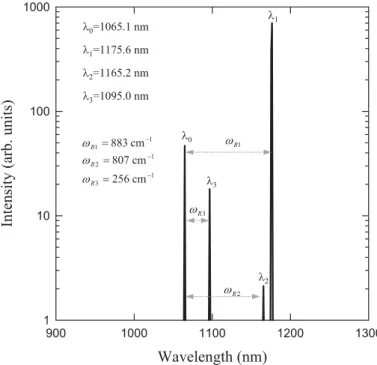
FIGURE 2 Optical spectrum for the passively Q-switched self-Raman output near the lasing threshold
FIGURE 3 The average output power and the pulse energy at the Stokes wavelength of 1175.6 nm with respect to the incident pump power
Cr4+:YAG crystal has a thickness of 2 mm with 70% initial transmission at 1.06 µm. Both sides of the Cr4+: YAG crystal were antireflection coated at the fundamental wavelength (R< 0.2%). The flat output coupler has a reflectivity R> 99.8% at 1.06 µm and R= 50% at 1.18 µm. The over-all Nd:GdVO4 laser cavity length was
approximately 14 mm. The spectral in-formation of the laser was monitored by an optical spectrum analyzer (Ad-vantest Q8381A). The spectrum ana-lyzer employing a diffraction lattice monochromator can be used for high-speed measurement of pulse light with a resolution of 0.1 nm. The pulse tempo-ral behavior was recorded by a LeCroy digital oscilloscope (Wavepro 7100, 10 Gs/s, 1-GHz bandwidth) with a fast PIN photodiode.
Initially, an a-cut Nd:GdVO4crystal
was used in the present cavity; however, the passive Q-switching process did not successfully operate. As a consequence, the intracavity fundamental power was not adequate to achieve Raman conver-sion. When a c-cutNd:GdVO4 crystal
was used in the laser cavity, the las-ing threshold for passive Q-switchlas-ing was found to be about 1.0 W. Near the lasing threshold, the optical spec-trum of the passively Q-switched self-Raman output displayed several lines, as shown in Fig. 2. Note that the strongest emission line of the Nd:GdVO4
crys-tal for the σ polarization is close to 1065 nm. The frequency shifts between laser and Stokes lines consist ofωR1= 883 cm−1,ωR2= 807 cm−1, andωR3= 256 cm−1, which agree very well with the optical vibration modes of tetrahe-dral VO3−4 ionic groups in the GdVO4
crystal [5].
For slightly far above threshold, the Stokes component of 1175.6 nm mostly predominated in the output power. Fig-ure 3 shows the average output power and the pulse energy at the Stokes wave-length of 1175.6 nm with respect to the incident pump power from the laser diode. With increasing pump power, the average output power reached 140 mW and the Stokes pulse energy remained nearly constant and was found to be 6.3 ± 0.2 µJ. The conversion efficiency from diode laser input power to Raman output power was approximately 7.0% and the slope efficiency was 14%. On the other hand, the pulse-repetition rate
CHEN Compact efficient self-frequency Raman conversion in diode-pumped passively Q-switched Nd:GdVO4laser 687
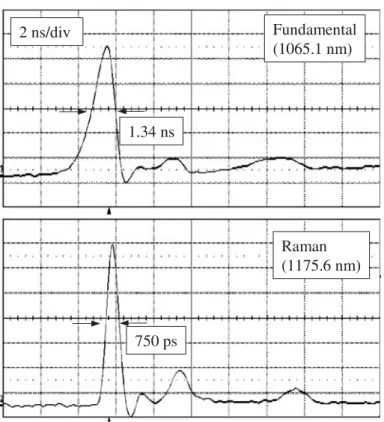
FIGURE 4 Typical oscilloscope traces for the fundamental and Raman pulses
changed from nearly 1 kHz at the thresh-old up to 22 kHz at a maximum pump power of 2.0 W.
The typical time shapes for the fun-damental and Raman pulses are shown in Fig. 4. It can be seen that the nonlin-ear frequency-conversion process leads to the pulse reduction of the Stokes component, as mentioned in previous work [14, 15]. The pulse duration of the Raman output was about 750 ps. As a consequence, the peak power was found to be higher than 8.4 kW.
The pulse-to-pulse amplitude fluctua-tion was found to be within±8%.
In summary, sub-nanosecond self-Raman conversion has been efficiently demonstrated in a diode-pumped pas-sively Q-switched Nd:GdVO4laser with
Cr4+:YAG as a saturable absorber. Ex-perimental results reveal that the self-frequency Raman conversion can be achieved with a c-cut Nd:GdVO4
crys-tal in a nearly hemispherical cavity. The compact size and high efficiency of the present self-Raman laser make it an
attractive source for practical applica-tions. At 2.0 W of incident pump power, the self-Raman laser produces stable 750-pspulses at the Stokes wavelength of 1175.6 nm with 6.3 µJ of pulse en-ergy at a 22-kHz repetition rate.
REFERENCES
1 T. Jensen, V.G. Ostroumov, J.P. Meyn, G. Hu-ber, A.I. Zagumennyi, I.A. Shcherbakov: Appl. Phys. B 58, 373 (1994)
2 V. Lupei, N. Pavel, Y. Sato, T. Taira: Opt. Lett. 28, 2366 (2003)
3 T. Ogawa, Y. Urata, S. Wada, K. Onodera, H. Machida, H. Sagae, M. Higuchi, K. Ko-daira: Opt. Lett. 28, 2333 (2003)
4 C.P. Wyss, W. Luthy, H.P. Weber, V.I. Vlasov, Y.D. Zavartsev, P.A. Studenikin, A.I. Zagu-mennyi, I.A. Shcherbakov: Appl. Phys. B 68, 659 (1999)
5 A.A. Kaminskii, K. Ueda, H.J. Eichler, Y. Kuwano, H. Kouta, S.N. Bagaev, T.H. Chyba, J.C. Barnes, G.M.A. Gad, T. Mu-rai, J. Lu: Opt. Commun. 194, 201 (2001) 6 G. Eckhardt, D.P. Bortfeld, M. Geller: Appl.
Phys. Lett. 3, 137 (1963)
7 W. Kaiser, M. Maier: in Laser Handbook, Vol.
II, ed. by F.T. Arecchi, E.O. Schultz-Dubois
(North-Holland, Amsterdam 1972) p. 1077 8 Y.R. Shen: The Principles of Nonlinear
Op-tics (Wiley, New York 1984)
9 T.T. Basiev, R.C. Powell: Opt. Mater. 11, 301 (1999)
10 A.E. Siegman: Lasers (University Science, Mill Valley, CA 1986) p. 1024
11 G. Xiao, M. Bass: IEEE J. Quantum Electron. QE-33, 41 (1997)
12 J.J. Degnan: IEEE J. Quantum Electron. QE-31, 1890 (1995)
13 Y.F. Chen, Y.P. Lan: Appl. Phys. B 74, 415 (2002)
14 J. Findeisen, H.J. Eichler, P. Peuser: Opt. Commun. 181, 129 (2000)
15 A.S. Grabtchikov, A.N. Kuzmin, V.A. Lisinet-skii, V.A. Orlovich, G.I. Ryabtsev, A.A. De-midovich: Appl. Phys. Lett. 75, 3742 (1999)