Fluorescence enhancement and structural development of sol–gel
derived Er
31-doped SiO
2by yttrium codoping
San-Yuan Chen,* Chu-Chi Ting and Chia-Hou Li
Department of Materials Science and Engineering National Chiao-Tung University, 1001 Ta-hsueh Road, Hsinchu 300 Taiwan, Republic of China. E-mail: [email protected]; Fax: 886-3-5725490; Tel: 886-3-5731818
Received 13th August 2001, Accepted 22nd January 2002
First published as an Advance Article on the web 4th March 2002
Er31–Y31codoped SiO
2powdered bulks were prepared by a sol–gel process. The effect of Y31codoping on
the fluorescence properties and structural development of Er31-doped SiO
2is investigated. The maximum
y1.54 mm photoluminescence (PL) intensity occurs in the sample with Er31
(10 mol%)–Y31(50 mol%) codoped and annealed at 985uC. This can be attributed to the competition between the content of hydroxy groups and Er site symmetry. Improvement of optimum PL properties due to Y31codoping by a factor of y20 for intensity and 1.8 for the full width at half maximum (57 nm) was obtained in comparison with the Er31-doped SiO
2system. Extended X-ray absorption fine structure analysis shows that the local chemical
environment of Er31ions in the Er31–Y31codoped SiO2is similar to that in Er2O3. The average spatial
distance between Er31ions is enlarged due to a partial substitution of Y31for Er31ions in the Er2O3-like local
structure, which results in a reduction of the concentration quenching effect.
1. Introduction
Rare-earth doped materials play very important roles in optoelectronics technology because they have good perfor-mance in the application of lasers and optical amplifiers.1–3 Among these rare-earth elements, they1.54 mm photolumi-nescence (PL) properties of Er31ions are of particular interest in fiber optical communication systems because it matches the lowest signal attenuation in silica-based optical fibers.4,5
They1.54 mm PL efficiency was strongly influenced by some factors such as the local symmetry of Er31sites in the host matrix, the concentration quenching effect, and the content of hydroxy impurities (OH2) in the sol–gel derived materials.6,7
In the case of free Er31ions, they1.54 mm optical emission of internal 4f–4f transitions (between the4I13/2first excited and the 4I
15/2ground state) is electric dipole forbidden. If the symmetry
of the local crystal field around the Er31lattice sites in the host matrix is distorted, the parity forbidden intra-4f transition will be allowed.8,9Additionally, for a high Er31doping, the Er31 ions tend to form clusters and the mean interaction distance between Er31ions becomes small, which results in substantial losses of excitation energy through the ion–ion interaction mechanism (e.g., co-operative up-conversion cross-relaxation and resonant energy migration) between the two nearby Er31
ions. In other words, the chemical environment of Er31ions (i.e. the site symmetry and clustering of Er31ions) in the host matrix significantly affects the luminescence efficiency. There-fore, the addition of specific heteroatoms into the host matrix to reduce the site symmetry and clustering of Er31ions will be
the most efficient method to promote the y1.54 mm PL intensity. For instance, it is well known that the solubility of Er31ions in silicate hosts is very low. Many researchers have tried to codope Al31or P31ions with Er31ions into a silicate
host in order to provide enough non-network oxygen species and hence decrease the concentration quenching effect.10–13 The addition of co-dopants Al31or P31ions has focused on the modification of the host matrix to improve the Er solubility. However, the structural role of Er in the host matrix has been neglected.
Y31/Er31ions have similar ionic radii (Y31~ 0.0892, and
Er31 ~ 0.0881 nm) and Y
2O3/Er2O3 have nearly the same
crystal structure and lattice constant. Therefore, we have tried to codope Y31ions into the Er31-doped SiO2network by the
sol–gel method in the present work. The role of the Y31 codopant in the phase development and PL properties of Er31
-doped silica materials will be investigated. Additionally, the extended X-ray absorption fine structure (EXAFS) technique will be used to analyze the influence of Y31ions on the local chemical environment around the Er31ions in an Er31–Y31 codoped SiO2system.
2. Experimental
2.1. Sample preparationTEOS [tetraethoxysilane, Si(OC2H5)4, Merck, 99.5%] was used
as the silicon alkoxide precursor for all of the Er31-doped samples. Erbium nitrate pentahydrate [Er(NO3)3?5H2O, Alfa,
99%], and yttrium nitrate pentahydrate [Y(NO3)3?5H2O, Alfa,
99%] were used as the sources of Er31 and Y31 ions, respectively. TEOS was first added to the mixture solution of deionized water and ethanol (Merck, 99.9%) (the molar ratio of TEOS : H2O : C2H5OH ~ 1 : 5 : 10), followed by stirring for
30 min. Then the erbium solution (erbium nitrate : H2O ~
1 : 10) and yttrium solution (yttrium nitrate : H2O ~ 1 : 10)
were spontaneously dropped into the initial TEOS solution. This sol solution was vigorously stirred at room temperature for 10 h in order to ensure a sufficient degree of hydrolysis and polycondensation. Molar ratios of Er31 and Y31(relative to Si41) ranging from 0.5 to 10% and 10 to 50% were used, respectively.
The final sol solutions were aged at room temperature for 6 days and gelled at 50uC in about 2 weeks. Gels were heat-treated at 100uC in air for 6 days and were then pyrolyzed at 700uC for 1 h in a dry oxygen atmosphere at a heating rate of 2uC h21
to remove organic species. Pyrolyzed gel powder was die-pressed to be a 1 cm-diameter pellet and then annealed at 800–1400uC for 1 h in a dry oxygen atmosphere at a heating rate of 10uC min21
.
1118 J. Mater. Chem., 2002, 12, 1118–1123 DOI: 10.1039/b107380j
2.2. Characterization measurements
The phase structure of the samples was determined by an X-ray diffractometer (MAC Science, M18X) using Cu-Ka radiation. Fourier transform infrared (FTIR) spectra were recorded on a Perkin–Elmer 580 spectrometer. A transmission electron microscope (TEM, JEOL-2000FX) equipped with EDX was used to observe and analyze the microstructure. The fluores-cence spectra were excited by a 980 nm laser diode with a power of 50 mW inclined 45u to irradiate the samples and recorded normally from the samples using a spectrophotometer equipped with a liquid N2-cooled Ge detector (NCSC).
Erbium LIII-edge X-ray absorption spectra were recorded on
Wiggler beamline S-05B at the Synchrotron Radiation Research Center (SRRC), Hsinchu, Taiwan. The electron storage ring was operated at an energy of 1.3 GeV and a current of 80–200 mA. A Si (111) double-crystal monochro-mator with a 0.5 mm entrance slit was used for energy scanning. The energy resolution, DE/E, was about 1.9 6 1024. Measurements were performed at room temperature in fluorescence mode and the sample was positioned at 45u to the incident X-ray beam. A polycrystalline Er2O3 powder
(Cerac, 99.9%) was used as a reference standard.
3. Results
The X-ray diffraction (XRD) patterns in Fig. 1 illustrate the effect of the annealing temperatures on the structural evolution of pure SiO2, Er31-doped SiO2and Y31-doped SiO2, where the
silicate host codoped with Er31(20 mol%)–Y31(0 mol%) and
annealed at 1100 uC is denoted as ‘‘Er20 Y0 1200 uC’’. For annealing temperatures below 1300 uC, the pure SiO2 host
exhibits an amorphous structure. The polymorphic SiO2 is
detectable when the annealing temperature exceeds 1400 uC. When 10 mol% Er31
ions were added into the SiO2
matrix, it was found that phase crystallization occurs at 1100 uC. With increasing Er31
concentration up to 20 mol%, the well-defined crystalline phase can be clearly identified as the Er-pyrosilicate phase (Er2Si2O7).14On the other hand, Y31-doped
SiO2 exhibits similar crystallization behavior to Er31-doped
SiO2 and also forms the polymorphic Y-pyrosilicate phase
(Y2Si2O7) at 1100 uC.15Notedly, both Er2Si2O7and Y2Si2O7
phases have almost the same XRD patterns, which means that both Er- and Y-pyrosilicates have the same crystal structure and nearly the same lattice constant.
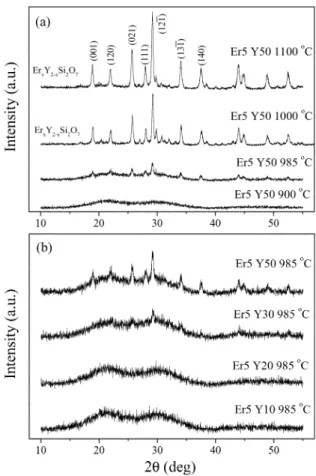
The effect of yttrium concentration on the phase evolution of the Er31 (5 mol%)-doped SiO2 at different annealing
tem-peratures is shown in Fig. 2. When annealed at 985 uC/1 h, even though as high as 50 mol% Y31 was added into the Er31-doped SiO2, the XRD pattern shows an amorphous
structure. The relationship between the total Er31 1 Y31 codoping concentration and annealing temperatures for the crystallization behavior of Er31–Y31codoped SiO2samples is
further summarized in Fig. 3. For example, when the total concentration of Er31and Y31ions is more than 30 mol%, the crystalline phase (ErxY22xSi2O7) will be generated for all of the
samples annealed at 985uC.
Fig. 4 shows the FTIR spectra of the Er31–Y31 codoped SiO2samples annealed at 800 and 1000uC for 1 h. The FTIR
spectrum of Er31 (5 mol%)–Y31 (10 mol%) codoped SiO2
annealed at 800uC is found to be similar to that of the pure silicate. The bands around 1079 cm21 and 796 cm21 correspond to the Si–O–Si antisymmetrical and symmetrical stretching vibrations, respectively.16,17,18The band around 455 cm21is due to the Si–O–Si and O–Si–O bending modes.18–20 However, with increasing Y31 concentration (from 30 to
Fig. 1 X-Ray diffraction patterns of SiO2 and Er31(or Y31)-doped
SiO2samples annealed at different temperatures for 1 h.
Fig. 2 X-Ray diffraction patterns of Er31(5 mol%)–Y31codoped SiO2
samples (a) annealed at temperatures of 900–1000uC/1 h, and (b) with different Y31concentration and annealed at 985uC/1 h.
Fig. 3 Dependence of crystallization behavior of Er31–Y31codoped
SiO2 samples on total Er31 1 Y31 codoping concentration and
annealing temperatures.
J. Mater. Chem., 2002, 12, 1118–1123
50 mol%), the band around 1079 cm21becomes broad and the band around 796 cm21gradually weakens and disappears. This
reveals that the network structure of short-range order tetrahedral SiO4was destroyed and became more disordered.
In addition, all of the samples exhibit a broad absorption in the 3000–3450 cm21region (the O–H stretching vibration) and a small band at y1620 cm21 (the molecular H–O–H bending
mode).18,21,22 This indicates that there exists a variety of hydroxy groups such as isolated Si–OH groups, pairs of hydrogen bonded Si–OH and physically adsorbed water molecules in the silica matrix.18,21,22
As the sample was annealed at 1000uC, some newly-formed peaks at 585, 851, 966 and 1084 cm21in the FTIR spectra were observed for the samples with a Y31 concentration above 30 mol% that could be related to the formation of the crystalline pyrosilicate ErxY22xSi2O7 phase. However, the
assignment of these peaks is not the focus of this paper. Additionally, the absorption bands around 3000–3450 and 1620 cm21have obviously disappeared. Since the content of hydroxy quenching centers is sensitive to the annealing tem-perature, the FTIR spectra in the range of 4000–3000 cm21 (where the intensity of absorption bands represents the content of hydroxy groups) were performed for the Er31 (5 mol%)– Y31 (50 mol%) codoped SiO2 samples annealed at 800–
1000uC. Fig. 5 illustrates that the content of hydroxy groups is rapidly reduced with an increase of annealing temperature from 970 to 1000uC.
Fig. 6 illustrates they1.54 mm PL spectra of the Er31
(1 and 5 mol%)–Y31(0–50 mol%) codoped SiO2samples annealed at
985uC for 1 h. These spectra exhibit a broad PL emission that consists of ay1.538 mm main peak and some broad shoulders. Moreover, the spectral bandwidths also become enlarged with
more Y31 codopant being added. Fig. 7 shows the annealing temperature dependence of they1.54 mm PL spectra observed from the Er31(5 mol%)–Y31(50 mol%) codoped SiO2samples.
The broad PL spectra will split into many sharp lines when the crystalline ErxY22xSi2O7phase is generated in the host matrix
at 1000uC.
The effect of annealing temperature on the PL intensity of the Er31(1–10 mol%)–Y31(50 mol%) codoped SiO2samples is
further illustrated in Fig. 8. The results reveal that the PL intensities were enhanced with increasing annealing tempera-tures from 800 to 985uC, while it decreased above 1000 uC. The dependence of Er31 and Y31 concentration on the PL intensity of Er31–Y31codoped SiO2samples annealed at 985uC
for 1 h is schematically summarized in Fig. 9. The PL intensity of the Er31 (5 and 10 mol%)–Y31 codoped SiO2
samples increases remarkably with the increase of the Y31 codoping level. However, for the Er31(1 mol%)–Y31codoped
SiO2samples, the PL intensities are slightly reduced when the
Y31codoping level exceeds 30 mol%. Notably, the PL intensity
of the Er31 (5 and 10 mol%)-doped SiO
2 sample can be
increased by a factor of almost 20 in the presence of 50 mol% Y31 codopant, demonstrating that Y31 codoping is a very efficient method for enhancing the PL intensity in the Er31 -doped SiO2system.
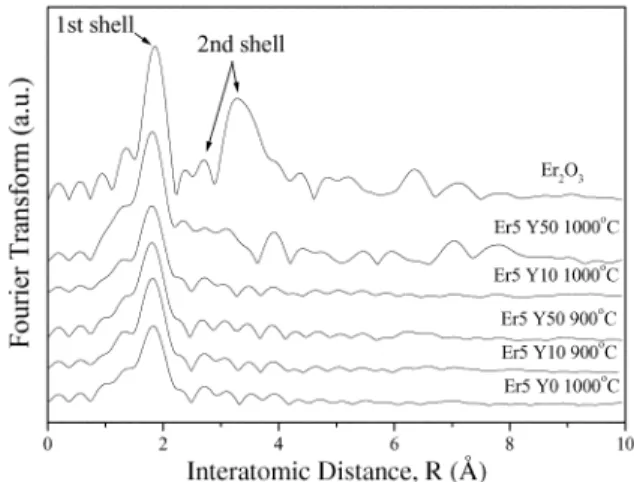
Fig. 10 shows the pseudo-radial distribution functions obtained from the k3-weighted Fourier transforms of the Er31–Y31codoped SiO2samples annealed at 900–1000uC for
1 h. Qualitative observation reveals that the first-neighbor
Fig. 4 FTIR absorption spectra of Er31–Y31codoped SiO 2 samples
annealed at different temperatures for 1 h.
Fig. 5 FTIR absorption spectra between 4000 and 3000 cm21showing
the effect of annealing temperature on the hydroxy content of Er31(5 mol%)–Y31(50 mol%) codoped SiO2samples.
Fig. 6y1.54 mm PL spectra of (a) Er31
(1 mol%) and (b) Er31(5 mol%)–doped SiO2samples with different Y31concentration codoped
and annealed at 950uC for 1 h. All of the spectra are normalized on the same basis of intensity for comparison among spectral features.
J. Mater. Chem., 2002, 12, 1118–1123
distance of Er31at 900uC is similar to that of the crystalline Er2O3, indicating that the first neighbors of Er31 ions are
primarily composed of O atoms. The second nearest neighbor distance of Er31is close to the distance of the second nearest
neighbor in Er2O3. Therefore, the local chemical environment
of Er31 ions in the amorphous Er31–Y31 codoped SiO2
samples is an Er2O3-like environment. At 1000uC, the EXAFS
curves of the Er31 (5 mol%)–Y31 (50 mol%) codoped SiO2
samples illustrate that the first shell is like that of Er2O3but its
outer shells are obviously different from those of amorphous samples because the coordination number of the Er31ion in the well-crystalline ErxY22xSi2O7phase is still 6-fold.23,24
4. Discussion
4.1. Influence of Y31content and annealing temperature on the PL properties
When the Er31(1–10 mol%)–Y31(0–50 mol%) codoped SiO2
samples were annealed at 950 uC, all of them have an amorphous structure and all exhibit similar broad PL spectra (see Fig. 6). However, there still existed an apparent difference in FWHM between these spectra. The FWHM isy45 nm for the Er31 (1 mol%)–Y31(10 mol%) codoped SiO2, which is
larger than that of the Er31(1 mol%)-doped SiO2without the
Y31codopant (FWHM ~y31 nm). The broadening of the PL spectra indicates that the Y31codopant plays a modifier role in affecting the bonding environment of Er31ions that can lead to a wider diversity of Er31 bonding sites. However, for Er31 (1 mol%)–Y31codoped SiO
2samples with a Y31concentration
varying form 10 to 50 mol%, the spectral bandwidth does not show an apparent difference. This implies that 10 mol% Y31 codoping is enough to modify the Er bonding environment and maximize the Er site diversity in the SiO2matrix. The
above-mentioned phenomenon is also observed for the Er31–Y31 codoped SiO2 samples with a larger amount of Er31 (5–
10 mol%). The full width at half maximum (y57 nm) is also larger than that (y40 nm) of the Er31
(5–10 mol%)-doped SiO2
without Y31codoping.
The phase evolution of Er31–Y31codoped SiO2samples is
strongly dependent on the Er31 1 Y31 concentration and annealing temperature. As shown in Fig. 3, for the samples with an Er311Y31concentration greater than 30 mol% and annealed above 985uC, the highly crystalline ErxY22xSi2O7
phase forms in the host matrix. The TEM micrograph of an Er31(5 mol%)–Y31(50 mol%) codoped SiO
2sample annealed
at 1000uC shows that many dark small droplet precipitates were observed (Fig. 11).25–27 The energy-dispersive X-ray (EDX) analysis reveals that these precipitates contain Er and Y elements. As compared with XRD patterns (Fig. 2(a)), these precipitates should be the ErxY22xSi2O7phase. This indicates
that most of the Er31ions are located on the well-defined sites
of the ErxY22xSi2O7phase. Therefore, a number of sharp PL
lines were observed as shown in Fig. 7.
Since both the content of hydroxy groups (i.e., quenching
Fig. 9 Dependence of Er31and Y31concentration on the PL intensity of Er31–Y31codoped SiO
2samples annealed at 985uC for 1 h.
Fig. 10 Fourier transform partial radial distribution function for the Er31–Y31codoped SiO
2samples annealed at 900–1100uC for 1 h.
Fig. 7 y1.54 mm PL spectra of Er31(5 mol%)–Y31(50 mol%) codoped
SiO2samples annealed at 900–1100uC for 1 h. All of the spectra are
normalized on the same basis of intensity for comparison among spectral features.
Fig. 8 PL intensity of Er31–Y31(50 mol% ) codoped SiO
2samples as
functions of Er31content and annealing temperatures.
J. Mater. Chem., 2002, 12, 1118–1123
centers) and the symmetry of local structure around the Er31 ions can affect the PL intensity, the final-revealed PL intensity results from the competition between these two factors. For the samples annealed at 970uC (i.e., no crystalline ErxY22xSi2O7
phase existing in the host matrix), the varying PL intensity is primarily related to the amount of OH2 hydroxy impurities. Therefore, in the temperature range 800–970 uC, the PL enhancement with increasing annealing temperature is mostly attributed to the decrease of the hydroxy quantity.28–31
When the annealing temperature reached 985uC, the poorly crystalline ErxY22xSi2O7phase had formed in the host matrix
and resulted in the reduction of the probability of the4I13/2A 4I
15/2 transitions. However, a maximum PL intensity was
observed at this temperature (985 uC) that reveals that the greatly decreased content of hydroxy quenching centers (see Fig. 5) can still offset the influence of the higher local symmetry of the Er site. On the other hand, as the samples were annealed at higher temperatures above 1000uC, the ErxY22xSi2O7phase
has been highly crystallized and thus the local structure around the Er31ions becomes more symmetric. Therefore, an abrupt
reduction of the PL intensity is observed.
4.2. Role of Y31codopant on the development of Er31local structure
EXAFS analysis in Fig. 10 shows that there is local Er2O3-like
structure in the amorphous Er31–Y31 codoped SiO2 host
matrix. These Er sites with Er2O3-like local symmetry are
generally thought of as the active luminescent centers.32–34 Because Er31and Y31have the same valence and similar ionic radii (0.0881 and 0.0892 nm, respectively), they could be replaced by each other. Therefore, by codoping Y31ions into the Er31-doped SiO2network, we believe that the –Er–O–Er–
O–Er– bonding structure can be possibly changed into –Er–O– (Y–O)n–Er–, which indicates that the average interionic
distance between Er31 ions can be enlarged. Additionally, the FTIR spectra (see Fig. 4) shows that the addition of a large number of Y31codopant could destroy the network of SiO2,
leading to an increase of non-bridging oxygen groups in the SiO2matrix as observed in the Er31-doped SiO2system by Al31
codoping.10–13 Some works reported that the non-bridging oxygen groups can reduce the tendency of the Er31ions to cluster.10,13According to the above-mentioned mechanism, the Y31 codopant plays an important role in increasing the
dispersion and solubility of Er31ions in the amorphous Er31– Y31codoped SiO2systems, which results in a reduction of the
concentration quenching effect and an increase of PL intensity. These explanations are very consistent with our experimental results evidenced in Fig. 9. When the Y31codoping concentra-tion is 0 and 10 mol%, the variaconcentra-tion of PL intensity shows the phenomenon: I(1%)?I(5%)?I(10%) [where I(1%)represents the PL
intensity of the sample with 1 mol% Er31 doping dose]. However, for the 20 mol% Y31codoping concentration, the
phenomenon changes to I(5%)?I(10%)?I(1%). This indicates that 10
mol% Y31 codoping concentration is still not enough to
disperse Er31ions very well and a large amount of Er31ions (5 and 10 mol%) still have access to form clusters. When a 20 mol% Y31codoping concentration was used, however, the
influence of the concentration quenching effect on I(5%) and
I(10%)can be considerably reduced.
For the sample with Y31concentration above 30 mol%, as the poorly crystalline pyrosilicate phase (ErxY22xSi2O7) was
crystallized in the host matrix, it can be assumed that the Er31 ions are located in the Y2Si2O7matrix. If the Er31ions were
postulated to randomly disperse in the ErxY22xSi2O7phases,
then the average spatial distance between Er31ions should be enlarged because some Er sites were occupied by Y31ions. This indicates that the concentration quenching effect can be reduced and hence the PL intensity is enhanced for the Er31 (5–10 mol%)–Y31 (30–50 mol%) codoped SiO2 samples.
Therefore, the addition of a large amount of Y31 (30–
50 mol%) codopant still efficiently disperses the Er31 (5– 10 mol%) ions, which can offset the PL intensity loss resulting from the symmetry effect of the Er site.
5. Conclusion
Er31–Y31codoped SiO2powdered bulks were prepared by a
sol–gel process. The maximum y1.54 mm PL intensity was obtained for the Er31(10 mol%)–Y31(50 mol%) codoped SiO2
sample annealed at 985 uC. This can be attributed to the competition between the content of hydroxy groups and Er site symmetry. Below 985uC, the content of hydroxy groups plays an important role in PL intensity. On the other hand, above 1000uC, the highly crystalline ErxY22xSi2O7phase forms and
the local environment around the Er31 ions becomes more symmetrical, resulting in reduced PL intensity and better resolved PL spectra. Additionally, the Y31codopant not only affects the crystallization behavior of the Er31–Y31codoped SiO2 sample but also modifies the bonding environment of
Er31 ions, which leads to an enlarged interionic distance
between two nearby Er31ions and a wider diversity of Er31 bonding sites. Therefore, a larger bandwidth ofy1.54 mm PL spectrum with improved efficiency is obtained for the Er31–
Y31codoped SiO2system.
Acknowledgements
The authors would like to thank the National Science Council of the Republic of China for financially supporting this research under Contract No. NSC-89-2216-E-009-034. Dr H. Y. Lee and Dr J. F. Lee of the Synchrotron Radiation Research Center are appreciated for EXAFS measurements and helpful discussions.
References
1 M. J. Weber, J. Non-Cryst. Solids, 1990, 123, 208.
2 B. Pedersen, W. J. Miniscalco and R. S. Quimby, IEEE Photonics Technol. Lett., 1992, 4, 446.
3 R. Reisfeld and Y. Eckstein, J. Chem. Phys., 1975, 63, 4001. 4 W. F. Krupke and J. B. Gruber, J. Chem. Phys., 1963, 39, 1024. 5 W. F. Krupke and J. B. Gruber, J. Chem. Phys., 1964, 41, 1225. 6 E. Bescher and J. D. Mackenzie, Mater. Sci. Eng. C, 1998, 6(2–3),
145.
7 K. Kojima, K. Tsuchiya and N. Wada, J. Sol–Gel Sci. Tech., 2000, 19, 511.
8 B. R. Judd, Phys. Rev., 1962, 127, 750.
9 R. M. Moon, W. C. Koehler, H. R. Child and L. J. Raubenheimer, Phys. Rev., 1968, 176, 722.
10 K. Arai, H. Namikawa, K. Kumata, T. Honda, Y. Ishii and T. Handa, J. Appl. Phys., 1986, 59, 3430.
11 C. K. Ryu, H. Choi and K. Kim, Appl. Phys. Lett., 1995, 66, 2496. 12 B. J. Ainslie, S. P. Craig and S. T. Davey, Mater. Lett., 1987, 5,
143. Fig. 11 TEM micrograph of Er31(5 mol%)–Y31(50 mol%) codoped
SiO2annealed at 1000uC for 1 h.
J. Mater. Chem., 2002, 12, 1118–1123
13 Y. Zhou, Y. L. Lam, S. S. Wang, H. L. Liu, C. H. Kam and Y. C. Chan, Appl. Phys. Lett., 1997, 71, 587.
14 ASTM JCPDS International Centre for Diffraction Data, 1997 [Ref.: 24-0062: Pfoertsch].
15 ASTM JCPDS International Centre for Diffraction Data, 1997 [Ref.: 32-1448 and 40-0034: Pfoertsch].
16 A. M. Efimov, J. Non-Cryst. Solids, 1996, 203, 1.
17 L. G. Hwa, S. L. Hwang and L. C. Liu, J. Non-Cryst. Solids, 1998, 238, 193.
18 A. A. Salem, R. Kellner and M. Grasserbauer, Glass Technol., 1994, 35, 135.
19 N. A. El-Shafi and M. M. Morsi, J. Mater. Sci., 1997, 32, 5185. 20 T. Ishikawa and S. Akagi, Phys. Chem. Glasses, 1987, 19, 108. 21 K. Sun, W. H. Lee and W. M. Risen, Jr, J. Non-Cryst. Solids, 1987,
92, 145.
22 R. F. Bartholomew, B. L. Butler, H. L. Hoover and C. K. Wa, J. Am. Ceram. Soc., 1980, 63, 481.
23 K. Hafidi, Y. Ijdiyaou, M. Azizan, E. L. Ameziane, A. Outzourhit, T. A. Nguyen and M. Brunel, Appl. Surf. Sci., 1997, 108, 251. 24 Y. I. Smolin and Y. F. Shepelev, Acta Crystallogr. Sect. B: Struct.
Crystallogr. Cryst. Chem., 1970, 26, 484.
25 L. L. Lee and D. S. Tsai, J. Mater. Sci. Lett., 1994, 13, 615. 26 W. V. Moreshead, J. R. Nogue`s and R. H. Krabill, J. Non-Cryst.
Solids, 1990, 121, 267.
27 A. Polman, J. Appl. Phys., 1997, 82, 1.
28 Y. Yan, A. J. Faber and H. de Waal, J. Non-Cryst. Solids, 1995, 181, 283.
29 E. Snoeks, P. G. Kik and A. Polman, Opt. Mater., 1996, 5, 159. 30 M. Benatsou, B. Capoen, M. Bouazaoui, W. Tchana and
J. P. Vilcot, Appl. Phys. Lett., 1997, 71, 428.
31 J. Phalippou, T. Woignier and J. Zarzycki, in Ultrastructure Processing of Ceramics, Glasses and Composites, Eds. L. L. Hench and D. R. Ulrich, Wiley, New York, 1984, p. 70.
32 D. L. Adler, D. C. Jacobson, D. J. Eaglesham, M. A. Marcus, J. L. Benton, J. M. Poate and P. H. Citrin, Appl. Phys. Lett., 1992, 61, 2181.
33 C. Piamonteze, A. C. In˜iguez, L. R. Tessler, M. C. Martins Alves and H. Tolentino, Phys. Rev. Lett., 1998, 81, 4652.
34 A. Terrasi, G. Franzo`, S. Coffa, F. Priolo, F. D’Acapito and S. Mobilio, J. Appl. Phys., 1997, 70, 1712.
J. Mater. Chem., 2002, 12, 1118–1123