Fragile Watermarking for Authenticating
3-D Polygonal Meshes
Hsueh-Yi Sean Lin, Hong-Yuan Mark Liao, Senior Member, IEEE, Chun-Shien Lu, Member, IEEE, and Ja-Chen Lin
Abstract—Designing a powerful fragile watermarking technique
for authenticating three-dimensional (3-D) polygonal meshes is a very difficult task. Yeo and Yeung [34] were first to propose a fragile watermarking method to perform authentication of 3-D polygonal meshes. Although their method can authenticate the integrity of 3-D polygonal meshes, it cannot be used for localiza-tion of changes. In addilocaliza-tion, it is unable to distinguish malicious attacks from incidental data processings. In this paper, we trade off the causality problem in Yeo and Yeung’s method for a new fragile watermarking scheme. The proposed scheme can not only achieve localization of malicious modifications in visual inspection, but also is immune to certain incidental data processings (such as quantization of vertex coordinates and vertex reordering). During the process of watermark embedding, a local mesh parameteriza-tion approach is employed to perturb the coordinates of invalid vertices while cautiously maintaining the visual appearance of the original model. Since the proposed embedding method is indepen-dent of the order of vertices, the hidden watermark is immune to some attacks, such as vertex reordering. In addition, the proposed method can be used to perform region-based tampering detection. The experimental results have shown that the proposed fragile watermarking scheme is indeed powerful.
Index Terms—Authentication, fragile watermarking,
parame-terization, polygonal meshes, tampering detection.
I. INTRODUCTION
T
RANSFERRING digitized media via the Internet has be-come very popular in recent years. Content providers who present or sell their products through networks are, however, faced with the copyright protection problem. In order to prop-erly protect the rights of a content owner, it is desirable to de-velop a robust protection scheme that can prevent digital con-tents from being stolen or illegally distributed. From a user’s point of view, after receiving a piece of digital content, he/she usually needs to verify the integrity of the content. As a result, there should be an authentication mechanism that can be used to perform the verification task. With the rapid advance of water-marking technologies in recent years, many investigators have devoted themselves to conducting research in this fast growing area. According to the objectives that a watermarking techniqueManuscript received June 17, 2003; revised September 25, 2004. The asso-ciate editor coordinating the review of this manuscript and approving it for pub-lication was Dr. Ton A. C. M. Kalker.
H.-Y. S. Lin and J.-C. Lin are with the Department of Computer and Infor-mation Science, National Chiao-Tung University, Hsinchu 300, Taiwan, R.O.C. (e-mail: [email protected]; [email protected]).
H.-Y. M. Liao and C.-S Lu are with the Institute of Information Science, Academia Sinica, Taipei, Taiwan 115, R.O.C. (e-mail: [email protected]; [email protected]).
Digital Object Identifier 10.1109/TMM.2005.858412
may achieve, two main-stream digital watermarking categories are: robust watermarking and fragile watermarking. While the former aims to achieve intellectual property protection of dig-ital contents, the latter attempts to authenticate the integrity of digital contents.
There are a great number of existing robust watermarking algorithms designed to protect three-dimensional (3-D) graphic models [1]–[3], [6], [7], [16], [18], [21]–[27], [33], [36]. Their common purpose is to provide a robust way to protect target contents when attacks are encountered. The existing fragile watermarking algorithms that are designed to authenticate 3-D graphic models are relatively few. In [10], Fornaro and Sanna proposed a public key approach to authenticating constructuve solid geometry (CSG) models. In [17], Kankanhalli et al., proposed the use of content-based signature to authenticate 3-D volume data. In [34], Yeo and Yeung proposed a fragile water-marking algorithm for authenticating 3-D polygonal meshes. They embed a fragile watermark by iteratively perturbing vertex coordinates until a predefined hash function applied to each vertex matches the other predefined hash function applied to that vertex. Since their embedding algorithm relies heavily on an ordered traversal of vertices, it is capable of detecting object cropping. However, the consideration of causality disables it from localization of changes and robustness against vertex reordering. In addition, particular attacks, such as floating-point truncation or quantization, applied to vertex coordinates might increase the false-alarm probability of tampering detection.
In this paper, we trade off the causality problem in Yeo and Yeung’s method for a new fragile watermarking scheme. The proposed scheme can not only achieve localization of malicious modifications in visual inspection, but also is immune to the aforementioned unintentional data processings. In addition, the allowable range for alternating a vertex is explicitly defined so that the new scheme is able to tolerate quantization of vertex coordinates (up to a certain amount). During the process of watermark embedding, a local mesh parameterization approach is employed to perturb the coordinates of invalid vertices while cautiously maintaining the visual appearance of the original model. Since the proposed embedding method is independent of the order of vertices, the hidden watermark is immune to some vertex order-dependent attacks, such as vertex reordering. The remainder of this paper is organized as follows. In Section II, Yeo and Yeung’s scheme for authenticating 3-D polygonal meshes is briefly reviewed. In Section III, the pro-posed fragile watermarking method is described in detail. Experimental results are given in Section IV. Finally, conclu-sions are drawn in Section V.
II. YEO ANDYEUNG’SAPPROACH ANDITSDRAWBACKS In [34], Yeo and Yeung proposed a novel fragile water-marking algorithm which can be applied to authenticate 3-D polygonal meshes. In Yeo and Yeung’s scheme [34], there are three major components, i.e., two predefined hash functions and an embedding process. For a given vertex, the vertex is identified as valid if and only if the values calculated by both hash functions are identical. Otherwise, the vertex is identified as invalid. During the authentication process, invalid vertices are considered as the set of vertices that has been tampered with. On the other hand, valid vertices indicate the set of ver-tices which has never been modified. In the embedding process, the coordinates of valid vertices are kept unchanged, but those of invalid vertices are iteratively perturbed until each of them becomes valid.
The first step in Yeo and Yeung’s approach is to compute lo-cation indices. In this step, the first hash function is defined by a conversion function and associated with a given watermark pat-tern . The conversion function is used to convert a vertex
coordinate into a location index .
The idea behind the conversion function is to map a 3-D co-ordinate onto a two-dimensional plane formed by a watermark
pattern of dimension . As a
result, the location index is used to point to a particular posi-tion in the watermark pattern. Then, the content of that particular position (either 0 or 1) is used for the purpose of com-parison. Since the conversion function defined in [34] calculates the centroid of the neighboring vertices of a given vertex, the causality problem occurs. Furthermore, the traversal of vertices during the alternation of vertex coordinates must take causality into account so as to avoid error propagation.
The second step in Yeo and Yeung’s approach is to compute value indices. In this step, the second hash function is related to a set of look-up tables (LUTs), i.e., , , and . These LUTs, which are composed of sequences of bits, are generated and protected by an authentication key. Yeo and Yeung [34] pro-posed to convert each component of a vertex coordinate into an integer number so as to index it into each of the LUTs. The con-tent of an indexed location is either 0 or 1. The three binary values derived from the three coordinates are then XORprocessed to generate a final binary value. This bi-nary value is used as one of the components for deciding whether the current vertex is valid or not. If the vertex is not valid, then it is perturbed until it is valid. The amount of change that makes this vertex valid is the watermark embedded.
After establishing the above-mentioned two hash functions, the next step is to perturb the coordinates of all invalid vertices until they become valid. In [34], the authors proposed an iter-ative procedure which can gradually perturb an invalid vertex until both hash functions are matched. On the one hand, in order to maintain transparency, the embedding procedure must tra-verse in an orderly manner each vertex during the alteration of vertex coordinates. In addition, the ordering of vertices must be maintained during the watermark extraction process. The benefit of taking the causality into account is for protection against changes of connectivity (in particular cropping). How-ever, the drawback is that their method cannot achieve
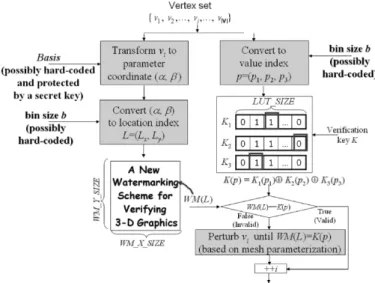
local-Fig. 1. Flowchart of the proposed authentication scheme for 3-D polygonal meshes.
ization of malicious modifications in visual inspection. In ad-dition, their method cannot tolerate certain incidental modifi-cations, such as quantization of vertex coordinates and vertex reordering. This drawback to some extent limits the power of Yeo and Yeung’s method. In this paper, we shall propose a new scheme that is more powerful than the existing fragile water-marking algorithms.
III. PROPOSEDFRAGILEWATERMARKINGMETHOD In this section, we shall propose a new fragile watermarking scheme for authenticating 3-D polygonal meshes. In order to tackle the issues that were not handled by Yeo and Yeung [34], we employ the following concepts. 1) Each hash function can be designed so as to form a binary state space particularly helpful for defining the domain of allowable alternation for a given vertex. Accordingly, the domain of acceptable alternation for a given vertex can be defined as the intersection of the binary state spaces where the values of both hash functions match each other. 2) In order to resolve the causality problem, the conver-sion function used in the first hash function can be designed to simply perform the mapping from the 3-D space to a 2-D plane without considering the neighboring vertices of a vertex. Based on the above two concepts, we have designed a new scheme, which is shown in Fig. 1. With the new authentication scheme, malicious attacks applied to 3-D polygonal meshes can be easily distinguished from certain incidental modifications. In what fol-lows, we shall describe our authentication scheme in more de-tail.
A. Computing Location Indices
Since the conversion function used in the first hash function (the left hand side of Fig. 1) aims to calculate the location index that can be used to locate a particular bit in the watermark pat-tern, any functions that can transform a 3-D coordinate into a 2-D coordinate can serve this purpose. Therefore, it is pos-sible to use some parameterization schemes to achieve the goal. As mentioned in the previous section, Yeo and Yeung did not use an analytical method to perturb invalid vertices. However,
Fig. 2. Illustration of the robustness construction: (a) basis for cylindrical parameterization [14]; (b) side view of the binary state space formed by the quantized cylindrical parameterization domain; (c) the side view of the binary state space formed by the conversion function for computing value indices; and (d) the two binary state spaces superimposed on a sidepiece of the cylindrical mesh with irregular connectivity.
a systematic perturbation strategy is always preferable. There-fore, we propose to adopt the parameterization-based approach to make the vertex perturbation process analytic. For the pur-pose of clarity, we propur-pose to split the location index computa-tion process into two steps.
Step 1: Given a vertex coordinate , the specified parame-terization converts the vertex coordi-nate into a parameter coordicoordi-nate. We propose to use so-called cylindrical parameterization [14] to per-form the conversion task. The procedure involved in performing cylindrical parameterization is as fol-lows [14]:
Given an oriented 3-D point, it is composed of a 3-D point and its orientation . As shown in Fig. 2(a), a cylindrical parameterization process1
can be expressed as
(1) where is the coordinate in the parameter do-main. The range for each dimension of the
param-eter domain is and ,
re-spectively.
1Note that although an oriented point defines five degrees of freedom (DOF) basis(m; n), the proposed method is not immune to geometrical transforma-tions. This results from the fact that whether a vertex is valid or not is guarded by the two hash functions.
Step 2: Convert the parameter coordinate formed in Step 1 into the so-called bin coordinate, i.e., the lo-cation index . This conversion can be accomplished by quantizing the parameter do-main. In addition, a modulus operator is required to map them onto the dimension of a watermark pattern. In what follows, we shall describe how the parameter domains are quantized. Assume that the size of a 2-dimensional watermark pattern is , the quanti-zation formula for a cylindrical parameteriquanti-zation domain is as follows:
(2) where is the quantization step for ordinary nu-meric values and % represents a modulus operator. A very important feature of the above design is that the quan-tized parameterization domain and the watermark pattern to-gether form a binary state space. Such a state space is helpful for defining a legal domain of alternation for a given vertex. The side-view of the binary state space corresponding to the quantized cylindrical parameterization domain is illustrated in Fig. 2(b).
B. Computing Value Indices
Even though any functions for converting a floating-point number into an integer can be used to calculate value indices, the following conversion function was designed since it is able to form a binary state space. Assuming that the size of each LUT is , the conversion function is formulated as
(3) where is the same quantization step as used to compute loca-tion indices.
The side-view of the binary state space corresponding to the above conversion function is illustrated in Fig. 2(c). In addition, Fig. 2(d) reveals that the domain of acceptable alternation for a given vertex can be defined as the intersection of the binary state spaces where the values of both hash functions applied to that vertex match each other. More precisely, for a valid vertex the displacement applied to its original coordinates will depend on the value of and thus it will make change as well. As long as the displacement for both location and value indices does not vary beyond the aforementioned domain of ac-ceptable alternation, the vertex will be identified as intact by our scheme. As a result, the encoded location and value indices will be robust to a certain extent of quantization.
C. Watermark Embedding
Since both hash functions have been well-designed to define the domain of acceptable alternation for a given vertex, the
Fig. 3. Proposed alternation procedure for an invalid vertex.
embedding procedure can focus on perturbing the coordinates of invalid vertices while maintaining transparency. In the remeshing-related literatures [9], [20], [28], [31], [37], the points over the surface of the polygonal model have frequently been used for resampling the geometry of a model. We, there-fore, apply a local mesh parameterization approach proposed in [20] for finding a valid point on the surface of a polygonal mesh. Assume that the polygonal model to be watermarked is a closed and oriented two-manifold mesh that has been triangulated, our method is as follows: Given an invalid vertex and its neighboring vertices in the counter-clockwise
order , where is the number of
’s neighboring vertices, the proposed alternation procedure for an invalid vertex is divided into five steps, which can be explained with the help of Fig. 3. The details of the five steps are as follows.
Step 1: Transform the vertex coordinate into the param-eter coordinate and its neighboring
ver-tices to ,
respectively, using arc-length parameterization. Let be the angle formed by vectors and . Then, the parameter coordinates are provided with the following properties [9]:
(4) (5) where
If we set and , the
pa-rameter coordinates can be easily
derived from (4) and (5). Hence,
form the boundary vertices of the star-shaped planar polygon with in its kernel. In
addi-tion, are the boundary vertices
of the polygon with one internal vertex . Let denote the triangle formed by the parameter
coordinates and denote the triangle
formed by the vertex coordinates for . Then, the two triangle sets and form the triangulation of the planar polygon and the polygon , respectively.
Step 2: Establish the local mesh parameterization by means of the well-known barycen-tric mapping. Let denote an arbitrary point inside
the planar polygon and denote the
signed area of the triangle formed by the vertices , , . Then, there exists a unique
such that the barycentric coordinates of will cor-respond to the triangle and have the following forms:
(6) The three barycentric coordinate components are all of the same sign. Hence, the corresponding point on the surface of the polygon can be represented as a combination of the points with re-spect to as follows:
(7) Step 3: Define an allowable region for alternating an invalid vertex in the parameter domain. Let the region be a shrunken ring whose origin is the parameter coor-dinate, , and let the scale for shrinkage be 0.5. (As shown in Fig. 2(d), for some invalid vertices to find a valid state may sacrifice a great deal of the orig-inal quality. As a result, the shrunken ring defined here can be regarded as the maximum bound of dis-tortion induced by alternating an invalid vertex. In addition, it can avoid geometrical degeneracies, like triangle flipping, T-joints, etc.)
Step 4: Distribute a set of points
randomly on the allowable region.2Next,
find a new parameter coordinate satisfying the condition
(8) where is the barycentric mapping derived from (6) and (7). If there does not exist such a new param-eter coordinate, alternation for the current invalid vertex is skipped, and is assigned.
Step 5: Record the new vertex coordinate . Note that the set of random points generated in Step 4 can be sorted according to its geometric distance to the parameter coordinate , in such a way that the new parameter coordinate can be chosen not only satisfying (8) but also minimizing the distortion. Currently, this feature has not been considered in our implementation since the maximum distortion has been bounded as described in Step 3. As for maximizing the robust-ness, the domain of acceptable alternation can be mapped onto the parameter domain using the inverse of the parameterization . Then, the new parameter coordinate that max-imizes the robustness can be determined. Since the efficiency of
the algorithm would be degraded, this feature has not been im-plemented in our system. As for the performance of our method, it is a natural outcome of the Step 4 that a certain amount of invalid vertices may remain untouched/invalid. We, therefore, propose some possible solutions to optimize the performance in the following section.
D. Analysis and Discussion
In this section, we shall conduct a thorough analysis of our authentication scheme for 3-D polygonal meshes. The watermarking parameters that can influence the quality of transparency and robustness are the shrinkage scale and bin size. On the other hand, we also know that the correlation value can never reach 1. Therefore, we shall examine several crucial issues: 1) how to optimize the performance so that can be very close to 1; 2) how to balance the competition between transparency and capacity using the shrinkage scale; and 3) how to guarantee the robustness of a hidden watermark. Before discussing the above mentioned issues, we adopt the correlation value used by Yeo and Yeung [34] and formulated it as
(9) where is the vertex set of a mesh and is the total number of vertices. Note that the correlation is the ratio of the number of valid vertices to the total number of vertices (instead of a linear correlation coefficient). In what follows, we shall discuss the aforementioned issues.
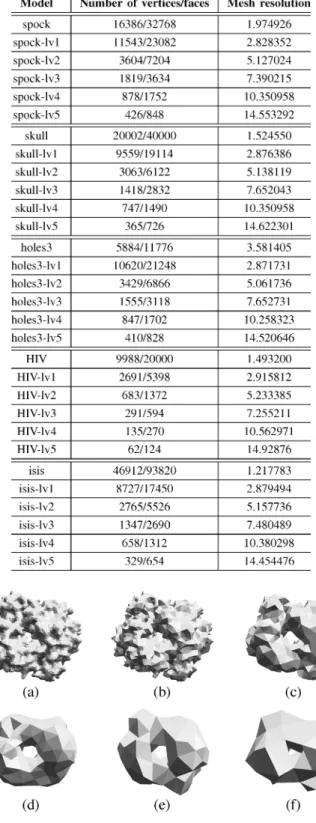
First of all, we aim to optimize the performance of our al-gorithm so that the watermark correlation value can be very close to 1. In our investigation, there are two possible solutions to optimize the performance. The first solution is to adopt a smaller quantization step, which would increase the possibility of finding a valid state. Such an approach will be a great benefit to the maintenance of transparency. However, the drawback is that the robustness would be sacrificed as well. An alternative solution is to make the spacing between vertices regular while maintaining the shape of a 3-D mesh. In such an approach, the robustness can benefit greatly from the specified quantization step (i.e., the bin size). However, the drawback is that the shape of the mesh would be simplified significantly when the spacing between vertices is increased. Our intention here is to maintain the robustness when encountering certain incidental modifica-tions, such as vertex quantization and noise addition. We, there-fore, picked five different models to generate analysis models with different mesh resolutions using a mesh resolution control algorithm described in [15].3Furthermore, for each model, we
generated five analysis models corresponding to different mesh resolutions. Thirty analysis models and their mesh resolutions are listed in Table I. Fig. 4 shows the flat-shaded HIV model and its analysis models corresponding to five different mesh resolu-tions. In the watermarking process, we fixed the shrinkage scale
3In [15], the resolution of a mesh is defined as the median of its edge length histogram. In addition, the edge length spread is defined as the half-width (upper quartile minus lower quartile) of the histogram. The goal of the mesh resolution algorithm is to adjust the resolution of the original mesh to a desired resolution while minimizing the edge length spread of the histogram.
TABLE I
LIST OF30 TRIANGULATEDMESHESUSED IN THEANALYSIS
Fig. 4. Analysis models for the HIV protease surface model: (a) original HIV model; (b) HIV-lv1 model; (c) HIV-lv2 model; (d) HIV-lv3 model; (e) HIV-lv4 model; (f) HIV-lv5 model.
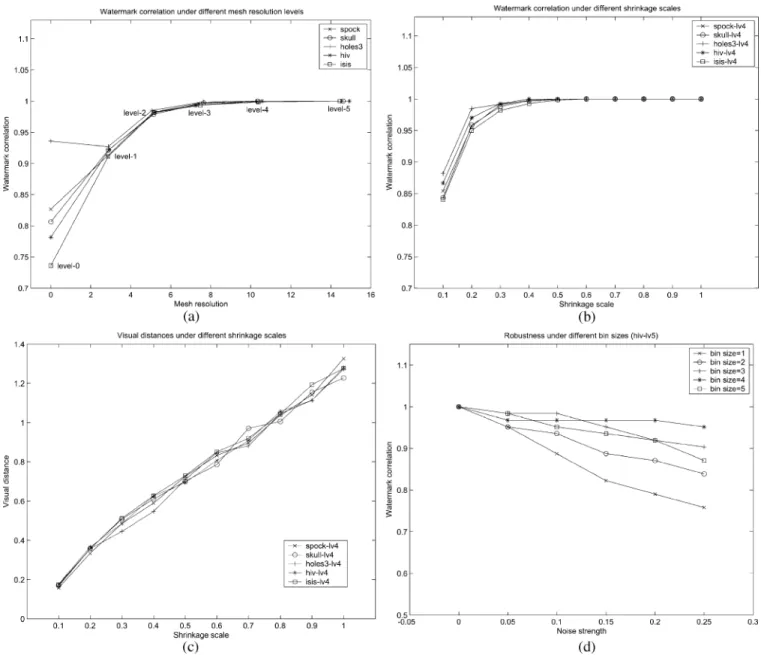
as 0.5 and the bin size as 2. With varied mesh resolution levels, our fragile watermark was embedded into each model to test the effect of the mesh resolution on the watermark correlation value. In addition, we ran each test five times using different keys and reported the median value. Fig. 5(a) shows the effect of different mesh resolutions on the watermark correlation value.
Fig. 5. (a) Effect of the mesh resolution on the watermark correlation value. Note that the mesh resolution of “0” indicates that the original models were not influenced by the mesh resolution control algorithm; (b) effect of the shrinkage scale on the watermark correlation value; (c) effect of the shrinkage scale on the transparency of our fragile watermark; and (d) robustness under different bin sizes for the HIV-lv5 model.
Obviously, the curves shown in Fig. 5(a) reveal that a polyg-onal mesh with higher mesh resolution would possess higher capacity for watermarking.
In order to investigate how the shrinkage scale can force a compromise between transparency and capacity, a suitable visual metric was needed to evaluate the difference between the original model and the watermarked model . In [19], Karni and Gotsman proposed the use of Root-Mean-Square measure plus a Laplacian-based visual metric to capture human visual preceptibilities. The RMS metric simply captures the geometric distance between corresponding vertices in both models. On the other hand, the Laplacian-based metric can capture more subtle visual properties (such as smoothness) with respect to both the topology and geometry. The geometric Laplacian operator applied to a vertex is defined as
(10)
where is the set of indices of ’s neighboring vertices, and is the geometric distance between vertices and . Hence, the visual difference between the original model and the wa-termarked model can be expressed as
(11) In the mesh-based watermarking literature [7], the above men-tioned visual metric has been used to capture the geometric dis-tortion between two models. We, therefore, adopted this visual metric to measure the transparency. In this analysis, we picked five models that were at the fourth resolution. We chose the bin size and the shrinkage scale as 2 and 0.5, respectively. With var-ious shrinkage scales, our fragile watermark was embedded into each model for transparency and capacity tests. In the same way,
we ran each test five times using different keys and reported the median value. Fig. 5(b) and (c) shows the effects of different shrinkage scales on the watermark correlation value and PSNR value, respectively. From Fig. 5(b) and (c), it is clear that the best choice of shrinkage scale is 0.5.
In order to demonstrate how robust our watermark is, we attacked the embedded watermark by means of randomization of vertex coordinates. To simulate such attacks, randomization of vertex coordinates was controlled by means of the noise strength, which is defined as the ratio of the largest displace-ment to the longest edge of the object’s bounding box. In this analysis, we picked five models with the largest resolution level from the set of analysis models and fixed the shrinkage scale at 0.5. With various bin sizes, our watermark was embedded into each model and then attacked using different noise strengths in robustness tests. In the same way, we ran each test five times using different keys and reported the median value. Fig. 5(d) shows the results of robustness tests using different bin sizes for the HIV-lv5 model. From these plots, it can be seen that a larger bin size can provide a hidden watermark with higher robustness. However, the drawback is that the false-alarm rate is increased as well.
IV. EXPERIMENTALRESULTS
A series of experiments were conducted to test the perfor-mance of the proposed fragile watermarking method. We shall start with parameter selection and then report quantitatively some experimental results. In addition, we shall present a set of visualization results that can demonstrate the power of the proposed method in distinguishing malicious attacks from incidental modifications.
A. Selecting Appropriate Parameters
We have reported in Section III that several parameters were needed during watermark embedding and detection. These pa-rameters included a binary watermark pattern, a set of LUTs, a basis for parameterization, and the degree of quantization. All of the parameters used in our experiments were set as follows. A binary watermark pattern with a size of 512 512 (as in-dicated in Fig. 6) was used in our experiments. That means, . In addition, a set of LUTs were generated and protected by one authentication key. The size of each table was 256. Therefore, . As to the basis for parameterization, since the 3-D vertex space is periodically aggregated into binary state spaces, its selection is not crucial to the proposed method. Therefore, we fixed the
basis as and in the experiments. As for
ap-propriate quantization steps, we assigned the ordinary numeric value, , in all the experiments such that the performance of our method is close to optimal (i.e., ). The selection of was based on the experiments gained from conducting quite a number of experiments. However, since the selection is an ill-posed problem, it is hard to systematically determine a right value that can fit in all cases.
One thing to be noted is that the basis and the quan-tization step together can possibly be hard-coded into the al-gorithm so that detecting a watermark for the purpose of au-thentication can be realized as oblivious detection. However, the
Fig. 6. Binary watermark pattern used in our experiments.
TABLE II
LIST OFFIVETRIANGULATEDMESHESUSED INOUREXPERIMENTS ANDTHEIRWATERMARKCORRELATIONVALUESDETECTED
USING THEPROPOSEDMETHOD
drawback is that the robustness (i.e., the domain of acceptable alternation) certainly varies with applications. These are the re-striction that are associated with an LUT/secret key approach in general.
B. Experimental Results of Authentication
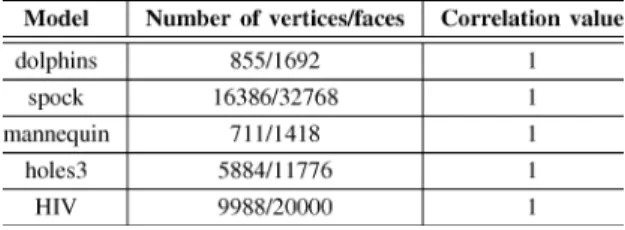
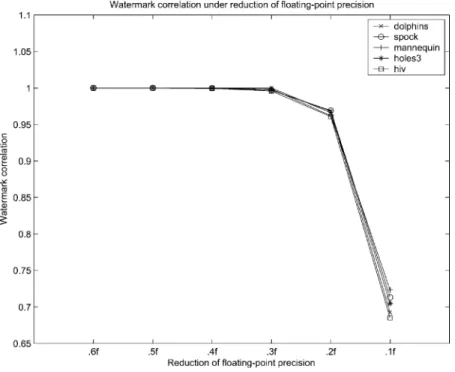
The data set used in our experiments was a set of triangu-lated and closed meshes, listed in Table II. Each of them was watermarked using our fragile watermarking method presented in Section III. The last column in Table II shows the water-mark correlation values for the five different models. The five test models were watermarked and tested to evaluate the robust-ness against reduction of floating-point precision. The results of this experiment are shown in Fig. 7, where the precision of a floating-point number is specified by a nonnegative decimal in-teger preceded by a period (.) and succeeded by a character f. It is clearly shown in Fig. 7 that the proposed method is very robust against vertex quantization down to three decimal digits. Note that for authentication applications one has to rely on vi-sual inspection since the correlation coefficient does not signal. For instance, for meshes with a large number of vertices, only modifying a small region does not affect the correlation value substantially. In addition, finding a threshold that is suitable for all kinds of meshes and resolutions is very difficult. In what fol-lows, therefore, we shall show how to visualize the authentica-tion results.
C. Visualization of Authentication Results
Visualization is a good way to “see” whether the proposed watermarking method is valid or not. Fig. 8 shows that the orig-inal and the watermarked Spock models were rendered as ei-ther wireframe or flat-shaded models, respectively. It can be seen that the watermarked model maintained high correlation with the original model, whether in a wireframe format or in a flat-shaded format.
The results of experiments on detecting malicious attacks from some incidental modifications are shown in Figs. 9 and
Fig. 7. Five test models were watermarked and tested to evaluate the robustness against reduction of floating-point precision.
Fig. 8. Visualization of the transparency test: (a) original Spock model rendered in a wireframe format; (b) watermarked Spock model rendered in a wireframe format; (c) original Spock model rendered in a flat-shaded form; and (d) watermarked Spock model rendered in a flat-shaded form.
10. Fig. 9(a) shows that the watermarked Spock model was tam-pered with by stretching out Spock’s nose. In addition, the quan-tization down to two decimal digits was applied to the vertex coordinates of the watermarked Spock model that has been tam-pered with. Fig. 9(b) shows some detected potentially modified
Fig. 9. Region-based tampering detection: (a) watermarked Spock model tampered with by stretching out its nose, which was followed by applying the quantization (down to two decimal digits) to the vertex coordinates.; (b) detected potentially modified regions (before morphological operators were applied); and (c) detected modified regions after the morphological operators were applied.
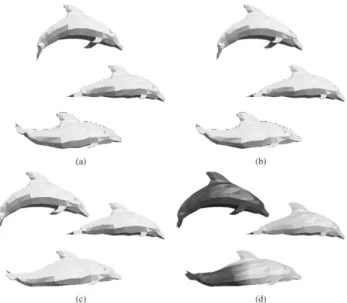
regions before the closing operator was applied. Note that ap-proximately 50% of vertices on Spock’s nose were identified as invalid vertices, as shown in Fig. 9(b). Therefore, in order to am-plify the effect of the authentication results, the morphological operators described in [29] were adopted so that the parts being tampered with in a model could be detected and highlighted. Fig. 9(c) shows the authentication results of Fig. 9(b) after some morphological operations were applied. Fig. 10 shows another example of malicious tampering involving vertex quantization, which could possibly occur in the real world. In this case, it is not obvious that the two dolphins were tampered with. Never-theless, the proposed method still succeeded in malicious tam-pering detection. As shown in Fig. 10(d), among the two dol-phins that were tampered with, one was translated, and the other one stretched out. Both attacks were detected and highlighted.
V. CONCLUSION
A new fragile watermarking scheme which can be applied to authenticate 3-D polygonal meshes has been presented in this
Fig. 10. Detection of malicious attack involving the incidental modification (such as quantization of vertex coordinates): (a) original dolphins model; (b) watermarked dolphins model; (c) slightly modified dolphins model; and (d) two out of the three dolphins have been tampered with. The maliciously modified dolphins were effectively detected.
paper. Watermarks are embedded using a local mesh parame-terization technique and can be blindly extracted for authenti-cation appliauthenti-cations. The proposed scheme has three remarkable features: 1) the domain of allowable alternation for a vertex is explicitly defined by two well-designed hash functions; 2) re-gion-based tampering detection is achieved by a vertex-order-independent embedding process; and 3) fragile watermarking is achieved for localization of malicious modifications and toler-ance of certain incidental manipulations (such as quantization of vertex coordinates and vertex reordering). To the best of our knowledge, this is the first 3-D mesh authentication scheme that can detect malicious attacks involving certain incidental modi-fications.
ACKNOWLEDGMENT
The authors would like to thank the anonymous reviewers for their comments and suggestions which have improved the read-ability and technical content of this paper. Polygonal meshes used in this paper were provided courtesy of the University of Washington and Cyberware. For the use of the HIV protease surface model, the authors would like to thank A. Olson of The Scripps Research Institute.
REFERENCES
[1] N. Aspert, E. Drelie, Y. Maret, and T. Ebrahimi, “Steganography for three-dimensional polygonal meshes,” Proc. SPIE, vol. 4970, 2002. [2] O. Benedens, “Affine invariant watermarks for 3-D polygonal and
NURBS based models,” in Proc. Information Security Workshop, Wollongon, Australia, 2000, pp. 20–21.
[3] , “Robust watermarking and affine registration of 3-D meshes,” in
Proc. Information Hiding, Noordwijkerhout, The Netherlands, 2002, pp.
177–195.
[4] P. J. Burt and E. H. Adelson, “Laplacian pyramid as a compact image code,” IEEE Trans. Commun., vol. COM-31, pp. 532–540, 1983. [5] H. Biermann, I. Martin, F. Bernardini, and D. Zorin, “Cut-and-paste
editing of multiresolution surfaces,” in Proc. SIGGRAPH, San Antonio, TX, 2002, pp. 312–321.
[6] F. Cayre and B. Macq, “Data hiding on 3-D triangle meshes,” IEEE.
Trans. Signal Process., vol. 51, no. 4, pp. 939–949, Apr. 2003.
[7] F. Cayre, P. Rondao-Alface, F. Schmitt, B. Macq, and H. Maître, “Ap-plication of spectral decomposition to compression and watermarking of 3-D triangle mesh geometry,” Signal Process.: Image Commun., vol. 18, pp. 309–319, 2003.
[8] M. Desbrun, M. Meyer, P. Schröder, and A. Barr, “Implicit fairing of irregular meshes using diffusion and curvature flow,” in Proc.
SIG-GRAPH, Los Angeles, CA, 1999, pp. 317–324.
[9] M. S. Floater, “Parameterization and smooth approximation of surface triangulations,” Comput. Aided Geom. Design, vol. 14, pp. 231–250, 1997.
[10] C. Fornaro and A. Sanna, “Public key watermarking for authentication of CSG models,” Comput.-Aided Design, vol. 32, pp. 727–735, 2000. [11] M. Garland and P. S. Heckbert, “Surface simplification using quadric
error metrics,” in Proc. SIGGRAPH, Los Angeles, CA, 1997, pp. 209–216.
[12] I. Guskov, W. Sweldens, and P. Schröder, “Multiresolution signal pro-cessing for meshes,” in Proc. SIGGRAPH, Los Angeles, CA, 1999, pp. 325–334.
[13] H. Hoppe, “Progressive meshes,” in Proc. SIGGRAPH, New Orleans, LA, 1996, pp. 99–108.
[14] A. Johnson and M. Hebert, “Using spin-images for efficient multiple model recognition in cluttered 3-D scenes,” IEEE Trans. Pattern Anal.
Mach. Intell., vol. 21, no. 5, pp. 433–449, May 1999.
[15] , “Control of polygonal mesh resolution for 3-D computer vision,”
Graph. Models and Image Process., vol. 60, pp. 261–285, 1998.
[16] B. Koh and T. Chen, “Progressive browsing of 3-D models,” in Proc.
IEEE Signal Processing Soc. Workshop on Multimedia Signal Pro-cessing, Copenhagen, Denmark, 1999, pp. 71–76.
[17] M. S. Kankanhalli, E.-C. Chang, X. Guan, Z. Huang, and Y. Wu, “Au-thentication of volume data using wavelet-based foveation,” in Proc. 6th
Eurographics Workshop on Multimedia, Manchester, U.K., 2001.
[18] S. Kanai, H. Date, and T. Kishinami, “Digital watermarking for 3-D polygons using multiresolution wavelet decomposition,” in Proc. 6th
IFIP WG 5.2 GEO-6, Tokyo, Japan, 1998, pp. 296–307.
[19] Z. Karni and C. Gotsman, “Spectral compression of mesh geometry,” in
Proc. SIGGRAPH, New Orleans, LA, 2000, pp. 279–286.
[20] A. W. F. Lee, W. Sweldens, P. Schröder, L. Cowsar, and D. Dobkin, “MAPS: Multiresolution Adaptive Parameterization of Surfaces,” in
Proc. SIGGRAPH, Orlando, FL, 1998, pp. 95–104.
[21] X. Mao, M. Shiba, and A. Imamiya, “Watermarking 3-D geometric models through triangle subdivision,” Proc. SPIE, vol. 4314, pp. 253–260, 2001.
[22] R. Ohbuchi, H. Masuda, and M. Aono, “Watermarking three-dimen-sional polygonal models through geometric and topological modifica-tions,” IEEE J. Select. Areas Commun., vol. 16, pp. 551–560, 1998. [23] , “Data embedding for geometrical and nongeometrical targets in
three-dimensional polygonal models,” Comput. Commun., vol. 21, pp. 1344–1354, 1998.
[24] , “A shape-preserving data embedding algorithm for NURBS curves and surfaces,” in Proc. Computer Graphics Int., Canmore, AB, Canada, 1999, pp. 177–180.
[25] R. Ohbuchi, A. Mukaiyama, and S. Takahashi, “A frequency-domain approach to watermarking 3-D shapes,” in Proc. EUROGRAPHICS, vol. 21, Saarbrucken, Germany, 2002, pp. 373–382.
[26] R. Ohbuchi, S. Takahashi, and T. Miyazawa, “Watermarking 3-D polyg-onal meshes in the mesh spectral domain,” in Proc. Graphics Interface, ON, Canada, 2001, pp. 9–17.
[27] E. Praun, H. Hoppe, and A. Finkelstein, “Robust mesh watermarking,” in Proc. SIGGRAPH, Los Angeles, CA, 1999, pp. 154–166.
[28] E. Praun, W. Sweldens, and P. Schröder, “Consistent mesh parameteri-zations,” in Proc. SIGGRAPH, Los Angeles, CA, 2001, pp. 179–184. [29] C. Rössl, L. Kobbelt, and H. P. Seidel, “Extraction of feature lines on
triangulated surfaces using morphological operators,” in Symp. Smart
Graphics, Stanford, CA, 2000.
[30] G. Taubin, “A signal processing approach to fair surface design,” in
Proc. SIGGRAPH, Los Angeles, CA, 1995, pp. 351–358.
[31] G. Turk, “Re-tiling polygonal surfaces,” in Proc. SIGGRAPH, Chicago, IL, 1992, pp. 55–64.
[32] , “Generating random points in triangles,” in Graphics Gems, A. Glassner, Ed. New York: Academic, 1999.
[33] K. Yin, Z. Pan, S. Jiaoying, and D. Zhang, “Robust mesh watermarking based on multiresolution processing,” Comput. and Graph., vol. 25, pp. 409–420, 2001.
[34] B. L. Yeo and M. M. Yeung, “Watermarking 3-D objects for verifica-tion,” IEEE Comput. Graph. Applic., vol. 19, pp. 36–45, 1999.
[35] M. M. Yeung and B. L. Yeo, “An invisible watermarking technique for image verification,” in Proc. Int. Conf. Image Processing, vol. 2, Piscat-away, NJ, 1997, pp. 680–683.
[36] M. G. Wagner, “Robust watermarking of polygonal meshes,” in Proc.
Geometric Modeling and Processing, Hong Kong, 2000, pp. 201–208.
[37] W. Sweldens and P. Schröder, “Course 50: digital geometry processing,” in SIGGRAPH’2001 Course Note, 2001.
Hsueh-Yi Sean Lin was born in Taipei, Taiwan, R.O.C., in 1975. He received the B.S. degree from the Chung-Hua University, Hsinchu, Taiwan, in 1997, and the M.S. degree from the Yuan-Ze Uni-versity, Chung-Li, Taiwan, in 1999, all in computer science. He is currently pursuing the Ph.D. degree in the Department of Computer and Information Science, National Chiao-Tung University, Hsinchu.
His current research interests include 3-D mesh processing, retrieval, and authentication.
Hong-Yuan Mark Liao (SM’01) received the B.S. degree in physics from National Tsing-Hua University, Hsinchu, Taiwan, R.O.C., in 1981, and the M.S. and Ph.D. degrees in electrical engineering from Northwestern University, Evanston, IL, in 1985 and 1990, respectively.
He was a Research Associate with the Com-puter Vision and Image Processing Laboratory, Northwestern University, during 1990–1991. In July 1991, he joined the Institute of Information Science, Academia Sinica, Taipei, Taiwan, as an Assistant Research Fellow. He was promoted to Associate Research Fellow and then Research Fellow in 1995 and 1998, respectively. From August 1997 to July 2000, he served as the Deputy Director of the institute. From February 2001 to January 2004, he was the Acting Director of the Institute of Applied Science and Engineering Research. He is jointly appointed as a Professor of the Computer Science and Information Engineering Department of National Chiao-Tung University. His current research interests include multimedia signal processing, wavelet-based image analysis, content-based multimedia retrieval, and multimedia protection.
Dr. Liao is the Managing Editor of the Journal of Information Science and
Engineering. He is on the Editorial Board of the International Journal of Visual Communication and Image Representation, Acta Automatica Sinica, and the
EURASIP Journal on Applied Signal Processing. He was an Associate Editor of the IEEE TRANSACTIONS ONMULTIMEDIAduring 1998–2001. He received the Young Investigators’ award from Academia Sinica in 1998; the Excellent Paper Award from the Image Processing and Pattern Recognition society of Taiwan in 1998 and 2000, the Distinguished Research Award from the National Sci-ence Council of Taiwan in 2003, and the National Invention Award in 2004. He served as the Program Chair of the International Symposium on Multimedia Information Processing (ISMIP’97), the Program co-chair of the Second IEEE Pacific-Rim conference on Multimedia (2001), and the Conference co-chair of the Fifth IEEE International Conference on Multimedia and Exposition (ICME).
Chun-Shien Lu (M’99) received the Ph.D. degree in electrical engineering from National Cheng-Kung University, Tainan, Taiwan, R.O.C., in 1998.
From October 1998 to July 2002, he joined Institute of Information Science, Academia Sinica, Taiwan, as a postdoctoral fellow for his military service. Since August 2002, he has been an Assistant Research Fellow at the same institute. His current research interests mainly focus on multimedia technologies and applications.
Dr. Lu organized a special session on Multimedia Security in the 2nd and 3rd IEEE Pacific-Rim Conference on Multimedia, respectively (2001–2002). He co-organized two special sessions (in the area of media identification and DRM) in the 5th IEEE International Conference on Multimedia and Expo (ICME), 2004. He is a guest co-editor of EURASIP
Journal on Applied Signal Processing special issue on Visual Sensor Network
in 2005. He has two U.S. patents, two R.O.C. patents, and one Canadian patent in digital watermarking. He has received the paper awards many times from the Image Processing and Pattern Recognition society of Taiwan for his work on data hiding.He was a co-recipient of a National Invention and Creation Award in 2004. He is a member of the ACM.
Ja-Chen Lin was born in Taiwan, R.O.C., in 1955. He received the B.S. degree in computer science in 1977 and the M.S. degree in applied mathematics in 1979, both from National Chiao-Tung University (NCTU), Hsinchu, Taiwan, and the Ph.D. degree in mathematics from Purdue University, West Lafayette, IN, in 1988.
From 1981 to 1982, he was an Instructor at NCTU. From 1984 to 1988, he was a Graduate Instructor at Purdue University. He joined the Department of Computer and Information Science, NCTU, in August 1988, and is currently a Professor there. His recent research interests include pattern recognition and image processing.
![Fig. 2. Illustration of the robustness construction: (a) basis for cylindrical parameterization [14]; (b) side view of the binary state space formed by the quantized cylindrical parameterization domain; (c) the side view of the binary state space formed by](https://thumb-ap.123doks.com/thumbv2/9libinfo/7631041.135089/3.891.112.382.98.492/illustration-robustness-construction-cylindrical-parameterization-quantized-cylindrical-parameterization.webp)