行政院國家科學委員會專題研究計畫 成果報告
探索員工自願學習行為之內因性動機之研究:交通事業與
民營企業員工之比較分析
研究成果報告(精簡版)
計 畫 類 別 : 個別型 計 畫 編 號 : NSC 100-2410-H-009-020- 執 行 期 間 : 100 年 08 月 01 日至 101 年 07 月 31 日 執 行 單 位 : 國立交通大學運輸科技與管理學系(所) 計 畫 主 持 人 : 張新立 計畫參與人員: 碩士班研究生-兼任助理人員:吳世杰 碩士班研究生-兼任助理人員:呂承澤 碩士班研究生-兼任助理人員:林菁倫 博士班研究生-兼任助理人員:梁竣凱 公 開 資 訊 : 本計畫可公開查詢中 華 民 國 101 年 10 月 29 日
中 文 摘 要 : 員工的「自願學習行為」(voluntary learning behavior) 是組織成長及國際化的主要動力之一;然而,目前仍只有少 數研究用以解釋為何員工願意於職場上產生自願學習行為, 且僅限於探討組織環境變數,以運輸組織為實證資料更是闕 如。本研究提出一個理論模式用以探索員工自願學習行為的 內因性動機,以「工作依賴(work dependency)」為前因變 數,「工作投入(work involvement)」為中介變數,進一步 建立與「自願學習行為」之間的假設關係:當工作依賴越高 時其工作投入程度也將越高,與自願學習行為間的正向關係 亦越高。基於獨立我(independent self) 與互依我 (interdependence self) 及華人折衷自我理論,工作依賴被 重新定義為「個人-相關他人」所共同構成的組合性多維構 念,樣本將被區分為高度、低度、直接與間接四種不同類型 的工作依賴,其和工作投入和自願學習行為之間的正向關係 程度也將有程度上的不同。人 口統計變數對模式的影響亦被納入考量。 本研究將使用問卷調查取得實證資料,以台灣鐵路管 理局及民營企業員工為樣本,應用聚類分析與結構方程模式 對模式進行驗證。預期本研究之理論模式及實證研究結果, 除可增加現有理論對於員工自願學習行為的解釋外,實務面 上亦可對組織提出相關建議用以促進員工的自願學習行為。 中文關鍵詞: 自願學習行為、工作依賴、工作投入、內因性動機 英 文 摘 要 : 英文關鍵詞:
行政院國家科學委員會補助專題研究計畫
行政院國家科學委員會補助專題研究計畫
行政院國家科學委員會補助專題研究計畫
行政院國家科學委員會補助專題研究計畫
█
█
█
█成果報告
成果報告
成果報告
成果報告
□
□
□
□期中進度報告
期中進度報告
期中進度報告
期中進度報告
探索員工自願學習行為之內因性動機之研究
探索員工自願學習行為之內因性動機之研究
探索員工自願學習行為之內因性動機之研究
探索員工自願學習行為之內因性動機之研究:
:
:
:交通事業與民營企業
交通事業與民營企業
交通事業與民營企業
交通事業與民營企業
員工之比較分析
員工之比較分析
員工之比較分析
員工之比較分析
計畫類別:█個別型計畫 □整合型計畫
計畫編號:NSC 100-2410-H-009-020
-
執行期間:2011 年 08 月 01 日至 2012 年 07 月 31 日
執行機構及系所:國立交通大學運輸科技與管理學系
計畫主持人:張新立
共同主持人:
計畫參與人員:博士班研究生 梁竣凱
碩士班研究生 吳世杰 呂承澤 林菁倫
成果報告類型(依經費核定清單規定繳交):█精簡報告 □完整報告
本計畫除繳交成果報告外,另須繳交以下出國心得報告:
□赴國外出差或研習心得報告
□赴大陸地區出差或研習心得報告
□出席國際學術會議心得報告
□國際合作研究計畫國外研究報告
處理方式:
除列管計畫及下列情形者外,得立即公開查詢
□涉及專利或其他智慧財產權,□一年□二年後可公開查詢
中 華 民 國 101 年 7 月 日
A DUALISTIC MODEL OF WORK DEPENDENCY AND ITS PROFILE: A
PILOT STUDY
1HSIN-LI CHANG AND JYUN-KAI LIANG
Department of Transportation Technology and Management National Chiao-Tung University, Taiwan, R.O.C.
Summary.─This study expounds the definition, structure, measurement scale and profile of work
dependency. By drawing on the theory of the Chinese composite self, the study defines work dependency as “the degree of psychological reliance on work in the lifetime of a person, particularly in order to pursue the life goals of the person and the group to whom the person belongs.” Work dependency is established as a profile multidimensional construct. Two dimensions of work dependency, individual- oriented dependency and social-oriented dependency, are measured by 9 and 7 items, respectively. 1,343 effective samples are collected to verify the reliability and validity of the measurement instrument. The results show that the measure has good reliability and validity. Work dependency is then classified into four types: Strong-dependency, Loose-dependency, Direct-dependency and Indirect-dependency. The researchers discuss the different types of work dependency using demographic variables gathered from a survey of employees in Taiwan. Research applications and future research directions are also presented.
1
Address correspondence to Professor, Hsin-Li Chang, Department of Transportation Technology and Management, National Chiao-Tung University, No.1001, Ta Hsueh Road, Hsinchu, 300, Taiwan, R.O.C. or e-mail ([email protected]).
It is commonly recognized that people nowadays keep inseparable relations with their work (England & Harpaz, 1990). In Taiwan, for example, employees work 185.2 hours monthly and 273.6 days yearly in average in 2011 (Directorate General of Budget, Accounting and Statistics [DGBAS], 2012). Situations like this remain unchanged until a person retires, usually at the age of sixty-five. People highly depend on their jobs or everyday work. Greenhalgh and Rosenblatt (1984) formulated this relationship as job dependency, which is defined as “a function of occupational mobility and economic insecurity.” Someone who has fewer job alternatives and relies much more on the income from a current job is more dependent on her/his job. Thus, job dependency has been widely discussed from the perspective of job insecurity and generally recognized as a moderator between job threat and reactions to job insecurity (e.g., Orpen, 1993; Kinnunen et al., 1999; Cheng & Chan, 2008).
However, job dependency is inadequate to describe the relationship between employees and their work, especially for Chinese people. First, job dependency lacks cultural content. Hwang(2011) pointed out culture-inclusive perspective is necessary for researchers who want to best delineate people’s mentalities toward social phenomenon within certain society. Glueck (1982) argued that attitudes toward work evolve from culture as well as one's family, school and work-experiences. People’s attitudes toward job or work are the results of long-term socialization. Obviously, Greenhalgh and Rosenblatt’s definition of job dependency did not take cultural perspective into account. Second, do people depend on jobs or on work? People may change jobs over and over again; however, working is an ongoing activity that remains constant no matter how many times people have changed their jobs. Kanungo (1982) argued that being engaged in a specific job is not the same as an occupation with work in general. He indicated that differentiating between job-related and work-related concepts is important. Job is an activity that an individual performs in exchange for specific benefits. Job dependency merely emphasizes the instrumental relationship (Hwang, 1987). However, for Chinese people, work is concerned with the ultimate meaning of their career (Wang and Lo, 2009). Work means a person put forth effort to accomplish or produce something. Keeping close relationship to work is not only for economic consideration, but also for life goal attainment. Following this line of thought, an alternative and broader construct, work dependency, is called for to know more about the relationship between employee and work.
Furthermore, two problems related to the previous studies of job dependency are also observed: (1) the robust theoretical perspective on the definition of job dependency does not be provided, and (2) it is questionable whether existing measurement scales of job dependency are appropriate. Researchers who want to apply the construct of job dependency in their study will face the problem of lacking consistent definitions that are established by a clear theoretical premise (Pedhazur& Schmelkin, 1991). Without this underpinning, any research results could be doubtful. In addition, there is an inconsistency between the construct definition that has been provided and the current measures of job dependency. According to Greenhalgh and Rosenblatt’s definition, job dependency should be measured as a multidimensional construct including occupational mobility and economic insecurity. Nevertheless, subsequent research has treated it as a unidimensional construct with only one measurement indicator -- the economic need to work (Ferse, 1985; Brockner et al., 1992; Orpen, 1993; Watkins & Subich, 1995; Campbell, 1999; Chen & Chan, 2008). The unascertained measurement evaluation on job dependency with single-item may underestimate the relationship between job dependency and other variables (Sverke et al., 2002).
culture factor of self-consciousness, based on the long-term socialization goals pertaining to self-development emphasized by Lu (2003). Unlike job dependency, which focuses on a person’s current job, work dependency is constructed as a normative belief about the relationship between a person and his/her work over the course of his/her lifetime. Furthermore, a concise but psychologically sound measure of work dependency is also developed to validate what is proposed in this study.
The Definition and Theoretical Basis of Work Dependency
Chinese people have been educated to enter the workforce since they were children. One of the most important learning goals for the students in Chinese society is to attain achievement in their future work. Learning brings them not only self-affirmation but also social status and honor to their families. This is the reason why Chinese students study so hard, even at a young age (Li, 2003). Same thing happens to the Chinese people for their working. Achieving a high level of work performance in society is like getting good grades in school. The connection between a person and his/her work is established early on a child’s life, and it continues until the person goes into retirement. Essentially, work dependency is the result of long-term socialization during the process of individual human growth.
To meet the needs of the persons and the group to whom the person belongs is the common goal of working hard. Many work motivation theorists argue that a primary motivation behind the decision to go to work is to satisfy inherent human needs, including psychological and physiological requirements (Latham & Pinder, 2005). These needs convert into the behavioral tendency to keep close contact with one’s work. Based on these arguments, this research defines work dependency as the psychological reliance on work which has been developing over the lifetime of a person and pushes him/her to pursue the life goals of himself/herself and his/her belonging group. This definition implies a statement of belief that a long-term relationship exists between people and work. Thus the work dependence could be conceptualized as a multidimensional construct including an individual-oriented dependency and a social-oriented dependency. The former describes the relation between the personal self and his/her work, and the latter delineates the relation between other people (related others) of a person and his/her work.
The researchers draw on Markus and Kitayama’s independent-interdependent self theory (1991) and Lu’s theory of the Chinese composite self (2003) to explain the contents of work dependency. Markus and Kitayama (1991) argued that a person’s beliefs, cognitions and even actions are deeply affected by self-consciousness that could be one of the two forms. The awareness of oneself as an independent entity, or a person whose behavior is arranged in reference one’s own thoughts, feelings, and actions, belongs to the Western and perhaps especially American notion of the self. By contrast, the Eastern or Asian view of the self implies an interdependent self, whose behavior is organized by the thoughts, feelings, and actions of others. The concept of an independent self leads to an emphasis on self-actualization, which denotes a person’s need, power and individual ability. This emphasis does not explicitly envisage the social context of a person, or a person’s role, status, commitment and responsibility in society (Brewer & Gardner, 1996). Viewing the person as an interdependent self implies a reference to the larger whole. The importance of success and achievement among East Asians directly relates to this expanded concept of the self. According to this concept, the person builds strong relationships with his/her belonging group and must therefore reflect well on his/her behaviors or actions (Markus & Kitayama, 1994, 1998; Nisbett, 2003).
Extending the thought of Markus and Kitayama, Lu (2003) argued that two types of self may coexist within a person or a society, especially for the people living in a modern society where the old and new
cultures coexist in daily life. Atypical case is Taiwan where traditional Chinese culture and contemporary Western culture are indeed symbiotic now. In this kind of multicultural society, the independent self and the interdependent self may both be stirred up with different amounts of intensity and to a certain extent simultaneously (Quah, 1995). The main reason is that globalization, an increasingly prevalent phenomenon, promotes the cultural exchange and blending of people from different countries. In this social environment, every person experiences the fluctuation between the independent and interdependent poles, and this continues throughout the person’s life.
To describe the person living in such a society, Lu proposed the concept of Chinese composite self. This is a flexible concept that combines the Asian construct of self-in-relation and the Western construct of independent and contained self. Thus, it is a concept with duality built in to it. The Chinese composite self has a two pole-structure with both an individual and a social orientation (Yang, 1995, 1996, 2004). A considerable amount of studies (Lu et al., 2001, 2003, 2007; Weng et al., 2004; Yang, 2006; Yang and Lu, 2008) provide empirical evidence to support this dual concept of the self. As studies have shown, conflicting orientations apparently coexist within same culture and same person.
Because Lu’s theoretical perspective is highly relevant to modern culture, it is able to describe the self-socialization process and content of Chinese people who are now living and working in a society where traditional and modern cultures co-exist. Thus, it provides an appropriate theoretical basis to investigate the proposed work dependency of people in Taiwan. Based on the definition proposed in this study, work dependency not only links people to their work but also serves as a connector to establish the social ties that exist in the workplace. The level of a person’s work dependency is determined by the degree to which he/she feels the need to be involved in an interpersonal network so as to satisfy both personal and social criteria. Thus, work dependency is shaped by both individual and social orientations that co-operate to guide the cognition, intention, attitudes and actions of the person in workplace.
Measurement Type of Work Dependency
Since work dependency is a multidimensional construct, including individual dependency and social-oriented dependency, it is necessary to identify the relationships between dimensions and overall construct clearly and concisely.(Law, Wong and Mobley: 1998). The taxonomy of a multidimensional construct is presented in Figure 1. Two classification criteria, relational level and relational form, should be considered on defining and identifying the construct and its dimensions (Law, Wong & Mobley, 1998; Wong, Law & Huang, 2008). Relation level investigates whether the multidimensional construct exist at a deeper and more embedded level than its dimensions. If the construct is a high-order abstraction underlying its dimensions, it is then classified as a latent model. General mental ability (GMA) (Spearman, 1972) is a good example of latent multidimensional construct. Otherwise, turn to next criterion-- relation form. Relation form investigates whether the multidimensional construct can be formed as an algebraic function of its dimensions. If the answer is yes, this type of construct is composed as an aggregate model. Job satisfaction (Locke, 1983) is a good example of an aggregate multidimensional construct. The algebraic function form of this kind of construct can be linear or nonlinear, and the dimensions can have different or indifferent weights in forming the construct. If the dimensions cannot be combined algebraically, this construct is then composed as a profile model. Personality is an obvious profile multidimensional construct (Myers & McCaulley, 1985). Further discussions about this issue can refer to Law, Wong & Mobley (1998).
Resource: Law, K. S., Wong, C. S. & Mobley, W. H. (1998).
FIG. 1: Taxonomy of a Multidimensional Construct
Based on above decision rule, work dependency will be a profile multidimensional construct, since it is a combination of two concerned dimensions but not in an algebraic form. That is, work dependency is composed of the combinations of individual-oriented dependency and social-oriented dependency. According to the high or low level of these dimensions, the construct can be developed into four different work dependency profiles, namely strong-dependency, loose-dependency, direct-dependency and indirect-dependency, respectively as shown in Figure 2. As a scientific construct, work dependency can then be used to develop hypotheses for testing and establishing links with other nomological constructs.
FIG. 2: Four Types of Work Dependency
METHOD
Item Development
Based on the definition of work dependency established in this research and the existing scale for the composite self, a Work Dependency Scale is developed to measure individual differences of proposed construct. Lu & Gilmour (2007) introduced a quite reliable and valid scale which was cross-validated in Taiwan and the UK and provided opportunity to incorporate personal needs, social demands on the person and work situations into a scale to measure the developed Work Dependency. After modified by authors, 9 items and 7 items were selected to form the Individual-Oriented Dependency (IOD) and Social-Oriented Dependency (SOD) Subscales, respectively. The items were used to examine the reliability, and convergent and discriminant validity of the measures. Thus, an appropriate scale of work dependency was developed for empirical validation.
used in previous research on job dependency. The demographic variables include age, gender, tenure, position in the company, the percentage of disposable income contributing to family and the presence or absence of children in the family (Frese, 1985; Brockner et al., 1992; Gallite et al., 1998; Kinnunen et al., 1999; Fugate et al., 2004).
Pretest
In order to select appropriate items for measuring IOD and SOD, the researchers invited a total of 94 night program MBA students (54 males, 40 females) to complete the Work Dependency Scale on the web. A 16-item preliminary measure of work dependency, including 9 items and 7 items for individual-oriented dependency and social-oriented dependency respectively, was tested by using a 6-point Likert-type scale ranging from 1 (Strongly disagree) to 6 (Strongly agree).
Both Cronbach’s alpha and Rasch person reliability were applied to preliminarily estimate the reliability of IOD and SOD. The results of reliability analysis yielded a Cronbach’s alpha coefficient of .90 for IOD and .87 for SOD; Rasch person reliability estimates were .83 and .78 for IOD and SOD, respectively as shown in Table1. According to these results, the reliability of this introductory questionnaire with 16 items was quite good, and all items were retained for the main study.
TABLE 1: Pretest Results Dimensions of Work Dependency Cronbach’s
alpha Rasch person reliability Number of items Individual-Oriented Dependency .90 .83 9 Social-Oriented Dependency .87 .78 7
Samples: Main Study
Cooperating with the largest human resource agency in Taiwan, samples were randomly selected from the databank of agency. The proportions of gender, age and number of employees in 23 counties of samples were in accordance with the population. A total of 1,343 employees participated in the main study survey. After eliminating incomplete responses, 1,314 valid questionnaires (748 males, 566 females) served as the input data for this study. These samples were then split into two independent groups. Sample Group 1 consisted of 430 employees, respondents aged from 21 to 60 years old (236 males, 194 females; Mean age = 37.84 yr., SD = 9.53 yr.; Mean tenure = 12.04 yr., SD = 8.75 yr.). This sample group was employed in exploratory factor analysis to evaluate the dimensional structure and appropriateness of the items. Sample Group 2 was an independent sample of 884 employees, aged from 17 to 61 years old (512 males, 372 females; Mean age = 36.94 yr., SD = 9.71 yr.; Mean tenure = 11.89 yr., SD = 8.92 yr.). The Sample Group 2 was used for confirmatory factor analysis of the Work Dependency Scale, which includes the two subscales of IOD and SOD. Finally, all 1,314 samples were combined to characterize the profile of work dependency.
RESULTS
Exploratory Factor Analysis for Work Dependency Scale
The first job in this research was to test the factorial structure of the instrument. The researchers conducted an exploratory factor analysis of the 16 items using the principle components method with varimax rotation. Bartlett’s test of sphericity and the Kaiser-Meyer-Olkin (KMO) test were used to inspect the feasibility of exploratory factor analysis in Sample Group 1. Results of Bartlett’s test of sphericity (
χ
2=5055.172, Sig. = 0.000.) and the KMO test (0.925) indicated that these data were appropriate for factoring (Sharma, 1996). Computer software SPSS 14.0 was used during this stage.
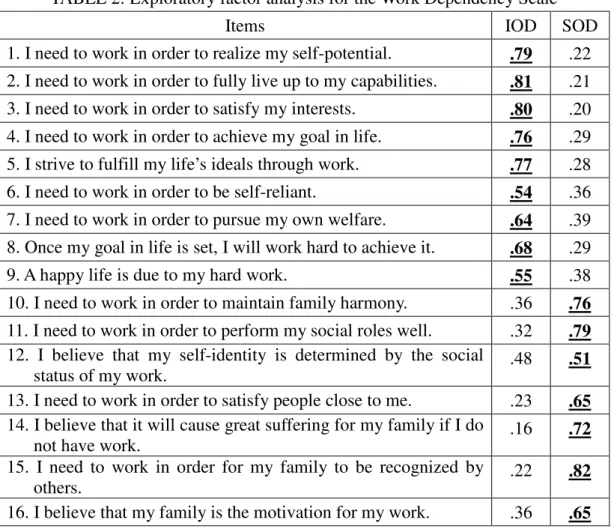
Table 2 shows the items and their factor loadings. A total of two factors were identified with an eigen value greater than one and the scree plot, accounting for 64.57% of the total variance. The first factor was termed individual-oriented dependency (IOD). The loadings of the first nine items loaded on this factor were all larger than .50 (ranging from .54 to .81). Similarly, the last seven items loaded on the second factor, labeled social-oriented dependency (SOD), all had loadings greater than .50 (ranging from .51 to .82). Thus, a clear two-factor structure emerged.
TABLE 2: Exploratory factor analysis for the Work Dependency Scale
Items IOD SOD
1. I need to work in order to realize my self-potential. .79 .22 2. I need to work in order to fully live up to my capabilities. .81 .21 3. I need to work in order to satisfy my interests. .80 .20 4. I need to work in order to achieve my goal in life. .76 .29 5. I strive to fulfill my life’s ideals through work. .77 .28 6. I need to work in order to be self-reliant. .54 .36 7. I need to work in order to pursue my own welfare. .64 .39 8. Once my goal in life is set, I will work hard to achieve it. .68 .29
9. A happy life is due to my hard work. .55 .38
10. I need to work in order to maintain family harmony. .36 .76
11. I need to work in order to perform my social roles well. .32 .79
12. I believe that my self-identity is determined by the social status of my work.
.48 .51
13. I need to work in order to satisfy people close to me. .23 .65
14. I believe that it will cause great suffering for my family if I do not have work.
.16 .72
15. I need to work in order for my family to be recognized by others.
.22 .82
16. I believe that my family is the motivation for my work. .36 .65
Confirmatory Factor Analysis for Work Dependency Scale
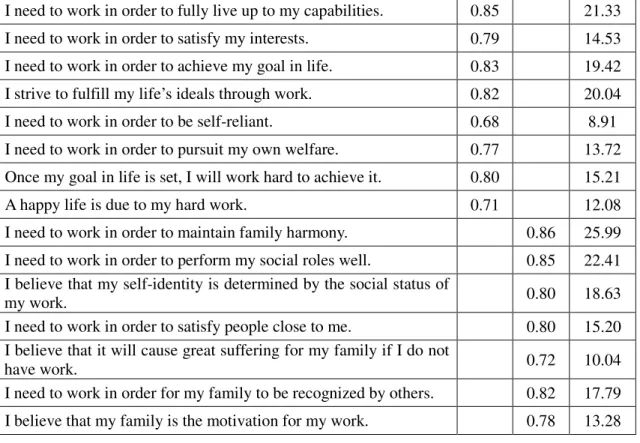
Based on the results of the exploratory factor analysis, a confirmatory factor analysis was conducted using the computer program SmartPLS (Ringle et al. 2005). In confirmatory factor analysis, the pattern of loadings of measurement items on the latent constructs is explicitly specified by the model. There are 9 items for IOD and 7 items for SOD. Sample Group 2 served as the input data in this stage. According to the rules suggested by Bagozzi & Yi (1988) and Steenkamp & Van Trijp (1991), the factor loading of each item should be greater than .50 and be statistically significant. Table 3 presents the outcomes of confirmatory factor analysis for the Work Dependency Scale. As shown, all factor loadings were greater than .50, ranging from .68 to .85 for IOD and .72 to .86 for SOD, and all t-values were greater than 1.96. The results show that the model fit the data reasonably well, indicating that the Work Dependency Scale has a sound two-factor structure.
TABLE 3: Confirmatory Factor Analysis for the Work Dependency Scale
Items IOD SOD t-value
I need to work in order to fully live up to my capabilities. 0.85 21.33
I need to work in order to satisfy my interests. 0.79 14.53
I need to work in order to achieve my goal in life. 0.83 19.42
I strive to fulfill my life’s ideals through work. 0.82 20.04
I need to work in order to be self-reliant. 0.68 8.91
I need to work in order to pursuit my own welfare. 0.77 13.72
Once my goal in life is set, I will work hard to achieve it. 0.80 15.21
A happy life is due to my hard work. 0.71 12.08
I need to work in order to maintain family harmony. 0.86 25.99
I need to work in order to perform my social roles well. 0.85 22.41
I believe that my self-identity is determined by the social status of
my work. 0.80 18.63
I need to work in order to satisfy people close to me. 0.80 15.20
I believe that it will cause great suffering for my family if I do not
have work. 0.72 10.04
I need to work in order for my family to be recognized by others. 0.82 17.79
I believe that my family is the motivation for my work. 0.78 13.28
Reliability Analysis
Cronbach’s alpha test and Rasch person reliability were adopted to test the internal consistency reliability of the Work Dependency Scale. Samples Group 1 and 2 were merged as the input data in this step. As suggested by Cronbach (1951), a value of Cronbach’s alpha greater .70 indicates high reliability. Rasch person reliability refers to the proportion of the total sample variability in measured activation that is not measurement error and it can be seen as the lower bound of reliability for a test (Linacre, 1997). Computer software SPSS 14.0 and Winsteps (Linacre & Wright, 2004) were used during this stage.
As shown in Table 4, the results of reliability analysis yielded a Cronbach’s alpha of .92 for IOD (including items 1 to 9) and .91 for SOD (including items 10 to 16). The Rasch person reliability estimates were .84 and .81 for IOD and SOD, respectively. The values of Cronbach’s alpha and Rasch person reliability in each dimension were greater than .90 and .80, showing high reliability for the Work Dependency Scale.
TABLE 4: Reliability Analysis for the Work Dependency Scale
Dimensions of Work Dependency Cronbach’s
alpha Rasch person reliability Number of items Individual-Oriented Dependency .92 .84 9 Social-Oriented Dependency .91 .81 7 Validity Analysis
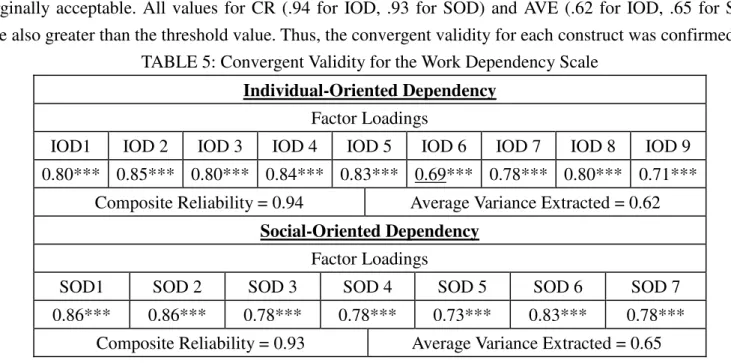
Regarding the validity of the developed construct, two types of factor validity were assessed: convergent validity and discriminant validity. These two measures of validity indicate how well the measurement items relate to the constructs (Vinzi et al., 2010). Computer software SmartPLS (Ringle et al. 2005) was used during this stage of testing. Convergent validity is shown when each measurement item correlates strongly with its assumed theoretical construct. There are three suggested rules for examining the convergent validity of constructs: factor loadings of items should be greater than .70 with a significant p-value at the .05 alpha protection level, composite reliability (CR) greater than .70 and average variance extracted (AVE) greater
than .50 (Hair et al., 1998; Chin, 1998; Fornell and Lacker, 1981). Table 5 displays the results of convergent validity for work dependency. All factor loadings were greater than .70 and significant, except IOD 6 (.69) is marginally acceptable. All values for CR (.94 for IOD, .93 for SOD) and AVE (.62 for IOD, .65 for SOD) were also greater than the threshold value. Thus, the convergent validity for each construct was confirmed.
TABLE 5: Convergent Validity for the Work Dependency Scale
Individual-Oriented Dependency
Factor Loadings
IOD1 IOD 2 IOD 3 IOD 4 IOD 5 IOD 6 IOD 7 IOD 8 IOD 9
0.80*** 0.85*** 0.80*** 0.84*** 0.83*** 0.69*** 0.78*** 0.80*** 0.71*** Composite Reliability = 0.94 Average Variance Extracted = 0.62
Social-Oriented Dependency
Factor Loadings
SOD1 SOD 2 SOD 3 SOD 4 SOD 5 SOD 6 SOD 7
0.86*** 0.86*** 0.78*** 0.78*** 0.73*** 0.83*** 0.78*** Composite Reliability = 0.93 Average Variance Extracted = 0.65 Note: *** P<0.01.
Discriminant validity is shown when each measurement item correlates weakly with all other constructs except the one to which it is theoretically associated. Discriminant validity was first verified by looking at whether the square root of the AVE is greater than all of the inter-construct correlations involving the construct (Fornell and Lacker, 1981). As suggested by Klein (2005), the value of the correlation of constructs should be below .70. According to the study results shown in Table 6, the correlation between IOD and SOD is .68 which is smaller than the square root of the AVE of each construct. As Chin (1998) noted, if the two constructs are discriminant, one should expect to see that each item loading is higher than its cross loading. As summarized in Table 7, each item loaded more highly on its own construct than on another construct. Based on the above results, discriminant validity for IOD and SOD was confirmed.
TABLE 6: Correlation between constructs
IOD SOD
IOD 0.79
SOD 0.68 0.81
Note: The numbers in the diagonal row are the square roots of the AVE TABLE 7: Loadings and Cross Loadings
IOD1 IOD2 IOD3 IOD4 IOD5 IOD6 IOD7 IOD8 IOD9
IOD .80 .85 .80 .84 .83 .69 .78 .80 .71
SOD .55 .55 .50 .53 .56 .52 .55 .51 .56
SOD1 SOD2 SOD3 SOD4 SOD5 SOD6 SOD7
IOD .60 .57 .66 .48 .42 .50 .55
SOD .86 .86 .78 .78 .73 .83 .78
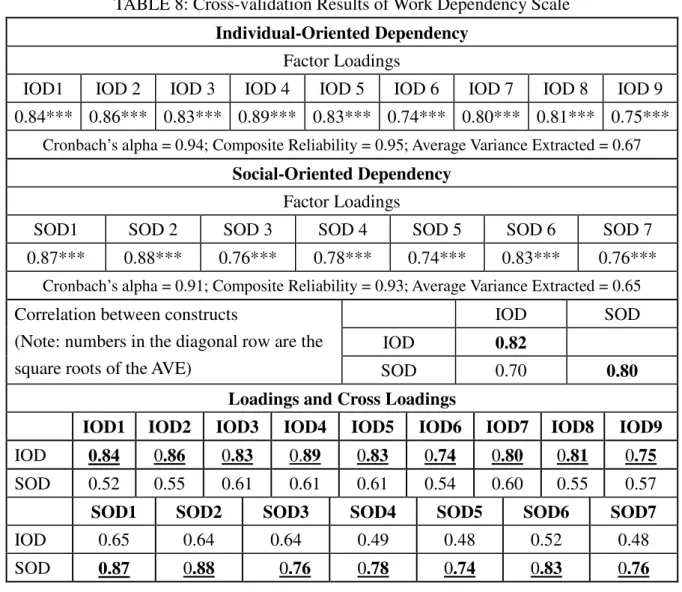
In order to verify the factorial structure of work dependency could be generalized to other samples, the researchers collected another independent sample in Taiwan for further empirical study. A total of 278 employees working in Taiwan Railway Administration were asked to respond to a questionnaire including sixteen items. Reliability analysis, confirmatory factor analysis, and tests of convergent validity and
discriminant validity were conducted for this questionnaire using computer program SPSS 14.0, Winsteps (Linacre & Wright, 2004) and SmartPLS (Ringle et al. 2005). The results are given in Table 8. An examination of these indices shows that the factorial structure of work dependency fit the data reasonably well. The magnitudes of these values were quite similar to those in the first developmental sample. The researchers concluded that the 16-item Work Dependency Scale effectively captured the work dependency dimensions.
TABLE 8: Cross-validation Results of Work Dependency Scale
Individual-Oriented Dependency
Factor Loadings
IOD1 IOD 2 IOD 3 IOD 4 IOD 5 IOD 6 IOD 7 IOD 8 IOD 9
0.84*** 0.86*** 0.83*** 0.89*** 0.83*** 0.74*** 0.80*** 0.81*** 0.75***
Cronbach’s alpha = 0.94; Composite Reliability = 0.95; Average Variance Extracted = 0.67
Social-Oriented Dependency
Factor Loadings
SOD1 SOD 2 SOD 3 SOD 4 SOD 5 SOD 6 SOD 7
0.87*** 0.88*** 0.76*** 0.78*** 0.74*** 0.83*** 0.76***
Cronbach’s alpha = 0.91; Composite Reliability = 0.93; Average Variance Extracted = 0.65
Correlation between constructs
(Note: numbers in the diagonal row are the square roots of the AVE)
IOD SOD
IOD 0.82
SOD 0.70 0.80
Loadings and Cross Loadings
IOD1 IOD2 IOD3 IOD4 IOD5 IOD6 IOD7 IOD8 IOD9
IOD 0.84 0.86 0.83 0.89 0.83 0.74 0.80 0.81 0.75
SOD 0.52 0.55 0.61 0.61 0.61 0.54 0.60 0.55 0.57
SOD1 SOD2 SOD3 SOD4 SOD5 SOD6 SOD7
IOD 0.65 0.64 0.64 0.49 0.48 0.52 0.48
SOD 0.87 0.88 0.76 0.78 0.74 0.83 0.76
Profile of Work Dependency
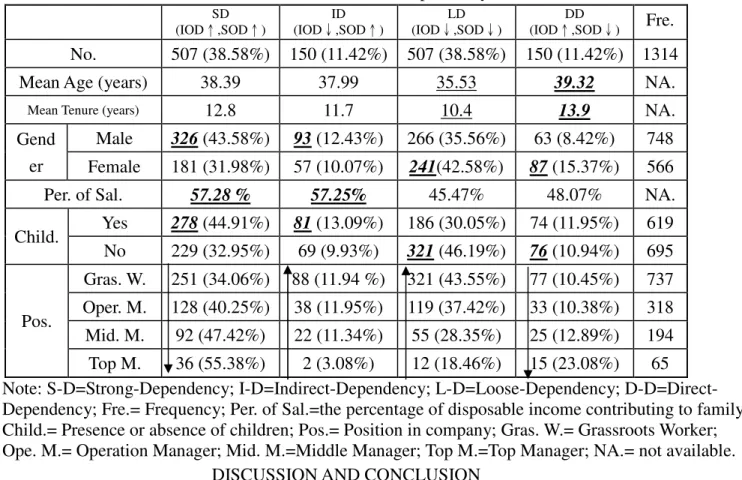
In this section, the profile of work dependency is described using some demographic variables, including age, gender, tenure, position in the company, the percentage of disposable income contributing to family and the presence or absence children. Sample Group 1 and Sample Group 2 were combined (1314 samples; 748 male, 566 female; mean age = 37.23 yr., SD = 9.66 yr.; mean tenure = 11.90 yr., SD = 8.81 yr.) as the input data for further exploration. The researchers first used the factor scores on the two dimensions (IOD and SOD) to create the four categories of work dependency. A median split was performed on each dimension (Tsui et al., 1997). Scores above the median on both dimensions were defined as strong-dependency; scores above the median on SOD but below the median on IOD were defined as indirect-dependency; scores above the median on IOD but below the median on SOD were defined as direct-dependency; finally, scores below the median on both dimensions were defined as loose-dependency. This categorization generated the following distribution of the IOD-SOD relationship across 1,314 samples: 38.58 % of the samples involved
Strong-Dependency; 11.42% with Indirect-Dependency; 11.42% with Direct-Dependency; and 38.58% with Loose-Dependency. Other demographic variables of respondents used to describe work dependency are listed in Table 9.
By looking at Table 9, the researchers tried to delineate the profile of work dependency. First, for mean age and mean tenure of the samples, the direct-dependency group was the highest, followed by strong-dependency and indirect-dependency; loose-dependency was the lowest. Regarding gender, 419 (56.01%) males had high SOD score, indicating strong-dependency and indirect-dependency, whereas scores, indicating direct-dependency and loose- dependency. Most of the males in the sample were in the strong-dependency group (43.58%) and most of the females (42.58%) were in the loose-dependency group. Next, considering position in company, the researchers found a gradually increasing trend in the strong-dependency group from the grassroots workers to top management. This trend was reversed in the loose-dependency group. For respondents with higher tendency toward SOD (strong-dependency and indirect-dependency), the percentage of disposable income contributing to family (57.28 % and 57.25%) was higher than those with lower tendency toward SOD (direct-dependency and loose- dependency) (45.47% and 48.07%). Finally, respondents who had children had higher tendency toward SOD (strong-dependency and indirect-dependency).
TABLE 9: Profile of Work Dependency
SD (IOD↑,SOD↑) ID (IOD↓,SOD↑) LD (IOD↓,SOD↓) DD
(IOD↑,SOD↓) Fre.
No. 507 (38.58%) 150 (11.42%) 507 (38.58%) 150 (11.42%) 1314
Mean Age (years) 38.39 37.99 35.53 39.32 NA.
Mean Tenure (years) 12.8 11.7 10.4 13.9 NA.
Gend er
Male 326 (43.58%) 93 (12.43%) 266 (35.56%) 63 (8.42%) 748 Female 181 (31.98%) 57 (10.07%) 241(42.58%) 87 (15.37%) 566
Per. of Sal. 57.28 % 57.25% 45.47% 48.07% NA.
Child. Yes 278 (44.91%) 81 (13.09%) 186 (30.05%) 74 (11.95%) 619 No 229 (32.95%) 69 (9.93%) 321 (46.19%) 76 (10.94%) 695 Pos. Gras. W. 251 (34.06%) 88 (11.94 %) 321 (43.55%) 77 (10.45%) 737 Oper. M. 128 (40.25%) 38 (11.95%) 119 (37.42%) 33 (10.38%) 318 Mid. M. 92 (47.42%) 22 (11.34%) 55 (28.35%) 25 (12.89%) 194 Top M. 36 (55.38%) 2 (3.08%) 12 (18.46%) 15 (23.08%) 65 Note: S-D=Strong-Dependency; I-D=Indirect-Dependency; L-D=Loose-Dependency; D-D=Direct- Dependency; Fre.= Frequency; Per. of Sal.=the percentage of disposable income contributing to family; Child.= Presence or absence of children; Pos.= Position in company; Gras. W.= Grassroots Worker; Ope. M.= Operation Manager; Mid. M.=Middle Manager; Top M.=Top Manager; NA.= not available.
DISCUSSION AND CONCLUSION
Definition and Measurement of the Work Dependency Scale
A new construct of work dependency is developed in this study that focuses on the Chinese context. Drawing on Lu’s theory (2003) of the composite self, the researchers define work dependency as a multidimensional construct with two dimensions, individual-oriented dependency and social-oriented dependency. As such, work dependency describes the intensity of the relationship between a person and her/his work over a lifetime. The distinguishing aspect of this study is its consideration of culture. Shweder (2000) indicated the importance of indigenous culture when interpreting social phenomenon in different
societies. Accordingly, an analysis of work dependency in the Chinese context must proceed differently from an analysis of job dependency. The researchers argue that the strength of work dependency among Asians, and specifically the Taiwanese people, is implicitly influenced by values formed during the socialization process. These values include beliefs about the self and about relevant others. Those who devote themselves to their work are highly evaluated, and work dependency motivates employees in an organization to perform at a high level of efficiency.
Following the definition of work dependency proposed in this study, a short and psychometrically sound measurement scale was established, which is called the Work Dependency Scale, with two subscales of Individual-Oriented Dependency Scale and Social-Oriented Dependency Scale. The definition of work dependency as well as the reliability and validity of the measurement scales were supported by empirical data. It appears that the work dependency, with a culture-inclusive theoretical perspective, penetrates deeply into explaining the relationship between people and work. In addition, the proposed measure is psychologically sound and relatively simple; it may be beneficial for future management research.
Profile of Work Dependency
Several findings about the profile of work dependency are worth noting. First, although the data used in this study are cross-sectional, the results indicate that the intensity of work dependency gradually changes with an increase in age and the granting of tenure in organizations. The change is from low-dependency to indirect-dependency, strong-dependency and direct-dependency. This result is consistent with past research that shows younger employees are less dependent on their jobs than older ones (Kinnunen et al., 1999; Cheng & Chen, 2008). However, the reason for the increase in work dependency is different from that in job dependency. Work dependency reflects the self-development and self-socialization of employees in companies. For younger employees, the challenge is to adapt to their change of identity from students to employees. At this stage, they face a conversion of long-standing goals, from working hard to achieve high marks in school, which is a well-defined and static goal, to the more dynamic and social-oriented goal of aiming to get along with others. In brief, these younger employees are searching for the kinds of relationships they should establish to keep to their jobs. This situation is akin to that described by Louis (1980) with respect to the job anxiety of newcomers in an organization. Like newcomers, these younger employees are in the loose-dependency stage. As time goes by, they gradually broaden their relationships, both within their organizations and in life. It is usual for significant others, including supervisors, colleagues, spouses and children, to progressively appear in their lives, and the relationships that are formed lead to a more elastic self concept. The need to work is now motivated by these interpersonal relationships and the desire to maintain them. This stage is marked by indirect-dependency.
The move from indirect-dependency to strong-dependency takes place as the linkages with others become more stable. Now, people turn their attention toward their own connections to work. Self needs and life values become embedded in people’s work, and the motivation to work increasingly becomes a motivation to find meaning in life. Thus, both individual-oriented and social-oriented dependency work in tandem to push people to a high level of work dependency. The above arguments can be verified by looking at two demographic factors: the percentage of disposable income contributing to family and the presence or absence of children. People in the strong-dependency stage have more children living at home than those in any other stage, and their disposable income is also higher, especially in comparison to those in the
loose-dependency and direct-dependency stages.
Finally in the direct-dependency stage, people’s social obligations are at a minimum level since their children are older and in many instances about to leave home; also, their socio-economic status is relatively stable. Now, people have more time to deeply ponder the question: what do I really want out of life? Individual-oriented dependency is thus enhanced during this stage.
Enterprise managers should recognize these shifts in the work dependency of employees and provide appropriate employee assistance programs (Googins, 1975). Such programs would help employees to clarify important relationships in the workplace and in their personal lives. Bringing clarity to these relationships could improve their overall work performance. In addition, enterprise managers are also suggested to acknowledge the mid-life crisis that many employees experience (Brim, 1976), which can cause them to re-evaluate their place in society and at work. As people enter middle age, their role in the workplace becomes more geared toward their own personal interests and the goals they want to pursue. In other words, they understand themselves to be in a more direct-dependency stage. It would be beneficial to a company to hire employees who are at this stage to stimulate organizational development.
With regard to position in a company, this study finds that the trajectory from loose-dependency to indirect-dependency, strong-dependency and direct-dependency correlates with workers’ level of occupation, from grassroots workers to top management. This is inconsistent with earlier findings suggesting that workers who are in a lower-level position in a company perceive high dependency on their jobs (Frese, 1985; Kinnunen et al., 1999; Sverke et al., 2002). The findings in this research may be explained by considering the job characteristics associated with the different levels of company positions (Hackman & Oldham, 1975). Skill variety, task identity, task significance, autonomy and feedback vary according to an employee’s position in a company, and a worker in higher-level position is expected to have a higher motivating potential score (MPS), which means stronger work values and a greater need for personal accomplishment and growth. Since the definition of work dependency in this research is based on a theory of self-consciousness, the intensity of individual-oriented dependency is aligned with the promotion of individuals in an organization. Operation managers and middle managers, who are at lower levels in an organization, need a stronger sense of social-identity at work, since maintaining good relationships with their superiors and subordinates demands it. At this stage, also, social status helps them to rise in their careers, which promotes family pride (Wang & Lo, 2009). In sum, social needs work to keep these employees at a higher level of social-oriented dependency.
Finally, the results of this study indicate that individual-oriented dependency has a stronger impact on women than on men. Table 9 shows that over 50% of women are in the loose-dependency and direct-dependency stages, whereas 56.01% males are in the strong-dependency and indirect-dependency stages. This may reflect the fact that men are more likely to regard themselves as the primary source of support for their families (De Witte, 1999), especially in Chinese society. Since childhood, men are taught to take responsibility for their family. To get good grades in school and perform well on their jobs brings self-satisfaction, but also honor to their family members. Consequently, men have more social obligations than women, and establishing a strong social identity is embedded in their self-consciousness. Fewer obligations allow women to have more time to think about the kind of work that may interest them personally. Although recent research indicates that the difference in work orientation between men and women is becoming smaller, and that it is not as uncommon today as it was some years ago for the woman to be the primary “breadwinner” of the family (Hakim, 1996), our study indicates that in comparison to women, men
still have a level of work dependency that is more oriented toward social values.
This study has presented new insight on the relationship between persons and work that is particularly relevant to the Chinese context. Whereas past studies have emphasized the economic aspect of work, this study highlights the cultural and social aspect that figures prominently among Asian people. According to the definition proposed by this study, work dependency is a multidimensional construct composed of two dimensions: an individual-oriented dependency and a social-oriented dependency. To assess the strength of a person’s work dependency, a measurement with good reliability and validity, the Work Dependency Scale, is also developed. By considering the four types of work dependency, including strong-dependency, loose-dependency, indirect-dependency and direct-dependency, enterprise managers will be able to have a better understanding of their employees, especially Asian employees. Employers also should consider that workers who depend more on their work bring more positive benefits to organizations.
Future research
New studies in the field of occupational health psychology should be conducted to investigate the role of work dependency in the workplace. Integrating work dependency with other nomological networks used to predict positive outcomes in organizations, such as organizational citizenship behavior (OCB, Smith et al., 1984) or voluntary learning behavior (Walumbwa et al., 2009), would be advantageous to furthering the theoretical discussion of work dependency. Although dependency is usually regarded as a negative trait, work dependency connotes a positive belief in the value of work for Chinese people. Understanding work dependency might therefore stimulate employees to develop positive attitudes toward work that lead to better work performance. This research anticipates that future studies will recognize work dependency as an important antecedent of positive organizational behavior.
All of the samples in this study were employees who are working in Taiwan, leaving open the extent to which our results can be generalized to other countries. It is suggested that researchers validate the proposed findings on work dependency by conducting surveys among employees in other parts of the world. As argued by Markus and Kitayama (1991), people in the West differ significantly in their cognition, belief systems and behavior from people in the East. The patterns of work dependency might also differ across various segments of society due to the diversity of social cultures in a single geographic region. Future research is encouraged to use different samples to cross-validate the current research findings.
This study has provided preliminary support for a theoretical understanding of work dependency among employees in the Chinese context. However, more research discussing the role of work dependency in the workplace is needed.
REFERENCES
Bagozzi, R. P., and Yi, Y.(1998). On the Evaluation of Structural Equation Models. Journal of the Academy of
Marketing Science, 16(1), 74-94.
Brewer, M. B., & Gardner, W. (1996). Who is this "We"? Levels of collective identity and self representations.
Journal of Personality and Social Psychology, 71(1), 83.
Brim, O. G. (1976). Theories of the male mid-life crisis. The Counseling Psychologist, 6(1), 2-9.
Brockner, J., Grover, S., Reed, T.F. & Dewitt, R.L. (1992). Layoffs, job insecurity, and surviors’ work effort: evidence of an inverted-u relationship. Academy of Management Journal, 35(2), 413-425.
Campbell, F.(1999). Survivors of redundancy: a justice perspective. University of Wolverhampton : Wolverhampton Business School Management Research Center Press.
Cheng, G. H. L., & Chan, D. K. S. (2008). Who suffers more from job insecurity? A meta-analytic review.
Applied Psychology-an International Review-Psychologie Appliquee-Revue Internationale, 57(2), 272-303.
Chin, W. W. (1998). The Partial Least Squares Approach to Structure Equation Modeling, In: Marcoulides, D. A. (ed.), Modern Method for Business Research, 295-336, Mahwah, New Jersey: Lawrence Erlbaum Associates.
Cronbach, L. J. (1951). Coefficient alpha and the internal structure of test. Psychometrika, 16, 297-334. De Witte, H. (1999). Job insecurity and psychological well-being: Review of the literature and exploration of
some unresolved issues. European Journal of Work and Organizational Psychology, 8, 155–177. Directorate General of Budget, Accounting and Statistics, Executive Yuan, R.O.C.(2012, January). Retrieved
from http://www.dgbas.gov.tw/mp.asp?mp=1
England, G. W., & Harpaz, I. (1990). How working is defined: National contexts and demographic and organizational role influences. Journal of Organizational Behavior, 11(4), 253-266.
Fornell, C. & Lacker, D. F. (1981). Evaluating Structural Equation Models with Unobservable Variables and Measurement Error. Journal of Marketing Research, 18(1), 39-50.
Frese, M. (1985). Stress at work and psychosomatic complaints - a causal interpretation. Journal of Applied
Psychology, 70(2), 314-328.
Fugate, M., Kinicki, A.J., & Asforth, B.E. (2004). Employability: A psycho-social construct, its dimensions, and applications. Journal of Vocational Behavior, 65, 14-38.
Gallie, D., White, M., Cheng, Y., & Tomlinson, M. (1998). Restructuring the employ-ment relationship. Oxford: Clarendon Press.
Glueck, W. F. (1982). Personnel: A diagnostic Approach. Business Publications Inc, Piano, Texas. Googins, B. (1975). Employee Assistance Programs. Social Work, 20(6), 464-467.
Greenhalgh, L. & Rosenblatt, Z. (1984). Job insecurity: Toward concept clarity. Academy of Management
Review, 9(3), 438-448.
Hackman, J. R., & Oldham, G. R. (1975). Development of the job diagnostic survey. Journal of Applied
Psychology, 60(2), 159-170.
Hair, J.F., Anderson, R. E., Tatham, R.L., & Black, W. C. (1998). Multivariate Data Analysis, 5th ed., New Jersey: Prentice-Hall, Inc.
Hakim, C. (1996). Key issues in women’s work. London: Athlone.
Hwang, K. K. (1987). Face and favor: The Chinese power game. American Journal of Sociology, 944-974. Hwang, K. K. (2011). Reification of Culture in Indigenous Psychologies: Merit or Mistake? Social
Epistemology, 25(2), 125-131.
Kelin, R. B. (2005). Principles and Practice of Structural Equation Modeling, 2nd ed., New York: The Guilford Press.
Kinnunen, U., Mauno, S., Nätti, J., & Happonen, M. (1999). Perceived job insecurity: Alongitudinal study among Finish employees. European Journal of Work and Organizational Psychology, 8, 243-260. Kanungo, R. N. (1982). Measurement of Job and Work Involvement. Journal of Applied Psychology, 67(3),
Latham, G. P., & Pinder, C. C. (2005). Work motivation theory and research at the dawn of the twenty-first century. Annual Review of Psychology, 56, 485-516.
Law, K. S., Wong, C. S., & Mobley, W. H. (1998). Toward a taxonomy of multidimensional constructs.
Academy of Management Review, 23(4), 741-755.
Li, J. (2003). US and Chinese cultural beliefs about learning. Journal of Educational Psychology, 95(2), 258. Linacre, J. M. (1997). KR-20 or Rasch Reliability: Which Tells the "Truth"? Rasch Measurement Transactions,
11(3), 580-581.
Linacre, J. M., & Wright, B. D. (2004). A use’s guide to WINSTEPS. Linacre JM. Ministeps rasch model computer programs. Chicago: Winsteps, 32-45.
Locke, E. A. (1969). What is job satisfaction? Organizational Behavior and Human Performance, 4, 309-336. Louis, M. R. (1980). Surprise and sense making: What newcomers experience in entering unfamiliar
organizational settings. Administrative science quarterly, 226-251.
Lu, L., Gilmour, R., Kao, S. F., Weng, T. H., Hu, C. H., Chern, J. G., et al. (2001). Two ways to achieve happiness: When the East meets the West. Personality and Individual Differences, 30(7), 1161-1174. Lu, L. (2003). Defining the self-other relation: the emergency of composite self. Indigenous Psychological
Research in Chinese Societies, 20, 139-207. (in Chinese)
Lu, L., & Gilmour, R. (2007). Developing a new measure of independent and interdependent views of the self.
Journal of Research in Personality, 41(1), 249-257.
Markus, H. R., & Kitayama, S. (1991). Culture and the self: implications for cognition, emotion, and motivation. Psychological Review, 98(2), 224-253.
Markus, H. R., & Kitayama, S. (1994). A collective fear of the collective: Implications for selves and theories of selves. Personality and Social Psychology Bulletin, 20, 568-568.
Markus, H. R., & Kitayama, S. (1998). The cultural psychology of personality. Journal of Cross-Cultural
Psychology, 29(1), 63-87.
Meyers, I. B. & McCaulley, M. (1985). Manual: A guide to the development and use of the Meyers-Briggs Type Indicator. Palo Alto, CA: Consulting Psychologist Press.
Nisbett, R. E. (2003). The geography of thought: Free Press New York.
Orpen, C. (1993). Job Dependence as a Moderator of Effects of Job Threat on Employees Job Insecurity and Performance. Psychological Reports, 72(2), 449-450.
Pedhazur, E. J., Schmelkin, L. P. (1991). Measurement, design, and analysis: An integrated approach. Hillsdale, NJ: Lawrence Erlbaum Association.
Quah, S. H. (1995). Socio-culture factors and productivity: The case of Singapore. In KK Huang (Ed.),
Easternization: Socio-culture impact on productivity. Tokyo: Asian Productivity Organization. Ringle, C. M., Wende, S., & Will, A. (2005). SmartPLS – Version 2.0. Hamburg: Universit¨ at Hamburg. Sharma S. (1996). Applied Multivariate Techniques. New York: Wiley.
Shweder, R. A. (2000). The psychology of practice and the practice of the three psychologies. Asian Journal
of Social Psychology, 3(3), 207-222.
Smith, C., Organ, D. W., & Near, J. P. (1983). Organizational citizenship behavior: Its nature and antecedents.
Journal of Applied Psychology, 68(4), 653.
Spearman, C. (1972). The abilities of man. New York: Macmillan.
Steenkamp J. B. & van Trijp H.(1991). The use of LISREL in validating marketing constructs. International
Sverke, M., Hellgren, J., & Naswall, K. (2002). No Security: A Meta-Analysis and Review of Job Insecurity and Its Consequences. Journal of Occupational Health Psychology, 7(3), 242-264.
Tsui, A. S., Pearce, J. L., Porter, L. W., & Tripoli, A. M. (1997). Alternative approaches to the employee-organization relationship: Does investment in employees pay off? Academy of Management
Journal, 40(5), 1089-1121.
Walumbwa, F. O., Cropanzano, R., & Hartnell, C. A. (2009). Organizational justice, voluntary learning behavior, and job performance: A test of the mediating effects of identification and leader-member exchange. Journal of Organizational Behavior, 30(8), 1103-1126.
Watkins, C. E., & Subich, L. M. (1995). Annual-review, 1992-1994 - career-development, reciprocal work nonwork interaction, and womens workforce participation. Journal of Vocational Behavior, 47(2), 109-163.
Wang, C. K., & Lo, K. Y. (2009). Effect of Chinese work end-values on individual’s choice between career development and family responsibilities. Journal of Education & Psychology, 32(1), 81-109. (in Chinese)
Wong, C. S., Law, K. S., & Huang, G. H. (2008). On the importance of conducting construct-level analysis for multidimensional constructs in theory development and testing. Journal of Management, 34(4), 744-764. Vinzi, V. E., Chin, W. W., Henseler J., & Wang, H. (2010). Handbook of Partial Least Squares: Concepts,
Methods and Applications. New York: Springer.
Yang, K. S. (1995). Chinese social orientation: An integrative analysis. In W. S. Tseng, T. Y. Lin, & Y. K. Yeh (Eds.), Chinese societies and mental health (pp 19-39). Hong Kong: Oxford University Press.
Yang, K. S. (1996). Psychological transformation of the Chinese people as a result of societal modernization. In M. H. Bond (Ed.), The handbook of Chinese psychology (pp. 479-498). New York: Oxford University Press.
Yang, K. S. (2004). Toward a theory of Chinese self: Conceptual analysis in terms of social orientation and individual orientation. In K. S. Yang & K. Y. Hsu (Eds.), Proceedings of the Symposium on Chinese Self Process, Knowledge, and Evaluation (pp.1-52). I-lan County, Taiwan: Department of Psychology, Fu Guang University
Yang, K.S. (2006). Indigenous personality research: The Chinese case. In U.Kim, K. S. Yang, & K. K. Hwang (Eds.), Indigenous and cultural psychology (pp. 285–314). New York: Springer.
Yang, K.S., & Lu, L. (2008). Ego and the Chinese People: A Psychological Analysis. Taipei: NTU Press. (in Chinese)
國科會補助計畫衍生研發成果推廣資料表
日期:2012/06/20國科會補助計畫
計畫名稱: 探索員工自願學習行為之內因性動機之研究:交通事業與民營企業員工之比 較分析 計畫主持人: 張新立 計畫編號: 100-2410-H-009-020- 學門領域: 交通管理無研發成果推廣資料
100 年度專題研究計畫研究成果彙整表
計畫主持人:張新立 計畫編號: 100-2410-H-009-020-計畫名稱:探索員工自願學習行為之內因性動機之研究:交通事業與民營企業員工之比較分析 量化 成果項目 實際已達成 數(被接受 或已發表) 預期總達成 數(含實際已 達成數) 本計畫實 際貢獻百 分比 單位 備 註 ( 質 化 說 明:如 數 個 計 畫 共 同 成 果、成 果 列 為 該 期 刊 之 封 面 故 事 ... 等) 期刊論文 0 0 100% 研究報告/技術報告 0 0 100% 研討會論文 1 1 100% 篇 研究一已在「領導人才論壇暨 2012 中 華 人 力 資 源 研 究會年會」口頭發 表。 論文著作 專書 0 0 100% 申請中件數 0 0 100% 專利 已獲得件數 0 0 100% 件 件數 0 0 100% 件 技術移轉 權利金 0 0 100% 千元 碩士生 2 2 100% 博士生 1 1 100% 博士後研究員 0 0 100% 國內 參與計畫人力 (本國籍) 專任助理 0 0 100% 人次 期刊論文 0 2 100% 研 究 一 「 A DUALISTIC MODEL OF WORK DEPENDENCY AND ITS PROFILE: A PILOT STUDY 」 已 準 備 投 稿 「 Psychological Report」。研究二 正 撰 寫 期 刊 投 稿 中。 研究報告/技術報告 0 0 100% 研討會論文 0 0 100% 篇 論文著作 專書 0 0 100% 章/本 申請中件數 0 0 100% 專利 已獲得件數 0 0 100% 件 件數 0 0 100% 件 國外 技術移轉 權利金 0 0 100% 千元碩士生 0 0 100% 博士生 0 0 100% 博士後研究員 0 0 100% 參與計畫人力 (外國籍) 專任助理 0 0 100% 人次 其他成果
(
無法以量化表達之成 果如辦理學術活動、獲 得獎項、重要國際合 作、研究成果國際影響 力及其他協助產業技 術發展之具體效益事 項等,請以文字敘述填 列。) 無 成果項目 量化 名稱或內容性質簡述 測驗工具(含質性與量性) 0 課程/模組 0 電腦及網路系統或工具 0 教材 0 舉辦之活動/競賽 0 研討會/工作坊 0 電子報、網站 0 科 教 處 計 畫 加 填 項 目 計畫成果推廣之參與(閱聽)人數 0國科會補助專題研究計畫成果報告自評表
請就研究內容與原計畫相符程度、達成預期目標情況、研究成果之學術或應用價
值(簡要敘述成果所代表之意義、價值、影響或進一步發展之可能性)
、是否適
合在學術期刊發表或申請專利、主要發現或其他有關價值等,作一綜合評估。
1. 請就研究內容與原計畫相符程度、達成預期目標情況作一綜合評估
■達成目標
□未達成目標(請說明,以 100 字為限)
□實驗失敗
□因故實驗中斷
□其他原因
說明:
2. 研究成果在學術期刊發表或申請專利等情形:
論文:□已發表 ■未發表之文稿 □撰寫中 □無
專利:□已獲得 □申請中 ■無
技轉:□已技轉 □洽談中 ■無
其他:(以 100 字為限)
3. 請依學術成就、技術創新、社會影響等方面,評估研究成果之學術或應用價
值(簡要敘述成果所代表之意義、價值、影響或進一步發展之可能性)(以
500 字為限)
研究一之主要目的乃在探討員工與工作之間的關係類型─工作依賴;內容包含工作依賴的 定義、結構、量表與各類型之特徵。以華人的「折衷自我」觀點,將工作依賴定義為:為 滿足與達到自我與自我相關之他人的需要,個人在生涯中對於工作的心理性依靠程度。工 作依賴包含兩個維度─個人取向依賴與社會取向依賴,依據兩維度的高低組合將工作依賴 設定為組合型多維構念,其分為四個類型:低度依賴型、間接依賴型、高度依賴型與直接 依賴型。根據定義,本研究發展出工作依賴量表,兩維度分別有 9 個、7 個問項進行測量。 後續蒐集 1,618 台灣員工有效樣本,進行量表之信、效度分析,結果顯示本研究所開發之 工作依賴量表兼具良好之信度與效度。運輸業員工與一般產業員工間無差異。 研究二之主要目的乃在驗證工作投入在工作依賴與員工自願學習行為間的中介關係。 主要假設:(1) 個人取向依賴與員工自願學習行為間具有正向關係;(2) 社會取向依賴與 員工自願學習行為間具有正向關係;(3)工作投入中介了個人取向依賴與員工自願學習行 為間的關係;(4) 工作投入中介了社會取向依賴與員工自願學習行為間的關係。經蒐集 1,618 台灣員工有效樣本,其結果顯示四個研究假設皆成立。然而,在中介模型中,工作 投入只「部分中介」了個人取向依賴與員工自願學習行為間的關係,但「完全中介」社會 取向依賴與員工自願學習行為間的關係。 本研究具有理論與實務貢獻如下:(1)工作依賴包含有「一種心智,多種心態」之精神,同文化中員工對工作的長久依賴關係。此種特性之構念係可替代過往文獻中所建立之 job dependency。(2)因工作依賴被定義為一個正向構念,也因此有機會扭轉過往文獻中將人 們的工作依賴視為負向行為前因之固有角度,在研究二中便可觀之。(3)中介模型清楚說 明了組織內員工自願學習的心理歷程。有別於傳統「社會交換」的觀點,員工在組織內的 正向行為,不僅僅是要與組織交換得到些什麼,而是具有積極且正向的內在動機,為了達 成自己與相關他人的人生目標。(4)在研究中,我們指出了管理者必須幫助員工釐清自己 與工作之間的關係,並輔導員工朝高度依賴型與直接依賴型邁進,可進一步將員工導向組 織內的正向行為。(5)在研究中,我們亦指出了「中年危機」是一個迷思,在這個階段的 員工已漸漸走向直接依賴型,對於人生自我目標更為清晰,亦有助於其在工作上展現出更 積極的態度與行為。