台大農藝系 遺傳學 601 20000 Chapter 23 slide 1
CHAPTER 14
Quantitative Genetics
Peter J. Russell
edited by Yue-Wen Wang Ph. D. Dept. of Agronomy, NTU
台大農藝系 遺傳學 601 20000 Chapter 23 slide 2
1. Traits with a few distinct phenotypes are
discontinuous traits. There is usually a simple
relationship between the genes responsible and
formation of the phenotype.
2. Often, penetrance, expressivity, pleiotropy,
epistasis and environmental factors are involved
in producing a continuous distribution of
phenotypes (continuous traits). Quantitative
台大農藝系 遺傳學 601 20000 Chapter 23 slide 3
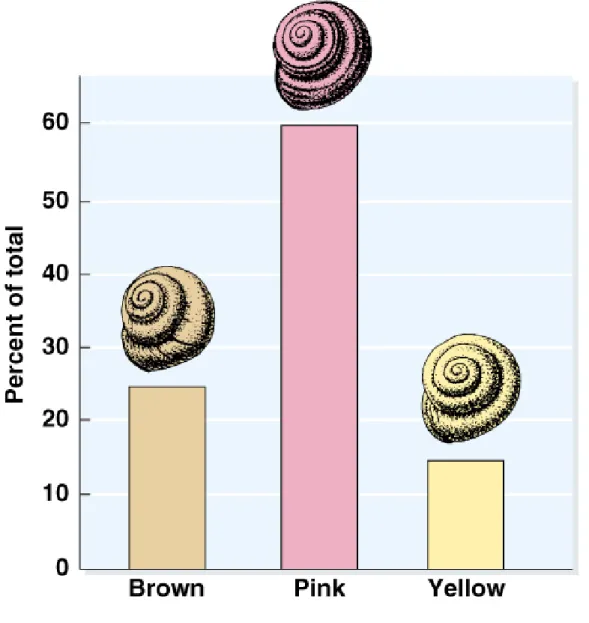
Fig. 14.1 Discontinuous distribution of shell color in the snail Cepaea
nemoralus from
台大農藝系 遺傳學 601 20000 Chapter 23 slide 4
Questions Studied in Quantitative Genetics
1. What role is played by genetics, and what role by environment?
2. How many genes are involved in producing phenotypes of the trait?
3. Do some genes play a major role in determining
phenotype, while others modify it only slightly, or are the contributions equal?
4. Do the alleles interact with each other to produce additive effects?
5. What changes occur when there is selection for a phenotype, and do other traits also change?
6. What method of selecting and mating individuals will produce desired phenotypes in the progeny?
台大農藝系 遺傳學 601 20000 Chapter 23 slide 5
The Inheritance of Continuous Traits
1. Statistical study of continuous traits began with
human traits such as height, weight, and mental
traits, even before Mendel’s principles
were understood.
2. Galton and Pearson (late 1800s) showed that these
traits are statistically linked between parents and
offspring, but they could not determine the mode
of transmission.
台大農藝系 遺傳學 601 20000 Chapter 23 slide 6
Polygene Hypothesis for Quantitative
Inheritance
Animation: Polygene hypothesis for wheat kernel color
1. Johannsen (1903) showed that continuous variation in bean seed weight is
multifactorial (partly genetic and partly environmental).
2. Nilsson-Ehle (1909) showed that a trait may be controlled by many genes, the polygene (multiple-gene) hypothesis for quantitative inheritance. He studied kernel color in wheat, crossing breeding red kernel wheat with true-breeding white (Table 14.1):
台大農藝系 遺傳學 601 20000 Chapter 23 slide 7
a. The F1 were all the same intermediate color between red and white, so
incomplete dominance was a possibility.
b. But intercross of F1 gave an F2 with four discrete shades of red (ranging
from parental red to very light) plus white, in a ratio of 1;4;6;4;1 (15 reds;1 white).
c. A 15;1 pattern is typical of a trait that results from the interactions of the products of two pairs of alleles. Both genes affect the same trait, and so are duplicate genes.
i. Alleles R (red) and C (crimson) result in red pigment, while r and c do not produce pigment.
ii. In the cross RRCC (dark red)´rrcc (white), the F1 are all RrCc
(intermediate red).
iii. Interbreeding the F1 produces an F2 with genotypes distributed as in
a typical dihybrid cross.
iv. The range of phenotypes results from incomplete dominance of the alleles, with each copy of R and C acting as a contributing allele to produce more red pigment. The r and c alleles are noncontributing alleles.
台大農藝系 遺傳學 601 20000 Chapter 23 slide 8
d. Some F
2populations show only three phenotypic classes (3 red;1
white), while others show a ratio of 63 red;1 white, with many
shades of red.
i. The 3;1 ratio is consistent with a single-gene system with two
contributing alleles.
ii. The 63;1 ratio is consistent with a polygene series with six
contributing alleles, (a+b)6.
3. This multiple-gene hypothesis has been applied to other
traits, including corn ear length. It proposes that some
attributes of quantitative inheritance result from the action
and segregation of a number of allelic pairs (polygenes),
each making a small but additive contribution to the
phenotype.
4. Quantitative trait inheritance appears to be complex,
however, and molecular aspects are often not yet well
understood.
台大農藝系 遺傳學 601 20000 Chapter 23 slide 9
Statistical Tools
1. Genes are always expressed in an environmental context,
and without genes there would be nothing to express. The
nature vs. nurture question provides an opportunity to
examine the relative contributions of both.
2. How much of a variation in phenotype (V
P) is due to
genetic variation (V
G) and how much to environmental
variation (V
E)? This can be expressed: V
P= V
G+ V
E.
3. To work this equation, variation must be measured and
then partitioned into genetic and environmental
components.
台大農藝系 遺傳學 601 20000 Chapter 23 slide 10
Samples and Populations
1.It is difficult to collect data for each individual
in a large population.
2.Sampling of a subset is an alternative method.
a.The sample must be large enough to minimizechance differences between the sample and the population.
b.The sample must be a random subset of the population.
3.Birth weight in humans is an example (Figure
14.2).
台大農藝系 遺傳學 601 20000 Chapter 23 slide 11
Fig. 14.2 Distribution of birth weight of babies (males + females) born to teenagers in
台大農藝系 遺傳學 601 20000 Chapter 23 slide 12
Distributions
1. Phenotypes are not easily grouped into classes when a continuous range occurs. Instead, a frequency distribution is commonly used, showing the proportion of individuals that fall within a range of phenotypes.
2. In a frequency distribution, the classes consist of specified ranges of the phenotype, and the number of individuals in each class is counted.
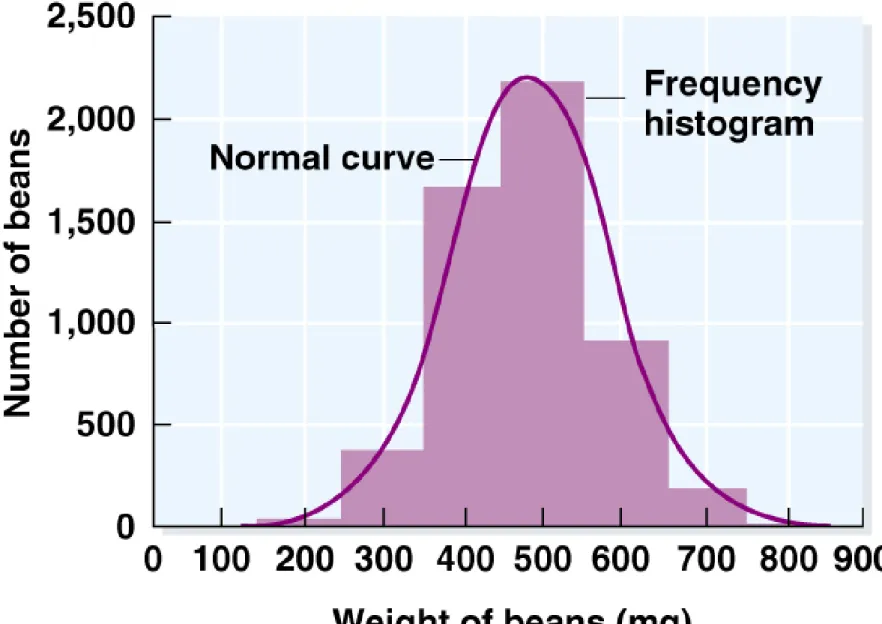
a. An example (Table 14.2) is Johannsen’s study of seed weight in the dwarf bean (Phaseolus vulgaris).
b. A histogram is used to show the distribution of individuals into phenotypic classes(Figure 14.3).
c. Tracing the outline of the histogram gives a curve characteristic of the frequency distribution.
3. Continuous traits often show a bell-shaped curve (normal distribution), due to influences of multiple genes and environmental factors.
台大農藝系 遺傳學 601 20000 Chapter 23 slide 13
台大農藝系 遺傳學 601 20000 Chapter 23 slide 14
The Mean
1. Frequency distribution of a phenotypic trait can be
summarized with two statistics, the mean and the
variance.
2. The mean (average) represents the center of the phenotype
distribution, and is calculated simply by adding all
individual measurements and then dividing by the number
of measurements added.
3. An example is East’s study of tobacco flower length in
genetic crosses.
a. He crossed a short-flowered strain (mean length of 40.4mm) with a long-flowered strain (mean length of 93.1mm).
台大農藝系 遺傳學 601 20000 Chapter 23 slide 15
The Variance and the Standard Deviation
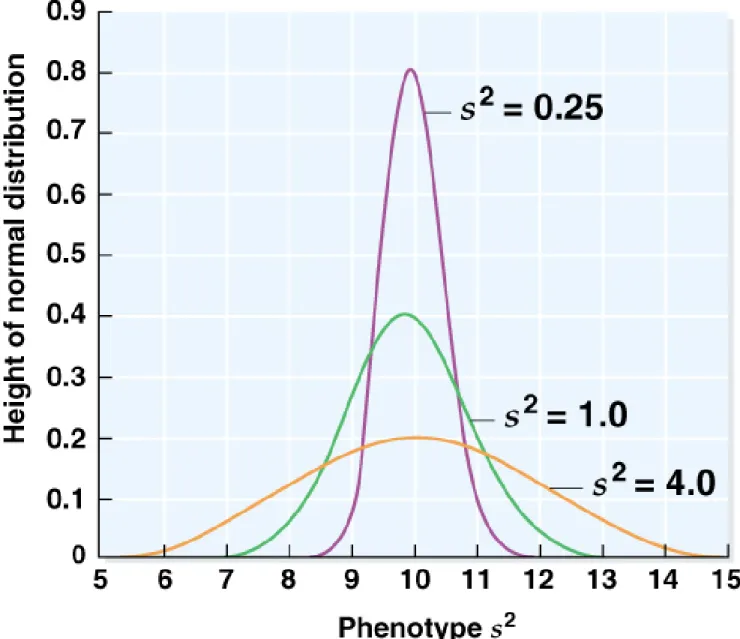
1. Variance is the measure of how much the individual measurements spread out around the mean (how variable they are).
a. Two sets of measurements may have the same mean, but different variances (Figure 14.4)
i. A broad curve shows high variability and a large variance.
ii. A narrow curve indicates little variability and a small variance.
b. The variance (s2) is the average squared deviation from the mean. To calculate s2:
i. Subtract the mean from each individual measurement. ii. Square the difference for each.
iii. Add the squared values.
iv.Divide by the number of original measurements minus 1 (n-1).
c. Standard deviation is used more often than variance because it shares the same units as the original measurements (rather than units squared as in variance). Standard deviation is the square root of the variance.
台大農藝系 遺傳學 601 20000 Chapter 23 slide 16
Peter J. Russell, iGenetics: Copyright © Pearson Education, Inc., publishing as Benjamin Cummings.
Fig. 14.4 Graphs showing three distributions with the same mean but different
台大農藝系 遺傳學 601 20000 Chapter 23 slide 17
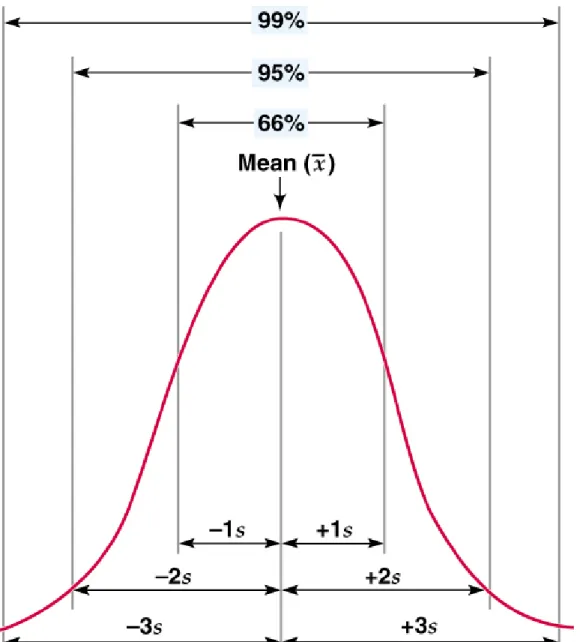
d. When mean and standard deviation are known, a theoretical
normal distribution is specified. Its shape is shown in Figure
14.5. In a theoretical normal distribution:
i.One standard deviation above or below the mean (±1s) includes
66% of the individual observations.
ii. Two standard deviations (±2s) include 95% of the individual
values.
iii. Three standard deviations (±3s) include>99% of the
individual values.
e. An example is body length of spotted salamanders (Table 14.3).
f. Analysis of variance is a statistical technique used to help
台大農藝系 遺傳學 601 20000 Chapter 23 slide 18
Peter J. Russell, iGenetics: Copyright © Pearson Education, Inc., publishing as Benjamin Cummings.
Fig. 14.5 Normal distribution curve showing proportions of the data in the distribution that are included within certain multiples of standard deviation
台大農藝系 遺傳學 601 20000 Chapter 23 slide 20
2. Variance and standard deviation provide
information about the phenotypes of a group. In
the tobacco flower example:
a. The original cross of short-flowered with
long-flowered produced an F
1with a mean flower length of
63.5mm, intermediate to the parents.
b. The F
2had a mean of 68.8mm, very similar to the F
1.
But the F
2had a variance of 42.2mm
2, while F
1variance was only 8.6mm
2, indicating that more
phenotypes occur among the F
2than among the F
1.
台大農藝系 遺傳學 601 20000 Chapter 23 slide 21
Correlation
1. Traits in individuals are often correlated, due to the pleiotropic effects of genes and environmental factors. Height and weight, for example, are aspects of a more general trait size.
a. When traits are correlated, change in one is associated with change in the other (e.g., human leg and arm length are usually correlated).
i. Correlation coefficient measures the strength of association between two variables in the same individual or experimental unit. In the arm and leg example, x = arm length, and y = leg length:
(1) Obtain the covariance of x and y (the variance shared by both traits) by taking the deviation from the mean for each.
(2) Take the product of each pair of x and y values. (3) Add all products together.
(4) Divide the sum by n - 1 to give the covariance of x and y where n= the number of xy pairs.
(5) The correlation coefficient (r) is then obtained by dividing the covariance by the product of the standard deviations of x and y (Table 14.4).
台大農藝系 遺傳學 601 20000 Chapter 23 slide 23
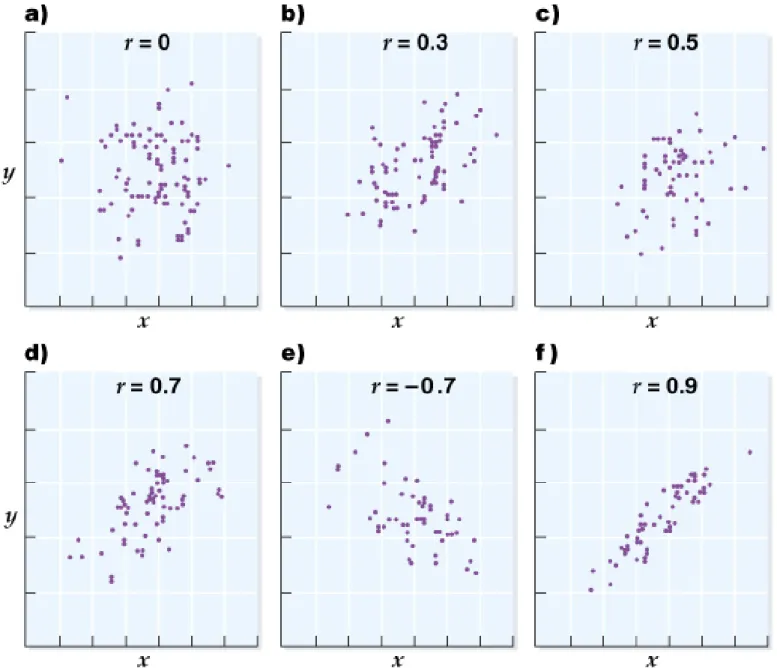
ii.Correlation coefficient is a standardized measure of
covariance that can range from -1 to +1 (Figure 14.6).
(1) A positive correlation coefficient means that an
increase in one variable is associated with an increase in
the other variable.
(2) A negative correlation coefficient means that an
increase in one variable is associated with a decrease in
the other variable.
(3) A correlation coefficient near 0 indicates a weak
relationship between the variables.
b. A correlation between variables does not imply a cause-effect
relationship.
c. Correlation is not the same thing as identity. Variables may be
highly correlated yet have very different values.
台大農藝系 遺傳學 601 20000 Chapter 23 slide 24
Peter J. Russell, iGenetics: Copyright © Pearson Education, Inc., publishing as Benjamin Cummings.
台大農藝系 遺傳學 601 20000 Chapter 23 slide 25
Regression
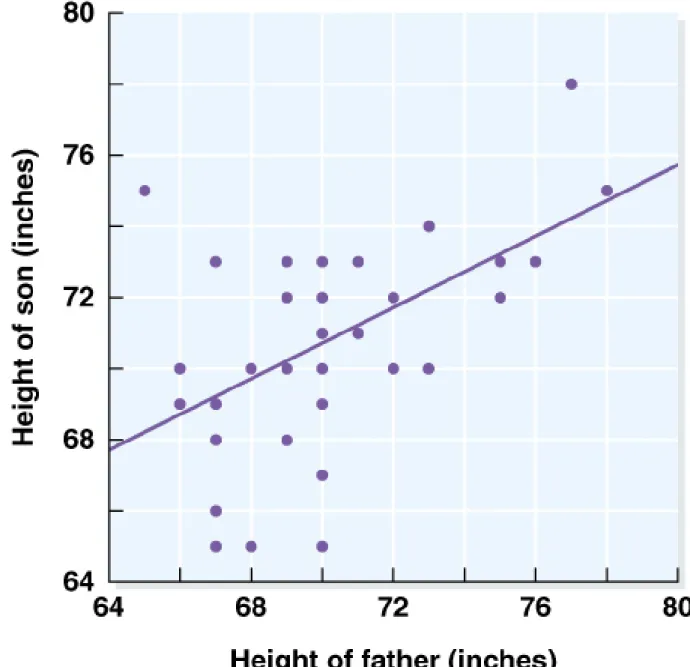
1. Regression analysis is used to determine the precise relationship between variables (Figure 14.7).
a. A graph is plotted for the individual data points, one on the x axis and the other on the y. The regression is the line that best fits the points (the squared vertical distance from the points to the regression line is
minimized).
b. The regression line can be represented with the equation y = a + bx, where:
i. x and y are values of the two variables. ii. b is the slope (regression coefficient).
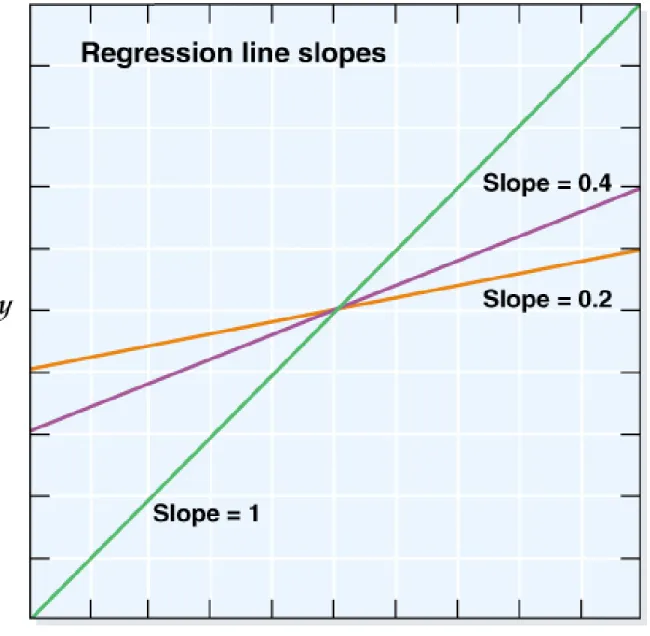
iii. a is the y intercept (the expected value of y when x is 0). c. The slope shows how much of an increase in the y variable is
associated with a unit increase in the x variable. (Figure 14.8)
2. Regression analysis is a common method for measuring the extent to which variation in a trait is genetically determined.
台大農藝系 遺傳學 601 20000 Chapter 23 slide 26
Peter J. Russell, iGenetics: Copyright © Pearson Education, Inc., publishing as Benjamin Cummings.
台大農藝系 遺傳學 601 20000 Chapter 23 slide 27
台大農藝系 遺傳學 601 20000 Chapter 23 slide 28
Analysis of Variance
1. Analysis of variance (ANOVA) determines if differences in
means are significant, and divides the variance into components.
a. It can tell whether a variation between two groups is likely to be due to chance, rather than to a true difference.
b. ANOVA can also determine how much of a difference is due to a factor such as genetics or the environment by partitioning the variance.
2. An example is selective breeding to increase milk production in
dairy cattle.
台大農藝系 遺傳學 601 20000 Chapter 23 slide 29
Quantitative Genetic Analysis
1. In the experiments described here, it was not clear at first
how these traits were inherited, only that their pattern of
inheritance differed from that seen with discontinuous
traits.
台大農藝系 遺傳學 601 20000 Chapter 23 slide 30
Inheritance of Ear Length in Corn
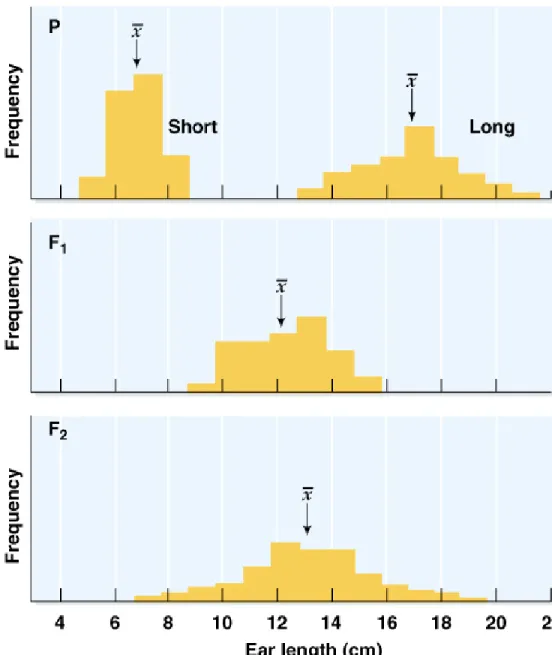
1. Emerson and East (1913) experimented with two pure-breeding strains of corn.
a. Each strain shows little variation in ear length.
i. The Black Mexican sweet corn variety has short ears (mean length 6.63 cm) with a standard deviation (s) of 0.816.
ii. Tom Thumb popcorn has long ears (mean length 16.80 cm), and s = 1.887. b. The two strains were crossed, and the F1 plants interbred (Figure 14.9).
i. The mean ear length in the F1 is 12.12 cm, approximately intermediate, and s =
1.519.
ii. Since both parents were true-breeding, all F1 plants should have the same
heterozygous genotype, and any variation in length would be due to environmental factors.
iii. The mean ear length of the F2 is 12.89 cm, very similar to the F1, but in the F2,
s = 2.252, reflecting its greater variability.
iv. It is expected that the environment would have the same effect on the F2 that it
had on the P and F1 plants, but it would not be expected to have more effect.
v. The increased variability in the F2 most likely results from its greater genetic
台大農藝系 遺傳學 601 20000 Chapter 23 slide 31
台大農藝系 遺傳學 601 20000 Chapter 23 slide 32
2. Aside from the environmental influence, four observations emerge that apply generally to similar quantitative-inheritance studies:
a. The F1 will have a mean value for the trait intermediate between the
means of the two true-breeding parental lines.
b. The mean value in the F2 is about the same as that for the F1.
c. F2 shows more variability around the mean than the F1 does.
d. Extreme values for the trait in the F2 extend farther into the parental
台大農藝系 遺傳學 601 20000 Chapter 23 slide 33
Heritability
1. Heritability is the proportion of a population’s
phenotypic variation attributable to genetic
factors.
2. Continuous traits are often determined by
multiple genes and by environmental factors. To
assess heritability, we must:
a. Measure the variation in the trait.
b. Partition the variance into components attributable
to different causes.
台大農藝系 遺傳學 601 20000 Chapter 23 slide 34
Components of the Phenotypic Variance
1. Phenotypic variance (VP) is the measure of all variability observed for a
trait.(Figure 14.10)
a. The portion of phenotypic variance caused by genetic factors is the genetic variance (VG).
b. Nongenetic sources of variation (e.g., temperature, nutrition, parental care) constitute environmental variance (VE).
c. The relationship is VP = VG + VE.
2. The partitioning of phenotypic variance is complex, and VG and VE may
covary, so that their sum is not the same as VP, and another term,
COVG,E, is needed.
a. For example, milk production in cows is influenced by both genetics and nutrition.
b. If a farmer provides progeny of good milking cows with less food than
progeny of poor milking cows, a covariance between genes and environment is produced.
c. In that case, the variance in milk production increases beyond that expected if genes and environment were acting independently.
台大農藝系 遺傳學 601 20000 Chapter 23 slide 35
Fig. 14.10 Hypothetical example of the effects of genes and environments on plant
台大農藝系 遺傳學 601 20000 Chapter 23 slide 36
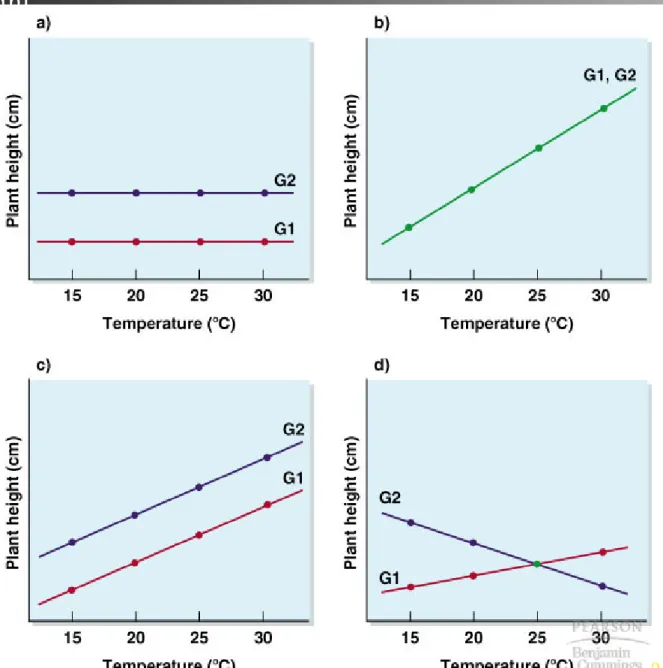
3. Knowledge that there is a genetic component to a trait does
not allow accurate predictions about offspring. Another
analysis method for phenotypic variance,
genotype-by-environment (G X E) interaction, is needed.
a. G X E variance exists when the relative effects of the genotypes differ among environments
b. An example is temperature affecting plant height:
i. In a cold environment, height of genotype AA plants averages 40 cm, while those with genotype Aa are 35 cm.
ii. In a warm climate, genotype AA is 50 cm tall, while genotype Aa is now 60 cm.
iii. Both genotypes grow taller in warm temperatures (an environmental effect). There is also a genetic effect, but it
depends on the environment. Genetic-environmental interaction is represented by VGx E.
台大農藝系 遺傳學 601 20000 Chapter 23 slide 37
4. Phenotypic variance is represented by the equation:
V
P= V
G+ V
E+ 2COV
G,E+ V
G x Ea. Phenotypic variation arises from:
i. Genetic variation (V
G).
ii. Environmental variation (V
E).
iii. Genetic-environmental covariation (COV
G,E).
iv. Genetic-environmental interaction (V
G x E).
b. Relative contributions of each factor depend on the genetic
composition of the population, specifics of the environment and
the manner in which the genes interact with the environment.
台大農藝系 遺傳學 601 20000 Chapter 23 slide 38
5. Genetic variance (VG) can be subdivided into three components arising from
different gene actions and interactions between genes.
a. Some genetic variance results from average effects of the different alleles, creating additive genetic variance (VA). Example:
i. Allele g contributes 2 cm to plant height, while G contributes 4 cm.
ii. A gg homozygote would receive 4 inches of height, a Gg heterozygote 6 inches, and a GG homozygote 8 inches.
iii. This effect is added to the height effects produced by alleles at other loci. iv. Nilsson-Ehle’s experiments with wheat kernel color are another example of
additive genetic variance.
b. Dominance variance (VD) occurs when one allele masks the effect of another allele at
the same locus, and prevents the effects from being strictly additive.
i. If G is a dominant allele and g a recessive one, the Gg genotype would make the same contribution to phenotype as GG.
ii. As dominance decreases, genotypic differences become phenotypic differences, turning dominance variance into additive genetic variance.
c. Epistatic interactions occur among alleles at different loci, adding another source of genetic variation, the epistatic or interaction variance (VI).
台大農藝系 遺傳學 601 20000 Chapter 23 slide 39
6. The environmental component of variance can also be partitioned.
a. General environmental effects (VEg) include factors like temperature and
nutrition, resulting in fairly irreversible differences among individuals. b. Special environmental effects (VES) result in immediate changes of
phenotype (e.g., skin pigment due to sun exposure) and are often reversible.
c. Environmental effects shared by members of a family (VECf) can be
mistaken for genetic influences, because they contribute to differences among families (e.g., insects that sequester host plant compounds for their own defense).
d. Maternal effects (VEm) are a common category of VECf (e.g., birth weight
and weight gain due to milk quality and volume in humans).
7. It is difficult to quantify all of these influences simultaneously, and
usually assumptions are made about some factors. In general, variation due to nature and nurture is summarized by the equation:
台大農藝系 遺傳學 601 20000 Chapter 23 slide 40
Broad-Sense and Narrow-Sense Heritability
1. The amount of variation among individuals resulting from genetic variance (VG) is the broad-sense heritability of a phenotype.
a. Broad-sense heritability = h2B= VG /VP (h2 is heritability, and B designates
“broad-sense”).
b. Heritability ranges from 0–1, with 0 meaning no variation from genetic differences, and 1 meaning that all variation is genetically based.
c. Broad-based heritability:
i. Includes all types of genes and gene actions.
ii. Does not distinguish between additive, dominance and interactive genetic variance.
iii. Assumes that interaction between genotype and environment (VG x E)
is not important.
台大農藝系 遺傳學 601 20000 Chapter 23 slide 41
2. Additive genetic effects are more often used, because this component allows prediction of the average phenotype of the offspring when phenotypes of the parents are known.
a. For example, in a cross for a trait involving a single locus:
i. One parent might be 10 cm tall, with the genotype A1A1, and the
other parent 20 cm tall, with the genotype A2A2.
ii. If the alleles are additive, the F1 (A1A2) will be 15 cm tall, while if
one allele is dominant, the F1 will resemble one of the parents.
b. In the same way, epistatic genes will not always contribute to the resemblance between parents and offspring.
3. Narrow-sense heritability is the proportion of the variance resulting from additive genetic variance.
a. Narrow-sense heritability = h2N= VA /VP (h2 is heritability,
and N designates “narrow-sense”).
b. VA determines resemblance across generations, and
台大農藝系 遺傳學 601 20000 Chapter 23 slide 42
Understanding Heritability
1. Heritability estimates have limitations that are often ignored, leading to misunderstanding and abuse. Important qualifications and limitations of heritability:
a. Broad-sense heritability does not indicate the extent to which a trait is genetic. Rather, it measures the proportion of the phenotypic variance in a population resulting from genetic factors.
i. For example, knowledge of football requires a nervous system, produced by genes, but differences in football knowledge are usually not due to genetic factors, so broad-sense heritability (VG) for football knowledge
is zero.
ii. If all individuals have the same genes at loci controlling a trait (e.g., eye or ear number), VG = 0, even though genes are clearly involved in
producing the trait.
iii.High heritability also does not mean that environment is unimportant. It may mean instead that environmental factors influencing the trait are relatively uniform across the population.
b. Heritability does not indicate what proportion of an individual’s phenotype is genetic. Heritability is a characteristic of a population, not an individual.
台大農藝系 遺傳學 601 20000 Chapter 23 slide 43
c. Heritability is not fixed for a trait. It depends on the genetic makeup and
environment of a population, and so a calculation for one group may not hold true in another. An example is human height.
i. In a population with a uniformly high quality diet, differences in height are likely to be due to genetic factors, especially if there is high ethnic
diversity.
ii. In a population where quality of diet varies widely, height differences will be due less to genetic factors, and relatively more to environmental
factors.
d. High heritability for a trait does not imply that a population’s differences in the same trait are genetically determined. An example is diet in mice.
i. Genetically diverse mice were randomly split into two groups. Both groups received the same space, water and other environmental necessities. The only difference was diet.
(1) Mice in the group receiving nutritionally rich food grew large. Heritability of adult body weight was calculated at 0.93.
(2) Mice in the group receiving an impoverished diet lacking calories and essential nutrients were smaller. Heritability of adult body weight was 0.93.
(3) Both large size and small size were calculated to be highly heritable in these mice. This is a contradiction, since both groups are from the same genetic stock.
台大農藝系 遺傳學 601 20000 Chapter 23 slide 44
(4) Another example is the correlation between presence of books in the home and a child’s reading skill.
e. Traits shared by members of the same family do not necessarily have high heritability.
i. Familial traits may arise from either shared genes or shared environment. ii. Familiality is distinct from heritability.
台大農藝系 遺傳學 601 20000 Chapter 23 slide 45
How Heritability Is Calculated
1. Many of the methods used compare related and unrelated individuals, or compare individuals with different degrees of relatedness. When
environmental conditions are identical:
a. Closely related individuals have similar phenotypes when the trait is genetically determined.
b. Related individuals are no more similar in phenotype than unrelated ones when the trait is environmentally determined.
2. In humans, environmental conditions are complex in structure, and
extended parental care means that it is difficult to separate the effects of genetics from those of nurture and culture. Methods of calculating
heritability in humans include:
a. Comparison of parents and offspring. b. Comparison of full and half siblings.
c. Comparison of identical and nonidentical twins. d. Response-to-selection data.
台大農藝系 遺傳學 601 20000 Chapter 23 slide 46
3. Heritability from parent-offspring regression is calculated by
correlation and regression of data measuring the phenotypes
of parents and offspring in a series of families.
a. The mean phenotype of the parents (mid-parent value) and
mean phenotype of offspring are plotted with each point on
the graph representing one family (Figure 14.11).
b. Slope of the parent-offspring regression line reflects the
magnitude of heritability.
i. If the slope is 0, narrow-sense heritability (h
2N) is also 0.
ii. If the slope is 1, offspring have a phenotype exactly
intermediate between the two parents, and additive gene
effects account for the entire phenotype.
iii. If the slope is between 0 and 1, both additive genes
and nonadditive factors (dominant and epistatic genes,
environment) affect the phenotype.
台大農藝系 遺傳學 601 20000 Chapter 23 slide 47
Fig. 14.11 Three hypothetical regressions of mean parental wing length on mean
台大農藝系 遺傳學 601 20000 Chapter 23 slide 48
c. When the mean phenotype of the offspring is regressed against
the phenotype of only one parent, the narrow-sense heritability is
twice the slope, because the offspring shares only 1/2 its genes
with the parent.
d. The factor by which the slope is multiplied to obtain heritability
increases as the distance between relatives increases.
4. Heritability values have been calculated for many traits in
a variety of species and populations, using several
methods. (Table 14.5)
a. Heritability estimates are not precise and may vary widely for the
same trait in the same organism.
b. Human heritability values are especially difficult, because
genetic and environmental factors are hard to separate.
台大農藝系 遺傳學 601 20000 Chapter 23 slide 50
Response to Selection
1. Both plant and animal breeding and evolutionary biology
are concerned with genetic change in groups of
organisms, and use the methods of quantitative genetics
to predict rate and magnitude of genetic change.
a. Both groups are concerned with evolution (genetic change within groups of organisms based on natural selection).
b. Artificial selection (selective breeding) by humans mimics this process, and can be a powerful tool for rapid change in a species (e.g., domestic dogs).
2. In both artificial and natural selection, genetic variation is
a key factor in determining the rate and type of evolution,
and quantitative genetics is used to:
a. Estimate the amount of genetic variation.
台大農藝系 遺傳學 601 20000 Chapter 23 slide 51
Estimating the Response to Selection
1. Phenotypes will change from one generation to the next in response to selection if the appropriate genes are present in the population. The amount of phenotypic change in one generation is the selection
response, R.
a. An example is body size in Drosophila melanogaster.
i. A geneticist begins by weighing flies to determine the average weight in the population (e.g., 1.3 mg).
ii. The largest flies (e.g., those 3 mg) are selected for breeding.≧
iii. Weights of the F1 are compared with those of the original unselected
population.
iv. If they are significantly larger, response to selection has occurred. b. The selection response is dependent upon:
i. Narrow-sense heritability.
ii. Selection differential (s), the difference between the mean phenotype of the selected parents and that of the unselected population. (In the
台大農藝系 遺傳學 601 20000 Chapter 23 slide 52
c. Selection response relates to selection differential and heritability by the “breeder’s equation,” R = h2S.
i. In the example, R (response to selection) is the difference in mean body weight between F1 flies and the original population (R = 2.0 mg - 1.3
mg = 0.7 mg).
ii. R and S are known, so the equation can be solved for h (narrow-sense heritability):
h2 = R/S = 0.7 mg/1.7 mg = 0.41.
iii. This is a common method for determining heritability of many traits. d. As long as genetic variation is present, traits will respond to selection in
each generation.
i. Dog evolution under domestication (Table 14.6) is an example. ii.Another example is selection for positive and negative phototactic behavior in Drosophila pseudoobscura (Figure 14.12) in which the
response to selection eventually decreased. Possible explanations include: (1) No further genetic variation for phototactic behavior exists within
the population.
(2)Some variation still exists, but genes for the selected trait have detrimental effects on other traits due to genetic correlations.
台大農藝系 遺傳學 601 20000 Chapter 23 slide 54
Fig. 14.12 Selection for phototaxis in Drosophila pseudoobscura
台大農藝系 遺傳學 601 20000 Chapter 23 slide 55
Genetic Correlations
1. Phenotypes of more than one trait may be correlated, and therefore do not vary independently (e.g., blond hair, fair skin and blue eyes).
Association is not complete, but the traits are found together more often than chance predicts.
a. Phenotypic correlation is computed by measuring the two phenotypes in a number of individuals, and then calculating a correlation
coefficient for the two traits.
b. Sometimes phenotypic correlation occurs because the traits are
influenced by a common set of genes (e.g., human hair, eye and skin color).
c. A gene affecting 2 traits is pleiotropic, and the traits will be ≧ correlated (e.g., human height and weight) (Table 14.7).
d. Environmental factors may also cause nonrandom associations
between phenotypes (e.g., fertilizing soil may cause taller plants with more flowers).
台大農藝系 遺傳學 601 20000 Chapter 23 slide 57
2. Genetic correlations may be positive or negative.
a. Positive correlation means increase in one trait correlates with an increase in the other (e.g., body and egg weight in chickens).
b. Negative correlation means an increase in one trait correlates with a decrease in the other (e.g., egg size and number of eggs laid). Negative correlations
represent trade-offs (genetic constraints). Examples include:
i. Garter snakes, where for unknown reasons speed in escaping predators correlates negatively with resistance to toxic newts in the diet(Figure 14.13).
ii. Dairy cattle, where milk yield correlates negatively with butterfat content.
3. Ability to adapt to a particular environment is also often influenced by genetic correlations among traits. An example is tadpoles, where
developmental rate and size at metamorphosis show a negative correlation.
a. Genes that accelerate development (a good thing for life in a puddle that may dry up quickly) cause metamorphosis to occur in smaller tadpoles, producing smaller frogs.
b. Smaller frogs have decreased survival due to water loss, predation and difficulty in finding food, and so there are constraints on the genes that accelerate development.
台大農藝系 遺傳學 601 20000 Chapter 23 slide 58
Peter J. Russell, iGenetics: Copyright © Pearson Education, Inc., publishing as Benjamin Cummings.
Fig. 14.13 Negative genetic correlation (r = -0.45) between speed and resistance to
台大農藝系 遺傳學 601 20000 Chapter 23 slide 59
Quantitative Trait Loci
1. The application of statistical analysis to polygenic inheritance has been powerful, requires specific knowledge of the quantitative trait loci (QTLs) that affect them. 2. QTLs are identified by correlation with phenotypic differences between
individuals, and work best when analyzing a population with:
a. A detailed linkage map
b. Significant phenotypic variation. c. Large numbers of individuals.
3. Typically, inbred lines with different phenotypes (homozygotes for different alleles) are crossed, and then backcrossed, intercrossed, or selfed to produce a series of recombinant inbred strains.
a. The resulting recombinant inbred strains are analyzed for marker genotypes that correlate with phenotypic variation.
i. If the phenotype mean value is the same for all classes, the marker locus is unlinked to a QTL.
台大農藝系 遺傳學 601 20000 Chapter 23 slide 60
4. QTLs responsible for agronomic traits and adaptive differences between closely related species have emerged from this work.
a. In plants, important species differences include the suites of traits that
attract pollinators (color, shape, odor, nectar rewards). Monkeyflowers are an example, with pollinators ranging from hummingbirds to bees, and
corresponding changes in traits (Figure 14.14).
i. Mimulus cardinalis has red color, deep nectar, tubes with abundant nectar, and reflexed petals. It is a hummingbird-pollinated species.
ii. M. lewisii has pink flowers, broad petals, and little nectar reward. It is a bee-pollinated species.
b. Crosses between these species show that at least one QTL controls³25% of phenotypic variation in pollinator attraction and efficiency traits (Figure 14.15).
c. In some cases, important phenotypic shifts correlate with mutations in single loci.
台大農藝系 遺傳學 601 20000 Chapter 23 slide 61
台大農藝系 遺傳學 601 20000 Chapter 23 slide 62
Fig. 14.15 QTL maps for 12 floral traits in monkeyflowers
台大農藝系 遺傳學 601 20000 Chapter 23 slide 63
5. QTL approaches have been used extensively in corn,
tomato, and the fruitfly. Examples:
a. In corn, the tb1 (teosinte branched 1) QTL controls the number
of axillary branches, distinguishing corn from its wild relative,
teosinte. tb1 is a DNA-binding transcriptional regulator that
suppresses growth in specific tissues.
b. In tomatoes, the fw2.2 QTL controls up to 30% of the fruit
weight difference between cultivated and wild species.
i. Expressed early in fruit development, variation in fw2.2 alleles
affects timing and levels of gene expression, but not major
differences in protein sequence.
ii. The small fruit allele also causes a pleiotropic effect, as
isogenic lines homozygous for the allele produce more fruits
than do plants homozygous for the large fruit allele.
台大農藝系 遺傳學 601 20000 Chapter 23 slide 64
6. QTL may sometimes be found by testing for associations
between phenotypic differences and allelic variation at
candidate loci. For example, in Drosophila a recently
discovered QTL defined for sternopleural bristle number
occurs near a known QTL for bristle number, hairy (h).
7. In humans, genes for quantitative traits cannot be found
through traditional pedigree analysis, due to the effects of
environment and other segregating genes.
a. Association studies use the occurrence of widely distributed DNA markers in a subject population and compare them with a random control population to detect QTL.
b. Genotype and phenotype of individuals is statistically analyzed to correlate DNA markers with QTL.