Structure and dielectric relaxation properties of Na
1−xLa
xNb
1−xCr
xO
3perovskites
Yu-Jen Hsiao and Yen-Hwei Changa兲
Department of Materials Science and Engineering, National Cheng Kung University, Tainan 70101, Taiwan Te-Hua Fang
Institute of Mechanical and Electromechanical Engineering, National Formosa University, Yunlin 63201, Taiwan
Yee-Shin Chang
Institute of Electro-Optical and Materials Science, National Formosa University, Yunlin 63201, Taiwan Yin-Lai Chai
Department of Resources Engineering, Dahan Institute of Technology, Hualien 97101, Taiwan 共Received 25 August 2005; accepted 10 February 2006; published online 23 March 2006兲 Na1−xLaxNb1−xCrxO3 perovskites were prepared by conventional solid-state reaction with x = 0.01,
0.05, 0.1, 0.2, 0.3, and 0.4. The structure with x = 0.01 is similar to that of NaNbO3 with an
orthorhombic structure. The crystal structure for compositions for x over 0.05 was found to have a distorted cubic structure. Grains of microcube topography were obtained. The average grain size is about 1 – 2m. The dielectric constants and dissipation factors were measured as functions of frequency 共20 Hz–1 MHz兲 and temperature 共225–500 K兲. The activation energy for x=0.2, 0.3, and 0.4 were 0.22, 0.21, and 0.19 eV, respectively. Space charge polarization and orientational polarization contribute to the observed dielectric behavior. © 2006 American Institute of Physics. 关DOI:10.1063/1.2182076兴
I. INTRODUCTION
Sodium niobate共NaNbO3兲 has received considerable
at-tention and interest owing to its ability to readily undergo various structural phase transitions from nonpolar to antifer-roelectric, and to finally enter the ferroelectric phase.1 The dielectric behavior of NaNbO3 may be modified by the
ad-dition of Li+or K+cations which induce a ferroelectric phase
at room temperature.2,3The antiferroelectric phase of sodium niobate is a solid solution with ferroelectric, dielectric, and lead-free piezoelectric characteristics. Most of these works have focused on doped sodium niobate.4,5 The replacement of Na+ by higher-valence ions creates additional positive charges, which are compensated by negative charges created from the replacement of Nb5+by lower-valence ions, leading to a charge neutrality. Its electrical properties are affected by oxygen nonstoichiometry, doping, stress, and electric field application.4A pure stoichiometric sodium niobate is almost an insulator, and its band gap is equal to 3.4 eV.6Thermally activated conductivity, characterized by a low concentration of current carriers, is described with the polaronic model.7 The oxygen vacancies occurring in the crystal lattice act as a carrier source of the electrical current, which increases the conductivity value and changes the corresponding activation energy.8,9Therefore, the participation of oxygen vacancies in the conductions process raises the question about partial ionic and partial electronic conduction. Materials with such mixed characteristics are interesting due to their potential applications in electrochemical devices.10
Lanthanum chromite is a p-type semiconductor material. Although the electric conductivity of LaCrO3 at room
tem-perature is very small, lanthanum chromite possesses excel-lent high temperature conductivity. LaCrO3 can be used to
perform magnetohydrodynamics共MHD兲 and can be used in high temperature solid oxide fuel cells共SOFC兲.11,12The fam-ily of perovskite-structure ABO3 compounds has attracted
considerable attention over the past half century. However,
A+1B+5O
3– A3+B3+O3 perovskite-structure compounds such
as Na1−xLaxNb1−xCrxO3-type materials provided the
motiva-tion for this research.
Parkash et al.13showed that the solid-solution forms for all values of x in the range of 0.01–0.99 in a La1−xNaxCo1−xNbxO3system having the rhombohedral phase
transform to the cubic phase when x = 0.4, and then to the orthorhombic phase when x = 0.99. The stability of the per-ovskite phase in the Na1−xLaxNb1−xCrxO3system synthesized
by solid-state reaction was investigated. Furthermore, the phase relationships and dielectric properties are also pre-sented in this paper.
II. EXPERIMENTAL PROCEDURES
The compounds used in this investigation were prepared using a conventional solid-state reaction technique. The start-ing materials were Na2CO3, Nb2O5, La2O3, and Cr2O3
hav-ing a purity of at least 99.9%. Solid-solution oxides with a formula of Na1−xLaxNb1−xCrxO3共x=0.01, 0.05, 0.1, 0.2, 0.3,
and 0.4兲 were prepared. The powders were mixed and ground with acetone in a zirconium oxide ball mill for 24 h. The mixed powders were dried and calcined at 1150 ° C for 5 h in air. The calcined powders were ground and pressed at
a兲Author to whom correspondence should be addressed; FAX:
⫹886-6-2382800; electronic mail: [email protected]
JOURNAL OF APPLIED PHYSICS 99, 064104共2006兲
0021-8979/2006/99共6兲/064104/7/$23.00 99, 064104-1 © 2006 American Institute of Physics
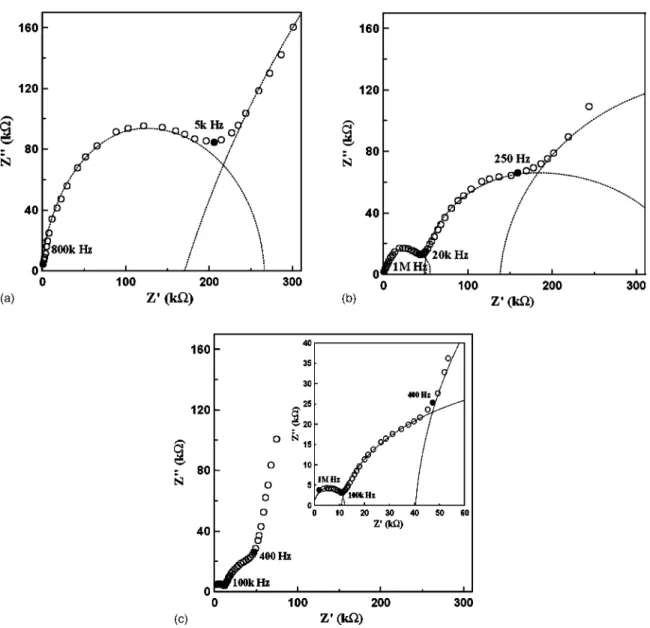
ization as mentioned earlier. Increasing the measured tem-perature from 375 to 480 K 关Figs. 6共a兲–6共c兲兴, a third de-pressed circular arc is further found; this contributed to the electrode-specimen interface polarization effect at lower fre-quencies.
Such a mark-up in the value of the dielectric constant at lower frequencies is explained in terms of interfacial polar-ization. The buildup of charges at the grain-grain boundary or electrode-specimen interface is responsible for the large polarization, therefore, the high dielectric constant at lower frequencies. In this study, the dielectric relaxation is not only claimed to be of the orientational polarization. It is also shown that the space charge polarization is due to the grain semiconductivity or the electrode-specimen interface effect in the Na1−xLaxNb1−xCrxO3 ceramics.
IV. CONCLUSIONS
This solid solution of Na1−xLaxNb1−xCrxO3 for x in the
range of 0.01艋x艋0.4 is synthesized. For x艌0.05 the crys-tal structure changes from orthorhombic to a distorted cubic structure. Grains of microcube topography were obtained.
The average grain size is about 1 – 2m. The dielectric con-stants increased with temperature but decreased with increas-ing frequency. The activation energy for x = 0.2, 0.3, and 0.4 were 0.22, 0.21, and 0.19 eV, respectively. The dielectric behavior of Na1−xLaxNb1−xCrxO3 ceramics reveals the
pres-ence of the orientational grain-grain boundary or electrode-specimen interface polarization processes.
ACKNOWLEDGMENT
The authors would like to thank the National Science Council of the Republic of China, Taiwan for financially sup-porting this research under Contract No. NSC 94-2216-E-006-012.
1H. D. Megaw, Ferroelectrics 7, 87共1974兲.
2R. R. Zeyfang, R. M. Henson, and W. J. Maier, J. Appl. Phys. 48, 3014
共1977兲.
3M. Ichikia, L. Zhang, M. Tanaka, and R. J. Maeda, J. Eur. Ceram. Soc. 24,
1693共2004兲.
4I. P. Raevski and S. A. Prosandeev, J. Phys. Chem. Solids 63, 1939
共2002兲.
5H. Khemakhem, A. Simon, R. Von Der Mühll, and J. Ravez, J. Phys.:
Condens. Matter 12, 5951共2000兲.
FIG. 7. Cole-Cole impedance plots for Na0.7La0.3Nb0.7Cr0.3O3at different temperatures共a兲 375 K, 共b兲 420 K, and 共c兲 480 K.
064104-6 Hsiao et al. J. Appl. Phys. 99, 064104共2006兲
6I. P. Rajevskij, M. A. Malicka, K. A. Wójcik, O. I. Prokopało, W. T.
Smotrakov, and E. G. Fesenko, Fiz. Tverd. Tela共Leningrad兲 19, 3589 共1977兲.
7R. Mañka, Phys. Status Solidi B 83, 69共1979兲.
8E. Ksepko, E. Talik, A. Ratuszna, A. Molak, Z. Ujma, and I. Gruszka, J.
Alloys Compd. 386, 35共2005兲.
9S. Lanfredi, L. Dessemond, and A. C. M. Rodrigues, J. Am. Ceram. Soc.
86, 291共2003兲.
10I. Riess, Solid State Ionics 157, 1共2003兲.
11K. P. Bansal, S. Kumari, B. K. Das, and G. C. Jain, J. Mater. Sci. 16, 1994
共1981兲.
12H. U. Andern, Solid State Ionics 52, 33共1992兲.
13O. Parkash, R. Kumar, D. Kumar, and D. Bahadur, J. Mater. Sci. Lett. 7,
383共1988兲.
14I. Santos, L. H. Loureiro, M. F. P. Silva, and A. Cavaleiro, Polyhedron 21,
2009共2002兲.
15C. Lee, J. Destry, and J. Brebnerc, Phys. Rev. B 11, 2299共1975兲. 16C. Y. Chung, Y. H. Chang, and G. J. Chen, J. Appl. Phys. 96, 6624共2004兲. 17L. Groupp and H. U. Anderson, J. Am. Ceram. Soc. 59, 449共1976兲. 18S. Lanfredi, A. C. M. Rodrigues, and L. Dessemond, J. Am. Ceram. Soc.
86, 2103共2003兲.
19Y. Li, X. Yao, and L. Zhang, Ceram. Int. 30, 1283共2004兲. 20R. Moos and K. H. Hardtl, J. Am. Ceram. Soc. 80, 2549共1997兲. 21R. K. Dwivedi, D. Kumar, and O. Parkash, J. Mater. Sci. 36, 3641共2001兲. 22A. S. Nowick, S. Q. Fu, W. K. Lee, B. S. Lin, and T. Scherban, Mater. Sci.
Eng., B B23, 19共1994兲.
23M. A. L. Nobre and S. Lanfredi, J. Appl. Phys. 93, 5557共2003兲. 24R. K. Dwivedi, D. Kumar, and O. Parkash, Br. Ceram. Trans. 100, 115
共2001兲.
25S. P. Singh, A. K. Singh, D. Pandey, H. Sharma, and O. Parkash, J. Mater.
Res. 18, 2677共2003兲.
064104-7 Hsiao et al. J. Appl. Phys. 99, 064104共2006兲