The distributed program reliability analysis on star topologies
Ming-Sang Chang
!, Deng-Jyi Chen!,*, Min-Sheng Lin", Kuo-Lung Ku#
!Institute of Computer Science and Information Engineering, National Chiao Tung University, Hsin Chu, Taiwan, ROC"Department of Information Management, Tamsui Oxford University College, Tamsui, Taipei, Taiwan, ROC #Chung-Shan Institute of Science and Technology, Tao-Yuan, Taiwan, ROC
Received March 1998; received in revised form November 1998
Abstract
A distributed computing system consists of processing elements, communication links, memory units, data "les, and programs. These resources are interconnected via a communication network and controlled by a distributed operating system. The distributed program reliability in a distributed computing system is the probability that a program which runs on multiple processing elements and needs to retrieve data "les from other processing elements will be executed successfully. This reliability varies according to (1) the topology of the distributed computing system, (2) the reliability of the communication edges, (3) the data "les and programs distribution among processing elements, and (4) the data "les required to execute a program. In this paper, we show that computing the distributed program reliability on the star distributed computing systems is NP-hard. We also develop an e$ciently solvable case to compute distributed program reliability when some additional "le distribution is restricted on the star topology.
Scope and purpose
Recent advances in VLSI circuitry have a tremendous impact on the price-performance revolution in microelectronics. This development has led to an increased use of workstations connected in the form of a powerful distributed computing system. Potential bene"ts o!ered by such distributed computing systems include better cost performance, enhanced fault tolerance, increased system throughput, and e$cient sharing of resources. Distributed program reliability is an important measure that should be examined for designing a high fault-tolerance distributed computing system. This reliability varies according to (1) the topology of the distributed computing system, (2) the reliability of the communication edges, (3) the data "les and programs distribution among processing elements, and (4) the data "les required to execute a program. This article is concerned with the analysis of distributed program reliability on star distributed computing systems.( 2000 Elsevier Science Ltd. All rights reserved.
Keywords: Distributed program reliability; Distributed computing system; Algorithms
* Corresponding author. Tel.: #886 35 712121 x54755; fax: #886 35 724176. E-mail address: [email protected] (D.-J. Chen)
0305-0548/00/$ - see front matter ( 2000 Elsevier Science Ltd. All rights reserved. PII: S 0 3 0 5 - 0 5 4 8 ( 9 9 ) 0 0 0 1 1 - 8
1. Introduction
A distributed computing system (DCS) consists of processing elements, communication links, memory units, data "les, and programs. These resources are interconnected via a communication network and controlled by a distributed operating system. A distributed computing system has become very popular for its high fault tolerance, potential for parallel processing, and better reliability performance. One of the important issues in the design of the DCS is the reliability performance. For traditional networks, many reliability indice have been proposed. They include two-terminal reliability, all-terminal reliability, and K-terminal reliability [1}5]. However, these measures are not applicable to practical DCS's since the reliability measure for DCSs should capture the e!ects of distribution on redundant data "les.
In Prasanna Kumar et al. [6] and Kumar et al. [7] distributed program reliability was introduced to model the reliability of DCS. The distributed program reliability in a dis-tributed computing system is the probability that a program which runs on multiple process-ing elements and needs to retrieve data "les from other processprocess-ing elements will be executed successfully.
Most of network reliability problems (e.g., K-terminal reliability), in general, are NP-hard. The class of NP-hard problems was introduced by Valiant [8]. Computing distributed program reliability (DPR) for general DCS's is also NP-hard. One possible means of avoiding this complexity is to consider only a restricted class of DCS's.
The star topology is one of the most widely used structures for a communication system. The star network was used because it was easy to control } the software is not complex and the tra$c #ow is simple. Fault isolation is also relatively simple in a star network because the line can be isolated to identify the problem. In a star topology, each machine on the network has its own dedicated connection to a hub or switch. The star topology is used mostly with twisted pair cabling, usually in an Ethernet environment.
In this paper, we are interested in star topologies. We highlight the problem of computing the distributed program reliability for a star topology because the simplicity of the topology may incorrectly be conceived as trivial. We show that computing the distributed program reliability on the star distributed computing systems is NP-hard. We also develop an e$ciently solvable case to compute distributed program reliability when some additional "le distribution is restricted on the star topology.
In Section 2, the de"nitions and notation are given for this paper. In Section 3, we show that computing the distributed program reliability on the star distributed computing systems is NP-hard. In Section 4, we propose an e$ciently solvable case of DPR problem for star topologies in which data "les are restricted to a certain type of distribution. Finally, summary and concluding remarks are given.
2. Notation and de5nitions Notation
D"(<, E, F) an undirected distributed computing system (DCS) graph with vertex set <, edge set E and data "le set F
m the number of distinct "les in a DCS
FAi the set of "les available at node i (note: F"XFAi) ei edge (r, vi)
vi the node whose incident edge is ei
pi reliability of edge i
qi 1!pi
H subset of "les of F, i.e., H-F, and H contains the programs to be executed and all needed data "les for the execution of these programs
R(DH) the DPR of D with a set H of needed "les: PrMall data"les in H can be accessed successfully by the executed programs in HN
De5nition. A ,le spanning tree (FST) is a tree whose nodes hold all needed "les in H.
De5nition. A minimal ,le spanning tree (MFST) is an FST such that there exists no other FST that is a subset of it.
De5nition. Distributed program reliability (DPR) is de"ned as the probability that a distributed program that runs on multiple processing elements (PEs) and needs to communicate with other PEs for remote "les will be executed successfully.
By the de"nition of MFST, the DPR can be written as
R(DH)"Prob(at least one MFST is operational), or R(DH)"Prob
A
dmfst
Z
j/1MFSTj
B
,wheredmfst is the number of MFSTs for a given needed"le set H.
De5nition. A star DCS is a topology with n#1 nodes Mr, v1, v2, 2, vnN and n edges M(r, v1), (r, v2), 2, (r, vn)N, where r is a root node of a star DCS.
De5nition. A set si of edges of DCS with a star topology is called a ,le cutset for "le fi if it consists of all edges (r, vi) such that node vi contains "le fi, i.e., sj"M(r, vj)D fi3FAjN.
De5nition. A star DCS D has the consecutive ,le distribution property i! for each node l, there exists, fi3FAl and fj3FAl then fk3FAl for all k, i(k(j.
3. The computational complexity of DPR for a star topology
In this section we show that computing the distributed program reliability on the star distributed computing systems is NP-hard. Complexity results are obtained by transforming a known
NP-hard problem into our reliability problem [9]. For this reason, we "rst state some known NP-hard problems.
(i) K-terminal reliability (K¹R) [5]
Input: An undirected graph G"(<, E) where < is the set of nodes and E is the set of edges that
fail s-independently of each other with known probabilities. A set K-< is distinguished with DKD*2.
Output: R(GK), the probability that the set K of nodes of G is connected in G.
(ii) Number of edge covers (dEC) [10] Input: an undirected graph G"(<, E). Output: the number of edge covers for G
,DMC-E: each node of G is an end of some edge in CND. (iii) Number of vertex covers (d<C) [11]
Input: an undirected graph G"(<, E). Output: the number of vertex covers for G
,DMK-<: every edge of G has at least one end in KND. Theorem 1. Computing DPR for a general DCS is NP-hard.
Proof. We reduce the K¹R problem to our DPR problem. For a given network G"(<, E) and
a speci"ed set K-<, we can de"ne an instance of the DPR problem. Construct a DCS graph
D"(<, E, F) in which the topology and the reliability of each edge are the same as G. Let F"X/0$%i|KM fiN and FAi"MfiN if node i3K else FAi"0 for each node i3<. If we set H"F"X/0$%i|KMfiN then we have R(DH)"R(GK). However, Rosenthal [5] and Valiant [8] show
that the problem of computing K¹R, in general, is NP-hard, so computing DPR, in general, is NP-hard. K
The result of Theorem 1 implies that it is unlikely that polynomial time algorithms exist for solving the DPR problem. One possible means of avoiding this complexity is to consider only a restricted class of structures. The class of interest here is a star topology that is widely used in one-node circuit switched networks.
Theorem 2. Computing DPR for a DCS with a star topology even with eachDFAiD"2 is NP-hard.
Proof. We reduce thedEC problem to our problem. For a given network G"(<1, E1) where E1"Me1, e2, 2, enN, we construct a DCS D"(<2, E2, F) with a star topology where
<2"Mr, v1, v2, 2, vnN, E2"M(r, vi)D1)i)nN, and F"M fiDfor each node i3GN. Let FAvi" M fu, fvD if ei"(u, v)3GN for 1)i)n, FAr"0 and H"F. From the construction of D, it is easy to show that there is one-to-one correspondence between one of the sets of edge covers and one FST. The DPR of D, R(DH), can be expressed as
R(DH)" +
&03 !-- FSTt|D
G
< &03 %!#)%$'% i|tpi <&03 %!#)%$'% iNt(1!pi)
H
Thus, a polynomial-time algorithm for computing R(DH) over a DCS with a star topology and each DFAiD"2 would imply an e$cient algorithm for dEC problem. Since dEC problem is NP-hard, Theorem 2 follows. K
Theorem 3. Computing DPR for a DCS with a star topology even when there are only two copies of
each ,le is NP-hard.
Proof. We reduce thed<C problem to our problem. For a given G"(<1, E1) where DE1D"n
and <1"Mv1, v2, 2, vmN, we construct a DCS D"(<2, E2, F) with a star topology where <2"<1XMrN, E2"Mei"(r, vi)D1)i)mN, and F"M fiD for all edge i3GN. Let FAi"M fjD for all edge j that are incident on vi3GN and H"F. From the construction of D, it is easy to show that there are only two copies of each "le in D and one-to-one correspondence between one of the sets of vertex covers and one FST of D. The DPR of D, R(DH), can be expressed as
R(DH)" +&03 !-- FST t|D
G
< &03 %!#) %$'% i|t pi <&03 %!#) %$'% iNt (1!pi)H
.Since d<C problem is NP-hard, Theorem 3 follows. K
By Theorems 2 and 3, we show that computing the DPR for a DCS with a star topology in general is NP-hard.
4. An e7ciently solvable case for DPR analysis on a star topology
The results of the previous section indicate that computing DPR over a star DCS is NP-hard. These results imply that it is unlikely that polynomial algorithms exist for solving them. It is, however, possible that an e$cient algorithm exists for computing DPR over a star DCS with a certain restricted class of "le distribution.
The following sections will use the concept of cutset to compute DPR for DCS with a star topology. We "rst introduce the concept of cutset for calculating the measure of network reliability. Then, we get the "le cutsets from a star DCS. We do not make a reduction of "le cutsets before a semilattice is considered because it cannot reduce the time complexity of algorithm REL in Section 4.2. We construct the "le cutsets to be a semilattice structure and test whether or not this semilattice structure is also satis"ed with some additional properties. If these additional properties are satis"ed, then an e$cient algorithm exists for computing DPR over a star DCS.
4.1. Basic concept
It is important to be able to assess the reliability of a complex system, based on know-ledge concerning the reliabilities of its individual components. In a typical situation, edges of the network are assumed to fail in a statistically independent fashion with known probabilities. For such networks, a variety of probabilistic measures of system performance have been considered.
Numerous algorithms have been proposed for calculating these measures of network reliability. One class of methods is based on the idea of a path, a minimal set of edges whose operation ensures that the system functions. In this approach, paths must "rst be enumerates and then combine either by applying the inclusion}exclusion principle or by e!ecting a partition into mutually disjoint events [12}14]. An alternative approach uses instead the enumeration and combination of cutsets, minimal sets of edges whose failure ensures that the system cannot function [15, 16].
The following section uses the concept of cutset to compute DPR for DCS with a star topology. The emphasis is on identifying an underlying semilattice structure that captures certain algorithmi-cally desirable features of such networks. In the following section, we apply the results of Provan and Ball [17] and Shier [18] to obtain a pseudo-polynomial-time algorithm for computing the DPR with a star topology.
4.2. A pseudo-polynomial-time algorithm for computing DPR of a DCS with a star topology
In this section, we will propose a pseudo-polynomial-time algorithm for computing the DPR of a DCS with a star topology. This algorithm is polynomially bounded in the number of "le cutsets. However, there exists a method that allows the "le cutsets to be generated e$ciently in terms of the number of data "les. Therefore, processing of these "le cutsets by a pseudo-polynomial algorithm might be e!ective in case the number of distinct "les, m, is not too large. On the other hand we believe that our algorithm alone is a polynomial solution if the solution of "le cutsets are not considered. Our algorithm REL assumes that "le cutsets S"Ms1, s2, 2, smN are obtained by some other "le cutset algorithms as the input of our proposed algorithm. The "le cutset problem, in fact, is another important separated issue.
Suppose that (C, K) is a coherent system with components C"Mc1, c2, 2, cnN and minimal cutsets K"Mk1, k2, 2, kmN. The collection of minimal cutsets K is assumed to be endowed with a partial ordering, ), that forms a meet semilattice. In other words, any two ki and kj have a greatest lower bound ki'kj. If this semilattice also satis"es the following two additional properties, then the O(nm2) algorithm can be applied to calculate the reliability of the system (C, K) [18].
Property I. If ki)kr)kj, c3ki, c3kj, then c3kr. Property II. ki'kj-kiXkj.
We transfer these restrictions into DCS with a star topology for computing DPR. In a DCS
D"(<, E, F) with a star topology, < is a node set, <"Mr, v1, v2, 2, vnN. E is an edge set, E"Me1, e2, 2, enN"M(r, vi)D1)i)nN, and data set F. By identifying edge ek3E of a star
topo-logy with component ck of a semilattice framework and identifying the "le cutset sj3S of a star topology with cutset kj of a semilattice framework. This means that the "le cutsets S of a star topology should be partially ordered by ), forming a semilattice. Moreover, the above properties can be restated in a fairly appealing manner:
Property I@. If si)sr)sj, e3si, e3sj, then e3sr. Property II@. si'sj-siXsj.
Property I@ simply states that each"le cutset siis a convex set with respect to the ordering ). Property II@ states a closure condition. We are interested in examining the implication of these properties with "le distribution of a star topology.
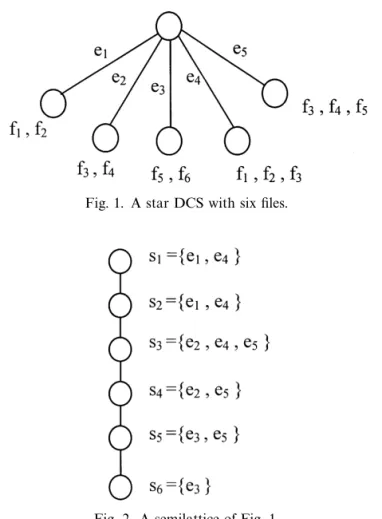
Example 1. Consider a star DCS D"(<, E, F) with edge E"Me1, e2, e3, e4, e5N shown in Fig. 1. Here the si will be the "le cutset of each needed "le of the network. If we need "les f1, f2, f3, f4, f5, f6 to complete one program's execution, then the "le cutsets of each "le can be obtained.
s1"Me1, e4N, s2"Me1, e4N, s3"Me2, e4, e5N, s4"Me2, e5N, s5"Me3, e5N, s6"Me3N.
The partial order ) is de"ned by
si)sj, j)i.
Then Properties I@ and II@ will hold. In this case, the Hasse diagram for the partial order is simply a chain shown in Fig. 2.
If the "le cutsets of a star topology with partial ordering, (si, )), have the semilattice property and satisfy Properties I@ and II@, then a polynomial time algorithm to compute DPR of a star topology can be fashioned by adapting the algorithm given in [18].
Fig. 1. A star DCS with six "les.
For purposes of exposition, suppose that the edges of a star topology are labelled 1, 2, 2 , n with
qk being the probability that the edge k fails. Let Xj denote all edges involved in "le cutset sj, j"1, 2, 2 , m. Fig. 2 displays an illustrative semilattice having six "le cutsets and "ve edges. To
present the computing of DPR of a star topology, we de"ne, for any set sj of "le cutsets S, )(Xj)" <k|X
jqk, )(/)"1.
Then the following algorithm correctly determines the DPR of a star topology.
Algorithm REL. This algorithm calculates DPR for a star topology with "le cutsets
S"Ms1, s2, 2, smN and edges E"Me1, e2, 2, enN that satisfy both the Properties I@ and II@. The
edge k fails randomly and independently with probabilities qk.
1. Place the "le cutsets s1, s2, 2, sm in topological order so that if si(sj, then j(i. Let Xj denote the set of edges contained in "le cutset sj.
2. For j"1, 2, 2 , m,
gj")(Xj)! +s
i:sjgi )(Xj!Xi),
where gj is the probability that "le cutset sj is not covered. 3. Output DPR"1!+mj/1 gj.
The quantity gj needed in step 2 can be computed using the value gi for "le cutset si. The validity of this algorithm follows from the development in Shier [18]. As also established there, its worst case complexity is O(nm2), which is polynomial in the number of edges n and the number of "le cutset m.
To illustrate this approach, we apply this algorithm to Example 1. We get
g6")(X6)! +s
i:s6gi )(X6!Xi)")(X6)")(e3)"q,
g5")(X5)! +s
i:s5gi)(X5!Xi)")(e3, e5)!+g6)(e5)"0,
g4")(X4)! +
si:s4gi )(X4!Xi)")(e2, e5)![g6)(e2, e5)#g5)(e2)]"q2!q3,
g3")(X3)! +s
i:s3gi)(X3!Xi)")(e2, e4, e5)![g6)(e2, e4, e5)#g5)(e2, e4)
#
g4)(e4)]"0, g2")(X2)! +
si:s2gi)(X2!Xi)")(e1, e4)![g6)(e1, e4)#g5)(e1, e4)
#
g1")(X1)! +s
i:s1gi)(X1!Xi)")(e1, e4)![g6)(e1, e4)#g5)(e1, e4)
#
g4)(e1, e4)#g3)(e1)#g2)(/)"0, DPR"1!+m
j/1gj"1!(q#q2!q3#q2!q3!q4#q5)"1!q!2q2#2q3#q4!q5.
For instance, if all edges in the problem of Fig. 2 were randomly available with probability q"0.1, then the DPR of a star topology is computed to be 0.88209.
By Theorem 2, we have shown computing DPR on a star topology with each DFAiD"2 is a NP-hard problem. In Properties III and IV, we will show classes of semilattice that satis"es Properties I@ and II@ for computing DPR over a star topology with each DFAiD"2.
Property III. If a semilattice, for computing DPR over a star topology with eachDFAiD"2, has at least
two branches on the same node with length greater than or equal to 2, then the semilattice does not satisfy Properties I@ and II@.
Proof. We "rst draw a semilattice with "le cutsets that has two branches on the same node with
length greater than or equal to 2 as in Fig. 3 and assume that the semilattice satis"es Properties I@ and II@.
From Fig. 3, assume edge ex3si'sj"sh. This means the "le fh is in a node, vx, whose incident edge is ex. By Property II@, ex-siXsj, then ex-si, or ex-sj. Without loss of generality, assume
ex-si. Then, the node vx contains a "le fi. By Property I@, if si)sk)sh, ex3si, ex3sh then ex3sk.
This means the "le fk is in the node vx.
From the above discussion, the "les, fi, fh, fk, are in the same node vx, which is a contradiction to DFAxD"2. K
Property IV. If a semilattice, for computing DPR over a star topology with each DFAiD"2, has at
least three branches with length equal to one, then the semilattice does not satisfy properties I@ and II@.
Fig. 4. A semilattice for Property IV.
Proof. We "rst draw a semilattice of three branches with length equal to 1 as in Fig. 4 and
assume that the semilattice satis"es Properties I@ and II@.
From Fig. 4 and Property II@, we have sk1'sj"si and si-sk1Xsj. Without loss of generality, we assume there is an edge ex such that ex3si and exN sj. This implies ex3sk1. With the same reason,
ex3sk2 and ex3sk3. From the above discussion, we conclude that ex3si, ex3sk1, ex3sk2, and ex3sk3.
This means the "les, fi, fk1, fk2, and fk3 are in the same node vx whose incident edge is ex. This contradictsDFAxD"2. K
Theorem 4. There are only two cases of semilattice, for computing DPR over a star topology with DFAiD"2 that can satisfy Properties I@ and II@.
(1) The semilattice is a linear chain.
(2) The semilattice has only two branches with length one on the top node of the linear chain.
Proof. We "rst draw these two cases of semilattice as follows:
Example 2. Consider a DCS D"(<, E, F) with a star topology andDFAiD"2 shown in Fig. 5. The "le cutset si of each "le fi are
s1"Me1, e2N, s2"Me2, e3N, s3"Me1, e3N, s4"Me4N, s5"Me4, e5N, s6"Me5N.
The partial order)is de"ned by
s1's3, s2's3, and s3's4's5's6.
Then, the semilattice is as shown in Fig. 6. From case (2) of Theorem 4, the semilattice satis"es Properties I@ and II@.
In the following, we propose a method to distribute the "les withoutDFAiD"2 restriction on a star topology. The semilattice can be easily obtained by this method and the DPR of a star topology can be computed in polynomial time. We use Theorem 5 to show this method.
Theorem 5. A ,le cutset, S"Ms1, s2, 2, smN is a semilattice with topological order sm(sm~1 (2(
s2(s1, satisfying Properties I@ and II@ i! all "les in a star DCS have the consecutive "le
distribution property.
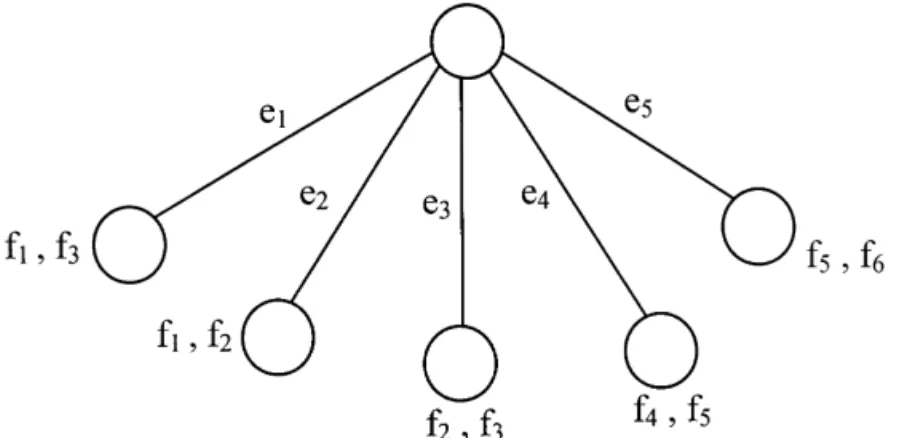
Fig. 5. An example for a star topology with eachDFAiD"2.
Proof. We "rst draw an example to show that all "les in a star DCS have the consecutive "le
distribution property as Fig. 7.
If : For edge ex, assume its adjacent node, vx, contains consecutive "les by its index, fi, fi`1, fi`2, 2, fj. Then, the "le cutsets si, si`1, si`2, 2, sj contain the edge ex and the semilattice of "le
cutsets with total order relation, sj(2(si`2(si`1(si, satis"es Properties I@ and II@.
Only if: We assume there exists a semilattice with a total order relation, sj(2si`2(si`1(si,
and satis"es Properties I@ and II@, then the"le cutsets si, si`1, si`2,2sj contain the same edge ex. This means the "les, fi, fi`1, fi`2, 2, fj, are in the same node of incident edge ex. K
4.3. The experiment result for algorithm REL
In this paper, we want to see the real a!ection of di!erent number of edges and data "les of star topologies. We use an ALR PC with 386/33 CPU to run the algorithm REL. We have run 72 sets of
Fig. 7. An example for Theorem 5.
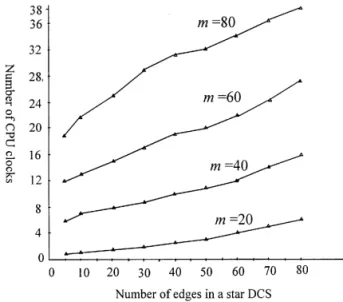
Fig. 9. The curve of CPU time of "xing number of distinction "le m.
data "les, generated by the consecutive "le distribution property, on star topologies to show how the execution time varies according to the changes in the number of edges n and the number of distinct "les m. One CPU clock time is 0.054945 s in Figs. 8 and 9. In Fig. 8, we "x the number of edges and vary the number of distinct "les. In Fig. 9, we "x the number of distinct "les and vary the number of edges.
5. Conclusions
In this paper, we investigated the problem of distributed program reliability on star distributed computing systems. We have shown that it is computationally intractable for star distributed computing systems. Furthermore, we identify one class of star topology, in which the "le distribu-tion is performed with respect to a consecutive property, for computing distributed program reliability can be done in polynomial time. We also propose a pseudo-polynomial time algorithm to compute the distributed program reliability over the class of a star topology. Theorem 4 is proposed to conclude that only two cases of semilattice on star distributed computing systems with DFAiD"2 can satisfy Properties I@ and II@. Finally, we propose Theorem 5, which is a method to distribute "les on each node for computing DPR in polynomial time withoutDFAiD"2 restriction on star distributed computing systems.
References
[1] Satyanarayana A, Hagstrom JN. A new algorithm for the reliability analysis of multi-terminal networks. IEEE Transactions on Reliability 1981;R-30:325}34.
[2] Agrawal KK, Rai S. Reliability evaluation in computer-communication networks. IEEE Transactions on Reli-ability 1981;R-30:32}5.
[3] Grnarov AP, Gerla M. Multi-terminal reliability analysis of distributed processing system. Proceedings of the 1981 International Conference on Parallel Processing, August 1981:79}86.
[4] Kevin Wood R. Factoring algorithms for computing K-terminal network reliability. IEEE Transactions on Reliability 1986;R-35:269}78.
[5] Rosenthal A. A computer scientist looks at reliability computations. In: reliability and fault tree analysis. SLAM 1975;133}52.
[6] Prasanna Kumar VK, Hariri S, Raghavendra CS. Distributed program reliability analysis. IEEE Transactions on Software Engineering 1986;SE-12:42}50.
[7] Kumar A, Rai S, Agrawal DP. On computer communication network reliability under program execution constraints. IEEE JSAC 1988;6:1393}9.
[8] Valiant LG. The complexity of enumeration and reliability problems. SIAM Journal on Computing. 1979;8: 410}21.
[9] Lin MS. Program reliability analysis in distributed computing system. PhD Dissertation, National Chiao Tung University, Taiwan, ROC, 1994.
[10] Ball MO, Provan JS, Shier DR. Reliability covering problems. Networks 1991;21:345}57.
[11] Provan JS, Ball MO. The complexity of counting cuts and of computing the probability that a graph is connected. SIAM Journal on Computing 1983;12(4):777}88.
[12] Agrawal A, Barlow RE. A survey of network reliability and domination theory. Operations Research 1984;32:478}92.
[13] Kim Y, Case K, Ghare P. A method for computing complex system reliability. IEEE Transaction on Reliability 1972;R-21:215}9.
[14] Satyanarayana A, Prabhakar A. New topological formula and rapid algorithm for reliability analysis of complex networks. IEEE Transactions on Reliability 1978;R-27:82}100.
[15] Abel U, Bicker R. Determination of all minimal cut-sets between a vertex pair in an undirection graph. IEEE Transactions on Reliability 1982;R-31:167}71.
[16] Nelson A, Batt J, Beadles R. A computer program for approximating system reliability. IEEE Transactions on Reliability 1970;R-19:61}5.
[17] Provan JS, Ball MO. Computing network reliability in time polynomial in the number of cuts. Operations Research 1984;32:516}26.
[18] Shier DR. Algebraic aspects of computing network reliability. In: Ringeisen RD, Roberts FS, editors. Applications of discrete mathematics. Philadelphia, PA: SIAM, 1988:135}47.
Ming-Sang Chang received the BS degree in Electronic Engineering from National Taiwan University of Science and Technology (Taipei, Taiwan) and the MS degree in Information Engineering from TamKang University (Taipei, Taiwan) and PhD degree in Computer Science and Information Engineering from National Chiao Tung University (Hsin Chu, Taiwan). He is currently working in Chunghwa Telecommunication Training Institute (Taipei, Taiwan). His research interests include computer network, performance evaluation, distributed system, and reliability evaluation.
Deng-Jyi Chen received the BS degree in Computer Science from Missouri State University (Cape Girardeau), and the MS and PhD degrees in Computer Science from the University of Texas (Arlington). He is now a professor at National Chiao Tung University (Hsin Chu, Taiwan). He has published nearly 100 referred journal and conference papers in the area of reliability and performance modeling of distributed systems, computer networks, object-oriented systems, and softwere reuse. Professor Chen is a consultant for many local companies.
Min-Sheng Lin received his MS and PhD in Computer Science & Information Engineering from National Chiao Tung University (Hsin Chu, Taiwan). He is currently an associate professor at Tamsui Oxford University College (Taipei, Taiwan). His research interests include reliability and performance evaluation of distributed computing systems.
Kuo-Lung Ku received the BS degree in Control Engineering from National Chiao Tung University (Hsin Chu, Taiwan), the MS degree in Electronic Engineering from National Chiao Tung University (Hsin Chu, Taiwan), and PhD degree in Electric Engineering from the University of Washington (Seattle). He is currently working in Chung-Shan Institute of Science and Technology. His research interests include parallel computing, image processing, and computing system reliability.