Design and Characterization of Heteroleptic Ruthenium Complexes
Containing Benzimidazole Ligands for Dye-Sensitized Solar Cells: The
E
ffect of Thiophene and Alkyl Substituents on Photovoltaic
Performance
Wei-Kai Huang, Hui-Ping Wu, Pi-Lun Lin, and Eric Wei-Guang Diau*
Department of Applied Chemistry and Institute of Molecular Science, National Chiao Tung University, Hsinchu 30010, Taiwan
*
S Supporting InformationABSTRACT: We designed heteroleptic ruthenium complexes RD16− RD18 containing fluoro-substituted and thiophene-based benzimidazole ligands for dye-sensitized solar cells. Whereas the substitution of only fluorine in the RD12 device has an effect of enhancing the open-circuit voltage (VOC), additional substitution of thiophene in the RD16−RD18 sensitizers showed a slightly decreased VOC. Systematic enhanced
short-circuit current density (JSC) and efficiency (η) of power conversion of the devices had the order RD18 > RD17 > RD16 > RD12 > N719, attributed to the increasing light-harvesting ability and the broadened spectral features with thiophene-based ligands. Measurements of charge extraction and intensity-modulated photovoltage spectra indicate that thiophene sub-stitution shifts downward the TiO2 potential and accelerates charge
recombination, but inclusion of a long hexyl chain on the thiophene moiety
retards charge recombination to account for the variation of VOC in the series. For a duration test of device performance at
ambient temperature, only∼2% degradation of cell performance was found for the devices of RD18 and RD12 over 2000 h, but a 10% decrease in overall efficiency was observed in the N719 device.
■
INTRODUCTIONDye-sensitized solar cells (DSSCs) attract considerable attention because of their potential as next-generation photo-voltaic devices.1,2 Photosensitizers such as ruthenium com-plexes,3,4 zinc porphyrin,5−8 and metal-free organic dyes9−11 have been developed to serve as efficient harvesters of light for DSSC. The DSSC devices made of homoleptic ruthenium complexes (e.g., N3 and N719) attained an impressive
efficiency, η ∼11%, of power conversion under one-sun
illumination,12,13 but the enduring stability of the devices made of these complexes has become a major challenge; an amphiphilic Ru sensitizer (Z907) was developed to improve their durability.14,15The strategy for design of the Z907 dye is to replace one bidentate 4,4′-dicarboxylic-2,2′-bipyridine (dcbpy) ligand in the N3 dye with an ancillary ligand similar to dcbpy but with two identical long alkyl chains replacing the two carboxylic acid groups.16Although the stability of the Z907 device was significantly improved, the dye suffers from small absorptivity to promote further its cell performance. To
improve the light-harvesting efficiency via an enhanced
absorption coefficient, heteroleptic ruthenium complexes were developed with various thiophene-based ancillary ligands.17−26 Similar to the molecular design for a Z907 dye, the two long alkyl chains in the ancillary ligand were replaced with two identical thiophene derivatives in the thiophene-based hetero-leptic Ru complexes. These thiophene derivatives feature
excellent light-harvesting abilities as photosensitizers (such as C101and C106 dyes), so to achieve remarkable efficiencies of power conversion, above 11.5%.22−24
For our designed heteroleptic ruthenium complexes containing benzimidazole (BI) ligands, the cell performance of the best dye (RD5) in the series was comparable to that of a N719dye.27This promising result encouraged us to design BI-based heteroleptic Ru dyes in a new series with the ancillary ligand consisting of a bidentate pyridine-benzimidazole moiety that is readily modified in four substitutable positions.28These fluoro-substituted devices effectively raise the TiO2 potential
and retard the charge recombination for an enhanced open-circuit voltage (VOC) with increasing number offluorine atoms, but the corresponding short-circuit current density (JSC) values
show an opposite trend.28Although the best dye (RD12) in the series exhibited a device performance superior to that of a N719 device, the molar absorption coefficients of these dyes are smaller than that of N719, which limits their light-harvesting ability to enhance the device performance. As examples17−26,29,30 including thiophene derivatives in the design of heteroleptic Ru dyes to enhance their light-harvesting capabilities were successful, in the present work we further
Received: December 3, 2012 Revised: January 11, 2013 Published: January 17, 2013
modified position B in the pyridine part of the ancillary ligand with thiophene derivatives based on the structure of RD12.28
As shown in Chart 1, RD16 has only one thiophene unit substituted in the B position. In RD17 a hexyl chain is attached in theα-position of the thiophene group, making half of the ligand resemble C101 but the other half retained as in RD12. In RD18, a further thiophene group is added in the pyridine part of the ligand; this alkyl bithiophene substitute resembles half of the ancillary ligand in the CYC-B1 dye17 for an exceptional light-harvesting capacity. The present work continues our systematic investigation of BI-based Ru sensitizers to promote the light-harvesting ability of the dyes with thiophene substituents to achieve outstanding device performance. Such a molecular design shows a systematic trend of cell performance with the order RD18 > RD17 > RD16 > RD12 > N719. We measured charge extraction (CE) and intensity-modulated photovoltage spectra (IMVS) to under-stand the trend of device performance in this series. Upon optimization, the device made of RD18 yielded JSC/mA cm−2=
17.80, VOC/mV = 735, FF = 0.73, and η = 9.6%, which is
significantly greater than that of an N719 device, η = 8.8%, similarly fabricated. A test of storage over 2000 h near 295 K indicated almost no degradation of performance for the devices of RD18 and RD12 but a 10% loss of efficiency in the N719 device.
■
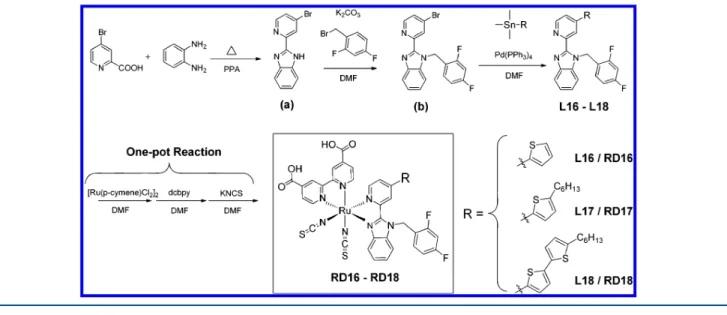
EXPERIMENTAL SECTIONSynthesis. The syntheses of RD16−RD18 were similar to that of RD12 except that 4-bromopyridine-2-carboxylic acid was a starting material instead of picolinic acid to prepare the bromo-substituted BI precursor (a) and that additional Stille coupling reactions were involved to make the ancillary ligands
L16−L18. The details of synthetic procedures and the
corresponding molecular characterizations follow.
2-(4-Bromopyridin-2-yl)benzimidazole (a). 4-Bromopyri-dine-2-carboxylic acid (1.40g, 7 mmol), 1,2-benzenediamine (0.8g, 7.7 mmol), and PPA (10 g) were heated to 150°C for 3 h. After cooling, the solution was poured into cool water with stirring; the pH was adjusted to 7−8 on addition of NaOH; the
resulting light yellow precipitate was filtered, washed with water, and dried in air without further purification.
2-(4-Bromopyridin-2-yl)- 1-(2 ,4 -di fluorobenzyl)-benzimidazole (b). 2-(4-Bromopyridin-2-yl)fluorobenzyl)-benzimidazole (a) (0.67 g, 2.4 mmol) and K2CO3(0.69 g, 5 mmol) were dissolved in DMF (20 mL) and stirred for 30 min; 1-(bromomethyl)-2,4-difluorobenzene (0.50g, 2.9 mmol) was added to the reaction mixture that was then stirred at 295 K for 4 h. After evaporation of the solvent under decreased pressure, H2O (50 mL) and ethyl acetate (50 mL) were added. The organic layer was separated and dried over MgSO4. The crude product was purified on a column chromatograph (silica gel) with a mixture of ethyl acetate and hexane (1/4) as eluent to afford a white
precipitate (0.71g, 74.1%). 1H NMR (DMSO-d
6): 8.56−8.52
(m, 2H), 7.80 (m, 2H), 7.60 (m, 1H), 7.60 (t, 1H), 7.36−7.21 (m, 3H), 6.93−6.90 (t, 2H), 6.22 (s, 2H). Mass, ESI-MS: calcd m/z 399; found 398.8 [M− H]−.
Ligands. 1-(2,4-Difluorobenzyl)-2-(4-(thiophen-2-yl)-pyridin-2-yl)-benzimidazole (L16). 2-(4-Bromopyridin-2-yl)-1-(2,4-difluorobenzyl)benzimidazole (b) (0.4 g, 1 mmol), trimethyl(thiophen-2-yl)stannane (0.3 g, 1.2 mmol), and Pd(PPh3)4 (0.06 g, 0.05 mmol) were dissolved in dry DMF
stirred at 85°C under Ar overnight. After rotary evaporation of DMF, the resulting solid was purified on a column chromato-graph (silica gel) with a mixture of ethyl acetate and hexane (1/ 4) as eluent to afford a yellow/white precipitate (0.28 g, 74.7%).1H NMR (DMSO-d6): 8.65 (d, 1H), 8.52 (d, 1H), 7.96 (d, 1H), 7.84−7.78 (m, 3H), 7.62−7.59 (m, 1H), 7.34−7.24 (m, 4H), 6.93−6.89 (m, 2H), 6.24 (s, 2H). Mass, ESI-MS: calcd m/z 375; found 373.9 [M− H]−. 1-(2,4-Difluorobenzyl)-2-(4-(5-hexylthiophen-2-yl)pyridin-2-yl)benzimidazole (L17). 2-(4-Bromopyridin-2-yl)-1-(2,4-difluorobenzyl)benzimidazole (b) (0.24 g, 0.6 mmol), (5-hexylthiophen-2-yl)trimethylstannane(0.3 g, 0.9 mmol), and Pd(PPh3)4 (0.04 g, 0.03 mmol) were dissolved in dry DMF
stirred at 85°C under Ar overnight. After rotary evaporation of DMF, the resulting solid was purified on a column chromato-graph (silica gel) with a mixture of ethyl acetate and hexane (1/ 5) as eluent to afford a yellow/white precipitate (0.21 g, 71.9%). 1H NMR (DMSO-d6): 8.45 (d, 1H), 7.83−7.78 (m,
Chart 1. Molecular Design of a Heteroleptic Ruthenium Complex Containing the Benzimidazole Ligand with Possible Substitutions in the A, B, C, and D Positions and Molecular Structures of RD12, RD16, RD17, and RD18 Reported Herein
2H), 7.71 (t, 1H), 7.60 (t, 1H), 7.35−7.22 (m, 3H), 7.00−6.89 (m, 3H), 6.24 (s, 2H), 2.69 (t, 2H), 1.70−1.61 (m, 2H), 1.35− 1.23 (m, 6H), 0.85 (t, 3H). Mass, ESI-MS: calcd m/z 487; found 486.2 [M− H]−.
1-(2,4-Difluorobenzyl)-2-(4-(5-(5-hexylthiophen-2-yl)-thiophen-2-yl)pyridin-2-yl)benzimidazole (L18). 2-(4-Bromo-pyridin-2-yl)-1-(2,4-difluorobenzyl)benzimidazole (b) (0.4 g, 1 m m o l ) , ( 5 ( 5 h e x y l t h i o p h e n 2 y l ) t h i o p h e n 2 y l ) -trimethylstannane (0.62 g, 1.5 mmol), and Pd(PPh3)4 (0.06
g, 0.05 mmol) were dissolved in dry DMF stirred at 85 °C under Ar overnight. After rotary evaporation of DMF, the resulting solid was purified on a column chromatograph (silica gel) with a mixture of ethyl acetate and hexane (1/6) as eluent to afford yellow precipitate (0.37 g, 65.0%).1H NMR (DMSO-d6): 8.65 (d, 1H), 8.50 (d, 1H), 7.92 (d, 1H), 7.84−7.77 (m, 2H), 7.60 (t, 1H), 7.38−7.23 (m, 5H), 6.94−6.87 (m, 3H), 6.25 (s, 2H), 2.81 (t,2H), 1.64 (t, 2H), 1.35−1.22 (m, 6H), 0.87 (t, 3H) Mass, ESI-MS: calcd m/z 569; found 568.1 [M− H]−.
Complexes. The1HNMR spectra of the RD16-RD18 dyes
are shown in Figure S1, Supporting Information. The NMR spectra of RD series dyes are complex because they contain two stereoisomers that cannot be separated by using the column chromatography methods such as silica gel, aluminum oxide, or Sephadex LH-20. As a result, the NMR spectra exhibit groups of doublet/multiple peaks in the 5−10 ppm region. Integration of the spectral peaks gives the ratio of the two isomers close to 1:1.28 Therefore, the average effect of the two inseparable stereoisomers should be considered for the results discussed in the following.
[Ru(4,4′-dicarboxylic-2,2′-bipyridine)(1-(2,4-difluoroben-zyl)-2-(4-(thiophen-2-yl)pyridin-2-yl)-benzimidazole)NCS2] (RD16). In a typical one-pot synthesis, [RuCl2(p-cymene)]2
(153 mg, 0.25 mmol) was dissolved in DMF (20 mL), and the precursor ligand L16 (188 mg, 0.5 mmol) was added. The reaction mixture was heated at 80°C under argon for 4 h; then dcbpy (122 mg, 0.5 mmol) was added. The reaction mixture was refluxed at 140 °C for another 4 h in darkness to avoid
photoinduced cis−trans isomerization. Excess KNCS was
added to the reaction mixture that was heated at 140 °C for 5 h. After the reaction, the solvent was removed with a rotary evaporator. Water was added to the resulting mixture to remove excess KNCS. The water-insoluble product was then collected on a sintered-glass crucible with suctionfiltration, washed with distilled water followed by diethyl ether, and dried in air. The crude product was dissolved in methanol and then passed through a column (Sephadex LH-20) with methanol as eluent. The main band was collected and concentrated. This purification was repeated five times. A few drops of HNO3
(aq, 0.01 M) were added to precipitate the purple red product (206 mg, 61.2%). Elemental analysis (%) calcd for C37H23N7F2O4S3Ru·0.5TBAOH·2.5H2O: C 52.44, H 4.45, N
10.19; found: C 52.32, H 4.45, N 10.11. Mass, ESI-MS: calcd m/z 865.0; found m/z 864.3 [M− H]−.
[Ru(4,4′-dicarboxylic-2,2′-bipyridine)(1-(2,4-difluoroben- zyl)-2-(4-(5-hexylthiophen-2-yl)pyridin-2-yl)benzimidazole)-NCS2] (RD17). RD17 was synthesized in a typical one-pot reaction with the same procedure as RD16. The reactants were [RuCl2(p-cymene)]2(153 mg, 0.25 mmol), L17 (243 mg, 0.5
mmol), dcbpy (122 mg, 0.5 mmol), and excess KNCS. The
crude product was purified on a column (Sephadex LH-20)
with methanol as eluent. The main band was collected and concentrated. This purification was repeated five times. A few
drops of HNO3 (aq, 0.01M) were added to precipitate the purple red product (247 mg, 52.1%). Elemental analysis (%) calcd for C43H34N7F2O4S3Ru·0.5TBAOH·2H2O·0.5MeOH: C 54.23, H 4.91, N 9.50; found: C 54.30, H 4.97, N 9.55. Mass, ESI-MS: calcd m/z 949.09; found m/z 949.4 [M− H]−.
[Ru(4,4′-dicarboxylic-2,2′-bipyridine)(1-(2,4-difluoroben- zyl)-2-(4-(5-(5-hexylthiophen-2-yl)thiophen-2-yl)pyridin-2-yl)benzimidazole)NCS2] (RD18). RD18 was synthesized in a typical one-pot reaction with the same procedure as RD16. The reactants were [RuCl2(p-cymene)]2(153 mg, 0.25 mmol), L18
(285 mg, 0.5 mmol), dcbpy (122 mg, 0.5 mmol), and excess KNCS. The crude product was purified on a column (Sephadex LH-20) with methanol as eluent. The main band was collected and concentrated. This purification was repeated five times. A few drops of HNO3 (aq, 0.01M) were added to precipitate the purple red product (274 mg, 53.2%). Elemental analysis (%) calcd for C47H37N7F2O4S4Ru·0.5TBAOH·1.5H2O. MeOH: C 55.13, H 5.16, N 8.61; found: C 55.28, H 5.24, N 8.91 Mass, ESI-MS: calcd m/z 1031.08; found m/z 1030.3 [M− H]−.
■
CHARACTERIZATIONSElectrochemical Measurements. Electrochemical tests were performed with a three-electrode potentiostat (CHI621D, CH Instruments) in dry DMF in the presence of (n-C4H9)4NPF6(0.1 M). For cyclic voltammetry (CV)
measure-ments, a three-electrode cell was equipped with a platinum (0.02 cm2) disk as working electrode, a platinum wire as auxiliary electrode, and an Ag wire as reference electrode. Potentials are reported vs Ag wire with reference to a ferrocene/ferrocenium (Fc/Fc+).
Electrode Preparation and Device Fabrication. Photo-anodes composed of nanocrystalline TiO2were prepared using the sol−gel method. A paste composed of TiO2nanoparticles
(diameter∼25 nm) and nanorods (length 100−300 nm and
diameter 20−30 nm) for the transparent active layer was coated on a TiCl4-treated and AR-coated FTO glass substrate (FTO, 8Ω/□) with repetitive screen printing to obtain the required
thickness of the film. To improve the performance of the
DSSC, an additional scattering layer (particle size 200−600 nm) was screen-printed on the transparent active layer. The TiO2working electrodes were gradually heated according to a
programmed procedure: (1) heating at 80°C for 15 min; (2) heating at 135°C for 10 min; (3) heating at 325 °C for 30 min; (4) heating at 375°C for 5 min; (5) heating at 450 °C for 15 min; (6) heating at 500 °C for 15 min. The resulting film
comprised a transparent layer (thickness 17 μm) and a
scattering layer (thickness∼5 μm), which were treated again with TiCl4at 70°C for 30 min and sintered at 500 °C for 30 min. After cooling in air, the sintered TiO2films were immersed
in dye solutions (0.3 mM in anhydrous CH3CN/t-BuOH (1:1
v/v) at 25 °C for 3 h) containing CDCA (0.3 mM) for dye
loading onto the working electrodes. The counter electrode was made on spin-coating the H2PtCl6/isopropyl alcohol solution
onto a FTO glass substrate (FTO, 8Ω/□, typical size 1.0 × 1.5 cm2) through thermal decomposition at 380 °C for 30 min. The two electrodes were assembled into a cell of sandwich type and sealed with a hot-melt film (SX1170, thickness 25 μm). Silver was coated on both electrodes to decrease the series resistance of the device. The electrolyte solution contained 1-methyl-3-propylimidazolium iodide (PMII, 1.0 M), guanidi-nium thiocyanate (GuSCN, 0.1 M), LiI (0.1 M), I2(0.03 M),
and 4-t-butylpyridine (TBP, 0.5 M) in a solvent mixture containing acetonitrile and valeronitrile (volume ratio 85:15).
The reference ruthenium complex N719 was purchased from solaronix, and before preparing dye solution, Sephadex LH-20 column purification with H2O (with 2 equiv TBAOH) as an
eluent was repeated five times. A few drops of HNO3 (aq,
0.01M) were added to precipitate the final compound at pH lowered to 4.3.
Photovoltaic Characterization. The current−voltage characteristics were determined with a digital source meter (Keithley 2400) with the device under one-sun AM 1.5G irradiation from a solar simulator (XES-502S, SAN-EI) calibrated with a standard silicon reference cell (Oriel PN 91150 V, VLSI standards). The efficiency (η) of conversion of light to electricity is obtained viaη = JSCVOCFF/Pin, in which
JSC/mA cm−2is the current density measured at short circuit
and VOC/V is the voltage measured at open circuit. Pin is the
input radiation power (for one-sun illumination Pin= 100 mW cm−2), and FF is thefill factor. The spectra of the IPCE of the corresponding devices were recorded with a system comprising a Xe lamp (PTi A-1010, 150 W), a monochromator (PTi, 1200
g mm−1 blazed at 500 nm), and a source meter (Keithley
2400). A standard Si photodiode (ThorLabs FDS1010) served as reference to calibrate the power density of the light source at each wavelength.
Impedance Characterization. The intensity-modulated photovoltage spectra (IMVS) were measured with the CIMPS equipment (Zahner) at an open-circuit condition based on a red LED light (λ = 610 nm) at five intensities (1.5−30 mW cm−2) controlled with a slave system (XPOT, Zahner) to obtain the photovoltaic response induced by the modulated
light.31 The modulated light was driven with a 10% ac
perturbation current superimposed on a dc current in a frequency range from 0.1 to 1000 Hz. The measurements of charge extraction (CE) were performed with the same CIMPS system under the same bias light irradiations. For that experiment, the system was initially set to an open-circuit condition for 10 s for the photovoltage of the device to attain a steady state; the red light from the LED was then terminated while the device was simultaneously switched to a short-circuit condition to extract the charges generated at that bias light intensity.
■
RESULTS AND DISCUSSIONScheme 1 summarizes the syntheses of RD16−RD18, which
are similar to that of RD12 except that 4-bromopyridine-2-carboxylic acid instead of picolinic acid became a starting material to prepare the bromo-substituted BI precursor (a) and that additional Stille coupling reactions32were undertaken to make ancillary ligands L16−L18.
Figure 1 compares the absorption spectra of these dyes with those of N719, Z907, and C101; the corresponding spectral
and electrochemical data are summarized in Table S1, Supporting Information. Of two major features indicated in these spectra, thiophene substituents effectively enhanced the molar absorption coefficients for these dyes with a systematic order RD18 > RD17 ∼ RD16 > RD12, whereas the hexyl substitute plays scarcely any role in enhancing the absorption coefficients. The second feature is that substitution with thiophene derivatives effectively shifted the peak of the MLCT band toward the longer wavelength region with the extent of the red shift in an order RD18∼ RD16 > RD17 > RD12; the hexyl substituent plays only a minor role in the blue shift of the absorption features. The bathochromatic spectral shifts of the RD16−RD18 dyes relative to N719 and Z907 are Scheme 1. Syntheses of Compounds (a) and (b), Benzimidazole Ligands L16-L18, and Ruthenium Complexes RD16-RD18
Figure 1.Absorption spectra of RD12, RD16, RD17, and RD18 in DMF. The spectra of N719, C101, and Z907 are shown as thin dashed curves for comparison.
∼30 nm, indicating the superior light-harvesting capability for dyes in this series. Moreover, with the same number of thiophene units in the ancillary ligand, the molar absorption coefficients of RD18 are much greater than those of C101 over the entire visible spectral region. This outstanding spectral feature makes RD18 a promising candidate as a highly efficient photosensitizer for DSSC applications.
The electrochemical properties of compounds RD12,
RD16−RD18, and N719 were investigated with cyclic
voltammetry (CV); the evaluated EHOMO and ELUMO values
are listed in Table S1, Supporting Information. Figure S2 shows energy levels of the RD dyes for comparison of the HOMO/ LUMO levels of each dye with respect to the conduction band (CB) of TiO2and the potential of the iodide/tri-iodide couple,
which show that both electron injection and dye regeneration are feasible when they serve as photosensitizers for DSSC. These heteroleptic ruthenium dyes were fabricated into DSSC devices according to the same procedures with three identical TiO2films (thickness 17 + 5 μm). The current−voltage (J−V) measurements were performed under standard AM-1.5G
illumination on devices with an active area 4 mm × 4 mm
(0.16 cm2) with a 5 mm × 5 mm (0.25 cm2) black shadow mask.33
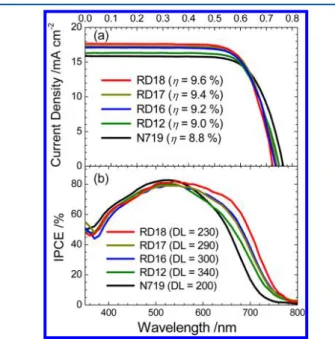
Figures 2a and 2b show typical current−voltage character-istics and the corresponding spectra of incident
photon-to-current conversion efficiency (IPCE), respectively, for the devices made of each ruthenium dye. Table 1 summarizes the amounts of dye-loading (DL) and the photovoltaic parameters. The photovoltaic performances of these devices show a systematic trend of JSC but a variation of VOC discussed below. For JSC, the values increase with increasing number of
thiophene units, showing an order RD18 > RD17 > RD16 > RD12 > N719. The enhancement of JSCon alkyl substitution
between RD17 and RD16 was insignificant; this result can be viewed from the variation of the IPCE action spectra showing a
systematic trend with the breadth of the spectra in an order RD18 > RD16∼ RD17 > RD12 > N719, consistent with their spectral features shown in Figure 1. Although the wavelengths of spectral features of the MLCT band are similar for the
RD16−RD18 dyes, the IPCE spectrum of RD18 displays an
ability to harvest light superior to that of other Ru dyes in the spectral range 550−700 nm; the IPCE values then gradually decrease to the background level near 800 nm. Even though less DL was involved in the RD18 device, the significantly greater absorption coefficients of the dye play a key role to enhance JSC.17−26
The VOCvalues show an opposite trend of JSC, with the order
N719 > RD12 > RD17 > RD16∼ RD18. This trend indicates that an involvement of the thiophene group in the BI ligand decreased the value of VOC, but an additional long alkyl chain at the end of the thiophene group helped to promote VOCslightly.
The degradation of VOC in the RD16−RD18 devices was
insignificant; the overall efficiencies of power conversion followed the trend of JSCwith the order RD18 (η = 9.6%) > RD17(η = 9.4%) > RD16 (η = 9.2%) > RD12 (η = 9.0%) > N719(η = 8.8%). To understand the key factors affecting the trend of VOC, we performed CE and IMVS measurements; the
results are discussed below.
Figures 3a and 3b display plots of VOC vs extracted charge
densities (Ne) and electron lifetime (τR) vs Ne, respectively, for thefive devices irradiated with red light from a LED (λ = 610 nm) atfive intensities. The CE results (Figure 3a) indicate that the positions of the TiO2 potentials of the devices have the
order N719 > RD12 > RD18∼ RD16 > RD17, whereas the IMVS results (Figure 3b) show the electron lifetimes of the devices to have the order RD17 > RD12 > RD18∼ RD16 > N719. We understand that VOCof N719 is greater than that of
the other RD dyes because of a significantly increased TiO2 potential upon dye uptake for N719 relative to other dyes, even though the rate of charge recombination in the case of N719 is larger than those of the other dyes. The BI-based ancillary
ligands hence have an effect of lowering the potential
significantly but also retarding, to some extent, the charge recombination to compensate the loss of the potential decreases. With RD12 as a reference, adding a thiophene unit in position B of the BI ligand lowers the potential and accelerates charge recombination, which reasonably explains the smaller VOC for RD16 than for RD12. Adding a further hexyl chain at the thiophene end of the ligand decreased slightly the potential but helps to retard the charge recombination to account for VOCof RD17 being larger than
Figure 2.Photovoltaic properties: (a) current−voltage characteristics and (b) the corresponding IPCE action spectra of devices made of RD12, RD16, RD17, RD18, and N719 with the same fabricated TiO2 films (17 + 5 μm) and active area 0.16 cm2with 0.25 cm2black metal mask under one-sun AM-1.5G irradiation. The amounts of dye loading (DL) shown in (b) are in units of nmol cm−2.
Table 1. Photovoltaic Parameters of DSSC with
Photosensitizers RD12, RD16−RD18, and N719 under
Simulated AM-1.5G Illumination (Power 100 mW cm−2)
and Active Area 0.16 cm2with 0.25 cm2Black Shadow Mask dye dye-loading/nmol cm−2 JSC/ mA cm−2 VOC/ mV FF η/% RD12 340 16.31 754 0.73 9.0 RD16 300 17.09 736 0.73 9.2 RD17 290 17.31 743 0.73 9.4 RD18 230 17.80 735 0.73 9.6 RD18a 18.93 734 0.72 10.0 N719 200 15.87 768 0.72 8.8
aPhotovoltaic parameters of DSSC with RD18 under AM-1.5G
illumination (power 100 mW cm−2) and active area 0.16 cm2without black shadow mask.
that of RD16. Adding a second thiophene unit into the ligand of RD17 to form RD18 slightly raised the potential but accelerated charge recombination, giving VOCfor RD18 smaller than for RD17. Our results thus indicate that the alkyl chain and the thiophene units little affected the potential but affected the charge recombination in varied directions. The net effects of an additional long alkyl chain and of an additional thiophene unit are compromised to some extent so that the potentials and the electron lifetimes are well matched between the RD18 and RD16 devices to explain their almost identical VOC values.
Because of the effect of accelerated charge recombination for the thiophene substituent, we expect that further thiophene units in the BI ligand of the dye would speed the charge
recombination so as to decrease VOC and degrade the
performance of the device.
As the RD18 dye featured an excellent light-harvesting ability to enhance JSCof the device with only slightly decreased VOC, we continued to test the device stability for a period over 2000 h near room temperature (∼295 K).34 Figure 4 shows the photovoltaic parameters as a function of time for dyes RD18, RD12,and N719, with the optimized devices fabricated under the same conditions without a shadow mask. As shown in Figure 4, the performances of the three devices exhibit initially a normal trend, with the order RD18 (η = 10.1%) > RD12 (η = 9.5%) > N719 (η = 9.4%), similar to the variation of JSC. Up to 50 h, the efficiencies of all three devices increased rapidly with the same order RD18 (η = 10.5%) > RD12 (η = 9.8%) > N719 (η = 9.7%). At this time, device N719 attained its best performance, device RD12 attained a stable point near its maximum performance, but the performance of device RD18 was still increasing to its maximum value. After 50 h, the efficiencies of N719 maintained ∼9.5% during 100−300 h but decreased rapidly to 9.2% at 500 h, to 9.0% at 1000 h, and eventually to 8.8% at 2000 h. For RD12, the device performance attained its maximum, η = 9.9%, at 400 h and remained stable (η > 9.7%) from 500 to 2000 h. For RD18, the best device performance (η = 10.7%) appeared at 300 h; the efficiency decreased slightly to 10.5% at 500 h and remained
nearly constant atη ∼10.5% until 2000 h. Although VOCslightly increased at longer times for both RD devices, it decreased significantly for N719. As a result, VOCdisplayed a trend N719
∼ RD12 > RD18 at small durations but altered to the order RD12 > RD18 > N719 at greater durations. The small decreases of JSCof devices RD18 and RD12 are responsible for
their efficiency degradation ∼2%, but the degradation almost 10% of the N719 device was accompanied by decreases of all three key photovoltaic parameters. Our results thus highlight the advantages of the RD series of photosensitizers not only for their superior photovoltaic performances but also for their outstanding durability for future commercialization.
■
CONCLUSIONWe report herein the design, synthesis, and characterization of
novel heteroleptic ruthenium complexes RD16−RD18
con-taining thiophene-substituted benzimidazole ligands, with the molecular structures modified based on a fluoro-substituted Ru complex (RD12) reported elsewhere,28 as promising photo-sensitizers for highly efficient dye-sensitized solar cells. Increasing the number of thiophene units in the BI ancillary ligands enhanced the light-harvesting ability to give JSCand the
corresponding IPCE of the devices with the order RD18 >
RD17 ∼ RD16 > RD12 > N719, consistent with their
absorption spectral features. VOC of the devices exhibited a trend opposite to that of JSC, showing the order N719 > RD12
> RD17 > RD16∼ RD18. The variation of VOCis understood from the results of CE and IMVS measurements: the additional thiophene units seemed not to affect the potential much, but they accelerated the charge recombination to some extent; the additional alkyl chain shifted down the potential slightly but retarded the charge recombination significantly to account for the trend of VOC. Because the decreases of VOC for the thiophene-substituted dyes were insignificant, the overall device Figure 3. (a) Open-circuit voltage (VOC) and (b) electron lifetimes
(τR) as a function of extracted charge densities (Ne) for devices made of RD12, RD16−RD18, and N719 irradiated with bias light at five intensities.
Figure 4.Stability of devices over 2000 h near 295 K showing the variation of the photovoltaic performance for (a) open-circuit voltage (VOC), (b) short-circuit current density (JSC), (c)fill factor (FF), and (d) efficiency (η) of power conversion for the devices made of RD18, RD12and N719.
performances display an order RD18 > RD17 > RD16 > RD12 > N719, similar to that of JSC. The performances of the three
typical devices, RD18, RD12, and N719, were further optimized with a complete thermal-pressure encapsulation for a test of stability over 2000 h near 295 K. For the best RD18 device, its best performance was attained during 100−300 h, with a maximum, η = 10.7% (characterized without adding a shadow mask), at 300 h. Only∼2% performance degradation was observed for both RD12 and RD18 devices, reflecting their excellent durability for future commercialization. Work is in progress to develop more efficient photosensitizers based on our BI-based ancillary ligands.
■
ASSOCIATED CONTENT*
S Supporting InformationSupplementary Figures S1−S4 and supplementary Table S1. This material is available free of charge via the Internet at http://pubs.acs.org.
■
AUTHOR INFORMATIONCorresponding Author
*E-mail: [email protected]. Fax: +886-3-5723764. Tel.: +886-3-5131524.
Notes
The authors declare no competingfinancial interest.
■
ACKNOWLEDGMENTSNational Science Council of Taiwan and Ministry of Education of Taiwan, under the ATU program, provided support for this project.
■
REFERENCES(1) Grätzel, M. Acc. Chem. Res. 2009, 42, 1788−1798.
(2) Hagfeldt, A.; Boschloo, G.; Sun, L.; Kloo, L.; Pettersson, H. Chem. Rev. 2010, 110, 6595−6663.
(3) Nazeeruddin, M. K.; Kay, A.; Rodicio, I.; Humphry-Baker, R.; Müller, E.; Liska, P.; Vlachopoulos, N.; Grätzel, M. J. Am. Chem. Soc. 1993, 115, 6382−6390.
(4) Robertson, N. Angew. Chem., Int. Ed. 2006, 45, 2338−2345. (5) Imahori, H.; Umeyama, T.; Ito, S. Acc. Chem. Res. 2009, 42, 1809−1918.
(6) Martínez-Díaz, M. V.; de la Torre, G.; Torres, T. Chem. Commun. 2010, 46, 7090−7108.
(7) Yella, A.; Lee, H.-W.; Tsao, H. N.; Yi, C.; Chandiran, A. K.; Nazeeruddin, Md. K.; Diau, E. W.-G.; Yeh, C.-Y.; Zakeeruddin, S. M.; Grätzel, M. Science 2011, 334, 629−634.
(8) Li, L.-L.; Diau, E. W.-G. Chem. Soc. Rev. 2013, 42, 291−304. (9) Zhang, G.; Bala, H.; Cheng, Y.; Shi, D.; Lv, X.; Yu, Q.; Wang, P. Chem. Commun. 2009, 2198−2100.
(10) Ning, Z.; Tian, H. Chem. Commun. 2009, 5483−5495. (11) Ning, Z.; Fu, Y.; Tian, H. Energy Environ. Sci. 2010, 3, 1170− 1181.
(12) Nazeeruddin, M. K.; De Angelis, F.; Fantacci, S.; Selloni, A.; Viscardi, G.; Liska, P.; Ito, S.; Takeru, B.; Grätzel, M. J. Am. Chem. Soc. 2005, 127, 16835−16847.
(13) Wang, Q.; Ito, S.; Grätzel, M.; Fabregat-Santiago, F.; Mora-Seró, I.; Bisquert, J.; Bessho, T.; Imai, H. J. Phys. Chem. B 2006, 110, 25210− 25221.
(14) Wang, P.; Zakeeruddin, S. M.; Moser, J. E.; Nazeeruddin, Md. K.; Sekiguchi, T.; Grätzel, M. Nat. Mater. 2003, 2, 402−407.
(15) Wang, P.; Zakeeruddin, S. M.; Comte, P.; Charvet, R.; Humphry-Baker, R.; Grätzel, M. J. Phys. Chem. B 2003, 107, 14336− 14341.
(16) Zakeeruddin, S. M.; Nazeeruddin, Md. K.; Humphry-Baker, R.; Péchy, P.; Quagliotto, P.; Barolo, C.; Viscardi, G.; Grätzel, M. Langmuir 2002, 18, 952−954.
(17) Chen, C.-Y.; Wu, S.-J.; Wu, C.-G.; Chen, J.-G.; Ho, K.-C. Angew. Chem, Int. Ed. 2006, 45, 5822−5825.
(18) Chen, C.-Y.; Chen, J.-G.; Wu, S.-J.; Li, J.-Y.; Wu, C.-G.; Ho, K.-C. Angew. Chem, Int. Ed. 2008, 47, 7342−7345.
(19) Chen, C.-Y.; Wang, M.; Li, J.-Y.; Pootrakulchote, N.; Alibabaei, L.; Ngoc-le, C.-H; Decoppet, J.-D.; Tsai, J.-H.; Grätzel, C.; Wu, C.-G.; Zakeeruddin, S. M.; Grätzel, M. ACS Nano 2009, 3, 3103−3109.
(20) Gao, F.; Wang, Y.; Shi, D.; Zhang, J.; Wang, M.; Jing, X.; Humphry-Baker, R.; Wang, P.; Zakeeruddin, S. M.; Grätzel, M. J. Am. Chem. Soc. 2008, 130, 10720−10728.
(21) Gao, F.; Wang, Y.; Zhang, J.; Shi, D.; Wang, M.; Humphry-Baker, R.; Wang, P.; Zakeeruddin, S. M.; Grätzel, M. Chem. Commun. 2008, 2635−2637.
(22) Cao, Y.; Bai, Y.; Yu, Q.; Cheng, Y.; Liu, S.; Shi, D.; Gao, F.; Wang, P. J. Phys. Chem. C 2009, 113, 6290−6297.
(23) Yu, Q.; Liu, S.; Zhang, M.; Cai, N.; Wang, Y.; Wang, P. J. Phys. Chem. C 2009, 113, 14559−14566.
(24) Yu, Q.; Wang, Y.; Yi, Z.; Zu, N.; Zhang, J.; Zhang, M.; Wang, P. ACS Nano 2010, 4, 6032−6038.
(25) Kim, J.-J.; Choi, H.; Kim, C.; Kang, M.-S.; Kang, H. S.; Ko, J. Chem. Mater. 2009, 21, 5719−5726.
(26) Yen, Y.-S.; Chen, Y.-C.; Hsu, Y.-C.; Chou, H.-H.; Lin, J.-T.; Yin, D.-J. Chem.Eur. J. 2011, 17, 6781−6788.
(27) Huang, W.-K.; Cheng, C.-W.; Chang, S.-M.; Lee, Y.-P.; Diau, E. W.-G. Chem. Commun. 2010, 46, 8992−8994.
(28) Huang, W.-K.; Wu, H.-P.; Lin, P.-L.; Lee, Y.-P.; Diau, E. W.-G. J Phys. Chem. Lett. 2012, 3, 1830−1835.
(29) Wu, K.-L.; Hsu, H.-C.; Chen, K.; Chi, Y.; Chung, M.-W.; Liu, W.-H.; Chou, P.-T. Chem. Commun. 2010, 46, 5124−5126.
(30) Chou, C.-C.; Wu, K.-L.; Chi, Y.; Hu, W.-P.; Yu, S. J.; Lee, G.-H.; Lin, C.-L.; Chou, P.-T. Angew. Chem, Int. Ed. 2011, 50, 2054−2058.
(31) Li, L.-L.; Chang, Y.-C.; Wu, H.-P.; Diau, E. W.-G. Int. Rev. Phys. Chem. 2012, 31, 420−467.
(32) Milstein, D.; Stille, J. K. J. Am. Chem. Soc. 1978, 100, 3636− 3638.
(33) We have tested the photovoltaic performance of the RD18 device with a square shadow mask of size 0.25 cm2; the results are shown in Supplementary Figure S3. The device with a mask displays an identical VOC but a lower JSC than the device without a mask, leading to∼5% reduction in power conversion efficiency. Integrating the IPCE over the AM-1.5G solar spectrum of N719, RD12, RD16-RD18(Supplementary Figure S4), and RD18 yields a calculated JSC (16.54 mA cm−2) which is slightly lower than the collected value (17.80 mA cm−2) obtained from the JV measurement.
(34) Because of the great feature for DSSC being operated under small light intensities, the stability test reported herein was performed at room temperature without imposing a strong irradiation. Under such a condition, the best performances of those devices were achieved at certain delayed times as we found in this report (e.g., 50 h for N719, 50−400 h for RD12, and 100−300 h for RD18).