不同栽植期對水稻臺農
71 號米質之影響
蕭巧玲、李裕娟、楊純明*、賴明信
行政院農業委員會農業試驗所作物組
摘要
本研究以良質米稻種臺農
71 號為參試材
料,自
2006 年 12 月至 2007 年 11 月期間連
續每月於行政院農委會農業試驗所農場試區
栽植,分別於收穫時割取穀粒產量來探討不
同栽植期對臺農
71 號米質之影響。根據試驗
結果,不同栽植期具有不同的氣象環境,使
得稻作栽培與發育所需生育天數互異,顯然
各栽植期存在的環境差異將形成不等稻株生
育進展及稻米品質,也發現影響穀粒的碾糙
率與碾白率。由穀粒大小與栽植期之分析,
發現包括粒長、粒寬、粒厚及千粒重等性狀
皆隨著不同栽植期改變,且穀粒長寬比與千
粒重之間呈現凸形曲線相關。將各栽植期收
穫之穀粒碾製成糙米後,區分出青米粒、被
害米粒、死米粒、心腹白米粒及完整米粒等
類別,以溫暖的
5-7 月份栽植所採收稻穀具
有較低比例之完整米粒及較高比例之不良外
觀米粒,特別是
5 月份栽植者表現最差。反
之,冷涼月份之完整米粒比例較高,尤以
11-1
月份為然。將糙米碾製成白米後,發現
1-6
月份收獲米粒之白度高於
7-12 月份者,並以
橫跨一年當中高溫與高日照期的
5 月份栽植
者最高。栽植期對白米透明度之效應參差不
齊,以
4-7 月份收獲白米較低,且以 5 月份
栽植者最低。將米粒進行化學組成分析後,
可看出糙米之粗蛋白質、直鏈性澱粉及游離
脂肪酸和白米之粗蛋白質、直鏈性澱粉等含
量皆受到栽植期影響。糙米與白米之粗蛋白
質含量以 6-8 月份收獲者較高、1-4 月份收獲
者較低,直鏈性澱粉含量在糙米及白米的高
低不一,糙米與白米分別以
11 月份與 4-5 月
份較低;糙米中的游離脂肪酸含量則以
4 月
及
11 月較低、6-8 月及 12 月較高。經比較穀
粒大小對糙米與白米之化學組成效應,發現
千 粒 重 高 低 和 糙 米 化 學 成 分 變 化 無 顯 著 相
關,惟和白米之直鏈性澱粉與粗蛋白質呈現
曲線關係,尤其與直鏈性澱粉關係達顯著水
準。再由白米之化學組成與米粒白度及透明
度之相關分析,顯示直鏈性澱粉含量與米粒
白度呈現反比,與米粒透明度則呈現正比,
但是蛋白質含量高低和米粒白度及透明度無
顯著相關。本研究驗證了栽植期環境將造成
碾糙率、碾白率及完整米比例的差異,同時
相關於米粒大小及米粒外觀,也改變米粒化
學組成,此結果可供調整栽植期或選擇合適
栽植環境以提高稻米品質之參考。
關鍵詞︰栽植期、水稻、米質、米粒化學組
成。
Effects of Planting Month on Rice
Quality of Cultivar TNG 71
Chiao-Ling Hsiao, Yuh-Jyuan Lee,
Chwen-Ming Yang* and Ming-Hsing Lai
Crop Science Division, Taiwan Agricultural Research Institute, Wufeng, Taichung Hsien, Taiwan ROCABSTRACT
An annual planting experiment using high-quality rice cultivar TNG 71 was conducted in the experimental farm of Taiwan Agricultural Research Institute (Wufeng, Taichung Hsien) * 通信作者, [email protected]
投 稿 日 期:2009 年 12 月 10 日 接 受 日 期:2009 年 12 月 25 日
作 物 、 環境 與生 物 資 訊 6:220-232 (2009) Crop, Environment & Bioinformatics 6:220-232 (2009) 189 Chung-Cheng Rd., Wufeng, Taichung Hsien 41362, Taiwan ROC
from December of 2006 through November of 2007. Except September and October of 2007, there were 10 seasons of harvested grains collected for studying the effects of planting months on rice quality. Since the time periods required to complete life cycle of rice plants varied in different planting months, apparently growth conditions were unique in each growing season and differences existed in plant development and rice quality among plantings. Results indicated that length, width and thickness of harvested grains, 1000-grain weight, and milling rates of brown rice and milled rice changed with planting months. There was a sigmoidal relationship between grain length to grain width ratio and 1000-grain weight, suggesting that both length and width of rice grains together should be considered for a better grain size and grain filling. The brown rice obtained from rice grains which harvested from different planting periods was classified into several categories, including unripe rice, damaged rice, death rice, white center/belly rice and head rice. Less head rice and more imperfect rice were identified from plants grown in warming planting months from May to July, especially those plants transplanted at May. On the other hand, higher ratio of head rice was found in plants grown in cooling planting months from November to January. The whiteness of milled rice was higher in those plants transplanted from January to June than those from July to December, particularly plants transplanted at May. In terms of the transparency of milled rice, the value was lower in rice grains that transplanted from April to July, with May the least. Results of chemical components analyses indicated the existence of planting months’ effects. The content of crude protein of brown rice and milled rice was higher in plants transplanted from June to August and was lower in those from January to April. The lowest amylose content of brown rice occurred in plants transplanted at November, but the lowest values obtained from April and May for milled rice. The content of free amino acid of brown rice was lower in plants transplanted at April and November and was higher at December and from June to August. No correlation was found between 1000-grain weight and any chemical components of brown rice. However, a curvilinear
relationship was shown with amylose and crude protein of milled rice. Further, changes of amylose content were negatively correlated with whiteness of milled rice and were positively correlated with transparency of milled rice. There were no significant relationships between crude protein and whiteness and transparency of milled rice. In summary, results of this study proved the effects of planting months on grain size, grain appearance and grain chemical compositions, and may hence be informative for selecting growing sites and seasons suitable for a better rice quality.
Key words: Planting month, Rice, Grain quality,
Grain chemical composition.
前言
稻米為國人傳統之主食,近年來隨著生
活水準的大幅提升稻米品質日益受到消費者
重視,民眾的飲食習慣也由要「吃得飽」轉
進為要「吃得好」
。據此,稻作的研究目標配
合由「重量不重質」改變成為「質量併重」
的指導方向,無論育種與栽培技術,莫不將
米質的改進列為重點。然而,米質除了稻種
本身遺傳基因控制之外,亦受到環境變化而
參差不齊,尤以溫度及光照的作用最為明顯
(Lin et al. 2007)。由文獻資料可知(Chu et al.
1980, Lin and Chen 1976a, Lin and Su
1976b, Wei and Liu 1984, Song and Hong
1990),從稻株的農藝性狀(如株高、分蘗、葉
片數甚至株型等
)、米質特性(如米粒外觀、膠
化溫度等物理徵狀和直鏈性澱粉、粗蛋白質
等化學組成)乃至於食味(如色澤、香氣、咀嚼
等)的表現,皆與溫度、光照等環境因子的變
化密切相關。許多研究均顯示,溫度的起伏
會影響稻穗穎果的發育及蛋白質的形成,光
照的強弱則會牽動光合作用的進行及碳水化
合物的生成,這些效果將會直接或間接反應
於水稻產量與品質的差異(Song and Hong
1990, Huang and Lur 2000, Lur et al. 2006)。
通 常 對 稻 米 品 質
( 即 米 質 ) 的 分 類 與 分
級,可分從穀粒大小、米粒外觀及化學組成
等方面的綜合分析來研判
(Song 1978)。對穀
粒 長 與 粒 寬 比 例 來 代 表 , 對 糙 米 外 觀 的 評
量 , 則 可 區 分 為 青 米 粒
(green immature
grains)、被害米粒(damaged grains)、死米
粒
(death grains) 、 腹 白 米 粒 (white belly
grains)、碎米粒(broken grains)及完整米粒
(head grains)等多種類別,且可配合檢定米
粒 的 透 明 度
(transparency) 及 白 堊 質 程 度
(whiteness)。除了前述物理徵狀之外,化學
組成亦為重要米質指標,其中去穀殼後的糙
米以直鏈性澱粉(amylose)、粗蛋白質(crude
protein)、游離脂肪酸(free fatty acid)為主要
分 析 成 分 , 磨 除 糠 層 的 白 米 則 以 前 兩 項 為
主。當澱粉顆粒與蛋白質體排列不緊密時,
會使米粒胚乳中形成白色不透光部分
(即白
堊質),而依發生部位的不同可分為腹白、心
白及背白等三種(Zhou et al. 2009a)。Tashiro
and Ebata (1974)之研究指出,白堊質之發生
牽涉到植株供源能力(source capacity)、積儲
強 度
(sink strength) 及 養 分 傳 導 (nutrient
translocation)等三方面,當生產與分配不均
時就會使得穀粒充實不完全。周遭環境對稻
穀發育影響十分的明顯,在高溫環境下常會
促使穀粒充實速率加快,致使穀粒養分供應
不均衡,從顯微構造上可見澱粉粒之間排列
鬆散,外觀上則易使心腹白比例提高(Zhou et
al. 2009b)。反之在低溫環境下,青米粒、被
害米粒、死米粒及不完整米粒發生的比例較
高,且由於低溫造成穀粒充實速率減緩、充
實期延長及穀粒發育不完全,進而降低完整
米粒比例(He et al. 1989)。
由前人的研究也發現,水稻穀粒大小係
受穎花形態限制,而穎花大小則決定於幼穗
分化時期的環境條件(Yoshida 1981)。稻株於
幼穗分化期間若有適當環境與肥料管理,在
充足的供源與旺盛的積儲相互配合下,將利
於稻穗分化能力的發揮而增進花序上的小穗
數及穎花大小,同時有助於穀粒的充實和粒
重的提升(Murata 1969)。其次,抽穗前穎花
生長最盛的減數分裂期若能順利進行,就有
機會獲得較多的穎花,而抽穗後穀粒充實期
間 的 糊 熟 階 段 若 能 獲 得 源 源 不 絕 的 養 分 供
應 , 則 穀 粒 即 有 機 會 可 充 實 至 最 大 潛 力
(Matsushima 1966)。因此,此二個決定穀粒
大小的發育時期若處於不良環境下,粒長、
粒寬及粒厚當然不佳,米粒化學組成與組織
結構也就低下,食味品質自然偏低(Matsue et
al. 2001)。另外,Kamata and Matsushima
(1992)的研究發現蛋白質及直鏈性澱粉含量
將會隨著穀粒厚薄程度出現不等差異,通常
穀粒厚度較小者蛋白質含量較高而直鏈性澱
粉含量較低,而且食味較差。
一 般 白 米 澱 粉
(starch) 約 佔 質 量 的
90%,其中直鏈性澱粉近 20%,兩者的高低變
化將會影響米飯的膠(糊)化溫度與凝膠展延
性,這些左右米質優劣的因子均受到環境干
擾(Kim 1988)。當周遭環境不利於穀粒充實
時,由於蔗糖分解酶及澱粉合成酶活性受到
抑制,穀粒內澱粉的累積會處於異常狀態,
甚至造成直鏈性澱粉及澱粉含量顯著下降,
尤 以 高 溫 逆 境 最 為 顯 著
(Li et al. 2006)。
Asaoka et al. (1985a) 及 Huang and Lur
(2000)的試驗結果又顯示,乳熟期低溫對直鏈
性澱粉的累積有正面助益,可明顯提升其在
穀粒內的含量。在稻米蛋白質部分,約有
80%
係分佈於胚乳外層中,且由糠層往胚乳內層
含量漸次減少,因此碾白程度將影響米粒蛋
白質含量(Zhou et al. 2009a)。環境溫度亦會
改變稻米蛋白質含量,Tamaki et al. (1989a,
1989b)的試驗即發現蛋白質含量隨著處理溫
度的降低而減少,並因此間接影響食味相關
之 咀 嚼 性 及 黏 稠 性 , 並 降 低 食 味 結 構 指 數
(textural palatability index;咀嚼性×黏稠
性)。Yoshikawa et al. (1965)的研究則指出,
成熟期處於高溫季節之早熟種水稻米粒蛋白
質 含 量 將 會 提 高 , 惟 食 味 品 質 將 呈 相 對 下
降。顯然環境溫度會影響稻米的化學組成,
過 高 或 過 低 的 溫 度 可 能 對 米 質 產 生 負 面 影
響。再者,吾人也可藉由米飯烹煮時的糊化
程度、凝膠展延性、軟硬度及黏度等的變化,
反饋評估溫度的效應及對食味品質的影響。
綜合上述可知,稻米產量與品質的高低
深受環境影響,合適的栽植環境對稻米質量
的維持或提升確實非常重要。又因米質與市
場銷售價格密切關聯,如何依照稻種對環境
的 適 應 特 性 栽 植 於 最 適 條 件 以 獲 得 最 佳 米
質,乃現階段優質水稻栽培的關鍵所在。因
此,本研究採用每月栽植水稻的週年栽培方
式,探討不同栽植期對米質性狀的影響,以
評估現行栽植期之適當性並釐清不同米質性
狀之相對反應,期以提供擬定栽植期
(環境)
對水稻栽培與米質影響評估作業之參考。
材料與方法
本研究於行政院農委會農業試驗所農場
(臺中縣霧峰鄉)實施田間試驗,分別於 2006
年
12 月至 2007 年 11 月期間每月栽植水稻
(Oryza sativa L.)臺農 71 號一批,共計 12 個
栽植月份(Table 1)。惟因其中的 9 月及 10 月
栽植期於生殖生長期間遭遇多次低溫(< 15
℃),致使抽穗異常及穀粒不稔實而未有產量
收穫,未有材料可供米質分析,因此僅以實
際收集的
10 個栽植期資料從事米質分析。
每月份栽植時將
3-4 葉齡秧苗以南北向
多本植機插於試驗田區,每一田區面積
0.1 ha
(50 m × 20 m),土壤為偏酸性(pH 5.36)之壤
土,有機質含量約為
2.21%。在肥料的施用
上,插秧前先施用台肥
39 號複合肥料(粒劑,
12% N,台灣肥料股份有限公司,高雄市) 200
kg ha
-1為基肥,秧後
1-2 週施用台肥硫銨(粒
劑,21% N) 200 kg ha
-1為第一次追肥,秧後
3-5 週施用台肥硫銨(粒劑,21% N) 200 kg ha
-1為第二次追肥,再於抽穗前
1-2 週施用台肥
39 號複合肥料(粒劑,12% N) 200 kg ha
-1為
穗肥。在雜草防除方面,插秧後施用
8%丁拉
殺丹粒劑
30 kg ha
-1,插秧後
3-4 週第一次追
肥前實施人工除草一次。病蟲害管理則視試
驗田區發生情形而定,插秧後
1-2 週內以苦
茶粕
100 kg ha
-1防治福壽螺;若發生紋枯病及
白葉枯病,乃分別施以
3%維利黴素溶液及 10%
克枯爛可濕性粉劑千倍稀釋液;若有瘤野螟及
二化螟蟲,則施以
6%培丹粒劑 30 kg ha
-1;若
有其他害蟲發生,另施以
40%加保伏水懸劑
1.2 L ha
-1千倍稀釋液。
各栽植月份皆於收穫時割取
10 m
2小區
產量
3 點,以取得穀粒鮮產量,經過烘乾(40℃)
使 水 分 維 持 於
12-13% 後 稱 取 烘 乾 穀 粒 產
量,再以此為材料進行各項米質分析。首先
為穀粒形態調查,逢機取
40 顆穀粒以放大測
Table 1. Effects of planting month on milling rates of brown rice and milled rice for cultivar TNG 71. Milling rate (%) Planting month Transplanting date 50% heading date Harvest
date Brown rice Milled rice
Dec., 2006 12/22/2006 04/02/2007 05/28/2007 0.86ax 0.86b Jan., 2007 01/29/2007 04/25/2007 06/04/2007 0.85a 0.85b Feb., 2007 02/27/2007 05/15/2007 06/20/2007 0.84a 0.83c March, 2007 03/28/2007 06/06/2007 07/10/2007 0.84a 0.83c April, 2007 04/27/2007 07/07/2007 08/13/2007 0.83b 0.81c May, 2007 05/25/2007 08/03/2007 09/11/2007 0.78c 0.73d June, 2007 06/25/2007 09/03/2007 01/12/2007 0.80c 0.84b July, 2007 07/27/2007 10/02/2007 11/07/2007 0.80c 0.88b Aug., 2007 08/21/2007 10/24/2007 11/30/2007 0.79c 0.87b Nov., 2007 11/26/2007 04/04/2008 05/13/2008 0.80c 0.94a LSD0.05 0.02 0.02
x Means followed by the different letters within each column are significantly different at P < 0.05 by
Fisher’s protected least significant difference (LSD) test. Brown rice milling rate= (weight of brown rice/grain weight)×100%; Milled rice milling rate= (weight of milled rice/weight of brown rice)×100%.
量器(model 66-SII enlarger, LPL Co. Ltd.,
Japan)將穀粒放大 5 倍後量測粒長及粒寬,
粒 厚 則 以 標 度 盤 式 厚 薄 計
(model SM540
dial thickness gauge, TECLOCK Co., Japan)
測定。稻穀之碾糙率係先稱取
600 g 穀粒,
經以脫穀機(model FC2K milling machine,
Otake Seisakusyo Co. Ltd., Japan)脫去穀殼
後稱取糙米重量,由糙米重與穀粒重之比值
表示。前項所得糙米又經過精白米機(McGill
No.2 miller, Seedburo Co., USA)去除糠層
碾成精白米(簡稱白米),由白米重與糙米重之
比 值 計 算 碾 白 率 。 米 粒 外 觀 調 查 係 逢 機 取
1,000 顆米粒後,以米粒顏色判別機(model
RGQI20A grain color sorter, Satake Co.,
Japan)分別區分青米粒、被害米粒、死米粒、
心腹白米粒及完整米粒等類別之數量與百分
比。米粒之透明度及白度之數值,乃由多功
能精米碾白計(model MM1C milling meter,
Satake Co., Japan)量測之。至於米粒之化學
組 成 , 則 以 近 紅 外 光 米 粒 測 計
( 或 稱 食 味
計
)(model AN-820 near infrared grain
tester, Kett Co., Japan)分析,以內建校正曲
線分別估測
稉型稻糙米之粗蛋白質、直鏈性
澱粉及游離脂肪酸和白米之粗蛋白質、直鏈
性澱粉等含量。
試驗資料之統計分析,係利用
SAS 軟體
(version 9.1, SAS Institute),而一般統計繪
圖則使用
SigmaPlot 軟體(version 8.0, SPSS
ASC BV, the Netherlands)。
結果與討論
本研究以水稻臺農
71 號為參試材料,自
2006 年 12 月至 2007 年 11 月期間連續每月於
行政院農委會農業試驗所農場試區(臺中縣
霧峰鄉)栽植,收穫時割取週年栽培之稻穀。
單以試驗期間收集之日照時數、日射量與日
均溫等三項氣象因子測值計算之各栽植月份
(季節)全生育期累加值變化(Fig. 1),可知不同
栽植期之氣象環境各異。由於
9-10 月份栽植
稻株遭受生殖生長期之多次長時低溫而無產
量,因此以合計
10 個不同栽植期之稻穀,來
探 討 不 同 栽 植 期 對 臺 農
71 號米質之影響
(Table 1)。由表列插秧、50%抽穗日期與收穫
Fig. 1. The seasonal accumulated values of daily mean air temperature (ADMAT), daily irradiance (ADIR) and daily sunshine hours (ADSH) collected from weather station of Taiwan Agricultural Research Institute for rice cultivar TNG 71 transplanted at different months from December 2006 to November 2007. ADSH: accumulated daily sunshine hours; ADIR: accumulated daily irradiance; ADMAT: accumulated daily mean air temperatures.
日期,可知不同栽植期所需生育天數互異,
顯然各栽植期存在環境差異,影響稻株的生
育、稻穀產量與稻米品質。又由
Table 1 可
知,栽植環境亦將影響臺農
71 號的碾白率(或
稱白米率)及碾糙率(或稱糙米率),因此慎選
栽植季節或栽植環境乃栽培水稻首要功課。
前人研究已發現水稻產量係由單位面積穗數
(即有效分蘗百分比)、一穗穎花數(即一穗粒
數)、稔實率(即稔實穎花數)及穀粒大小(即千
粒重)等構成要素決定(Matsushima 1966),其
中穗數於稻株生育前期形成,後三項於幼穗
分化後逐時完成(Hsieh and Liu 1979),因此
產量與米質性狀均將受到栽植環境影響。
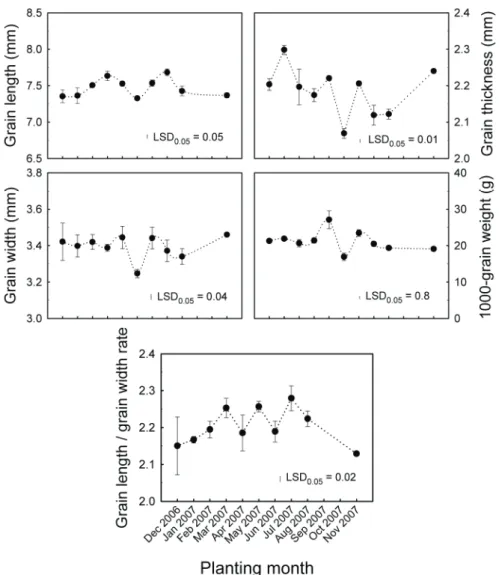
續由
Fig. 2 之試驗資料顯示,臺農 71 號
穀粒大小之改變與栽植期有關,粒長、粒寬、
粒厚及千粒重皆隨著栽植期之變化而異。由
此彰顯出栽植環境的複雜性,經任兩性狀之
間的相關分析結果(資料未列出),得知決定
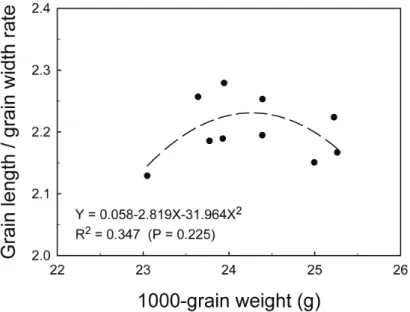
穀粒大小的性狀之間並無顯著相關。又穀粒
長寬比與千粒重之間呈現凸形曲線,因此僅
增加穀粒長度或寬度無助於提高穀粒重量,
而必須同時考量粒長與粒寬之比例,本試驗
Fig. 2. Changes in length, width, thickness and length/width rate of rice grains and 1000-grain weight to planting month for rice cultivar TNG 71.
顯示以介於
2.2 − 2.3 長寬比之穀粒具有較大
粒重(Fig. 3)。至於環境因子對於構成穀粒大
小的長、寬、厚等性狀之作用機制,尤其在
穀粒發育期間的氣象變化,則尚待研究釐清。
將各栽植期收穫之穀粒碾製成糙米,以
分析栽植期對糙米粒外觀的影響,所區分的
青米粒、被害米粒、死米粒、心腹白米粒及
完整米粒等類別之比例標示於
Fig. 4。由圖
示,在溫暖的
5-7 月所栽植之臺農 71 號完整
米 粒 比 例 較 低 , 卻 有 高 比 例 的 不 良 外 觀 米
Fig. 3. Changes in length/width rate of rice grain to 1000-grain weight obtained from different planting months for cultivar TNG 71.
Fig. 4. Changes in the percentages of immature, damaged, death, white center/belly and head rice to planting month for rice cultivar TNG 71. No data for September and October 2007.
粒,尤以
5 月份栽植者表現最差。反之,冷
涼月份則有較高完整米粒比例,尤以
11-1 月
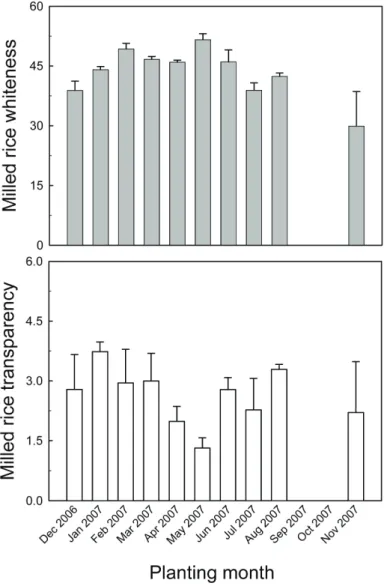
份較高。再將糙米碾製成白米後比較栽植期
對米粒白度及透明度之影響,發現
1-6 月份
收獲米粒白度高於
7-12 月份者,而以 5 月份
栽植者白度最高(Fig. 5)。由於 5 月份栽植期
間自
05/25 起至 09/11 止,橫跨一年當中的
高溫與高日照期,隱示白度值可能受到生育
期間高溫與高日照的影響。結果也顯示栽植
期對白米透明度的效應參差不齊,以
4-7 月
份收獲白米較低,尤以
5 月份栽植者最低。
這些都值得進一步試驗探討,究明氣象環境
的影響機制。而雖然白米之透明度與白度之
間未呈現顯著的直線或曲線關係(資料未列
出),但無法排除環境因子的影響,特別是高
溫加高日照的潛在作用,因為栽植期間維持
高溫與高日照的
5 月份栽植期同時具有高白
度和低透明度。
由 週 年 栽 培 的 米 粒 化 學 組 成 資 料 可 看
出,糙米之粗蛋白質、直鏈性澱粉及游離脂
肪酸和白米之粗蛋白質、直鏈性澱粉等含量
皆受到栽植期的影響(Table 2)。糙米與白米
Fig. 5. Changes in milled rice whiteness and transparency to planting month for rice cultivar TNG 71. No data for September and October 2007.
Table 2. Effects of planting month on chemical components of brown rice and milled rice for cultivar TNG 71.
Brown rice Milled rice
Crude protein Amylose Free fatty acid Crude protein Amylose Planting month ––– % ––– mg g-1 –––%––– December, 2006 8.23 c x 19.73 a 22.77 a 7.43 b 19.20 a January, 2007 6.23 e 19.60 a 21.63 b 5.57 e 19.23 a February, 2007 8.37 c 19.43 b 20.90 c 6.60 c 18.47 b March, 2007 8.40 c 19.30 b 20.57 c 6.07 d 18.53 b April, 2007 7.20 d 19.37 b 19.10 e 5.00 f 17.83 c May, 2007 8.87 b 19.70 a 21.10 b 6.30 c 16.97 d June, 2007 9.63 a 19.57 a 22.23 a 8.33 a 18.47 b July, 2007 9.37 a 19.70 a 22.97 a 8.00 a 19.07 a August, 2007 9.27 a 19.43 b 22.20 a 8.00 a 19.20 a November, 2007 7.10 d 19.00 c 20.00 d 7.50 b 19.10 a LSD0.05 0.44 0.17 0.59 0.46 0.24
x Means followed by the different letters within each column are significantly different at P < 0.05 by
Fisher’s protected least significant difference (LSD) test.
之粗蛋白質含量以
6-8 月份收獲者較高、1-4
月份收獲者較低,直鏈性澱粉含量在糙米及
白米的高低不一,糙米與白米分別以
11 月份
與
4-5 月份較低;糙米中的游離脂肪酸含量
則以
4 月及 11 月較低、6-8 月及 12 月較高。
綜合糙米與白米之化學組成量測結果,大致
以
6-8 月份之含量較高、2-4 月份之含量較
低。作者未來將於二次週年栽培資料合併整
理與分析後,深入釐清栽植環境之效應。另
經初步交叉分析兩兩化學成分間之關係,發
現任兩者間並無顯著之直線或曲線相關(資
料未列出
),顯示化學組成之間似非簡單的兩
兩連動,而係更複雜的多項連動。
本研究另比較穀粒大小對糙米與白米之
化學組成效應,發現千粒重高低和糙米化學
成分變化無顯著相關
(Fig. 6A),惟和白米之
直 鏈 性 澱 粉 與 粗 蛋 白 質 呈 現 曲 線 關 係
(Fig.
6B),尤其與直鏈性澱粉關係達顯著水準。千
粒重介於
16.7~23.6 範圍之白米,具有較高之
直鏈性澱粉與粗蛋白質
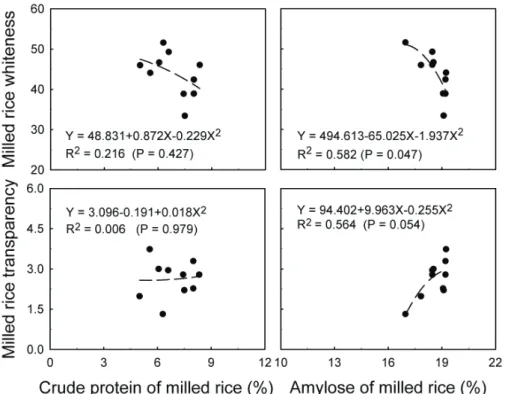
(Fig. 6B)。再由白米之
化學組成與米粒白度及透明度之相關分析,
顯示直鏈性澱粉含量與米粒白度呈現反比,
與米粒透明度則呈現正比,但是蛋白質含量
高 低 和 米 粒 白 度 及 透 明 度 無 顯 著 相 關
(Fig.
7)。顯然的,米粒直鏈性澱粉含量將會影響
白米之白度與透明度,然而仍需要更多試驗
資料佐助以獲得更明確的結果。
米質之優劣受到內在遺傳和外在環境因
素的多重影響,客觀上產生了稻米不等的商
品價值及加工品質,主觀上控制了米飯不同
的烹調食味及色香品味。本研究驗證了栽植
環境將造成碾糙率、碾白率及完整米比例的
差異,同時相關於米粒大小及米粒外觀,也
改變米粒化學組成,提供了栽植期與栽植環
境對米質影響的具體試驗佐證。
Zhou et al.
(2009a)的試驗結果指出,米粒大小會影響蛋
白質含量的高低,通常較高蛋白質含量之稻
穀具有較厚的糊粉層細胞及數量較多的球蛋
白體
(Bradbury et al. 1980)。一般而言,環境
的高溫會提高穀粒蛋白質含量,並間接影響
碾 米 品 質 。 穀 粒 充 實 期 處 於 較 高 環 境 溫 度
時,將會促進糊粉層及糠層的厚度,並因此
增加蛋白質含量(Nagato et al. 1960)。事實上
綜觀前人研究(Song 1978, Asaoka et al.
1985a, 1985b, He et al. 1989, Asaoka et al.
1991, Huang and Lur 2000)可知,抽穗開花
時期的溫度起伏會形成米粒的腹白,係影響
米粒透明度的主要因素;高日均溫及低日夜
溫差會加快穀粒灌漿速率而增加腹白,使米
粒透明度變差,反之則腹白較少而透明度較
大。實務上高腹白米粒不僅外觀品質較差,
Fig. 6A. Changes in protein and starch of brown rice to 1000-grain weight obtained from different planting months for rice cultivar TNG 71.
在碾米過程中亦會有較多碎米,因而降低完
整米粒的比例。此外,高溫時期充實的米粒
又有高膠化溫度之缺點,米粒較硬,煮出的
米飯柔軟度較低、食味較差。因此,從業人
員可以參考本文研究結果來調整栽植期,或
選擇合適的栽植環境進行水稻栽培,以獲得
較佳米質之稻作生產。至於個別氣象因子及
氣象因子間交感對米質的實質影響,將是作
者未來的研究重點之一,透過更多的氣象環
境組合與米質分析資料來逐一解明、釐清。
誌謝
本研究承蒙行政院農業委員會科技計畫
經費補助[98 農科-4.2.1-農-C2(1)],特以致
謝。
Fig. 6B. Changes in crude protein and amylose of milled rice to 1000-grain weight obtained from different planting months for rice cultivar TNG 71.
Fig. 7. Changes in whiteness and transparency to crude protein and amylose of milled rice obtained from different planting months for cultivar TNG 71.
引用文獻
Asaoka M, K Okuno, Y Sugimoto, H Fuwa (1985a) Developmental changes in the structure of endoperm starch of rice (Oryza sativa L.). Agric.
Biol. Chem. 49:1973-1978.
Asaoka M, K Okuno, K Hara, M Oba, H Fuwa (1985b) Effects of environmental temperature at the milky stage on amylase content and fine structure of amylopectin of waxy and nonwaxy endosperm starches of rice (Oryza sativa L.).
Agric. Biol. Chem. 49:373-379.
Asaoka M, K Okuno, K Hara, M Oba, H Fuwa (1991) Effects of environmental temperature at the early developmental stage of seed on the characteristics of endosperm starches of rice (Oryza sativa L.). Starch/Starke 1:1-8.
Bradbury JH, JG Collins, NA Pyliotis (1980) Methods of separation of the major histological components of rice and characterization of
their proteins by amino acid analysis. Cereal
Chem. 57:133-137.
Chu C, WHJ Kwo, SF Chiu (1980) Dry matter accumulation and filling characteristics in developing grains of the first and second crops of rices. (in Chinese with English abstract) Sci.
Develop. 8:414-427.
He GC, K Kogure, H Suzuki (1989) Development of endosperm and synthesis of starch in rice grain. III. Starch property as affected by the temperature during grain development. Jpn. J.
Crop Sci. 59:340-345.
Hsieh SC, DJ Liu (1979) The causes of low yield of the second crop rice in Taiwan and the measure for improvement. Proc. Natl. Sci.
Council ROC 3:301-302.
Huang JJ, HS Lur (2000) The influences of temperature during grain filling stage on grain quality in rice (Oryza sativa L.) 1. Effect of temperature on yield components, milling
quality, and grain physico-chemical properties. (in Chinese with English abstract) J. Agric.
Assoc. China 1:370-389.
Kamata H, T Matsushima (1992) Studies on the qulity and elements in rice grain. II. Effect of grain thickness compositions on amylase and protein contents of brown rice. Rep. Hokuriku
Branch, Crop Sci. Soc. Jpn. 27:10-13.
Kim KH (1988) Research status and prospects in rice quality. Korean J. Crop Sci. 33:1-17. Li T, QH Liu, R Ohsugi, T Yamagishi, H Sasaki
(2006) Effect of high temperature on sucrose content and sucrose-cleaving enzymes activity in rice during grain filling stage. (in Chinese with English abstract) Chinese J. Rice Sci. 20:626-630.
Lin CZ, CP Li, SY Cheng, YC Lin, AN Hsu, FS Thseng, ST Wu, HM Ku (2007) Tagging QTL for grain quality related traits by rice SSR markers. (in Chinese with English abstract)
Crop Environ. Bioinform. 4:269-284.
Lin AC, CS Chen (1976a) Studies on the causee of low yielding in the 2nd crop of rice in Taiwan. I. Comparison of the characteristic of tillering between the lst and 2nd Crop. (in Chinese with English abstract) Sci. Develop. 4(10):53-70. Lin AC, H Su (1976b) Studies on the causee of low
yielding in the 2nd crop of rice in Taiwan. I. Comparison of the photosysnthesis under community conditions between the lst and 2nd Crop. (in Chinese with English abstract) Sci.
Develop. 4(11):5-21.
Lur HS, YH Liu, Agrometeorology Section of Central Weather Bureau (2006) Environmental challenge and strategy for quality rice culture in Taiwan. (in Chinese with English abstract)
Crop Environ. Bioinform. 3:297-306.
Matsue Y, H Sato, Y Uchimura (2001) The palatability and physicochemical properties of milled rice for each grain-thickness group.
Plant Prod. Sci. 4:71-76.
Matsushima S (1966) Crop Science in Rice. Fuji Publishing Co., Ltd. Tokyo, Japan.
Murata Y (1969) Physiological response to nitrogen in plant. p.235-263. In: Physiological
Aspects of Crop Yield. JD Eastin, FA Bave
(eds.) American Society of Agronomy, Madison, Wisconsin.
Nagato K, M Ebata, Y Tanda (1960) On the quality of rice kernel in early season cultivation. (in Japanese with English abstract) Jpn J. Crop Sci. 28:359-362.
Song S (1978) Study of classification of rice grain in Taiwan. (in Chinese with English abstract)
Bullet. Taichung Dist. Agric. Res. Ext. Stn.
2:26-31.
Song S, MC Hong (1990) Studies on the physico-chemical properties of rice. II. The effect of cultural seasons on the physicochemical properties of rice. (in Chinese with English abstract) Bullet. Taichung Dist.
Agric. Res. Ext. Stn. 27:15-28.
Tamaki M, M Ebate, T Tashiro (1989a) Physio-ecological studies on quality formation of rice kernel. I. Effects of nitrogen top-dressed at full heading time and air temperature during ripening period on quality of rice kernel.
Jpn. J. Crop Sci. 58:653-658.
Tamaki M, M Ebate, T Tashiro (1989b) Physio-ecological studies on quality formation of rice kernel. II. Changes in quality of rice kernel during grain development. Jpn. J. Crop
Sci. 58:659-663.
Tashiro T, M Ebata (1974) Studies on white-belly rice kernel. II. Location on the panicle on occurrence of white-belly kernel. (in Japanese with English abstract) Proc. Crop Sci. Soc. Jpn. 43:105-110.
Wei ML, DJ Liu (1984) Comparison on the yield and the production and distribution of dry matter in rice between crop seasons. p.143-152.
In: Special Publication No. 16. Taiwan
Agricultural Research Institute, Taichung Hsien, Taiwan ROC.
Yoshida S (1981) Fundamentals of Rice Crop
Science. The International Rice Research
Institute. Los Baños, Lahuna, Philippines. 269pp.
Yoshikawa S, S Nishimaru, M Ishizuka, H Yasui (1965) Sensory evaluation of cooked rice by early seasonal cultivation or early sowing. Rep.
Zhou LH, QQ Liu, MH Gu (2009a) Milling characteristics and distribution of seed storage protein in rice with various grain shapes. (in Chinese with English abstract) Acta Agron. Sin. 35:317-323.
Zhou LJ, L Jiang, QH Zhai, JM Wan (2009b) Current status and strategies for improvement of rice grain chalkiness. (in Chinese with English abstract) Hereditas (Beijing) 31:563-572.