Self-protection against
fiber fault for
ring-based power-splitting
passive optical networks
Chen-Hung Yehaand Sien Chib
aIndustrial Technology Research Institute, Information and Communications Research Laboratories, Chutung, Hsinchu 31040, Taiwan
bNational Chiao Tung University, Department of Photonics and Institute of Electro-Optical Engineering, Hsinchu 30010, Taiwan and Yuan Ze University, Department of Electrical Engineering, Chungli 32003, Taiwan
E-mail: [email protected]
Abstract. We propose and investigate a new ring-based power-splitting passive optical network 共PS-PON兲 with a self-healing mechanism that prevents fiber fault. Using our proposed Y-type passive component with bidirectional func-tion in each remote node共RN兲, the proposed ring-based PS-PON can be retrieved directly under single fiber failure. © 2008 Society of Photo-Optical Instrumentation Engineers.
关DOI: 10.1117/1.2841702兴
Subject terms: self-healing; ring; time division multiplexing passive optical network.
Paper 070696LR received Aug. 22, 2007; revised manuscript received Nov. 19, 2007; accepted for publication Nov. 28, 2007; published online Feb. 26, 2008.
1 Introduction
Because of the requirements of high capacity data access and multiservices共such as Internet, video, voice, etc.兲, fiber to the home共FTTH兲 in optical access networks is getting more and more important.1 Fiber-based access networks would provide the greatest high-speed bandwidth for down-stream and updown-stream data connections. Therefore, power-splitting passive optical networks 共PS-PONs兲 are the choices for FTTH network applications. Recently, PS-PONs have been thoroughly explored and standardized2–4 for point-to-multipoint solutions moving into the access field. The broadband PON 共B-PON兲 standard has already existed.2 In addition, the standards in gigabit PON 共G-PON兲 as well as for Ethernet PON 共E-共G-PON兲 are emerging. Generally, the architectures of PON have three basic to-pologies of bus, star, and ring structure, respectively. The point-to-multipoint connectivity between the optical line termination 共OLT兲 and each optical network unit 共ONU兲 would be achieved by employing a passive splitting device on the remote node共RN兲. Traffic from an OLT to an ONU is called “downstream” 共point-to-multipoint兲, and traffic from an ONU to the OLT is called “upstream” 共multipoint-to-point兲. Two wavelengths of 1310 and 1490 nm are used for the upstream 共up兲 and downstream 共down兲 transmis-sions, respectively. While a fiber link from the OLT to the ONU is cut due to some reason, the affected ONU will become unreachable from OLT. Furthermore, to achieve fi-ber network protection, the alternative protection fifi-ber paths should be completed.2,5,6
We have proposed and demonstrated a novel self-protecting architecture for a ring-based PON to prevent fi-ber failure. The proposed configuration not only can pro-vide a protection mechanism, but also can obtain the approximate fiber-fault point in the major ring path imme-diately by OLT. In addition, the downstream traffic perfor-mance has also been measured and discussed in this ring-based access network.
2 Proposed Architecture
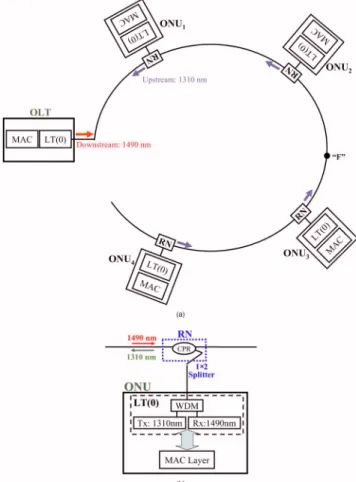
Figure 1共a兲 shows the traditional ring-based architecture in TDM-PONs. The entire data path from OLT to ONU in Fig. 1共a兲 only uses one direction for the downstream and up-stream traffics without any fiber fault protection. A 1⫻2 optical splitter 共coupler, CPR兲 is used in RN to connect each ONU for data link, as shown in Fig. 1共b兲. However, when a fiber fault occurs at the “F” point in the fiber ring path, this access network does not have any function behind the failure point. Thus, the upstream signal from ONU after this fault point is unable to advance. To achieve a desired network survivability, different protection schemes are rec-ommended. The dual-path technique with double transceiv-ers 共line terminals, LTs兲 at both ends and two individual physical paths for the self-protecting ring-based or tree-based PS-PONs has been studied.2,6Furthermore, the two paths increase the cost of building fiber and need to add other passive components. An additional transceiver in OLT and ONU also increases the cost in PONs. To improve
0091-3286/2008/$25.00 © 2008 SPIE
Fig. 1 共a兲 Traditional ring-topology PON with four ONUs. 共b兲 The 1⫻2 optical splitter in RN to connect each ONU.
OE L
ETTERS
Optical Engineering 020501-1 February 2008/Vol. 47共2兲
these drawbacks, we have proposed and investigated a new ring-based architecture with a self-protecting function in PON only by one fiber path, as shown in Fig. 2共a兲. In the proposed architecture, we use two line terminals关LT共0兲 and LT共1兲兴 共also called optical transceivers兲 in OLT for the downstream and upstream data links. LT共0兲 and LT共1兲 con-nect the points “1” and “2” for data link in the same ring path, respectively. In normal status, the LT共1兲 is static with-out any action. The LT共0兲 transmits a downstream signal through path 1 共clockwise兲 without any fiber fault, and LT共1兲 is prepared against the failure occurring. Moreover, Fig. 2共b兲 presents the proposed Y-type optical splitter in RN with bidirectional function to access the downstream and upstream links. This Y-type splitter is constructed by 1 ⫻2 and 2⫻2 optical couplers. The two couplers are com-bined to act as a bidirectional optical splitter for two direc-tion data links. The proposed Y-type component only in-creases the power-loss budget of 3 dB in each RN. When a fiber fault occurs at the “F” point in Fig. 3, the ONUs behind the fault point is unreachable. LT共1兲 is started by the same media access control共MAC兲 in OLT for data traffic through path 2 共counterclockwise兲 to serve the remaining ONUs at the same time. Moreover, the fault point was also located between ONU2to ONU3, because the upstream link behind ONU2cannot be received by OLT, as diagramed in Fig. 3. When failure is restored, then the operation mecha-nism of PON will revive.
Moreover, Ref. 5 also provides a bidirectional 1:1 pro-tection against any fiber cut between the RN and ONUs in tree-architecture PON, and the two ONUs should be a group to obtain bidirectional protection. Also, each ONU needs to add two OSs, a wavelength division multiplexing 共WDM兲 filter, and two monitor apparatus to provide a bi-directional way against fiber fault. Compared with Ref. 5, our proposed self-healing ring-based PON not only has a simple scheme but also has a lower cost for the self-protection mechanism.
3 Experimental Results
To realize and analyze the system performance of the pro-posed self-protecting ring-based PON, the propro-posed access network is experimented. The experimental setup is the same as in Fig. 2. Four Y-type splitters are used at each remote node 共RN兲 to simulate a ring-based PON serving four ONUs. A transmission distance between OLT关LT共0兲兴 and ONU4 is 20 km long. The 1490-nm downstream and 1310-nm upstream signals have 1.25-Gb/s direct modula-tion. In regard to the system power budget, a 1490-nm sig-nal will traverse five optical splitters 共15 dB兲, and about 20-km single-mode fiber 共SMF, ␣= 0.2 dB/km兲; the loss budget is about 19 dB. The bit error rate 共BER兲 perfor-mance is measured by a 1.25-Gb/s nonreturn-to-zero共NRZ兲 pseudo-random binary sequence 共PRBS兲 with a pattern length of 231− 1 for the downstream traffic between the OLT and ONU4 without and with protection. Figure 4 shows the measured downstream BER of the PON against the received power for the back-to-back type and the down-stream traffic passing through in the proposed ring-based optical network with and without protection for down-stream and updown-stream traffic. The observed optical power penalties of Figs. 4共a兲 and 4共b兲 are very small, while the BER is 10−9with and without protection. The slight penal-ties in the access architectures are due to the chromatic dispersion of fiber. Simultaneously, to evaluate the
feasibil-Fig. 2 共a兲 The proposed self-protecting ring-based PON with four ONUs without any fiber fault occurring共OLT has two transceivers兲. 共b兲 The proposed Y-type optical splitter with bidirectional function.
Fig. 3 The proposed self-protecting ring-based PON while a fiber fault occurs at the “F” point. LT共0兲 still operates to serve ONU1and
ONU2, and LT共1兲 will be started immediately to serve the remaining
ONUs.
OE L
ETTERS
Optical Engineering 020501-2 February 2008/Vol. 47共2兲
ity of the proposed architecture, we also measure the throughput performances of the 1.25-Gb/s downstream and upstream traffic by employing a performance analyzer with a 1518-byte frame length in the same network of Fig. 2共a兲. Also, the ring access network has four ONUs. Therefore, the throughput performances of downstream and upstream traffic are measures at 96.6 and 99.1%, respectively.
4 Conclusion
We propose and investigate a new ring-based power-splitting passive optical network 共PS-PON兲 with a self-healing function to avoid fiber fault. Based on the proposed Y-type passive component in each RN, the PS-PON will retrieve protection against fiber failure. Moreover, down-stream traffic performance is also measured and analyzed in this ring-based access network.
Acknowledgments
The authors would like to thank C. S. Lee and S. L. Yeh for help with the experiments.
References
1. M. D. Vaughn, D. Kozischek, D. Meis, A. Boskovic, and R. E. Wag-ner, “Value of reach-split ratio increase in FTTH access networks,” J.
Lightwave Technol. 22, 2617–2622共2004兲.
2. “Broadband optical access systems based on passive optical network 共PON兲,” ITU-T, Recommendation G. 983.1 共1998兲.
3. “Gigabit-capable passive optical network共GPON兲: General charac-teristics,” ITU-T, Recommendation G. 984.1共2003兲.
4. “Ethernet in the first mile task force,” IEEE.
5. T. J. Chan, C. K. Chan, L. K. Chen, and F. Tong, “A self-protected architecture for wavelength-division-multiplexed passive optical net-work,” IEEE Photonics Technol. Lett. 15, 1660–1662共2003兲. 6. K. D. Langer, J. Grubor, and K. Habel, “Promising evolution paths
for passive optical access networks,” ICTON’04, pp. 202–207共2004兲. Fig. 4 BER performance of downstream traffic at 1.25-Gb/s
modu-lation from LT共0兲 when the proposed Y-type splitter is applied in each RN共as shown in Fig. 2兲. The distance between OLT 关LT共0兲兴 and ONU4is 20 km long.
OE L
ETTERS
Optical Engineering 020501-3 February 2008/Vol. 47共2兲