Author query sheet
Queries for Author
Journal: Acupuncture in Medicine Paper: acupmed-2011-010084
Title: An unusual complication related to acupuncture point catgut embedding treatment of obesity The proof of your manuscript appears on the following page(s).
Please note that this is a galley proof and the layout of the article may change before publication. Please read the manuscript care-fully, checking for accuracy, verifying the reference order and double-checking fi gures and tables. When reviewing your page proof please keep in mind that a professional copyeditor edited your manuscript to comply with the style requirements of the journal. This is not an opportunity to alter, amend or revise your paper; it is intended to be for correction purposes only.
During the preparation of your manuscript for publication, the questions listed below have arisen (the query number can also be found in the gutter close to the text it refers to). Please attend to these matters and return the answers to these questions when you return your corrections.
Please note, we will not be able to proceed with your article and publish it in print if these queries have not been addressed.
Query Reference
Query
1 Please note that alterations cannot be made after you have approved for publication, irrespective of whether it is Online First or published directly into a print issue.
2 Please ensure all author names are correct because we are close to publishing your paper online - this data will be recorded on PubMed and CrossRef.
3 Please check whether the affi liations and correspondence information are correct.
4 Please check that the “Provenance and peer review” statement is correct about your article.
If you are happy with the proof as it stands, please email to confi rm this. Changes that do not require a copy of the proof can be sent by email (please be as specifi c as possible). Email: [email protected]
If you have any changes that cannot be described easily in an email, please mark them clearly on the proof and email a scan of the changes by replying to the eProof email or by fax:+44(0)20 7554 6088.
PLEASE RESPOND WITHIN 48 HOURS
Query sheet ends
--acupmed-2011-010084.indd i
Case report
Acupunct Med XXX XXX Vol XX No X 1
INTRODUCTION
Acupuncture point catgut embedding has been using for thousands of years in traditional Chinese medicine for the treatment of several conditions. Although it is regarded as safe, we present an unusual complication that occurred in the treatment of obesity: multiple tender subcutaneous nodules developed over the lower abdomen and both medial thighs 1 month after embedding the catgut.
CASE HISTORY
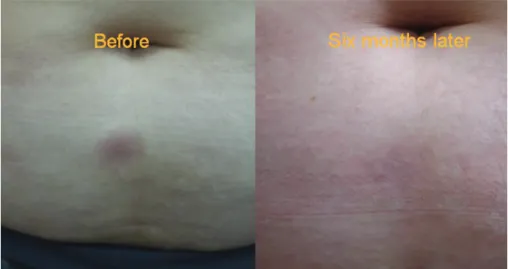
A 27-year-old woman visited our out-patient department on 11 December 2010 with multiple itchy and tender skin lesions over the lower abdomen and both medial thighs, as shown in fi gure 1. She had had three courses of acupuncture point catgut embedding treatment with 7 days intervals between each course. A special needle was used to bury sterile catgut in the acupuncture points on both medial thighs and lower abdomen. An erythematous swelling appeared after the second course and became severe after the third course. She noticed that almost every tender lump developed on sites where cat-gut had previously been embedded. Dermatological examination disclosed multiple, tender, bean-sized erythema-tous nodules with central darkened points in a linear arrangement over both medial thighs and over the lower abdomen fi gures 1 and 2.
There was no inguinal lymph-adenopathy or other systemic signs.
histological report was of degenera-tive, individual or clustered, thread-like eosinophilic foreign material surrounded by localised mixed acute and chronic xanthogranulomatous infl ammatory infi ltrates with evident foreign body reaction fi gure 3. Special stains for infectious organisms, such as acid-fast stain, Gram stain, periodic acid–Schiff stain and Grocott’s meth-enamine silver stain were all negative. Tissue cultures for bacteria, fungus and mycobacterium were negative.
Further excisional biopsy was arranged for some large and painful lesions while intralesional steroid was injected into others. Tissue cultures for bacteria, fungus and mycobacte-rium were repeated, and the result was still negative.
OUTCOME
These tender and pruritic nodules on her lower abdomen and both medial thighs regressed spontaneously with postinfl ammatory hyperpigmenta-tion. The appearance 6 months later is shown in fi gures 1 and 2.
DISCUSSION
Acupuncture point catgut embed-ding has been used for thousands of
An unusual complication related to
acupuncture point catgut embedding
treatment of obesity
Yung-Ting Chuang,
1Tzong-Shiun Li,
2Tze-Yi Lin,
3Chih-Jung Hsu
1ABSTRACT
Treatment of obesity by embedding catgut in acupuncture points has a satisfactory therapeutic effect in many patients. Even though results of its effectiveness are mixed, serious complications are rarely reported with this Chinese traditional therapy. Here an unusual complication of the treatment is reported: multiple tender subcutaneous nodules developed where the catgut was embedded over the lower abdomen and both medial thighs 1 month after treatment. Clinicians should be alert to this possible cause of a rather strange presenting physical sign.
Her medical history did not include any systemic disease and she had not recently started any new drug. Our clinical impression was of for-eign body granuloma, and in order to establish the diagnosis, and in particu-lar to rule out iatrogenic infection, we arranged further investigation.
INVESTIGATIONS
Skin excisional biopsy and tissue cul-tures for bacteria, fungus and myco-bacterium were performed. The
Figure 1 (Left) Multiple bean-sized tender erythematous subcutaneous nodules with linear distribution on both medial thighs. (Right) The subcutaneous nodules regressed spontaneously, leaving postinfl ammatory hyperpigmentation 6 months later.
1 2 1 2 3 4 5 6 7 8 9 10 11 12 13 14 15 16 17 18 19 20 21 22 23 24 25 26 27 28 29 30 31 32 33 34 35 36 37 38 39 40 41 42 43 44 45 46 47 48 49 50 51 52 53 54 55 56 57 58 59 60 61 62 63 64 65 66 67 68 69 70 71 72 73 74 75 76 77 78 79 80 81 82 83 84 85 86 87 88 89 90 91 92 93 94 95 96 97 98 99 100 101 102 103 104 105 106 107 108 109 110 111 112 113 114 115 116 117 118 acupmed-2011-010084.indd 1 acupmed-2011-010084.indd 1 10/27/2011 8:10:15 PM10/27/2011 8:10:15 PM
Case report
Acupunct Med XXX XXX Vol XX No X 2
years in traditional Chinese medicine for the treatment of perimenopausal syndrome (climacteric syndrome),1
chronic urticaria,2 depressive
neuro-sis, refractory insomnia,3 Alzheimer’s
disease, obesity, sciatica, ulcerative colitis, facial paralysis and trigeminal neuralgia.
Treatment of obesity with embed-ding catgut in acupuncture points has a satisfactory therapeutic effect in many patients. Even though results of its
effectiveness are mixed, serious com-plications are rarely reported with this Chinese traditional therapy. We believe this is the fi rst report of this unusual complication in which multiple tender subcutaneous nodules developed in the sites where catgut had been embedded 1 month previously.
Iatrogenic infection during the proce-dure must be the fi rst consideration of doctors examining such cases. A differ-ential diagnosis, including foreign body
reaction, panniculitis, or atypical infec-tion, might be considered. Infection is generally the most likely side effect in patients receiving an invasive proce-dure, and in the absence of systemic upset the possibility of a foreign body reaction cannot be ruled out.
When suture granuloma is sus-pected clinically, ultrasonography has been reported to be effective for diag-nosis.4 Pathologically, the suture
mate-rial is birefringent under polarised light.5 The correct diagnosis always
depends on careful history taking and histopathological fi ndings.
From our experience in this case, clinicians should remember the possi-bility of the presence of foreign body granuloma due to catgut embedding treatment in the differential diagnosis of skin conditions with this somewhat strange distribution.
1Department of Dermatology, China Medical University Hospital/China Medical University, Taichung, Taiwan, Republic of China
2Department of Plastic Surgery, Division of Plastic Surgery, China Medical University Hospital/China Medical University, Taichung, Taiwan, Republic of China 3Department of Pathology, China Medical University Hospital/China Medical University, Taichung, Taiwan, Republic of China
Contributors TSL: patient follow-up, CJH: instructor,
YTC: manuscript, TYL: pathology explanation.
Correspondence to Chih-Jung Hsu, Department of
Dermatology, China Medical University Hospital/China Medical University, No.2, Yu-Der Road, Taichung City 40447, Taiwan, Republic of China;
Competing interests None. Patient consent Obtained.
Provenance and peer review Not commissioned;
internally peer reviewed. Accepted 11 October 2011 Acupunct Med 2011;XX:XXX–XXX. doi:10.1136/acupmed.2011.010084
REFERENCES
1. Liu BX, Wang LP, Xu M, et al. Postmenopausal osteoporosis of liver and kidney defi ciency type treated with acupoint catgut embedding by stages. Zhongguo
Zhen Jiu 2011;31:315–9.
2. Yang XL, Jia QL, Liu PH, et al. Effi cacy observation on acupoint catgut embedding therapy combined medication for treatment of chronic urticaria induced by Helicobacter pylori infection. Zhongguo Zhen Jiu 2010;30:993–6. 3. Wei Y. Clinical observation on acupoint catgut
embedding at head-acupoint combined with massage of sole for treatment of refractory insomnia. Zhongguo
Zhen Jiu 2010;30:993–6.
4. Rettenbacher T, Macheiner P. Suture granulomas: sonography enables a correct preoperative diagnosis.
Ultrasound Med Biol 2001;27:343–50.
5. Thirumaran M, Jackson A. Suture granuloma. Postgrad
Med J 2004;80:18.
Figure 2 (Left) A bean-sized tender erythematous subcutaneous nodule on the lower abdomen. (Right) This nodule regressed spontaneously leaving mild postinflammatory hyperpigmentation 6 months later.
Figure 3 Degenerative, individual or clustered, thread-like eosinophilic foreign material engulfed and surrounded by multinucleate foreign body giant cell. (haematoxylin and eosin stain; original magnifi cation ×400). 3 4 178 179 180 181 182 183 184 185 186 187 188 189 190 191 192 193 194 195 196 197 198 199 200 201 202 203 204 205 206 207 208 209 210 211 212 213 214 215 216 217 218 219 220 221 222 223 224 225 226 227 228 229 230 231 232 233 234 235 236 119 120 121 122 123 124 125 126 127 128 129 130 131 132 133 134 135 136 137 138 139 140 141 142 143 144 145 146 147 148 149 150 151 152 153 154 155 156 157 158 159 160 161 162 163 164 165 166 167 168 169 170 171 172 173 174 175 176 177 acupmed-2011-010084.indd 2 acupmed-2011-010084.indd 2 10/27/2011 8:10:16 PM10/27/2011 8:10:16 PM