T
he “Kellogg-HKUST Executive MBA Program,” jointly organized by Kellogg and the HKUST business schools, was officially launched in the week of 18 January 1998.The week’s activities included the first live-in session for the students on the HKUST campus; a reception for the students and r e p r e s e n t a t i v e s f r o m b o t h b u s i n e s s s c h o o l s a n d t h e sponsoring companies. The highlight was a black tie dinner at the Mandarin Oriental Hotel on 24 January.
At the inauguration ceremony of the EMBA program, Prof. Donald Jacobs, Dean of the Kellogg School, said, “The partnership with the HKUST business school is an important addition to our global network. Together with t h e o t h e r t w o j o i n t E M B A programs which we have already d e v e l o p e d w i t h t h e L e o n Recanati Graduate School of Business Administration in Israel
ISSUE 1
FEBRUARY 1998
1
EXPERTS EXCHANGE VIEWS
ON CHINA BUSINESS
HANG LUNG CENTER FOR
ORGANIZATIONAL RESEARCH
OPENS WITH EXCELLENT
KELLOGG AND HKUST BUSINESS SCHOOL LAUNCH EMBA PROGRAM
and the Koblenz School of C o r p o r a t e M a n a g e m e n t i n Germany, we are in a unique p o s i t i o n t o o f f e r g e n u i n e international exposure to the students of all participating schools.”
On the same occasion, Prof. Yuk-Shee Chan, Dean of the HKUST business school, said, “We are delighted to be the first Asian business school to organize a degree program with a world-class institution such as Kellogg. Combining the strengths of the teaching faculty members from both schools, we will be able to provide our students with the best training to meet the greater challenges ahead from a global and integrative perspective.” Dr Steve DeKrey, Director of the E M B A p r o g r a m , s a i d , “ O u r program is very international in its every making. Our students, for example, include senior executives from different parts of the region and industries. This
will enhance the exchange of ideas and experience and also interaction among the class.” A total number of 35 students are enrolling in the first batch of the Kellogg-HKUST EMBA program. Seven of them are from Malaysia, Shanghai, Taiwan and Thailand. The program takes 16 months to complete. The students are
required to attend classes two weekends every month on the H K U S T c a m p u s a n d a r e a c c o m m o d a t e d i n t h e n e w University Center. Classes are held on Friday afternoons, Saturdays and Sundays. The students will attend the second live-in session at the Kellogg School on Northwestern
E
ighteen speeches on doing business in China were delivered during a forum to launch the Shui On Center for China Business and Management.The assembly, entitled “China Business Forum”, was held on 17 December 1997 in the new wing of the Hong Kong Convention and Exhibition Centre.
Speakers of the Forum included the Chief Executive of the Hong Kong Special Administrative Region Tung Chee Hwa (see picture), leading Hong Kong businessmen and academics
from the HKUST business school, Nanjing University, Beijing University and the Australian National University. Four major topics w e r e c o v e r e d : “ C h i n a ’s E c o n o m i c Development”, “China and the World Trade Organization”, “Management of Executive Resources in
China” and “Investment Strategies”.
The full-day forum was a t t e n d e d b y o v e r 7 0 0 delegates(see related story on page 4).
T
he Hang Lung Center for Organizational Research was officially opened on 15 January 1998. A series of activities including a reception, an inauguration ceremony, a formal dinner and a research conference were held during that week to mark the Center’s opening.Dedicated to the promotion of research in China– related organization and management issues, the Research Center was named after Hang Lung in
recognition of the company’s donation of HK$20 million towards the building of the new University Annex. Prof. Anne S. Tsui, Head of the Department of Management of Organizations and Founding Director of the Research Center, said, “I am pleased that the Center has received so much support at its initial stage of development. One of the research areas that is of interest to us is quanxi (relationships). The setting up and running of the Center will be in itself a good case to demonstrate where quanxi matters. More importantly, the Center will be pivotal in building partnerships between business executives and academic researchers in the creation of knowledge.”
Guests who attended the Center’s inauguration events included Dr Thomas Chen, Director of the Sterling Group; Mr Ronnie C. Chan, Hang Lung’s Chairman; Dr Lily Chiang, Executive Director of Chen Hsong Machinery; Dr William Overholt, Managing Director of Bankers Trust Company; Prof. Chia-Wei Woo, HKUST President; Prof. Otto C. C. Lin, HKUST Vice President for Research & Development and research scholars from the US, Europe, Hong Kong and the Chinese mainland.
“Managing business in China... “ – Mr Ronnie Chan Prof. Lawrence Dumas, Provost of the Northwestern University (centre left) and Prof. Chia-Wei Woo, President of HKUST,
shake hands after a plaque-unveiling ceremony at the EMBA inauguration dinner while Dean Yuk-Shee Chan (far left) and Dean Donald Jacobs look on.
University’s Evanston campus in September 1998.
On completion, the graduates will be awarded a degree jointly by the Northwestern University and HKUST. They will become alumni of both institutions. The s e c o n d c l a s s w i l l b e g i n i n January 1999.
2
A PROPOSAL TO DEFEND THE HK$ EXCHANGE RATE LINK IN TIMES OF CRISIS
by Alex Chan, Visiting Assistant Professor of Finance, and Nai-fu Chen, Professor of Finance
The Hong Kong University of Science of Technology
Since the Asian financial turmoil hit Hong Kong in late October 1997, a number of proposals on how to improve the territory’s currency system have been put forward by both academics and market practitioners to government authorities. Among those, the proposal from Alex Chan, Visiting Assistant Professor, and Nai-fu Chen, Professor in HKUST’s Department of Finance, has attracted a lot of attention locally as well as internationally.
In their proposal, Chan and Chen argue that while it is important to protect the exchange rate link
▲ ▲ ▲ R4 R3 R2 R1
BUSINESS FORUM
The main objective of our proposal is to keep the local economy from panics while preventing speculators from gaining profits. A little pain for the speculators would be good but it is of secondary concern.
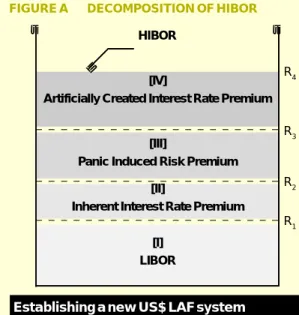
The key idea is to prevent the market from developing into a bank-run equilibrium. Thus, injecting confidence into the market is the first order of business for the government when faced with pressure on the currency. Ideally, the Hong Kong Inter-Bank Offer Rate (HIBOR) – London Inter-Bank Offer Rate (LIBOR) rate differential should reflect only the inherent risk of devaluation, not the lack of resolve of the Hong Kong Monetary Authority (HKMA) to maintain the link nor the lack of confidence in its handling of the crisis. If HIBOR is too low, it provides speculators and hedgers low funding cost (cheap insurance) to add pressure on the currency. If HIBOR is too high, it partially shuts down the market, creates panics and ruins the economy. Thus the response from HKMA should be to provide a commitment to maintain the link and a foundation for the market to find the correct market rate for HIBOR in the absence of panics. In the following figure (Figure A), the correct level of HK$ interest rate is at R2, which is the sum of the “Inherent Interest Rate Premium” (reflecting the true inherent risk of devaluation under the correct government response) and the LIBOR. The “artificially created interest rate premium” can be eliminated as long as the government does not drain liquidity from the market as a response. The “panic-induced risk premium” can be reduced by explicit government commitments to maintaining the link and staying away from counterproductive policies. As the market slowly builds confidence that the government is not mishandling the crisis, the market interest rate (HIBOR) will fall back to the R2 level.
FIGURE A DECOMPOSITION OF HIBOR
HIBOR
[IV]
Artificially Created Interest Rate Premium
[III]
Panic Induced Risk Premium
[II]
Inherent Interest Rate Premium
[I] LIBOR
Establishing a new US$ LAF system
Similar to the existing HK$ LAF(Liquidity Adjustment Facility) system, our proposed US$ LAF provides a source of funding to the Hong Kong banking system. However, in the proposed US$ LAF system, banks are allowed to borrow
US$ loans from HKMA by the collateral of Exchange Fund Bill/Notes under the following special terms:
If a bank borrows US$ loan (say 3-month loan of US$1 Billion) from HKMA through the proposed US$ LAF, at the loan maturity, the bank can choose to
(1) repay (US$1 Billion + Interest payment for US$ LAF)
or (2) repay Hong Kong Dollar equivalent of (1) calculated by a pre-specified exchange rate at HK$7.8/US$
The interest rate of the US$ LAF borrowing should be set at a level appropriately slightly higher than LIBOR. Ideally, it should be at the level of R2 (plus a small transaction cost) in Figure A.
This system can
- restore public confidence through explicit commitment by HKMA (with its HK$ put options), and then - induce a change of behavior of banks through the HKMA’s
offering of the US$ call options (or equivalently HK$ put options); banks are induced to engage in interest rate arbitrage, which will strengthen the HK$ exchange rate and reduce the interest rate differential between HIBOR and LIBOR.
By issuing the put option only to banks that have HK$ Exchange Fund Bill/Notes, HKMA can limit the outstanding put options in the market by controlling the issuance of Exchange Fund Bill/Notes. HKMA can borrow the US$ from the Euro-dollar market, thus only acting as a middleman with a guarantee.
Functioning of the US$ LAF system
Under the existing system, when speculators attack the HK$/US$ exchange rate, HKMA sometimes controls the HK$ money supply through some restrictive policies and the HK$ money supply becomes very tight. Banks find it difficult to borrow HK$ through the inter-bank market, and the HIBOR will rise dramatically; in turn the liquidity problem in the banking system will create a harmful effect on our economy.
With the proposed US$ LAF, when the above situation (high HIBOR) happens, banks will be induced to (1) borrow US$ LAF from the HKMA, (2) sell the US$ on the spot Forex market directly for HK$, and (3) lend out the received HK$ for their HK$ borrowing demand and push down the HIBOR. These three steps are similar to buying HK$ forward. Moreover, the overall HK$ money supply in the economy can remain the same at the discretion of HKMA. Under the exisiting system, banks do not borrow US$ to fund the HK$ demand because of the potential exchange rate risk between HK$/US$. If a bank borrows US$ to fund the HK$ lending, it can suffer a significant loss should the HK$ link be suddenly broken. A piece of evidence is the
significant interest rate differential between HK$ and US$ around the end of October 1997.
Our proposed US$ LAF does not only lend out US$ loans to banks to alleviate their liquidity problem, but it also provides an option to the borrowing bank to choose between US$ repayment and HK$ repayment at the loan maturity. The bank is protected from any exchange rate risk through borrowing US$ loans to fund HK$ lending/cash demand.
Strengths of the proposed system
1. HK$ money supply need not be increased through the US$ LAF. The proposed US$ LAF induces banks to borrow US$ from HKMA to buy HK$ and then lend out HK$ to clients who demand HK$ loans. As liquidity is the lubricant for the economy, this allows the quick introduction of the lubricant in the tight market without f l o o d i n g t h e m a r k e t w i t h H K $ , w h i c h m i g h t inadvertently help speculators.
2. Offering the optional repayment scheme is a strong signal of the rigorous exchange rate policy (HK$7.8/ US$ system); it, in turn, provides the needed confidence to the public.
3. Banks can solve their liquidity problems through borrowing US$ from the US$ LAF to fund their HK$ cash demand. Hence, the market forces can maintain the HK$ link once this foundation is established. It can also stabilize the interest rate differential between HK$ and Euro-dollars to a reasonable level. HIBOR will be more stable and will stay reasonably close to the Euro-dollar interest rate.
4. As the opportunity to borrow US$ loans from the US$ LAF requires the collateral of HK$ Exchange Fund Bill/ Notes, the value of the US$ call option is paid in the auctioning of the HK$ Exchange Fund Bill/Notes. 5. The eventual interest rates will be established by the
market in the absence of panics.
Conclusion
1. Raising interest rates (in response to attacks on HK$) enriches (rather than punishes) the speculators. 2. The HK$ link has been supported by Hong Kong
economy, not by the high interest rates. The high interest rates are slowly ruining the Hong Kong economy and weakening the link.
3. There is a mechanism to guide the Hong Kong markets away from panics, thereby lowering the absurdly high interest rates, strengthening the economy and maintaining the link.
4. The introduction of US$ LAF will not increase the incentive to attack the HK$.
Alex Chan and Nai-fu Chen can be reached at
[email protected] & [email protected]
between the HK$ and the US$, the traditional defense mechanism of raising interest rates and maintaining high domestic interest rates are ineffective, short-term measures in combating attacks on the Hong Kong currency because of the proliferation of derivative products like swaps and forwards. Alternatively, they propose the establishment of an “Inter-temporal Currency Board (or US$ Liquidity Adjustment Facility)”. Nobel laureate Merton Miller has openly supported their proposal. Below is their general approach to the defense of the Hong Kong Dollar exchange rate in times of crisis.
3
HKUST BUSINESS SCHOOL – Newsletter
T
he HKUST Business School Newsletter will be published every quarter to report on the School's events and activities. We are excited about this first issue because starting from now, we will have a newsletter of our own.At the launch of our first newsletter, I think it is timely to take a step back and look at where we are as a young but fast-growing business school.
CURRENT STATUS
There have been five congregations since the establishment of the business school in 1991. The business school has to date some 2,300 graduates of which 1,900 are undergraduate students and 390 are postgraduates (primarily MBA's). In spite
of our short history, we have produced a good number of aspiring graduates with diverse career interests and expertise.
The business school has 150 faculty members. We currently enroll some 2,550 students of which 2,100 are undergraduates and 450 are postgraduates (including 300 MBA's). In terms of student enrollment in degree programs, the HKUST business school is the largest among its peers in Hong Kong.
At the outset, our target was to build a world-class business school in Asia. I think we have been moving in the right direction and, to a large extent, fulfilled our target. For example: we follow the highest international standards in our hiring of faculty. Our young and aspiring faculty received their training from the best doctoral programs and our senior faculty are accomplished and world-renowned scholars in their fields. The quality of research produced by our scholars is judged according to international standards.
WORLD CLASS STANDARD
We have recently been invited by the American Assembly of Collegiate Schools of Business to participate in the Assembly's first round of international accreditation in Asia.
We are proud to have offered the first joint EMBA degree program in Asia with a world-class partner, the Kellogg School of Northwestern University (see story on page 1). The U.S. News’ America’s Best Graduate Schools released in 1998 ranked Kellogg’s EMBA program the No.1 EMBA program in the U.S.
Our MBA program is the only Chinese member of the Graduate Management Admissions Council, which runs the GMAT. The program itself has been ranked among the best international programs in Asia by the World Executive Digest.
The School's undergraduate and MBA programs have, respectively, 24 and 22 partner universities participating in their student exchange programs worldwide. Those universities include Northwestern University, UC Berkeley, University of Chicago, and University of Pennsylvania in North America; HEC, ESSEC and the Koblenz School of Corporate Management in Europe; as well as other well-known universities closer to home in the Asia-Pacific.
Regarding the provision of professional services, we continue to be an active promoter of academia-business and academia-government collaborations. Two new centers — Shui On Center for China Business and Management and Hang Lung Center for Organizational Research — have been established to promote China-related business education and research with the sponsorship of major corporations.
Our faculty members are often invited to give their expert opinions to the media, Government and other concerned groups on issues such as retirement funds, the economic policies of Hong Kong, the financial markets and system, and the labor market. Many of them have served as advisors and consultants to public bodies and business corporations.
CHALLENGES
While we take pleasure in the achievements the business school has made in its short history, there is absolutely no place for complacency. Our priorities for the future will focus on:
1. further strengthening our faculty capability; 2. reviewing and improving our program offerings; 3. continual investment in our facilities;
4. expanding outreach efforts; and
5. enhancing corporate and community relationships.
ACCOUNTING DEPARTMENT
Dr Amihud Dotan (1977 PhD, Cornell University) as Visiting Scholar from January 1998 to January 2000. Dr Dotan’s research interests include: financial and managerial accounting; special reporting issues, disclosure decision making and valuation.
INFORMATION AND SYSTEMS MANAGEMENT DEPARTMENT Dr Hugues Levecq (1997 PhD, New York University) as Assistant Professor from January 1998. Dr Levecq’s research interests include: financial information systems; technology and innovation; modeling and simulation.
Dr Javier Cabrera (1983 PhD, Princeton University) as Visiting Associate Professor from January to June 1998. Dr Cabrera‘s research interests include statistical computing and graphics; projection pursuit; directional data.
Dr Vojislav Misic (1993 PhD, University of Belgrade) as Visiting Scholar from January to June 1998. Dr Misic’s research intersts include: software metrics; object-oriented information modeling; formal methods and their application.
Mr Wang Xiangdong as Visiting Scholar from January to May 1998. Mr Wang is Deputy Secretary-General and Associate Professor of the Center for Information Infrastructure and Economic Development, Chinese Academy of Social Sciences (CASS).
Dr Jun Yuan (1995 PhD, Southeast University) as Visiting Scholar from January to June 1998. Dr Yuan’s research interests include: information systems for the multi-organizational environment; data mining and data warehouse; data management for Internet and web server.
MANAGEMENT OF ORGANIZATIONS DEPARTMENT
Dr Gary Katzenstein (1997 PhD, Carnegie Mellon University) as Assistant Professor from December 1997. Dr Katzenstein’s research interests include: managerial and organizational cognition; organizational learning: organizational knowledge creation, storage, and transfer.
MARKETING DEPARTMENT
Dr Byong-Duk Rhee (1990 PhD, University of Michigan, Ann Arbor) as Visiting Assistant Professor from January 1998 - January 2000. Dr Rhee’s research interests include: product differentiation; first mover advantages and new product positioning; transaction costs in positioning.
HKUST BUSINESS SCHOOL
GEARS UP FOR AACSB
ACCREDITATION
T
he HKUST business school is one of four Asian schools invited by the American Assembly of Collegiate Schools of Business (AACSB) to participate in the Assembly's first round of international accreditation in Asia.AACSB accreditation is a standard quality assurance scheme for business schools in North America. The Assembly has recently started branching out its evaluation coverage to Europe and Asia.
Dean Yuk-Shee Chan of the HKUST business school, said, "The invitation is a great honor to us. The fact that two Hong Kong business schools have been invited shows that the quality of our business education is recognized by our peers internationally. A task force has been set up to spearhead the project with the support of our faculty members and staff." The evaluation process will take 15 months. The project advisor visited the School in February and the self-evaluation report is expected to be ready for review in September. The AACSB Peer Review Team will visit the School in early 1999 to assess its programs' standards – with the view for completion of the accreditation review by April 1999.
NEW APPOINTMENTS
FROM THE DEAN
Dean Yuk-Shee Chan
Suggestions and comments on this newsletter are welcome. Please contact us by email at: [email protected] (May Hung) or [email protected] (Elaine Chu) or by fax (852) 2358 1467.
4
The Hong Kong University of Science of Technology HKUST Business SCHOOL – Newsletter
PUBLICATIONS
F
our research reports on current issues relating to doing business in China were compiled for the China Business Forum (see story on page 1). Below is a brief account on each of the reports.Prof. Justin Yifu Lin, Department of Economics and Director of China Center for Economic Research, Peking University, wrote on "Issues in China's economic reform: roots and options". Prof. Lin pointed out that instead of emphasizing the development of capital-intensive high-tech industry, China should focus on capitalizing on China's comparative advantages and the establishment of a transparent, ruled-based legal system that protects property rights in order to encourage innovations and t e c h n o l o g i c a l p r o g r e s s , a n d attracts domestic and foreign investment.
In "The impact of China's accession to the World Trade Organization (WTO) on foreign firms", Head of Economics, Prof. Leonard Cheng, reckoned that the most important issues surrounding the conditions for China to access the WTO are
1 ) M F N ; 2 ) t r a d i n g r i g h t s ; 3)transparency, uniformity, and continuity of foreign trade and investment rules and regulations; 4)protection of intellectual property rights and 5)trade liberalization and market access. Although China's WTO membership will mean a better environment for foreign investors, the market will, as a result, become more competitive for both domestic and foreign firms that currently operate in China. D r. K a t h e r i n e X i n , A s s i s t a n t P r o f e s s o r , D e p a r t m e n t o f Management and Organization, Marshall School of Business, University of Southern California and Visiting Assistant Professor, Department of Management of Organizations, Prof. Shuming Zhao, Dean of the School of International Business, Nanjing University and P r o f . A n n e Ts u i , H e a d o f t h e Department of Management of Organizations, conducted a survey in China that found that demand for middle managers and executives will remain high in the next three y e a r s d u e t o t h e c o n t i n u e d e c o n o m i c e x p a n s i o n a n d t h e
ISMT DEVELOPS ELECTRONIC
LIBRARY FOR OPEN UNIVERSITY
P
rof. Wilfried Vanhonacker, Head of the MarketingDepartment, announced publication of the first collection of case studies on Asian business, The Asian Marketing Case Book. Written by Prof. Vanhonacker and Prof. Noel Capon, a former visiting professor at the University, the book is being published by Prentice-Hall together with a
companion volume of teaching notes, and is expected to be used at all levels of education.
Prof. Vanhonacker is collecting information and materials for another case book on China business. The book is expected to be published in 1998.
acceleration of marketization of s t a t e - o w n e d e n t e r p r i s e s . T h e professors suggested educators and companies should collaborate in addressing the critical gap between demand and supply in management talent.
In their research paper, "Investment Strategies", Dr Larry Qiu and Dr Changqi Wu, Assistant Professors in the Department of Economics, systematically analyzed the major investment strategies and modes of investment in China. They concluded that different strategies require compatible external and internal factors to make investment in China a success. Government policy also plays a critical role in determining the success or failure of ventures in China. The reports have been collated in a publication entitled Research Reports On Doing Business In China: Current
Issues.
T
he development of an electronic library by the Information and Systems Management (ISMT) Department for the Open University is now well underway for its full launch in April 1998.The project commenced in February 1997. The ISMT Department was selected among many competitors by the Open University to be the project manager. The project involved a detailed review of the needs, comprehensive planning, system design, selection of vendors and overall project management. The total budget for development of the electronic library was HK$40 million. The electronic library was designed to allow over 20,000 students of the Open University to access the university’s library materials by dialing in via
a modem or by connecting through the Internet. Pilot run of the electronic library started in November 1997. Project leader Dr Kar Yan Tam, of the ISMT Department said, “this is the first similar system of such size being developed in Hong Kong. The major challenges were interface design, security and electronic document management. Our team benefited a lot from the project.” The ISMT Department has been successful in making direct technology transfers. Apart from the electronic library project, it has recently been awarded a contract by Hongkong Bank to review the possibility of electronic cash transactions over the Internet using the Mondex platform.
NEW CASEBOOKS ON DOING BUSINESS IN ASIA
PROFESSOR LEE
RECEIVES WORLD
RECOGNITION
P
r o f e s s o r L e e L u n g - F e i o f t h e E c o n o m i c s Department has recently been ranked the world’s third most productive econometrician in an article “Worldwide Institutional Rankings in Econometrics: 1989 - 1995” to be published this year.This is the first time an Asian economist has received such a ranking from the publication.
Professor Lee joined the University in 1994. Prior to that he was Professor of Economics at the University of Michigan from 1991 - 94 and Professor of Economics at the University of Minnesota from 1984 to 91. Professor Lee received his PhD from the University of Rochester. Professor Lee’s research interests include econometrics, microeconometrics, statistics and applied economics. He is a fellow of the Econometric Society.
NEW DIPLOMA
PROGRAM PROVIDES
TRAINING FOR
EXECUTIVES
T
he School of Business and Management has introduced a new part-time diploma course in management targeting working executives.Entitled the “Graduate Diploma in Management Program”, the one-year course commenced on the last Saturday of November 1997. The program offers a complete core general management curriculum including the latest thinking and tools in accounting, economics, finance, information systems and operations management, management policy and marketing. It comprises six course modules. Each module requires 35 hours of classroom instruction. Classes are held on Tuesday nights (downtown) and Saturday afternoons.
20 students were admitted to the first class. They come from a diversity of industries including hotel, construction, securities, public utilities, telecommunications, banking, trading and education institutes.
This is the latest addition to the School’s portfolio of executive training courses. The next will be a diploma course in China business and management, which is expected to be introduced in the Spring of this year by the Shui On Center for China Business and Management.