
國
立
交
通
大
學
資訊科學與工程研究所
碩
士
論
文
IEEE 802.11e 無線區域網路下針對 VoIP
話務之高能源效率媒體存取控制協定
A Power-Efficient MAC Protocol for VoIP Traffic
over IEEE 802.11e WLANs
研 究 生:呂幸妤
指導教授:王國禎 教授
IEEE 802.11e 無線區域網路下針對 VoIP 話務之
高能源效率媒體存取控制協定
A Power-Efficient MAC Protocol for VoIP Traffic
over IEEE 802.11e WLANs
研 究 生:呂幸妤 Student:Hsing-Yu Lu
指導教授:王國禎 Advisor:Kuochen Wang
國 立 交 通 大 學
資 訊 科 學 與 工 程 研 究 所
碩 士 論 文
A ThesisSubmitted to Institute of Computer Science and Engineering
College of Computer Science
National Chiao Tung University
in Partial Fulfillment of the Requirements
for the Degree of
Master
in
Computer Science
June 2006
Hsinchu, Taiwan, Republic of China
i
IEEE 802.11e無線區域網路下針對VoIP話務之
高能源效率媒體存取控制協定
學生:呂幸妤 指導教授:王國禎 博士
國立交通大學資訊科學與工程研究所
摘 要
在無線網路環境下對於 VoIP 攜帶式裝置,如何節省能源是一個重要的
問題。在本論文中,我們提出了一個與 IEEE 802.11e 相容的高能源效率媒
體存取控制協定(PEP)去改進原有的 ODP 機制。在 ODP 機制裡,當基地台
收到連續兩個 QoS Null 訊框,就會將其對應的語音用戶站從輪詢表中移
除。PEP 機制結合 HCF 中輪詢機制(HCCA)和競爭機制(EDCA)。基地台
動態地維持輪詢表。我們假設在輪詢表中的所有語音用戶站皆是處於主動
模式。當語音用戶站傳送 Null 訊框裡的貯列大小值為零,並且仍有剩下的
TXOP 時,其語音用戶站會被視為進入寂靜模式,此語音用戶站將會自輪詢
表中被移除。此語音用戶站可在 EDCA 競爭週期裡尋求再加入到輪詢表
中。為了增加預測語音用戶站進入寂靜模式的準確性,在 PEP 機制裡加入
了一個評估 TXOP 利用率的啟發式方法。模擬結果顯示關於能源消耗方面,
在沒有犧牲網路產量的情況下,PEP 機制比 RRP 和 ODP 機制分別節省了
24.5%到 37.1%和 12.9%到 15.1%的能源。
關鍵詞: 混合協調機制,無線區域網路,媒體存取層協定,能源效率,網
路電話。
iii
A Power-Efficient MAC Protocol for VoIP
Traffic over IEEE 802.11e WLANs
Student: Hsing-Yu Lu Advisor: Dr. Kuochen Wang
Institute of Computer Science and Engineering National Chiao Tung University
Abstract
Power saving is a critical issue for VoIP over WLANs, especially when using handheld
devices. In this thesis, we present an IEEE 802.11e compatible power-efficient MAC protocol
to improve the on-demand polling (ODP) scheme. In the ODP scheme, if two consecutive
QoS Null frames are received by a QoS AP (QAP), the corresponding QoS station (QSTA)
will be removed from the polling list. The proposed Power-Efficient Polling (PEP) scheme
uses both the polling-based (HCCA) and contention-based (EDCA) channel access over the
hybrid coordination function (HCF) mechanism. A QAP maintains a polling list dynamically.
All QSTAs in the polling list are assured active. When a QSTA sends a NULL frame with a
queue size of zero and the allocated transmission opportunity (TXOP) is not used up, the
QSTA will be regarded as entering the silence period. The QSTA will be removed from the
polling list. The QSTA can join the polling list again during the contention-based period of
EDCA. In order to increase the prediction accuracy of a QSTA entering the silence period, a
heuristic method to evaluate the utilization of allocated TXOP is added to the PEP scheme.
Simulation results show that the PEP scheme in terms of normalized power consumption
outperforms the RR and ODP schemes from 24.5% to 37.1% and 12.9% to 15.1%, without
sacrificing the throughput.
Acknowledgements
Many people have helped me with this thesis. I deeply appreciate my thesis advisor, Dr.
Kuochen Wang, for his intensive advice and instruction. I would like to thank all the
classmates in Mobile Computing and Broadband Networking Laboratory for their invaluable
assistance and suggestions. The support by the NCTU EECS-MediaTek Research Center
under Grant Q583 is also grateful acknowledged. Finally, I thank my family for their endless
v
Contents
Abstract (in Chinese) i
Abstract (in English) iii
Acknowledgements v
Contents vi
List of Figures viii
List of Tables ix
Abstract ...iii
Contents... v
List of Figures ...viii
List of Tables ...ix
Chapter 1 Introduction ... 1
1.1 Overview of IEEE 802.11...1
1.2 Power Saving Issues in IEEE 802.11 MAC ... 2
1.2.1 Power Management ... 2
1.3 Thesis Objective and Organization... 3 Chapter 2 Preliminary ... 5 2.1 802.11e HCF Mechanism ... 5 2.1.1 EDCA [6][7] ...5 2.1.2 HCCA [6][8][7] ... 6 2.2 Speech Model ... 7
2.2.1 Six-state Brady’s Model [9][10]... 7
2.2.2 A Simple Two-State On-Off Speech Model ...8
Chapter 3 Related Work... 10
3.1 Existing Polling Schemes ... 11
3.1.1 The Round Robin Polling Scheme (RRP) [11] ... 11
3.1.2 The On-demand Polling Scheme (ODP) [9]... 11
3.1.3 Comparison of Existing Polling Schemes ... 12
Chapter 4 Design Approach ... 14
4.1 Basic Idea ... 14
4.2 A Heuristic Method for Prediction Accuracy Enhancement... 16
vii
5.1 Simulation Model ... 19
5.2 Simulation Results and Discussion ... 21
Chapter 6 Conclusion and Future Work... 23
6.1 Concluding Remarks ... 23
6.2 Future Work ... 23
List of Figures
Fig. 1: Two operation modes of IEEE 802.11. ... 2
Fig. 2: The IFS relationships diagram of 802.11e EDCA [6]. ... 6
Fig. 3: The TSPEC element format [6]... 7
Fig. 4: The Brady’s Speech model with two speakers A and B [10]. ... 8
Fig. 5: A simple two state on-off speech model [14]... 9
Fig. 6: An example of the RRP scheme [11]. ... 11
Fig. 7: An example of the ODP scheme [9]... 12
Fig. 8: MAC frame format [6]. ... 14
Fig. 9: An example of the PEP scheme... 16
Fig. 10: The flowchart of the PEP scheme. ... 18
Fig. 11: Normalized power consumption of voice stations. ... 21
Fig. 12: Aggregate throughput of voice stations. ... 22
ix
List of Tables
Table 1: Four access categories and parameters [6]. ... 6
Table 2: Comparison of three polling schemes. ... 13
Table 3: QoS control field [6]. ………..15
Chapter 1
Introduction
IEEE 802.11 wireless LANs (WLANs) provide broadband wireless access. The
applications of WLANs to provide network connectivity to portable or mobile devices include
best effort services such as FTP and email, and real time services such as voice or video
services. In order to guarantee the quality of real time services, the WLAN has to support the
QoS requirements of end users. In recent years, Voice over IP (VoIP) is gaining a lot of
popularity and it allows users to make telephone calls using a computer network like the
Internet. As many VoIP clients for mobile handheld devices, such as PDAs, are becoming
available, VoIP over IEEE 802.11 WLANs will spread very rapidly. Because mobile
handheld devices use batteries which have limited power capacity, minimizing power
consumption is an important issue when considering VoIP over IEEE 802.11 WLANs.
1.1 Overview of IEEE 802.11
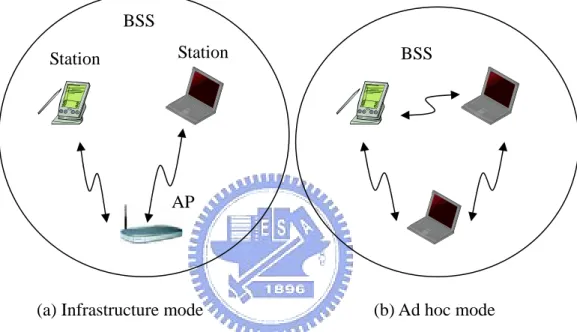
IEEE 802.11 is the most widely used standard for WLANs. It specifies two operation
modes:(1) the infrastructure and (2) the ad hoc, which are shown in Fig. 1. In the
infrastructure mode, when a station wants to communicate with others, it should communicate
with an access point (AP) first. The AP plays the role as a gateway to the Internet. Each basic
service set (BSS) includes one AP and some stations. In the ad hoc mode, the stations
communicate in a peer-to-peer manner. IEEE 802.11 provides two functions in the MAC
sublayer ─ PCF (Point Coordination Function) and DCF (Distributed Coordination
Function). The PCF is a centralized mechanism, where a point coordinator (PC) sends a
CF-Poll frame to each pollable station (STA) and allows it contention free to transmit frames.
2
mechanism and allows the station to contend to access the medium. In order to support quality
of service (QoS), the task group E of the IEEE 802.11 standardizes the MAC protocol,
donated IEEE 802.11e. IEEE 802.11e defines two MAC functions ─ Enhanced Distributed
Channel Access Function (EDCAF) and Hybrid Coordination Function (HCF), which are
extended from DCF and PCF, respectively. The HCF is suitable to the infrastructure network
and real time services, which will be described in Chapter 2.
Fig. 1: Two operation modes of IEEE 802.11.
1.2 Power Saving Issues in IEEE 802.11 MAC
Solutions to the power saving issues in the IEEE 802.11 MAC can be classified into two
categories: Power Management and Power Control.
1.2.1 Power Management
Power management techniques have been studied extensively in the context of CPU,
memory and disk management in the past. Similar ideas have been used in the context of
WLANs [1]. A wireless interface supports sleep, active, power-off and power saving modes. A
power management policy in WLANs needs to decide when a device switches its state
without degrading the performance of the device. An optimal power management scheme [2]
Station Station
BSS
AP
BSS
using the Markov Decision Process (MDP) approach to model the power tuning process was
compiled with the power saving mode (PS mode) deployed in IEEE 802.11 WLANs to reduce
unnecessary power consumption. In [1], the authors presented a mathematical abstraction of
time-out driven power management policies together with different wakeup mechanisms in
WLANs to characterize the energy-performance trade-offs. In [3], it set up multiple queues in
an AP buffer and used the AP to schedule the transmission sequence of buffered packets to
improve energy efficiency without degrading the response time of the system.
1.2.2 Power Control
Since power control is not our focus, only a brief introduction is given. A power control
policy is to vary the transmit power level to reduce power consumption. In [4], the proposed
power control MAC (PCM) can improve the energy saving of a basic scheme without
degrading network throughput. This is because the basic scheme uses different power levels
for RTS-CTS and DATA-ACK, which degrades network throughput and results in higher
power consumption. In [5], the authors presented a solution, called MINPOW, to provide a
globally optimal routing solution with respect to total power consumed.
1.3 Thesis Objective and Organization
In this thesis, we assume that all stations are operated in HCF mode for all voice
transmissions. We focus on power management in the infrastructure network. We propose a
power-efficient MAC protocol (PEP) that an AP maintains its polling list dynamically to
achieve power saving without sacrificing the throughput. This thesis is organized as follows.
In Chapter 2, the HCF mechanism and Brady speech model are overviewed. Two existing
polling approaches, the round-robin polling scheme and on-demand polling scheme, are
briefly reviewed and compared in Chapter 3. In Chapter 4, the design approach of our
proposed power saving scheme is described. In Chapter 5, we compare our scheme with other
4 describe the future work in Chapter 6.
Chapter 2
Preliminary
Our proposed scheme is based on the IEEE 802.11e HCF and for VoIP traffic. Therefore,
in this chapter, the HCF mechanism and two speech models are reviewed.
2.1 802.11e HCF Mechanism
The HCF provides stations with prioritized (EDCA) and parameterized (HCCA) QoS
support access to the wireless medium and it combines both contention-based channel access
(EDCA) and contention-free channel access (HCCA) [6]. All frames transmit during the
contention period (CP) or contention-free period (CAP).
2.1.1
EDCA [6][7]
In the CP, the contention channel access depends on the EDCA mechanism which is
based on the CSMA/CA algorithm. The traffic is mapped to four access categories (AC), as
shown in Table 1, in order to meet different QoS requirements. Each AC associated with a
prioritized queue. When the traffic requires lower transmission delay, the AC which has a
higher priority can be used. ACs use different Arbitration Inter-Frame-Space (AIFS) and
contention window sizes to contend for channel access. The value of AIFS is determined by
the following equation:
AIFS = AIFSN × aSlotTime + SIFS
where the value of AIFS Number (AIFSN) is an integer greater than zero and is
dependent on each AC.
It can be expected that the smaller AIFS a station has, the higher priority the station can have.
6
Fig. 2: The IFS relationships diagram of 802.11e EDCA [6].
Table 1: Four access categories and parameters [6].
Priority
Access
category
(AC)
CWmin CWmax AIFSN
AC_BK aCWmin aCWmax 7
AC_BE aCWmin aCWmax 3
AC_VI 2 1 min + aCW - 1 aCWmin 2 Lowest Highest AC_VO 2 1 min + aCW - 1 2 1 min + aCW - 1 2
2.1.2
HCCA [6][8][7]
The HCCA mechanism uses a centralized coordinator, called hybrid coordinator (HC).
The HC is a QoS access point (QAP). A QAP manages the access of the wireless medium and
allocates a transmission opportunity (TXOP) to a QoS station (QSTA). The HCCA
contention-free frame exchange with QSTAs. A QSTA sends a traffic request to the QAP
using the traffic specification (TSPEC). The TSPEC element is shown in Fig. 3. After the
QAP acknowledges the admission of this request, the QAP will poll the QSTA periodically,
allowing the QSTA to make transmission during the granted TXOP. A TXOP is an interval of
time when a particular QSTA has the right to initiate frame exchange sequences onto the
wireless medium (WM) and it is defined by a starting time and a maximum duration [6]. If the
QSTA has no frames to send or the MPDUs (MAC Protocol Data Units) are too long to be
sent under the specific TXOP limit, it will send a Null frame. MPDUs are partitioned from a
MSDU (MAC Service Data Unit), which is smaller than the original MSDU.
Element ID Length TS Info Nominal MSDU Maximum MSDU Minimum Service Maximum Service Inactivity Interval Suspension Interval 1 1 3 2 2 4 4 4 4 Service Start Time Minimum Data Rate Mean Data Rate Peak Data Rate Burst Size Delay Bound Minimum PHY Rate Surplus Bandwidth Allowance Medium Time 4 4 4 4 4 4 4 2 2
Fig. 3: The TSPEC element format [6].
2.2 Speech Models
2.2.1
Six-state Brady’s Speech Model [9][10]
This model consists of all scenarios, double-talk, mutual-silence, downlink-only and
uplink-only. The double-talk state indicates that the uplink and downlink are both talking. The
mutual-silence state indicates that the uplink and downlink are both silent. The downlink-only
state indicates that only the downlink is talking and the uplink is silent. The uplink-only state
indicates that only the uplink is talking and the downlink is silent. Fig. 4 shows the six-state
Brady’s model that illustrates the interaction between two speakers.
Octets:
8
Fig. 4: The Brady’s Speech model with two speakers A and B [10].
2.2.2
A Simple Two-State On-Off Speech Model
The six-state Brady’s model can be simplified to a two-state speech model. This speech
model is often used [11][12][13]. The two-state on-off speech model is shown in Fig. 5. This
speech model ignores events such mutual silence and double talk of the six-state Brady’s
model. User A alternates between the state of “talk-spurt” and “silence period”. The speech
model of our proposed approach is also based on this model.
Double Talk, B is interrupted
Mutual Silence, A Spoke Last
B Talks and A is Silent A and B are both Silent
A Talks, B Silent
A Talks and B is Silent A and B are both Talking
B Talks, A Silent Mutual Silence, B Spoke Last Double Talk, A is interrupted B talks B goes silent B talks B goes silent B talks A talks A goes silent A talks B goes silent A goes silent
Fig. 5: A simple two state on-off speech model [14]. User A
Talk-spurt
Silence period
10
Chapter 3
Related Work
In recent years, several researches focused on the capacity of VoIP over IEEE 802.11
WLANs. Shin et al. [15] proposed a dynamic PCF to improve the capacity of VoIP over
WLANs. It used a dynamic polling list to minimize the waste of bandwidth by sending
CF-Polls and Null packets when STAs have no packets to send. In 802.11 DCF, Wang et al.
[16] proposed a voice multiplex-multicast (M-M) scheme to overcome the large overhead of
VoIP over WLANs. This scheme combines several downlink data into one single packet. By a
single transmission of multicasting the multiplexed packet, each station can receive it by a
single transmission.
Some researches focused on power saving for VoIP over IEEE 802.11 WLANs. Chen et
al. [17] proposed Unscheduled Power Save Delivery (UPSD) to save power. They defined an
unscheduled service period, which allows a STA to transmit data continuously. At the end of a
period, the AP sets the more data bit to FALSE in the downlink frame, allowing the STA to go
to sleep. This scheme permits a lower duty cycle and provides better VoIP capacity than
legacy techniques. Wang et al. [18] used a power saving real-time gateway (POWSAR
gateway). The gateway was installed on the wired infrastructure and it filtered all traffic
towards a set of APs. It can improve the real-time and power saving performance of
compatible voice stations (VSs). With respect to integrating the cellular network and
VoWLAN, Huang et al. [19] implemented a cellular/VoWLAN dual mode service for
enterprises. VoWLAN is regarded as one of the killer applications, but it suffers from the
problem of limited coverage. The combination of cellular/VoWLAN has the advantage of low
cost of VoWLAN and high mobility of cellular systems. They also proposed power saving
802.11e HCF. Using on-demand polling (ODP) scheme, it supports integrated voice and data
service over WLAN. Their speech model is the four-state Brady’s Speech model. This scheme
reduces excess CF-Poll and Null frames in order to save power.
3.1 Existing Polling Schemes
3.1.1
The Round Robin Polling Scheme (RRP) [11]
The round-robin polling (RRP) scheme was adopted to schedule voice sources. The QAP
polls a QSTA according to its polling list, even if the QSTA doesn’t have any frame to send. It
may cause power waste due to sending excess CF-Poll and Null frames when QSTAs have no
frames to send, as shown in Fig. 6.
Fig. 6: An example of the RRP scheme [11].
3.1.2
The On-demand Polling Scheme (ODP) [9]
The on-demand polling (ODP) scheme maintains a polling list dynamically. The QAP
only keeps active QSTAs in its polling list. When a QSTA enters the silence period, the QAP
will remove it from the polling list. When QSTAs are initiating a talkspurt, they will use PIFS SIFS SIFS SIFS SIFS SIFS SIFS SIFS SIFS
Beacon QoS CF-Poll QoS CF-Poll QoS Null Data Data QoS Null ACK ACK TXOP 1 TXOP 2
Controlled Access Phase (CAP)
…..
QSTA 2 QSTA 1
QAP
12
higher access priority in EDCA to send voice frames for joining the polling list. When the
QAP receives two consecutive Null frames from a QSTA, the QSTA will be regarded as
entering the silence period. Fig. 7 depicts the operation of the ODP scheme, where a QSTA
was removed from the polling list if it entered the silence period. This scheme improves the
RRP scheme. Nevertheless, the ODP scheme still has a power waste problem due to some
excess CF-Poll and Null frames.
Fig. 7: An example of the ODP scheme [9].
3.1.3
Comparison of Existing Polling Schemes
We highlight the major differences among these existing polling schemes, including the
proposed PEP scheme in Table 2. Except the RRP scheme, the ODP and the PEP schemes
maintain a polling list dynamically. Therefore, the complexity of implementing of the ODP
and the PEP schemes is higher than the RRP scheme. The PEP scheme consumes less power
than the others, without reducing the throughput. In Chapter 4, we will describe the PEP
scheme in detail.
PIFS SIFS SIFS SIFS SIFS
Beacon QoS CF-Poll QoS CF-Poll QoS Null QoS Null TXOP 2 TXOP 2
Controlled Access Phase (CAP)
….. PIFS Beacon .... .... .... Contention Period (CP) ….. QSTA 2 QSTA 2 QSTA 1 QAP QSTA QSTA 1
Table 2: Comparison of the three polling schemes. Scheme Round-robin polling (RRP) scheme [11] On-demand polling (ODP) scheme [9] Power-efficient polling (PEP) scheme (Proposed) Characteristics of polling scheme
Static Dynamic Dynamic
Complexity of
implementation
Easy Medium Medium
Normalized power
consumption
Highest Medium Lowest
Aggregate
throughput
Higher Lower
Slightly lower than
RRP
Average
end-to-end delay
14
Chapter 4
Design Approach
4.1 Basic Idea
We propose a power-efficient polling (PEP) scheme to improve the ODP scheme. The
IEEE 802.11e standard [6] defines the MAC frame format, as shown in Fig. 8. We will use the
QoS control field for power saving purpose. The QoS control field is used to identify which
traffic stream (TS) or traffic category (TC) a frame belongs to. A TS is defined as a set of
MAC service data units (MSDUs) to be delivered subject to the QoS parameter values
provided to the MAC in a particular TSPEC. A TC is defined as a label for MSDUs that has a
distinct user priority (UP). Each QoS control field contains five subfields that identify the
sender frame type and subtype. These subfields are shown in Table 3. The TID subfield
identifies a TC or TS to which the corresponding MSDU in the Frame Body field belongs.
The EOSP (end of service period) subfield is used by the HC to indicate the end of the current
service period. The Ack policy identifies the acknowledgement policy.
Fig. 8: MAC frame format [6].
We will use the queue size subfield in the QoS control field. The queue size subfield
indicates the amount of buffered traffic for a given TC or TS at the QSTA sending a MAC
frame. A QSTA can request a TXOP by setting the queue size. If this field is set to zero, it
represents that no buffered traffic in the QSTA’s queue. We suppose if this field is set to zero,
a QSTA may have no frames to send when it enters the CAP again. When the QSTA have no
Octets:2 2 6 6 6 2 6 2 0-23124 4
Frame Control
Duration ID
Address 1 Address 2 Address 3
Sequence Control Address 4 QoS Control Frame Body FCS MAC Header
frame to send or the size of the frame exceeds the given TXOP limit, the QSTA will send a
Null frame to the QAP.
Applicable frame
(sub) types Bits 0-3 Bit 4 Bits 5-6 Bit 7 Bits 8-15 QoS (+) CF-Poll frames
sent by HC TID EOSP Ack policy Reserved TXOP limit QoS Data, QoS Null, and
QoS Data + CF-Ack frames sent by HC
TID EOSP Ack policy Reserved QAP PS buffer state
TID 0 Ack policy Reserved TXOP duration requested QoS data type frames
sent by non-AP QSTAs
TID 1 Ack policy Reserved Queue size
In our proposed scheme, as shown in Fig. 9, non-real time data traffic is only transmitted
during EDCA. When a QAP accepts a new voice call from a QSTA, the QAP will add the
QSTA to the polling list. Then the QAP in HCCA will periodically poll a QSTA according to
the polling list and wait for transmission of uplink voice packets. The QAP will check the
Null frame from the QSTA if the queue size field in the QoS control field is set to zero. The
QAP will remove a QSTA from the polling list if this field is set to zero and the TXOP is not
used up. When a removed QSTA starts to talk, it will use a higher access priority in EDCA to
send a voice packet for joining the polling list. The proposed scheme makes sure that QSTAs
in the polling list have frames to send. It avoids unnecessary waste of CF-Poll and Null
frames and achieves the goal of power saving.
16
Fig. 9: An example of the PEP scheme.
4.2 A Heuristic Method for Prediction Accuracy
Enhancement
In order to predict silent QSTAs correctly, we add a heuristic method of allocated TXOP
to the PEP polling scheme. According to the concept of six-state Brady’s speech model and
the speech behavior in the real world, we set a criterion for removing QSTAs from the polling
list. We first define the utilization of allocated TXOP for a QSTA.
where allocated TXOP means the TXOP assigned for a QSTA by the QAP.
Remaining TXOP means the portion of a given TXOP that is not used up by the QSTA.
By simulations, we derived the following rules:
allocated TXOP – remaining TXOP
Utilization = × 100% allocated TXOP
PIFS SIFS SIFS SIFS SIFS PIFS
Beacon QoS CF-Poll QoS Null Data ACK TXOP 1
Controlled Access Phase (CAP)
….. QAP QSTA QSTA 1 QSTA 2 .... Beacon .... Contention Period (CP) CAP .... QSTA 1 QSTA 2
(1). Utilization of allocated TXOP < 20%
In this case, we assume that it is in the downlink-only state which represents one station
seldom talks. The QSTA will be removed from the polling list immediately. It represents that
the QSTA seldom talks.
(2). 20% ≦ Utilization of allocated TXOP ≦ 70%
In this case, we assume that it is in the mutual-talk state which is between the
uplink-only state and downlink-only state. The QSTA won’t be removed from the polling list
at the moment. If this situation happens in two consecutive beacon intervals, the QSTA will be
removed from the polling list.
(3). Utilization of allocated TXOP > 70%
In this case, we assume that it is in the uplink-only state which represents that one
station always talks. The QSTA won’t be removed from the polling list at the moment. If this
situation happens in three consecutive beacon intervals, the QSTA will be removed from the
polling list.
4.3 The Operation of the PEP Scheme
Fig. 10 depicts the operation of the PEP scheme. When sending a Beacon frame by a
QAP, the CAP begins. If it is not the end of the CAP, the QAP will send a CF-Poll to a QSTA
in the polling list. The QSTA will send a QoS Null frame to the QAP after its transmission end.
The QAP will check if the queue size of the QoS Null frame is zero and calculate the
utilization of allocated TXOP of this QSTA. By the three rules described in the last sec`tion,
the QAP will make a decision whether or not to remove the QSTA from the polling list. When
the CAP ends, the CP follows. If it is not the end of the Beacon interval, all QSTA can
transmit data based on the CSMA/CA mechanism. If the QAP received a voice packet sent by
18
Fig. 10: The flowchart of the PEP scheme.
20% ≦Utilization ≦ 70% ?
Remove the QSTA from the polling list and the counter set 0 Send QoS NULL frame Beacon start CAP end ? Send CF-Poll to a QSTA Have data to transmit ?
Wait until current transmission end Is queue size = 0 ? Utilization < 20% ? Is the counter = 1 ? Utilization > 70% The counter is incremented Is the counter = 2 ? Beacon end ? Transmitting data based on CSMA/CA Is a voice packet ? Add to the polling list All transmissions finish ?
During CAP During CP
Yes No Yes No Yes No Yes No Yes No Yes Yes No No Yes No Yes No Yes No Calculate the utilization of allocated TXOP
Chapter 5
Simulation and Discussion
5.1 Simulation Model
For evaluation, we used the ns-2 simulator [20]. Simulation parameters are showed in
Table 4 and the values of PHY-related parameters were from [9]. The length of a beacon
interval is 20 ms. We used the G.723.1A codec with a payload of 20 bytes for our simulation
[15]. Each station generates variable-bit-rate (VBR) traffic according to the two-state on-off
speech model [11][12]. We also used the parameters specified in [12] to set time to
“talk-spurt” = 1 sec and time to “silence period” = 1.35 sec. In other words, the percentage of
time spent in the talking state is 43% and the percentage of time spent in the silence state is
57%. Three performance metrics ─ normalized power consumption (%), aggregate
throughput (Kb/sec) and average end to end delay (msec) ─ have used to evaluate the merits
of each scheme. We simulated and compared the round-robin polling scheme (RRP), the
20
Table 4: Simulation parameters.
Parameter Value
Duration of the superframe 20 ms
Voice coding rate in bps 5.3 K
Transmission rate in bits/sec 11 M
MAC header (QoS data type) in bits 30 x 8
Header overheads (IP+UDP+RTP) in bits 40 x 8
Physical overhead in seconds (including preamble length and header length)
192 µs
Beacon size in bit 40 x 8
SIFS 10 µs
PIFS 30 µs
Slot time 20 µs
5.2 Simulation Results and Discussion
We compare our PEP with the RRP and ODP quantitatively. Fig. 11 shows the
normalized power consumption versus the number of voice stations. The normalized power
consumption is defined as the percentage of a voice QSTA that is in active mode during a
superframe [9]. We can see that the PEP scheme consumes less power than the RR and ODP
schemes. The power consumption of the ODP and PEP schemes increased with the number of
voice stations, which is due to the increased mean contention time. The PEP scheme
outperforms the RR and ODP schemes by a margin of 24.5% to 37.1% and 12.9% to 15.1%,
respectively. . 0.51 0.71 0.91 1.11 1.31 1.51 1.71 1.91 2.11 1 3 5 7 9 11 13 15 17 19 21 23 25
Numbe r of voice stations
N o r m a li z e d po w e r c o ns umpt io n ( % ) RRP ODP PEP
Fig. 11: Normalized power consumption of voice stations.
In Fig. 12, we can see that the aggregate throughputs of three schemes are very close.
The aggregate throughput is computed by summarizing the throughput of all connection flows.
The aggregate throughput of the PEP scheme is slightly higher than that of the ODP scheme,
but is slightly lower than that of the RRP scheme. This represents that the PEP scheme can
22 0 10 20 30 40 50 60 70 80 90 1 3 5 7 9 11 13 15 17 19 21 23 25 Numbe r of voi c e st a t i ons
A ggr e ga te t hr oughput ( K b/ se c ) RRP ODP PEP
Fig. 12: Aggregate throughput of voice stations.
We also measured the average end-to-end delay of voice stations. The average end to end
delay is computed by summarizing the end to end delay of all connection flows and averaging
it. If a removed QSTA has packets to send, it will be a penalty that the delay of this QSTA will
increase. In Fig. 13, we observe that the RRP scheme has lower average end-to-end delay than
the other two schemes, because the RRP scheme will not remove a QSTA from the polling list.
The average end-to-end delay of the PEP scheme is slightly higher than that of the RRP
scheme, but is lower than that of the ODP scheme. This is because the prediction accuracy of
the PEP scheme is higher than that of the ODP scheme.
0 0.05 0.1 0.15 0.2 0.25 0.3 0.35 0.4 0.45 1 3 5 7 9 11 13 15 17 19 21 23 25 Numbe r of voi c e st a t i ons
A ve ra ge e nd to e nd de la y (m se c ) RRP ODP PEP
Chapter 6
Conclusions and Future Work
6.1 Concluding Remarks
In this thesis, we have presented a power-efficient polling (PEP) scheme for VoIP traffic
over IEEE 802.11e HCF. A QAP can maintain its polling list dynamically. This scheme will
reduce the unnecessary polling of silent QSTAs to achieve power saving by checking the
queue size field in the Null frame that a QSTA sends to the QAP and the utilization of
allocated TXOP. To increase the prediction accuracy of a QSTA entering the silence period,
we have also added a heuristic method to evaluate the utilization of allocated TXOP in the
PEP scheme. Simulation results have shown that the PEP scheme in terms of the normalized
power consumption outperforms the RRP and ODP schemes from 24.5% to 37.1% and from
12.9% to 15.1%, respectively, without sacrificing the aggregate throughput.
6.2 Future Work
In our proposed PEP scheme, the thresholds of the utilization of allocated TXOP were
derived from simulations. A more systematic way of deriving such thresholds deserves to
further study. In addition to voice traffic, video traffic is also an important category of real
time traffic, but the characteristics of these two types of traffic are different. Voice traffic is
delay-sensitive, while video traffic can be buffered and then played. The future work is to
consider both voice traffic and video traffic to further investigate power efficiency techniques
24
Bibliography
[1] Rong Zheng, J.C Hou. and Lui Sha, “On time-out driven power management policies in
wireless networks”, in Proc. IEEE GLOBECOM, Nov.-Dec. 2004, vol. 6.
[2] Huan Chen and Chen-Wei Huang, “Power management modeling and optimal policy for
IEEE 802.11 WLAN systems”, in Proc. IEEE VTC, Sept. 2004, vol. 6, pp. 4416-4421.
[3] H. Lei and A.A Nilsson, “A power management scheme for the IEEE 802.11 based
WLANs”, in Proc. IEEE IPCCC, April 2005, pp. 123-127.
[4] Eun-Sun Jung and Nitin H. Vaidya, “A power control MAC protocol for ad hoc networks”,
in Proc. ACM Mobile Computing and Networking, 2002, pp. 36-47.
[5] Vikas Kawadia and P.R. Kumar, “ Power control and clustering in ad hoc networks”, in
Proc. IEEE INFOCOM, March-April 2003, vol. 1, pp. 459-469.
[6] IEEE std. 802.11e, Medium Access Control (MAC) Enhancements for Quality of Service
(QoS), http://standards.ieee.org/catalog/olis/new.html
[7] L. Yang, “Enhanced HCCA for real-time traffic with QoS in IEEE 802.11e based
networks”, in Proc. IEEE Intelligent Environments, June 2005, pp. 203-209.
[8] L.W. Lim, R. Malik, P.Y. Tan, C. Apichaichalermwongse and K. Ando and Y. Harada, “A
QoS scheduler for IEEE 802.11e WLANs”, in Proc. IEEE CCNC, Jan. 2004, pp. 199-204.
[9] Chih-Yung Shih, Yih-Shen Chen, Ray-Guang Cheng and Chung-Ju Chang, “A
power-efficient MAC protocol for integrated voice and data services over 802.11e HCF,”
in Proc. IEEE Vehicular Technology Conference, 2004.
[10] Harold P. Stern, Samy A. Mahmoud and Kin-Kwok Wong, “A comprehensive model for
voice activity in conversational speech—development and application to performance
analysis of new-generation wireless communication systems”, in ACM Wireless Networks,
[11] M. Veeraraghavan, N. Cocker and T. Moors, “Support of voice services in IEEE 802.11
wireless LANs”, in Proc. IEEE INFOCOM, 2001, vol. 1, pp. 488–497.
[12] M.A. Visser and M. El Zarki, “Voice and data transmission over an 802.11 wireless
network”, in Proc. IEEE Personal, Indoor and Mobile Radio Communications, Sept. 1995,
vol. 2, pp. 648–652.
[13] S. Nanda, D.J. Goodman and U. Timor, “Performance of PRMA: a packet voice
protocol for cellular systems”, in the IEEE Transactions on Vehicular Technology, Aug.
1991, vol. 40, pp. 584-598.
[14] P.M. Fiorini, “Voice over IP (VoIP) for enterprise networks: performance implications &
traffic models”, [Online]. Avaliable:
http://www.bmc.com/offers/performance/whitepapers/docs/2000/voice_over_ip_pm.pdf.
[15] T. Kawata, S. Shin, A.G. Forte and H. Schulzrinne, “Using dynamic PCF to improve the
capacity for VoIP traffic in IEEE 802.11 networks,” in Proc. IEEE Wireless
Communications and Networking Conference, 2005.
[16] Wei Wang, Soung Chang Liew, and V.O.K Li, “Solutions to performance problems in
VoIP over a 802.11 wireless LAN,” in the IEEE Transactions on Vehicular Technology,
Jan. 2005, vol. 54, pp. 366 - 384.
[17] Y. Chen, N. Smavatkul and S. Emeott, “Power management for VoIP over IEEE 802.11
WLAN,” in Proc. IEEE Wireless Communications and Networking Conference, 2004,
vol.3, pp. 1648 - 1653.
[18] Xiaofan Wang, T.D. Todd, D. Zhao and V. Kezys, “Power saving gateways for real-time
voice handset support in IEEE 802.11 wireless LANs,” in Proc. IEEE Communications
Conference, June 2004, vol 1, pp.164–169.
[19] Chung-Huei Huang, Chih-Chien Hsu, Li-Wei Huang, Pang-Hsiang Lo, You-Lin Chen
and Shiao-Li Tsao, “The design and implementation of cellular/VoWLAN dual mode
26
![Table 1: Four access categories and parameters [6].](https://thumb-ap.123doks.com/thumbv2/9libinfo/7642617.138161/17.892.181.756.551.916/table-four-access-categories-and-parameters.webp)
![Fig. 3: The TSPEC element format [6].](https://thumb-ap.123doks.com/thumbv2/9libinfo/7642617.138161/18.892.115.766.466.751/fig-the-tspec-element-format.webp)
![Fig. 4: The Brady’s Speech model with two speakers A and B [10].](https://thumb-ap.123doks.com/thumbv2/9libinfo/7642617.138161/19.892.163.768.158.686/fig-brady-s-speech-model-speakers-b.webp)
![Fig. 5: A simple two state on-off speech model [14]. User A](https://thumb-ap.123doks.com/thumbv2/9libinfo/7642617.138161/20.892.298.666.130.367/fig-simple-state-speech-model-user.webp)
![Fig. 6: An example of the RRP scheme [11].](https://thumb-ap.123doks.com/thumbv2/9libinfo/7642617.138161/22.892.155.768.540.852/fig-example-rrp-scheme.webp)
![Fig. 7: An example of the ODP scheme [9].](https://thumb-ap.123doks.com/thumbv2/9libinfo/7642617.138161/23.892.166.731.360.769/fig-example-odp-scheme.webp)
![Table 2: Comparison of the three polling schemes. Scheme Round-robin polling (RRP) scheme [11] On-demand polling (ODP) scheme [9] Power-efficient polling (PEP) scheme (Proposed) Characteristics of polling scheme](https://thumb-ap.123doks.com/thumbv2/9libinfo/7642617.138161/24.892.153.788.125.714/comparison-polling-schemes-scheme-efficient-proposed-characteristics-polling.webp)
![Fig. 8: MAC frame format [6].](https://thumb-ap.123doks.com/thumbv2/9libinfo/7642617.138161/25.892.114.804.769.870/fig-mac-frame-format.webp)
![Table 3: QoS control field [6].](https://thumb-ap.123doks.com/thumbv2/9libinfo/7642617.138161/26.892.143.794.236.515/table-qos-control-field.webp)
