Received on December 17, 2005. 1154-1010 $03.50 © Dynamic Publishers, Inc.
Multipurpose Image Watermarking Method Based
on Mean-removed Vector Quantization
Zhe-Ming Lu1*, Wei-Min Zheng2, Jeng-Shyang Pan3 and Zhen Sun 41 Harbin Institute of Technology Shenzhen Graduate School, Visual Information Analysis and Processing Research Center,
Room 417,Building No.4,HIT Campus Shenzhen University Town, Xili,Shenzhen 518055 P.R.China. (*corresponding author)
2 Chinese Academy of Sciences, Institute of Computing Technology,
Beijing 100080, P. R. China
3 National Kaohsiung University of Applied Sciences, Department of Electronic Engineering,
Kaohsiung 807, Taiwan
4 Harbin Institute of Technology, Department of Automatic Test and Control,
P. O. Box 339, Harbin 150001, P. R. China
Abstract: Digital watermarking technique has been presented and widely researched to solve some important issues in the digital world, such as copyright protection, copy protection, and content authentication. Conventional watermarking algorithms are mostly based on discrete cosine transform (DCT), discrete Fourier transform (DFT), and discrete wavelet transform (DWT). Most of these algorithms are designed for only one purpose. In recent years, some multipurpose digital watermarking methods based on DWT and DFT have been presented to achieve the goal of both content authentication and copyright protection. Lately, several robust watermarking schemes based on vector quantization (VQ) have been presented, but they can be used only for copyright protection. In this paper, we present a novel multipurpose digital image watermarking method based on a mean-removed vector quantizer (MRVQ) structure. In the proposed method, the fragile watermark and the robust watermark are embedded in mean indices and residual indices using different techniques, and both of them can be blindly extracted. Simulation results demonstrate the effectiveness of our algorithm in terms of robustness and fragility.
Keywords: Copyright protection, fragile watermarking, image authentication, mean-removed vector quantization, multipurpose watermarking, robust watermarking.
1. Introduction
The explosive growth of digital multimedia techniques, together with the rapid development of digital network communications, has created a pressing demand for techniques that can be used for copy protection, copyright protection, and content authentication. Conventional cryptographic systems permit only valid keyholders access to encrypted data, but once such data are decrypted there is no way to track its reproduction or retransmission. Over the last decade, digital watermarking has been presented to complement cryptographic processes. Digital watermarking is a technique to insert a secret signal (i.e., a watermark) in digital data (namely audio, video or a digital image), which
enables one to establish ownership or identify a buyer. In general, there are two types of digital watermarks addressed in the existing literature, visible and invisible watermarks. A visible watermark typically contains a visible message or a company logo indicating the ownership of the image. On the other hand, the invisibly watermarked digital content appears visually very similar to the original.
Most of existing invisible watermarking schemes are designed for either copyright protection or content authentication. Invisible watermarks can be broadly classified into two types, robust and fragile watermarks. Robust watermarks [1]-[6] are generally used for copyright protection and ownership verification because they are robust to nearly all kinds of image processing operations. In comparison, fragile watermarks [7]-[10] are mainly applied to content authentication and integrity attestation because they are completely fragile to any modifications. To fulfill multipurpose applications, several multipurpose watermarking algorithms based on wavelet transform [11] and fast Fourier transform [12] have been presented. In [11], watermarks are embedded once in the hiding process and can be blindly extracted for different applications in the detection process. In addition to images (gray-scale and color), this method has been extended to audio watermarking [12]. It should be addressed that, unlike multipurpose watermarking, multiple or cocktail watermarking methods [13], [14] are mainly applied to copyright protection by embedding multiple robust watermarks, each one being robust to certain kinds of attacks. Recently, some robust image watermarking techniques based on vector quantization (VQ) [15]-[21] have been presented. References [15]-[18] embed the watermark information into the encoded indices under the constraint that the extra distortion is less than a given threshold. Reference [19] embeds the watermark bit in the dimension information
Sun
of the variable dimension reconstruction blocks of the input image. References [20], [21] embed the watermark information by utilizing the properties, such as mean and variance, of neighboring indices. In this paper, we present a novel multipurpose watermarking method based on mean-removed vector quantization. In the proposed algorithm, the robust watermark is embedded in the quantized mean indices by using the embedding method presented in [20], and the fragile watermark is embedded in the residual codeword indices by using a novel index constrained method.
The remainder of this paper is organized as follows. In Section 2, previous VQ-based watermarking algorithms are reviewed. In Section 3, the proposed multipurpose watermarking method is described in detail. The simulation results and conclusions are given in Section 4 and Section 5, respectively.
2. Previous
VQ-based
Watermarking
Algorithms
2.1 Vector quantization
VQ is an efficient block-based lossy image compression technique with a high compression ratio and a simple table lookup decoder. VQ can be defined as a mapping from
k-dimensional Euclidean space Rk into a finite codebook
C={ci| i=0, 1,…,N-1}, where ci is called a codeword and N is the codebook size. Before online encoding, VQ first generates a representative codebook offline from a number of training vectors using the well-known GLA algorithm [22]. In image vector quantization, the image to be encoded is first segmented into vectors and then sequentially encoded vector by vector. In the encoding stage, for each k-dimensional input vector x=(x1, x2,…, xk), we find the nearest neighbor
codeword ci = (ci1,ci2,…, cik) in the codebook
C={c0,c1,…cN-1}, which satisfies the following condition:
)
,
(
min
)
,
(
1 0 j ix
c
c
x
d
d
N-j≤ ≤=
(1) Where d(x, cj) is the distortion between the input vector x and the codeword cj, which can be defined as follows∑
=−
=
k l jl lc
x
d
1 2)
(
)
,
(
x
c
j (2) And then the index i of the nearest neighbor codeword assigned to the input vector x is transmitted over the channel to the decoder. The decoder has the same codebook as the encoder. In the decoding phase, for each index i, the decoder merely performs a simple table look-up operation to obtain ci and then uses ci to reconstruct the input vector x. Compression is achieved by transmitting or storing the index of a codeword rather than the codeword itself.2.2 Watermarking algorithms based on codebook
partition
The main idea of the VQ-based digital watermarking schemes presented in [15]-[18] is to carry secret copyright information by codeword indices. The aim of the codebook partition is to
classify the neighboring codewords into the same cluster. Given a threshold D>0, we denote by S={S1,S2,…,SM} a
standard partition of the codebook C={c0,c1,…,cN-1} for the threshold D, if S satisfies the following four conditions:
1)
U
M i iS
S
1 ==
; 2)∀
i, j,1≤
i, j≤
M, if i≠
j, thenS
iI
S
j=
Φ
; 3)∀
i, 1≤
i≤
M, if cl∈
Si and cj∈
Si (0≤
l, j≤
N-1), then d(cl, cj)≤
D; 4)2
n(i) iS
=
. WhereS
i denotes the number ofcodewords in Si and n(i) is a natural number.
Before the embedding process, the original image is first divided into blocks. For each block, the index of the best match codeword is found. The watermarked codeword index is then obtained by modifying the original codeword index according to the corresponding watermark bits. The modification is under the constraint that the modified index and the original one is in the same partition such that the introduced extra distortion is less than the given distortion threshold. In the decoding phase, not the original but the watermarked codeword is used to represent the input image block. Therefore, the VQ-based digital image watermarking will introduce some extra distortion. Whether the original image is required or not during the watermark extraction is dependent on the embedding method. In these algorithms, the codebook is open for users but the partition is the secret key. Experimental results show that these algorithms are robust to VQ compression with high-performance codebooks, JPEG compression and some spatial image processing operations. However, these algorithms are fragile to rotation operations and VQ compression with low-performance codebooks.
2.3 Watermarking algorithms based on index
properties
To enhance the robustness to rotation operations and VQ compression operations, some image watermarking algorithms [20], [21] based on the properties of neighboring indices have been proposed. In [20], the original watermark W with size Aw×Bw is first permuted by a predetermined key,
key1, to generate the permuted watermark WP for embedding. The original image X with size A×B is then divided into vectors x(h,l) with size (A/Aw)×(B/Bw), where x(h,l) denotes
the image block at the position of (h,l). After that, each vector x(h,l) finds its best codeword ci in the codebook C and the index i is assigned to x(h,l), we can then obtain the indices matrix Y with elements y(h,l), which can be represented by
U U
U U
1 0 1 0 1 0 1 0)
,
(
))
,
(
VQ(
)
VQ(
− = − = − = − ==
=
=
w w Aw w A h B B l A A h B B ll
h
y
l
h
x
X
Y
(3) For natural images, the VQ indices among neighboring blocks tend to be very similar, so we can make use of this property to generate the polarities P. After calculating the
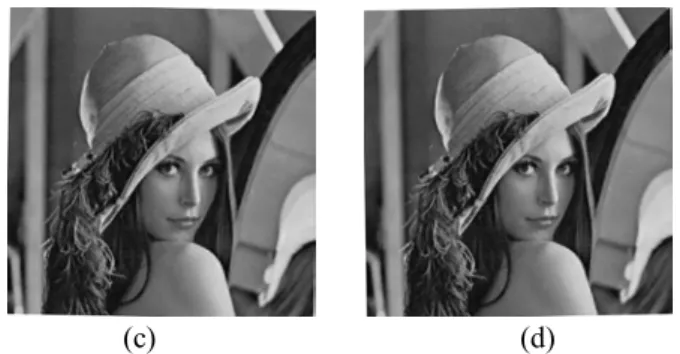
(c) (d)
Figure 15. The rotated watermarked images. (a) Rotation by 0.5o in the clockwise direction. (b) Rotation by 0.5o in the
counter-clockwise direction. (c) Rotation by 1o in the clockwise direction. (d) Rotation by 1o in the
counter-clockwise direction.
(a) (b) (c) (d)
(e) (f) (g) (h) Figure 16. The watermarks extracted from rotated watermarked images. (a) The robust watermark extracted
from Fig. 15(a), NHS=0.69. (b) The fragile watermark extracted from Fig. 15(a), NHS=0.13. (c) The robust watermark extracted from Fig. 15(b), NHS=0.69. (d) The fragile watermark extracted from Fig. 15(b), NHS=0.14. (e) The robust watermark extracted from Fig. 15(c), NHS=0.61.
(f) The fragile watermark extracted from Fig. 15(c), NHS=0.15. (g) The robust watermark extracted from Fig. 15(d), NHS=0.61. (h) The fragile watermark extracted from
Fig. 15(d), NHS=0.13.
Acknowledgment
This work was supported by the National Natural Science Foundation of China under grant 60272074 and Program for New Century Excellent Talents in University of China under grant NCET-04-0329 and Foundation for the Author of National Excellent Doctoral Dissertation of P. R China (No. 2003027).
References
[1] J. J. K. O'Ruanaidh, W. J. Dowling and F. M. Boland. “Watermarking Digital Images for Copyright Protection”, IEE Proceedings-Vision, Image and Signal
Processing, 143 (4), pp. 250-256, 1996.
[2] I. J. Cox, J. Kilian, F. T. Leighton and T. Shamoon. “Secure Spread Spectrum Watermarking for Multimedia”, IEEE Transactions on Image Processing, 6 (12), pp. 1673-1687, 1997.
[3] M. D. Swanson, Z. Bin and A. H. Tewfik. “Multiresolution Scene-based Video Watermarking
Using Perceptual Models”, IEEE Journal on Selected
Areas in Communications, 16 (4), pp. 540-550, 1998.
[4] G. Voyatzis and I. Pitas. “The Use of Watermarks in the Protection of Digital Multimedia Products”,
Proceedings of the IEEE, 87 (7), pp. 1197–1207, 1999.
[5] S. Pereira and T. Pun. “An Iterative Template Matching Algorithm Using the Chirp-Z Transform for Digital Image Watermarking”, Pattern Recognition, 33(1), pp. 173-175, 2000.
[6] Y. Wang, J. F. Doherty and R. E. Van Dyck. “A Wavelet-based Watermarking Algorithm for Ownership Verification of Digital Images, IEEE Transactions on
Image Processing, 11(2),pp. 77-88, 2002.
[7] P. S. L. M. Barreto, H. Y. Kim and V. Rijmen. “Toward Secure Public-key Blockwise Fragile Authentication Watermarking”, IEE Proceedings- Vision, Image and
Signal Processing, 149(2), pp. 57-62, 2002.
[8] M. U. Celik, G. Sharma, E. Saber and A. M. Tekalp. “Hierarchical Watermarking for Secure Image Authentication with Localization”, IEEE Transactions
on Image Processing, 11 (6), pp. 585-595, 2002.
[9] L. Jaejin and S. W. Chee. “A Watermarking Sequence Using Parities of Error Control Coding for Image Authentication and Correction”, IEEE Transactions on
Consumer Electronics, 46(2), pp. 313-317, 2000.
[10] D. Kundur and D. Hatzinakos. “Digital Watermarking for Telltale Tamper Proofing and Authentication”,
Proceedings of the IEEE, 87 (7), pp. 1167-1180, 1999.
[11] C. S. Lu and H.Y.M. Liao. “Multipurpose Watermarking for Image Authentication and Protection”, IEEE
Transactions on Image Processing, 10 (10), pp.
1579-1592, 2001.
[12] C. S. Lu, H. Y. M. Liao and L. H. Chen. “Multipurpose Audio Watermarking”. In Proc. 15th Int. Conf. Pattern
Recognition, vol. 3, pp. 282-285, 2000.
[13] C. S. Lu, S. K. Huang, C. J. Sze and H. Y. M. Liao. “Cocktail Watermarking for Digital Image Protection”,
IEEE Transactions on Multimedia, 2 (4), pp. 209-224,
2000.
[14] C. Busch and S. D. Wolthusen. “Tracing Data Diffusion in Industrial Research with Robust Watermarking”. In 2001 IEEE Fourth Workshop on Multimedia Signal
Processing, pp. 207-212, 2001.
[15] Z. M. Lu and S. H. Sun. “Digital Image Watermarking Technique Based on Vector Quantisation”, Electronics
Letters, 36 (4), pp. 303-305, 2000.
[16] Z. M. Lu, J. S. Pan and S. H. Sun. “VQ-based Digital Image Watermarking Method”, Electronics Letters, 36 (14), pp. 1201-1202, 2000.
[17] Z. M. Lu, C. H. Liu and S. H. Sun. “Digital Image Watermarking Technique Based on Block Truncation Coding with Vector Quantization”, Chinese Journal of
Electronics, 11 (2), pp. 152-157, 2002.
[18] J. Minho and K. HyoungDo. “A Digital Image
Watermarking Scheme Based on Vector Quantisation”,
IEICE Trans. Information and Systems, E85-D (6), pp.
1054-1056, 2002.
[19] A. Makur and S. S. Selvi. “Variable Dimension Vector Quantization Based Image Watermarking”, Signal
Sun
[20] H. C. Huang, F. H. Wang and J. S. Pan. “A VQ-based Robust Multi-watermarking Algorithm”, IEICE
Transactions on Fundamentals, E85-A (7), pp.
1719-1726, 2002.
[21] H. C. Huang, F. H. Wang and J. S. Pan. “Efficient and Robust Watermarking Algorithm with Vector Quantisation”, Electronics Letters, 37 (13), pp. 826-828, 2001.
[22] Y. Linde, A. Buzo and R. M. Gray. “An Algorithm for Vector Quantizer Design”, IEEE Transactions on
Communications, 28 (1), 84-95, 1980.
[23] Z. M. Lu, J. S. Pan and S. H. Sun. “Efficient Codeword Search Algorithm Based on Hadamard Transform”,
Electronics Letters, 36 (16), pp. 1364-1365, 2000.
Author Biographies
Zhe-Ming Lu was born in Zhejiang Province, China, in 1974. He received the
B.S. and M.S. degrees in electrical engineering and the Ph.D. degree in measurement technology and instrumentation from the Harbin Institute of Technology (HIT), Harbin, China, in 1995, 1997, and 2001, respectively. He became a Lecturer with HIT in 1999. Since 2003, he has been a Professor with the Department of Automatic Test and Control, HIT. He has published more than 110 papers and two books (in Chinese). He also participated in a chapter entitled “Watermarking Based on Vector Quantization” in the book Intelligent Watermarking Techniques by J. S. Pan, H.-C. Huang, and L. C. Jain (editors) (Singapore: World Scientific, 2004). His current research interests include speech coding, image processing, and information security.
Wei-Min Zheng was born in Zhejiang Province, China, in 1971. He received
the B. S. degree in Electrical & Electronic Engineering in Harbin University of Science and Technology, Harbin, China, in 1993. He received the Ph.D. degree in Testing and Metering Technology and Instrumentation in Harbin Institute of Technology, Harbin, P. R. China, in 2001. Since 2001, he has been engaged in the research and development of Computer Hardware (Godson CPU and its Motherboard) and System-On-Chip Design. He has more than 2 years Practical Experiences on Computer Hardware Architecture and more than 5 years Practical Experiences on Testing and Metering Technology and Instrumentation, and more than 10 years Practical Experiences on Hardware system PCB design and debugging. His current research interests include computer architectures and digital watermarking.
Jeng-Shyang Pan received the B. S. degree in Electronic Engineering from the
National Taiwan University of Science and Technology, Taiwan in 1986, the M. S. degree in Communication Engineering from the National Chiao Tung University, Taiwan in 1988, and the Ph.D. degree in Electronic Engineering from the University of Edinburgh, U.K. in 1996. He became a Member (M) of IEEE in 2003. Currently, he is a Professor in the Department of Electronic Engineering, National Kaohsiung University of Applied Sciences, Taiwan. Professor Pan has published more than 45 international journal papers and 80 conference papers. His current research interests include data mining, information security and image processing.