The Contribution of DNA Apurinic/apyrimidinic Endonuclease
Genotype and Smoking Habit to Taiwan Lung Cancer Risk
Wei-Chun Chen1,2,3,*, Chia-Wen Tsai2,4,*, Te-Chun Hsia1,2,3*, Wen-Shin Chang2,5, Liang-Yi Lin2, Shinn-Jye Liang1, Chih-Yen Tu1,2, Wei-Erh Cheng1, Hung-Jen Chen1, Shu-Ming Wang2, Da-Tian Bau2,3,4
1Department of Internal Medicine and 2Terry Fox Cancer Research Laboratory, China Medical University Hospital, Taichung; 3Department of Respiratory Therapy and Graduate Institutes of 4Basic Medical Science and 5Clinical Medical Science, China Medical University, Taichung, Taiwan, R.O.C.
Correspondence to: Da-Tian Bau, Terry Fox Cancer Research Lab, China Medical University Hospital, 2 Yuh-Der Road, Taichung, 404 Taiwan, P.R.C. Tel: +886 422053366 Ext 3312, Fax: +886 422053366 Ext 1511, e-mail: [email protected]; [email protected]
Abstract
To evaluate the association and interaction among APEX1/Ref-1 (the gene for DNA-apurinic/apyrimidinic endonuclease) genotypic polymorphism, personal smoking habit and lung cancer risk in Taiwan, the polymorphic variants of
APEX1/Ref-1, Asp148Glu (rs1130409), was analyzed in association with lung cancer risk, and discussed of its joint effect with personal smoking habits on lung cancer susceptibility. In the hospital-based case-control study, 358 lung cancer patients and 716 cancer-free controls frequency matched by age and sex were recruited and genotyped by PCR-RFLP. The results showed that the percentages of TT, TG and GG
APEX1/Ref-1 Asp148Glu genotypes were 43.0, 41.1 and 15.9% in the lung cancer patient group and 39,9, 46.1 and 14.0% in non-cancer control group, respectively. We have further analyzed the genetic-environmental effects on lung cancer risk and found the contribution of APEX1 Asp148Glu genotypes to lung cancer susceptibility was neither enhanced in the cigarette smokers nor in the non-smokers (P=0.3550 and 0.8019, respectively). Our results provide the evidence that the non-synonymous polymorphism of APEX1 Asp148Glu may not directly associate with lung cancer risk, or enhance the effects of smoking habit on the lung cancer development.
Introduction
Lung cancer has kept its throne as the leading cause of cancer death all over the world and in Taiwan, which has been reported to be one cigarette smoking-related cancer [Jemal A, Siegel R, Xu J, Ward E. Cancer statistics, 2010. CA Cancer J Clin. 2010;60(5):277-300]. There are many carcinogens contained in the cigarette smoke which may produce lots of reactive oxygen species that can induced various of DNA damage and adducts [Hecht SS. Cigarette smoking and lung cancer: chemical mechanisms and approaches to prevention. Lancet Oncol 2002;3:461-9]. However, the previous studies showed that only 10 to 15% of smokers develop lung cancer during their life, suggesting that individual susceptibility to those carcinogens varies among our population [Shields PG. Molecular epidemiology of smoking and lung cancer. Oncogene 2002;21:6870-6; Shields PG, Harris CC. Cancer risk and low-penetrance susceptibility genes in gene-environment interactions. J Clin Oncol 2000;18:2309-15]. Individual susceptibility differences may be inherited in genes encoding those DNA repair proteins, which are essential in maintaining genomic integrity for human cells [Spitz MR, Wei Q, Dong Q, Amos CI, Wu X. Genetic susceptibility to lung cancer: the role of DNA damage and repair. Cancer Epidemiol Biomarkers Prev 2003;12:689-98].
a major role in repairing the oxidative and small non-helix-distorting base lesions [Fleck O, Nielsen O. DNA repair. J Cell Sci 2004;117:515-7]. BER plays a central role to remove damaged bases that could otherwise cause DNA mutations via mispairing or lead to DNA strand breaks during DNA replication. The overall process of BER is initiated by DNA glycosylases, which recognize and remove specific damaged or inappropriate bases, forming apurinic/apyrimidinic (AP ) sites . These AP sites are then cleaved by an AP endonucleases. The resulting single-strand break can then be processed by either short-patch (where a single nucleotide is replaced) or long-patch BER (where 2-10 new nucleotides are synthesized) [Liu Y, Prasad R, Beard WA, Kedar PS, Hou EW, Shock DD, Wilson SH. Coordination of Steps in Single-nucleotide Base Excision Repair Mediated by Apurinic/Apyrimidinic Endonuclease 1 and DNA Polymerase β. Journal of Biological Chemistry 282(18): 13532–13541, 2007]. The major human AP endonuclease, APEX1 (also known as APE1, HAP1, and REF-1, in the follow will be abbreviated as APEX1/Ref-1), plays a central role in the BER DNA repair pathway. As a member of AP endonucleases, APEX1/Ref-1 initiates the repair of AP sites in DNA produced either spontaneously hydrolyzing the 5’ phosphodiester bone of the AP site or after enzymatic removal of damaged bases. It can also act as a 3’-phosphodiesterase by initiating the repair of DNA strands breaks with 3’-blocking damage [Izumi T, Hazra TK, Boldogh I, et al.
Requirement for human AP endonuclease 1 for repair of 3'-blocking damage at DNA single-strand breaks induced by reactive oxygen species. Carcinogenesis 2000;21:1329-34]. Importantly, APEX1/Ref-1 also functions as a reduction-oxidation activators of some famous transcription factors closely related to carcinogenesis, such as AP-1 (Fos/Jun), CREB, and p53 [Tell G, Damante G, Caldwell D, Kelley MR. The intracellular localization of APE1/Ref-1: more than a passive phenomenon? Antioxid Redox Signal 2005;7:367-84].
The genetic variations, such as polymorphisms, are most possible explanations for heritable individual susceptibility to various types of cancer. Although the functional influences of single nucleotide polymorphisms (SNPs) in the APEX1/Ref-1 gene are not well understood, it is possible that some of these variants could have regulatory effects on the mRNA/protein expression and the sequential cellular DNA repair capacity, thereby modulating individual susceptibility to lung cancer. In 2012, Lin and his colleagues have reported that no association with age, smoking status, tumor histology or stage was found for APEX1/Ref-1 Asp148Glu (rs1130409) genotype, except that male had a borderline higher frequency than female of Asp/Asp genotype [Lin Chun-Hsuan…and Hui Lee. J Epidemiol 22(6): 537-542, 2012]. Their data also showed that the risk of p53 mutation was increased in those non-small cell lung cancer patients with APEX1/Ref-1 Asp148Glu Asp/Asp genotype [Lin Chun-Hsuan…
and Hui Lee. J Epidemiol 22(6): 537-542, 2012]. Their investigated population contained 217 lung cancer cases and 217 controls. In the present work, we aimed at examining the association of lung cancer susceptibility with the famous polymorphism of APEX1/Ref-1 Asp148Glu, in a larger and more representative population (case/control=358/716) and summarizing the contribution of APEX1/Ref-1 genotype and its joint effect with smoking habit to lung cancer risk in Taiwan.
Materials and Methods
Study population and sample collection. Three hundred and fifty-eight patients
diagnosed with lung cancer were recruited at the outpatient clinics of general surgery between 2005-2008 in China Medical University Hospital, Taichung, Taiwan. The clinical characteristics of patients including histological details were all graded and defined by expert surgeons. All participants voluntarily completed a self-administered questionnaire and provided their peripheral blood samples. Twice as many non-lung cancer healthy volunteers as controls were selected by matching for age, gender and personal habits after initial random sampling from the Health Examination Cohort of our hospital. The exclusion criteria of the controls included previous malignancy, metastasized cancer from other or unknown origin, and any genetic or familial diseases. Our study was approved by the Institutional Review Board of the China
Medical University Hospital and written-informed consent was obtained from all participants.
Genotyping assays. Genomic DNA was prepared from peripheral blood leukocytes
using a QIAamp Blood Mini Kit (Blossom, Taipei, Taiwan) and further processed according to previous studies [Wen-Shin Chang , Chia-Wen Tsai, Kuang-Hao Cheng, Chi-Shun Lien, Chi-Ping Huang, Wen-Ling Liao, Meng-Hsuan Lee, Hsi-Chin Wu, Chao-Hsiang Chang, Cheng-Chieh Lin, Da-Tian Bau. The Role of APEX1/Ref-1 (apurinic/apyrimidic Endonuclease DNA-Repair Gene) in Renal Cell Carcinoma. Adaptive Medicine 4(4): 216-223, 2012; 張文馨Chang WS, The role of XRCC6 T-991C functional polymorphism in renal cell carcinoma. Anticancer Res 32: 3855-60, 2012; 張 文 馨 Chang WS, Association of cyclooxygenase 2 single-nucleotide polymorphisms and hepatocellular carcinoma in Taiwan. Chin J Physiol 55(1): 1-7, 2012; 夏 德 椿 Hsia TC, Association of DNA double-strand break gene XRCC6 genotypes and lung cancer in Taiwan. Anticancer Res 32: 1015-20, 2012]. The polymerase chain reaction (PCR) cycling conditions were as followed: one cycle at 94oC for 5 min; 35 cycles of 94oC for 30 sec, 55oC for 30 sec, and 72oC for 30 sec, and a final extension at 72oC for 10 min. The PCR resultant 350 bp PCR product was mixed with 2 U MnlI. The G form PCR products could be further digested while the T
form could not. Two fragments 252 and 98 bp were present if the product was digestible C form. The reaction was incubated for 2 h at 37 oC. Then, 10 l of product was loaded into a 3% agarose gel containing ethidium bromide for electrophoresis. The pairs of PCR primer sequences and specific restriction enzyme for identifying the DNA product are summarized in Table I.
Statistical analyses. All of the 716 of the controls and 358 cases with genotypic and
clinical data were analyzed. To ensure that the selected controls represented the general population of Taiwan and to exclude the possibility of genotyping error, the deviation of the APEX1/Ref-1 Asp148Glu genotype frequencies in the controls from those expected under the Hardy-Weinberg equilibrium was assessed using the goodness-of-fit test. Pearson’s Chi-square test was used to compare the distribution of the genotypes between cases and controls. Data were recognized as significant when the statistical P-value was less than 0.05. The lung cancer risk associated with the genotypes was estimated as an odds ratio (ORs) and 95% confidence intervals (CIs) by unconditional logistic regression with adjustment for the effect of possible confounders such as age, gender, and pack-years of smoking.
Results
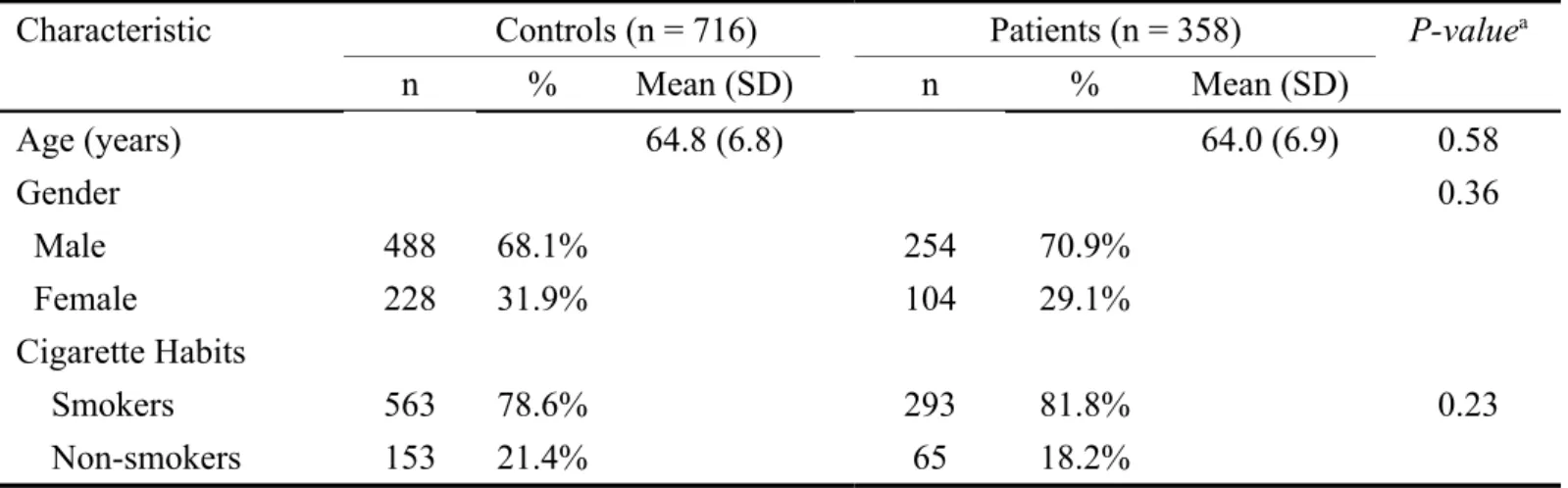
716 non-cancer controls, and the frequency distributions of selected characteristics of lung cancer patients and controls are shown in Table II. Since we used frequency matching to select the non-cancer controls, none of the differences between both groups were statistically significant (P>0.05) (Table II).
The distributions of genotypic and allelic frequencies of the APEX1/Ref-1 Asp148Glu polymorphism in lung cancer cases and controls are presented in Table III. The ORs after adjusting the confounding factors (age, gender, smoking and alcohol drinking status) for the people carrying TG and GG genotypes were 0.82 (95% CI = 0.58-1.17) and 1.08 (95% CI = 0.65-1.73) respectively, compared to those carrying TT wild-type genotype. The P for trend was not significant (P = 0.2819). In the dominant (TG plus GG versus TT) or recessive (GG versus TT plus TG) models, the association between APEX1/Ref-1 Asp148Glu polymorphism with the risk for lung cancer was not statistically significant either (P = 0.3570 and 0.4101, respectively) (Table III). To sum up, these data indicated that individuals carrying variant G allele at APEX1/Ref-1 Asp148Glu may not have a higher or lower risk of lung cancer than those carrying T allele.
The interaction of genotype of APEX1/Ref-1 Asp148Glu and the smoking habits was of great interest since lung cancer is believed to be a smoking-related disease. The genotypic distribution of various genetic polymorphisms of APEX1/Ref-1
Asp148Glu was not significantly different between lung cancer and control groups who have smoking habit (P=0.3550), nor was that for non-smokers (P=0.8011) (Table IV). Overall, there was no differential distribution of genotypic frequency of APEX1/Ref-1 Asp148Glu among smokers in lung cancer patient and control groups. There was neither any differential genotypic distribution of APEX1/Ref-1 Asp148Glu in the non-smoking lung cancer and control groups.
Discussion
In order to reveal the role of APEX1 genotype in lung cancer, we examined the non-synonymous SNP of the APEX1 gene, Asp148Glu (Table I), and investigated its association with the risk for lung cancer in a 358/716 case/control study in central Taiwan (Table II). We found that the distributions of TT, TG and GG genotypes of
APEX1 Asp148Glu were 43.0, 41.1 and 15.9% among lung cancer patients, which were not associated with lung cancer risk in Taiwan (Table III). This is consistent with the previous study conducted among lung cancer patients in Taiwan with a smaller population [Lin Chun-Hsuan…and Hui Lee. J Epidemiol 22(6): 537-542, 2012]. As for the investigation of joint effects of genetic (the genotype of APEX1/Ref-1 Asp148Glu) and environmental (personal smoking status) factors on lung cancer risk, there was no statistically positive association observed in this study. There are still
many further studies needed to reveal the contribution of APEX1/Ref-1 to lung carcinogenesis. One is to investigate the expression alterations at mRNA and protein levels for APEX1/Ref-1 in tumor sites from the lung cancer patients and another is to investigate the contribution of other SNPs for APEX1/Ref-1 to lung carcinogenesis. For instance, Lo and her colleagues provided evidence to suggest that GG and GT genotypes of APEX1/Ref-1 T-656G (rs1760944) are protective ones for lung cancer risk in Taiwan [Lo, YL, et al. A polymorphism in the APE1 gene promoter is associated with lung cancer risk. Cancer Epidemiol Biomarkers Prev. 18(1):223-9, 2009]. They have also proved that GG and GT variant promoter could performed higher transcriptional activity than that with the TT genotype in lung cancer cells.
Literature investigating the association between APEX1/Ref-1 Asp148Glu and lung cancer is inconsistent among different populations. For example, it was found that lung cancer risk was increased among people carrying Glu variant in their
APEX1/Ref-1 compared to those with Asp/Asp genotype in Belgium population [De
Ruyck K, Szaumkessel M, De Rudder I, Dehoorne A, Vral A, Claes K, et al. Polymorphisms in base-excision repair and nucleotide-excision repair genes in relation to lung cancer risk. Mutat Res. 2007;631:101–10]. However, subjects carrying the Glu variant in their APEX1/Ref-1 were reported to have decreased risk of lung cancer in a southeast China population [Deng Q, et al. Genetic polymorphisms in
ATM, ERCC1, APE1 and iASPP genes and lung cancer risk in a population of southeast China. Med Oncol 28: 667-72, 2011]. In addition, the studies have found no association between APEX1/Ref-1 Asp148Glu genotype and lung cancer risk in Japanese [Ito H, Matsuo K, Hamajima N, Mitsudomi T, Sugiura T, Saito T, et al. Gene-environment interactions between the smoking habit and polymorphisms in the DNA repair genes, APE1 Asp148Glu and XRCC1 Arg399Gln, in Japanese lung cancer risk. Carcinogenesis. 2004;25:1395–401] and Germany [Popanda O, Schattenberg T, Phong CT, Butkiewicz D, Risch A, Edler L, et al. Specific combinations of DNA repair gene variants and increased risk for non-small cell lung cancer. Carcinogenesis. 2004;25:2433–41]. Clinically, advanced non-small cell lung cancer patients carrying APEX1-Glu variants are reported to have poorer responses to chemotherapy and radiotherapy than those with Asp/Asp genotype. [Su D, Ma S, Liu P, Jiang Z, Lv W, Zhang Y, et al. Genetic polymorphisms and treatment response in advanced non-small cell lung cancer. Lung Cancer. 2007;56:281–8]. Functionally, the in vitro endonuclease activity and DNA binding activity were not significantly different among APEX1/Ref-1 Asp148Glu polymorphic variants [Hadi MZ, Coleman MA, Fidelis K, Mohrenweiser HW, Wilson DM 3rd. Functional characterization of Ape1 variants identified in the human population. Nucleic Acids Res. 2000;28:3871– 9]. We have also found that the mRNA and protein levels among APEX1/Ref-1
Asp148Glu polymorphic variants were similar among patients of renal cell carcinoma in Taiwan [Wen-Shin Chang, Chia-Wen Tsai, Kuang-Hao Cheng, Chi-Shun Lien, Chi-Ping Huang, Wen-Ling Liao, Meng-Hsuan Lee, Hsi-Chin Wu, Chao-Hsiang Chang, Cheng-Chieh Lin, Da-Tian Bau. The Role of APEX1/Ref-1 (apurinic/apyrimidic Endonuclease DNA-Repair Gene) in Renal Cell Carcinoma. Adaptive Medicine 4(4): 216-223, 2012].
To sum up, this is a study which summarized the contribution of APEX1 genotype to lung cancer, and discussed the joint effects of APEX1 Asp148Glu with personal smoking habit on lung cancer risk in Taiwan. The current and previous findings together may indicate that APEX1 T-656G genotype played a major role, while non-synonymous Asp148Glu genotype played a minor one, in the tumorigenesis of lung cancer in Taiwan.
Acknowledgements
The authors thank Fang-Jing I, Hong-Xue Ji, Yi-Ting Chang and the Tissue Bank at the China Medical University for their technical assistance. This study was supported by research grants from the Terry Fox Cancer Research Foundation, and Taiwan Department of Health, China Medical University Hospital Cancer Research of Excellence (DOH101-TD-C-111-005) and China Medical University Hospital
(DMR-Table I. The sequences of forward and reverse primers, polymerase chain reaction and restriction
fragment length polymorphism (PCR-RFLP) conditions for identifying APEX1 genotypes
Polymorphism (location)
Primers sequences (5’ to 3’) Restriction
enzyme SNP sequence DNA fragment size (bp) Asp148Glu (rs1130409) F: CCAGCTGAACTTCAGGAGCT R: CTCGGCCTGCATTAGGTACA MnlI 37 oC for 2 h T (Asp) G (Glu) 350 252 + 98 *F and R indicate forward and reverse primers, respectively.
Table II. Characteristics of investigated lung cancer patients and controls
Characteristic Controls (n = 716) Patients (n = 358) P-valuea
n % Mean (SD) n % Mean (SD) Age (years) 64.8 (6.8) 64.0 (6.9) 0.58 Gender 0.36 Male 488 68.1% 254 70.9% Female 228 31.9% 104 29.1% Cigarette Habits Smokers 563 78.6% 293 81.8% 0.23 Non-smokers 153 21.4% 65 18.2%
Table III. Distributions of APEX1 Asp148Glu genotypic and allelic frequencies and their association with risk of lung cancer
Lung Cancer Cases (%) Controls (%) Adjusted ORa (95% CI) P-value
APEX1 Asp148Glu
TT 154 (43.0) 286 (39.9) 1.00 (ref) TG 147 (41.1) 330 (46.1) 0.82 (0.58-1.17) 0.1819 GG 57 (15.9) 100 (14.0) 1.08 (0.65-1.73) 0.7713 P for trend 0.2819 (TG+GG) vs TT 0.86 (0.67-1.24) 0.3570 GG vs (TT+TG) 1.14 (0.80-1.89) 0.4101
Table IV. Distribution of APEX1 Asp148Glu genotypes among lung cancer patients after stratification by personal smoking habits
Variable APEX1 Asp148Glu genotype
TT (%) TG (%) GG (%) P-valuea Smokers 0.3550 Controls 225 (40.0%) 259 (46.0%) 79 (14.0%) Patients 126 (43.0%) 120 (41.0%) 47 (16.0%) Non-smokers 0.8011 Controls 61 (39.9%) 71 (46.4%) 21 (13.7%) Patients 28 (43.1%) 27 (41.5%) 10 (15.4%) a Based on Chi-square test.