Articles
Preparation and Properties of Polyacrylate/Clay Photocured
Nanocomposite Materials
Yu-Young Wang* and T.-E. Hsieh
Department of Materials Science and Engineering, National Chiao-Tung UniVersity, Hsinchu, Taiwan 30010, ROC
ReceiVed August 2, 2004. ReVised Manuscript ReceiVed January 4, 2005
A functionalized surfactant, GME-N-C10containing a CdC double bond, was synthesized to modify clays such as montmorillonite (MMT) and mica for the preparation of organic-inorganic composite resins via radical photoinduced polymerization. As revealed by X-ray diffraction (XRD) analysis of the organophilic samples, the synthesized surfactant was successfully intercalated into the layers of clay by its full molecular length and such an intercalation generated a paraffin-like structure in the modified clays. By forming the C-C bonds between surfactants and oligomers/monomers during subsequent radical photoinduced polymerization, the hybrid comprising organophilic clay/oligomers/monomers became an intercalated nanocomposite resin. The thickness of the dispersed lamellae was less than 100 nm, as revealed by transmission electron microscopy (TEM). For the composite sample containing 5.0 wt.% of organophilic clay, the decomposition temperatures raised at least 15°C; the transmittance detected by UV-visible spectrometer showed a less than 15% loss in the visible light region but a satisfactory transparency was still retained, and the degree of moisture absorption decreased from 3.4% to about 1% due to dispersive organophilic clay in the polymer matrix.
Introduction
Nanocomposites are a new class of materials that may form by the hybridization of organic polymer and inorganic compounds as oxides, clays, etc. at a nanometer scale. In the past decade, utilization of inorganic nanoparticles as additives to enhance performance of polymeric materials has been widely reported,1-10and related studies have attracted considerable attention from both theoretical and application points of view.4,11,12Owing to the unique interfacial properties and phase morphology in the nanometer scale, the nano-composites exhibit improved physical and chemical proper-ties such as better mechanical and thermal properproper-ties,1,12-14 lower gas permeability,15,16 and higher fire retardation
capability.17For instance, nylon-6 nanocomposite containing 4 wt.% of montmorillonite (MMT)1,13 possesses superior mechanical and thermal properties compared with additive-free nylon-6.16 Polymer comprising 7.5 vol % of the exfoliated 1-nm-thick silicate layers yielded a 10-fold incre-ment on the mechanical strength.14An exfoliated polymer-clay nanocomposite might lag the moisture diffusion inside so as to achieve the low permeation property.2In contrast to the former cases, kaolin, a nonswelling clay, had also been used to prepare nylon-6 composites but the enhancement in mechanical and thermal properties was limited due to the lack of nanometer-scale dispersion.18,19 Apparently, the dispersion morphology is the primary cause affecting the performance of nanocomposites.
The concept of nanocomposite has been successfully applied to various organics such as polyimide,1-2,5epoxy,6,15 polysiloxane,10polystyrene,20and polyacrylate,21-24etc., and most of them were thermally cured, e.g., the nanocomposites (1) Usuki, A.; Kojima, Y.; Kawasumi, M.; Okada, A.; Fukushima, Y.;
Kurauchi, T.; Kamigatio, O. J. Mater. Res. 1993, 8, 1179. (2) Yano, K.; Usuki, A.; Okada, A.; Kurauchi, T.; Kamigatio, O. J. Polym.
Sci. A: Polym. Chem. 1993, 31, 2493.
(3) Messersmith, P. B.; Giannelis, E. P. J. Polym. Sci. A: Polym. Chem. 1995, 33, 1047.
(4) Okada, A.; Usuki, A. Mater. Sci. Eng.: C 1995, 3, 109. (5) Lan, T.; Pinnavaia, T. J. Chem. Mater. 1994, 6, 573.
(6) Lan, T.; Kaviratna, P. D.; Pinnavaia, T. J. Chem. Mater. 1995, 7, 2144. (7) Gilman, J. W. Appl. Clay Sci. 1999, 15, 31.
(8) Vaia, R. A.; Prince, G.; Ruth, P. N.; Nguyen, H. T.; Lichtenhan, J. Appl. Clay Sci. 1999, 15, 67.
(9) Goldman, A. Y.; Montes, J. A.; Barajas, A.; Beall, G. W.; Eisenhour, D. D. Ann. Technol. Soc. Plast. Eng. 1998, 56 (2), 2415.
(10) Burnside, S. D.; Giannelis, E. P. Chem. Mater. 1995, 7, 1597. (11) Messersmith, P. B.; Stupp, S. I. J. Mater. Res. 1992, 7, 2599. (12) Giannelis, E. P.; AdV. Mater. 1996, 8, 29.
(13) Kojima, Y.; Usuki, A.; Okada, A.; Fujushima, A.; Kurauchi, T.; Kamigatio, O. J. Mater. Res. 1993, 8, 1185.
(14) Lan, T.; Pinnavaia, T. J. Chem. Mater. 1994, 6, 2216.
(15) Messersmith, P. B.; Giannelis, E. P. Chem. Mater. 1994, 6, 1719. (16) Kojima, Y.; Fujushima, A.; Usuki, A.; Okada, A.; Kurauchi, T. J.
Mater. Sci. Lett. 1993, 12, 889.
(17) Gilman, J. W.; Kashiwagi, T. SAMPE J. 1997, 33, 42.
(18) Kyu, T.; Zhou, Z. L.; Zhu, G. C.; Tajuddin, Y.; Qutubuddin, S. J. Polym. Sci., Part B: Polym. Phys. 1996, 34, 1761.
(19) Kyu, T.; Zhou, Z. L.; Zhu, G. C.; Tajuddin, Y.; Qutubuddin, S. J. Polym. Sci., Part B: Polym. Phys. 1996, 34, 1769.
(20) Fu, X.; Qutubuddin, S. Polymer 2001, 42, 807.
(21) Seckin, T.; Onal, Y.; Aksoy, I.; Yakinci, M. E. J. Mater. Sci. 1996, 31, 3123.
(22) Dietsche, F.; Mulhaupt, R. Polym. Bull. 1999, 43, 395.
(23) Chen, Z.; Huang, C.; Liu, S.; Zhang, Y.; Gong, K. J. Appl. Polym. Sci. 2000, 75, 796.
10.1021/cm0487268 CCC: $30.25 © 2005 American Chemical Society Published on Web 06/04/2005
surfactant, preparation of photocured nanocomposite resins comprising well-intercalated polyacrylate-clays by inter-facial chemical reactions via photopolymerization between surfactants/monomers or surfactants/oligomers and their property characterization. With the functional CdC groups and unusual geometry, this particular surfactant might effectively extend the lamellar spacing of clays and further provide fine dispersion of clays in polymer matrix.
Experimental Section
Materials. MMT powder (code PK802, provided by Pai Kong Ceramic Material Co.) with cationic exchange capacity (CEC) ) 95 mEq/100 g, and mica powder with CEC ) 60 mEq/100 g (termed Mica60 in this work) were adopted as the inorganic components of composite resins. Bisphenol A epoxy diacrylate (viscosity ) 27.1 M mPa‚s at 25°C), glycidyl methacrylate ester, and dipentaerythritol pentaacrylate were purchased from Sartomer Co. The radical polymerization initiator, 1-hydroxycyclohexylphenyl ketone, was obtained from Chembridge International Co. Didecyl-amine, 3-(trimethoxysilyl)propyl methacrylate, and 2,3,4,5,6-pen-tafluorostyrene were purchased from Aldrich Chemical Co. The synthesized surfactant, GME-N-C10, was prepared by the reaction of glycidyl methacrylate ester and didecylamine (molar ratio 1:1) in ethanol at 60°C for 48 h. The product was distilled in a vacuum rotator at T > 80°C to remove the ethanol completely, and its molecular structure was characterized by FTIR and 1H NMR spectroscopy.
Cationic Exchanged Clays. Organophilic MMT and mica were prepared by cationic exchange in clay galleries in aqueous solution. Before cationic exchange, all clays were dried at 80°C for 24 h to remove absorbed moisture. The GME-N-C10was first acidified by hydrochloric acid (HCl). The MMT and Mica60 were respectively added in 300 mL of distilled water and stirred for several hours to form a suspending solution. The acidified GME-N-C10was added
removed as completely as possible by heating at 90°C for more than 12 h. Finally, 5.0 wt.% of radical photoinitiators, based on the weight of oligomer, and the above mixture were sealed in amber sample vials and stirred in N2ambient at 40°C for 90 min to prevent unexpected reaction.
Subsequent radical photopolymerization was carried out at room temperature. The pre-polymer layers of about 110µm thick were
coated onto the glass substrates. The specimens were cured in an UV oven (CL-1000, UVP) in which the source of UV irradiation comes from an array of five 8-W dual bipin discharge tubes emitting UV light with wavelength ranging from 350 to 400 nm (peak wavelength at about 365-370 nm) to induce the photopolymeri-zation. Total energy of the photopolymerization was about 6 joules/ cm2. After polymerization, the specimens were further cured at 80 °C for 1 h to complete the polymerization.
Characterization. Molecular structure of GME-N-C10surfactant was characterized by FTIR and NMR. The1H NMR spectrum was provided by Varian UnityInova 500 NMR with CDCl3as the sample solution. The FTIR spectra were obtained from a Nicolet Prote´ge´ 460 FTIR spectrometer. The X-ray characterization of modified clays and polymer-clay composites were carried out in a Siemens D5000 X-ray diffractometer using Cu KR (λ ) 1.5418 Å) radiation
and a scanning rate of 0.02°/sec. Thermogravimetric analysis (TGA) was performed within a DuPont 2950 TGA. The specimens were heated at a rate of 20°C/min from 30 to 800°C then an isothermal soak for 10 min in air atmosphere to calibrate the residual weight of clay; meanwhile, another thermal recipe with the heating rate of 10°C/min from 30 to 800°C was performed to determine the decomposing temperature (Td). The TGA data were further trans-formed into differential thermogravimetry (DTG) curves to identify the bonding interactions between modified clays and polymer matrix. In-plane thermomechanical analysis (TMA) was carried out in a DuPont 2940 TMA at a heating rate of 10°C/min from 30 to 200°C to identify the coefficient of thermal expansion (CTE) of the composites. The microstructures of modified clays and polymer-clay composites were observed by using a JEOL 2000FX TEM operating at 200 kV. The transmittance of composite films was characterized by a HP8453 UV-visible spectrometer with scanning wavelength ranging from 190 to 1200 nm.
Results and Discussion
Synthesis and Characterization of GME-N-C10
Sur-factant. Surfactants play a very important role for clay exfoliation in polymer. They reduce the energy of the organic/inorganic interface so that various dispersion mor-phologies may be achieved in the polymer-based composites. Functionalization of surfactants further provides functional (24) Lin, J.; Wu, J.; Yang, Z.; Pu, M. Macromol. Rapid Commun. 2001,
22, 422.
(25) Keller, L.; Decker, C.; Zahouily, K.; Benfarhi, S.; Le Meins, J. M.; Miehe-Brendle, J. Polymer 2004, 45, 7437.
(26) Decker, C.; Zahouily, K.; Keller, L.; Benfarhi, S.; Bendaikha, T.; Baron, J. J. Mater. Sci. 2002, 37, 4831.
(27) Uhl, F. M.; Davuluri, P. S.; Wong, S. C.; Webster, D. C. Chem. Mater. 2004, 16, 1135.
(28) Benfarhi, S.; Decker, C.; Keller, L.; Zahouily, K. Eur. Polym. J. 2003, 40, 493.
(29) Bozena, P.; Slawomir, S.; Beata, J.; Lars-A° ke, L.; Jerzy, P. Appl. Clay Sci. 2004, 25, 221.
(30) Uhl, F. M.; Davuluri, P. S.; Wong, S. C.; Webster, D. C. Polymer 2004, 45, 6175.
groups to induce the polymerization. After cationic exchange reaction, the modified clays containing organophilic func-tionalized surfactants would polymerize with the oligomers and monomers. Moreover, via interacting with the organic material, the modified clays might disperse evenly to form exfoliated polymer-clay nanocomposites. Figure 1 shows the 1H NMR spectrum of GME-N-C10synthesized in this work. A comparison of the NMR spectra of synthesized surfactant and its reactants revealed that the proton peaks of methyl (-CH3) and methylene (-CH2) among long alkyl chains appear nearδ ) 0.8 and δ ) 1.2 for both specimens.
The peaks corresponding to the proton resonance in CdC double bond of GME-N-C10and its reactants offer another evidential support. In general, identification of proton resonance in CdC double bond could be derived from the calculation of chemical shift related to the substituent constant (Z) effect. The calculation based on the Z effect for chemical shift of proton resonance in CdC double bond has been reported in the range ofδ ) 5.0-7.0.31In the1H NMR spectra for reactants, there are two peaks betweenδ
) 5.5 to 6.5: one is very close to δ ) 5.5 and the other is
nearδ ) 6.0. Similarly, in the NMR spectrum of
GME-N-C10, peak groups e and f, both comprising two peaks, locate atδ ) 5.5 and 6.0, respectively. This provides evidence that
the didecylamine did react with glycidyl methacrylate ester to form the synthesized surfactants.
Figure 2 shows the FTIR spectrum of GME-N-C10 surfactant. After synthesis, the surfactant was transparent yellow and its viscosity was similar to that of isopropyl alcohol at room temperature from their outward appearances. TheνCsHof normal long alkyl chains bonded with nitrogen appears in the region of 3000-2840 cm-1. Absorption of stretching hydroxyl groups generated by the epoxy/amine reaction occurs at the wavenumber of 3500 to 3220 cm-1,20 and the other three stretching bands of CdO, C-N, and Cd C of methacrylate groups appear near 1760 cm-1, in the region of 1250 to 1020 cm-1and at 1635 cm-1, respectively.
The above NMR and FTIR analyses evidenced that our synthesis reaction did proceed to generate the surfactants with expected structure. We note that the huge absorbance difference between CdC double bonds and hydroxyl groups within surfactants might result from the incomplete removal of ethanol during synthesis.
Cationic Exchange of Clays by Surfactants. The result of TGA analysis for native and modified clays in ambient air is shown in Table 1. As expected, after cationic exchange the acidified surfactants were substituted for the cations in clays and intercalated into the lamellae. Less weight ratio was observed in all the modified clays after thermal decomposition. For instance, residual weight ratio of native MMT decomposed in air is about 87.08%, which is higher than that for modified MMT at about 57.27%. The degree of modification, or the modification ability of surfactants, represents the ratio of the amount of acidified surfactants intercalated into the lamellae during cationic exchange to the maximum amount of acidified surfactants that could be intercalated into the clays according to their CEC value. Our calculation revealed that both modified MMT and Mica60 have relatively high degrees of modification over 70%. Those results evidenced that the synthesized surfactants may effectively increase the d-spacing of clay lamellae with inherent steric hindrance.
Figures 3 and 4 depict the XRD patterns of the three types of clays before and after modification. The d001 spacings calculated based on the XRD data are given in Table 2. The native clays consist of a lamellar structure formed by sharing the edges of two silica tetrahedral sheets of aluminum or magnesium hydroxide.32In the inserted layers, cations within a few H2O molecules induce hydrophilicity to the organic (31) Silverstein, R. M.; Bassler, G. C.; Morrill, T. C. Spectrometric
Identification of Organic Compounds, 5th ed.; John Wiley & Sons:
New York, 1991, p 215. (32) Wang, Z.; Pinnavaia, T. J. Chem. Mater. 1998, 10, 1820. Figure 1. (a) Molecular structure of surfactant GME-N-C10synthesized
in this work; and (b)1H NMR spectrum of GME-N-C
10dissolved in CDCl4.
Figure 2. FTIR spectrum of GME-N-C10.
Table 1. TGA Analysis of Clays Before and After Modification
residual weight (%)
before after degree of modificationa(%)
MMT 87.08 57.27 71.36
Mica60 92.70 71.22 81.33
aDegree of modification was calculated according to following formula:
{[(residual weight before modification) - (residual weight after modifica-tion)]÷ (molar weight of surfactant)}× (1000 ÷ CEC) × 100.
polymer so that compatibility between them is always an interesting issue. After cationic exchange reaction, the modified clays dispersed in organic media. In Figure 3, the d001spacing of native MMT is equal to 13.64 Å. This value was adopted to evaluate the degree of dispersion induced by the surfactants after cationic exchange reaction. As reported by Kornmann et al.,33the higher the value of d
001 spacing of modified clays, the better the dispersion of clays in the organic polymer. It might also promote the separation of clay lamellae during the polymerization when the surfac-tant was attached to clays and monomers of polymers. For modified MMT, the (001) peak at 2θ ) 2.66°indicated that it possesses a d001spacing equal to 3.321 nm, which is larger than that of native MMT. Furthermore, the XRD peaks of
modified MMT show a better regularity after discovering similar d-spacing deduced from the 1st to 3rd diffraction peaks as indicated in Table 2. These facts imply the surfactant synthesized in this work not only effectively enlarged the lamellar spacing of MMT, but also formed a uniformly dispersive structure in MMT. Similar phenomena were also observed in organophilic mica, as shown in Figure 4. Fu and Qutubuddin20pointed out that the quaternary monomer could homopolymerize and copolymerize with other mono-mers due to the existence of CdC double bond. It may also intercalate into inorganic compounds possessing lamellar structure according to their XRD studies.
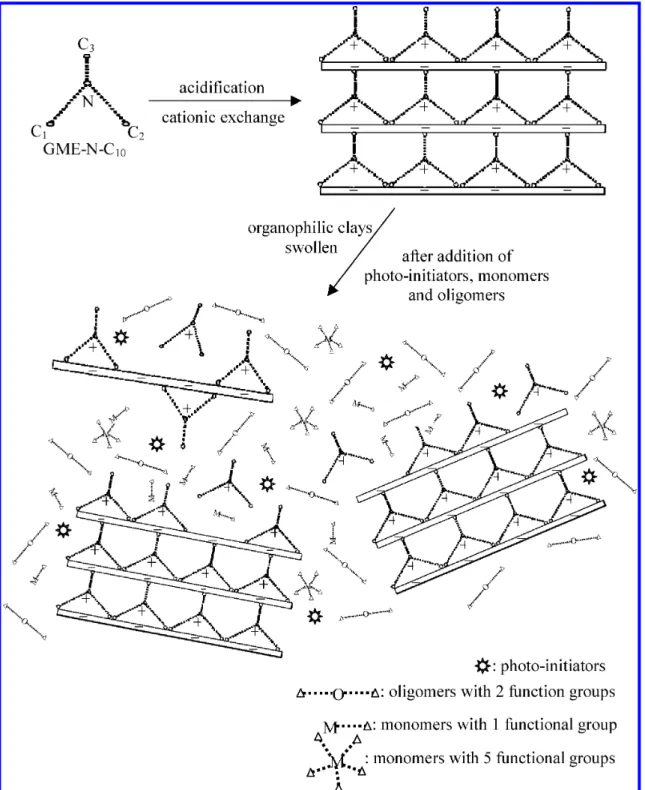
Figure 5 schematically illustrates the simulated molecular structure of GME-N-C10. The chain-length information is given in Table 3. Further calculation based on data in Table 3 indicated that the distance from C3to the plane containing C1-C2 in GME-N-C10is about 2.2179 nm. To attract the negative charges in clays, the angle between the two long alkyl chains should be as large as possible to reduce the effect of steric hindrance; therefore, the linear length of surfactants intercalated in lamellar structure should be reduced slightly. It is known that the thickness of clay lamella is about 1 nm. Consequently, the sum of linear length of surfactant and thickness of clay lamella is about 3.2 nm, which is very much the same as the experimental results obtained by XRD. Furthermore, based on the XRD results and structure simulation, a paraffin-like structure34could be found in the organophilic clays as illustrated in Figure 6. Finally, because GME-N-C10 contains two 10-carbon alkyl chains, the ge-ometry ofλ-shaped surfactant may make itself tougher than
the ammonium salt of long alkyl containing 16-18 carbons.
(33) Kornmann, X.; Lindberg, H.; Berglund, L. A. Polymer 2001, 42, 1303.
(34) Lebaron, P. C.; Wang, Z.; Pinnavaia, T. J. Appl. Clay Sci. 1999, 15, 11.
Figure 3. XRD patterns of (a) pristine MMT, (b) commercial clay (CL34), (c) composite resin containing 5.0 wt.% modified MMT, and (d) MMT modified by GME-N-C10(m-MMT).
Figure 4. XRD patterns of (a) pristine Mica60, (b) composite containing 5.0 wt.% modified Mica60, and (c) Mica60 modified by GME-N-C10 (m-Mica60).
Table 2. d100Spacing of Modified Clays
MMT (nm)
Mica60 (nm) d001calculated from 1st order diffraction peak 3.321 3.201
d001calculated from 2nd order diffraction peak 3.347 3.249
d001calculated from 3rd order diffraction peak 3.383 3.259
average value of d001 3.350 3.236
in X-Y dimension and each molecular chain is treated as linear, ignoring molecular vibration.
Table 3. Simulated Chain Length of GME-N-C10Molecule distance (nm) C1-C2 1.5478 C1-C3 2.0247 C2-C3 1.8235 N-C1 1.2713 N-C2 1.2650 N-C3 0.6549
Microstructure. Figure 7 presents the DTG analysis of the reactivity between surfactants, surfactants and monomers, and surfactants and pre-polymer. It was deduced from the data obtained by TGA analysis in ambient air in order to calibrate the reactivity of surfactants during the radical photoinduced polymerization. As indicated by curves (a) and (b) in Figure 7, photoinduced polymerization caused a slight shift of the highest peak, and the polymerization induced new peaks at about 200 and 600°C (curve (b)). The new peak at about 600°C might correspond to the formation of C-C bonds between surfactants containing CdC double bonds due to copolymerization induced by the radicals
derived from the UV-breakage of photoinitiators.35 Addition-ally, in the cured sample with monomers, the shift of the highest peak toward about 400 °C in curve (c) evidences the higher probability of C-C bonds formation between surfactants and monomers than that between surfactants. Hence, the functionalized surfactants, which are active during radical photoinduced polymerization, should be able to cross-link with pre-polymer and exfoliate the modified clays during subsequent process. Furthermore, the higher decomposition (35) Decker, C.; Nguyen Thi Viet, T.; Decker, D.; Weber-Koehl, E. Polymer
2001, 42, 5531.
Figure 6. Expected schematic representation in the modification stage of clay lamellae by GME-N-C10and the clay lamellae attached with GME-N-C10
rate around 500 °C observed in curves (d) and (e) would indicate the occurrence of homopolymerization between surfactants and pre-polymer among composite resin.
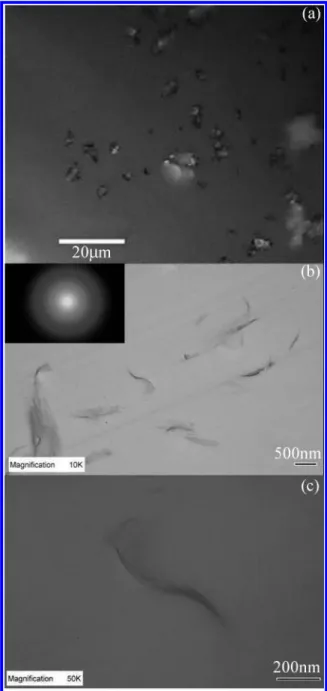
Figure 8a shows the as-purchased MMT samples without modification and Figure 8b and c are the TEM micrographs of composite containing 5.0 wt.% modified MMT and its enlargement. The comparison between 8a and b indicates that the surfactants synthesized in this work could effectively provide the intercalation of clay in polymer. Furthermore, the MMT segments dispersed in polymer matrix are about 60-80 nm thick, as indicated by Figure 8c, and this corresponds to about 20-30 clay lamellae in each segment. The analyses above also indicate that ethanol added during the synthesis of surfactant is unlikely to be removed completely. With appropriate selection of solvent according to the solubility parameters, the organoclays should be able to achieve better exfoliation during swelling and photocured nanocomposites containing finely dispersed inorganic fillers could be obtained.
Thermal Properties. Figure 9 and Table 4 list the thermal properties of photocured nanocomposites prepared in this work. The 5.0% weight-loss decomposing temperature of pre-polymer is about 179°C, and when 5.0 wt.% of modified MMT and Mica60 were added, the decomposing temperature (Td) of composites raised at least 15°C. The improvement of the thermal properties was attributed to the high thermal stability of clays and their interactions with the polymer matrix.36-39 Table 4 also lists the coefficient of thermal expansion values of pre-polymer and composites in the range of 40-90°C. It can be seen that hybridization of modified clays increases the CTE of composites. One of the possible causes of this is that the van der Waals force between the two species bearing opposite charges would decrease as their distance increases.40As shown in Figure 5, because the two 10-carbon long chains connect to the N atom, the distance
between the negative charge on clays and the ionized N atom on acidified surfactant increases so that the N+atoms are unable to reach to the surface of clays as much as they could even though those surfactants could be highly intercalated into clay lamellas according to the degree of modification listed in Table 1. The steric hindrance would decrease the attractive force and lead to some of surfactants attached to clays leaving their original sites, and remain free after swelling as shown in Figure 6. This phenomenon would decrease the interfacial area between the clay and polymer matrix,2thus increasing the CTE value of the composites. Besides, as mentioned above, ethanol molecules might residue in the lamellae of organophilic clays due to the incomplete removal of solvent, which may also cause the increase of CTE values of the composites prepared in this work.
(36) Wen, J.; Wikes, G. L. Chem. Mater. 1996, 8, 1667.
(37) Fischer, H. R.; Gielgens, L. H.; Koster, T. P. M. Acta Polym. 1999, 50, 122.
(38) Petrovic, X. S.; Javni, L.; Waddong, A.; Banhegyi, G. J. J. Appl. Polym. Sci. 2000, 76, 133.
(39) Zhu, Z. K.; Yang, Y.; Yin, J.; Wang, X.; Ke, Y.; Qi, Z. J. Appl. Polym. Sci. 1999, 3, 2063.
(40) Loudon, G. M. Organic Chemistry, 3rd ed.; The Benjamin/Cummings Publishing Company: Redwood City, CA, 1995; p 69.
and (e) composite containing 5.0 wt.% m-MMT.
Figure 8. (a) Morphology of MMT before surfactant modification, (b)
TEM micrographs of composite containing 5.0 wt.% m-MMT with corresponding electron diffraction pattern, and (c) enlargement of part of (b).
Optical Properties. Transmittances of pre-polymer and composites are given in Table 5. The transmittance of composites in the visible light region decreases due to the addition of opaque clays in polymer. The average transmit-tance decreases from 88.68 to 76.60% for the specimen containing 5.0 wt.% of modified MMT and to 66.74% for the specimen containing 5.0 wt.% modified Mica60. Since the sizes of modified MMT and mica are smaller than the wavelength of visible light, the composites might retain satisfactory transparency after hybridization.
Moisture Absorption.. Table 6 shows that the moisture absorption reduces from 3.444% for pre-polymer to 1.304% for the specimen containing 5.0 wt.% of modified Mica60 and to 1.308% for the specimen containing 5.0 wt.% of modified MMT. Kojima et al.41pointed out that nanocom-posites have excellent resistance to moisture permeation
because of a decrease in the diffusion coefficient compared with that of additive-free polymers. The increasing diffusion length due to the large aspect ratio feature of clay lamella should also benefit the moisture absorption.
Conclusions
A functionalized surfactant containing a CdC double bond was synthesized in this work to provide intercalation of clays in polymers. Molecular structure analyses indicated that the steric hindrance in surfactants induced a paraffin-like struc-ture in the modified clays. The CdC double bonds in surfactants reacted with those in oligomers/monomers, even with others in surfactants, to form C-C covalent bonds during radical photoinduced polymerization so as to produce the nanocomposite resin. As revealed by TEM, the thickness of dispersed clay segments was about 60-80 nm, which corresponds to 20-30 clay lamellae in each segment. Microstructure analyses indicated that the intercalated nano-composite resins consisting of organoMMT/oligomer/ monomers were successfully prepared. Experimental analyses also indicated that the organic-inorganic composites pre-pared in this work possessed better thermal stability, satisfac-tory transparency, and low moisture absorption properties due to the nanometer-scale dispersion of modified clays in the polymer matrix. The incomplete removal of ethanol after the synthesis of surfactant and swelling of organoMMT and the long-chain feature of the surfactant synthesized in this work might result in the increase of CTE of the nanocom-posites and hence further structure refinement of surfactant and appropriate selection of solvent according to the solubil-ity parameters is required.
Acknowledgment. This work was supported by the Ministry of Education, Taiwan, Republic of China within the Project of Excellence “Semiconducting Polymers and Organic Molecules for Electroluminescence: B. Development of Advanced Materi-als and Devices for Organic Light Emitting Diodes (OLED) Technology” under contract 91-E-FA04-2-4.
CM0487268
(41) Kojima, Y.; Usuki, A.; Kawasumi, M.; Okada, A.; Kurauchi, T.; Kamigaito, O. J. Appl. Polym. Sci. 1993, 49, 1259.
Figure 9. TGA thermograms of (a) pre-polymer under N2, (b) pre-polymer hybridized 5.0 wt.% m-Mica60 under N2, (c) hybridized 5.0 wt.% m-MMT under N2, (d) hybridized 5.0 wt.% m-Mica60 under air, and (e) hybridized 5.0 wt.% m-MMT under air.
Table 4. Thermal Properties of Composites
Td(°C) residual weight (%) CTE40∼90°C (ppm/°C) pre-polymer 179 62.44 pre-polymer + 5.0 wt.% modified MMT 195 4.34 86.63 pre-polymer + 5.0 wt.% modified mica 209 5.81 85.12
Table 5. Optical Properties of Composites average transmittance in visible light region (%) pre-polymer 88.68 pre-polymer + 5.0 wt.% modified MMT 76.60 pre-polymer + 5.0 wt.% modified mica 66.74
Table 6. Moisture Absorption of Composites moisture absorption (%)
pre-polymer 3.444
pre-polymer + 5.0 wt.% modified MMT 1.308 pre-polymer + 5.0 wt.% modified mica 1.304