2004 5th Asian Control Conference
Sliding-Mode Tracking
Control of
the
Stewart
Platform
Chin-I
Huangl,Chih-Fu
Chang',Ming-Yi Yu'
and Li-Chen Fu"' Departmentof
Electrical Engineering'National Taiwan University, Taipei, Taiwan, R.Q.C. E-mail:
d992
[email protected]Department
of
Electrical Engineering'Department
of
Computer Science and Information Engineerin$ National Taiwan University, Taipei, Taiwan,R.O.C.
E-mail: [email protected],tw
Abstract
This paper presents a sliding mode control approach for the motion control of a Stewart platform. The control scheme is proposed given that the overall system parameters are subject to uncertainties while only the positions and velocities of links are measurable. To achieve high performance tracking control of a 6 DOF Stewart platform normally requires the full knowledge of the system dynamics. In this paper, some important properties of the dynamics of the Stewart platform have been derived and expIoited to develop a sliding-mode controller which can drive the motion tracking error to zero asymptotically. Stability analysis based on Lyapunov theory is performed to guarantee that the controller design is stable. Finally, the experimental results confirm the effectiveness of our control design.
&words- Stewart Platform, Paralfel Manipulators, Sliding Mode Control
1 Introduction
In recent years, the parallel link manipulators .have attracted much attention and many studies have been done on the kinematics or static analysis o f the parallel link manipulators [ 121. Generally
speaking,
the parallellink
manipulators provide better accuracy, higher rigidity, higher load-to-weight ratio, and more uniform load distribution than the serial manipulators. Such advantages of fully paralle1 manipulators [I] originate from the fact that the actuators act in parallel sharing the common payload. The Stewart platform manipulator is a 6DOF mechanism with two bodies connected together by six extensible legs [l, 21. This closed-loop structure makes the manipulator system far more rigid in proportion to size and weight than any serial link robot, and yields a force-output-to- manipulator-weight ratio more than one order of magnitude greater than serial link robot. Practical usage of the Stewart platform manipulator has generally been in the area of low speed and large payload conditions such as motion base ofthe classical automobile or flight simulator, and motion bed of a machine tool [4]. For the design and the control of the Stewart platform manipulators, dynamics analysis is a crucial step. In recent years, many research works have been conducted on the dynamics of the Cough-Stewart platform manipulator [3-111. Several methods such as the Lagrange equation, Newton-Euler equation and principle of virtual work are proposed to derive dynamic equations of the Gough-Stewart platform. The Lagrange formulation is well structured and can be expressed in closed form, but a large amount of symbolic computation is needed to find partial derivatives of the Lagrangian in this method. The Newton-Euler approach requires computation of all constraint forces and moments between the links. However, these computations are not necessary for the simulation and control of a manipulator.
The
methodof
virtual work is an efficient approach to derive dynamic equations for the inverse dynamics of the Stewart platform[S,
91. However, for the forward dynamics, the method of virtual work is not straightforward because of the complicated velocity transform between the joint-space and task-space.In this paper, an approach based on a sliding-mode control technique has been successfully developed for motion control of the Stewart platform system with having parametric uncertainty. These schemes are designed to guarantee practical
robustness
and stability.The
remainder of this article is organized as follows: The kinematics and dynamics models for the Stewart platform are discussed in Section 2. In Section 3 the sIiding mode controller for a Stewart platform system is developed and the stability analysis is conducted. Section 4 shows some experimental resultson
controlling a realistic Stewart platform. Finally, some conclusions are made in Section 5.2 Kinematics and Dynamics of a Stewart Platform
The Stewart Platform is a parallel manipulator [ I , 21. It has a lower base platform and an upper payload platform
connected by six extensible legs with ball joints at both ends. In the following subsections, we fvst make the inverse kinematics analysis of the Stewart platform, and then derive its dynamics.
2.1 Inverse and Forward Kinematics Analysis of a Stewart Platform
The Stewart platform has parallel actuators in contrast to the traditional manipulator arm equipped with serial actuators. The coordinates to represent the 6 DOF motion are the inertial frame and the moving frame attached to moving platform. The 6 DOF motions are linear and angular motions. Linear motions consist of the longitudinal (surge), lateral(sway), and vertical(heave) motion. Whereas angular motions are expressed as Eulerian angle rotations with respect to x-axis, y-axis, and z-axis, i.e. roll, pitch and yaw, in sequence.
The inverse kinematics are mathematics treating the problem of describing the postion and orientation of the payload platform in terms of the actuator variables, i.e., to express (x, y , z , a, j, y ) by the actuator lengths l i , i = 1 , 2 , . - - , 6 . As the sketch map shown in Fig. 1, we attach two coordinate h m e s {P) and {B) to the payload platform and the base platform, respectively. Suppose that vector
4
= [ p , p3y p , , I T describes the postion of the reference point4
shown in Fig, l(a) with respect to frame(P}. Then,
<
can be expressed as. s L
Ai
= A;-,+
8, i = 2,4,6 where rp is radius of the upper plate and in our case?I
8, =- L
On the other hand, the vector B, = [b, be b,]’ in Fig. l(a) describes the postion of the attachment point
Bi
with respect to frame {B), whereBi
can be expressed asA, = A,-l +Ob i = 2,4,6 again, r8 is radius of the lower plate, and in our case
IT
# ‘ - 6
Fig. l(b) Sketch Map foxhe Stewart Platform Now,
let
orientation matrix R represent the orientation of the frame {P} with respect to the frame {B), as being expressed as:c a c p c a s p s y - s a c y caspcy+sasy
where
ca
I C O S Q and sa ~ s i n a . By adopting propercoordinate transformation, the actuator vector Li corresponding to the actuator leg i w.r.t. h m e {B} can be derived as:
( 2 )
Li =
R - T
-b P - B, for i = 1,2,-.. ,6,where P = [ x y z]‘ . Since the actuator length is 1, = IIL,
)I
, we can obtain complete solution of the inverse kinematics as followed:1,2 = r 2 + y 2 + z 2 + ~ ~ 2 + r ~ 2 + 2 ( ~ 1 ~ c r + 1 ; 2 p ~ ) ( X - b e )
+ 2(r,,PD + WT )(Y -
by)
f 2 h P W + %PiY )z-2(x*b, +y.b,) f o r i = 1,2,.-.,6, (3) where rp and r, represent the radius of the payload platform and that of the base platforms, respectively.
The forward kinematics of Stewart platform the 6 DOF motions of the upper payload platform the link length variables, which plays important role for the MIMO control or the motion visualization of the Stewart platform, but unfortunately it is difficult to come by because of the nonlinearity and complexity. Although the Newton Raphson method, is a popular technique to solve the derivation problem, it suffers from repetitive steps before solution convergence and hence fails to become a real-time solution. Moreover, such method may ever lead to infinite loop provided wrong selection of the initial values. Nevertheless, the general from of expression can be made as follows:
f;(x, y , z, a,
p,
y ) = x2+
J
+
z2+
r,‘+
r;+
2(r,,%+
1;&)(x --BJ + 2(r,,p,+aP,1Cv-q
+ 2(131% +r,,%)z-2(x-Bu + y . B,)-Iz2
= O
(i =1,2,...,
4) 2.2 Dynamics Analysis of Stewart PtatformTo design a system with high operational performance, a sound control method is crucially needed. However, to control the Stewart Platform system well is very challenging due to the high nonlinearity in system dynamics, system uncertainties, and complex kinematics. In general, the dynamic equations [4] of the Stewart Platform system can be written as:
M ( q ) 4 +. C ( W M + Gfq) = J T s (4) where M ( q ) i s an 6 x 6 inertia matrix, which is a symmetric and positive definite for all q E
R 6 ;
C(q,q)q isthe CoriolislCentripetal vector; G(q) and r are 6 x 1
vectors
containinggravity
torquesand
input torques, respectively, Some pertaining properties are given below. Property 1: C(q,q) andA&q) are bounded functions ifq andq are bounded. C(q,q) is a bounded function if
q , q and ij are bounded.
Property 2:
k
f
is a symmetric and positive defmite matrix. Moreover, for an appropriate choice of C,M
- 2C can be a skew-symmetric matrix, which means that x T(k
-
2C)x = 0, Vx E R” . This property is well knownin
the robotics literature.We now investigate every component of the Stewart Platform dynamics. For notational simplicity, we use SC),
C(-) to stand for sin(.) and cos(.) , respectively, I ( - )
represent the inertia of the platform. Thus, the inertia matrix M(.) can be written as:
o m 0 0 0 0 m O O 0 0 O O O M , 0 Ma O I 0 0 0 MH Mss where M M =
rxc;c;
+
z,c;s; +
rzs;,
M,, = Ms4 = (Ir - I,)C,C,S, 3 M , = M H = IzSo,M55
= IxS:+
IyC:, M66 = I,,and Corilois and Centrifugal Matrix C(.) can be explicitly written as:
J =
where
3 Sliding-Mode Control Design
A sliding-mode controlIer is proposed in this section to drive the Stewart platform system such that the motion tracking errors asymptotically converge to zero, i.e., where q,(r) is the desired trajectory. Some notations are now introduced to simplify the derivation addressed later. Thus, define
q(') q d ( t ) , q(t) j as O3 9
ep
=
q d0)
- 4 ( 4 ep ER"
4, = ( A t ' p + q d ) , 4, ER"
where ep
,
q, denote the motion error and a set of auxiliary signals, respectively. Assume that the equations of motion are linear in terms of an appropriately selected set of constant parameters 8 , i.e.,where U(.) is an 6 x r matrix of known functions of q , q , q d , [jd and qd ; B is an r-dimensional vector, containing the unknown or uncertain parameters. In the literature, 19 and Yare called the unknown parametric vector and the regression matrix, respectively. This assumption is sometimes considered as a linear parameterization property and is valid for robot manipulators [13].
The sliding surface s E R 6 , which is composed of
motion error as well as force error, is defined as
(6)
, Note that the motion tracking can be insured once the
sliding surface s can be well controlled. When s ( t ) = O , then to zero.
W r
+
Cqr + G = Y ( q ,4,
q d 9 q d 9 4 d ) Q ( 5 )s = q, - q = Aep
+
epAep
+
kP = 0, (7) ' and the standard linear control arguments assure that lim,+= gP, ep = 0. In a word, e,, ep converge to zero asr
+
w as long as s ( t ) = 0.
In terms of the sliding surface, the error dynamics can be rewritten in the following form:Mi = M ( 4 , - i j )
= Mqr - Mq
= Mqr
+
Ccj+
G-
J T
T (8)r = J-'(Ksgn(s)+U(.)q7), (9) So, if one sets the control law T in the form
where the controller parameter
K
= diag{Kl, K,, ... ,&I,,
6; Y(.) is defined in Eq. (5); andK,
> 0, I = 1, 2,p=[q, p,] is the switching function designed according to the sliding-mode theory [ I I], as follows:,
J = I
with
e
21 6'iI,
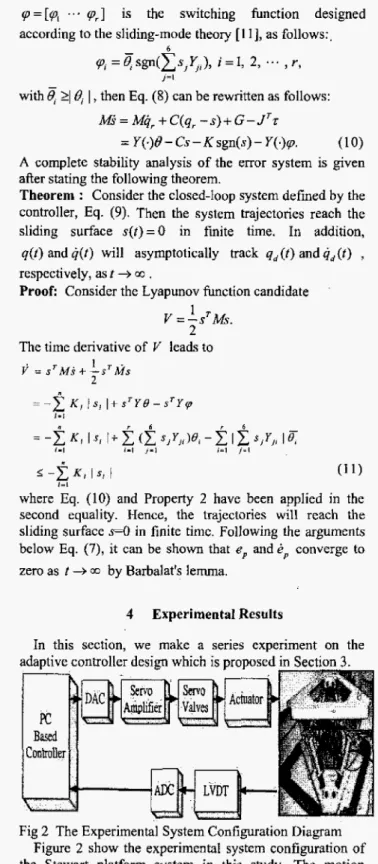
then Eq. (8) can be rewritten as follows: M = Mqr + C ( q , -s)+G-J'r= Y ( ) d - C ~ - K s g n ( s ) - Y(.)p. (10) A complete stability analysis of the error system is given after stating the following theorem.
Theorem : Consider the closed-loop system defined by the controller, Eq. (9). Then the system trajectories reach the sliding surface s ( r ) = O in finite time. In addition, q(t) and
q(r)
will asymptotically track q d ( f ) andqd(t)
, respectively, as t+
m ,Proof: Consider the Lyapunov function candidate 1
v
= -sTM. 2 The time derivative of V leads to1 G = s T M S
+
- s ' M s 2 = - ~ K , l s J + s = Y ~ - s ~ Y p 1.1 S - k K , l S , l 11 1) i = lwhere Eq. (10) and Property 2 have been applied in the second equality. Hence, the trajectories will reach the sliding surface s=O in finite timc. Following the arguments below Eq. (7), it can be shown that ep and&p converge to zero as c
-+
00 by Barbalat's lemma.4 Experimental Results
In this section, we make a series experiment on the
Fig 2 The Experimental System Configuration Diagram Figure 2 show the experimental system configuration of the Stewart platform system in this study. The motion control system computer runs a drive logic to control a hydraulic system that drive a 6 degree-of-freedom Stewart platform for creating realistic motion cue. The experiment are done with 6 DOF hydraulic Stewart platform system, and is manufactured by SGD Co.. The hydraulic servo valve in the Stewart platform uses MOOG'S JO76-104. The 565
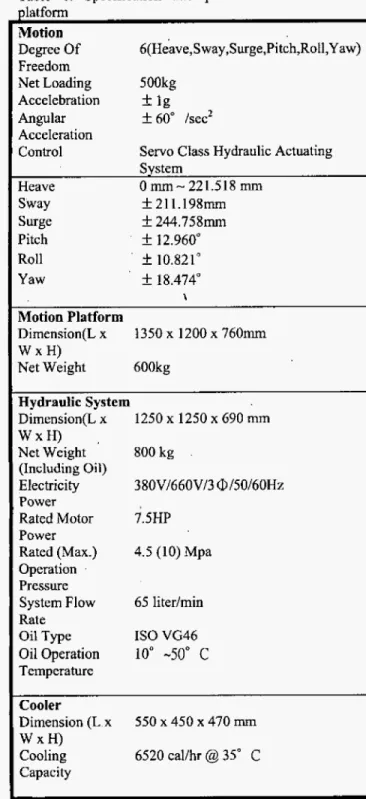
D/A card uses Adventech's 726 and A/D card uses Adventech's 818H. The Detailed parameters and specification will be found in Table 1.
Heave Sway Surge Pitch Roll Yaw Table 1: Specification and parameter of the Stewart
platform Motion Degree Of
6(Beave,Sway,Surge,Pitch,RoH,Yaw)
Freedom Net Loading 500kg Angularf
60" /secZ AccelerationControl Servo Class Hydraulic Actuating AcceIebration
*
IgSystem
Heave 0 KKII
-
221.518 IIKIISway
f
211.198mm Surgef
244.758mm Pitchf
12.960" Rollf
10.821' Yawf
18.474" 8 0-10-0 cm 0 cm 0 cmlOsin(ft) degreehec; f+ad/sec 0 degree 0 degree Motion Platform Dimension(L x Net Weight 600kg Hydraulic System 1350 x 1200 x 7 6 0 m W x H ) D&ension(L x Net Weight (Including Oil) Electricity Power Rated Motor Power Rated (Max.) Operation Pressure System Flow Rate Oil Type Oil Operation Temperature W x H ) , 1 2 5 0 x l 2 5 0 x 6 9 0 m m 800 kg 3 XOV/660V/3
0
/50/60Hz7.5HP
4.5 (10) Mpa 65 litedmin I S 0 VG46 10"-50"
C
Cooler Dimension (L x W x H) Cooling Capacity 550 x 450 x 470 mm 6520 calihr @ 35"C
4. I Results of Sliding mode Controller Design for circular
motion
trackingcase are shown in Table 2:
The desired trajectories for circular motion tracking
Fig. 3 Desired Circular Trajectory I
^___II
I
1
Fig.
4
Desired z , a,p ,
y TrajectoryTable 2 Circular Motion Trajectories
Fig.
5 The Leuajectories .LFig.
9 The Leg5 TrajectoriesP _LI_
Fig. 6 The Leg2 Trajectories
___r
r*rar
Fig. 7 The Leg3 Trajectories
. Tart
Fig. 8 The Leg4 Trajectories Fig, 12 Desired x, y,z,a,y Trajectory
567
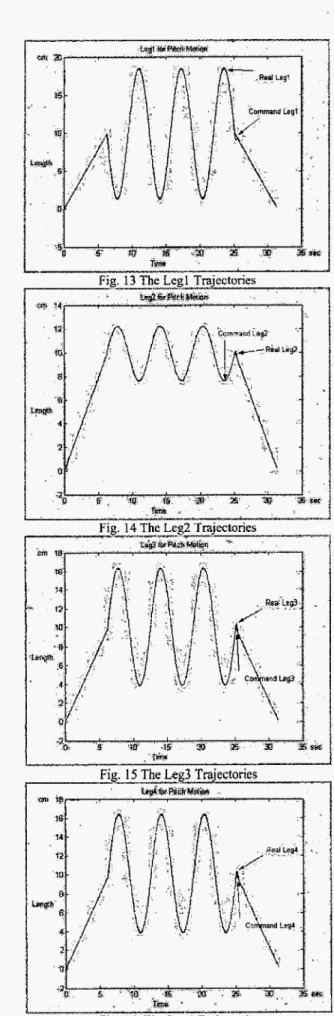
Fig. 16 The Leg4 Trajectories
t
s r a x a as=
r w
Fig. 17 The Leg5 Trajectories
5 Conclusions
In
this paper we present a sliding mode control approach for the motion control of a Stewart platform. The control scheme is proposed given that the overall system parameters are subject to uncertainties while only the positions and velocities of links are measurable. To achieve high performance tracking control of a -6 DOF Stewart platform normally requires the full knowledge of the system dynamics. In this paper, some important properties of the dynamics of the Stewart platform have been dcrived and exploited to develop a sliding-mode controller which can drivethe
motion trackmg
error to zero
asymptotically. Stability analysis based on Lyapunov theory is performed to guarantee that the controller design is stable. Finally, the experimental results c o n f m the effectiveness of our control design.I References
[I] V. E. Gough and S. G. Whitehall, "Universal type test machine," in Proc.9th Int. Tech. Congress FISITA, D. Stewart, "A platform with six degree-of-freedom," in Proc. Inst.Mech. Eng., vol. 180, 1965, pp. 371-386. Z. Geng, L. S . Haynes,
1.
D.
Lee, and R. L. Carroll, "On the dynamics model and kinematics analysis of a 1962, pp. 117-137.[2] [3]
class of Stewart platform,” Robot,Autonomous Syst., G. Lebret, K. Liu, and F. L. Lewis, “Dynamic analysis and control of a Stewart platform manipulator,”
J.
Robot. Syst., vol. 10, no. 5, pp.629-655, 1993. W. Q . D. Do and D. C,
H. Yang,
“Inverse dynamic analysis and simulation of a platform type of robot,”J.
Robot. Syst., vol. 5, no. 3, pp.209-227, 1998.B. Dasgupta and T. S. Mmthyunjaya, “Closed-form dynamic equations of the General Stewart platform through the Newton-Euler approach,”Merh. Mach. Themy, vol. 33, no. 7,pp. 993-1012, 1998.
B. Dasgupta and T. S. Mruthyunjaya, “A Newton- Euler formulation for the inverse dynamics of the Stewart platform manipulator,” Mech. Much. Theoy,
vol. 33, no. 8, pp, 1135-1 152, 1998.
C. D. Zhang and S. M. Song, “An efficient method for the inverse dynamics of manipulators based on the virtual work principle,”
L
Robot. Syst., vol. 10, no. 5, J.Wang and C .M.
Gosselin, “A new approach for the dynamic analysis of parallel manipulators,” MuItiho& vol. 9, pp. 237-254, 1992,pp. 605-627,1993.
S y ~ t . Qw., vol. 2, pp. 3 17-334,1998.
[lo] K. E. Zanganek, R. Sinatra, and J. Angeles, “Kinematics and dynamics of a six-degree-of-freedom parallel manipulator with revolute legs,” Robot, vol. (1 11 L. W. Tsai, “Solving the inverse dynamics of parallel manipulators by the principle of virtual work,” in 1998
A S M E
Design Eng. Tech. CQnf(DETC/MECH-5865),
Sept. 1998, pp. 451457.
[I21 K. M. Lee and D. H. Shah, “Kinematics Analysis of a 3 DOF in Parallel Actuated Manipulator”, IEEE Journal of Robotics and Automation. Vol. 4, No. 3, 15, pp. 385-394,1997.
PP354-360, 1988.
[ 131 J.J.E. Slotine and W.