Reductive dechlorination of carbon tetrachloride by
zero-valent aluminum coupled with Pd/Al
2O
3Hsing-Lung Lien, Department of Civil and Environmental Engineering, National
University of Kaohsiung, 811 Kaohsiung University Rd., Kaohsiung, Taiwan, Fax: 011886-7591-9376, [email protected]
Introduction
Reductive dehalogenation of halogenated organic compounds (HOCs) by zero-valent metals (ZVMs) has extensively been studied1-4. The reaction mechanism involves metal corrosion. For example, in the reduction of carbon tetrachloride with zero-valent iron, iron serves as an electron donor that releases electrons through iron corrosion (eq. 1) while carbon tetrachloride undergoes hydrodehalogenation gaining electrons to form chloroform in the presence of protons (eq. 2).
− + + →Fe 2e Fe0 2 (1) − − + + → + +H 2e CHCl Cl CCl4 3 (2)
Although zero-valent iron was one of the most successful reactive media among the ZVMs in HOC reduction, studies has revealed the limitation of iron3. The corrosion of iron leads to the increase of pH and the formation of iron oxide precipitating on the iron surface. This inevitably results in the decrease of the iron reducibility. 2 2 ) OH ( Fe OH Fe + + − → (3)
Moreover, because of the low reactivity of iron, production and accumulation of chlorinated byproducts were often found. Zero-valent aluminum (Al0), however, provides a great opportunity to dehalogenate HOCs under alkaline conditions because the presence of OH- removes the aluminum oxide layer5:
O H AlO 2 OH 2 O Al2 3 + − → 2− + 2 (4)
It is well known that when molecular hydrogen adsorbs onto palladium (Pd) surface, Pd-H is formed readily through the H2 dissociation6-7. The H-covered
surface of Pd has been used to hydrodehalogenate HOCs. Studies have shown that a small amount of Pd deposited on iron increases reduction rates by at least one order of magnitude8. Using H2 as a reductant, supported Pd catalysts have also shown an
excellent performance for dehalogenation of many HOCs9. Further, complete degradation that leads to benign products is often observed in the presence of palladium.
In this work, attempt was made to develop a greener technology for HOC treatment at high pH by taking advantage of both zero-valent aluminum and supported palladium. Carbon tetrachloride was chosen as the model substance because it undergoes different pathways at various pH.
Experimental Methods
Preparation of Al0-Pd/Al2O3. For a typical experiment, 2.0 g of Al0 and 1.0 g
of aluminum oxide (activated, acidic, Brockmann I) mixtures were added into a palladium solution prepared by dissolving 0.022 g of palladium acetate into a 20 mL ethanol. 20 mL of 0.75 N NaOH solution was then added into the suspension. The dark palladium solution turned to be colorless quickly. This indicated the Pd2+ was converted to Pd0. Meanwhile, the white aluminum oxide became gray particles, which indicated the Pd0 was deposited onto the Al2O3 surface. After stirring for 3
minutes, the suspension was filtered and washed by distilled water. Assuming that all the Pd metal was reductively precipitated onto the Al2O3, the maximum content of
the Pd in the Al2O3 was calculated as 1% by weight.
Batch experiments. Batch experiments were conducted in 150 mL serum
bottles (Wheaton glass). For each batch bottle, 20 µL of methanol solution of a chlorinated methane was spiked into a 50 mL aqueous solution to achieved a desired concentration. Typical metal loading of Al0 and Pd/Al2O3 was 40 g/L and 20 g/L,
respectively. The serum bottles were capped with Teflon Mininert valves and mixed on a rotary shaker (30 rpm) at room temperature (22±1 °C). Batch bottles containing the chlorinated methane in the absence of metals were used as controls.
Methods of analyses. Concentrations of chlorinated methanes were measured
by a HP5890 GC equipped with a DB-624 capillary column (30 m x 0.32 mm, J&W) and an electron capture detector (ECD). Temperature conditions were programmed as follows: oven temperature at 50 °C; injection port temperature at 200 °C; and detector temperature at 300 °C. Hydrocarbon products in the headspace were quantified with GC equipped with a flame ionization detection (FID) and an AT-Q
column (30 m x 0.32 mm, Alltech). Oven temperature was set at 30 °C, injection port temperature at 250 °C, and detector temperature at 300 °C.
Results and Discussion
The transformation of chlorinated methanes by Al0-Pd/Al2O3 was conducted at
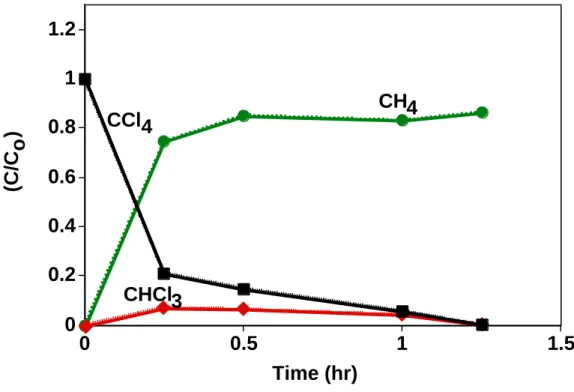
pH 9.0. As shown in Figure 1, complete and rapid degradation of carbon tetrachloride was observed. Methane appeared as the major product accounting for about 86.4% of the carbon tetrachloride lost. Chloroform was detected in a small amount (~4.2%) and no dichloromethane was found. The use of Pd in the treatment of HOCs often results in the low yield of lesser-halogenated intermediates8-9, which is consistent with this study. The direct transformation is likely to be attributed to the catalytic hydrodehalogenation that is favorable to occur at the surface of the low cathodic hydrogen overpotential metals such as Pd10. The degradation of chloroform to methane by Al0-Pd/Al2O3 was also found as shown in Figure 2. 30 mg/L of
chloroform was completely dehalogenated within 6 hours. Methane accounted for about 77% of the disappearance of chloroform and dichloromethane was detected in a small amount (~5%) after one hour.
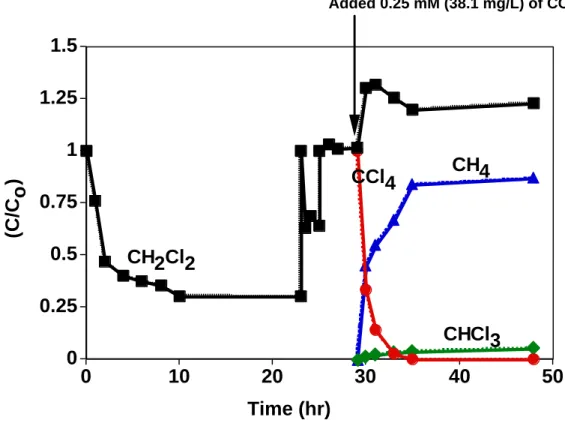
A preliminary experiment showed that approximately 80% of dichloromethane was removed within 10 hours but no reaction byproducts were detected in the presence of Al0-Pd/Al2O3. A repetitive test of spiking dichloromethane into a batch
bottle was then conducted. The batch bottle containing 20 g/L of Pd/Al2O3 and 20
g/L of Al0 was spiked with 16 µmole of dichloromethane for three times. As shown in Figure 3, removal of dichloromethane stopped after the addition of about 48 µmoles of dichloromethane while no intermediates were found. This suggested that the removal of dichloromethane by Al0-Pd/Al2O3 was through the sorption process for
which the sorption sites were saturated with 48 µmoles of dichloromethane.
The addition of carbon tetrachloride was used to investigate the activity of Al0-Pd/Al2O3 after the surface sites were saturated with dichloromethane. Carbon
tetrachloride was degraded rapidly to methane (78%) and chloroform was detected in small amounts (~8%). This is consistent with the results shown in Figure 1. The degradation of carbon tetrachloride to methane indicates no loss of activity of Al0-Pd/Al2O3 when the surface sites had been saturated with dichloromethane. In
addition, a rebound of dichloromethane concentration was observed after the addition of carbon tetrachloride. The rebound of dichloromethane concentration suggests that there would be a competitive sorption between carbon tetrachloride and dichloromethane.
In summary, this work indicated that zero-valent aluminum coupled with supported palladium effectively dechlorinated carbon tetrachloride to methane under
alkaline conditions. No accumulation of less-chlorinated products was found. This suggested that the elemental aluminum coupled with Pd/Al2O3 is an
environmental-friendly technology for the treatment of HOC contamination.
References
Gillham, R. W.; O’Hannesin, S. F. Ground Water 1994, 32, 958. 1. 2. 3. 4. 5. 6. 7. 8. 9. 10.
Roberts, A. L.; Totten, L. A.; Arnold, W. A.; Burris, D. R.; Campbell, T. J. Environ. Sci. Technol. 1996, 30, 2654.
Matheson, L. J.; Tratnyek, P. G. Environ. Sci. Technol. 1994, 28, 2045.
Boronina, T.; Klabunde, K. J.; Sergeev, G. Environ. Sci. Technol. 1995. 29, 1511. Birnbaum, H. K.; Buckley, C.; Zeides, F.; Sirois, E.; Rozenak, P.; Spooner, S.; Lin, J. S. J. Alloys Compounds. 1997, 253-254, 260.
Masel, R. I. Principles of Adsorption and Reaction on Solid Surfaces, John Wiley & Sons, Inc. 1996.
Weiss, A. H.; Gambhir, B. S.; Leon, R. B. J. Catal. 1971, 22, 245. Lien, H. L.; Zhang, W. J. Environ. Eng. 1999, 125, 1042.
Lowry, G. V.; Reinhard, M. Environ. Sci. Technol. 1999, 33, 1905. Brewster, J. H. J. Am. Chem. Soc. 1954, 76, 6361.
o
0
0.2
0.4
0.6
0.8
1
1.2
(C/C
)
0
0.5
1
1.5
Time (hr)
CH4
CCl4
CHCl3
0 0.25 0.5 0.75 1 1.25 (C/C o ) 0 2 4 6 8 Time (hr) CH4 CHCl3 CH2Cl2
Figure 2. Transformation of chloroform by Al0-Pd/Al2O3.
0 0.25 0.5 0.75 1 1.25 1.5 (C/C o ) 0 10 20 30 40 50 Time (hr) CH2Cl2 CCl4 CH4 CHCl3 Added 0.25 mM (38.1 mg/L) of CCl 4