科技部補助專題研究計畫成果報告
期末報告
幼童語言及幼童導向語言中的自我重複現象
計 畫 類 別 : 個別型計畫 計 畫 編 號 : MOST 102-2410-H-004-056- 執 行 期 間 : 102 年 08 月 01 日至 103 年 10 月 31 日 執 行 單 位 : 國立政治大學語言學研究所 計 畫 主 持 人 : 黃瓊之 計畫參與人員: 碩士班研究生-兼任助理人員:鄭宇涵 報 告 附 件 : 出席國際會議研究心得報告及發表論文 處 理 方 式 : 1.公開資訊:本計畫涉及專利或其他智慧財產權,2 年後可公開查詢 2.「本研究」是否已有嚴重損及公共利益之發現:否 3.「本報告」是否建議提供政府單位施政參考:否中 華 民 國 104 年 02 月 03 日
中 文 摘 要 : 自我重複現象在語言使用中經常發生。自我重複現象不僅在 成人對話中常見,在成人與幼童對話中更為頻繁。過去的研 究對成人對話中的自我重複多視為一種溝通策略,然而對成 人與幼童對話中的自我重複卻僅限於視其為一種教導策略或 學習策略。本研究的目的在於探討除了可能的教導或學習目 的之外,在親子對話中母親與小孩是否及如何使用自我重複 作為他們溝通的策略。換句話說,本研究認為需考慮幼童不 僅是學習者也是溝通者這個事實。 本研究的參與者為 12 位說漢語的幼童及他們的母親。這些幼 童可分為三個年齡層:兩歲組(2;1-2;7),三歲組(3; 1-3;2),及四歲組(4;5-4;11),每組包括四位幼童 (兩男兩女)。幼童與母親在家中的自然對話以錄影方式錄 下,每對親子對話錄影一小時。所蒐集的語料以 CHAT 系統 (MacWhinney, 2000)進行譯寫。然後對幼童語料中的自我 重複現象以及母親語料中的自我重複現象進行形式與功能的 分析,分類成 4 種形式及 9 種功能。 研究結果發現,幼童的自我重複在形式與功能的種類上隨年 齡的增加而增加,顯示了發展上的變化。幼童顯然在自我重 複中學習溝通,他們學習架構語句形式來達到特定的溝通需 求。在母親的自我重複部分,研究結果發現,母親自我重複 的頻率、形式、及功能都與幼童的年齡有關,反映了兒童導 向語言的特性。母親的自我重複現象顯然顯示了母親在與認 知及語言發展中的孩子對話時,特殊的互動敏感度及溝通需 求。 中文關鍵詞: 自我重複,兒童語言、兒童導向語言、漢語
英 文 摘 要 : Self-repetition, repetition of a speaker's own utterances, has been noted as a pervasive phenomenon in language behavior. Self-repetition occurs
frequently in adult conversation, and perhaps even more frequently in adult-child interaction. While self-repetition in adult conversation has been examined as a communicative strategy, it has often been treated merely as an instructive/learning
strategy in adult-child conversation. The purpose of this study is to examine whether and how
self-repetition, in addition to its potential
and children as a communicative strategy in mother-child interaction. In other words, this study
attempts to take into account the fact that children are not only learners but also communicators.
The participants of this study were 12 Mandarin-speaking children and their mothers. These children can be divided into three age groups: two-year-olds (2;1-2;7), three-year-olds (3;1-3;2), and four-year-olds (4;5-4;11); each group consisted of four children (two boys and two girls). The children's natural conversation with their mothers was video-recorded in their homes. Each mother-child dyad was recorded for an hour. The collected conversation data were then transcribed using CHAT convention
(MacWhinney, 2000) for analysis. Self-repetitions were identified in the children's speech and in the mothers' child-directed speech. The identified self-repetitions were further classified into four forms and nine functions according to the coding scheme used in this study.
The results show that the children expanded their repertoires of both the forms and the functions of self-repetitions with increasing age, revealing a developmental change. It appears that in repeating, children are learning to communicate and to construct utterances to meet specific communicative needs. As for the mothers' self-repetitions, the results showed that the frequencies, the forms, and the functions of the mothers' self-repetitions were related to the ages of the children, reflecting the characteristics of child-directed speech. It appears that the mothers' use of self-repetitions
demonstrates their particular interactional
sensitivity and communicative needs when addressing their cognitively and linguistically developing children.
英文關鍵詞: self-repetition, children's speech, child-directed speech, Mandarin Chinese
Self-repetition in children’s speech and child-directed Speech
Chiung-chih Huang National Chengchi University
1. Introduction
Self-repetition, repetition of a speaker’s own utterances, has been noted as a pervasive phenomenon in language behavior. Self-repetition occurs frequently in adult conversation, and perhaps even more frequently in adult-child interaction. Many studies have been conducted to investigate the role of self-repetition in adult conversation (e.g., Johnstone et. al., 1994; Ku, 1998; Norrick, 1987; Tannen, 1987; Tsai, 2002; Wong, 2000) and in adult-child interaction (e.g., Brodsky, Waterfall, & Edelman, 2007; Gisela & Matthias, 2009, Moerk, 1989; Munoz-Duston, 1992; Shatz & Ebeling, 1991). While self-repetition in adult conversation has been examined as a communicative strategy, it has often been treated merely as an instructive/learning strategy in adult-child conversation. The purpose of this study is to examine whether and how self-repetition, in addition to its potential instructive/learning purpose, may be used by mothers and children as a communicative strategy in mother-child interaction. In other words, this study attempts to take into account the fact that children are not only learners but also communicators.
1.1 Self-repetition in adult speech
Research on self-repetition in adult conversation has treated the phenomenon of repetition as a communicative strategy. From a discourse/conversation analysis perspective, researchers have identified a variety of functions of self-repetition in adult conversation (Johnstone et al, 1994; Ku, 1998; Norrick, 1987; Tannen, 1987; Tsai, 2002; Wong, 2000).
Norrick (1987) proposed that self-repetition in adult conversation can serve four categories of functions, namely, semantically based functions, production-based functions, comprehension-based functions, and interaction-based functions. Further taxonomy was suggested. Semantically based functions include idiomatic, iconic, and parallel phrasing functions. Production based functions include the functions of holding flooring and of bridging interruptions. Comprehension-based functions include the functions of insuring precise understanding and of increasing coherence. As for interaction-based functions, the categories include question/answer, repeat unchanged, repeat with stress, and repeat with expansion.
Similarly, Tannen (1987) also pointed out that the varied functions
production, comprehension, connection, and interaction. In addition, the congruence of these levels of discourse provides a fourth and over-arching function in the establishment of coherence and interpersonal involvement.
Wong (2000) examined one form of self-repetition, which has been addressed in prior literature as verbal bracketing or repair repeat. In this form of repetition, a speaker produces a ‘first saying’ and a ‘second saying’ within the same turn, with an inserted element between the two sayings. Wong suggested that this particular form of repetition is used by speakers as a storytelling technique in the accomplishment of the action of resumption.
Tsai (2002) investigated repetition in spoken Mandarin. It was shown that self-repetition in Mandarin serves a variety of discourse functions, including describing iconicity, bridging interruptions, responding to other-initiated repairs, soliciting responses, targeting the next action, and humor/savoring.
1.2 Self-repetition in children’s speech
Research on self-repetition in adult-child interaction has mainly concerned its role in children’s linguistic development. Children’s self-repetition has often been referred to as a learning strategy, and investigations have been done to determine the role of this strategy in the learning of vocabulary and syntax. In some studies, it has also been regarded as a phenomenon resulting from children’s production problems.
Moerk (1989) indicated that self-repetition reveals the redundancy of the interactions between mothers and young children. Such redundancy not only lowers the information-processing load for the children but also provides massive rehearsals for the linguistic terms involved. In addition, many of these self-repetitions are not exact repetitions; instead, the repeated form is somewhat superior to the original form. It was suggested that self-repetition may be beneficial for lexical acquisition.
Kirchner and Prutting (1987) investigated spontaneous verbal repetition in the speech of normal children (1;8-2;6) and language disordered children (2;8-4;2). The results showed that the children, whether disordered or normal, showed higher frequencies of self-repetition than repetition of the speech of another person. As for repetition subtypes, the highest proportion of self-repetition was in the category of complete repetition followed by partial/reduction and complete/expanded. Two potential functions of repetition were identified. First, repetition was used to extend communicative ability while compensating for linguistic and cognitive deficits. The second function is repetition as a context for practice which contributes both to the acquisition of language structure and to the development of verbal skill.
Similarly, in Nelson’s (1973) investigation of the strategies of language
an ‘accommodative strategy’ used by less effective talkers when experiencing difficulty in communication. In other words, self-repetition may be related to production problems at a point where language acquisition has begun but is not advanced.
Perez-Pereira (1992) investigated the speech of two twin sisters; one of the children was blind while the other had normal vision. The children were recorded once a month from 2;5 to 3;5. The children’s imitations, repetitions and routines (IRR speech) were analyzed in comparison with their productive utterances. The results showed that MLU for IRR speech was greater than that for productive utterances. It appeared that IRR speech facilitated language development. It was further found that a large number of modified self-repetitions were used by both children, revealing clear evidence of the potential of self-scaffolding strategies. In other words, the children used progressively modified self-repetitions to convey their intentions more effectively. Comparing the two children’s discourse, the analysis showed that the blind girl used modified self-repetitions with a significantly higher frequency than her sighted sister.
In addition, Shatz and Ebeling (1991) also examined revisions (i.e.,
self-repetitions). The analysis showed a large number of revisions with self-correction produced by the six children they observed (aged 2;0 to2;6). Almost 73% of all revisions included a grammatical change (either syntactic or morphological) of some sort. The authors suggested that these revisions served as a self-monitoring device.
As seem above, self-repetition in adult-child interaction has been investigated mostly for its effect on children’s linguistic development. Only a few studies have focused on the pragmatic functions of children’s self-repetition (Ochs Keenan, 1977; Munoz-Duston, 1992).
Munoz-Duston (1992) analyzed the speech of Spanish and English bilingual children. It was shown that the children repeat themselves more in their native
language, Spanish, than they do in their second language, English. The self-repetitions in the data perform a variety of functions, including the functions of cohesion, rapport, and emphasis within the discourse. In addition, self-repetitions are also pervasive in contingent queries and self-repairs, and they also serve the function of retaining or fulfilling a speaking turn. In addition to Munoz-Duston (1992), Ochs Keenan (1977) also suggested that children may use self-repetition as a device to solicit responses from their co-conversationalists.
1.3 Self-repetition in child-directed speech
As for self-repetition in child-directed speech, i.e., adult speech in addressing children, studies have been done to examine the effect of maternal self-repetition on
the linguistic progress of children. The results, however, have been inconsistent. While a number of studies have concluded that self-repetition in maternal speech plays no role or even a negative role in children’s linguistic development (Gisela & Matthias, 2009; Newport & Gleitman, 1977), other studies have reported that maternal self-repetition facilitates grammatical and lexical development (Brodsky, Waterfall, & Edelman, 2007; Hoff-Ginsberg, 1985, 1986, 1990; Brown, 1998; Moerk, 1983; Waterfall, 2006).
According to Newport and Gleitman (1977), no indication was found from their naturalistic study that mothers who repeat themselves a great deal have children who acquire language more quickly. In addition, their experimentally controlled study further revealed that children give no evidence of responding to repetitions as repetitions, indicating a rejection of the premise of the repetition hypothesis. The authors concluded that it seems unlikely that repetition per se could have a beneficial effect on language acquisition.
In addition, the results reported in Gisela and Matthias (2009) showed that maternal self-repetitions were negatively related to child progress in grammar. It was suggested that self-repetitions do not help the child’s developing grammar, and that, on the contrary, they have a negative influence. As suggested by Gisela and Matthias, this may be due to the fact that more repetitions offer less variety, reflecting a
generally inflexible and uninteresting dialogue style. Such style may cause a child to pay less attention to adult speech.
However, Moerk (1983) showed that maternal self-repetitions are rarely identical and mostly include a range of systematic variations. These diverse variations
emphasize specific instructional contents. It was suggested that maternal self-repetitions can function as linguistic models for the child.
Hoff-Ginsberg (1985, 1986, 1990) also examined the effect of maternal self-repetitions in children’s progress in language acquisition. The studies revealed that maternal self-repetitions are positively correlated with the development of verb phrases and noun phrases in child speech. The results showed that maternal
self-repetitions that alter materials at major constituent boundaries are related to the growth of verb phrases while those that alter materials within a phrasal constituent aid in the growth of noun phrases.
Kuntay and Slobin (1996) further investigated the effect of variation sets, i.e., clusters of self-repetitions, in child-directed speech. They found that variation sets made up approximately 20% of child-directed speech. It was suggested that variation sets seem to be ideal environments for learning lexical items and constituent
structures. Brown (1998) pointed out that underlying a variation set is a single communicative intention, which is rephrased and repeated with lexical substitutions,
addition and deletion. Although it is self-repetition, it is interactive in being adapted to the child’s perceived response (or lack thereof). Furthermore, Waterfall (2006) also found that children’s production of a structure is highly correlated with parents’ manipulation of that structure in variation sets.
1.4 Huang (2010, 2012): A discourse-pragmatic approach
As mentioned above, both children’s speech and maternal speech are highly repetitive in nature. Children and mothers repeat their own utterances (self-repetition); in addition, they also repeat a large number of utterances addressed to them
(other-repetition). While both self-repetition and other-repetition in adult-child conversation have been studied mostly for their role in children’s linguistic
development, it has been suggested that repetition may play a more important role in the development of communicative competence than it does in the development of linguistic competence (Ochs Keenan, 1977; Casby, 1986). While little has been done on self-repetition from this perspective, a few studies have adopted such approach to investigate other-repetition, including two previous studies of mine (Huang, 2010, 2012).
Huang (2010) aimed to investigate other-repetition in Mandarin child discourse from a discourse-pragmatic perspective. The participants of the study consisted of two 2-year-old children; the children’s natural conversations with their parents were observed longitudinally for a year. Analyses were conducted to examine the forms, functions and discourse profiles of the children’s other-repetition. The forms of other-repetition were classified into four categories: (1) exact repetition, (2) reduced repetition, (3) modified repetition, and (4) expanded repetition. The different forms of other-repetition were further examined to determine their communicative functions in the conversational interaction. In addition, discourse profiles of other-repetition were also analyzed; the profiles consisted of linguistic and behavioral events prior to, during, and after the other-repetition. The results showed that the children used other-repetition for a variety of communicative functions, including imitating preceding adult utterances, answering questions, acknowledging what the prior speaker had said, and showing agreement. It was also found that different forms of other-repetition tended to serve different functions. From the analysis, it was shown that other-repetition often reflected the children’s competence and not their
incompetence as communicators. The findings were further discussed in relation to the developmental aspects of the children’s conversational skills.
Huang (2012) attempted to demonstrate that parental other-repetition needs to be considered not only as models of linguistic forms but also as acts in communicative exchanges, and needs to be studied as part of verbal interaction sequences. Thus, from
a discourse-pragmatic perspective, this study investigated the types and functions of parental other-repetition in Mandarin parent-child interaction. The subjects of this study were two Mandarin-speaking parent-child dyads. The data included six hours of natural conversations recorded when the children were between the ages of 2;1 and 3;1. Parental other-repetitions were classified into four repetition types: Exact, Reduced, Modified, or Expanded. The different types of repetitions were further analyzed to examine the pragmatic functions of parental other-repetition within the framework of communicative exchanges. It was found that the parents used the different types of repetition for a variety of communicative purposes such as acknowledging the receipt of information, asking for clarification, asking for confirmation, targeting a next action, and reformulating the child’s utterances. It appears that parental other-repetition reflects the particular nature of parent-child interaction; i.e., the parent is interacting with a partner who has limited cognitive and verbal skills. Other-repetition reflects parents’ attempts to facilitate interaction through appropriate responsiveness, and the responsivity demonstrated by parental other-repetition appears to be a principal component of a development-fostering relationship. In addition, there appears to be some differences between
other-repetition used in adult conversation and in parental speech to children,
suggesting that parents make some adjustments of their use of other-repetition in their child-directed speech.
In sum, while many previous studies have referred to other-repetition in child language as a learning mechanism, and that in parental speech as an instructive technique, Huang (2010, 2012) have shown that other-repetition serves important communicative functions in children’s speech and in child-directed speech. In addition, the children’s and the parents’ use of other-repetition also reflects the particular nature of parent-child conversation.
1.5 The present study
In taking repetition merely as an instructive/learning mechanism in parent-child interaction, many previous studies have dealt with language in the absence of
communicative intent (Casby, 1986). Since adults use self-repetition for
communicative purposes, children may just be trying to do the same thing. In other words, children are not only learners but also communicators (Ochs Keenan, 1977).
As seen above, my earlier works Huang (2010, 2012) have explored other-repetition in Mandarin-speaking children’s and parents’ speech from a discourse-pragmatic perspective. These studies have shed some light on our
understanding of the pragmatic functions of other-repetition in Mandarin child speech and parental speech within the framework of communicative exchanges. The present
study attempts to serve as a further endeavor of this line of research. As shown in Kirchner and Prutting (1987), self-repetitions occur even more frequently than other-repetitions in children’s speech. The purpose of this study is thus to investigate how self-repetitions are used to serve communicative purposes in the speech of Mandarin-speaking children and their mothers, and how the use of self-repetitions may reflect the particular nature of children’s speech and child-directed speech. It is hoped that this study can further our understanding of the development of children’s conversational skills and the characteristics of mothers’ child-directed speech.
2. Methods
2.1. Participants and data
The participants of this study were 12 Mandarin-speaking children and their mothers. These children can be divided into three age groups: two-year-olds (2;1-2;7), three-year-olds (3;1-3;2), and four-year-olds (4;5-4;11); each group consisted of four children (two boys and two girls). The children’s natural conversation with their mothers was video-recorded in their homes. Each mother-child dyad was recorded for an hour. The collected conversation data were then transcribed using CHAT
convention (MacWhinney, 2000) for analysis.
2.2. Coding scheme
The transcribed data were analyzed to investigate the forms and functions of self-repetitions in the children’s speech and in the mothers’ child-directed speech. The coding scheme is as follows:
(1) Speakers:
Self-repetitions in both the children’s speech and the mothers’ child-directed speech were identified.
(a) Child: self-repetitions by the child (b) Mother: self-repetitions by the mother (2) Forms:
Self-repetitions were classified into four forms according to the faithfulness of the self-repetitions to the repeated utterances. The categorization follows Perez-Pereira (1994) and Huang (2010, 2012).
(a) Exact: Reproduction of all the words of the utterance, in the same order without any changes or additions.
(b) Reduced: The reproduction involves omission of functors, morphemes or content words from the utterance.
(c) Modified: The reproduction involves changes of the pronoun, the order of the elements, or the complement, etc.
(d) Expanded: One part of the utterance is repeated and another part involves added elements.
(3) Functions:
Self-repetitions were examined in the conversational discourse to determine their communicative functions. Based on previous studies (Johnston, et al., 1994; Ku, 1998; Tsai, 2002), the classification system used in this study is as follows:
(a) Soliciting responses (SRP): Repetition of the speaker’s own previous question/request to solicit a verbal/nonverbal response from the listener. (b) Elaboration (ELA): Repetition of the speaker’s own previous utterance with
new information added.
(c) Clarification (CLA): Repetition of the speaker’s own previous utterance to remedy interruption/overlap or to respond to an other-initiated repair. (d) Answering (ANS): Repetition of the speaker’s own previous utterance to
answer a question posed by the speaker himself/herself.
(e) Emphasis (EMP): Repetition of the speaker’s own previous utterance to strengthen the force of the utterance or to increase the comprehensibility of the utterance.
(f) Reporting (REP): Repetition of the speaker’s own previous utterance to report previously mentioned information to another addressee.
(g) Attention getting (AG): Repetition of the speaker’s own previous utterance to draw the listener’s attention.
(h) Conceptual planning (CP): Repetition of the speaker’s own previous utterance to gain more time for processing.
(i) Describing iconicity (DI): Repetition of the speaker’s own previous utterance to describe the distribution, iteration, or continuation of an act
3. Results
3.1 Children’s self-repetition
Table 1 shows the numbers of total utterances and the numbers of self-repetitions in the children’s data. In addition, the proportions of the children’s self-repetitions are also presented. As seen in Table 1, self-repetitions occurred most frequently in the two-year-olds’ data. Among the total utterances produced by the two-year-olds, 12.5% of the utterances were self-repetitions. As for the data for the three-year-olds and the four-year-olds, lower percentages of self-repetitions were observed: they were 9.69% and 9.81%, respectively.
Table 1. Frequency of children’s self-repetition
N % N % N % N % Self-repetition 245 12.50 210 9.69 249 9.81 704 10.56 Total utterances 1960 100 2167 100 2537 100 6664 100
Further analysis was conducted to examine the forms of self-repetitions used by the children. As seen in Table 2, the two-year-olds used mostly exact repetitions; they used exact repetitions as frequently as 56.73% of the time. The distribution patterns were less skewed toward exact repetitions in the data for the three-year-olds and the four-year-olds. The two older groups of children used both exact repetitions and expanded repetitions frequently; these two forms were used from 29.52% to 40.56% of the time in the data for the two older groups.
Table 2: Forms of children’s self-repetition
2-year-olds 3-year-olds 4-year-olds Total Children N % N % N % N % Exact 139 56.73 62 29.52 101 40.56 302 42.9 Expanded 48 19.59 68 32.38 79 31.73 195 27.70 Modified 13 5.31 43 20.48 24 9.64 80 11.36 Reduced 45 18.37 37 17.62 45 18.07 127 18.04 Total 245 100.00 210 100.00 249 100.00 704 100.00
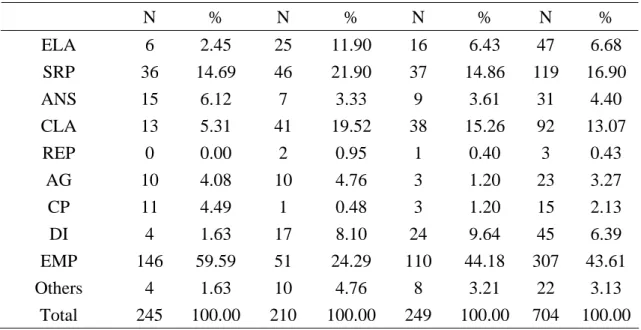
In addition to the forms of self-repetition, the functions of the self-repetition were also analyzed. Table 3 presents the proportions of different functions expressed by the children’s self-repetitions. Table 3 shows that Emphasis was the predominant function of the two-year-olds’ self-repetitions. This function occurred as frequently as 59.59% of time in the two-year-olds’ self-repetitions. Another main function of the two-year-olds’ self-repetitions was Soliciting Responses, which occurred 14.69% of the time. As for the three-year-olds and the four-year-olds, they also used
self-repetitions mainly for the function of Emphasis. However, the percentages of Emphasis in the data for the two older groups were not as high as that found in the two-year-olds’ data; they were 24.29% and 44.18%, respectively. In addition to Emphasis, other main functions in the two older groups’ self-repetitions were Soliciting Responses and Clarification. The proportions of Soliciting Responses and Clarification were 21.90% and 19.52% in the three-year-olds’ data, and 14.86% and 15.26% in the four-year-olds’ data.
Table 3: Functions of children’s self-repetition
N % N % N % N % ELA 6 2.45 25 11.90 16 6.43 47 6.68 SRP 36 14.69 46 21.90 37 14.86 119 16.90 ANS 15 6.12 7 3.33 9 3.61 31 4.40 CLA 13 5.31 41 19.52 38 15.26 92 13.07 REP 0 0.00 2 0.95 1 0.40 3 0.43 AG 10 4.08 10 4.76 3 1.20 23 3.27 CP 11 4.49 1 0.48 3 1.20 15 2.13 DI 4 1.63 17 8.10 24 9.64 45 6.39 EMP 146 59.59 51 24.29 110 44.18 307 43.61 Others 4 1.63 10 4.76 8 3.21 22 3.13 Total 245 100.00 210 100.00 249 100.00 704 100.00
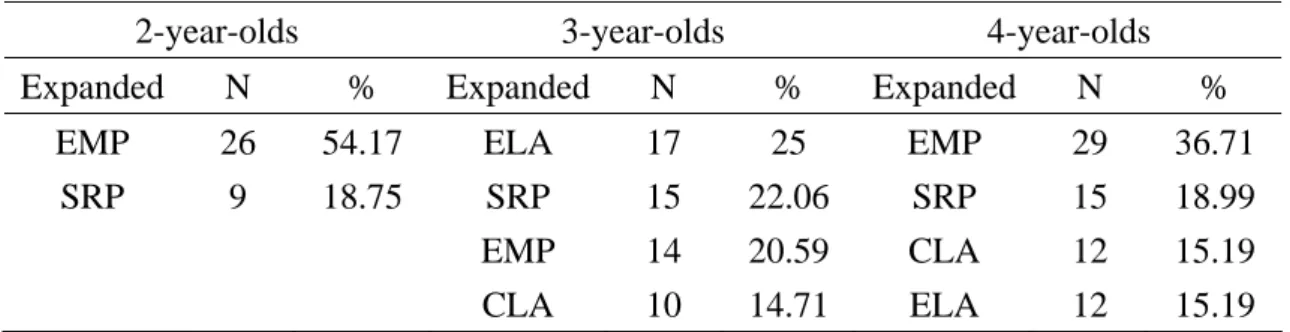
In order to have a better idea of the form-function relationship of the children’s self-repetitions, further analysis was conduced to examine the functions expressed by the different forms of self-repetitions in the children’s data. Tables 4a-4d present the major functions served by exact, expanded, modified, and reduced repetitions; these are the functions which have a percentage equal to or above 10% in the data.
Tables 4a-4d show that for the two-year-olds, Emphasis and Soliciting Responses were the two major functions for all of the four different forms of self-repetitions, with the proportions of Emphasis much larger than those of
Soliciting Responses. Although the two-year-olds also used modified repetitions for the functions of Conceptual Planning (15.38%) and Elaboration (15.38%), these two functions actually included only 2 occurrences, due to the small number of modified repetitions in the two-year-olds’ data. As for the three-year-olds and the
four-year-olds, the tables show that these two groups of children used exact, expanded, and modified repetitions for four major functions, and used reduced repetitions for three major functions. In other words, although Emphasis and
Soliciting Responses were also the main functions in their data, the two older groups were less restricted to these two functions when using self-repetitions. They were able to use self-repetitions to perform a larger variety of functions.
Table 4a: Exact repetitions and major functions in children’s data
2-year-olds 3-year-olds 4-year-olds Exact N % Exact N % Exact N %
EMP 86 61.87 EMP 16 25.81 EMP 48 47.52 SRP 18 12.95 CLA 14 22.58 DI 18 17.82 SRP 13 20.97 CLA 11 10.89
DI 9 14.52 SRP 11 10.89
Table 4b: Expanded repetitions and major functions in children’s data
2-year-olds 3-year-olds 4-year-olds Expanded N % Expanded N % Expanded N %
EMP 26 54.17 ELA 17 25 EMP 29 36.71 SRP 9 18.75 SRP 15 22.06 SRP 15 18.99 EMP 14 20.59 CLA 12 15.19 CLA 10 14.71 ELA 12 15.19
Table 4c: Modified repetitions and major functions in children’s data
2-year-olds 3-year-olds 4-year-olds Modified N % Modified N % Modified N %
EMP 4 30.77 EMP 11 25.58 EMP 9 37.5 SRP 3 23.08 CLA 9 20.93 CLA 6 25
CP 2 15.38 SRP 8 18.6 ELA 4 16.67 ELA 2 15.38 ELA 7 16.28 SRP 4 16.67
Table 4d: Reduced repetitions and major functions in children’s data
2-year-olds 3-year-olds 4-year-olds Reduced N % Reduced N % Reduced N %
EMP 30 66.67 EMP 10 27.03 EMP 24 53.33 SRP 6 13.33 SRP 9 24.32 CLA 9 20 CLA 8 21.62 SRP 7 15.56
3.2 Mothers’ self-repetition
Table 5 shows the numbers of total utterances and the numbers of self-repetitions in the mothers’ data. In addition, the proportions of the mothers’ self-repetitions are also presented. As seen in Table 5, self-repetitions occurred most frequently in the data for the two-year-olds’ mothers. Among the total utterances produced by the two-year-olds’ mothers, 19.23% of the utterances were self-repetitions. The data for the three-year-olds’ mothers contained a lower percentage of self-repetitions (14.19%). An even lower percentage of self-repetitions was found in the data for the
four-year-olds’ mothers (8.22%). It appears that the frequency of the mothers’
self-repetitions was affected by the age of the children; that is, the mothers of younger children tended to resort to self-repetitions more frequently than those of older
Table 5. Frequency of mothers’ self-repetition
2-year-olds 3-year-olds 4-year-olds Total Mothers
N % N % N % N % Self-repetition 874 19.23 514 14.19 281 8.22 1669 14.41 Total utterances 4544 100 3621 100 3417 100 11582 100
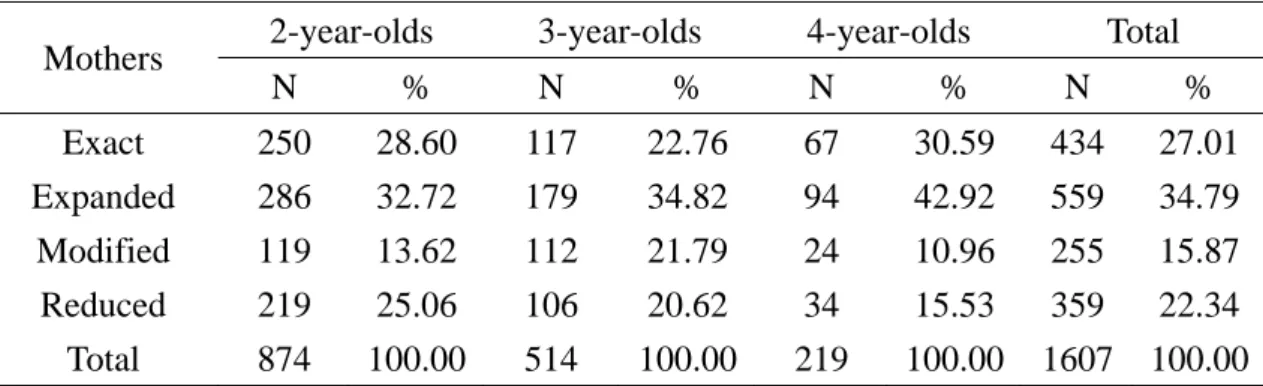
Further analysis was also conducted to examine the forms of self-repetitions used by the mothers. As seen in Table 6, expanded repetitions were the most frequently used form in the data for the three groups of mothers. The percentages of expanded repetitions were 32.72% for the two-year-olds’ mothers, 34.82% for the
three-year-olds’ mothers, and 42.92% for the four-year-olds’ mothers. It appears that the mothers of older children tended to use more expanded repetitions. An opposite pattern was found in the mothers’ use of reduced repetitions. As seen in the table, the percentages of reduced repetitions were 25.06% for the two-year-olds’ mothers, 20.62% for the three-year-olds’ mothers, and 15.53% for the four-year-olds’ mothers. It appears that the mothers of older children tended to use less reduced repetitions.
Table 6: Forms of mothers’ self-repetition
2-year-olds 3-year-olds 4-year-olds Total Mothers N % N % N % N % Exact 250 28.60 117 22.76 67 30.59 434 27.01 Expanded 286 32.72 179 34.82 94 42.92 559 34.79 Modified 119 13.62 112 21.79 24 10.96 255 15.87 Reduced 219 25.06 106 20.62 34 15.53 359 22.34 Total 874 100.00 514 100.00 219 100.00 1607 100.00
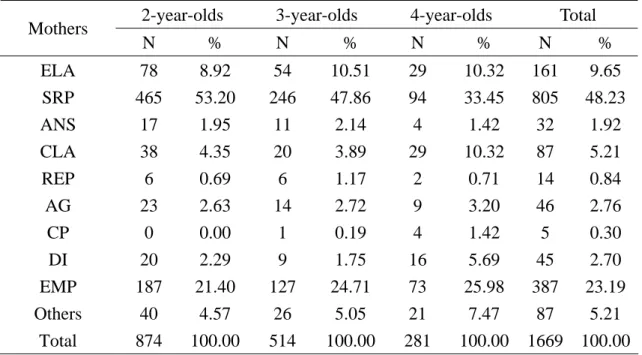
The functions of the mothers’ self-repetitions were also examined. Table 7 presents the proportions of the varied functions in the mothers’ data. As seen in the table, the most frequently expressed function in the data for the three groups of mothers was Soliciting Responses. The percentages of Soliciting Responses were 53.20% for the two-year-olds’ mothers, 47.86% for the three-year-olds’ mothers, and 33.45% for the four-year-olds’ mothers. It appears that there was a decrease of the proportion of Soliciting Responses in the mothers’ data with the increase of the children’s age. The second frequently expressed function in the data for the three groups of mothers was Emphasis. The percentages of Emphasis were 21.40% for the two-year-olds’ mothers, 24.71% for the three-year-olds’ mothers, and 25.98% for the four-year-olds’ mothers. It appears that there was a slight increase of the proportion of Emphasis in the mothers’ data with the increase of the children’s age.
Table 7: Functions of mothers’ self-repetition
2-year-olds 3-year-olds 4-year-olds Total Mothers N % N % N % N % ELA 78 8.92 54 10.51 29 10.32 161 9.65 SRP 465 53.20 246 47.86 94 33.45 805 48.23 ANS 17 1.95 11 2.14 4 1.42 32 1.92 CLA 38 4.35 20 3.89 29 10.32 87 5.21 REP 6 0.69 6 1.17 2 0.71 14 0.84 AG 23 2.63 14 2.72 9 3.20 46 2.76 CP 0 0.00 1 0.19 4 1.42 5 0.30 DI 20 2.29 9 1.75 16 5.69 45 2.70 EMP 187 21.40 127 24.71 73 25.98 387 23.19 Others 40 4.57 26 5.05 21 7.47 87 5.21 Total 874 100.00 514 100.00 281 100.00 1669 100.00
Further analysis was also conducted to examine the form-function relationship of the mothers’ self-repetitions. The major functions of the mothers’ exact, expanded, modified, and reduced repetitions are presented in Table 8a-8d. The major functions are those which have a percentage equal to or above 10%.
The tables show that the mothers of the four-year-olds expressed more functions than the mothers of the two-year-olds and the three-year-olds when using exact, expanded, and modified repetitions. As seen in Table 8a, the mothers of the
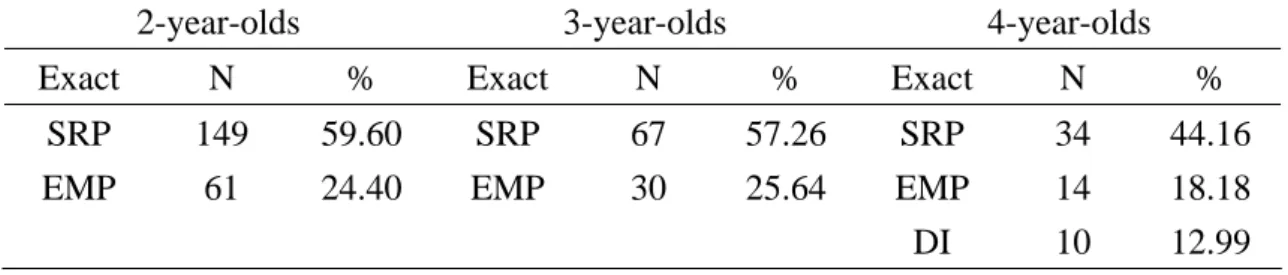
two-year-olds and the three-year-olds used exact repetitions mainly for the functions of Soliciting Responses and Emphasis. While the mothers of the four-year-olds also used exact repetitions frequently for the two functions, they used exact repetitions for another major function – Describing Iconicity. Table 8b shows that expanded
repetitions served three major functions – Soliciting Response, elaboration, and
emphasis – in the data for the two-year-olds’ mothers and the three-year-olds’ mothers. While the three functions were also the major functions in the data for the
four-year-olds’ mothers, an additional major function – Clarification – was observed. As for modified repetitions, Table 8c shows that there were three major functions – Soliciting Responses, Elaboration, and Emphasis – in the data for the two-year-olds’ mothers and the three-year-olds’ mothers. However, there were five major functions, with the additional functions of Answering and Clarification, in the data for the four-year-olds’ mothers. As for reduced repetitions, Table 8d shows that two major functions – Soliciting Responses and Emphasis – were observed in the data for the three groups of mothers; however, it also shows that the proportion of Soliciting
Responses decreased in the mothers’ data with the increase of the children’s age.
Table 8a: Exact repetitions and major functions in mothers’ data
2-year-olds 3-year-olds 4-year-olds Exact N % Exact N % Exact N %
SRP 149 59.60 SRP 67 57.26 SRP 34 44.16 EMP 61 24.40 EMP 30 25.64 EMP 14 18.18 DI 10 12.99
Table 8b: Expanded repetitions and major functions in mothers’ data
2-year-olds 3-year-olds 4-year-olds Expanded N % Expanded N % Expanded N %
SRP 120 41.96 SRP 71 39.66 SRP 34 28.33 ELA 57 19.93 ELA 42 23.46 ELA 26 21.67 EMP 51 17.83 EMP 27 15.08 EMP 23 19.17 CLA 21 17.5
Table 8c: Modified repetitions and major functions in mothers’ data
2-year-olds 3-year-olds 4-year-olds Modified N % Modified N % Modified N %
SRP 63 52.94 SRP 49 43.75 EMP 9 30 ELA 18 15.13 EMP 32 28.57 SRP 7 23.33 EMP 15 12.61 ELA 12 10.71 ANS 4 13.33 CLA 4 13.33
ELA 3 10
Table 8d: Reduced repetitions and major functions in mothers’ data
2-year-olds 3-year-olds 4-year-olds Reduced N % Reduced N % Reduced N %
SRP 133 60.73 SRP 59 55.66 EMP 27 50 EMP 60 27.4 EMP 38 35.85 SRP 19 35.19
4. Discussion
This study has analyzed the use of self-repetition by Mandarin-speaking children and mothers. In the analysis of the children’s data, the results showed that
self-repetitions occurred more frequently in the two-year-olds’ data than in the data for the three-year-olds and the four-year-olds. It was found that a great majority of the two-year-olds’ repetitions were exact repetitions, and that a great majority of their
repetitions expressed the function of Emphasis. In contrast, the two older groups’ self-repetitions were less restricted to the form of exact repetitions and the function of Emphasis. In addition, in the analysis of the form-function relationship, the results further showed that the two older groups of children were able to use the different forms of self-repetitions to perform a larger variety of functions than the
two-year-olds.
The results of the children’s self-repetitions appear to reveal a developmental change. The children appear to expand their repertoires of both the forms and the functions of self-repetitions with increasing age. As suggested by Slobin (1982), new functions are first expressed in old forms and new forms first express old functions. As communicative functions in children’s speech expand, old forms of repetitions are used to serve new functions. In addition, as children use new forms of repetitions, these forms are used to express old functions. From the results of this study, we may speculate that when children repeat themselves, they first use the form of exact repetitions for the function of Emphasis, and later they begin to use other forms of repetitions and to express other communicative functions. Thus, children’s repetitions are not constructed at random; in repeating, children are learning to communicate and to construct utterances to meet specific communicative needs (Ochs Keenan, 1977).
As for the mothers’ self-repetitions, the results showed that the frequency of the mothers’ self-repetitions was related to the ages of the children. That is, the mothers of younger children tended to use more self-repetitions than the mothers of older children. As for the forms of self-repetitions, while it was exact repetitions that were used most frequently by the children, it was expanded repetitions that were the predominant form in the mothers’ data. The results also showed that the proportion of the mothers’ expanded repetitions increased with the increase of the children’s age, and that in contrast, the proportion of the mothers’ reduced repetitions decreased with the children’s increasing age. As for the analysis of functions, it was found that while the function of Soliciting Responses was the predominant function expressed by the mothers’ self-repetitions, the proportion of this function decreased in the mothers’ data with the increase of the children’s age. As for the form-function relationship of the mothers’ self-repetitions, it was found that the mothers of older children expressed more functions than the mothers of younger children in their use of the different forms of self-repetitions.
The results of the mothers’ self-repetitions appear to reflect the characteristics of child-directed speech. In mother-child communication, the mother is interacting with a partner who has limited cognitive and verbal skills. Self-repetition appears to reflect the mother’s attempts to foster interaction through appropriate repetitiveness. As suggested by McDonald and Pien (1982), maternal speech can be divided into two
types of utterances: one oriented toward controlling the child’s actions, the other toward eliciting the child’s participation in conversation. Self-repetition seems to be particularly relevant to the second type. Therefore, as seen in the results, not only the occurrences of self-repetitions overall but also the function of Soliciting Responses were particularly prevalent in the data for the mothers of younger children. In addition, the mothers also appear to be sensitive to the children’s developing competencies. As seen in the results, the mothers used relatively less expanded repetitions and expressed a smaller numbers of functions with self-repetitions when interacting with younger children. In other words, the mothers’ use of self-repetitions demonstrates their particular interactional sensitivity and communicative needs when addressing their cognitively and linguistically developing children.
References
Brodsky, Peter, Waterfall, Heidi & Edelman, Shimon. 2007. Characterizing motherese: On the computational structure of child-directed language. In: McNamara, D. S. & Trafton, J. G.. (Eds.), Proceedings of the 29th Cognitive Science Society Conference, pp. 833–38.
Brown, Penelope. 2000. Conversational structure and language acquisition: The role of repetition in Tzeltal adult and child speech. Journal of Linguistic Anthropology 8(2):197-221.
Casby, Michael W. 1986. A pragmatic perspective of repetition in child language. Journal of Psycholinguistic Research, 15(2), 127-140.
Gisela, Szagun. & Matthias, Ruter. 2009. The influence of parents' speech on the development of spoken language in German-speaking children with cochlear implants. Revista de Logopedia, Foniatría y Audiología, 29(3), 165-173. Hoff-Ginsberg, Erika. 1985. Relations between discourse properties of mothers’
speech and their children’s syntactic growth. Journal of Child Language, 12, 367-385.
Hoff-Ginsberg, Erika. 1986. Function and structure in maternal speech: their relation to the child’s development of syntax. Developmental Psychology, 22, 155-163. Hoff-Ginsberg, Erika. 1990. Maternal speech and the child’s development of syntax:
a further look. Journal of Child Language, 17, 85-99.
Huang, Chiung-chih.2010. Other-repetition in Mandarin child language: A discourse-pragmatic perspective. Journal of Pragmatics, 42(3), 825-839. Huang, Chiung-chih. 2012. Parental other-repetition in Mandarin parent-child
interaction. Journal of Pragmatics 44, 542-562.
Johnston, Barbara, 1994. Repetition in Discourse: Interdisciplinary Perspective, Vol. I. Albex, Norwood, NJ.
Kirchner, Diane M. and Prutting, Carol A. 1987. Spontaneous verbal repetition: a performance-based strategy for language acquisition. Clinical Linguistics & Phonetics, 1(2), 147-169.
Ku, Hsiang-chin. 1998. Teacher Repetition in Junior High School EFL Classroom: A Case Study. Unpublished MA Thesis: National Changhua University of
Education.
Kuntay, Aylin, and Slobin, Dan, I. 1996. Listening to a Turkish mother: Some puzzles for acquisition. In: Slobin, D.I., Gerhardt, J., Kyratzis, A., and Guo, J. (Eds). Social Interaction, Social Context, and Language: Essays in Honor of Susan Ervin-Tripp, pp. 265-286. Hillsdale, NJ: Erlbaum.
MacWhinney, Brian, 2000. The CHILDES project: Tools for analyzing talk, 3rd ed. Lawrence Erlbaum, Mahwah, NJ.
Moerk, Ernst, L. 1983. Behavioral Analysis of Controversial Topics in First Language Acquisition: Reinforcements, Corrections, Modeling, Input Frequencies, and the Three-Term Contingency Pattern. Journal of Psycholinguistic Research, 12(2), 129-155.
Moerk, Ernst, L. 1989. The fuzzy set called “imitation”. In Speidel, G. E. & Nelson, K. E. (Eds.) The Many Faces of Imitation in Language Learning. New York:
Springer-Verlag.
Muñoz-Duston, E. 1992. Self-Repetitions: Analyzing the Speech of Spanish and English Bilingual Children. Dissertation Abstracts International, 53(6).
Nelson, Katherine. 1973. Structure and strategy in learning to talk. Monographs of the Society for Research in Child Development, 38, Nos. 1-2, Serial No. 149.
Newport, Elissa, L. and Gleitman, Henry. 1977. Maternal self-repetition and child’s acquisition of language. Papers and Reports on child Language Development, 13.
Norrick, Neal, 1987. Functions of repetition in conversation. Text, 7(3), 245-264. Ochs Keenan, Elinor, 1977. Making it last: Repetition in children’s discourse. In:
Ervin-Tripp, S. & Mitchell-Kernan, C. (Eds.), Child discourse. Academic, pp. 26-39, New York.
Pérez-Pereira, Miguel, 1994. Imitations, repetitions, routines, and the child’s analysis of language: Insights from the blind. Journal of Child Language, 21, 317-337. Shatz, Marilyn. & Ebeling, Karen. 1991. Patterns of language learning-related
behaviours: evidence for self-help in acquiring grammar. Journal of Child Language, 18, 295-313.
Slobin, Dan, 1982. Universal and particular in the acquisition of language. In: E. Wanner & L. Gleitman (Eds.), Language acquisition: The state of the art. Cambridge University Press, Cambridge.
Tannen, Deborah, 1987. Repetition in conversation: Toward a poetics of talk. Language, 63(3), 574-605.
Tsai, I-ni, 2002. Repetition in Spoken Chinese. Unpublished M.A. Thesis. National Taiwan University.
Wong, Jean. 2000. Repetition in conversation: A look at “first and second saying”. Research on Language and Social Interaction, 33(4), 407-424.
Waterfall, Heidi. 2006. A little change is a good thing: Feature theory, language acquisition and variation sets. Unpublished doctoral dissertation, University of Chicago.
國科會補助專題研究計畫出席國際學術會議心得報告
日期: 103 年 7 月 31 日 計畫編號 NSC102-2410-H-004 -056 計畫名稱 幼童語言及幼童導向語言中的自我重複現象 出國人員 姓名 黃瓊之 服務機構及 職稱 國立政治大學語言學 研究所 教授 會議時間 103 年 7 月 14 至 103 年 7 月 18 日 會議地點 阿姆斯特丹大學 (University of Amsterdam) 會議名稱 (中文)第 13 屆兒童語言研究國際研討會(英文) The 13th International Congress for the Study of Child Language
發表題目 (中文) 漢語照護者語言的首選論元結構
(英文)Preferred argument structure in Mandarin caregiver speech
本人於 103 年 7 月 14 日至 7 月 18 日參加第 13 屆兒童語言研究國際研討會 (The 13th International Congress for the Study of Child Language),此次研討會由阿 姆斯特丹大學(University of Amsterdam)主辦。研討會集合了許多來自世界各地研 究兒童語言的學者,會中也有不少來自台灣的教授及學生。與會學者從兒童語言 的各個面向,作研究的分享與交流。五天的研討會,讓參與研討會的成員享受了 一次豐富的學術饗宴。 本次研討會議程的安排精彩而豐富。五天的議程從早上 9:00 到晚上 6:30。 包含了特邀演講、專題論文發表、個別海報發表、及餐會。讓與會者有很多討論 及交流機會。 大會安排了五場特邀演講,由五位知名的兒童語言學者主講。包括了 Elma Blom、Aylin Kuntay、 Morten Christiansen、Ann Senghas 及 Debbie Mills。五位 學者在兒童語言研究領域都有重要的貢獻,他們的精彩演講讓與會者收穫豐富。 Elma Blom 的演講探討雙語習得研究如何幫助我們對瞭解特定型語言障礙
(Specific Language Impairment),Aylin Kuntay 的演講討論兒童的指涉溝通, Morten Christiansen 從語言處理的角度解釋語言習得,Ann Senghas 討論語言習 得與語言湧現(language emergence)之間的關係,而 Debbie Mills 則發表其對雙語
兒童大腦發展的研究成果。
議程中並安排了平行場次的專題論文發表(symposium),每場皆有數位學者 發表相關議題的論文。其中一場的主題為 Chinese language narration: Culture, cognition, and emotion。此場次包括五位中、港、臺、美地區學者在漢語兒童敘 述發展上的研究報告。另外一場主題為 Language acquisition in interaction 由四位 學者發表相關論文,而此場主題發表的一個主要目的是要將論文出版專書向兒童 語言研究大師 Eve Clark 教授致敬,以表彰其在此領域研究的重要貢獻及影響。 Eve Clark 教授在事先不知情的狀況下應允擔任此場次的與談人,在的得知之 後,她發表了具啟發性的感言,並對此場論文及兒童語言研究領域做了精彩的評 論,讓滿場的聽眾獲益匪淺。而 Which pragmatic factors have the most influence on comprehension and production of referring expressions? 這場專題發表的論文與我 目前的研究有直接的關係,本人近年也發表了數篇漢語兒童在 referring
expressions 習得的論文,此場發表讓我與在場學者有很多交流的機會。另一場有 趣的專題發表是 New technologies for the study of child language,本場論文介紹了 LENA、 gaze-contingent methodologies、touchscreen methodologies 以及 fNIRS, 這些科技提供了兒童語言研究更多的研究工具與方法。 除了專題論文發表之外,個別論文則皆以海報方式發表。海報展示讓作者在 作品前和與會者進行面對面的說明及討論,近距離的互動不僅讓與會者對各個研 究有更清楚的瞭解,也讓各研究發表者能獲得和與會者即時交流的機會。海報論 文中有數篇是來自台灣的研究,顯示台灣的學者及學生積極參與國際學術研討會 發表研究成果。本人的海報論文發表安排在 7 月 15 日下午,此次發表的論文題 目是 Preferred argument structure in Mandarin Caregiver speech。本人的論文獲得 了不少與會學者正面的回應,一些意見及問題也對我繼續發展本篇論文有很大的 幫助。 除了較嚴肅的研討會場合之外,大會亦安排了餐會及徒步導覽的活動。在這 些較輕鬆的場合中,與會的學者可以有更多的交流互動,以增進瞭解並建立友 誼,同時對阿姆斯特丹的歷史文化也可以有更深入的認識。 此次參加第 13 屆兒童語言研究國際研討會不僅有機會發表本人的研究成果 之外,也有機會與不同國家的學者做學術討論與分享,是一次很有意義、很豐富 的學術交流經驗。
科技部補助計畫衍生研發成果推廣資料表
日期:2015/02/03科技部補助計畫
計畫名稱: 幼童語言及幼童導向語言中的自我重複現象 計畫主持人: 黃瓊之 計畫編號: 102-2410-H-004-056- 學門領域: 心理語言學無研發成果推廣資料
102 年度專題研究計畫研究成果彙整表
計畫主持人:黃瓊之 計畫編號: 102-2410-H-004-056-計畫名稱:幼童語言及幼童導向語言中的自我重複現象 量化 成果項目 實際已達成 數(被接受 或已發表) 預期總達成 數(含實際已 達成數) 本計畫實 際貢獻百 分比 單位 備 註 ( 質 化 說 明:如 數 個 計 畫 共 同 成 果、成 果 列 為 該 期 刊 之 封 面 故 事 ... 等) 期刊論文 0 0 100% 研究報告/技術報告 1 1 100% 研討會論文 0 0 100% 篇 論文著作 專書 0 0 100% 申請中件數 0 0 100% 專利 已獲得件數 0 0 100% 件 件數 0 0 100% 件 技術移轉 權利金 0 0 100% 千元 碩士生 4 4 100% 博士生 1 1 100% 博士後研究員 0 0 100% 國內 參與計畫人力 (本國籍) 專任助理 0 0 100% 人次 期刊論文 0 0 100% 研究報告/技術報告 0 0 100% 研討會論文 1 1 100% 篇 論文著作 專書 1 1 100% 章/本 申請中件數 0 0 100% 專利 已獲得件數 0 0 100% 件 件數 0 0 100% 件 技術移轉 權利金 0 0 100% 千元 碩士生 0 0 100% 博士生 0 0 100% 博士後研究員 0 0 100% 國外 參與計畫人力 (外國籍) 專任助理 0 0 100% 人次其他成果