國
立
交
通
大
學
運
輸
科
技
與
管
理
學 系
碩 士 論 文
聯合-獨立評估與產品屬性對消費者決策合理化之
影響
Effect of Joint-Separate Evaluation and Product Attributes on
Consumer‟s Justification in Decisions
研 究 生:徐敏倫
指導教授:任維廉 教授
聯合-獨立評估與產品屬性對消費者決策合理化
之影響
Effect of Joint-Separate Evaluation and Product Attributes on
Consumer’s Justification in Decisions
研 究 生: 徐敏倫 Student: Min Lun Hsu
指導教授: 任維廉 Advisor: William Jen
國 立 交 通 大 學
運 輸 科 技 與 管 理 學 系
碩 士 論 文
A Thesis
Submitted to Department of Transportation Technology and Management
College of Management
National Chiao Tung University
in Partial Fulfillment of the Requirements
for the Degree of
Master
in
Transportation Technology and Management
Sep 2010
Hsinchu, Taiwan, Republic of China
i
聯合-獨立評估與產品屬性對消費者決策合理化
之影響
研究生:徐敏倫
指導教授:任維廉
國立交通大學運輸科技與管理學系
摘 要
對消費者而言,找到理由支持自己的決定是相當常見且重要的,這表示消費者需要 藉由決策的合理化,讓自己對所做的決定感到安心。不過,人們不一定總是能夠順利地 找到理由支持自己的決定,這是因為在做決定的當下,無法得到足夠的或適當的決策資 訊所造成。而在過去的研究中,許多學者討論了消費者在不同購物環境,例如聯合評估 或單獨評估下,所面臨到的決策合理化問題與困難,也有研究指出購買不同屬性的產品 亦會影響到消費者決策合理化的難易度。本研究認為,購買功能性、享樂性產品所需的 資訊與不同購物環境下所突顯的資訊之一致性,會對消費者決策合理化難易度產生影 響。當購買功能性產品時,聯合評估會比單獨評估容易合理化決策;相對地,當購買享 樂性產品時,單獨評估會比聯合評估容易合理化決策。為了驗證假設,本研究先對相關 構面發展量表問卷,再使用情境設計,設計了四種購物情境:在聯合評估或單獨評估下 購買功能性產品,在聯合評估或單獨評估下購買享樂性產品。分析335份有效問卷後, 其分析結果支持本研究之假設。最後,作者根據研究結果提供若干管理意涵,也對後續 研究提出相關建議。 關鍵字:聯合評估,獨立評估,合理化,享樂性,功能性ii
Effect of Joint-Separate Evaluation and Product Attributes
on Consumer‟s Justification in Decisions
Student: Min Lun Hsu Advisor: William Jen Department of Transportation Technology and Management
National Chiao Tung University
Abstract
Given reasons for decisions is very common and important for decision makers since people need to justify their decision to be feel relieved and comfortable. However, the justification is not always easy to get because of the lack of sufficient or appropriate information. In the past, several researchers discuss the justification and decision difficulty when people under different purchase context (e.g. joint evaluation or separate evaluation). Besides, some studies point out that different characteristic of product would cause different degrees of ease of justifications. In our research, we propose that purchasing utilitarian or hedonic products would lead people focus on different information, and compatibility of the product information and evaluation mode would affect people‟s ease of justification. When people purchase utilitarian products, they feel higher ease of justification in JE than in SE. Likewise, when people purchase hedonic products, they perceive higher ease of justification in SE than in JE. For the sake of examine our hypothesis, we develop related measurement of the concepts, and use scenario experiment design, including four groups of conditions (utilitarian purchase in JE and in SE, hedonic purchase in JE and in SE). There are 335 samples for the final analysis, and the result supports our hypotheses. Lastly, the author provides the several managerial implications for marketers and directions for future researchers.
iii
誌
謝
想起兩年前,在排球場上知道自己與好友們都考上研究所,真的非常開心,但轉 眼間卻要從生活六年的交大畢業,各奔東西。研究所的兩年裡,受到了很多很多的貴 人相助,當我遭遇困難,大家都二話不說的馬上伸出援手拉我一把。感恩大家,有你 們的幫忙,我才能順利完成這份論文。 首先感謝我的家人,給我最無私的包容與關懷。不論在外面遇到什麼困難,一回 家馬上就能痊癒,能夠生長在這樣幸福的家庭真的很幸運。尤其是爸跟媽,從年輕到 開始長白頭髮,日日夜夜辛勤不懈的工作供我念書,從不讓我煩惱經濟的問題,謝謝 您們對我的付出與栽培我完成碩士學位。另外,要謝謝兩個貼心的妹妹在我低潮時陪 伴我,還幫我發問卷、收問卷,當你們的姐姐真好。 非常感謝我的指導教授任維廉老師,在學術上給我很大的研究自由與信任,循循 善誘的教導我正確的學習態度與方向,而且碩士班有幸能參加實驗室的計畫案,讓我 學習到如何與人溝通合作。在生活上老師與師母更是將我們當成自己的孩子一般關 愛,能夠成為老師的研究生,除了幸運之外更多了一分福氣。特別感謝北京大學涂榮 庭老師,碩一下時到北京交換學生受到老師許多的照顧,老師總是細心觀察生活中每 個小細節,讓我了解做研究應該從日常現象開始,並且教導我用正確且積極的處事態 度面對問題。感謝在論文口試期間,林祥生老師與胡凱傑老師的細心審查與建議,幫 助我更完整呈現研究的成果。 在大學期間,感謝我的畢專指導老師郭秀貴老師,從會計學一直到畢專,大三時 更鼓勵我們參加新竹貨運的行銷比賽,啟發了我對研究的認識。郭老師一路皆用最認 真的態度陪著我們一起學習,像媽媽又像親密好友,三不五時跟我們分享家庭與生活 的大小智慧,謝謝老師將我們視如己出。 感謝堂榮學長、士宏學長、明穎學長、毓娟學姊、友維學長給我許多研究上的建 議與協助,在困惑的時候與我討論,幫助我釐清問題所在。碩士生不如死的階段,好 險有各路好友相挺,有幼芝、阿舍、思琪、禹瑄陪我一起度過無數次的摧殘,在碩一 時感謝有山姆、竹軒、熊、維中傳授我看paper的技巧與經驗分享,也謝謝三位乖巧 的學弟韋任、韋志、世民,還有最美麗大方的愉雪,幫忙處理實驗室的大小瑣事,讓 我能專心在研究上。此外,感謝系足夥伴、運管的大家、系排的老老少少、親愛的室 友們、還有國高中的好友們,在三更半夜答應幫我寫問卷、曬太陽發問卷、聽我紓壓 抱怨、要運動吃宵夜隨時都找得到人,認識你們是我人生中最珍貴的事情,超級感謝。 最後,要感謝每一位幫我寫問卷的好心人,沒有你們的協助無法完成這份論文。 在家靠父母,出外靠朋友,僅將完成論文的喜悅分享給各位貴人,感恩。
徐敏倫 謹誌
中華民國九十九年九月iv
Contents
Chinese Abstract ... i English Abstract ... ii Contents ... iv List of Figures ... v List of Tables ... v 1. Introduction ... 1 2. Literature Review ... 42.1 Joint Evaluation (JE) and Separete Evaluation (SE) ... 4
2.1.1 Preference Reverseal Due to JE and SE ... 4
2.1.2 Attribute Evaluability in JE and SE ... 6
2.1.3 Inherently Evaluable and Inherently Inevaluable ... 7
2.1.4 Thinking and Feeling in Consumer Evaluations ... 8
2.2Need for Ease of Justification ... 9
2.3 Utilitarian and Hedonic Products ... 11
2.4 Summary ... 12
3. Research Hypotheses and Methodology... 14
3.1 Research Hypotheses ... 14
3.1.1 Utilitarian Purchase in Joint-Separate Evaluation ... 16
3.1.2 Hedonic Purchase in Joint-Separate Evaluation ... 17
3.2 Operational Definition ... 18
3.2.1 Joint and Separate Evaluation... 18
3.2.2 Ease of Justifications ... 19
3.2.3 Utilitarian and Hedonic Products ... 19
3.3 Research Methodology ... 20
3.3.1 Design and Procedure ... 20
3.3.2 Measurements ... 23
3.3.3 Pretest ... 24
4. Formal Survey Analysis and Result ... 25
4.1 Reliability and Validity Test ... 27
4.2 Manipulation Check ... 28
4.3 Hypotheses Test ... 29
5.Discussion and Implications ... 33
v
5.2 Managerial Implication... 35
5.3 Limitations ... 37
5.4 Future Suggestions for Future Research ... 37
Reference ... 39
Appendix 1. Experimental Product Design Samples... 42
Appendix 2. Questionnaire ... 44
List of Tables
Table 1 Four Experimental Conditions ... 20Table 2 Attributes of Utilitarian and Hedonic Product in Study ... 21
Table 3 Result of Reliability for Pretest ... 24
Table 4 Eight Conditions in Formal Survey ... 25
Table 5 Sample Profile ... 26
Table 6 Purchase Decision for Utilitarian Purchase ... 27
Table 7 Purchase Decision for Hedonic Purchase ... 27
Table 8 Result of Reliability and AVE for Formal Survey ... 28
List of Figures
Figure 1 Test Result of Hypothesis 1 ... 29Figure 2 Test Result of Hypothesis 2 ... 30
Figure 3 Test Result of H1::Type 1 Rechargeable Battery as Target Product ... 31
Figure 4 Test Result of H1: Type 2 Rechargeable Battery as Target Product ... 31
Figure 5 Test Result of H2: Beligum Chocolate Ice Cream as Target Product ... 32
Effect of Joint-Separate Evaluation and Product Attributes
on Consumer‟s Justification in Decisions
1. Introduction
For most consumers, giving reasons for which actions were done is very common and important, since they have to justify their decisions so as to feel more relieved and comfortable (Shafir, Simonson, and Tversky 1993). In fact, there are many choice problems around daily life, and these problems are usually resulted from without clear preference or lack of enough knowledge to well identify the values of the options. On account of the variety of decisions circumstances, people are not always easy to find reasons for decisions and be hard to feel relieved about the choice. However, pervious researches discuss many elements which cause different purchasing context, such as presentation way of products, the characteristic of products, and so on. Even though, there are few studies to talk about how people easy or hard to justify their decision or choice when they be in those conditions.
In reality, sometimes people have multiple options to consider at same time (ex: shopping in department store). But under certain conditions, people relatively may only contact with single product or option (ex: display window). Several researchers suggest that the presentation of products would lead people use different evaluation mode (joint evaluation and separate evaluation) and then bias their choice (e.g. Hsee and Zhang 2004). Simply illustrate, people contacting with multiple or single option would generate different reasons to justify decisions (Hsee‟s 1996; Okada 2005).
Take an example to discuss, consider to buying one car may focus on some features, such as horsepower, engine, shapes, brand, etc. If there are many cars promoted, and then we naturally compare together. After the comparison, the one has compelling advantages would be favorable. Likewise, the one show the weakness will be eliminated from the choice list directly. On the contrary, if we only see one car in display window, we don‟t have
available comparison, our judgment mostly come from how we feel about that car. Consequently, we may like it because the brand is famous, or don‟t like it because the shape is too heavy. That is because people tend to use the most available or salient information at the moment (Hsee and Leclerc 1998) to help them evaluate the options and justify in decisions. It appears that presenting options together or alone will yield different types of information to have dissimilar accessibilities and then influence the evaluations.
Furthermore, we discover that it is common to see related products be presented together, such as ice cream stores or 3C shops. Though people can compare products directly, they are not necessary to feel easily to determine which option they want or which one is better. For instance, stand in front of ice cream store, facing a great number of flavors and all of them seem so delicious and attractive. Thus, the comparison may let us fall into uncomfortable trade-offs. It is probably that giving peoples multiple options to compare not necessary guarantee to better discerning the values of options. Conversely, if only see one kind of ice cream putting in the display window, people don‟t need to struggle for which is to choice, thus, may be easier to make up their mind to accept or not. Accordingly, some products appear more appropriate to be presented jointly while some do not.
In the cause of the most available information can be the justifications, while it is not useful every time. Since one product may contain variety of attributes, and provide many advantages. Some people purchasing good to fulfill functional or practical requirements (utilitarian products), the other may focus on the experience or entertainment gains (hedonic products) (e.g. Holbrook and Hirschman 1982; Batra and Ahtola 1990). Thus, consuming products for different needs would make people pay attention on different parts (Chernev 2004; Higgins 1997). For instance, it is more important to notice the performance of washing machines, such as load size and clearing power. Nevertheless, buying cakes seems more focus on how wonderful to eat it, and pay attention to evaluate the flavor or design.
On the basis of discussion above, buying different kinds of products may be beneficial by corresponding decision context.
It is common to see purchase problem in the same product category rather than different categories, just as mention above, shopping in 3C shops or cake stores. In order to solve the problem, consumers usually seek several justifications and make evaluation to determine to make decisions. However, in the past more discover about how people make choice between different product categories through justification aspect and there is few researches talk about the same product category.
To sum up the discussion above, the characteristic of products would influence how people evaluated it except for connecting with products jointly or separately. Indeed, how to present products in the most beneficial manner seems to be the marketers‟ main concern when they promote products. What is more, marketers usually have the power to affect people connecting with products jointly or separately. Thus, first and foremost, our research purpose is to figure out that when did consumers easy to justify in decisions and feel relieved. Second, realize that how marketers should present their products would let consumers easy to understand the values depend on different product attributes. Importantly, our research distinguishes into two streams to talk about the ease of justification in purchase decision, for utilitarian purchase and for hedonic purchase. According to the discussion, provide some advice for managers and future researches in the last.
2. Literature Review
2.1 Joint Evaluation (JE) and Separate Evaluation (SE)
People do not always contact with multiple alternatives simultaneously, maybe there is only one option available. By the definition of Hsee (1996), when the stimulus options are presented side by side and people evaluated these options comparatively, it is called joint evaluation (JE) mode. Otherwise, when the stimulus option is presented separately and people evaluated it isolated, it is called single or separate evaluation (SE) mode. For example, shopping in the department store for a DVD-player, we are usually in JE mode, there are many DVD-players for us to compare at same time. On the other side, when we watch a shopping channel sale a particular DVD-player, in that moment we only view one DVD-player and evaluate it alone and in SE mode relatively. Obviously, JE and SE mode do not exclusively different evaluation modes, there still some situation combined these two modes. For the sake of simplicity, we discriminate JE and SE mode by the stimulus options are present together or single in front of consumers.
Currently, a growing up studies found some absorbing discoveries about joint and separately evaluations, such as preference reversals, attributes evaluability hypothesis, inherently evaluable or not, and other application basis these finding.
2.1.1 Preference Reversal Due to JE and SE
It is common to see that people do not feel as satisfaction as their evaluation at the beginning. Even we think many possible conditions and pay great efforts to make choices. There are series of academic researches explored why people reverse their preference, like choice-pricing preference reversals (e.g. Grether and Plott 1979) and choice-matching preference reversals (e.g. Tversky, Sattath, and Slovic 1988). Notably, these researches primed that the PR was resulted by involving different evaluation scales (Bazerman,
Loewenstein, and White 1992). However, neither the choice-pricing nor the choice-matching preference reversals both discuss the inconsistency of choice and judging. Our research is interested in evaluating options together or separately and focuses on the evaluation mode not the evaluation scales.
Unlike those preference reversals evoked by evaluation scales, the JE/SE preference reversals are new type of preference reversal. Take the dictionary study (Hsee 1996) for example; the two second hand dictionaries had the same publication year: dictionary A contains 10,000 entries and the cover has no defects; dictionary B contains 20,000 entries and the cover is torn. In JE, respondents were gave two dictionaries at same time and ask them how much they would be willing to pay for each one. Likewise, in SE, respondents only see one dictionary and ask how much they would be willing to pay for it. The result show the clear reversal in WTP between JE and SE. Dictionary B has higher WTP in JE, yet dictionary A has higher WTP in SE. Obviously, the evaluation scale was identical in both conditions, so the reversal could only caused by the difference in evaluation mode.
On account of JE, consumers prefer the option which easy to exhibit advantages with comparison (e.g. the number of entries which the dictionary contains), and these advantages are easy to be the reason for choosing. Through the comparisons, people can effortlessly compare values and discern options differences (Kleinmuntz and Schkade 1993). Thus, JE may mislead people focus on attributes or options which may not stand for their preference but provide useful justifications. So, evaluating options together prone to cause people choose wrong options which not as favorable as they evaluate. Perhaps, evaluating options separately has more chance to make the right decision and making closer to preference evaluation in our mind (Hsee 1998).
Ideally, using SE could make people focus on the option because no other stimulus to draw away their attentions. In that case, people judge the option depends on how they feel
about the option and the evaluation mostly come from the single option. In SE, people would be focus on the attributes which do not need comparison to show the values (e.g. the cover of dictionary is torn or no defects), and use the attributes to make their final evaluations. Shortly, preference reversals due to JE and SE have a great deal with people use what attributes to be the main concern of their decisions.
2.1.2 Attribute Evaluability in JE and SE
As mention before, JE and SE will focus on different attributes of the options. We know in JE, the comparison decide the evaluation toward the options. Yet, doesn‟t like JE, people have less precise idea of how good or how bad the option is in SE. They are able to tell generally positive or negative of the option but lack of enough resource to tell the exactly values. Indeed, in SE, involving no trade-off between options, and no immediately reference criteria to compared. People have to use their prior experience or knowledge as reference point to estimate characteristics which the option contained and then making evaluations.
According to Hsee‟s (1996) evaluability hypothesis, easy-to-evaluated attributes loom larger impacts than hard-to-evaluate attributes in SE and hard-to-evaluated attributes have more powerful impacts than easy-to-evaluated in JE. Still take the dictionary study to explain, the cover of dictionary is the easy-to-evaluated attributes which don‟t need special knowledge to recognize how good or how bad; the number of entries is the hard-to-evaluated attributes because people are not familiar with it and need other standard or comparison to recognize the value. In simple words, easy- and hard-to evaluate attributes represented whether people could evaluate the attributes independently or not. Except for Hsee (1996), the evaluability hypothesis has also been proposed by other scholars in different terms, such as by Nowils and Simonson (1994) named context dependency of attributes.
From other point of view, consider the reference which JE and SE utilize to judge the values of options, we find that people tend to rely on external reference generated by comparing available options (e.g. comparative attribute or common attribute among the options) in JE and rely on internal reference induced by past related experience and existing knowledge (e.g. prior preference or memory) in SE. So far, it implied JE and SE making different attributes become more salient respectively. Those easy to compare and quantifiable attributes draw more attention in JE, then, those abstract and hard to quantifiable attributes gain more attention in SE.
2.1.3 Inherently Evaluable and Inherently Inevaluable
In actually, every product has multiple attributes but people would not use all of them to construct evaluations. Just like in JE, people may make decision rely on hard-to-evaluate attributes than easy-to-evaluated attributes, and vice versa. Recently, the researches bring out similar arguments with the attribute evaluability hypothesis (Hsee 1996). First, the easy-to-evaluated independently attributes don‟t need external standard to realize the values, and which also means we can make judgments without extrinsic reference. Second, the hard-to-evaluated independently attributes need other outsider comparison to show the values, thus, we rely on external relationship to evaluate it heavily. Consist with the notion of Hsee et al. (1999), the evaluability of information would influence people can or can‟t evaluate them independently.
Following to the discussion, Hsee et al. (2009) also distinguish consumption experiences into two variables, inherently evaluable and inherently inevaluable. He defined inherently evaluable variables are those desirability human beings have an innate, largely common, and stable scale in our mind to assess (e.g. temperature, boredom, and so on). And inherently inevaluable variables are those desirability human beings have no innate scale to
gauge and rely on external information to judge (e.g. the horsepower of car, the capacity of batteries).
Hence, the attributes evaluability and inherently evaluability has much analogy. More specifically, people are probably in an absolute condition to judge things when facing the easy-to-evaluated (inherently evaluable) attributes and tend to in a relative concept to judge things when facing hard-to-evaluated (inherently inevaluable) attributes (Hsee et al. 2009). We apply the common idea of people could or could not evaluated the values of options or attributes when they encounter different purchase decisions to discuss our topic.
2.1.4 Thinking and Feeling in Consumer Evaluations
There is various ways to present products in markets. In some place, consumers will choose one product from multiple options, but in other place, it may only single choice in front of consumers. Several authors referred that present different format of information will affect people‟s processing of information (Bettman and Kakkar 1977). Likewise, we imply there was a discrepancy in the information generates from present options jointly or separately. Therefore, the options are present jointly or separately will let people adopt different information processing, and then influence their evaluations.
If people evaluate many options at one time, comparing between options is often seen. Several authors demonstrate that exposure to multiple stimulus objects usually performs careful trade-off analyses (Tversky et al. 1988). Also, the each option was evaluated in comparison with the others (e.g. Lynch, Chakravarti, and Mitra 1991). On the other side, if people only see one option, no object could produce the comparisons, then, the arguments may depend on how much they understand about it. That is, when evaluating only one option, people will use whatever reference information available at the time (Hsee and Leclerc 1998). Not surprised, the past experience and existing knowledge about the options
is the most available reference information right away.
Similarly, Kahneman and Frederick (2002) construct two mental processing, called system 1 and system 2. The former described as automatic, rapid, associative, and affective and the latter describe as controlled, slow, deliberative, and deductive. In JE, giving the stimulus options directly will draw people‟s attention of the relationship and comparative between the focal options (Tversky 1969). And then it is more likely to produce deliberative comparison, thus, resemble in system 2. Talk about situations in SE, people incline to use internal reference which created by previous related experience to produce the evaluation. In this way, by SE will lead people more closely to their truly preference (Hsee 1996). Therefore, the evaluating process is similar to system 1 which is proposes intuitive answers.
2.2 Need for Ease of Justification
Conclusion of consumer decision making, there are four goals which people want to accomplished: (1) Minimizing the cognitive effort for the decision. (2) Maximizing the accuracy of decision. (3) Minimizing negative emotions during decision making. (4) Maximizing ease of justify the decision (Bettman et al. 1998). Notably, ease of justification is usually concerned by people why they have to make some decisions. Only when people find arguments strong enough for making a decision then they think they are prepared to make a choice (Montgomery 1983). And as Simonson (1989) suggested that need to feel justified in one‟s decisions is playing an important role in choice, either privately or publicly. In order to simplify our purpose, we focus on people need for justification privately. For the reason that evaluating objects is relatively an internal process, provide persuasion to self seems more important while make any judgments.
Especially, when dealing with difficulty of evaluating, decision makers prefer the alternatives that provide the best reasons (Shafir et al. 1993). In our study, making evaluation joint or separately have different obstacles, respectively. The common difficulty in JE is like
previous literatures disputed about the trade-off difficulty, maybe the trade-off between attributes or options, even for the consequences after choosing. Oppositely, evaluating isolated has the problem of lack of standard or unfamiliar with the alternatives to make judgments. Regardless of JE or SE, people all need to provide justification for their judgments even in different reasons. Once people feel justified their choice would increase their reliance on the decision context (Simonson 1989).
There are some research imply that justification related to JE and SE, such as present together would increase utilitarian products‟ attractiveness, and sale hedonic product single will make it more acceptable for people (Okada 2005). Because of in SE, people are much easier to construct a reason to consume hedonic products. That is, evaluating hedonic product isolated would facilitate people to enjoy the benefits and feel they have enough reason to buying the product. In JE, compare to hedonic product, the utilitarian one is easier to justify (Shafir, Simonson, and Tversky 1993).
Another study suggest that the determination of products would be appear more attractive separately or together is the relationship between product and average standards (Hsee and Leclerc 1998). Generally speaking, superior products will hurt in comparison and should be promoted separately. Since during comparison, people will naturally seek the better one from available options, one would be choose and another one would be reject. On the contrary, Inferior products will be enhance through comparison and should be presented together. Because people more focus on product itself and don‟t need to make accurate judgments, then, have half chance to see the good part and half chance to see the drawbacks.
Furthermore, under different evaluation mode will lead people perceived diverse reason to justify their decisions. It depends on what part providing the most appropriate explanation to justify their decisions on the spot.
2.3 Utilitarian and Hedonic Products
Following previous justification discussion, people usually need reason to justify their decisions. Some scholar claimed that consumer purchase goods for two basic reasons, utilitarian and hedonic benefits (Holbrook and Hirschman 1982). Consuming products offers some benefits and helps us accomplish tasks or fulfill our desirability. There is a great body of researches in marketing divided those product benefits into two parts: the utilitarian and hedonic benefits (e.g. Batra and Ahtola 1990; Chitturi, Raghunathan, and Mahajan 2007; Dhar and Wertenbroch 2000; Strahilevitz and Myers 1998). The former refers the functional, instrumental, and practical benefits of consumption offerings and the latter refers to aesthetic, experiential, and enjoyment-related benefits. Further, we sort products or goods by the benefits they offer to consumer are utilitarian or hedonic benefits. Consist to Strahilevitz and Myers (1998) and Hirschman and Holbrook (1982) defined the utilitarian goods and the hedonic goods.
However, hedonic and utilitarian are not necessarily two ends of a one-dimensional scale (Voss, Spangenberg, and Grohmann 2003). One product can be perceived utilitarianism and hedonism depend on how people judging it, just like a car could be utilitarian goods if people think the car is a vehicle to commute or be hedonic goods if people think driving cars let them feel more luxury and rich. Relatively, different product can be high or low in both hedonic and utilitarian attributes (Crowley, Spangenberg, and Hughes 1992), such as ice cream, cakes are both high in hedonic products and wash machine, USB drive is high in utilitarian products. Moreover, the utilitarian goods offering more quantifiable and concrete benefits than hedonic goods (Sela, Berger, and Liu 2009) such as the capacity of USB drive which described by gigabyte. Relatively, hedonic goods usually contained abstract and nonquantifiable attributes, such as the taste of ice cream is hard to use a specific number or label to value it.
Additionally, purchasing utilitarian and hedonic products is likely to turn people into different regulatory goals, prevention or promotion goals (Chernev 2004). Utilitarian products are typically linked to practical or necessary part of life (Hirschman and Holbrook 1982) and likely to be associated with prevention goals. In contrast, hedonic products are viewed as experiential or frivolous consumption (Strahilevitz and Myers 1998) and usually connect with promotion goals. By the notion of these finding, we were convinced purchasing utilitarian and hedonic products would let individuals put more weight on different attributes, respectively.
2.4 Summary
On the basis of literatures, the numbers of available options induce people to use different evaluation mode and then focus on different attributes. In joint evaluation, those belong to hard-to-evaluated or inherent inevaluable attribute have greater impact on the judge of values. Relatively, easy-to-evaluated or inherent evaluable attributes become more salient in separate evaluation. More specifically, the discrepancy between JE and SE is the evaluability information, whether people could evaluation the value of options independently. In the past, studies related to JE and SE debates more problems about preference reversals or consumers‟ choice between different products. However, few researches discuss the ease of justification in JE and SE for the same product category. What is more, in daily life, there are more situations we have to choose from the same category, just like purchasing in 3C store, ice cream shops and there are less research discuss about these situations.
As the literature mentioned, justify in decisions is important for consumers. Especially, finding justification is one strategy for consumers to resolve the choice problem. Once people could find justification for decisions they are more likely to make up their mind and feel ease. Moreover, the most obvious and available information has greater chance to be
received by consumers and use them as the determination of values. We believed that people favor the easy approach to find justification. The much easier to get appropriate information the much easier to construct the justification for decisions.
Yet, the available information are not necessary the suitable information. Although people prefer the easy way to find justifications, the fitting of information and purchase concerns seems more likely to be used as reason for decisions. We further recommend that buying different products have different concerns, and require specific information. In the past, many studies suggest purchasing for utilitarian and hedonic is two good reasons and focus on how people choose between these two kinds of products. Dissimilar to before, we think for utilitarian purchase and hedonic purchase should be separate into two streams to discuss about how people make decisions.
So far, we know people incline to get justification to help them make decisions but justifications are not always been easy to find. Nevertheless, the key point is whether people able or unable to get appropriate information. We think the evolution mode (JE and SE) and product attributes (utilitarian and hedonic) have critical effect of people‟s justification in their decisions. In the following section, the research hypotheses would be proposed and attempt to find the relationship between evaluation modes and product attributes.
3. Research Hypotheses and Methodology
3.1 Research Hypotheses
Lots of research about consumer behavior and decision making indicated that preferences are often constructed when people need to make decisions, rather than always existing in memory (Bettman, Luce, and Payne 1998). As this point of view, Gregory, Lichtenstein, and Slovic (1993) describe consumer preference formation as architecture, building some defensible set of values, instead of as archaeology, uncovering values that are already there. Furthermore, People find justifications for their decisions or tell themselves why they prefer that option not the others, and then feel comfortable and relieved (Simonson 1989). However, it is not always so easy to find suitable justifications because the purchase environment is varied and not fixed. Further, under different decision context would use different reason to justify (Shafir et al. 1993). We think that once people easy to get appropriate information, they would be more likely to feel higher ease of justification and then be easier to make decisions. Yet, factors causing people in different decision context has many possibilities, in our study, presenting products jointly or separately and purchasing what kind of products are the major topic we want to figure out. Simply saying, we want to discover the presentation of products, jointly or separately, would affect consumers are easy or hard to justify and make decisions when they purchase different kind of products.
In the joint evaluation (JE) situation, people can easily compare each options and use the external reference generate by the relationship of focal options to making evaluations. In the single evaluation (SE) situation, people have no objects to compare directly so they tend to use their past experience or knowledge form as internal reference to give the value of the options. And what is more, pervious researches indicated that the attractiveness of a
stimulus option depends not only on the absolute value but also on its relationship with other options (e.g. Shafir, Osherson, and Smith 1993).
Of course, either the advantages or the weaknesses of each option related to other option, people would see these parts by the comparisons in JE (Hsee and Leclerc 1998). That means through the comparisons people would pay attention to the relationship among options. Conversely, viewing single option would apt to rely on past experience, associated memories, and feelings to assess the option because of those information are most available at that time.
Otherwise, evaluation mode (JE and SE) will make different product attributes become clear and ease to access or become vague and hard to associate. We think there are another element could provide the similar conclusion, that is, some product attributes are much easier to show the values in JE and others would be much easier to understand the worth in SE. More importantly, consuming different products usually bring people different benefits and fulfill people‟s variety needs or desires. Specifically speaking, the benefits are either utilitarian or hedonic benefits (Batra and Ahtola 1990; Dhar and Wertenbroch 2000). The former are usually described in quantitative manners, such as the horsepower of this car is 300hp. The latter are expressed in abstract manners, just like the taste of this cake is as good as come from paradise. Compare with other research (e.g. Chitturi, Raghunathan, and Mahajan 2007; Strahilevitz and Myers 1998), hedonic benefits bring people enjoyment and experiential feelings which is don‟t need other reference to decide their preference. In contrast, utilitarian benefits offer people functional and quantifiable advantages which would be more obvious with the comparisons. The following part we will suggest our related hypothesis by more detailed discussion.
3.1.1 Utilitarian Purchase in Joint-Separate Evaluation
Utilitarian products bring people functional, instrumental, and concrete benefits (Strahilevitz and Myers 1998; Hirschman and Holbrook 1982), and these merits usually be described by numerical manner or quantified specifications. For instance, the capacity of USB is 4 gigabytes or the battery life for one charge is 15 hours. What is more, people may in prevention focus when they purchase utilitarian products (Chernev 2004). On account of pursuing safety, reliable, and prevent from losing under prevention concerns (Higgins, 1997), individuals are willing to seek the better options to fulfill their needs and be afraid of choosing the wrong products. Notably, one special character of utilitarian products is the quantifiable attributes, just like the battery recharged times. That also why we usually see marketers provide many specifications about utilitarian products for consumers.
Building on the notion of Hsee (1996), presenting products side by side is easy to procedure the comparison of each option and focuses on hard-to-evaluated, quantifiable attributes. We believe the comparison can help people to discern the differences between utilitarian products easily because it generates a vivid reference right away. Also, joint evaluation makes attributes easy to compared become salient which just fit people‟s utilitarian purchase concerns.
Nonetheless, if there is only one product presented, lacking of directly comparison subject would let utilitarian products hard to show the values. And people probably feel confused of how good or bad of the performance or benefits. Notably, it requires external standard to helping people judge values of quantifiable attributes. In SE, people are not sure about the value of utilitarian products and the absence of enough information to convince them to make decisions.
because they contain with quantifiable attributes. Relatively, lack of comparison would be hard to discover the advantages or drawbacks of utilitarian products because of there are no explicit standard. In joint evaluation, people can compare products directly and construct an external standard to discern the value as a reason to justify decisions.
Then, we propose the first hypotheses:
H1: For utilitarian purchases, it is easier for consumers to justify their decisions
when the products are presented jointly than when the products are presented separately.
3.1.2 Hedonic Purchase in Joint-Separate Evaluation
Due to the hedonic product brings more abstract and sensational benefits, people are likely to use as feeling process to evaluate (Mano and Oliver 1993). Thus, purchasing hedonic products often rely on desires and how the products could fulfill the wants. In other words, how do the hedonic products make people feel and related to internal experiences would master the judgments. Consider the research of Chernev (2004), promotion focus usually linked with hedonic purchasing because people like to seeking maximum gain, happy and enjoyment.
In reality, the marketers would present product either putting products together and let people evaluated side by side or showing products separately thus make them being evaluated in isolation (Hsee 1996). In single evaluation mode, people decide the values of the option by feels, experiential knowledge, previous experiences, and pay more attention on easy-to-evaluated attributes (Hsee 1996; Mano and Oliver 1993) seems closer to how people evaluate hedonic products. Moreover, those attributes become obvious in SE (e.g. the flavor of ice cream) don‟t need outsider reference to show the values. People can judge it by their internal and instinct reference scale (e.g. personal tasty and feeling).
Relatively, in the joint evaluation mode, people make comparisons naturally and tend to make deliberately trade-off between options (Tversky et al. 1988). However, the trade-off would make people feel negative emotions because of they have difficulty to recognize which option is better or worse. It probably results people hard to generate a reason or explanations for their decisions. Further, hedonic products are prone to be thinking about desirability and human wants. Presenting multiple hedonic products is easy to occur the pain form trade-offs between favorable options. That is, choosing one would feel pain of losing the other one.
Thus, we propose the second hypothesis:
H2: For hedonic purchases, it is easier for consumers to justify their decisions
when the products are presented separately than when the products are presented jointly.
3.2 Operational Definition
In this article, we explore decisions under different evaluation modes, joint evaluation and separate evaluation, would affect people‟s perceived ease of justification. Moreover, purchasing different characteristics of products would also influence the effect of consumer‟s justification in their decisions. The following section defines some important variables and concept in our research.
3.2.1 Joint and Separate Evaluation
Applying from Hsee (1996)‟s studies, we make respondents in joint and separate evaluation mode by presenting two or one product in front of respondents, respectively. Since putting two products together creates a comparison decision environment, people are easy to be into the joint evaluation condition. By the same way, when people contact with single product, they only could evaluate it without any directly comparison which creates the separate evaluation condition.
3.2.2 Ease of Justifications
The definitions of justification came from Simonson (1989), he initially suggested that the idea of focusing on the reasons supporting alternatives to explain choice behavior is based on the implicit assumption that people seek reasons for their choice. Moreover, the concept of “ease” we derived from Davis‟ (1989) definition which is freedom from difficulty or great effort. Thus, we refers the ease of justifications as the degree to which a person believe that seeking reasons for their decision would be free of great effort. Besides, in our research, we concentrate on how people justify their decision to themselves because the procedure for evaluating products is inside people‟s mind. In here, the justifications are perceived by consumers but not been provided to others. Consistent with the decision justification theory (Connolly and Zeelenberg 2002), justification of a decision refers to justifying the decision process to oneself rather than to another person.
3.2.3 Utilitarian and Hedonic Products
The most common discrimination between utilitarian and hedonic goods is the benefits people obtained by consuming these goods. Utilitarian products primarily provide the functional, instrumental, and practical benefits; hedonic products offering more experiential, sensory, and enjoyment-related benefits (Batra and Ahtola 1990; Dhar and Wertenbroch 2000). We think the utilitarian benefits usually describe by numerical specification or quantifiable attributes since it would be clearly introduce the products to consumers. Conversely, hedonic benefits usually characterize as abstract and hard to quantifiable attributes because it would be easier to deliver desirable features. Therefore, we suggest the utilitarian products have more quantifiable attributes and the hedonic products have more abstract attributes in our article.
3.3 Research Methodology
3.3.1 Design and Procedure
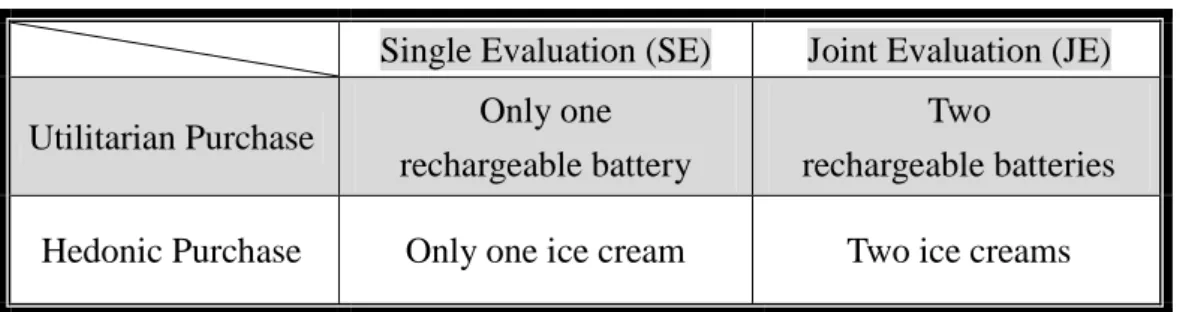
To exam our hypothesis, we demonstrate scenario designs. And our study could be distributed into two parts, one for utilitarian purchasing condition, and another for hedonic purchasing condition. Imitating Hsee‟s (1996) studies, we conduct four different groups of experiments, two for hedonic purchasing in JE and SE and two for utilitarian purchasing in JE and SE (see Table 1). Because we conduct a between subject design, each respondent randomly assign to only one of four conditions.
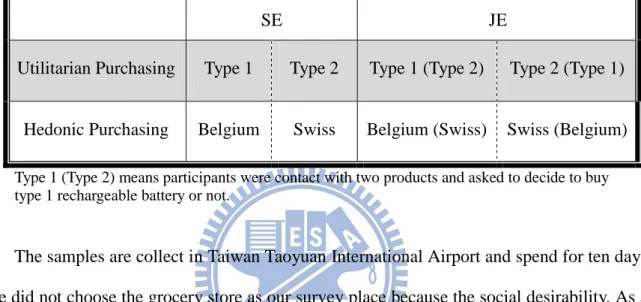
Importantly, in our research, we did not examined response between utilitarian and hedonic purchases, but compare the response for purchasing utilitarian products in JE and SE, and purchasing hedonic products in JE and SE, respectively. Thus, we devise two special scenarios, one for utilitarian purchases and another for hedonic purchases. Moreover, consider of the ordering effects, we switch product as the target product in the formal survey. That means half of participants received type 1 rechargeable battery or Belgium chocolate ice cream as target product, and half of participants received type 2 rechargeable battery or Swiss chocolate ice cream as target product. Totally, there would be eight conditions and randomly assign to our participants.
Table 1 Four Experimental Conditions
Single Evaluation (SE) Joint Evaluation (JE) Utilitarian Purchase Only one
rechargeable battery
Two
rechargeable batteries Hedonic Purchase Only one ice cream Two ice creams
In order to decide experimental products, we cite Voss et al. (2003) study result and use rechargeable battery as utilitarian products. And apply Writz and Lee„s (2003) suggestion,
using the ice cream as an representative of hedonic products. These two products are common to see in daily life and most people know what it is. Thus, it is easier for participants to get into the purchasing condition and answer to the questions.
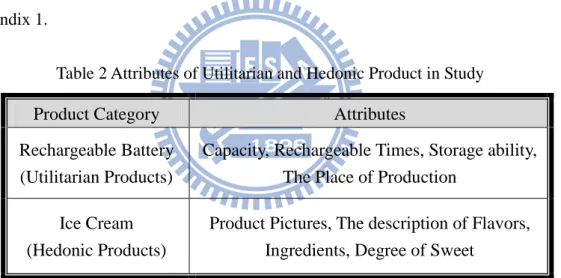
Next, for the purpose of design product characteristics, we observed the relevant web sites and record how they introduce or describe rechargeable battery and ice cream. After understanding how the marketers promote products, then we change to the point of consumers‟ view to proceeding interviews. Collecting of consumers‟ experience about what they considered when they purchase those products. Lastly, we concluded several attributes to describe and make differentia of our utilitarian and hedonic products (show in Table 2). And use these attributes as the major elements to design our study products and the final design sample is in the Appendix 1.
Table 2 Attributes of Utilitarian and Hedonic Product in Study
Product Category Attributes Rechargeable Battery
(Utilitarian Products)
Capacity, Rechargeable Times, Storage ability, The Place of Production
Ice Cream (Hedonic Products)
Product Pictures, The description of Flavors, Ingredients, Degree of Sweet
At the beginning, we design four rechargeable batteries and four ice creams. And then produce a preference investigation in order to choose two products as our final experimental products from the initial four products in each category. The preference investigate is made by asking participants to rate their preference of the product (“How you like the rechargeable battery/ice cream?” Please rate from 7 (strongly like) to 1 (strongly dislike)). Besides, in the following survey we also conduct the preference examination again as double check.
Continuously, for the utilitarian purchase scenario, we told participants they are assumed just buy a new digital camera, and the salesclerk advice them to use the rechargeable batteries as the power. Then, request participants to imaging that they are considering to buy some appropriate rechargeable battery. In SE condition, participant would be gave only one rechargeable battery (type 1) information which contains the specification about the product, and asked them to consider whether to buy it or not, and according that thinking to answer the following questionnaire. Likewise, in JE condition, despite the former products, the participants were told there are another rechargeable battery of the other brand (type 2) is available. And then still ask them to consider whether to buy the type 1 rechargeable battery or not.
For the hedonic purchase scenario, we request participant to imaging they are having meal at a restaurant which they often visited. And the owner of the restaurant told them what kind of dessert offering now. In SE condition, there is only one kind of ice cream (Belgium chocolate ice cream) offering, and ask participants consider whether to buy it as the dessert or not. From the same operation, in JE condition, two different ice creams (Belgium and Swiss chocolate ice cream) were offered and ask them to think about whether to buy Belgium chocolate ice cream as the dessert or not. Then, accord to the thoughts to answering the following up questions.
Generally, for each condition, the participants would read the description on the first page. After reading related instructions and product introduction pictures, they will be asked questions related to how they perceive the ease of justification and decision difficulty under such circumstance. When participants finished questionnaires, they would be thanked for the assistance and gave little gifts.
3.3.2 Measurements
Manipulation Check. First of all, the manipulation check for product type was
conducted using Voss et al. (2003) HED/UT scale. Originally, there are five adjective- “effective, helpful, functional, necessary, and practical” -measured the utilitarian value of products and five adjective - “fun, exciting, delightful, thrilling, and enjoyable” - measured the hedonic value of products. We create 10 items by this ten key adjective and use a 7-point Likert Scale ranking from 7 (strongly agree) to 1 (strongly disagree) to measure how participants thinking about the products (we replace utilitarian items by “U” and hedonic items by “H”). If the average ranking scores of utilitarian items is higher than hedonic items, we identify participants view that product is primarily a utilitarian product, and vice versa.
Dependent Variables. In the case of ease of justification (EOJ), we applied Heitmann et
al. (2007) justifiability scale. We use justifiability scale to measure the concept of ease of justification because justify is rarely to be measured directly. Moreover, Heitmann et al. (2007) conduct this scale by qualitative prestudy, we believe the scale could be well represented our ideas through some small adjustments. Originally, the justifiability scale had 3 items: “I thought it would be easy to justify a purchase decision, in case someone challenges it”, “I was able to see at first sight that some products were superior”, “In order to decide for one product, it was not necessary to make any difficult trade-offs”. According to the definition of justify, we do some adjustment to make these items more close to the concept of our definition of ease of justification. We transfer the scale into 6 items to reflect the degree of ease of justification.
Additionally, every participant has to answer whether they would purchase the product or not in the end of the questionnaire, in order to know people‟s purchase decision between JE and SE.
3.3.3 Pretest
A pretest was conduct for the sake of reliability analysis and checked our scenarios design. Hence, we not only required participants finish the questions, but also asked them to indicate where they feel hard to answer or confused parts in detail. The date was collected with a sample of 40 students from the National Chiao Tung University. Each condition we have 10 participants and they are randomly assigned to one of four condition. Since the pretest need produce face to face questions and answer, we convince that the students is the most willing to operate in coordination group and student also familiar with our experimental product, rechargeable battery and ice cream. Further, it spends 3 days to collect pretest samples. After face to face interview the participants, we make some adjustment in our scenario description on the basis of their suggestion and professionals‟ opinion, making our survey more complete and proper.
We use SPSS 14.0 software as statistic tools. Consequently, reliability tests were examined. All Cronbach‟s α of each construct were over 0.8 which imply good internal consistency of multiple items for the construct. Especially, reliability test for ease of justification would become better form 0.890 to 0.927 if we take of that improper item. The detail is shown in Table 3.
Table 3 Result of Reliability for Pretest
Items EOJ1~EOJ6 U1~U5 H1~H5 Cronbach‟s α 0.890 0.946 0.815
In the end, our questionnaire contains four main parts. Part 1: 5 items for ease of justification (question 1 to 5). Part 2: examine participant preference for the experimental products, one question for SE scenario and two questions for JE scenario. And Part 3: using each 5 items to measure utilitarian (question 1 to 5) and hedonic (question 6 to 10) in part 3. Last, one question to ask participant whether to buy the product or not. Further, we collect some simple personal information. The formal survey is shown in Appendix 2.
4. Formal Survey Analysis and Result
According to pretest result, eliminated unsuitable items and adjusted scenario slightly. Through the modification process, we finished formal questionnaire. Thus, our formal survey could be divided from four to eight conditions, as Table 4.
Table 4 Eight Conditions in Formal Survey
SE JE
Utilitarian Purchasing Type 1 Type 2 Type 1 (Type 2) Type 2 (Type 1) Hedonic Purchasing Belgium Swiss Belgium (Swiss) Swiss (Belgium)
Type 1 (Type 2) means participants were contact with two products and asked to decide to buy type 1 rechargeable battery or not.
The samples are collect in Taiwan Taoyuan International Airport and spend for ten days. We did not choose the grocery store as our survey place because the social desirability. As a matter of fact, if participants surrounded by many products would be like in JE condition, they probably compare the experimental products with the actual selling products in the shelf. Nevertheless, our study design distinguishes SE and JE is that people contact with single one or two product to evaluate when they make decisions. For the formal survey, it is should be avoid unnecessary disturbance. Besides, the passengers have longer waiting time before they get into a plane, they are inclined to helping us to finish the questionnaire and spend time to involve our experimental scenario design. Combining with these concerns, we think the airport is a suitable place to collect our samples. Additionally, when we conduct our survey, we keep away from the people who are too old or too young to finish and understand the questionnaires.
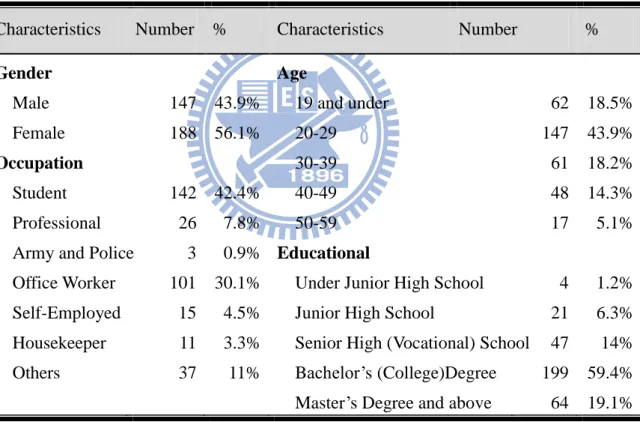
In formal survey, 345 samples are collected, and 10 of them didn‟t finish the questionnaires. Therefore, only 335 samples are used for final analysis. Of the sample, 87 of utilitarian purchasing in SE, 82 of utilitarian purchasing in JE, 84 of hedonic purchasing in SE, and 82 of hedonic purchasing in JE. That show the sample size for each condition is quite balanced. Participants consist of 43.9% male and 56.1% female. Age ranged from 20-29 (43.9%) mostly. Further, 42.4% participants are students and 30.1% are office workers. And educational background is mainly bachelor‟s (or college) degree, 59.4% of participants. Table 5 shows the information of the sample compensation.
Table 5 Sample Profile
Characteristics Number % Characteristics Number %
Gender Age
Male 147 43.9% 19 and under 62 18.5% Female 188 56.1% 20-29 147 43.9%
Occupation 30-39 61 18.2%
Student 142 42.4% 40-49 48 14.3% Professional 26 7.8% 50-59 17 5.1% Army and Police 3 0.9% Educational
Office Worker 101 30.1% Under Junior High School 4 1.2% Self-Employed 15 4.5% Junior High School 21 6.3% Housekeeper Others 11 37 3.3% 11%
Senior High (Vocational) School 47 14% Bachelor‟s (College)Degree 199 59.4% Master‟s Degree and above 64 19.1%
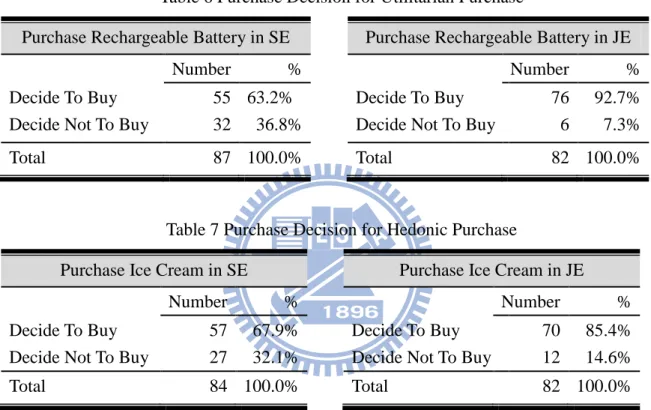
Related to the final purchase decision, 63.2% participants are willing to buy the rechargeable battery in SE and 92.7% are willing to buy in JE. Another hedonic purchase scenario, 67.9% are willing to buy ice cream in SE and 85.4% are willing to buy in JE (see Table 6 and 7). No matter what product, there is more people decide to buy the product in JE than in SE.
Table 6 Purchase Decision for Utilitarian Purchase
Purchase Rechargeable Battery in SE Purchase Rechargeable Battery in JE Number % Number % Decide To Buy 55 63.2% Decide To Buy 76 92.7% Decide Not To Buy 32 36.8% Decide Not To Buy 6 7.3% Total 87 100.0% Total 82 100.0%
Table 7 Purchase Decision for Hedonic Purchase
Purchase Ice Cream in SE Purchase Ice Cream in JE Number % Number % Decide To Buy 57 67.9% Decide To Buy 70 85.4% Decide Not To Buy 27 32.1% Decide Not To Buy 12 14.6% Total 84 100.0% Total 82 100.0%
4.1 Reliability and Validity Test
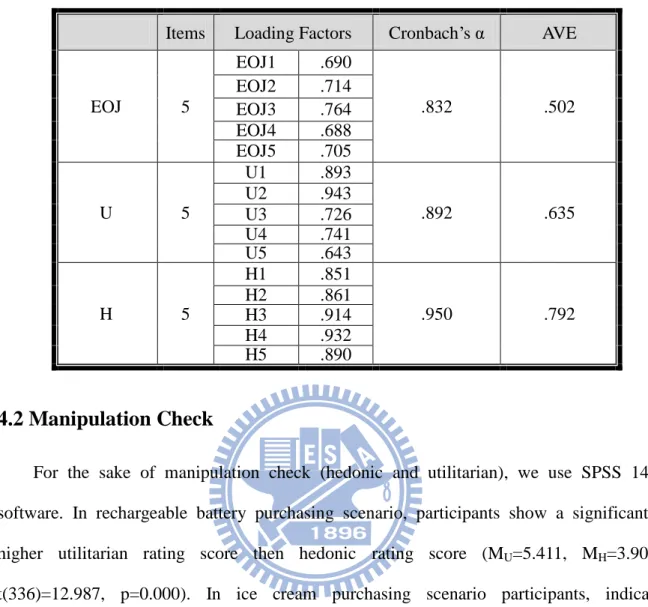
Again, we conduct a reliability and validity test for formal survey. All items‟ Cronbach‟s α score is over acceptable threshold with 0.8, suggesting good internal consistency. Besides, the average variance extracted (AVE) of all construct exceeded the 0.5 (the minimum criterion), implying good convergent validities of items (Fornell and Lacker 1981). The result is display in Table 8.
Table 8 Result of Reliability and AVE for Formal Survey Items Loading Factors Cronbach‟s α AVE
EOJ 5 EOJ1 .690 .832 .502 EOJ2 .714 EOJ3 .764 EOJ4 .688 EOJ5 .705 U 5 U1 .893 .892 .635 U2 .943 U3 .726 U4 .741 U5 .643 H 5 H1 .851 .950 .792 H2 .861 H3 .914 H4 .932 H5 .890
4.2 Manipulation Check
For the sake of manipulation check (hedonic and utilitarian), we use SPSS 14.0 software. In rechargeable battery purchasing scenario, participants show a significantly higher utilitarian rating score then hedonic rating score (MU=5.411, MH=3.908;
t(336)=12.987, p=0.000). In ice cream purchasing scenario participants, indicate significantly higher hedonic rating score than utilitarian rating score (MH=5.127, MU=3.815;
t(330)=-10.833, p=0.000). Hence, the manipulation check was successful.
Furthermore, we investigate the preference of experimental products, two rechargeable batteries and two ice creams. By the analysis, the mean preference of two rechargeable batteries are 4.512 and 4.591(t(85)=-0.332, p=0.741), there is no significant difference. In neither case, two ice creams also have equal preference rating, 5.163 and 4.951 (t(82)=0.846, p=0.400). It means participants perceived equal preference toward our experimental products.
4.3 Hypotheses Test
Purpose of this research is to realize how the evaluation mode (JE and SE) affect people perceived ease of justification and difficulty in their decisions. On the basis of prior research, we put our discussion into two parts, for utilitarian and for hedonic purchasing. Hypothesis 1 examines purchasing rechargeable battery scenario, we expect people would perceived easier to justify their decisions in JE than in SE. Likewise, hypothesis 2 investigates purchasing ice cream scenario, the participants probably feel easier to justify in their decisions in SE than in JE.
Thus, the data use Independent-Samples T-test analysis to compare the means on each scenario. Additionally, we check the test for the equality of variance of our samples at first, and then read the report of t-test for equality of means as our hypotheses test.
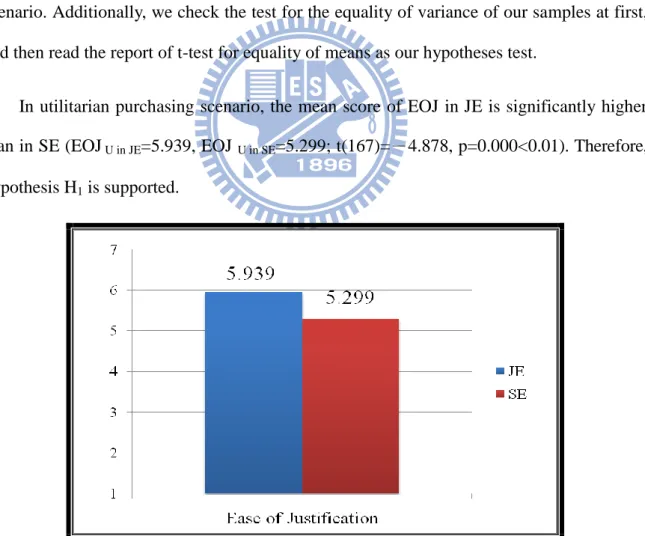
In utilitarian purchasing scenario, the mean score of EOJ in JE is significantly higher than in SE (EOJ U in JE=5.939, EOJ U in SE=5.299; t(167)=-4.878, p=0.000<0.01). Therefore,
hypothesis H1 is supported.
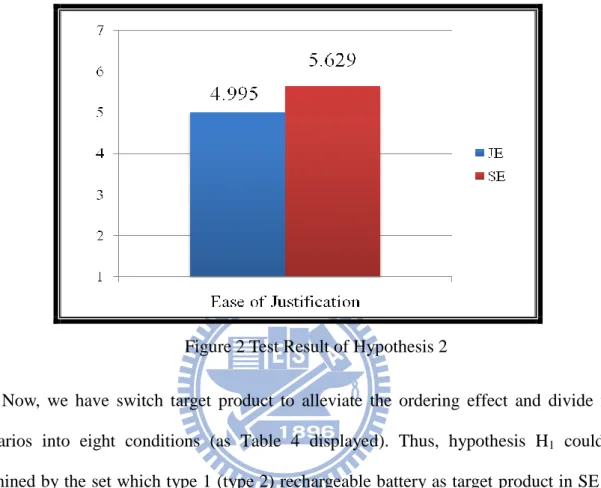
In support of H2, the mean score of EOJ in SE is significantly higher than in JE (EOJ H in SE=5.629, EOJ H in JE=4.995; t(141)=4.512, p=0.000<0.01) for hedonic purchasing scenario
(see Figure 2). Hence, hypothesis H2 is supported.
Figure 2 Test Result of Hypothesis 2
Now, we have switch target product to alleviate the ordering effect and divide four scenarios into eight conditions (as Table 4 displayed). Thus, hypothesis H1 could be
examined by the set which type 1 (type 2) rechargeable battery as target product in SE and give type 2 (type1) as the another available product in JE. Similarly, hypothesis H2 also
could be examine by the set which Beligum (Swiss) chocolate ice cream as target product in SE and provide Swiss (Beligum) chocolate ice cream as another available option in JE. Overall, there would be four sets to test our hypothesis. Figure 3 to Figure 6 display the analysis result of these four sets.
Firstly, when the type 1 rechargeable battery as the target product, it provides higher mean score of EOJ in JE than in SE (EOJ1 =5.330, EOJ12=5.800; t(81)= - 2.608,
Figure 3 Test Result of H1: Type 1 Rechargeable Battery as Target Product
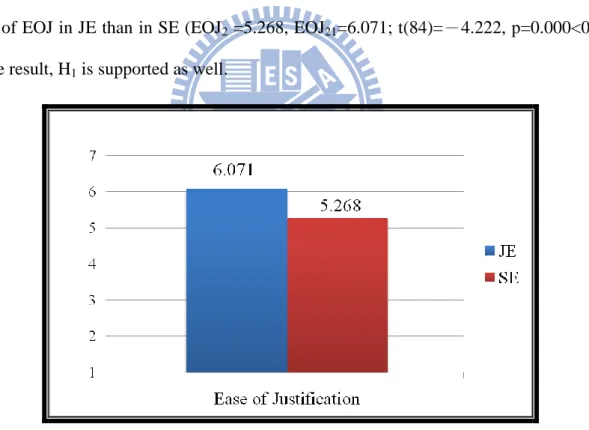
Secondly, type 2 rechargeable battery as the target product, it exhibit higher mean score of EOJ in JE than in SE (EOJ2 =5.268, EOJ21=6.071; t(84)=-4.222, p=0.000<0.05).
As the result, H1 is supported as well.
Figure 4 Test Result of H1: Type 2 Rechargeable Battery as Target Product
For hedonic purchase scenario, when Beligum chocolate ice cream as the target product, the mean score of EOJ is higher in SE than in JE. (EOJB=5.604, EOJBS=4.751; t(82)=4.494,
Figure 5 Test Result of H2: Beligum Chocolate Ice Cream as Target Product
Lastly, when Swiss chocolate ice cream as the target product, is present higher mean score of EOJ in SE than in JE (EOJS=5.654, EOJSB=5.239; t(80)=2.048, p=0.044<0.05). As
our predict, H2 is supported.
Figure 6 Test Result of H2: Swiss Chocolate Ice Cream as Target Product
However, according to our analysis result, the ordering effect didn‟t come up and the results all support our hypotheses. In simple words, our scenario designs are successful.
5. Discussion and Implications
5.1 Conclusion and Discussion
Most of people hope to make relieved decisions and feel comfortable, that‟s the main reason for people need justification for their decisions (Shafir, Simonson, and Tversky 1993). In reality, consumers usually lay in various decision contexts which may result from the number of available options at purchase time. Putting products side by side would let people in joint evaluation mode, focus on the external relationship and the comparison between options to make choice. Otherwise, presenting products separately would make people in single evaluation mode, weighting more on product itself and making decisions rely on their own internal feelings. Moreover, a series of studies report that decision about different product categories may use different types of reference information (Hsee and Leclerc 1998). According to our study, we discover the identity of purchasing concern (e.g. focus on what attributes) and the information which JE and SE provide would affect people‟s ease of justification.
For utilitarian purchases, buying such kind of products tended to care more about the utility, practical functions, and the exactly performance (as in prevention-focused, see Hirschman and Holbrook (1982)). Relatively, in JE could provide sufficient information through the comparison directly than in SE. The comparison makes people easy to discern the value and construct an external standard of quantitative attributes which usually used to describe utilitarian product‟s benefits and performance. Therefore, it is easier for consumers to justify decisions and feel less decision difficulty since they got appropriate information easily in JE than in SE. In our study, hypothesis H1 is form with this argument and has been
support by the study result. People do feel higher ease of justification and less decision difficulty when they purchasing utilitarian products in JE than in SE.