國
立
交
通
大
學
運 輸 科 技 與 管 理 學 系 碩 士 班
碩 士 論 文
不同決策程序系統下依附感相關效應之探討
Effect of Attachment of Two Process Systems on
Decision Making
研 究 生:林幼芝
指導教授:任維廉 博士
不同決策程序系統下依附感相關效應之探討
Effect of Attachment of Two Process Systems on Decision
Making
研 究 生:林幼芝 Student:Yu Chih Lin
指導教授:任維廉 Advisor:William Jen
國 立 交 通 大 學
運 輸 科 技 與 管 理 學 系
碩 士 論 文
A Thesis
Submitted to Department of Transportation Technology and Management College of Management
National Chiao Tung University in partial Fulfillment of the Requirements
for the Degree of Master
In
Transportation Technology and Management
September 2010
Hsinchu, Taiwan, Republic of China
I
不同決策程序系統下依附感相關效應之探討
研究生:林幼芝
指導教授:任維廉
國立交通大學運輸科技與管理學系碩士班
摘 要
人們在做決策時,理想上應該多應用理性資訊處理過程系統,但實際上當他們腦中 使用認知的資源已被其他事物占據時,常就無法有效的應用理性過程系統,而會比較受 到情感的影響。本研究主要在推論與比較在這兩種過程系統下之決策,會產生的不同可 能效應。人們除了在理性比較選擇群中的選項各可以為我們帶來的好處外,在選擇的過 程中,也會想像若使用這種產品或接受這種服務的情況,於是可能導致他們與這些選項 產生了心理上的聯繫,而這種依附感會進一步使人們產生彷彿已經擁有這些選擇的感覺, 所以當他們要從其中選出一個選項時,那些沒有被選擇的選項似乎變得比選前他們所想 的還要有吸引力。本研究為探討這些負面效應對決策的影響,推演出四個研究假設,並 且設計了兩階段的研究程序來驗證假設。第一階段的問卷在檢定人們在消費行為時是否 有上述兩種不同的決策處理方式,亦即辨認與區分哪些狀況下受測者較易受到依附感的 影響。第二階段的問卷則在比較不同情境下兩類受測者之後續效應。所有問卷都有經過 前測及修正,而正式施測結果發現實證結果支持本研究的假設推論。最後,作者根據研 究結果提供若干管理意涵,也對後續研究提出相關建議。 關鍵字:決策,過程系統,依附感,損失趨避II
Effect of Attachment of Two Process Systems on
Decision Making
Student: Yu Chih Lin Advisor: William Jen
Department of Transportation Technology and Management
National Chiao Tung University
Abstract
When people making decisions, ideally should process the related information more
rationally and thoughtfully to get more satisfied choice. But as people’s cognitive resource is
impeded by other disruptions, people cannot function the cognitive system well. Meanwhile,
they become easily influenced by affective reactions which means, ruled by the affective
system. This research mainly discusses and compares the decisions under the two process
systems and its consequences effect. People consider their choice options closely to get a
more satisfied choice. But in the that process of decision, as people deliberating the benefits
the products can bring or wondering the possible experience of the services, they could
proximate the psychological distance between them and the options. Thus, they may attach to
the choice options. The attachment would further cause people to feel a sense of ownership of
the options. So, when people choosing one out of the set, they may feel like forego the
nonchosen options. The attached people may surprisingly found they are hit by psychological
discomfort and feel the nonchosen options seem better before decision is made. To discover
the negative effect on the process system, on this research we reasoning four hypotheses and
design a two stage experiment. The first study is to examine the condition when people using
different process system. The second study recognizes the attachment effect under different
systems. All questionnaire are modified and pretested, the formal results supports our
hypotheses. Last, based on the results, we provide implications and suggestions of future
research.
III
誌 謝
儘管論文是延遲了一些時間才完成,但重要的是最終我還是幸運的完成了碩士論文。 在碩士的求學過程中,經歷了許多我從未預料會發生的事,這讓我更珍惜在這短短兩年 所得到的知識與經驗,得到剩下的是深刻的體會與感謝。 首先我要感謝我的家人,我的父親母親從小到大都沒有強迫我一定要走怎麼樣的人 生道路,給予我充分的自由,就讀研究所一事亦然,沒有疑慮給予我的只有充份支持, 在這兩年他們給予我許多精神上與金錢上的支持,尤其願意讓我能夠到北京當一學期的 交換學生,這個經驗對我來說是畢生難忘的,著實感謝您們。其次我要感謝我的姊姊們, 大姊與二姊雖然是被迫要當我的訪談對象,但是在最後若沒有妳們的鼓勵與談話,我想 我會很難繼續走完這條路,謝謝妳們。這裡也特別感謝秋薰姐姐,在我兩年期間協助我 取得許多交大沒有的期刊文章,在這裡特別感謝妳的協助與支持。 接下來我要感謝我的指導教授任維廉老師,任老師在研究上給予我們寬大的彈性與 空間,更不吝支持我們前往北京當交換學生,在計畫案及助教方面也給了我許多學習的 機會,老師的為人處事更是我未來待人接物的模範,很高興碩士班是進入到任老師實驗 室,謝謝老師兩年來的照顧,也謝謝師母不時的關心與愛心。感謝北京大學的涂榮庭老 師,在老師的教誨下,我的邏輯與思想上都得到了許多的啟發。尤其在北京交換學生期 間,無論在研究上的引導或是生活的點滴照顧,在這裡也想跟老師說聲感謝。謝謝口試 老師胡凱傑老師與林祥生老師的指導讓我的研究更趨完整。 謝謝實驗室的大支柱堂榮學長,堂榮學長在我們一進入實驗室就很有耐心的一步步 引導我們正確的研究觀念,在學長身上我看到學習單純的熱忱,跟學長討論是我從小就 學以來感到最有腦力激盪的時刻了,十分感謝學長的照顧。其次是明頴學長,特別謝謝 明頴學長在北京對我們生活及研究上照顧,對於生活的道理更是不吝與我們分享,謝謝 學長。友維學長對我來說介於大學長與平輩之間(所以請原諒我都沒有稱呼你學長),我 衷心認為你的基礎與經驗使你無疑地擁有堅強的硬實力與軟實力,感謝你兩年的照顧與 分享。佛諭、竹軒、熊和維中學長的照顧與相處,使我碩一得到許多生活上與研究上的 樂趣,感恩。夥伴思琪、禹瑄、阿舍和敏倫的互相打氣與支持是研究生活的一道曙光, 特別給敏倫和阿舍,從同一個寢室到同一個實驗室,六年起跳的交情不簡單,感謝妳們 願意忍受我這個不是很好相處的朋友,真心感謝妳們。最後一併感謝在研究路途中幫助 過我的人,系足的大家與學弟妹們,謝謝你們。最後的最後,祝大家身體健康。林幼芝 謹誌
中華民國九十九年八月IV
Contents
Chinese Abstract ... I English Abstract ... II Acknowledgments ... III Table of Contents ... IV List of Figures ... V List of Tables ... V 1. Introduction ... 2 2. Literature Review ... 5 2.1 Process System ... 52.1.1 The Associated-based and Rule-based system ... 5
2.1.2 The Dual Process -- System 1 and System 2 ... 6
2.1.3 The Relationship between the two Systems ... 8
2.1.4 The Working Capacity ... 8
2.2 Cognitive Resource ... 9
2.2.1 Cognitive Load ... 10
2.3 Attachment ... 10
2.3.1 Emotional Attachment ... 10
2.3.2 What Causes Attachment ... 11
2.3.3 The Measurement of Attachment ... 12
2.4 Loss Aversion ... 13
2.4.1 Endowment Effect ... 13
2.4.2 The Moderator of Loss Aversion ... 14
2.4.3 Feelings of Ownerships ... 14
2.5 Process-Induced Affect ... 15
2.6 Summary ... 16
3. Research Model and Hypotheses ... 17
3.1 Operational Definition ... 17
3.1.1 Process Systems ... 17
3.1.2 Cognitive Load ... 17
3.1.3 Attachment ... 18
3.1.4 Postchoice Discomfort and Changed Attractiveness of Forgone Option18 3.2 Research Hypotheses ... 18
3.2.1 The Effect of Cognitive Load on Process Systems ... 18
3.2.2 The Attachment of the Process Systems ... 19
3.2.3 The Postchoice Effect of Attachment ... 20
V
3.3 Research Methodology ... 22
3.3.1 Study 1 ... 22
3.3.2 Study 2 ... 24
4. Analyses and Results ... 27
4.1 Study 1 ... 27 4.1.1 Results of Pretest ... 27 4.1.2 Formal Investigation ... 27 4.1.3 Manipulation Check ... 29 4.1.4 Hypothesis Test ... 30 4.2 Study 2 ... 31 4.2.1 Results of Pretest ... 31 4.2.2 Formal Investigation ... 32 4.2.3 Hypotheses Test ... 33
5. Discussion and Managerial Implication ... 36
5.1 General Discussion ... 36
5.2 Managerial Implication... 37
5.3 Limitations and Future Research ... 39
5.3.1 Limitations ... 39 5.3.2 Future Research ... 40 Reference ... 41 Appendix 1 Study 1 ... 46 Appendix 2 Study 2 ... 56
List of Charts
Chart 1 Brand EA Model of Thomson et al. (2005) ... 12Chart 2 Research Reasoning Flow Chart ... 22
Chart 3 The Mediation of Postchoice Discomfort ... 39
List of Tables
Table 1 Kahneman and Frederick’s (2002) Two Systems ... 7Table 2 Espein’s (1994) Comparison of Experiential and Rational Systems... 7
Table 3 The Place Attachment questionnaire of Gross and Brown (2006) ... 13
Table 4 Study 1 Pretest Result of Reliability Test... 27
Table 5 Descriptive Statistics of Study 1... 28
VI
Table 7 Study 1 Result of Independent-samples t-Test ... 30
Table 8 Study 1 Result of Homogeneity of Proportions Test ... 31
Table 9 Study 2 Pretest Result of Individual-samples t-test ... 32
Table 10 Descriptive Statistics of Study 2... 33
Table 11 Study 2 Result of Reliability Test ... 33
Table 12 Study 2 Result of Individual-samples t-test ... 35
Table 13 Study 2 Result of Mediation Test ... 40
1
Effect of Attachment of Two Process Systems on
Decision Making
1. Introduction
Common sense suggests that consumers believe they make more satisfied decisions as
they consider their choice options more closely. Imagine Ms. A is planning a tour trip for the
summer vacation. She identified two contenders but has not decided which one of them to go.
One spot is Paris and another is New York. Each of the cities has its own characteristics and
distinguishing features. To a more satisfied decision, she acts rationally. She deliberate
extensively and rehashing the features of the two options. For several days later, she finally
makes her decision to Paris. However, as she books the ticket to Paris, rather than feels
satisfied with her choice, she is hit by a feeling of unease about her decision. And New York
seems better than she thought before the choice. The purpose of the effortful decision process
is for a more satisfied choice, yet it is the process in cognition induces affective reaction
which leads to undesirable effects. The effortful decision process is to make a more satisfied
choice, but it is also the process that makes the choice become not so charming.
Nonetheless, in our daily life, sometimes people cannot perform rationally, especially
when they are cognitively busy or impeded. For example, some students study less efficient
when they listening to music than when they study in quite environment. Things that interrupt
or impede the cognition work hereafter called cognitive load. The cognitive load is believed to
disrupt more conscious, controlled processing without disrupting nonconcious, automatic
processing (Gilbert, Pelham and Krull, 1988). As the decision maker’s working resource is occupied by other unrelated issues, some people make their decision mostly by their feelings.
2
and West (2001) describe the traditional processes which partitioned into two main families –
traditionally called intuition and reason – as system 1 and system 2. The systems are
separately described as System 1 is an associative and feeling based process and system 2 is a
deliberated and rule-based process (Kahneman and Frederick, 2002). As a matter of fact, as
people deliberating the decision options, they are using the system 2. For people using
feelings and intuitions to make decision, they are using the system 1. In short, system 1 is
relative affective and system 2 is relative cognitive. And when people with higher cognitive
load, their cognitive system 2 are impeded, thus they decide more based on the affective
system 1.
People often being reminded to be rational rather than to act impetuously, especially
when they making decisions. That is using the more rational and deliberative system 2.
However, deliberate the advantages of each choice alternative can increase the psychological
proximity to the options. This kind of prefactual thinking about the choice options might
bring could induce the attachment (Carmon and Ariely, 2000; Dhar and Wertenbroch, 2000;
Hoch and Loewnstein, 1991). The emotional attachment is a relationship-based construct that
reflects the emotional bond connecting an individual with a consumption entity, i.e., brand,
person, place or object (Park and Macinnis, 2006). Once people attach to the option choices,
they may induce the sense of ownerships (Areily, Huber and Wertenbroch, 2005; Carmon,
Wertenbroch and Zeelenberg, 2003). To be specifically illustrated, the ownership is based on
the “perceptions of people” rather than the “fact.” Thus, while facing to make decision, choose one among the options become having to forgone the others. Losing an object is an
experience of unpleasant, yielding to psychological discomfort and people often view their
feelings as information when they make judgment (Pham, Cohen, Pracejus and Hughes, 2001;
Schwarz, 2001). Thus, the feeling of losing the nonchosen option may induce the postchoice
3
the foregone option, that the nonchosen options seem better than they were before the choice.
People percept to choose a more satisfied choice requires a thoughtful decision process,
that is, via a rational system 2 process. Apparently, consumers are willing to execute a more
effortful decision process to get a more satisfied or accurate choice. However, it might is the
process trying to reduce the possible negative feeling generated after choice that reversely
induces postchoice discomfort. To be more specifically, we propose another possible way of
people attach to objects via their decision process rather than the presentation mode of the
objects (Carmon and Ariely, 2000; Dhar and Wertenbroch, 2000; Hoch and Loewnstein,
1991). Further, the effect as a matter of fact relates to several underlying issues and this
research could contribute to them. Firstly, we only know a few about the relationship between
accuracy maximization, negative emotion minimization and effort minimization metagoals in
consumer goals (Bettman et al., 1998). Such as, Drolet and Luce (2004) discover that when
people trying to prevent negative emotion via preventing trade-off the options’ attributes. But
with a little cognitive load, they less focus on the goal of reduce negative emotion, thus
trade-off the attributes which is the appropriate way to make decision. In this research, we
hope to render some discussion to the decision goal conflict topic by discuss the other aspect,
maximize accuracy.
Second, one thing to notice is the common effect of cognitive load may interrupt the
process people try to use. They may thus make decision based on the affective system 1. In
this research we examine one possible consequence of the usage the two process systems. We
adopt the concept of dual-process systems, however, we can still contribute to argue the myth
that people using the rational system 2 make more satisfied choices than using affective
system 1.Finally, the evaluation of a option is not only depend on the option itself, sometime
the decision process may render some output that also affect the evaluation of the final choice.
4
the assessment of a new product (Meyers-levy and Tybout, 1989; Stayman, Alden, and Smith,
1992).
In our research, we provide another case of process-induced affect influencing the goods.
Especially, instead of discussing the chosen option being influenced, in this research focus is
the effect on the nonchosen option. In sum, the purpose of this research is to uncover the
phenomenon of why people effort to get satisfied choice, but less satisfied sometimes. And
reversely, when they have cognitive load, that they decide more rely on their feeling, they
reduce the chance of getting postchoice discomforts. It uncovers a case of how people
generate attachment on choice option via their decision process instead of how the options
being presented. This result could contribute to the issue of consumer behavior which is the
concern of the marketers. With the discover of the phenomenon, managerial implications can
also be derived from our study which can help marketing practitioners with better
understanding of consumers’ decision process and developing more appropriate tactics, such as the applied on the advertising and product promotion strategies.
5
2. Literature Review
2.1 Process System
Process systems are the way people absorb, retain and process information stimuli, and
have been shown to be influential in the consumer decision process as information acquisition,
even the consumer’s decision making (Hoch and Lowensstein, 1991; Hsee and Kunreuther, 2000; Luce, 1998; Luce, et al., 1999; Pham et al., 20001; Rottenstreich et al., 2007; Shiv and
Fedorikhin, 1999). Recent researches have indentified two distinct mental processing, one is
associative and feeling based and the other is deliberate and rule based (Chaiken and Trope,
1999; Epstein, 1994; Peter and Slovic, 2000; Sloman, 1996; Stanovich and West, 2002).
Kahneman and Frederick (2002) contrast the two naturally different systems as system 1 and
system 2. They depict system 1 as automatic, rapid, associative and affective, and system 2 as
controlled, slow, deliberated and deductive. Before entering how the mental processing
influence the consumer behavior, in the next part is firstly to introduce the nature of the two
systems.
2.1.1 The Associated-based and Rule-based systems
According to Sloman (1996), the system 1 is more associative. It encodes and process
statistical regularity of its environment, frequencies and correlations amongst the various
features of the world. It treats objects in similar ways to the extent that the objects are
perceived as similar. Rather to find a reason on the basis of an underlying causal or
mechanical structure, system 1 constructs estimates based on underlying statistical structure.
In contrast, the system 2 is more rule-based. The rule-based systems are productive in that
they can encode an unbounded number of propositions. And the rules are considered as
systematic, in the sense that their ability to encode certain facts implies an ability to encode
6
Accordance to Sloman (1996) who believe rules are the form of representation that
exhibit the properties of productivity and systematicity most transparently, the rule can be
abstractions that apply to any and all statements which originally have certain well-specific,
symbolic structure. The difference exhibit when people using the two processes, what is the
underlying mechanisms that beneath people’s action or thoughts. Via the research of how people’s reasoning differently, it is helpful for us to get a generally and initially concept of why the two systems can affect people’s behavior or their decisions. Thought the
psychological part is fascinating, the next part is to introduce more exterior part of the mental
process systems.
2.1.2 The Dual Process -- System 1 and System 2
Stanovich and West (2001) describe the traditional processes which partitioned into two
main families – traditionally called intuition and reason – as system 1 and system 2. The term
they use is a suggestion of the image of autonomous homunculi rather than an intended
meaning. And now it is widely applied under the general label of dual-process theories
(Rottenstrech, 2007; Sloman, 1996). Follow with Stanovich and West (2001), Kahneman and
Frederick (2002) take systems as label for collections of processes that are distinguished by
their speed, controllability, and the contents on which they operate. With previous research,
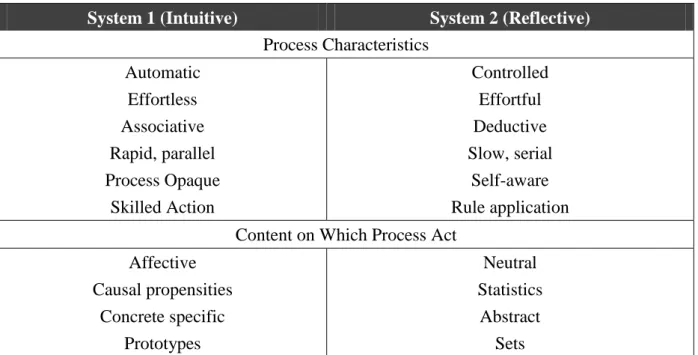
they order the process characteristics of the two systems (see table 1). They described system
1 as associative and feeling based process and system 2 as deliberated and rule-based process.
Espein (1994) also suggest a related cognitive-experiential self-theory which depicts the
cognitive and the psychodynamic unconscious by assuming the existence of two parallel,
interaction modes of information processing. One is rational system and the other is
emotionally driven experiential system. Basically is other terms replace the different systems
7
Table 1: Kahneman and Frederick’s (2002) Two Systems
System 1 (Intuitive) System 2 (Reflective)
Process Characteristics
Automatic Controlled
Effortless Effortful
Associative Deductive
Rapid, parallel Slow, serial
Process Opaque Self-aware
Skilled Action Rule application
Content on Which Process Act
Affective Neutral
Causal propensities Statistics
Concrete specific Abstract
Prototypes Sets
To be general discuss, with the previous related researches, it can be summarized that the
affective system 1 includes fast and instinctive processes formed by associative learning
method that operate largely beyond awareness. And the rational system 2 is capable of
constructing mental representations and simulations of future based on hypothetical or
abstract thought. And this research follows with Kahneman and Frederick’s (2002) definition – system 1 and system 2 – to describe the two process systems.
Table 2: Espein’s (1994) Comparison of Experiential and Rational Systems
Experiential system Rational system
Holistic Analytic
Affective: pleasure-pain oriented Logical: reason oriented Associationistic connection Logical connections Behavior mediated by vibe from past
experiences
Behavior mediated by conscious appraisal of events
More rapid processing: oriented toward immediate action
Encodes reality in abstract symbols, words and numbers
More crudely differentiated More highly differentiated More crudely integrated More highly integrated
8 2.1.3 The Relationship between the two Systems
Traditional approach believe that affect in preference is an outcome of cognitive
representations of the object; that is, before you can say you like something, you must know
what it is. However, situation abound in everyday decision making when it is assumed that
system 1 and System 2 are set in motion simultaneously and work independently to provide
their respective feedback when face with a decision task (Zajonc, 1980; Zajonc and Markus,
1982). They conceptualized as two distinct entities which can proceed independently, as well
as work together. With their concept, many researcher also agree with them, and conclude that
individuals most likely to use a combination of affective and cognitive processing (Edward,
1990; Giese and Sojka, 1998).
The concept of two parallel systems providing feedback to decision task has gained
significantly lately (Kahneman, 2003; Stanovich, 2004; Stanovich and West, 2002; Sloman,
2002). Misgra et al. (2007) propose a different notion that affective system is able to interfere
the information integration of system 2 which is believed to utilize everyday consumer
decision making. Though there are many branches depict the relations of the two systems, the
nature of the systems still remains quite vivid among all the discussions.
2.1.4 Working Capacity to Process the Systems
Since the system 1 is to employ affected charged, automatic, rapid, parallel,
heuristic-based process that are relatively undemanding of cognitive capacity (Kahneman and
Frederick, 2002; Stanovich, 2004; Sloman, 2002). In contrast, system 2 is a controlled,
rule-based, slow, serial and deliberative and is constrained by working memory capacity
(Giese and Sojka, 1998; De Neys, 2006; Rettenstreich, 2007; Shiv and Fedorikhin, 1999). It is
believed that system 1 quickly proposes intuitive answers to judgment problems as they arise,
9
override (Kahneman and Frederick, 2002). And it is proposed that logical reasoning requires
cognitive resources (Stanovich and West, 1998). Zajonc (1998) also describe the affective
system 1 as precognitive in nature, it occurs without any extensively perceptual and cognitive
processes.
Among all the direct or indirect suggestions, it is clearly that the two systems require
different capacity or cognitive resources to be processed. The capacity or the cognitive
resource is quite different across individuals, and the gap is especially evident under conflict
decisions (De Neys, 2006). Though there is something in common which can influence
people’s ability to process the more effortful system 2, the cognitive load is believed to impede more conscious, controlled processing without disrupting nonconscious, automatic
processing (Gilbert, Pelham and Krull, 1988).
2.2 Cognitive Resource
Psychology research suggests that person perception consists of (1) categorization (i.e.,
identifying action), (2) characterization (i.e., drawing dispositional inferences about the actor),
(3) correction (i.e., adjusting those inferences about the actor, Trope, 1986; Quattrone, 1982).
And it is believed that characterization is generally an overlearned, relatively automatic
process that requires little effort or conscious attention, whereas correction is a more
deliberate, relatively controlled process that uses a significant portion of the perceiver’s
processing resource (Gilbert, Pelham and Krull, 1988). Just like how the affective system1
and deliberative system 2 works, the automatic system 1 need just few conscious and
cognitive efforts whereas the rational system 2 requires cognitive resource to process. Once
the process is relates to the cognitive process, it needs cognitive resource to be function.
Reversely, it is reasonable to presume that once the cognitive resource is impeded or disrupted,
10 2.2.1 Cognitive Load
Gilbert, Pelham and Krull (1988) found when people are cognitively busy, one
component of the person-perception process (correction) suffers more than another
(characterization). The cognitively busy seems to impair the ability to use information about
the situational constraints. In other words, when the cognitive resource is processing on other
subjects, the left resource is not quiet available to provide sufficient support to function well.
In this condition, it can be understand as when people with cognitive loads. Further, the
cognitive load is believed to impede more conscious, controlled processing without disrupting
nonconscious, automatic processing (Rottenstrech, Sood and Brenner, 2007; Shiv and
Ferdorikhin, 1999).
Recent research implies the load’s specific effect is to interfere with people’s use of prestored information, including self-goals, prominent effect, self-control behavior or
choice-generated emotion (Drolet and Luce, 2004; Drolet, Luce and Simonson, 2008;
Rottenstrech, Sood and Brenner, 2007; Shiv and Ferdorikhin, 1999; Ward and Mann, 2000). It
is notice while that the cognitive load is especially affected on the issue of self-control or
self-regulation. Self-control is to use the cognitive part of individual to prevent from affective
impulsive behavior, i.e., dieter prevent from eating high calories food. So when the dieter with
cognitive load, it reduce their cognitive monitoring function thus they may unable to process
cognition part of decision, thus acting impulsive behaviors like eating high fat food. It is
noticeable that once the individual is not dieter, the decision is less likely to be affected by the
cognitive load (Ward and Mann, 2000).
2.3 Attachment
2.3.1 Attachment
11
emotional-laden target-specific bond between a person and a specific object. The emotional
attachment is a relationship-based construct that reflects the emotional bond connecting an
individual with a consumption entity, i.e., brand, person, place or object (Park and Macinnis,
2006). Attachments vary in strength and stronger attachments are associated with stronger
feelings of connection, affection, love and passion. Not only linked to attitudes, it is also
evidently by psychological and behavioral outcomes not typically linked to attitudes.
According Park and Macinnis’ (2006) integration, they suggest emotional attachment entails evaluative properties like attitudes, but it also include hot affect, reflecting the
motivational and emotional properties associated with a relationship bond. They identify
several below. First, the concept of self is a relevant one for the attitude construct which is
inherently bonded to attachment. Second, attachment has strong motivational and behavioral
implications, such as proximity-seeking behavior, separation distress, as sense that attached
object offers a safe haven and mourning of its loss (Bowly, 1979). With strong emotional
attachment, individual is more likely than attitude to predict behaviors that reflect
commitment and investment in the consumption object (Thomson et al., 2005). Third, strong
self-object linkages result in a rich set of schemas, exemplars, and affective- laden memories
linked to the object (Mikulincer et al., 2001).
2.3.2 What Causes Attachment
As attachment is described as a psychology bond of the individual and the specific object,
its existence is quite different from each person. Though, there is still commonly factor or
behavior that causes the attachment to occur. Deliberating on advantages of each choice
alternative can increase the psychological proximity to the options, thus increases attachment.
This kind of pre-factual thinking about the options and imagination of the feeling the
12
and Ariely, 2000; Dhar and Wertenbroch, 2000; Hoch and Loewnstein, 1991).
2.3.3 The Measurement of Attachment
In consumer behavior there are also researches document that a variety of emotions (e.g.,
love, warm feelings) characterize collector’s emotional attachments to brand (Slater, 2000).
Previous mentioned higher attachment would lead to higher commitment toward the object. In
a marketing context, the commitment can play as a indicator of the extent to which the
individual remains royal to the brand (Garbarino and Johnson, 1999). But, only few
empirically test measurement of consumers’ emotional attachment. Thomsonet al. (2005) are the first to develop a psychometrically measure of the strength of consumers’ emotional attachments to brands. Through a series a valid and reliable test, they suggest a stable
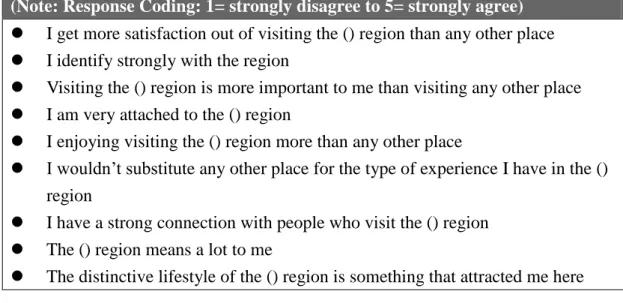
underlying structure to the EA scale (see Chart1). Gross and Brown (2006) also suggest an
emotional scale about place attachment accordance with many previous place attachment
studies (see Table 3).
Chart1. Brand EA Model of Thomson et al. (2005) Affection Loved Peaceful Friendly Attached Bonded Connected Passionate Delighted Captivated Connection Affection Passion Brand Loyalty Price Premium
13
Table 3: The Place Attachment questionnaire of Gross and Brown (2006)
Place Attachment
(Note: Response Coding: 1= strongly disagree to 5= strongly agree) I get more satisfaction out of visiting the () region than any other place I identify strongly with the region
Visiting the () region is more important to me than visiting any other place I am very attached to the () region
I enjoying visiting the () region more than any other place
I wouldn’t substitute any other place for the type of experience I have in the () region
I have a strong connection with people who visit the () region The () region means a lot to me
The distinctive lifestyle of the () region is something that attracted me here
2.4 Loss Aversion
2.4.1 Endowment Effect
The endowment effect is defined as a discrepancy between buying and selling. That is,
goods which one owns are valued more highly than identical goods not held in the
endowment. For the non-owners, their perceive gain from acquisition was apparently lower
than the owners’ potential loss from sell (Kahneman, Knethsch and Thaler, 1990; Kahneman, Knethsch and Thaler, 1991).
Endowment effect is commonly explained as the result of loss aversion (Kahneman and
Thaler, 1979). The word “loss” denotes something inherently aversive (Areily, Huber and
Wertenbroch, 2005). If one initially owns an object, the prospect of losing it is seen as a
(relatively large) loss. Instead, if one does not, the prospect of acquiring it is seen as a
(relatively small) gain. Novemsky and Kahneman (2005) build the boundaries of loss
aversion. Their key idea is the exchange goods are given up as intended do not exhibit loss
14
individual’s intentions and not the only on the objective state of affairs at the moment of decision, they focus is whether the individual intention can produce or inhibit loss aversion.
For instance, money give up in purchase is not always subject to loss aversion.
2.4.2 The Moderator of Loss Aversion
As mentioned, losses loom larger than gains implies people impute greater value to a
given object when they given it up than when they acquire it (Kahneman and Tversky, 1979).
As previous research suggests, the intention determines whether giving up that good is
evaluated as a loss or a foregone gain (Novemsky and Kahneman, 2005). The change in
cognitive perspective plays a role of loss aversion (Areily, Huber and Wertenbroch, 2005).
For example, the perspectives of buyers and sellers. Seller focus on the aspects of the
exchange that they might lose, the object; while the buyers focus on the aspect of exchange
they might lose, the expenditure. It seems that the ownership of the object leads to cognitive
gaps between the sellers and buyers.
Consumers adapt to ownership over time, prior ownership can increase the value that
consumer place on an object. It is believed as a gradual adaption process as the consumer’s psychological state moves from no ownership, to partial ownership, to complete ownership
(Stahilevitz and Loewenstain, 1998). Instead of real ownership of the object, previously
induced emotions affect the cognitive appraisal object with which people approach a
transaction. The emotional attachment is proposed as a moderator of the loss aversion (Areily,
Huber and Wertenbroch, 2005) since it can produce a sense of ownership even before the
purchase happens (Carmon, Wertenbroch and Zeelenberg, 2003).
2.4.3 Feelings of Ownerships
The traditional factor determines the endowment effect and the effect of loss aversion is
15
mental identity or cognition of the consumer rather than the fact. The followings are the cases
of feelings of ownerships.
Ariely and Simonson (2003) propose a test about the auction bid. In which they found
the highest bidders realize they stand in a leading position of the auctions, begin to think ore
concretely about the possessing the object and therefore more partially attached to it, called
the “pseudoendowment effect.” The theory of option attachment also suggests that during the decision process, the duration of the deliberation causes consumers attached to the objects
(Carmon, Wertenbroch and Zeelenberg, 2003). This option attachment leads consumer a
sense of prefactual ownership.
Quasi-endowment is another effect due to the attachment of the web-based bid objects
(Heyman,Orhun, and Ariely, 2003). The bidder with longer duration time attached more to the
object. It causes the bidder the sense of quasi-endowment which increases the willingness of
submitting higher prices. Reb and Connolly (2007) also suggest there is not only the factual
ownership leads to endowment effect, the feeling of ownership generated by possession of the
object also works as well. The matters is not the real ownership of the object, it is the
consumer’s cognitively belief of the ownership decides the effect of loss aversion.
2.5 Process-Induced Affect
Process of processing may generate affect, in addition to affective reactions generated by
the information itself (Garbraino and Edell, 1997). Affective reactions and processing
activities are related, despite whether the final choice is the same, sometimes affect is also
generated in the process and it can change the assessment of a new product (Meyers-levy and
Tybout ,1989; Stayman, Alden, and Smith ,1992).
Losing an object is an experience of unpleasant, yielding to psychological discomfort
16
Hughes, 2001; Schwarz, 2001). That is, individuals view their feelings as information when
they make judgments.
2.6 Summary
So far, research related to the process systems discussed the nature of the two systems
(Chaiken and Trope, 1999; Epstein, 1994; Peter and Slovic, 2000; Sloman, 1996; Stanovich
and West, 2002). There are also reports about how the process systems would influence the
final choice of the decisions (Hoch and Lowensstein, 1991; Hsee and Kunreuther, 2000;
Pham et al., 20001; Rottenstreich et al., 2007). Unlike previous work focus on what exact
people choose, discussed in this research is the possible consequence effect of using the
different systems. To be specifically, the effect results from peoples’ attachment on the
chosen options.
Articles about attachment discuss the nature of the attachment, such as the formal of
attachment between people and specific objects, such as brand, place or product (Bowlby,
1979; Park and Macinnis, 2006). They also discuss the formation of attachment and possible
performed action and attitude of people attached to some objects (Gross and Brown, 2006;
Garbarino and Johnson, 1999; Slater, 2000; Thomson et al., 2005). Though articles of what
causes the attachment is discussed (Carmon and Ariely, 2000; Dhar and Wertenbroch, 2000;
Hoch and Loewnstein, 1991), however, the factors they propose is mostly how the
presentation of the objects affects. Here we propose the way people decide could alter the
17
3. Research Model and Hypotheses
3.1 Operational Definition
Our main purpose of this research is to discover the phenomenon when people try hard
to make a more satisfied decision, sometimes after they make their decisions they seem not
quite satisfied with their choices. That is, when people using the deliberating and effortful
system 2 to make decisions rather than decide via the feeling and fast system 1. To provide a
more generally condition, we discuss the effect of cognitive load that impede the cognitive
system 2 but not the system 1. Thus, we can discuss when people might use the system 1 and
when might the system 2.
3.1.1 Process Systemss
Process systems are the way people absorb, retain and process information stimuli, and
have been shown to be influential in the consumer decision process as information acquisition,
even the consumer’s decision making (Hoch and Lowensstein, 1991; Hsee and Kunreuther, 2000; Luce, 1998; Luce, et al., 1999; Pham et al., 20001; Rottenstreich et al., 2007; Shiv and
Fedorikhin, 1999). In this research adopts the two dual-process concept (Rottenstrech, 2007;
Sloman, 1996) that distinguish the two systems by speed, controllability, and the contents on
which they operate. The system 1 is to employ affected charged, automatic, rapid, parallel,
heuristic-based process that are relatively undemanding of cognitive capacity (Kahneman and
Frederick, 2002; Stanovich, 2004; Sloman, 2002). In contrast, system 2 is a controlled,
rule-based, slow, serial and deliberative and is constrained by working capacity (Giese and
Sojka, 1998; De Neys, 2006; Rettenstreich, 2007; Shiv and Fedorikhin, 1999).
3.1.2 Cognitive Load
18
use the cognitive load (Rottenstrech, Sood and Brenner, 2007; Shiv and Ferdorikhin, 1999) to
examine the moment of cognitive business and its effect on the process systems. Cognitive
load is believed to disrupt more conscious, controlled processing without disrupting
nonconcious, automatic processing (Gilbert, Pelham and Krull, 1988).
3.1.3 Attachment
The emotional attachment is a relationship-based construct that reflects the emotional
bond connecting an individual with a consumption entity, i.e., brand, person, place or object
(Park and Macinnis, 2006). And the emotional attachment is also evidenced by, among other
things, psychological and behavioral outcomes not typically linked to attitudes: i.e. mourning
of its loss (Bowlby, 1979). The emotional attachment is proposed as a moderator of the loss
aversion (Areily, Huber and Wertenbroch, 2005) since it can produce a sense of ownership
even before the purchase happens (Carmon, Wertenbroch and Zeelenberg, 2003).
3.1.4 Postchoice Discomfort and Changed Attractiveness of Forgone Option
The intention determines whether giving up that good is evaluated as a loss or a foregone
gain (Novemsky and Kahneman, 2005).Outcomes as gains and losses depends on the
individual’s intentions and not the only on the objective state of affairs at the moment of decision, the focus is whether the individual intention can produce or inhibit loss aversion.
Losing an object is an experience of unpleasant, yielding to psychological discomfort which
positively colors the valuation of the threaten objects (Pham et al., 2001; Schwarz, 2001).
3.2 Research Hypotheses
3.2.1 The Effect of Cognitive Load on Process Systems
Process systems are the way people absorb, retain and process information stimuli, and
have been shown to be influential in the consumer decision process as information acquisition,
19
2000; Luce, 1998; Luce, et al., 1999; Pham et al., 20001; Rottenstreich et al., 2007; Shiv and
Fedorikhin, 1999). Generally, people commonly can use two distinct process systems, the
affective system 1 and the cognitive system 2 (Kahneman and Frederick, 2002). In this
research adopts the two dual-process concept (Rottenstrech, 2007; Sloman, 1996) that
distinguish the two systems by speed, controllability, and the contents on which they operate.
The system 1 is to employ affected charged, automatic, rapid, parallel, heuristic-based
process that are relatively undemanding of cognitive capacity (Kahneman and Frederick, 2002;
Stanovich, 2004; Sloman, 2002). In contrast, system 2 is a controlled, rule-based, slow, serial
and deliberative and is constrained by working capacity (Giese and Sojka, 1998; De Neys,
2006; Rettenstreich, 2007; Shiv and Fedorikhin, 1999). To manipulate the cognitive busy
condition that happened commonly among people, we use the cognitive load (Rottenstrech,
Sood and Brenner, 2007; Shiv and Ferdorikhin, 1999) to examine the moment of cognitive
business and its effect on the process systems.
Nonetheless, it is difficult to measure the psychological changes of process system. To
test the effect of cognitive load, most of related research checks the effect via subjects’ behavior or decision (Drolet and Luce, 2004; Drolet, Luce and Simonson, 2007; Giese and
Sojka, 1998; Rottenstreich et al., 2007; Shiv and Fedorikhin, 1999). Followed with previous
research, to test the effect of cognitive load, we provide subjects a cognitive-favored and an
affective-favored choice. We propose that when there is higher cognitive load, people will
tend to less appreciate to the cognitive-favored choice since their cognitive system 2 is being
impeded. Thus, the first hypothesis is below:
H1: Compare to people with higher cognitive load, those with less cognitive load tend to choose more cognitive-favored options.
20
As we know, people made decisions may via two different systems, one is emotionally
driven experiential system 1 and the other is rational system 2. It seems that the attachment is
connected to the affective system 1 with higher probability. However, deliberate the
advantages or constructing mental representations and simulations of each choice alternative
can increase the psychological proximity to the options. This kind of prefactual thinking about
the choice options might bring could induce the attachment (Carmon and Ariely, 2000; Dhar
and Wertenbroch, 2000; Hoch and Loewnstein, 1991). Thus, though the system 1 is affected
charged, its process is still relatively rapid. The deliberation of the choice option might be
constrained by the decision time. Instead, when individual uses system 2 which is rule-based
strategy, slow, serial and deliberative, they spend times on their elaboration of the choice
options. Despite the nature of system 2 is relatively cognitive, this elaboration on the
advantage the choice option might offer proximate the psychological distance between the
individual and the options. Thus, contrary to intuition, the attachment might occur when
people using the cognitive system 2 rather than affective system 2. The hypothesis is:
H2: Compare to system 1 processors, system 2 processors tend to generate more attachment for the choice option
3.2.3 The Postchoice Effect of Attachment
Endowment effect describes the perceive value of a specific object differs between
sellers and buyers (Kahneman, Knethsch and Thaler, 1990; Kahneman, Knethsch and Thaler,
1991). The dissimilar perceived value was due to the loss aversion effect (Kahneman and
Thaler, 1979). It was suggested that the endowment effect did not occurs only in factual
ownership (Ariely and Simonson, 2003; Reb and Connolly, 2007). Since the intention could
determine whether giving up that good is evaluated as a loss or a foregone gain (Novemsky
21
(Areily, Huber and Wertenbroch, 2005). And the emotional attachment is also proposed as a
moderator of the loss aversion (Areily, Huber and Wertenbroch, 2005).
As previous mentioned, individual processes system 2 might generate more attachment
to the choice options. Besides, when individual was in the deliberating process, they may
meanwhile developing a sense of anticipatory feeling of possession before actually own the
option. The prefactual possession of the choice options may render a kind of change of
cognition. So, when the attached individuals have to making the decision from the options,
choose one out of them seems equal to have forgone the others. Losing an object is an
experience of unpleasant, yielding to psychological discomfort (Pham, Cohen, Pracejus and
Hughes, 2001; Schwarz, 2001). And the emotional attachment is also evidenced by, among
other things, psychological and behavioral outcomes not typically linked to attitudes: i.e.
mourning of its loss (Bowlby, 1979). Thus, we believe the attachment individual generated
from the deliberating process could cause postchoice discomfort because the attachment
moderates the loss aversion (Areily, Huber and Wertenbroch, 2005). The hypothesis is below:
H3: Compare to system 1 processors, system 2 processors tend to perceive higher postchoice discomfort.
3.2.3 Feeling as information
As proposed, we believe that individual processing system 2 might face a feeling of
discomfort after they made their decision which infers having to forgone their attached
options. Losing an object is an experience of unpleasant, yielding to psychological discomfort
and people often view their feelings as information when they make judgment (Pham, Cohen,
Pracejus and Hughes, 2001; Schwarz, 2001). This feeling of discomfort is proposed to be
positively colors the valuation of the threaten target objects. In general, they suggest
22
the research, the target objects represent here is the nonchosen options. The discomfort feeling
due to lose the nonchosen options could make the nonchosen options being perceived better
than the options were before the choice. Thus, we propose that:
H4: Compare to system 1 processors, system 2 processors tend to perceive greater attractiveness of nonchosen options right after choosing.
For more general concept about the research reasoning and the four hypotheses above,
please consult the context with the suggesting flow chart 2 presented below.
3.3 Research Methodology
To examine the research hypotheses, we conduct empirical studies. Since the attachment
can come about in multiple ways and cannot be manipulated directly, we separate the
hypothesis via two individual studies.
3.3.1 Study 1
The purpose of the first study is to examine hypothesis 1 which propose the choice
proportion. We ask subject to choose from a cognitive-favored choice (salad) and an
affective-favored choice (chocolate cake), and separate the subjects into two group for
contrast. The usage of chocolate cake and salad as study stimulus is because the effect of
cognitive load is related with the subjects’ goal. Unlike the goal-related studies, this research is to generally discuss that people occasionally influenced by cognitive loads, our test subject
were not specific group. So the study stimulus must satisfy the goals of most of people. Refer System 1
System 2 Attachment
Postchoice Discomfort Increased Attractiveness
Load
23
to self-control study which also has the same restricted condition, the concept of self-control
dilemma is a suitable stimulus for us to apply here. In a self-control dilemmas, consumers
have to choose between options with immediate benefits but delayed costs (leisure goods or
relative vices; an affective-favored choice) and options with immediate costs but delayed
benefits (investment goods or relative virtues, a cognitive-favored choice; Wertenbroch
[1998]). The choice between chocolate cake and salad is also a commonly used self-control
dilemma which provides us an affective-favored (tasty) and cognitive-favored (healthy)
dilemma choice (Kivetz and Keinan, 2006).
For the nontarget group, we simply give them a story to make them choose between a
cake and salad as a side dish of their casual meal. They were asked to make a choice right
after the leading story. As for the target group, they were notified that it’s a study about
memory (Shiv and Fedeorikhin, 1999) to insure that the subject would remember the numbers.
So in the beginning of the study, we gave them a nine digit number and ask them to memorize
(Shiv and Fedorikhin, 1999; Shiv and Huber, 2000; Ward and Mann, 2000), and we clearly
notified the subjects we will ask the recall the numbers later. After the cognitive load
manipulation, they read the exact same leading story, and made a choice between the choices.
The target group is further asked to recall the nine-digit number after the choice for the
load manipulation check. Meanwhile, to ensure the two groups were actually using relatively
different process systems. Both the contrasted groups were answer to a questionnaire about
the process system (Hoch and Loewenstein, 1991; Rock and Fisher, 1995; Puri, 1996) and the
perceptions about the choices (Crites, Fabrigar and Petty, 1994; Hoch and Loewenstein, 1991).
The subjects were asked to indicate the process system via four seven-point items that were
presented: My final decision about which snack to choose was driven by, “my thought (1)/my feeling (7)”, “my willpower (1)/my desire (7)”, “my prudent self (1)/my impulsive self (7)’, “the rational of me (1)/the emotional side of me (7).” (noted as the order of pro1-pro4 in the
24
analysis part) The items to examine how the subjects think about the choice separated into
two parts, items are to ask the affection and the following three items are about the cognition,
they are presented as a seven-point scale following: “I felt an impulsive to take it”, I felt a
strong, irresistible urge to take it’, “The emotional side of me was arouse me to take it”, “It is good for health”, It is beneficial for me”, “It is a wise choice.” (noted as the order of
Aff1-Aff3 and Cog1-Cog3 in the analysis part) The final part is descriptive statistic data
collections (more details are in Appendix 1).
Finally, we test the hypotheses by examing the proportion of the choice two groups made
are significantly different in their choice proportion, we adopt a test of homogeneity of
proportions. The following is the formula:
–
3.3.2 Study 2
The purpose of study 2 is to examine the rest of the hypotheses. That is, examine
whether the usage of the process systems would lead the decision makers view the same
options differently, in our research, we discuss the attachment induced via the systems. And
further, we examine whether the attachment generated due to the process systems and its
consequent post-choice effects. Giving the exactly same environment, for example, same
brand, same product, same advertisement……,and so on; not everyone will generate the attachment, which is individually different. It comes about in multiple ways, and cannot being
manipulated directly. Instead using a real choice for the subjects, we provide scenario-based
target and nontarget manipulation descriptions.
We conduct a within subject experiment. All the subjects will view the same scenario.
25
questionnaire is associated with the story. The scenario contains two parts, the introduction
and manipulation descriptions. The purpose of the introduction is to ensure the difference
between Ms. A and Ms. B is only the decision process. In the introduction part, the subjects
were informed that Ms. A and Ms. B have the same attitudes toward the choice condition and
equal attractiveness of the same choice options. The manipulation descriptions are focus on
the different process systems. The nontarget Ms. A was described as making her decision via
process system 1, and the target Ms. B was described as make her decision via system
2.Using the scenario-based descriptions, we can guard our hypothesis in restricted condition
against parsimonious rival explanation. After reading the scenario, the subjects answer a
following questionnaire as measurement. The following section is the scenario:
Two people, Ms. A and Ms. B, who do not know one another, are planning their summer trip individually. Both of them accidently consider Paris and New York as the choice options. Ms. A and Ms. B are equally excited about this trip and both find the two destinations equally attractive. The time for taking the road is coming, so they have to make up their minds. Nonetheless, how they make their decision is quite different.
Ms. A merely uses her image and feelings of Paris and New York to make the decision. In her memory, Paris is a beautiful Europe city with famous architecture. And New York is a big, lively city where contains lots of scene showed in the movie. Depends on her feeling and the impressions of the two cities, Ms. A make up her mind fast and just based on her intuition.
Ms. B carefully and deeply considers the sightseeing spots. And wonders what would happen in her trip to Paris or New York. If she going to the leisurable Paris, there is Eiffel Tower where she can climb up and view the whole beautiful city scene. But in New York, she can visit the famous Fifth Avenue. She can walk on the street
26
and appreciate various buildings and stores……. She keeps considering and comparing the destinations like this. In the end, she spends several days to make the decision before the dead line.
The reason of using the vacation destination as choice base is because the measurements
of the attachment are rare. To facilitate a relatively valid measurement, we conduct previous
measuring items of place attachment (Gross and Brown, 2006). The attachment items
construct the first part of questionnaire: “She will gradually attached to the places during the decision process”, “The decision process will cause she to image or wonder when she travel in the places”, “During the decision process, she starts to believe it will be a satisfied experience”, “During the decision process she feel the travel is gradually important to her”, “During the decision process, she felt it will become an inreplaceable experience”, “During the decision process, she start to feel sad when she notice she has to forgive one of the
choices”. (noted as the order of Att1-Att6 in the analysis part) The items were design to separately measure the how the psychologically attached to the choice options Ms. A and Ms.
B were. The second part is about the post-choice discomfort and changed attractiveness of the
forgone option (Carmon et al., 2003). Before answer the items, the subjects were told Ms. A
and Ms. B were made the same final choice, in other words, they forgone the same choice
option. The subjects were asked to indicate the effects via three seven-point items that were
presented: Her final decision of deciding to Paris instead of New York, how she feels about it,
“No at all bothered (1)/Bothered (7)”, “Not at all discomfort (1)/Discomfort (7)” (noted as Pcd1 and Pcd2 in the analysis part), New York is “become less attractive (1)/become more attractive (7).” The final part is the descriptive statistic collections (more details are in Appendix 2).
27
4. Analyses and Results
4.1 Study 1
4.1.1 Results of Pretest
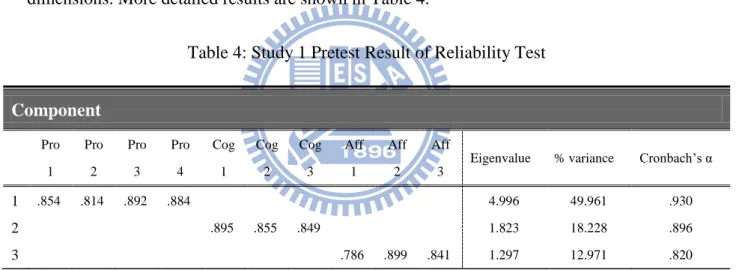
The pretest is conducted with a sample of 59 respondents. The EFA produces 3 factors
with eigenvalues all greater than one (see table 4). For study 1, the questionnaire is for the
manipulation checks, including whether the stimuli are separately perceived as
cognitive-favored and affective-favored and the process systems the two group use.
Most of the Cronbach’s α values are over 0.8, which implies good reliabilities of the dimensions. More detailed results are shown in Table 4.
Table 4: Study 1 Pretest Result of Reliability Test
Component Pro 1 Pro 2 Pro 3 Pro 4 Cog 1 Cog 2 Cog 3 Aff 1 Aff 2 Aff 3
Eigenvalue % variance Cronbach’s α
1 .854 .814 .892 .884 4.996 49.961 .930
2 .895 .855 .849 1.823 18.228 .896
3 .786 .899 .841 1.297 12.971 .820
*Pro: process system; Cog: perceived cognition of the stimuli; Aff: perceived affection of the stimuli 4.1.2 Formal Investigation
We use the experiment method, the subjects are separated into two group. One is the
target group in which the subjects are given the cognitive load manipulation. Another group
for contrast is nontarget group, the subjects simply made the choice. All the subjects are asked
to make a choice between a dilemma choice, and a followed questionnaire. When they finish
filling out the surveys, they are given a gift as a return of the favor. In total, 100 sample are
28
for nontarget). The data collection process lasts for 10 days during the beginning of July.
Subjects are randomly chosen but we avoid people cannot finish the survey such as children
and senior citizens. To get a more general data the questionnaire is distributed in the train
station. Part of our experiment requires the subjects to remember the cognitive load. So we
also collect data from college campus because students are more willing to cooperate and
helpful to the effortful experiment process. The environment of the campus is also more
suitable for the experiment which needs subjects to be focus on. The descriptive statistic
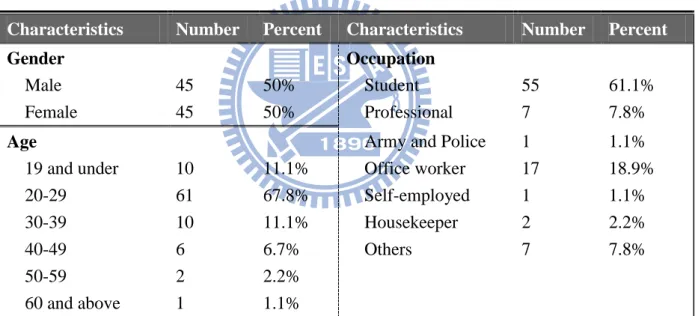
information showed in table 5. Of the sample, 50% are male and 50 % are female. Age of
20-29 stands for the highest portion (61%). 55 % are student and 18.9 % are office worker.
Table 5: Descriptive Statistics of Study 1
Characteristics Number Percent Characteristics Number Percent
Gender Occupation
Male 45 50% Student 55 61.1%
Female 45 50% Professional 7 7.8%
Age Army and Police 1 1.1%
19 and under 10 11.1% Office worker 17 18.9%
20-29 61 67.8% Self-employed 1 1.1%
30-39 10 11.1% Housekeeper 2 2.2%
40-49 6 6.7% Others 7 7.8%
50-59 2 2.2%
60 and above 1 1.1%
In the formal investigation, we again test the reliability of each dimension in the
questionnaire. Including the decision process system, affective perceived and cognitive
perceived for the stimuli. The EFA produces 3 factors with eigenvalues all greater than one.
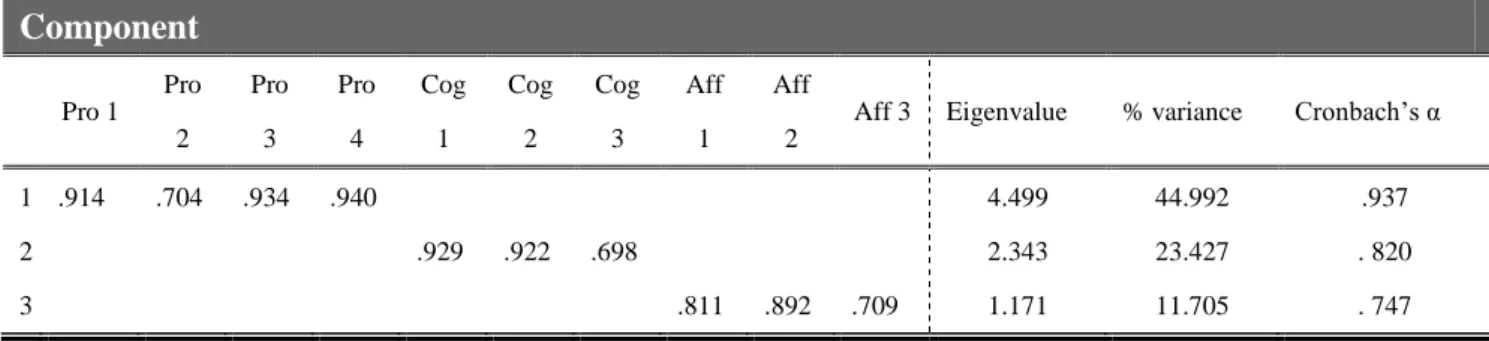
Most of the Cronbach’s α values are over 0.7 suggesting good reliabilities. More detailed results are shown in Table 6.
29
Table 6: Study 1 Result of Reliability Test
Component Pro 1 Pro 2 Pro 3 Pro 4 Cog 1 Cog 2 Cog 3 Aff 1 Aff 2
Aff 3 Eigenvalue % variance Cronbach’s α 1 .914 .704 .934 .940 4.499 44.992 .937 2 .929 .922 .698 2.343 23.427 . 820 3 .811 .892 .709 1.171 11.705 . 747
*Pro: process system; Cog: perceived cognition of the stimuli; Aff: perceived affection of the stimuli
4.1.3 Manipulation Check
Before examine the hypotheses, we examine whether the experiment manipulations is
successful. First, we should confirm that the subject view the experiment stimuli as a dilemma
between affective and cognitive. We conduct the individual t-test. The examination includes
two parts: we first examined whether the H0: (σ1)2 = (σ2)2 to examine the variance
homogeneity. Next, according the result of the first part, we examine the H0: μ1 = μ2. Our
examinations of individual t-test in the rest of the research analyses so on are accordance with
the procedure. To be a clearer representation, we only report the results of second step: H0:
μ1 = μ2.
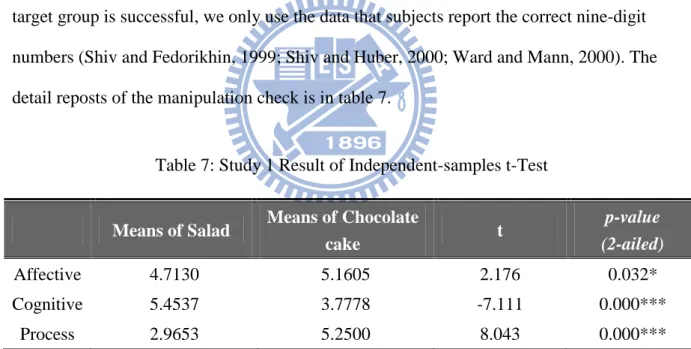
As the result reports, the mean of perceived affective (tasty) for chocolate cake is 5.1605
and for salad is 4.7130. The Individual-samples t-test revealed that perceived affective
between the choices is significantly different. As for the perceived cognitive (healthy), means
of perceived cognitive for chocolate cake is 3.7778 and for salad is 5.4537. The
Individual-samples t-test revealed that perceived cognitive between the choices is
significantly different. So we can suppose for the subjects they believe the chocolate cake is
affective-favored (tasty) and the salad is cognitive-favored (healthy).
30
cognitive-favored choices via the concept of dilemma. We compare the process system items
of subjects choosing chocolate cake to subjects choosing salad. As result reports, the mean of
chocolate is 5.2500 and the mean of salad is 2.9653. Individual-samples t-test reports a
significant difference. The results represent that for subjects who choose chocolate cake, they
make their decision is process relatively depend more on system 1. And for subjects who
choose salad, the decision process is relatively depending more on system 2. The combined
results suggest that for subjects, they know they are making a decision between a
cognitive-favored choice and affective-favored choice, and the choice they make is base on
corresponded process systems. Thus, the manipulation of dilemma choice is successful.
Final, we referring previous related load studies. To ensure the load manipulation for the
target group is successful, we only use the data that subjects report the correct nine-digit
numbers (Shiv and Fedorikhin, 1999; Shiv and Huber, 2000; Ward and Mann, 2000). The
detail reposts of the manipulation check is in table 7.
Table 7: Study 1 Result of Independent-samples t-Test
Means of Salad Means of Chocolate
cake t p-value (2-ailed) Affective 4.7130 5.1605 2.176 0.032* Cognitive 5.4537 3.7778 -7.111 0.000*** Process 2.9653 5.2500 8.043 0.000*** Note: * p≦0.05, ** p≦0.01, *** p≦0.001,**** p≦0.0001 4.1.4 Hypothesis Test
Our first proposition is examining whether the cognitive load would impede the process
of system 2, thus hypothesize the choice rate of the cognitive-favored salad would less for
people with higher cognitive load than people with less load. To test the hypothesis, we
31
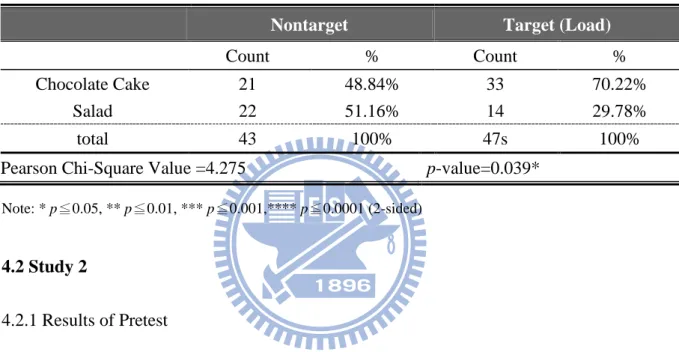
are manipulated with cognitive load, 14 of them choose the salad. For the notarget group, 22
of the total 43 subjects choose the salad. In another word, the choice rate of salad is 29.78%
for the target group, and 51.16% for the nontarget group. Consists with hypothesis 1, the
Homogeneity of Proportions Test provides statistical significance result. Detailed report is
shown in table 8.
Table 8: Study 1 Result of Homogeneity of Proportions Test
Nontarget Target (Load)
Count % Count %
Chocolate Cake 21 48.84% 33 70.22%
Salad 22 51.16% 14 29.78%
total 43 100% 47s 100%
Pearson Chi-Square Value =4.275 p-value=0.039*
Note: * p≦0.05, ** p≦0.01, *** p≦0.001,**** p≦0.0001 (2-sided)
4.2 Study 2
4.2.1 Results of Pretest
The pretest sample contains 30 respondents, and 23 are used for analysis. The EFA
produces 1 factor, attachment, with eigenvalue all greater than one. The other dimensions are
with only one item. The Cronbach’s α value for attachment is 0.644, merely marginally
significant. The results of compare means related to the hypotheses are quiet undesirable
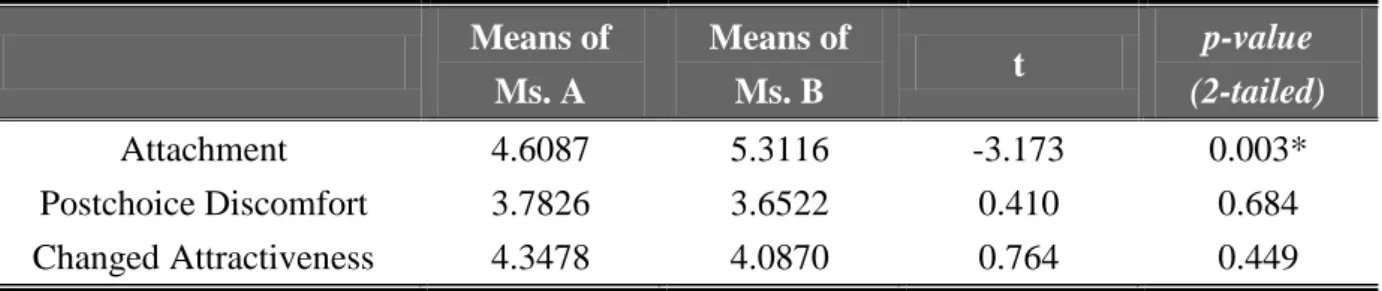
(detail is in table 9). We can see the result of pretest is not ideal, thus we further modified our
items and the scenario according to qualitative interview survey. We ask subjects about the
experiment in detail. We apply their responds and literature review, modified the statement of
the questionnaire items and the presentation mode of the stimuli story. Then propose a final
32
Table 9: Study 2 Pretest Result of Individual-samples t-test
Means of Ms. A Means of Ms. B t p-value (2-tailed) Attachment 4.6087 5.3116 -3.173 0.003* Postchoice Discomfort 3.7826 3.6522 0.410 0.684 Changed Attractiveness 4.3478 4.0870 0.764 0.449 Note: * p≦0.05, ** p≦0.01, *** p≦0.001,**** p≦0.0001 4.2.2 Formal Investigation
Study 2 conducts a scenario-based experiment. The scenario describes two factitious
people who individually make decision via two different process systems. After reading the
scenario, subjects are informed that there is a following questionnaire related to the scenario.
When they finish filling out the surveys, they are given a gift as a return of the favor. We
collect the data during the middle of July. The data is collected from the boarding hall of the
airport. Data collected in the airport provide us a more general formed data base and the
environment is more comfortable and quite than the train station. Further, people waiting for
their flights have more extra free time than people catching the train. The factors above
compose good condition which makes subjects to be more helpful and concentrate on our
survey. The subjects are randomly chosen, but we avoid people who possibly cannot finish
the survey such as children and senior citizens.
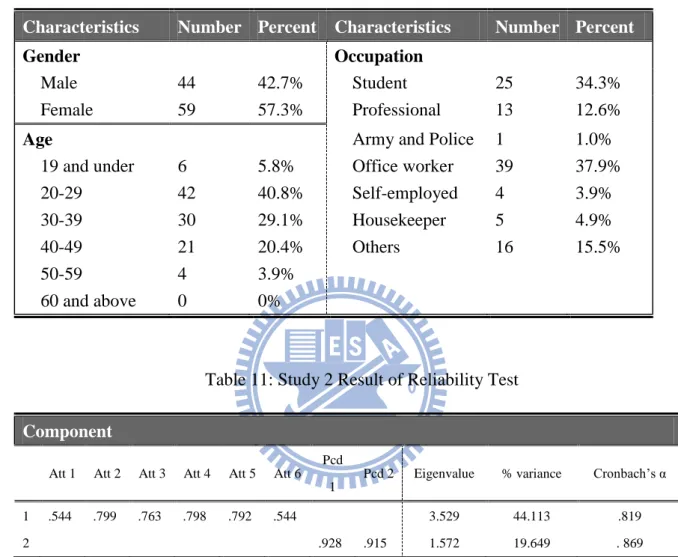
In total, 109 samples are collected and 103 samples are used for analysis. Of the sample,
42.7% are male and 57.3 % are female. The age of 20-29 stands for the highest portion (42%).
For the occupation, 55 % are office worker and 34.3 % are student. More detailed can be
viewed in the bellowed table 10. We further test the reliability of each dimension in the
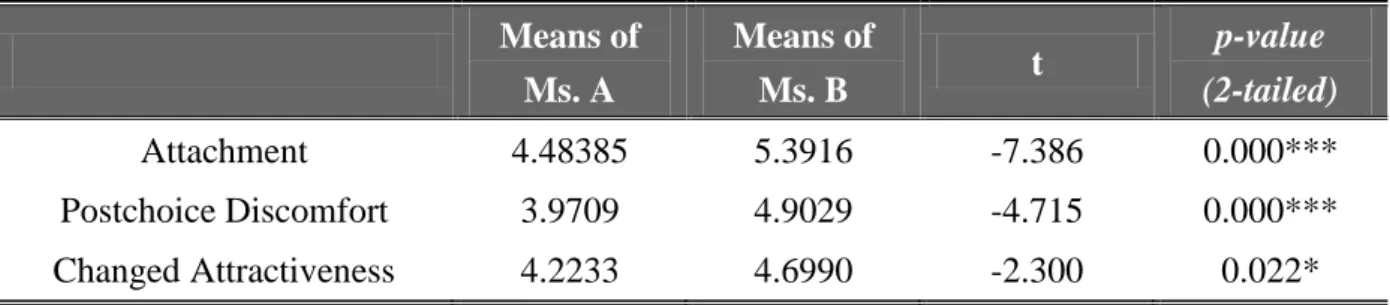
questionnaire, Including attachment, postchoice discomfort and decision difficulty. The EFA