DEVELOPING E-LEARNING BASED ON THE WEB
CLIENT-SERVER ARCHITECTURE
Shu-Sheng Liaw
Associate Professor, Center of General Education, China Medical University
Abstract
The Internet and World Wide Web are incredibly popular at public domains and they have provided unprecedented opportunities of conducting E-learning for educational or business purposes. Based on the client-server architecture, this article suggests that the Web-based learning can be divided into three different layers: the layer of browsing, the layer of learning activity, and the layer of instructional content. Based on these three layers, this research develops three different learning models, including direct instruction, interdisciplinary learning, and collaborative learning, by client-based, distributed, and server-based learning. Furthermore, this article provides considerations and techniques for developing Web E-learning.
Keywords: Web-based learning, client-server architecture, E-learning, learning model
Requests for reprints should be sent to Shu-Sheng Liaw, General Education Center, China Medical University, 91 Hsueh-Shih Road, Taichuang 404, Taiwan. E-mail: [email protected]. Phone: 886-422053366 Ext. 1927
Developing E-learning based on the Web client-server architecture
1. Introduction
Owing to the wide application of advanced technology for school use, especially for learning and training, the Internet and Web (World Wide Web) seem to demonstrate possibilities for E-learning (electronic learning). Educators have already noted the potential of the Web in learning and training. The development of Web-based learning (WBL) has started a revolution in content delivering and social communication for learning activities. Essentially, WBL can be viewed as an innovative approach for delivering instruction or learning activities to remote online audiences using the Internet and Web as delivery systems. In general, a WBL environment should include multiple formats and various resources. It should also support collaboration, offer interaction, implement Web-based activities as part of learning framework, and assist both novices and experts. Based on these explanations, WBL is capable of creating a wealth of online and distance learning opportunities to users that is not readily available in textbooks or faculty lectures.
In this paper, the author would like to examine a developing aspect of Web-based learning or training for empowering learning flexibility and performance. First of all, this paper will show the steps of designing Web-based learning systems. Second, due to the client-server architecture of the Web, this paper will present three architectures of Web application for E-learning. After that, Web client-server models for learning will be described in details and considerations for designing Web client-server models will be discussed at the last part.
2. Steps of designing Web-based learning systems
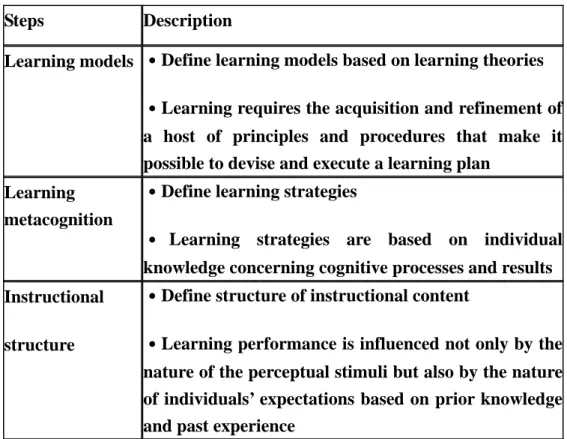
When designing a Web E-learning program, the major three processing steps can be defined as: learning models, learning metacognition, and instructional
structure. According to learning models, a great deal of learning performance requires the execution of complex principles for processing instruction or activities. Learning to do things, such as developing computer skills, involves the acquisition and refinement of complex motoric skills which become faster, more accurate, and more automatic with the accumulation of experience and expertise. In addition, learning to solve educational problems requires the acquisition and refinement of many learning principles and procedures which in turn that make it possible to devise and execute learning activities or solutions. Therefore, learning models should come from learning theories to create a more appropriate and flexible learning environment.
Learning metacognition indicated refers to the gradual increase in a learner’s own active and conscious control of instruction or content processing strategies during learning processing. Essentially, metacognition is the knowledge concerning individual cognitive processes and products or anything related to them. When designing Web-based learning programs, learning metacognition refers to learning strategies that make users actively and consciously control learning in order to develop a memory structure for constructing their own knowledge.
An instructional structure deserves more attention because an appropriate instructional structure will help learners to create their own knowledge. Essentially, learning processes are influenced not only by the nature of the perceptual stimuli but also by the nature of individuals’ expectations that are based on prior knowledge and past experience. Therefore, an appropriate instructional structure can enhance learners’ knowledge construction from their short-term memory to their long-term memory. Table 1 presents the steps when designing Web-based learning programs.
Table 1: Steps for designing Web-based learning programs
Steps Description
Learning models ․Define learning models based on learning theories
․Learning requires the acquisition and refinement of
a host of principles and procedures that make it possible to devise and execute a learning plan
Learning metacognition
․Define learning strategies
․ Learning strategies are based on individual
knowledge concerning cognitive processes and results Instructional
structure
․Define structure of instructional content
․Learning performance is influenced not only by the
nature of the perceptual stimuli but also by the nature of individuals’ expectations based on prior knowledge and past experience
3. Web client-server architectures for E-learning
A Web application can be defined as any application program that runs on the Internet. Individuals use Web browsers (such as Internet Explorer or Netscape Communicator) on client computers (users’ computers) to run programs residing on server computers. Client-server computing splits processing between “clients” and “servers” on networks. Generally speaking, in client-server computing, client computers denote the user point-of-entry for the required function. Normally, a desktop computer, workstation, laptop computer, plate computer, PDA (Personal Digital Assistant), or even a cell phone can be used as a client computer. The definition of server computers is the component that satisfies the user’s request for data and/or functionality and that performs back-end functions not visible to users. In client-server computing, distributed processing
means the distribution of computer processing works among multiple computers linked by a communication network (Laudon & Laudon, 2000).
If almost all processes are done on the client computer, then we can call it client-based processing. In contrast to client-based processing, if almost the entire processes are done on the server, then we may name it as server-based processing. Furthermore, if some of the entire processes are done on the client computer and other processes are done on the server, then we may call it is distributed processing. Client-based processing has grown very popular in recent times because it not only improves the overall application’s responsiveness, but also allows some resources of the Web server to be used for other tasks. Applications that use server-based processing do almost all of the application’s processing on the server and then only send results back to the client computer. Distributed processing, however, allows parts of the Web application to be located on separate computers, possibly in different locations. Based on the system approach, a major benefit of a client-based processing is that client computers share the loading of server computers. As for the key advantage of server-based processing, the server computer can control all processes of a Web application. Turning to distributed processing, its main value lies in its adaptability to a changing network environment.
Based on Web client-server architecture, the learning models of WBL programs can be divided into three different types: client-based learning, distributed learning, and server-based learning. Generally speaking, in client-based learning, learning activities and course instructional content are usually operated on client computers; individuals do not need to interact with servers frequently. In distributed learning, some learning activities and instructional content rely on client computers, while others are run on servers. This means that client computers have complete opportunities to handle learning activities and contents. In server-based learning, both learning activities and course instructional content are usually run on servers as individual computers are only used as Web browsers. This means that learners have more chances to
communicate with other learners or instructors through server computers.
4. Layers of the Web client-server learning
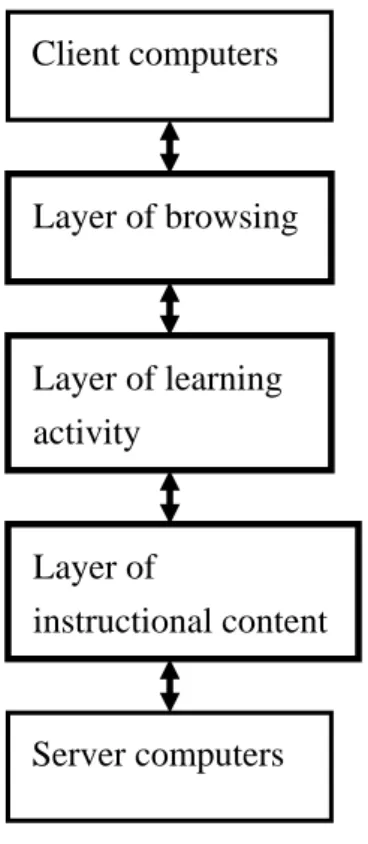
The client-server architecture of the Web allows the development of distributed online learning programs. Essentially, the WBL programs can be subdivided into three different layers: browsing, learning activity, and instructional content. The layers of the WBL and steps of designing learning systems are shown in Figure 1.
Figure 1: Layers of Web client-server learning.
The layer of browsing constitutes the interface between users (client computers) and the layer of learning. On the Web, the word “browsing” means learners can access data and information through browsers. In other words, learners use client browsers to communicate with servers. In general, users
Layer of browsing Layer of learning activity Layer of instructional content Client computers Server computers
communicate to other users through e-mail, online discussions or conferences with Web browsers. In Web browsers, hyperlinks are nonlinear tools that offer multi-linkages within, between, and among the nodes of a network. Hyperlinks permit individuals to jump directly to any Web page they are interested in. Moreover, the hypermedia environment of the WBL can be simultaneously represented in any combination of media formats, such as texts, images, sounds, and animations, for supporting multimedia instruction and interactive communications among learners.
The layer of learning activity constitutes the interface between the layer of browsing and the layer of instructional content. Based on characteristics of the Web, such as hyperlinks and random access, learning activities can be created from individual learning through group learning, from synchronous communication through asynchronous communication, and from content interaction through social interaction (Liaw & Huang, 2000). Based on learning aspects, behavioral learning usually focuses on individual learning and content interaction. On the other hands, constructivist learning generally focuses on knowledge exploration and social communication.
The layer of instructional content constitutes the interface between the layer of learning activity and the server. In the layer of instructional content, the learning materials are the complete domain knowledge, represented in different ways (such as in databases or files). Additionally, the layer of instructional content can also include online discussions or conferences for social communication among users. Thus, instructional content may be well or ill-structured depending on learning activities.
5. Models of Web client-server learning
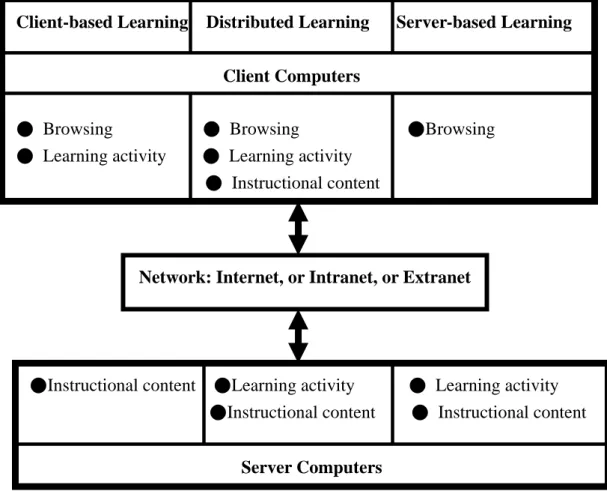
From the point of view of learning models, it is easy to create the model of direct instruction from client-based learning. Distributed learning is appropriate to establish the model of interdisciplinary learning. Furthermore, server-based learning is available to set up the model of collaborative learning. The architecture
types of the WBL are presented in Figure 2.
Figure 2: Web-based learning based on client-server architectures
5.1 Client-based learning for creating direct instruction
For client-based learning, learners’ learning activities are run and operated on client computers. Therefore, the client-based learning can easily create the learning model of direct instruction. Various conventional computer assisted instruction (CAI) programs are examples of direct instruction (such as tutoring programs as well as drill and practice programs) because they are based on the premise that the teacher controls instructional goals, chooses materials appropriate for the learner's ability, and passes the instructional episode
Client-based Learning Distributed Learning Server-based Learning
Client Computers
● Browsing ● Browsing ●Browsing ● Learning activity ● Learning activity
● Instructional content
Network: Internet, or Intranet, or Extranet
●Instructional content ●Learning activity ● Learning activity ●Instructional content ● Instructional content
(Darling-Hammond & Snyder, 1992). The direct instruction environment is predominantly focused on learning where learners are engaged in academic tasks for a long period of time to achieve a higher rate of success. The major goal of direct instruction lies in the maximization of individuals' learning time (Joyce & Weil, 1996).
According to Rosenshine (1986), direct instruction included presenting materials in small steps so that one point can be mastered at a time; providing various examples of the new skills or concepts; modeling of the learning task or giving narrated demonstrations; avoiding digressions and re-explaining difficult points. However, the use of this model should be preceded by effective diagnosis of learners' knowledge or skills to ensure that they have the prerequisite knowledge or skills to achieve high levels with the instructional materials. Up to these points, Web characteristics of multiple information formats, massive information database, and multimedia presentation are all appropriate factors for creating direct instruction.
5.2 Distributed learning for creating interdisciplinary learning
In distributed learning, individual learning activities and course instructional content are processed on both client and server computers. The characteristics of the Web facilitate distributed learning through its massive information database, multiplicity, multiple linkages, multiple mixed media, and responsive interactive navigation tools to enhance learning performance or to solve real-life problems. Indeed, this kind of distributed learning is also interdisciplinary because it is easy to integrate various learning subjects on the Web from various Web servers. When hypermedia is integrated with the Internet, this Web-based system allows all individuals with Web browsers or search engines to transfer files and information from thousands of possible real-life sources to themselves (Gilbert, & Moore, 1998). In the WBL environment, the search engine is a major information retrieval tool to encourage users to explore related knowledge for promoting interdisciplinary learning.
Interdisciplinary instruction represents a philosophy of integrated subject matters, learner-center, local issues, real-life, and group activities (Ellis & Fouts, 1997). From a constructivist point of view, the knowledge exploration should be connected to real life. In general, for users, there is too much information to be covered in the instruction. Much content quickly becomes "inert" while processed and integrated (Gagne, Yekovich, & Yekovich, 1993), as it has little relevance to the life circumstance of the learners. The capability of multiple representations on the Web provides learners across the various resources and content domains to facilitate their integration of knowledge. In addition, it allows them to criss-cross the intellectual landscape in multiple dimensions, to traverse among these multiple routes for their understanding, and to induce information into their existing knowledge structures.
5.3 Server-based learning for creating collaborative learning
In server-based learning, individual learning activities and instructional content all happen on server computers. Based on shared sources in server computers, it is easy for learners to interact and communicate with each other. In server-based learning, the Web offers interactive communication and creates a potentially collaborative learning environment. With hypermedia binding an online system, this multi-user network presents great possibilities for collaborative learning. In a Web communication system, users engage in side-by-side and online discussion, debate, or negotiation. In addition, this simultaneously synchronous and asynchronous nature offers a productive environment to generate group problem-solving activities and test new ideas. Furthermore, this feature of the networking process for collaborative learning is a democratic environment where all users have an equal opportunity to share their views.
Collaboration helps individuals to make progress through their ZPD activities in which they participate (Vygotsky, 1978). Moreover, collaborative learning also provides a mean to create more engaging and dynamic instructional settings. From the social constructivist perspective, learners are more interested in
activities that call for cooperation with others. In Web collaborative learning, learners have opportunities to develop complex cognitive skills, such as breaking a topic down into subtopics, organizing diverse information, and formulating a point of view (Turner & Dipinto, 1997). Moreover, these learning activities are effective in developing higher-order thinking skills, defining issues, judging information, solving problems, and drawing appropriate conclusions.
6. Considerations of designing Web client-server learning
In consideration of how to design client-based learning, learning activities ares based on linear interaction. In addition, learning activities are targeted toward content interaction and individual learning. Instructional content is based on direct instruction of predominant areas where users are engaged in learning tasks. In client-based learning, learning activities should be well-organized for learners to experience success in mastering the subject matter. This organization is formed using step-by-step and well-structured methods. Additionally, instructors control instructional goals and choose appropriate learning materials.
For distributed learning, learning activities emphasize both content interaction and group communication. In additional, asynchronous and synchronous communication are both available for learning activities. Instructional content can be designed for individuals or group interaction. Instructional files or databases that support instructional goals should also be readily available. In the distributed WBL, based on both linear and nonlinear interactive communication, learners are encouraged to explore related knowledge, to enhance instructional databases, to improve social communication, and to promote learning activities.
As for server-based learning, group communication is based on asynchronous (and/or synchronous) communication which is the major part of learning activities. The instructional files or databases are changed or improved by group learning activities. In other words, instructional content can be revised or
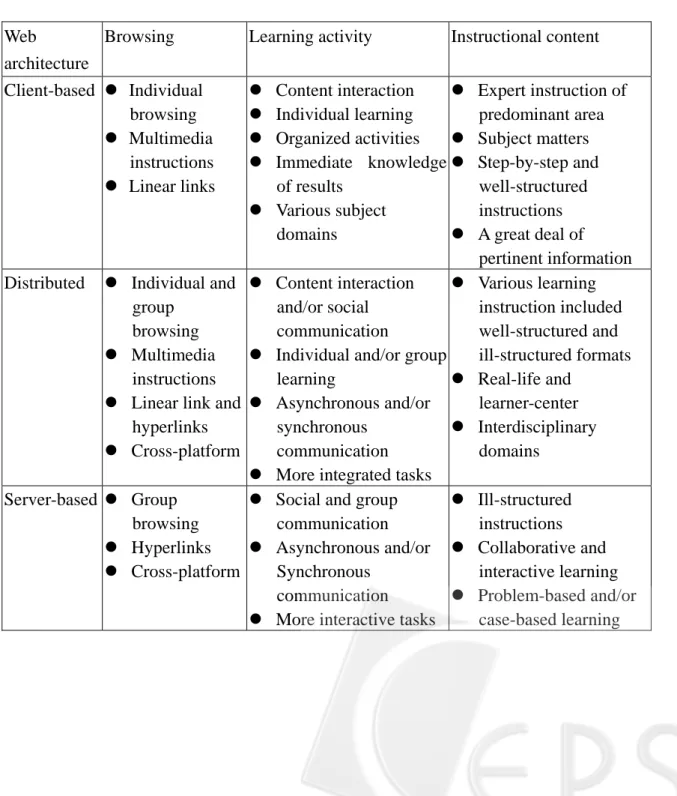
modified through online learning activities. From the social constructivist viewpoint, users are more interested in activities that engage them to work with others. In Web-based collaborative learning, users have more opportunities to develop complex cognitive skills (Turner & Dipinto, 1997). Table 2 presents the considerations of the WBL.
Table 2: Considerations of designing Web client-server learning
Web
architecture
Browsing Learning activity Instructional content
Client-based z Individual browsing z Multimedia instructions z Linear links z Content interaction z Individual learning z Organized activities z Immediate knowledge of results z Various subject domains z Expert instruction of predominant area z Subject matters z Step-by-step and well-structured instructions z A great deal of pertinent information Distributed z Individual and
group browsing z Multimedia
instructions z Linear link and
hyperlinks z Cross-platform
z Content interaction and/or social communication
z Individual and/or group learning
z Asynchronous and/or synchronous
communication z More integrated tasks
z Various learning instruction included well-structured and ill-structured formats z Real-life and learner-center z Interdisciplinary domains Server-based z Group browsing z Hyperlinks z Cross-platform
z Social and group communication z Asynchronous and/or
Synchronous communication z More interactive tasks
z Ill-structured instructions z Collaborative and interactive learning z Problem-based and/or case-based learning
7. Conclusions
Essentially, each medium has its own particular characteristics for training and learning purposes. From the educational viewpoint of Web applications in learning, more appropriate use of client-server systems will enable more users to develop themselves through self-discovery and personal insight. In Web-based learning, the dilemma is that when instructional programs add the complexity needed for the design of instructional purposes, it itself becomes increasingly complex to use. Therefore, the assistance and advice of consultant development specialists are crucial for the success of novice developers to success. For empowering Web application for online E-learning, this paper provides client-server learning models. Although increasing the flexibility of educational purposes will raise the complexity of Web-based learning, it is hoped that as Web-based learning development progresses, with the client-server architecture as its foundation, simple-to-use models will be developed. They will then allow for the inclusion of complex objections for online learning and training.
Acknowledgement
This research was supported in part by a grant from the Ministry of Education of Republic of China, project number: H045, and also supported in part by a grant from the China Medical University, project number: CMC91-GCC-03. The formal version was presented at International Hawaii Education Conference.
References
Darling-Hammond, L., & Snyder, J. (1992). Curriculum studies and traditions of inquiry: The scientific tradition. In P. W. Jackson, (Ed.). Handbook of Research on
Curriculum (pp. 41-78). New York: Macmillan.
Ellis, A. K., & Fouts, J. T. (1997). Research on Educational Innovations (2nd ed.). New York: Eye on Education.
Gagne, E., Yekovich, C. W., & Yekovich, F. (1993). The Cognitive Psychology of
Schooling Learning (2nd ed.). New York: Harper Collins.
Gillbert, L., & Moore, D. R. (1998). Building interactivity into Web courses: tools for social and instructional interaction. Educational Technology, 38(3), 29-35. Joyce B., & Weil M. (1996). Model of Teaching. (5th ed.). Needham Heights, MA: Allyn & Bacon.
Laudon, K. C., and Laudon, J. P. (2000). Management Information Systems,
Organization and Technology in Networked Enterprise (6th Edition). Prentice Hall Inc.
Liaw, S. S., and Huang, H. M. (2000). Enhancing interactivity in Web-based instruction: A review of the literature. Educational Technology, 40(3), 41-45. Rosenshine, B. (1986). Synthesis of research on explict teaching. Educational
Leadership, 43(7). 60-69
Turner, S. V. & Dipinto, V. M. (1997). Peer collaboration in a hypermedia learning environment. Journal of Research on Computing in Education, 29(4), 392-402. Vygotsky, L. S. (1978). Mind in Society. Cambridge MA: Harvard University Press.