
Maximum-Revenue Multicast Routing and Partial Admission Control for Multimedia Distribution
6
0
0
全文
(2) Int. Computer Symposium, Dec. 15-17, 2004, Taipei, Taiwan.. computational experiments. Finally, in Section 5 we present our conclusions and the direction of future research.. 2. Problem Formulation The network is modeled as a graph where the switches are depicted as nodes and the links are depicted as arcs. A user group, which has one source and one or more destinations, is an application requesting transmission on this network. Given the network topology, the capacity of links and the bandwidth requirement of user groups, we want to jointly determine the following decision variables: (1) the routing assignment (a tree for multicasting, or path for unicasting) of each admitted destination; and (2) the admitted number of destinations of each partially admitted multicast group. We assume that the multicasting is single-rate. By formulating the problem as a mathematical programming problem, we intend to solve it optimally to obtain a network that fits into our goal, i.e., ensures the network operator can earn maximum revenue from servicing the partially admitted destinations. This model is based on the following viable assumptions. The revenue from each partially admitted group can be fully characterized by two parameters: the entire admitted revenue of the group and the number of admitted destinations. The revenue from each partially admitted group is a monotonically increasing function with respect to the number of admitted destinations. The revenue function from each partially admitted group is a concave function with respect to the entire admitted revenue of the group and the number of admitted destinations. However, the entire admitted revenue and the number of admitted destinations jointly may not be a concave function. The revenue from each partially admitted group is independent. The notations used to model the problem are listed in Table 1.. L. Iv. The incoming links to node v. rg. The multicast root of multicast group g. I rg. The incoming links to node rg. The set of paths user d of multicast group g may use The indicator function which is 1 if link l δ pl is on path p and 0 otherwise Decision Variables Notation Descriptions xgpd 1 if path p is selected for group g destined for destination d and 0 otherwise y gl 1 if link l is on the subtree adopted by multicast group g and 0 otherwise The number of admitted destinations in fg multicast group g According to the description in previous, the maxrevenue problem is formulated as a combinatorial optimization problem in which the objective function is to maximize revenue from servicing the partially admitted destinations. Of course a number of constraints must be satisfied. Optimization Problem:. Pgd. Objective function: min − ∑ Fg ( a g , f g ). (IP). subject to: ∑ α g ygl ≤ Cl. ∀l ∈ L. (1). ∀g ∈ G. (2). g ∈G. g∈G. ∑y l∈L. gl. ∑ ∑x. ≥. d ∈Dg p∈Pgd. ∑ ∑x. d ∈Dg p∈Pgd. ∑y. gpd. gpd. δ pl ≤ Dg ygl ∀g ∈ G, l ∈ L. (3). ∀g ∈ G , v ∈ V − {rg }. (4). ∀g ∈ G. (5). ygl = 0 or 1. ∀ l ∈ L, g ∈ G. (6). xgpd = 0 or 1. ∀g ∈ G, p ∈ Pgd , d ∈ Dg. (7). ∑x. ∀d ∈ Dg , g ∈ G. (8). ∀g ∈ G. (9). ∀g ∈ G. (10). l∈I v. gl. ∑y. l∈I rg. p∈Pgd. Table 1. Description of notations Given Parameters Notation Descriptions Revenue generated from admitting partial Fg users of multicast group g, which is a function of fg and ag Revenue generated from admitting ag multicast group g Traffic requirement of multicast group g αg. G V. Cl. The set of destinations of multicast group g Capacity of link l. Dg. gl. ≤1. =0. gpd. ∑ ∑. d ∈Dg p∈ pgd. ≤1. xgpd = f g. f g ∈ {0,1, 2,......, Dg }. The objective function of (IP) is to maximize the total revenue of servicing the partially admitted destinations in multicast groups g, where g∈G and G is the set of user groups requesting transmission. Fg reflects the priority of partial users belonging to group g, while different choices of Fg may provide different physical meanings of the objective function. For example, if Fg is chosen to be the mean traffic requirement of partial users belonging to group g,. The set of all multicast groups The set of nodes in the network The set of links in the network. 120.
(3) Int. Computer Symposium, Dec. 15-17, 2004, Taipei, Taiwan.. then the objective function is to maximize the total system throughput. On the other hand, if Fg is chosen to be the earnings of servicing partial users belonging to group g, then the objective function is to maximize the total system revenue. In general, if user group g is to be given a higher priority, then the corresponding Fg may be assigned a larger value. Constraint (1) is the capacity constraint, which requires that the aggregate flow on each link l does not exceed its physical capacity Cl. Constraint (2) requires that if one path is selected for group g destined for destination d, it must also be on the subtree adopted by multicast group g. Constraint (3) is the tree constraint, which requires that the union of the selected paths for the destinations of user group g forms a tree. Constraints (4) and (6) require that the number of selected incoming links ygl is 1 or 0 and each node, excepting the root, has only one incoming link. Constraint (5) requires that there is no selected incoming link ygl that is the root of multicast group g. As a result, the links we select can form a tree. Constraints (7) and (8) require that at most one path is selected for each admitted multicast sourcedestination pair, while Constraint (9) relates the routing decision variables xgpd to the auxiliary variables fg. The introduction of the auxiliary variables fg may facilitate the decomposition in the Lagrangean relaxation problem to be discussed later. Constraint (10) requires that the number of admitted destinations in multicast group g is the set of integers.. 3. Solution Procedure 3.1 Lagrangean relaxation By using the Lagrangean Relaxation method [2][3], we can transform the primal problem (IP) into the following Lagrangean Relaxation problem (LR) where constraints (1), (2), (3), and (9) are relaxed. For a vector of Lagrangean multipliers, a Lagrangean Relaxation problem of (IP) is given by. g ∈G l∈L. +∑∑. ∑ ∑θ. g ∈G l∈L d ∈D g p∈Pgd. ∑ ∑. g ∈G d ∈D g p∈Pgd. gl. λ g x gpd. x gpd δ pl. ∑ ∑ε. g. − λg + ∑ θ glδ pl ) xgpd l∈L. subject to: (7)(8). The Subproblem 1 is to determine xgpd and it can be further decomposed into |G||Dg| independent shortest path problems with nonnegative arc weights θgl. Each shortest path problem can be easily solved by Dijkstra’s algorithm. Subproblem 2: (related to decision variable ygl) Z Sub 2 ( β , λ , θ ) =. min. ∑ ∑ (β α l. g∈G l∈L. g. + λg − θ gl Dg ) y gl. subject to: (4)(5)(6). The Subproblem 2 can be decomposed into |G| independent problems. For each multicast group g ∈G : Z Sub 2.1 ( β , λ , θ ) =. min. ∑ (β α l. l∈L. g. + λg − θ gl Dg ) y gl. subject to: (4)(5)(6). The algorithm to solve to Subproblem 2.1 is stated as follows: 1. Compute the coefficient βlαg+λg-θgl|Dg| for all links in the multicast group g. 2. Sort the links in descending order according to the coefficient. 3. According to the order and complying with constraints (4) and (5), if the coefficient is less than zero, assigns the corresponding negative coefficient of ygl to 1; otherwise 0.. Z D = max Z D ( β l , λg , θ gl , ε g ). g ∈G l∈L. g ∈G d ∈D g p∈Pgd. g. Dual Problem (D):. − ∑ ∑ θ gl Dg y gl +∑. ∑ ∑ ∑ (ε. g∈G d ∈Dg p∈Pgd. g∈G. g ∈G l∈L. l∈ L. min. subject to: (10). We can easily solve Subproblem 3 optimally by exhaustively searching from the known set of fg. According to the weak Lagrangean duality theorem [4], for any βl,θgl≥0, ZD(βl, λg, θgl, εg) is a lower bound on ZIP. The following dual problem (D) is then constructed to calculate the tightest lower bound.. min − ∑ Fg ( a g , f g ) + ∑ ∑ β lα g y gl g ∈G. Subproblem 1: (related to decision variable xgpd) Z Sub1 (λ ,θ , ε ) =. Subproblem 3: (related to decision variable fg) Z Sub 3 (ε ) = min − ∑ ( Fg (ag , f g ) + ε g f g ). Optimization problem (LR): Z D ( β , λ ,θ , ε ) =. − ∑ β l Cl + ∑ ∑ λ g y gl − ∑. into the following five independent and easily solvable optimization subproblems.. subject to: βl,θgl≥0. There are several methods for solving the dual problem (D). The most popular is the subgradient method [5], which is employed here. Let a vector s be a subgradient of ZD(βl, λg, θgl, εg). Then, in iteration k of the subgradient optimization procedure, the multiplier vector is updated by ωk+1=ωk+tksk. The. x gpd − ∑ ε g f g g ∈G. subject to: (4)(5)(6)(7)(8)(10). Where βl, λg, θgl and εg are Lagrangean multipliers and βl,θgl≥0. To solve (LR), we can decompose (LR). 121.
(4) Int. Computer Symposium, Dec. 15-17, 2004, Taipei, Taiwan.. step size tk is determined by tk=δ(ZhIP – ZD(ωk))/||sk||2. ZhIP is the primal objective function value for a heuristic solution (an upper bound on ZIP). δ is a constant and 0 < δ ≤ 2.. Step 3. 3.2 Getting primal feasible solutions After optimally solving the Lagrangean dual problem, we get a set of decision variables. However, this solution would not be a feasible one for the primal problem since some of constraints are not satisfied. Thus, minor modification of decision variables, or the hints of multipliers must be taken, to obtain the primal feasible solution of problem (IP). Generally speaking, the best primal feasible solution is an upper bound (UB) of the problem (IP), while the Lagrangean dual problem solution guarantees the lower bound (LB) of problem (IP). Iteratively, by solving the Lagrangean dual problem and getting the primal feasible solution, we get the LB and UB, respectively. So, the gap between UB and LB, computed by (UB-LB)/LB*100%, illustrates the optimality of problem solution. The smaller gap computed, the better the optimality. To calculate the primal feasible solution of the maximum revenue tree, the solutions to the Lagrangean relaxation problems are considered. The set of {xgpd} obtained by solving Subproblem 1 may not be a valid solution to problem (IP) because the capacity constraint is relaxed. However, the capacity constraint may be a valid solution for some links. The set of {ygl}obtained by solving Subproblem 2 may not be a valid solution because of the link capacity constraint and the union of {ygl} may not be a tree. Also, because the constraint (9) is released, the set of {fg} obtained by solving Subproblem 3 may not be a valid solution. Here we propose a comprehensive, two-part method to obtain a primal feasible solution. It utilized a Lagrangean multipliers based heuristic, followed by adjustment procedures. While solving the Lagrangean relaxation dual problem, we may get some multipliers related to each OD pair and links. According to the information, we can make our routing more efficient. We describe the Lagrangean based heuristic below. [Lagrangean Multipliers based heuristic] Step 1 Step 2. the maximal subgradient (-Fg(ag,fg)εgfg). Go to Step 2.1. Add procedures: 3.1 Sort the dropped group in ascending order according to the subgradient (Fg(ag,fg)-εgfg). 3.2 In accordance with the order, re-add the groups to the network. Use βlαg+λg-θgl|Dg| as link l’s arc weight, removes the overflow links from the graph and run the T-M heuristic. If it can not find a route for the destinations, drop the destinations.. 4. Computational Experiments In this section, computational experiments on the Lagrangean relaxation based heuristic and other primal heuristics are reported. The heuristics are tested on three kinds of networks - regular networks, random networks, and scale-free networks. Regular networks are characterized by low clustering and high network diameter, and random networks are characterized by low clustering and low diameter. The scale-free networks, which are power-law networks, are characterized by high clustering and low diameter. Reference [7] shows that the topology of the Internet is characterized by power laws distribution. The power laws describe concisely skewed distributions of graph properties such as the node degree. Two regular networks shown in Figure 1 are tested in our experiment. The first one is a grid network that contains 100 nodes and 180 links, and the second is a cellular network containing 61 nodes and 156 links.. (a) Grid Network. (b) Cellular Network. Figure 1: Regular Networks Random networks tested in this paper are generated randomly, each having 100 nodes. The candidate links between all node pairs are given a probability following the uniform distribution. In the experiments, we link the node pair with a probability smaller than 2%. If the generated network is not a connected network, we generate a new network. Reference [8] shows that the scale-free networks can arise from a simple dynamic model that combines incremental growth with a preference for new nodes to connect to existing ones that are already well connected. In our experiments, we applied this preferential attachment method to. Use βlαg+λg-θgl|Dg| as link l’s arc weight and run the T-M heuristic [6] to get a spanning tree for each multicast group. Drop procedures: 2.1 Check the capacity constraint of each link. If there is a link violate the capacity constraint, go to Step 2.2, otherwise Step 3. 2.2 Sort the links in descending order according to {Cl – the aggregate flow on the link}. Choose the maximal overflow link and drop the group with. 122.
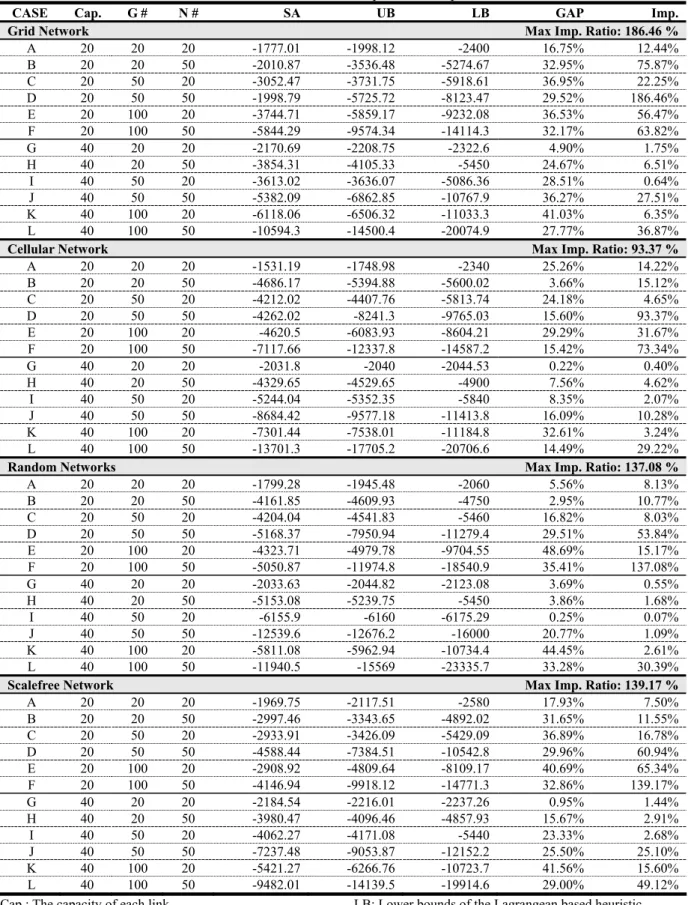
(5) Int. Computer Symposium, Dec. 15-17, 2004, Taipei, Taiwan.. generate the scale-free networks. The corresponding preferential variable ( m0 , m ) is (2, 2). The number of. simple algorithm. First, the Lagrangean based heuristic makes use of the related Lagrangean multipliers which include the potential cost for routing on each link in the topology. Second, the Lagrangean based heuristic is iteration-based and is guaranteed to improve the solution quality iteration by iteration. Therefore, in a more complicated testing environment, the improvement ratio is higher. To claim optimality, we also depict the percentile of gap in Table 3. The results show that most of the cases have a gap of less than 40%. We also found that the simple heuristic performs well in many cases, such as the case I of grid network and case G of random network.. nodes in the testing networks is 100. In order to prove that our heuristics are good enough, we also implement a simple algorithm to compare with our heuristic. [Simple Algorithm] Step 1 Step 2. Step 3. Set link l’s arc weight to 1 and run the T-M heuristic to get a spanning tree for each multicast group. Drop procedures: 2.1 Check the capacity constraint of each link. If there is a link violate the capacity constraint, go to Step 2.2, otherwise Step 3. 2.2 Sort the links in descending order according to {Cl – the aggregate flow on the link}. Choose the maximal overflow link and drop the group with the minimal revenue. Go to Step 2.1. Add procedures: 3.1 Sort the dropped group in descending order according to the unit revenue {Group revenue/number of destination of the group}. 3.2 In accordance with the order, re-add the groups to the network. Remove the overflow links from the graph, set each link’s arc weight to the aggregate flow of the link and run the T-M heuristic. If it can not find a feasible route for the destinations, drop the destinations.. 5. Conclusions In this paper, we attempt to solve the problem of capacitated max-revenue multicast routing and partial admission control for multimedia distribution. Our achievement of this paper can be expressed in terms of mathematical formulation and experiment performance. In terms of formulation, we propose a precise mathematical expression to model this problem well. In terms of performance, the proposed Lagrangean based heuristic outperforms the simple heuristics. Our model can be easily extended to deal with the constrained multicast routing and admission control problem for multi-layered multimedia distribution by modifying some constraints. These issues will be addressed in future works.. References. For each testing network, several distinct cases, which have different pre-determined parameters such as the link capacity, the number of multicast group and the number of nodes in a group, are considered. The traffic demands for each multicast group are drawn from a random variable uniformly distributed in pre-specified categories {1, 2, 5, 10, 15, 20}. We conducted 120 experiments for each kind of network. For each experiment, the result was determined by the group source and destinations generated randomly. Table 3 summaries the selected results of the computational experiments. For each testing network, the maximum improvement ratio between the simple heuristic and the Lagrangean based heuristic is 186.46 %, 93.37%, 137.08 %, and 139.17%, respectively. In general, the Lagrangean based heuristic performs well compared to the simple heuristic. We also find that in more congested network, either with more destinations or with less link capacity, the Lagrangean based heuristic outperforms the simple heuristic such as the case D of grid network and case F of scale-free network. There are two main reasons of which the Lagrangean based heuristic works better than the. [1] D. Wu, Y. T. Hou, W. Zhu, T. Q. Zhang, and J. Peha, “Streaming video over the Internet: approaches and directions”, IEEE Transactions on Circuits and Systems for Video Technology, vol. 11, no. 3, pp. 282300, March 2001. [2] M. L. Fisher, “The Lagrangian relaxation method for solving integer programming problems”, Management Science, vol. 27, pp. 1-18, 1981. [3] R. K. Ahuja, T. L. Magnanti, and J. B. Orlin, Network Flows: Theory, Algorithms, and Applications, Prentice Hall, ISBN0-13-027765-7, 1993. [4] A. M. Geoffrion, “Lagrangean relaxation and its uses in integer programming,” Math. Programming Study, vol. 2, pp. 82-114, 1974. [5] M. Held and R. M. Karp, “The Traveling salesman problem and minimum spanning trees: Part I,” Operations Research, vol. 18, pp. 1138-62, 1970. [6] H. Takahashi and A. Matsuyama, “An approximate solution for the Steiner problem in graphs,” Math Japonica, vol. 6, pp. 573-577, 1980. [7] C. Faloutsos, P. Faloutsos, and M. Faloutsos, “On power-law relationships of the Internet topology,” Proceedings of the ACM SIGCOMM, Sept. 1999. [8] A.-L. Barabasi and R. Albert, “Emergence of scaling in random networks,” Science, Vol. 286. pp. 509-512, Oct. 1999.. 123.
(6) Int. Computer Symposium, Dec. 15-17, 2004, Taipei, Taiwan.. Table 3. Selected results of computational experiments CASE Cap. G# N# SA Grid Network A 20 20 20 -1777.01 B 20 20 50 -2010.87 C 20 50 20 -3052.47 D 20 50 50 -1998.79 E 20 100 20 -3744.71 F 20 100 50 -5844.29 G 40 20 20 -2170.69 H 40 20 50 -3854.31 I 40 50 20 -3613.02 J 40 50 50 -5382.09 K 40 100 20 -6118.06 L 40 100 50 -10594.3 Cellular Network A 20 20 20 -1531.19 B 20 20 50 -4686.17 C 20 50 20 -4212.02 D 20 50 50 -4262.02 E 20 100 20 -4620.5 F 20 100 50 -7117.66 G 40 20 20 -2031.8 H 40 20 50 -4329.65 I 40 50 20 -5244.04 J 40 50 50 -8684.42 K 40 100 20 -7301.44 L 40 100 50 -13701.3 Random Networks A 20 20 20 -1799.28 B 20 20 50 -4161.85 C 20 50 20 -4204.04 D 20 50 50 -5168.37 E 20 100 20 -4323.71 F 20 100 50 -5050.87 G 40 20 20 -2033.63 H 40 20 50 -5153.08 I 40 50 20 -6155.9 J 40 50 50 -12539.6 K 40 100 20 -5811.08 L 40 100 50 -11940.5 Scalefree Network A 20 20 20 -1969.75 B 20 20 50 -2997.46 C 20 50 20 -2933.91 D 20 50 50 -4588.44 E 20 100 20 -2908.92 F 20 100 50 -4146.94 G 40 20 20 -2184.54 H 40 20 50 -3980.47 I 40 50 20 -4062.27 J 40 50 50 -7237.48 K 40 100 20 -5421.27 L 40 100 50 -9482.01 Cap.: The capacity of each link G#: The number of multicast group N#: The number of destinations in each multicast group SA: The result of the simple algorithm UB: Upper bounds of the Lagrangean based heuristic. UB. GAP Imp. Max Imp. Ratio: 186.46 % -1998.12 -2400 16.75% 12.44% -3536.48 -5274.67 32.95% 75.87% -3731.75 -5918.61 36.95% 22.25% -5725.72 -8123.47 29.52% 186.46% -5859.17 -9232.08 36.53% 56.47% -9574.34 -14114.3 32.17% 63.82% -2208.75 -2322.6 4.90% 1.75% -4105.33 -5450 24.67% 6.51% -3636.07 -5086.36 28.51% 0.64% -6862.85 -10767.9 36.27% 27.51% -6506.32 -11033.3 41.03% 6.35% -14500.4 -20074.9 27.77% 36.87% Max Imp. Ratio: 93.37 % -1748.98 -2340 25.26% 14.22% -5394.88 -5600.02 3.66% 15.12% -4407.76 -5813.74 24.18% 4.65% -8241.3 -9765.03 15.60% 93.37% -6083.93 -8604.21 29.29% 31.67% -12337.8 -14587.2 15.42% 73.34% -2040 -2044.53 0.22% 0.40% -4529.65 -4900 7.56% 4.62% -5352.35 -5840 8.35% 2.07% -9577.18 -11413.8 16.09% 10.28% -7538.01 -11184.8 32.61% 3.24% -17705.2 -20706.6 14.49% 29.22% Max Imp. Ratio: 137.08 % -1945.48 -2060 5.56% 8.13% -4609.93 -4750 2.95% 10.77% -4541.83 -5460 16.82% 8.03% -7950.94 -11279.4 29.51% 53.84% -4979.78 -9704.55 48.69% 15.17% -11974.8 -18540.9 35.41% 137.08% -2044.82 -2123.08 3.69% 0.55% -5239.75 -5450 3.86% 1.68% -6160 -6175.29 0.25% 0.07% -12676.2 -16000 20.77% 1.09% -5962.94 -10734.4 44.45% 2.61% -15569 -23335.7 33.28% 30.39% Max Imp. Ratio: 139.17 % -2117.51 -2580 17.93% 7.50% -3343.65 -4892.02 31.65% 11.55% -3426.09 -5429.09 36.89% 16.78% -7384.51 -10542.8 29.96% 60.94% -4809.64 -8109.17 40.69% 65.34% -9918.12 -14771.3 32.86% 139.17% -2216.01 -2237.26 0.95% 1.44% -4096.46 -4857.93 15.67% 2.91% -4171.08 -5440 23.33% 2.68% -9053.87 -12152.2 25.50% 25.10% -6266.76 -10723.7 41.56% 15.60% -14139.5 -19914.6 29.00% 49.12% LB: Lower bounds of the Lagrangean based heuristic GAP: The error gap of the Lagrangean relaxation Imp.: The improvement ratio of the Lagrangean based heuristic. 124. LB.
(7)
數據

相關文件
Promote project learning, mathematical modeling, and problem-based learning to strengthen the ability to integrate and apply knowledge and skills, and make. calculated
Wang, Solving pseudomonotone variational inequalities and pseudocon- vex optimization problems using the projection neural network, IEEE Transactions on Neural Networks 17
volume suppressed mass: (TeV) 2 /M P ∼ 10 −4 eV → mm range can be experimentally tested for any number of extra dimensions - Light U(1) gauge bosons: no derivative couplings. =>
Define instead the imaginary.. potential, magnetic field, lattice…) Dirac-BdG Hamiltonian:. with small, and matrix
• Formation of massive primordial stars as origin of objects in the early universe. • Supernova explosions might be visible to the most
(Another example of close harmony is the four-bar unaccompanied vocal introduction to “Paperback Writer”, a somewhat later Beatles song.) Overall, Lennon’s and McCartney’s
Given an undirected graph with nonnegative edge lengths and nonnegative vertex weights, the routing requirement of a pair of vertices is assumed to be the product of their weights.
Microphone and 600 ohm line conduits shall be mechanically and electrically connected to receptacle boxes and electrically grounded to the audio system ground point.. Lines in
