© 1997 Wiley-Liss, Inc.
Further Evidence of No Association Between
Ser9Gly Polymorphism of Dopamine D3
Receptor Gene and Schizophrenia
Chia-Hsiang Chen,1,2*Mei-Ying Liu,6Fu-Chuan Wei,4Farn-Jong Koong,4Hai-Gwo Hwu,5and Kwang-Jen Hsiao3,6
1
Division of Psychiatry, Cheng Hsin Rehabilitation and Medical Center, Taipei, Taiwan 2
Division of Neuropsychiatry, School of Medicine, National Yang-Ming University, Taipei, Taiwan 3
Institute of Genetics, National Yang-Ming University, Taipei, Taiwan 4
Hung-Chi Psychiatric Hospital, Hsin Tien City, Taiwan 5
Department of Psychiatry, National Taiwan University, Taipei, Taiwan 6
Clinical Biochemistry Research Laboratory, Department of Medical Research, Veterans General Hospital-Taipei, Taipei, Taiwan
Dopamine D3 receptor (DRD3) was demon-strated to have important implications in schizophrenia, because it binds antipsy-chotic drugs and is abundant in the limbic system of the brain. Several groups at-tempted to find an association between a serine-to-glycine polymorphism at codon 9 of the DRD3 gene (Ser9Gly) and schizophre-nia; however, the results were inconsistent. We conducted a case-control association study in Han Chinese schizophrenic pa-tients from Taiwan, to examine the relation-ship of this serine-to-glycine polymorphism and schizophrenia. We noted no significant differences of genotype distribution, allele frequencies, or homozygosity proportion of this polymorphism between schizophrenic patients (N 5 178) and controls (N 5 100). When patients were divided according to sex, or presence or absence of family history, the differences were still not significant. Our study does not support the contention that the Ser9Gly polymorphism of the DRD3 gene plays a major role in schizophrenia.
Am. J. Med. Genet. 74:40–43, 1997.
© 1997 Wiley-Liss, Inc.
KEY WORDS: dopamine; D3 receptor; poly-morphism; schizophrenia
INTRODUCTION
Schizophrenia is a chronic, severe, devastating dis-ease affecting approximately 1% of the general
popu-lation. Although family, adoption, and twin studies supported the genetic component of the etiology of schizophrenia, the genes for schizophrenia have not yet been identified, suggesting the complex nature of this disease [Kendler and Diehl, 1993]. Pharmacological studies supporting the involvement of the dopamine pathway in the pathogenesis of schizophrenia come from two lines of evidence. First, currently-used an-tipsychotic drugs block dopamine receptors [Carlsson, 1988]; second, dopamine receptor-potentiating drugs, such as amphetamines and phencyclidines, accelerate psychotic symptoms of patients [Janowsky and Davis, 1976; Carlsson, 1988]. Hence, dopamine receptors are plausible candidate genes for schizophrenia.
Recent isolation and characterization of a subtype of the dopamine receptor gene, the dopamine D3 receptor (DRD3) gene [Sokoloff et al., 1990], was thought to have important implications in the study of schizophrenia. DRD3 has strong affinity not only to classical antipsy-chotic drugs, but also to atypical antipsyantipsy-chotic drugs, such as (2)sulpiride, thioridazine, and clozapine [Sokoloff et al., 1990, 1992]. In addition, DRD3 is abun-dant in the limbic system of the brain [Sokoloff et al., 1990; Bouthenet et al., 1991], an area important for emotion, cognition, and behavior. Furthermore, a re-cent study reported selective loss of DRD3 and mRNA expression in parietal and motor cortices in patients with chronic schizophrenia [Schmauss et al., 1993], in-dicating an important role of DRD3 in the pathology of schizophrenia.
The DRD3 gene, which was assigned to 3q13.3 [Le Coniat et al., 1991], contains five exons, and encodes a guanine nucleotide-binding protein-coupled receptor with seven putative transmembrane domains. A poly-morphism with A-to-G transition was identified at the first exon of the D3 receptor gene. This A-to-G transi-tion changes a BalI or MscI restrictransi-tion site, and pre-dicts an amino-acid substitution from serine-to-glycine *Correspondence to: Dr. Chia-Hsiang Chen, Peitou P.O. Box
2-207, Taipei 11216, Taiwan.
Received 22 February 1996; Revised 28 June 1996
Dopamine D3 Receptor Gene and Schizophrenia 41
at codon 9 (Ser9Gly), located at the N-terminal extra-cellular domain of DRD3 [Lannfelt et al., 1992].
Crocq et al. [1992] first reported excessive homozy-gosity of the BalI polymorphism of the DRD3 gene among schizophrenic patients in British and French Caucasian populations. However, the same result was not found in German patients [Nothen et al., 1993]. Further replication studies did not support the associa-tion of the BalI polymorphism of the DRD3 gene and schizophrenia in Swedish Caucasians [Jonsson et al., 1993], in Chinese from mainland China [Yang et al., 1993], and in Japanese [Nanko et al., 1993]. Neverthe-less, the relationship between the BalI polymorphism of the DRD3 gene and schizophrenia is still inconclu-sive, as more studies are performed. Nimgaonkar et al. [1993] reported an association of the BalI polymor-phism of the DRD3 gene among patients with positive family history. Mant et al. [1994] also reported that an excess of BalI homozygosity was found in male patients with high familial loading and good neuroleptic treat-ment response. More recently, another association study in North American patients supported the asso-ciation between the BalI polymorphism and schizo-phrenia [Kennedy et al., 1995].
Prompted by the possible involvement of DRD3 in the pathogenesis of schizophrenia, and by the inconsis-tent results of previous association studies, we set out to examine the relationship between the codon 9 serine-to-glycine polymorphism of the DRD3 gene and schizo-phrenia in a Han Chinese population from Taiwan, by using a case-control association study.
MATERIALS AND METHODS Subjects
Patients fulfilling the DSM-III-R diagnostic criteria of schizophrenia were recruited from two psychiatric hospitals in Taipei, Taiwan. Clinical symptoms and di-agnosis of patients were evaluated by two senior psy-chiatrists (F.-C.W. and F.-I.K.) with consensus. Family histories were obtained from interviews with care-givers of patients, and from review of medical records. One hundred and seventy-eight unrelated patients were included in this study (95 males and 82 females, mean age 47 years). The controls were unrelated adult nonpsychiatric patients recruited from a community general hospital in the same area as the psychiatric hospitals. The control group consisted of 47 males and 53 females, with mean age of 45 years.
Genotyping
Genomic DNA was extracted from peripheral blood, using standard methods. The genotyping of Ser9Gly was essentially based on the PCR-based restriction analysis described by Mant et al. [1994], with some modification. After amplification, an aliquot (10 µl) of PCR product was incubated with 3 U of MscI (an isoschizomer of BalI) (New England Biolabs, Inc., Bev-erly, MA) in a volume of 15 µl at 37°C overnight. The di-gested PCR products were subjected to electrophoresis in 3% agarose gel, then stained with ethidium bromide, and visualized under ultraviolet light. Allele 1 (A1, which encodes serine at codon 9) showed DNA frag-ments with 130 and 111 bp, whereas allele 2 (A2, which encodes glycine at codon 9) showed DNA fragments with 111, 98, and 32 bp.
Statistical Analysis
The genotype frequencies of Ser9Gly polymorphism of schizophrenic patients and controls were examined for fitness of the Hardy-Weinberg equilibrium using the x2
test. Testing for differences of allele frequencies, genotypes, and homozygosity was performed with the x2
test. For a two-by-two contingency table, correction for continuity was applied. All statistics were imple-mented using the Linkage Utilities Programs [Ott, 1991].
RESULTS
The data on genotype distribution and allele frequen-cies of patients and controls are shown in Table I. Geno-type distributions among patients and controls did not deviate from the Hardy-Weinberg equilibrium (x2 5
0.74, df 5 1, P 5 0.39 for schizophrenic patients; x25 0.23, df 5 1, P 5 0.63 for controls). There were no sig-nificant differences of genotype counts (x25 1.02, df 5 2, P5 0.60) or allele frequencies (x25 0.10, df 5 1, P 5
0.76) between patients and controls. No excess of ho-mozygosity in patients was noted compared with con-trols (x25 0.16, df 5 1, P 5 0.69). When patients and controls were divided according to sex, still, no differ-ences of genotype distribution (x25 0.27, df 5 2, P 5 0.88) or allele frequencies (x25 0.00, df 5 1, P 5 1.00) were detected in males. The difference of homozygosity was also not significant between male patients and male controls (x25 0.04, df 5 1, P 5 0.85). Similarly, no significant differences of genotype distribution (x25 1.08, df 5 2, P 5 0.58), allele frequencies (x25 0.21,
TABLE I. Genotype Counts and Allele Frequencies of the Ser9Gly Polymorphism of the D3 Receptor Gene
Among Schizophrenic Patients and Controls
Genotypes Allele frequency
A1A1 A1A2 A2A2 N A1 A2
Schizophrenics 89 (0.50) 77 (0.43) 12 (0.07) 178 0.72 0.28 Male 44 (0.46) 44 (0.46) 8 (0.08) 96 0.69 0.31 Female 45 (0.55) 33 (0.40) 4 (0.05) 82 0.75 0.25 Controls 50 (0.50) 40 (0.40) 10 (0.10) 100 0.70 0.30 Male 22 (0.47) 20 (0.43) 5 (0.10) 47 0.68 0.32 Female 28 (0.53) 20 (0.38) 5 (0.09) 53 0.72 0.28
42 Chen et al.
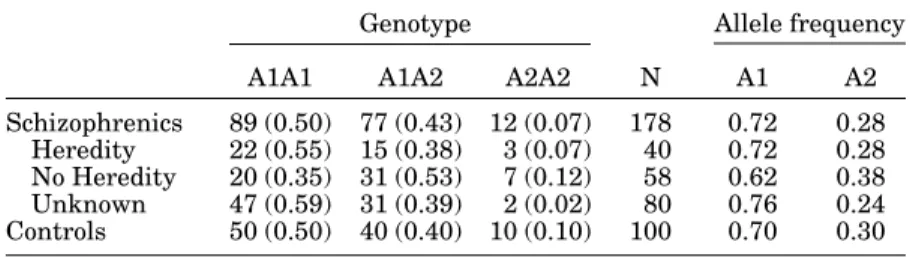
df 5 1, P 5 0.65), or homozygosity (x25 0.01, df 5 1, P 5 0.91) were detected between female patients and female controls. When patients were grouped according to pres-ence or abspres-ence of family history, 40 patients were found to have positive family history, whereas 58 patients did not have positive family history, and 80 patients, who could not be confirmed due to insufficient information, were categorized as “unknown.” The data on genotype counts and allele frequencies of these subgroups are listed in Table II. No differences of genotype distribution (x2 5 0.38, df 5 2, P 5 0.83) allele frequencies (x2 5 0.23, df 5 1, P 5 0.63), or homozygosity (x25 0.01, df 5 1, P5 0.93) were detected between patients with posi-tive family history and controls. When patients with positive family history were compared with patients without family history, similarly, the differences of genotype counts (x25 4.09, df 5 2, P 5 0.13), allele fre-quencies (x25 2.80, df 5 1, P 5 0.09), or homozygosity (x25 1.82, df 5 1, P 5 0.18) were not significant.
DISCUSSION
In this communication, we reported no association of the Ser9Gly polymorphism of the human DRD3 gene and schizophrenia in a Han Chinese population from Taiwan. Our data are consistent with the results re-ported by Yang et al. [1993], who also found no associa-tion between the Ser9Gly polymorphism of the DRD3 gene and schizophrenia in Han Chinese from Sichuan province of western mainland China. It is notable that the allele frequencies and genotype frequencies of both patients and controls from these two studies are almost the same (as summarized in Table III), indicating high homogeneity of the Ser9Gly polymorphism of the DRD3
gene in both studies. In consideration of population-based case-control association design, population strat-ification or sampling bias is an important confounding factor that leads to false-positive results [Kidd, 1993]. The highly homogeneous ethnic background and close fit of genotype frequencies to the Hardy-Weinberg equi-librium reduce the possible error due to population stratification in the present study. When we divided pa-tients and controls into subgroups by sex or family his-tory, still no association was observed in our study, which is also in agreement with results from Yang et al. [1993]. We did not subgroup patients according to neu-roleptic responses in the present study, because our patients are recruited from two long-stay mental hos-pitals, and in fact, most of the patients are poor responders to neuroleptic treatment.
Another important strategy to test claimed associa-tion is to increase sample size, and to conduct replica-tion study by independent groups. The present study, which is independent from that of Yang et al. [1993] us-ing a Chinese population, has a large sample size of pa-tients (N 5 178) and controls (N 5 100), to offer enough power to detect association if present. Thus, our study provides further evidence of lack of association between the Ser9Gly polymorphism of the DRD3 gene and schiz-ophrenia.
The results of the present study are also in line with another study using family-based association design. Macciardi et al. [1994] used haplotype relative risk (HRR) design to examine the relationship of Ser9Gly polymorphism and schizophrenia in an Italian popula-tion, and no association was detected. HRR uses parental nontransmitted alleles as controls, and
pre-TABLE II. Genotype Count and Allele Frequencies of the Ser9Gly Polymorphism of the D3 Receptor Gene Among Schizophrenic Patients
With and Without Family History and Controls
Genotype Allele frequency
A1A1 A1A2 A2A2 N A1 A2
Schizophrenics 89 (0.50) 77 (0.43) 12 (0.07) 178 0.72 0.28
Heredity 22 (0.55) 15 (0.38) 3 (0.07) 40 0.72 0.28
No Heredity 20 (0.35) 31 (0.53) 7 (0.12) 58 0.62 0.38
Unknown 47 (0.59) 31 (0.39) 2 (0.02) 80 0.76 0.24
Controls 50 (0.50) 40 (0.40) 10 (0.10) 100 0.70 0.30
TABLE III. Genotype Count and Allele Frequencies of the Ser9Gly Polymorphism of the D3 Receptor Gene Among Schizophrenic Patients
and Controls From Taiwan and Mainland China
Allele
Genotypes frequency
A1A1 A1A2 A2A2 N A1 A2
Schizophrenics, Taiwan 89 (0.50) 77 (0.43) 12 (0.07) 178 0.72 0.28 Schizophrenics, mainland China 54 (0.51) 45 (0.42) 8 (0.07) 107 0.71 0.29 Controls, Taiwan 50 (0.50) 40 (0.40) 10 (0.10) 100 0.70 0.30 Controls, mainland China 50 (0.51) 40 (0.41) 8 (0.08) 98 0.71 0.29
Kidd KK (1993): Association of disease with genetic markers: Déjà vu all over again. Am J Med Genet 48:71–73.
Lannfelt T, Sokoloff P, Martres M-P, Pilon C, Giros B, Jonsson E, Sed-vall G, Schwartz J-C (1992): Amino acid substitution in the dopamine D3 receptor as useful polymorphism for investigating psychiatric disorders. Psychiatr Genet 2:249–256.
Le Coniat M, Sokoloff P, Hillion J, Martres MP, Giros B, Pilon C, Schwartz JC, Berger R (1991): Chromosomal localization of the human D3 dopamine receptor gene. Hum Genet 87:618–620. Macciardi F, Verga M, Kennedy JL, Petronis A, Bersani G, Pancheri
P, Smeraldi E (1994): An association study between schizophrenia and the dopamine receptor genes DRD3 and DRD4 using haplo-type relative risk. Hum Hered 44:328–336.
Mant R, Williams J, Asherson P, Parfitt E, McGuffin P, Owen MJ (1994): Relationship between homozygosity at the dopamine D3 re-ceptor gene and schizophrenia. Am J Med Genet 54:21–26. Nanko S, Sasaki T, Fukuda R, Hattori M, Dai XY, Kazamatsuri H,
Kuwata S, Juji T, Gill M (1993): A study of the association between schizophrenia and the dopamine D3 receptor gene. Hum Genet 92:336–338.
Nanko S, Fukuda R, Hattori M, Sasaki T, Dai XY, Yamaguchi K, Kazamatsuri H (1994): Further evidence of no linkage between schizophrenia and the dopamine D3 receptor gene locus. Am J Med Genet 54:264–267.
Nimgaonkar VL, Zhang XR, Caldwell JG, Ganguli R, Chakravarti A (1993): Association study of schizophrenia with dopamine D3 re-ceptor gene polymorphisms: Probable effects of family history of schizophrenia? Am J Med Genet 48:214–217.
Nothen MM, Cichon S, Propping P, Fimmers R, Schwab SG, Wilde-nauer DB (1993): Excess of homozygosity at the dopamine D3 re-ceptor gene in schizophrenia not confirmed. J Med Genet 30:708–712.
Ott J (1991): “Analysis of Human Genetic Linkage, Revised Edition.” Baltimore: Johns Hopkins University Press, pp 165–193. Sabate O, Campion D, d’Amato T, Martres MP, Sokoloff P, Giros B,
Leboyer M, Jay M, Guedj F, Thibaut F, Dollfus S, Preterre P, Pe-tit M, Babron M-C, Waksman G, Mallet J, Schwartz J-C (1994): Failure to find evidence for linkage or association between the dopamine D3 receptor gene and schizophrenia. Am J Psychiatry 151:107–111.
Schmauss C, Haroutunian V, Davis KL, Davidson M (1993): Selective loss of dopamine D3-type receptor mRNA expression in parietal and motor cortices of patients with chronic schizophrenia. Proc Natl Acad Sci USA 90:8942–8946.
Sokoloff P, Giros B, Martres M-P, Bouthenet M-L, Schwartz J-C (1990): Molecular cloning and characterization of a novel dopa-mine receptor (D3) as a target for neuroleptics. Nature 347: 146–151.
Sokoloff P, Martres M-P, Giros B, Bouthenet M-L, Schwartz J-C (1992): The third dopamine receptor (D3) as a novel target for an-tipsychotics. Biochem Pharmacol 43:659–666.
Wiese C, Lannfelt L, Kristbjarnarson H, Yang L, Zoega T, Sokoloff P, Ivarsson O, Schwartz J-C, Moises HW, Helgason T (1993): No evi-dence of linkage between schizophrenia and D3 dopamine receptor gene locus in Icelandic pedigrees. Psychiatry Res 46:69–78. Yang L, Li T, Wiese C, Lannfelt L, Sokoloff P, Xu CT, Zeng Z, Schwartz
J-C, Liu X, Moises HW (1993): No association between schizophre-nia and homozygosity at the D3 dopamine receptor gene. Am J Med Genet 48:83–86.
Dopamine D3 Receptor Gene and Schizophrenia 43
vents the error of population stratification [Falk and Rubinstein, 1987]. In addition, several linkage studies did not find close linkage of the DRD3 gene locus and schizophrenia [Wiese et al., 1993; Nanko et al., 1994; Sabate et al., 1994]. Hence, taking together the results of linkage and association studies, the DRD3 gene locus may not play an important role in schizophrenia ge-netics.
Despite the negative results of association and link-age studies, the possible physiological role of the DRD3 gene in the pathogenesis of schizophrenia cannot be ruled out. A recent study revealed selective loss of DRD3 mRNA expression in the motor, primary so-matosensory, and somatosensory areas of cortices from postmortem brains of chronic schizophrenic patients, which cannot be explained by age of patients or treat-ment with neuroleptics [Schmauss et al., 1993]. Al-though the results need to be confirmed by further studies, this study implicates another possibility, that molecular defects in other genes that regulate the ex-pression of the DRD3 gene could be involved in the pathogenesis of schizophrenia.
REFERENCES
Bouthenet M-L, Souil E, Martres M-P, Sokoloff P, Giros B, Schwartz J-C (1991): Localization of dopamine D3 receptor mRNA in the rat brain using in situ hybridization histochemistry: Comparison with dopamine D2 receptor mRNA. Brain Res 564:203–219.
Carlsson A (1988): The current status of the dopamine hypothesis of schizophrenia. Neuropsychopharmacology 1:179–186.
Crocq M-A, Mant R, Asherson P, Williams J, Hode Y, Mayerova A, Collier D, Lannfelt L, Sokoloff P, Schwartz C, Gill M, Macher J-P, McGuffin J-P, Owen MJ (1992): Association between schizophre-nia and homozygosity at the dopamine D3 receptor gene. J Med Genet 29:858–860.
Falk CT, Rubinstein P (1987): Haplotype relative risk: An easy, reli-able way to construct a proper control sample for risk calculations. Ann Hum Genet 51:227–233.
Janowsky DA, Davis JM (1976): Methylphenidate, dextroampheta-mine, and levamphetamine: Effects on schizophrenic symptoms. Arch Gen Psychiatry 33:304–308.
Jonsson E, Lannfelt L, Sokoloff P, Schwartz J-C, Sedvall G (1993): Lack of association between schizophrenia and alleles in the dopamine D3 receptor gene. Acta Psychiatr Scand 87:345–349. Kendler KS, Diehl SR (1993): The genetics of schizophrenia: A
cur-rent, genetic-epidemiologic perspective. Schizophr Bull 19: 261–285.
Kennedy JL, Billett EA, Macciardi FM, Verga M, Parsons TJ, Meltzer HY, Lieberman J, Buchanan JA (1995): Association study of dopamine D3 receptor gene and schizophrenia. Am J Med Genet 60:558–562.