Impact of Regulatory Focus on Ambiguity Aversion
Abstract
The author proposes that people’s regulatory focus (promotion vs. prevention) might influence their
ambiguity aversion, which indicates that consumers prefer a risky to an ambiguous option. Three
experiments were conducted to test whether people with promotion focus show less ambiguity aversion
than those with prevention focus: The first experiment revealed that, compared to chronically
promotion-focused individuals, prevention-focused subjects preferred a risky to an ambiguous option.
The second experiment showed that priming of the subjects’ goal orientations leads to similar results.
Experiment 3 demonstrated that participants showed less ambiguity aversion for expected performance of
an investment product representative of promotion (e.g., a stock fund) rather than one representative of
prevention (e.g., a bond fund). In other words, people showed less preference for a bond fund when the
probability distribution of its expected performance was unknown than when it was known, whereas they
showed less preference difference between known and unknown probability distributions for the expected
performance of a stock fund. This study thus integrates research pertaining to regulatory focus and
ambiguity aversion, and the results confirm that the impact of regulatory focus on ambiguity aversion is
robust across different methods and decision tasks.
Introduction
Long ago, two shoe sellers working for two different companies were assigned to conduct some
market research in Africa. Both found that no African consumers wore their companies’ shoes. One came
back agitated, because she believed no Africans would ever buy her company’s products and no
opportunity existed in Africa. The other came home cheerful, because he inferred that all Africans needed
his company’s products and he would have a great chance of success in Africa.
—Proverbial business story
Ambiguity was first distinguished from risk by Knight (1921). In Knight’s terminology, a risky
decision is one for which the outcome probability is known, but the actual outcome that will occur is not.
However, when a decision maker is ignorant of even the probabilities, a decision is made under
uncertainty. Knight gave an example to distinguish uncertainty from risk: for two men drawing balls from
one urn, “One man knows that there are red and black balls, but is ignorant of the numbers of each; another
knows that the numbers are three of the former to one of the latter” (pp. 218–219). The first man chooses
under uncertainty, whereas the second chooses under risk. Similarly, Luce and Raiffa (1957) distinguished
risk from certainty and uncertainty: If it is known that each action invariably leads to a specific outcome,
then the decision is made under certainty. However, if each action leads to one of a set of possible specific
outcomes and each outcome occurs with a known probability, the decision is made under risk.
Furthermore, if a decision maker knows neither the outcome of each action nor the probability of the
partial information about the true state, the decision is made under partial ignorance. In other words, a
decision made under partial ignorance is an intermediate state between risk and complete ignorance. After
reviewing previous studies, Yates and Stone (1992) identified a continuum of uncertainty levels. At one
extreme is “ignorance”, used according to Luce and Raiffa, which means there is no basis whatsoever for
assigning the chances of loss. At the other extreme of the continuum is prescience (or “certainty” in
Knight’s terminology), in which the chance of any given outcome is either 1 or 0. Risk (or “objectivity” in
Yates and Stone terminology) means that the chances are sometimes known as actuarial or aleatory
probabilities in some circumstances. Ambiguity is an intermediate state between risk (all but one
distribution is ruled out) and ignorance (the decision maker cannot rule out any distributions). Overall,
ambiguity can be regarded as a lack of precise knowledge about the likelihood of events (i.e.,
second-order probability; Hogarth, 1987)
In the real world, decision makers know the precise probability of potential outcomes in some
situations (e.g., tossing a coin or drawing a poker card). But most decisions people make are characterized
by uncertain or ambiguous knowledge about the probability of events. For example, managers often
cannot establish a clear idea of the probability of success of a business venture. Similarly, a patient might
have to decide whether to undergo a new medical treatment for which the probability of success is
uncertain. Therefore, exploring the ambiguity effect is meaningful in a range of fields.
How do decision makers deal with such ambiguity about outcome probabilities? Ellsberg (1961)
notion often deemed “ambiguity aversion” (for a review, see Keren & Gerritsen, 1999). Since Ellsberg’s work, many other researchers have extended the original experiments by varying or adding study
parameters. Although the predominant propensity for ambiguity aversion has been well established across
many circumstances, few studies have explored whether individual differences influence ambiguity
aversion. McLain (1993) developed a measure to understand a person’s tolerance for ambiguity, but we
still have no idea about whether individual chronic differences, such as goal orientations and motivations,
influence the ambiguity aversion. In this article, the author explore whether individuals’ motivations,
specially on their regulatory focus, might influence their ambiguity aversion.
According to regulatory focus theory (Higgins, 1998), self-regulation involves two systems, one for
promotion and one for prevention. A promotion focus originates from the regulation of nurturance needs
and centers on the achievement of positive goals, whereas a prevention focus originates from the
regulation of security needs and centers on preserving the absence of unwanted occurrences. Because
people with a promotion focus are more sensitive to the presence or absence of positive outcomes, are in a
state of eagerness to attain accomplishments and gains, and make their decisions with a strategic
inclination to match the maximal goal (Crowe & Higgins, 1997; Higgins, 1998; Higgins et al., 1994), they
might focus more on the positive aspects of one option. By contrast, people with a prevention focus are
more sensitive to the presence or absence of negative outcomes, are in a state of vigilance to assure safety
and prevent losses, and make their decisions with a strategic inclination to avoid mismatches to the
distribution of outcomes, whereas ambiguity often is associated with the distribution of probabilities
(Bernasconi & Loomes, 1992; Camerer & Weber, 1992), an ambiguous option may “own” more potential
positive and negative aspects than a risky option. Therefore, people with promotion focus might focus
more on the positive aspects of an ambiguous option (“I might have more chances of winning if I choose the ambiguous rather than the risky option”) whereas people with prevention focus might focus on the negative aspects (“I might have less chance of winning if I choose the ambiguous rather than the risky option”). Accordingly, compared with prevention-focused people, promotion-focused individuals should exhibit less ambiguity aversion. Moreover, Zhou and Pham (2004) propose that investment accounts are
typically set up to achieve their salient goals, and people learn that different financial products are
associated with specific goals (promotion versus prevention) as a result of repeated exposure to business
news and financial advice. For example, stock is usually regarded as a promotion product because it
regulates the achievement of financial gains, whereas a bond is regarded as a prevention product because
it regulates the avoidance of financial loss. Zhou and Pham demonstrated that, because of the activation of
promotion versus prevention orientations through the process of investing relevant financial products,
investor decisions about financial products were consistent with these orientations. Therefore, the author
infers that people might show more ambiguity aversion for the expected performance of investment
products that represent a prevention focus (vs. a promotion focus).
Three experiments were used to test these propositions. Experiment 1 showed that compared to those
ambiguous option. The results for Experiment 2, in which the goal orientation of subjects was primed
experimentally, again supported that ambiguity aversion was more pronounced among
prevention-focused than promotion-focused individuals. Finally, Experiment 3 revealed that people
showed less ambiguity aversion for the expected performance of financial products representative of
promotion rather than of prevention focus. That is, people showed less preference for a prevention product
when the probability distribution of its expected performance was unknown than when it was known, but
they didn’t show preference difference between known and unknown probability distributions of the
expected performance for a promotion product. This study therefore offers several significant
contributions and highlights possible applications and directions for further research into ambiguity and
regulatory focus.
Theoretical Background
Ambiguity Aversion
Ellsberg (1961) proposes that people generally prefer to bet on gambles with known probabilities
rather than unknown probabilities. In Ellsberg’s study, a simple demonstration of this effect involves two
urns: Urn 1 contained 50 red balls and 50 green balls (i.e., a risky gamble), and urn 2 contained 100 red
and green balls in unknown proportion (i.e., an ambiguous gamble). Participants bet the color of the ball
before blindly drawing a ball from an urn; they won a prize if their bet was correct, and nothing else.
Ellsberg’s work, many other researchers have extended the original experiments by varying or adding study parameters. Some articles show that participants are willing to pay a premium to avoid betting on an
ambiguous gamble (Becker & Brownson, 1964; MacCrimmon & Larsson, 1979; Yates & Zukowski,
1976). On the whole, the predominant propensity for ambiguity aversion has been well established,
although some factors influence its effects, including the decision maker’s perceived degree of
competence (Heath & Tversky, 1991), state of relative knowledge or comparative ignorance (Chow &
Sarin, 2001; Fox & Tversky, 1995; Fox & Weber, 2002), the framing of options (Kuhn, 1997), decision
formats (single vs. repeated decisions) (Liu & Colman, 2009), and the range of expected probabilities
(Curley & Yates, 1985; Du & Budescu, 2005; Einhorn & Hogarth, 1985; Hogarth & Einhorn, 1990; Kahn
& Sarin, 1988; Keren & Gerritsen, 1999; Tversky & Fox, 1995).
Regulatory Focus
Self-regulation refers to the processes by which people set goals, select means to attain these goals,
and assess progress towards them (Carver & Scheier, 1998). According to the regulatory focus theory of
Higgins (1998) and Higgins et al. (1994), self-regulation involves two systems, one for promotion and one
for prevention. A promotion focus, which originates from the regulation of nurturance needs and centers
on the acquisition of positive goals, is associated with advancement, accomplishment, and the realization
of desired end states. By contrast, a prevention focus, which originates from the regulation of security
protection, and maintenance of the status quo.
People can differ in their chronic regulatory focus, namely, whether focused on hopes, aspirations,
and accomplishments or centered on duties, obligations, and safety (Higgins, 1998). In addition to varying
chronically across individuals, a regulatory focus can be activated in specific situations (Chernev, 2004a,
2004b; Friedman & Förster, 2001; Higgins et al., 1994; Liberman et al., 1999). For example, Chernev
(2004a) demonstrated that priming participants to generate reports of their hopes and aspirations versus
their duties and obligations leads them to become more promotion-focused and exhibit less preference for
the status quo option.
Higgins (2002) also proposed that decision makers with a promotion focus treat promotion-relevant
attributes as more important than prevention-relevant attributes in their decision making, whereas the
reverse applies to decision makers with a prevention focus. For example, attributes compatible with a
promotion orientation include luxury, which reflects accomplishment, and technical innovation, which
reflects advancement. By contrast, attributes compatible with a prevention orientation include protection
warning, which reflects safety, and service reliability, which reflects security. A link between regulatory
focus and the weight of different attributes has been demonstrated by Safer (1998) and Chernev (2004b).
Promotion-focused and prevention-focused people also differ in their strategic inclination to achieve
desired end states or avoid undesired states. Brendl and Higgins (1996) and Crowe and Higgins (1997)
proposed that because promotion-focused people are sensitive to the presence or absence of positive
they generally prefer to use “eagerness means” to make their decisions (i.e., a strategic inclination to
pursue matches with their maximum hopes or aspirations). By contrast, because prevention-focused
individuals are sensitive to the absence or presence of negative outcomes, they want to achieve or meet
standards for duties, obligations, and responsibilities, which are necessities or minimal goals. Therefore,
they prefer “vigilance means” to make their decisions (i.e., a strategic inclination to avoid mismatches
with their minimum duties and obligations). Results in Higgins et al. (1994) study of friendship strategies
support this proposition: promotion-focused persons are more inclined to use “approaching match”
strategies (e.g., support your friends), whereas prevention-focused persons prefer “avoiding mismatch”
strategies (e.g., stay in touch). Similarly, Crowe and Higgins (1997) conducted a signal detection task in
which participants first viewed a list of target items and after a delay reviewed test items, including both
the original target items and new non-target items. Crowe and Higgins proposed that promotion-focused
respondents in a state of eagerness want to detect a signal correctly (i.e., a “hit”, which represents an
accomplishment) and to avoid failure to detect a true signal (i.e., a “miss”, which represents a lack of
accomplishment), whereas prevention-focused persons in a state of vigilance want to reject a false alarm
correctly (i.e., “correct rejection”, or avoidance of a mistake) and to avoid a failure to reject a false alarm
(i.e., “false alarm”, or making a mistake). Their results support this proposition. Promotion-focused
participants exhibited a risky bias in indicating that a test item was among the original targets (i.e., a
relatively large number of hits and false alarms) in a recognition memory task, whereas
original target set (i.e., a relatively large number of correct rejections and misses).
Regulatory Focus and Ambiguity Aversion
Imagine you have a ticket allowing you to participate in one of two bets: urn 1 contains 50 red balls
and 50 green balls, whereas urn 2 contains 100 balls for which red and green are in unknown proportions.
The proportions of red and green balls in urn 2 are governed by computer and every possible ratio is
equally likely. Draw a ball blindly from an urn and guess its color. If you choose urn 1 and your guess is
correct, you win NT$ 500 (approximately US$16.50). If you choose urn 2 and your guess is correct, you
win NT$ 600 (approximately US$20). Which urn would you choose?
In this modified Ellsberg scenario, the 50–50 urn represents the risky option and the 0–100 urn
represents the premium ambiguous option. Moreover, the premium of the ambiguous bet is set to 20% of
the outcome, which coincides with previous studies (Yates & Zukowski, 1976) showing that the ambiguity
premium is approximately 20% of the outcome or probability. The premium makes the ambiguous option
as attractive as the risky one, avoiding the floor effect. Finally, subjects know the outcome is random and
generated by computer, which minimizes their tendency to perceive any experimenter bias (Keren &
Gerritsen, 1999; Kühberger & Perner, 2003; Pulford, 2009).
Because promotion-focused individuals prefer to maximize the occurrence of positive outcomes and
use eagerness means to make their decisions (Higgins, 2002), they are likely to focus more on the positive
guessing the right color if I choose the ambiguous urn, and the payoff is higher”). The ambiguous option is
thus relatively more attractive than the risky option because it represents a (possibly) greater probability of
acquiring more money. By contrast, because people with a prevention focus prefer to minimize the
occurrence of negative outcomes and vigilance means to make their decisions, they are likely to focus on
the negative aspects of the ambiguous option. Therefore, they believe that the possibility of loss might be
greater for the ambiguous than for the risky option (“It is possible that I will have a better than 50% chance
of guessing the wrong color if I choose the ambiguous urn, although the payoff is higher”) and thus prefer
the risky option. The following hypothesis thus results:
H1: Compared to prevention-focused individuals, promotion-focused people are more likely to
prefer the premium ambiguous option to the risky option.
Experiment 1: Impact of Chronic Regulatory Focus on Ambiguity Aversion
Participants
To fulfill course requirements, 132 Taiwanese college students were invited to join this experiment, without receiving rewards or credits.
Design
Experiment 1 was conducted to examine whether individuals’ chronic regulatory focus influence
their ambiguity aversion. As a measure of chronic regulatory focus, an 18-item regulatory focus scale,
developed by Lockwood, Jordan, and Kunda (2002), was used to assess participants’ chronic promotion
goals (e.g., “In general, I focus on preventing negative events in my life”) and promotion goals (e.g., “I
frequently imagine how I will achieve my hopes and aspirations”). These items are conceptually
consistent with the theoretical constructs used by Higgins, Shah, and Friedman (1997). Responses to the
18 statements fall on a scale ranging from 1 (not at all true of me) to 9 (very true of me).
Procedure
Participants answered a seven-page questionnaire and were informed that the purpose of the study
was to explore individuals’ decision procedures, so there were no “right” answers. After reading the
instructions on the first page of the questionnaire, they chose an option from the modified Ellsberg gamble,
as previously described, on the second page. Following the choice tasks, they completed four filler tasks in
the following four pages (about 5–10 minutes), in which two tasks were modified from research into the
compromise effect (Chang & Liu, 2008) and the other two modified from research into feature matching
(Houston, Sherman, & Baker, 1991; Slaughter & Highhouse; 2003). Finally, they completed the
regulatory focus measure on the final page.
To avoid any time pressure effect, participants answered the questionnaire at their own pace. After
finishing the questionnaire, they were thanked and debriefed.
Results
The regulatory focus measure consisted of two subscales designed to measure promotion and prevention goals, both of which were reliable (=0.82 for promotion and 0.78 for prevention). Measures of the strength of promotion and prevention goals equaled the sum of the items belonging to each of these
subscales; on average, promotion goal strength was greater than prevention goal strength (59.65 vs. 56.67;
t(131)=3.45, p<0.01), which is similar to the result of a previous study (Lockwood et al., 2002). The
measure for relative regulatory focus intention (regulatory focus score) was the difference between scores
for promotion goal and prevention goal strength for each subject. The higher the regulatory focus score,
the relatively greater was a subject’s promotion focus. Similar to previous studies (Idson, Liberman, &
Higgins, 2000; Louro, Pieters, & Zeelenberg, 2005), a median split separated participants into promotion-
and prevention-focused groups on the basis of regulatory focus measures (median score was 2.50). The
resulting mean composite regulatory focus scores differed significantly between the promotion and
prevention groups (MPREV=–4.55 vs. MPROM=10.50; F(1,130)=179.41, p<.01). Moreover, the promotion
group (N=66) exhibited greater intentions for promotion than for prevention goals (Mpromotion goal=62.82; Mprevention goal=52.32, t=12.33, p<.01), whereas the prevention group (N=66) exhibited greater intentions
for prevention goals (Mprevention goal=61.03; Mpromontion goal=56.48, t=–6.21, p<.01).
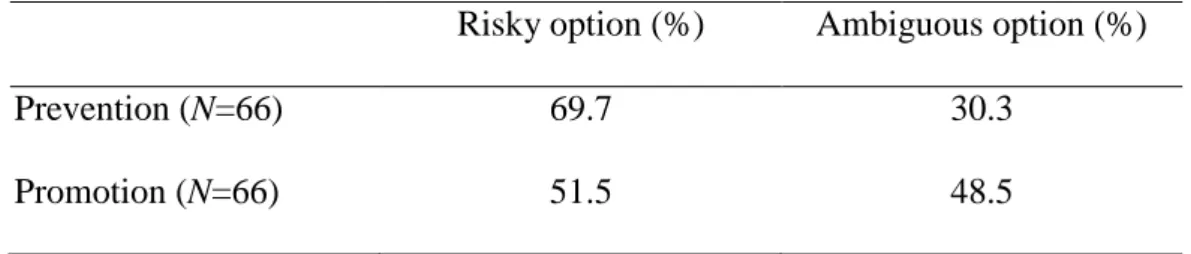
The results, illustrated in Table 1, indicate that 69.7% of prevention-focused subjects preferred the
risky option, whereas only 51.5% of promotion-focused subjects preferred the risky option (χ2 (1, N = 132) =4.50, p=.03)1. H1 was supported.
<Insert Table 1 around here>
Discussion
The result was as expected: Promotion-focused subjects exhibited less ambiguity aversion than
To avoid a floor effect, the payoff for the ambiguous option was set higher than that for the risky
option in Experiment 1. One might argue that the result of Experiment 1 existed because participants
suspected that the ambiguous option was more “risky” than the risky option because of its higher payoff.
Therefore, promotion-focused participants might prefer the ambiguous option compared to
prevention-focused participants because they are less sensitive to loss (Chernev, 2004a). To eliminate this
possible alternative explanation, the payoff for the ambiguous option was set to the same as that for the
risky option in Experiment 2.
Experiment 2: Impact of Induced Regulatory Focus on Ambiguity Aversion
Although the results for Experiment 1 confirm the proposition that chronic regulatory focus
influences individuals’ ambiguity aversion, an interesting question is whether priming a subject’s
regulatory focus has the same effect. Many studies have indicated that an individual’s regulatory focus
varies over time (Chernev, 2004a, 2004b; Friedman & Förster, 2001; Higgins et al., 1994; Liberman et al.,
1999). If chronic regulatory focus moderates the effect of ambiguity aversion, priming participants with
specific goals (i.e., prevention vs. promotion; Chernev, 2004a, 2004b) should have the same effect. To
examine H1 more completely, the goal orientations of participants in Experiment 2 were primed.
Another main difference from Experiment 1 is that the payoff for the ambiguous option was the same
as that for the risky option. This eliminated the possibility that participants might suspect that the
ambiguous option is more “risky” than the risky option, as previously noted. Compared to
aspect of the ambiguous option (“It is possible that I have a better than 50% chance of guessing the right
color if I choose the ambiguous rather than the risky urn”), so they should be more likely to choose the
ambiguous option, even though its payoff is the same as that for the risky option.
Third, this experiment adopted not only an Ellsberg gamble but also a marketing decision scenario to
examine the robustness of proposition H1 across different tasks.
Finally, participants’ expected probability of success (EPS; i.e., expectation regarding the probability
of winning a prize or of the success of the marketing plan) was measured for the risky and ambiguous
options in both Ellsberg and marketing strategy scenarios. If promotion-focused participants are more
likely to focus on the positive aspects of the ambiguous option than prevention-focused participants, it is
reasonable to anticipate that, compared to prevention-focused participants, promotion-focused individuals
will believe that the probability of success is greater for the ambiguous than for the risky option.
Therefore:
H2: Compared to prevention-focused participants, promotion-focused individuals are more likely
to expect that the probability of success is greater for the ambiguous than for the risky option.
Participants
To fulfill course requirements, 292 Taiwanese college students were invited to join this experiment, without receiving rewards or credits.
Design
Decision Tasks
and urn 1 (NT$ 500). The marketing decision scenario was as follows:
Imagine that you are the CEO of an international company and that the marketing manager
recently planned two new service programs (M and Z) for Taiwanese customers based on the
company’s strengths. You believe that both programs might create advantages and bring huge
profits for the company. However, you have to choose only one of them because of limited
resources. Based on previous experience and the ability of competitors, your company advisors all
agree that the probability of success for option M would be 50%. However, they argue that the
probability of success for option Z might be 30–70% because they are unsure whether competitors
will be able to offer the same service. If the program you choose is successful, then regardless of
whether you choose M or Z, you would make NT$ 50 million for your company. Which program
would you choose?
Goal Priming
To prime different goals, the experiment included two different five-page questionnaires. The first
page of both questionnaires informed participants that the purpose of the questionnaire was to explore the
relation between a Chinese language degree and choice, so there was no “right” answer for their choices.
The following two pages of the questionnaires primed participants’ goals. In the promotion (prevention)
priming condition, the second page of the questionnaire informed participants that their goals were to gain
(not lose) a Chinese language course credit and their task was to pass (not fail) the examination. On the
they found eight or more (missed two or fewer) wrong words, they passed (did not fail) the examination
and gained (did not lose) the credit. After participants completed the second page, they verified the
number of correct answers at their own pace on the third page, which reprinted the questions and provided the correct answers. They then checked (“”) each question if they were right (marked an “” if they missed the answer) and counted “the total words you hit (missed).” On the same page, they responded to
the item: “Did you pass (fail) the examination?” Then participants answered three manipulation check
questions on the bottom of the same page, modified from Pham and Avnet (2004): (1) I would prefer to “do what is right” (prevention) versus “do whatever I want” (promotion); (2) If I had enough money now, I would prefer to “take a trip around the world” (promotion) versus “pay back my loans” (prevention); and
(3) I would prefer to “go wherever my heart takes me” (promotion) versus “do whatever it takes to keep
my promises” (prevention). The more promotion-relevant options the participants indicated that they
preferred, the more promotion-focused they are considered.
After the two-page priming task, participants responded to two decision tasks, with one task on each
page. In each task, participants first indicated their EPS for both the risky and ambiguous options, then
chose the option they preferred. In the Ellsberg task, they separately answered “If you choose urn 1, you
expect the probability of success will be__?” and “If you choose urn 2, you expect the probability of
success will be__?”. Similar questions were designed for the marketing strategy scenario. To avoid order
Procedure
Participants were randomly assigned to either the promotion-priming (N=144) or prevention-priming
(N=148) questionnaire. After reading the instruction page and answering the two priming pages, the
subjects answered the EPS question for both ambiguous and risky options and then chose the options they
preferred on the final two task pages. The other details were similar to those in Experiment 1, except as
previously noted.
Results
Manipulation checks
Participants in the promotion condition chose 1.86 promotion-relevant options on average, whereas
those in the prevention condition only chose 1.58 promotion-relevant options (F(1,290)=5.86; p=.02). The
result shows that the manipulation was successful. Moreover, participants’ correct responses to the ten
questions were very similar for the two priming conditions. The average hits were 8.95 (std=1.17) in the
promotion priming condition and 8.95 (std=1.32) in the prevention priming condition. Furthermore, the
passing rates were not very different: 89.6% of participants in the promotion priming condition correctly
answered more than or equal to 8 questions and 88.5% of participants in the prevention priming condition
missed fewer than or equal to 2 questions (χ2 (1, N = 292) =.09, p>0.1).
EPS and choice
participants’ choices for either the Ellsberg gamble (χ2 (1, N = 292) =.64, p>0.1) or the marketing strategy (χ2 (1, N = 292) <0.01, p>.1) scenario, so the author pooled the data across the two orders for both tasks.
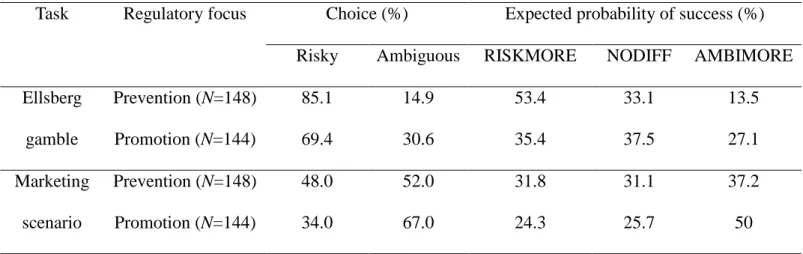
The results were shown in Table 2. In the modified Ellsberg gamble, 85.1% of prevention-focused
subjects preferred the risky option, whereas only 69.4% of promotion-focused subjects did. A CATMOD
analysis with participants’ choices as the dummy dependent variable (1= ambiguous option, 0= risky
option) and regulatory focus as the dummy independent variable (REGUTYPE; 1=promotion,
0=prevention) revealed that REGUTYPE influences choice of the ambiguous option (χ2 (1, N = 292) =9.92, p<.01). Moreover, the data can be classified into three subgroups according to EPS results for the
two options. For example, if participants expected the probability of success to be higher for the risky than
for the ambiguous option (e.g., 50% vs. 40%), they were categorized as RISKMORE. By contrast,
subjects with lower EPS for the risky than for the ambiguous option (e.g., 50% vs. 60%) were categorized
as AMBIMORE. Finally, subjects with the same EPS for the risky and ambiguous options (e.g., 50% vs.
50%) were categorized as NODIFF. The results reveal that 53.4% of prevention-focused participants
expected a higher EPS for the risky than for the ambiguous option, whereas only 35.4% of
promotion-focused participants made the same prediction. By contrast, 27.1% of promotion-focused
participants expected a higher EPS for the ambiguous option, whereas only 13.5% of prevention-focused
participants did. A CATMOD analysis with EPS subgroup as the dummy dependent variable and
REGUTYPE as the dummy independent variable revealed that REGUTYPE influenced the relative EPS
CATMOD analysis, the impact of EPS on choice was still significant (χ2 (2, N = 292) =79.21, p<.01), but the impact of REGUTYPE on choice was not significant (χ2 (1, N = 292) =1.56, p>.1). In other words, EPS mediated the effect of REGUTYPE on ambiguity aversion (Baron & Kenny, 1986). A similar result
was observed for the marketing scenario2. Overall, the results support H1 and H2. <Insert Table 2 about here>
Discussion
Experiment 2 involved a different method and two decision tasks, yet the result was similar to that for
Experiment 1: ambiguity aversion was more pronounced for prevention-focused than for
promotion-focused subjects. Moreover, the payoff was the same for the ambiguous and the risky options,
so the result cannot be attributed to participants’ belief that the ambiguous option must be more “risky”
than the risky option. Rather, the result indicates that promotion-focused (prevention-focused) participants
are likely to focus more on the positive (negative) aspects of the ambiguous option. This inference is
supported by the finding that more promotion-focused participants (compared to prevention-focused
participants) believed they would have more chances of success if they chose the ambiguous rather than
the risky option. Moreover, the result also shows that participants’ EPS mediates the effect of REGUTYPE
on their choice.
Recently, Pulford (2009) demonstrated that highly optimistic participants showed less ambiguity
optimists must have judged the probability of winning to be greater in the ambiguous urn than in the
known-risk one” (p. 1086). Taken together, Pulford’s study and the results of Experiment 2 support one
main concept: because the ambiguous option “owns” more possible successful and failure probability than
the risky one, some factors, such as personality (e.g., optimism) and motivation (e.g., regulatory focus),
should influence EPS for the ambiguous options.
It is also interesting to note that 77.4% of Taiwanese participants chose the risky option (across two
priming conditions) in the traditional Ellsberg gamble condition whereas in previous studies
approximately 60–70% of North American participants preferred the risky option in a traditional Ellsberg
gamble and this effect was robust (Camerer & Weber, 1992; Curley & Yates, 1989; Rode et al., 1999).
Aaker and Lee (2001) and Hamilton and Biehal (2005) found that people with an accessible independent
self-view were more promotion-focused and more likely to be persuaded by promotion-relevant
information, whereas those with an interdependent self-view were more prevention-focused and more
persuaded by prevention-relevant information. Moreover, Aaker and Lee proved that because participants
in North America tend to be more independent than participants in East Asia, they are more likely to be
persuaded by promotion-framed information. If North American people are more independent and
accordingly promotion-focused than those from East Asia, then it might be reasonable to infer that North
American participants should exhibit less ambiguity aversion than East Asian participants. This
comparison between the result of Experiment 2 and previous studies seems to support the inference that
prevention focused, which would make them less likely to choose the ambiguous option. Although it is not
clear whether the difference is statistically significant, it would be interesting to examine this proposition
by conducting more rigorous experiments across different cultures.
Experiment 2 also offered a useful suggestion for practice. That is, priming subjects with promotion
goals might reduce the prevalence of ambiguity aversion. For a fund manager, for example, priming of
consumer goals (e.g., talking about a client’s hopes versus obligations) might be a good method to
improve the attractiveness of specific products.
Experiment 3: Product-Induced Goals and Ambiguity Aversion
Zhou and Pham (2004) proposed that different financial products represent promotion versus
prevention because people learn through repeated exposure to information such as business news,
promotional materials, and financial advice. Therefore, common stocks and small business ownership are
usually representative of promotion because they regulate the achievement of financial gains, whereas
government bonds and deposit certificates are relatively more representative of prevention because they
regulate the avoidance of financial loss. Zhou and Pham (2004) further proposed that, because of the
activation of promotion versus prevention orientations through the process of investing specific financial
products, investor decisions about financial products should be consistent with these orientations.
Therefore, investors are differentially sensitive to gains and losses, depending on the goals (promotion
prevention) × 3(payoff conditions: baseline vs. great gain vs. great loss) between-subject experiment,
financial products were categorized as mutual funds in an IRA account (prevention product) or individual
stocks in a trading account (promotion product), and the potential payoffs for the products were
manipulated at three levels, including baseline (an 85% chance of gaining 12% and a 15% chance of
losing 4.5%), greater gains (an 85% chance of gaining 24% and a 15% chance of losing 4.5%), and greater
loss (an 85% chance of gaining 12% and a 15% chance of losing 13.5%) conditions. Participants were
informed the gains and losses would be realized in one year and then asked to indicated their intention of
investing in the financial product on a nine-point scale. Zhou and Pham demonstrated that when
participants were assigned to the promotion product condition, their investment intentions were higher in
the greater gains than in the baseline condition, which was not significantly different from the greater loss
condition. By contrast, when participants were assigned to the prevention product condition, their
investment intentions were relatively lower in the greater loss condition than in the baseline condition,
which was not significantly different from the greater gains condition. The result was in agreement with
their expectation: evaluations of financial products that represent promotion exhibit greater sensitivity to
potential gains and lesser sensitivity to potential losses, whereas evaluations of products that represent
prevention exhibit a greater sensitivity to potential losses and lesser sensitivity to potential gains.
If different products represent different regulatory goals, it is reasonable to anticipate that individuals
will show more ambiguity aversion for the expected performance of prevention products because
show less ambiguity aversion for the expected performance of promotion products, because ambiguity is
compatible with the promotion focus that these represent. To explain the concept more clearly, first
imagine two bond funds (prevention product) for which one has 20% expected profit and the other has
10–30% expected profit. The author anticipate that individuals will exhibit lesser preference for the bond
with 10–30% expected profit than for that with 20% expected profit, because the process of considering
the bond funds activate a prevention focus and ambiguous performance is not compatible with this focus.
By contrast, individual preferences will differ less between the stock funds (promotion product) with 20%
and 10–30% expected profit because the process of considering the stock funds activate a promotion focus
and ambiguous performance is compatible with this focus. Therefore:
H3: People show more ambiguity aversion for the expected performance of financial products that
represent prevention rather than promotion.
Design
A 22 performance uncertainty of promotion products (risky vs. ambiguous)performance uncertainty of prevention products (risky vs. ambiguous) between-subject design was used to test H3.
Stock and bond funds represented promotion and prevention products, respectively, and the performance
uncertainty of each could be either ambiguous or risky. Thus, Experiment 3 consisted of four cells: risky
stock and bond funds, risky stock and ambiguous bond funds, ambiguous stock and risky bond funds, and
When the predicted performance of the stock fund was risky, the questionnaire described its
performance as a 50% possibility of gaining 12% but a 50% possibility of gaining 2%; when its
performance was ambiguous, this was described as a 40–60% possibility of gaining 12% but a 40–60%
possibility of gaining 2%. The same designs were for the predicted performance of the risky and
ambiguous bond funds (Table 3).
<Insert Table 3 about here>
For example, in the risky (ambiguous) stock and risky (ambiguous) bond fund condition, the task was
as follows:
Imagine that you get a NT$ 300,000 (approximately USD $10,000) bonus from your
company and want to invest in one of the mutual funds in the market. The salesperson in the bank
offers two new mutual funds. One fund is associated with stocks and the other is associated with
bonds. The two fund managers are both experienced and expert in their areas, and both have
enough experience to operate mutual funds. The performances of the funds they represent have
generally all been excellent, and the profits of these funds rank near the top among all other
funds. You are satisfied with both fund managers with regard to their experience and
performance. However, you must choose one of the funds, because you have limited money.
Because the two funds are both new, you cannot acquire any other relevant information from the
the fund managers’ predictions. The stock fund manager predicts a 50% possibility of gaining
12% profit but a 50% possibility of gaining 2% (40–60% possibility of gaining 12% but 40–60%
possibility of gaining 2%) for this product. Similarly, the bond fund manager predicts a 50%
possibility of gaining 12% profit and a 50% possibility of gaining 2% (40–60% possibility of
gaining 12% but 40–60% possibility of gaining 2%) for this product. With this limited
information, you must make a decision. Which one would you want to choose?
After participants made their choices, they wrote down the reasons for their decisions. If participants
exhibit less preference for the ambiguous bond fund because its ambiguous performance is not consistent
with the prevention focus that it represents, it is reasonable to infer that participants in the ambiguous bond
fund (vs. risky bond fund) should note fewer prevention-relevant reasons, such as safety, responsibility,
and obligation. By contrast, if participants relatively prefer the ambiguous stock fund because its
ambiguous performance is compatible with the promotion focus that this fund represents, it is reasonable
to infer that participants in the ambiguous stock fund (compared to the risky stock fund) should indicate
relatively more promotion-relevant reasons, such as accomplishment and hope during their decision
process. This additional measure for the stated reasons is helpful in exploring whether the ambiguous
performance of the bond fund contradicts the prevention focus it represents or if the ambiguous
performance of the stock fund is consistent with the promotion focus it represents.
One might argue that, in real-world situations, stocks usually have a higher mean expected outcome
studies showed that some variables might influence individuals’ ambiguity aversion, including the mean
expected outcomes (Rode et al., 1999), the range of possible second-order probabilities (Heath & Tversky,
1991), and the gain and loss of the outcomes (Budescu et al., 2002; Einhorn & Hogarth, 1985; Kühberger,
Schulte-Mecklenbeck, & Perner, 1999; Tversky & Fox, 1995; Tversky & Kahneman, 1992). Therefore, it
is necessary to design a rigorous experiment to control for the three relevant variables3.
Participants and procedure
Unlike previous experiments, the subjects in Experiment 3 were recruited from eight refresher
courses held at two colleges rather from among typical college students, so they represented 228
Taiwanese students pursuing further education. However, 18 subjects were excluded because they did not
complete the questionnaire (e.g., provided no reasons), misunderstood the task (e.g., one participant chose
both the stock and bond funds rather than either), or other factors (e.g., one subject in the risky stock and
bond condition suspected that the design was not realistic). Of the 210 remaining participants, 93.8% had
work experience, with a mean working time of 9.74 years (std=5.23). Furthermore, 60.9% have invested
or are investing in mutual funds. Participants also completed a two-page questionnaire, with the task on
the first page and the second page featuring room for noting rationales and personal information, such as
working experience and investment experience. After they finished, they were thanked and debriefed.
Results
As illustrated in Table 4. When the stock and bond funds were both risky, 59.7% of participants
37.8% of participants preferred it (χ2 (1, N = 107)=5.00, p=0.03). By contrast, slightly more participants preferred the stock fund in the ambiguous stock and risky bond condition than in the risky stock and bond
fund condition, although the difference was not significant (44.3% vs. 40.3%,χ2 (1, N = 123)=0.20, p>0.1). These two comparisons revealed that participants showed more ambiguity aversion for the expected
performance of the bond fund than to that of the stock fund. The proposition is clearer in and confirmed by
the comparison of the results between both risky funds and both ambiguous funds conditions. When the
two funds were both risky, 59.7% of participants preferred the bond fund. By contrast, only 42.9%
participants preferred the bond fund when the two options were both ambiguous (χ2 (1, N = 104)=2.84,
p=0.09, N=104).
<Insert Table 4 about here>
The CATMOD analysis used participants’ choice as the dummy dependent variable (1= stock fund,
0= bond fund) and the performance uncertainty of promotion products (risky vs. ambiguous), the
performance uncertainty of prevention products (risky vs. ambiguous), and their interaction as the dummy
independent variables. The ambiguous performance (relative to risky performance) of the bond fund had a
significant negative influence on participants’ preference for the bond fund (χ2 (1, N = 210)=6.11, p=0.01), whereas neither the performance uncertainty of the stock fund nor their interaction had any effects (χ2 (1, N = 210)=0.01 and 0.43, respectively, p>0.1). In other words, keeping the performance uncertainty of the
stock fund consistent, participants less likely chose the bond fund when the expected performance of the
Reasons for decisions
The reasons participants listed for their decisions can be categorized into three subgroups. First,
promotion relevant (PromRele) category regarded as the presence or absence of promotion-relevant goals.
That is, the stated reasons were associated with the presence or absence of a promotion goal, for which the
option chosen (rejected) would help (prohibit) participants to approach a maximum goal. For example,
participants might choose (reject) the option because it offered better (worse) performance, such as a
greater (lower) probability of success, higher (lower) expected value, or better (worse) outcome. One
rationale in the subgroup indicated that the subject chose the ambiguous stock rather than the risky bond
because it had a higher probability of success. Second, prevention relevant (PrevRele) category regarded
as the presence or absence of prevention-relevant goals. That is, the stated reasons were associated with
the presence or absence of a prevention goal, for which the option chosen (rejected) would help (prohibit)
participants to avoid mismatching a minimum goal. For example, participants might choose (reject) the
option because it was safer (less safe), with lower (higher) ambiguity, lower (higher) risk, lower (higher)
uncertainty, or lower (higher) variance. One rationale in the subgroup indicated that the risky bond seemed
safer than the ambiguous stock because its probability of success was more certain according to the
respondents. Third, the final category, labeled as “Others,” indicates that the participant’s decision
reflected some other rationale, such as tossing a coin.
It should be noted that the terms “risk”, “ambiguity”, “uncertainty”, “variance”, and “risk” used by
used in this article. These terms are sometimes exchangeable for many people. In this article, the term “risky option” is defined as an option with a known probability distribution, which is more specific than the meaning typically used by participants. What is important is the relationship between participants’
rationales and their regulatory focus or their goals, which was the basis used to categorize the rationales.
Two independent judges, unaware of the purpose of Experiment 3, categorized each written rationale
into one of these categories; the interjudge reliability was 87.1% and any disagreements were resolved by
a third blind judge.
The results for the four conditions are listed in Table 5A; the data separately pooled for stock and
bond funds are in Table 5B. Using Table 5B for further explanation, 24.3% of participants’ rationales
belonged to the promotion-relevant category in the risky stock conditions (i.e., risky stock and bond, risky
stock and ambiguous bond), whereas 37.9% of participants’ rationales indicated a promotion-relevant
category in the ambiguous stock conditions (i.e., ambiguous stock and bond, ambiguous stock and risky
bond). By contrast, 58.5% of the rationales belonged to a prevention-relevant category in the risky bond
conditions, but 36.8% belonged to the prevention-relevant category in the ambiguous bond conditions.
These two comparisons revealed that the ambiguous performance of the bond fund contradicted the
prevention focus it represents, whereas the ambiguous performance of the stock fund was relatively
compatible with the promotion focus it represents.
To explore whether participant rationale mediates the effect of the performance uncertainty of stock
(because “Others” rationales might interfere with the effects). First, a CATMOD analysis used
participants’ choice as the dummy dependent variable (1= stock fund, 0= bond fund) and the performance
uncertainty of promotion products (risky vs. ambiguous), the performance uncertainty of prevention
products (risky vs. ambiguous), and their interaction as the dummy independent variables. The ambiguous
(vs. risky) performance of the bond fund had a negative significant influence on choosing the ambiguous
option (χ2 (1, N = 169)=14.04, p<0.01), whereas neither the performance uncertainty of the stock fund nor their interaction had any effects (χ2 (1, N = 169)=0.95 and 0.59, respectively, p>0.1). Second, another CATMOD analysis, with rationale as the dummy dependent variable (1=PrevRele, 0=PromRele) and the
same three dummy independent variables, showed that the ambiguous (vs. risky) performance of the bond
fund and stock fund separately had a significant positive influence on participants’ rationales belonging to
the PromRele category (χ2 (1, N = 169)=16.28 and 5.73, respectively, p<0.05), whereas the interaction had no effect (χ2 (1, N = 169)<0.01, p>0.1). Finally, when the model included participants’ rationales, the impact of these rationales on choice was still significant ((χ2 (1, N = 169) = 51.10, p<0.01), but the performance uncertainty of neither the bond fund nor the stock fund had any impact on choice ((χ2 (1, N = 169)=1.66 and 0.79, respectively, p>0.1 for both). Taken together, these three analyses showed that
participants’ rationales mediated the impact of the performance uncertainty of stock and bond funds on
their choices (Baron & Kenny, 1986).4
Discussion
ambiguity aversion for the expected performance of an investment product that represents a prevention
focus than that represents promotion. The result is consistent with H3. Moreover, ambiguous performance
more likely leads participants to justify their rationales with promotion-relevant reasons. Finally,
participants’ rationales mediate the performance uncertainty of the financial products on their choices.
One might suspect why prevention-related reasons are more common than promotion-related reasons
for three of the four conditions (Table 5A).We should note that participants’ rationales and decisions are
influenced by two forces: one is the compatibility between the performance uncertainty of the stock and
the promotion focus it represents, and the other is the compatibility between the performance uncertainty
of the bond and the prevention focus it represents. Therefore, it is easier for subjects to judge and infer
their choices and reasons in the ambiguous stock and bond condition and the risky stock and bond
condition. In the former condition, the ambiguous expected performance is consistent with the promotion
focus that the stock fund represents and incompatible with the prevention focus that the bond fund
represents, so individuals in this condition will more likely prefer the stock fund and note more
promotion-relevant rationales (partly because people note relatively fewer prevention-relevant rationales).
In the latter condition, by contrast, the risky expected performance is less consistent with the promotion
focus that the stock fund represents and more consistent with the prevention focus that the bond fund
represents, so it is reasonable to infer that people in this condition will be more to likely prefer the bond
fund and note more prevention-relevant rationales (partly because they note relatively fewer
likely to note relatively more promotion-relevant than prevention-relevant rationales in the ambiguous
stock and bond condition (52.4% vs. 26.2%) whereas participants noted relatively more
prevention-relevant than promotion-relevant rationales in the risky stock and bond condition (59.7% vs.
12.9%). However, it is more difficult to infer how individuals note their rationales in the risky stock and
ambiguous bond condition and in the ambiguous stock and risky bond condition. In the former condition,
the risky expected performance is relatively less consistent with the promotion focus that the stock fund
represents and the ambiguous expected performance is also inconsistent with the prevention focus that the
bond fund represents. Similarly, in the latter condition, the ambiguous expected performance is consistent
with the promotion focus that the stock fund represents and the risky expected performance is consistent
with the prevention focus that the bond fund represents. How participants note their rationales and make
their decisions for these two conditions might depend on their chronic regulatory focus. As previously
discussed for Experiment 2, Taiwanese participants are more interdependent and prevention focused, so
they might note relatively more prevention-relevant rationales in both the compatible (ambiguous stock
and risky bond: PrevRele=57.4% vs. PromRele=27.9%) and incompatible (risky stock and ambiguous
bond: PrevRele=46.7% vs. PromRele=40.0%) conditions. This might explain why prevention-related
reasons were more common than promotion-related reasons for most conditions.
Overall, Experiment 3 not only extends the proposition of Zhou and Pham (2004), but also broadens
the application of this study to practice. Marketing managers who sell products that represent prevention
does not become more ambiguous.
GENERAL DISCUSSION
Three experiments confirmed that prevention-focused subjects are less likely to choose ambiguous
options than promotion-focused individuals. Moreover, people show more ambiguity aversion for the
expected performance of products representative of a prevention focus than of a promotion focus. These
results should not be attributed to the perception that the ambiguous option is more risky than the risky
option, but rather to the finding that compared with prevention-focused participants, promotion-focused
individuals expect a higher probability of success for the ambiguous option (Experiment 2).
Several academic and practical implications arise from the study. First, this article seems to be the
first to explore the relation between ambiguity aversion and regulatory focus and thus offers a more
comprehensive conceptualization. Its results also imply that researchers should control for regulatory
focus (e.g., measure participants’ chronic regulatory focus as covariance) to acquire more precise results
when they conduct research into ambiguity aversion.
These findings also offer a suggestion regarding how companies should display their brands and
products to amplify their relative advantage. When the performance of a firm’s brands or products seems
ambiguous, salespeople should talk about hopes, aspirations, and accomplishments (versus duties,
obligations, and safety). Similarly, when the brands or products represent a prevention focus (e.g., bond
fund), the product manger should design products to avoid ambiguous expected performance. For
fund and what percentage of investments are assigned to each bond. Thus, customers can anticipate the
expected performance of the fund more precisely, which reduces the ambiguity of the performance and
makes the bond fund seem more attractive.
Suggestions for further research
Several additional avenues also exist for further research. As previously noted, based on the
proposition by Aaker and Lee (2001) and the results of this article (see the discussion sections for
Experiments 2 and 3), it is reasonable to infer that North American participants should exhibit less
ambiguity aversion than East Asian participants. Although the results seem to show that Taiwanese
participants are more prevention-focused than participants in North America (Experiment 2) and more
influenced by the performance uncertainty of prevention products (Experiment 3), this proposition should
be examined with more rigorous experiments.
Another possible research direction would be to obtain more direct evidence of how participants with
a different regulatory focus make choices. For example, it might be suitable to use a protocol method to
determine how participants make decisions. Experiment 2 indicates that although more
promotion-focused than prevention-focused participants expected higher EPS for the ambiguous
compared to the risky option and chose according to the EPS of the two options, 31.9% of the data points
(across the two tasks) without probability differences had similar results. For 186 responses (95 for
preferred the risky option, whereas only 58.2% of the promotion-focused participants did (χ2 (1, N = 186)=9.01, p<0.01). This result implies that participants made their decisions depending not only on the
EPS, but also on other relevant regulatory focus factors such as hope, accomplishment, and maximum
goals versus safety, obligation, or minimum goals. This finding is worthy of further research.
Acknowledgments
The research reported in this article was supported by research grant NSC 97-2410-H-218-025 from
the National Science Council of Taiwan. I thank the journal editor and three anonymous reviewers for
their helpful suggestions. I also thank Chou, Yu-Jen for helpful discussions and for suggesting relevant
References
Aaker, J. L., & Lee, A. Y. (2001). “I” seek pleasures and “we” avoid pains: The role of self-regulatory
goals in information processing and persuasion. Journal of Consumer Research, 28, 33–49.
Baron, R. M., & Kenny, D. (1986). The moderator-mediator variable distinction in social psychological
research: Conceptual, strategic, and statistical considerations. Journal of Personality and Social
Psychology, 51, 1173–1182.
Becker, S. W., & Brownson, F. O. (1964). What price ambiguity? Or the role of ambiguity in
decision-making. Journal of Political Economy, 72, 62–73.
Bernasconi, M., & Loomes, G. (1992). Failures of the reduction principle in an Ellsberg-type problem.
Theory and Decision, 32 (1), 77-100.
Brendl, C. M., & Higgins, E. T. (1996). Principles of judging valence: What makes events positive or
negative? In M. P. Zanna (Ed.), Advances in experimental social psychology (Vol. 28, pp. 95–160).
New York: Academic Press.
Budescu, D. V., Kuhn, K. M., Kramer, K. M., & Johnson, T. R. (2002). Modeling certainty equivalents for
imprecise gambles. Organizational Behavior and Human Decision Processes, 88, 748–768.
Camerer, C., & Weber, M. (1992). Recent developments in modeling preference: Uncertainty and
ambiguity. Journal of Risk and Uncertainty, 5, 325–370.
Carver, C. S., & Scheier, M. F. (1998). On the self-regulation of behavior. New York: Cambridge
Chang, C.-C., & Liu, H.-H. (2008). Which is the compromise option? Information format and task format
as determinants. Journal of Behavioral Decision Making, 21, 59–75.
Chernev, A. (2004a). Goal orientation and consumer preference for the status quo. Journal of Consumer
Research, 31, 557–565.
Chernev, A. (2004b). Goal–attribute compatibility in consumer choice. Journal of Consumer Psychology,
14, 141–150.
Chow, C. C., & Sarin, R. K. (2001). Comparative ignorance and the Ellsberg paradox. Journal of Risk and
Uncertainty, 22, 129–139.
Crowe, E., & Higgins, E. T. (1997). Regulatory focus and strategic inclinations: Promotion and prevention
in decision making. Organizational Behavior and Human Decision Processes, 69, 117–132.
Curley, S. P., & Yates, J. F., (1985). The center and range of the probability interval as factors affecting
ambiguity preferences. Organizational Behavior and Human Decision Processes, 36, 273-287.
Curley, S. P., & Yates, J. F. (1989). An empirical evaluation of descriptive models of ambiguity reactions
in choice situations. Journal of Mathematical Psychology, 33, 397–427.
Du, N., & Budescu, D. (2005), The effects of imprecise probabilities and outcomes in evaluating
investment options. Management Science, 51, 1791–1803.
Einhorn, H. J., & Hogarth, R. M. (1985). Ambiguity and uncertainty in probabilistic inference.
Psychological Review. 92, 433–461
643–649.
Fox, C. R., & Tversky, A. (1995). Ambiguity aversion and comparative ignorance. Quarterly Journal of
Economics, 110, 585–603.
Fox, C. R., & Weber, M. (2002). Ambiguity aversion, comparative ignorance, and decision context.
Organizational Behavior and Human Decision Processes, 88, 476–498.
Friedman, R. S., & Förster, J. (2001). The effects of promotion and prevention cues on creativity. Journal
of Personality and Social Psychology, 81, 1001–1013.
Hamilton, R. W., & Biehal, G. J. (2005). Achieving your goals or protecting their future? The effects of
self-view on goals and choice. Journal of Consumer Research, 32, 277–283.
Heath, C., & Tversky, A. (1991). Preference and belief: Ambiguity aversion and competence in choice
under uncertainty. Journal of Risk and Uncertainty, 4, 5–28.
Higgins, E. T. (1998). Promotion and prevention: Regulatory focus as a motivational principle. In M. P.
Zanna (Ed.), Advances in experimental social psychology (Vol. 30, pp. 1–46). New York: Academic
Press.
Higgins, E. T. (2002). How self-regulation creates distinct values: The case of promotion and prevention
decision making. Journal of Consumer Psychology, 12, 177–191.
Higgins, E. T., Roney, C. J. R., Crowe, E., & Hymes, C. (1994). Ideal versus ought predilections for
approach and avoidance: Distinct self-regulatory systems. Journal of Personality and Social
Higgins, E. T., Shah, J., & Friedman, R. (1997). Emotional responses to goal attainment: Strength of
regulatory focus as moderator. Journal of Personality and Social Psychology, 72, 515–525.
Hogarth, R. M. (1987). The psychology of judgment and choice (2nd ed.). San Francisco, CA: Jossey Bass.
Hogarth, R. M., & Einhorn, H. J. (1990). Venture theory: A model of decision weights. Management
Science, 36 (7), 780-803.
Houston, D. A., Sherman, S. J., & Baker, S. M. (1991). Feature matching, unique features, and the
dynamics of the choice process: Predecision conflict and postdecision satisfaction, Journal of
Experimental Social Psychology, 27, 411–430.
Idson, L. C., Liberman, N., & Higgins, E. T. (2000). Distinguishing gains from nonlosses and losses from
nongains: A regulatory focus perspective on hedonic intensity. Journal of Experimental Social
Psychology, 36, 252–274.
Kahn, B. E., & Sarin, R. K. (1988). Modeling ambiguity in decisions under uncertainty. Journal of
Consumer Research, 15, 265–272.
Keren, G., & Gerritsen, L. E. M. (1999). On the robustness and possible accounts for ambiguity aversion.
Acta Psychologica, 103, 149–172.
Kluger, A. N., Stephan, E., Ganzach, Y., & Hershkovitz, M. (2004). The effect of regulatory focus on the
shape of probability-weighting function: Evidence from a cross-modality matching method.
Organizational Behavior and Human Decision Processes, 95, 20–39.
Kuhn, K. M. (1997). Communicating uncertainty: Framing effects on responses to vague probabilities.
Organizational Behavior and Human Decision Processes, 71, 55–83.
Kühberger, A., & Perner, J. (2003). The role of competition and knowledge in the Ellsberg task. Journal of
Behavioral Decision Making, 16, 181–191.
Kühberger, A., Schulte-Mecklenbeck, M., & Perner, J. (1999). The effects of framing, reflection,
probability, and payoff on risk preference in choice tasks. Organizational Behavior and Human
Decision Process, 78, 204–231.
Lee, A. Y., & Aaker, J. L. (2004). Bringing the frame into focus: The influence of regulatory fit on
processing fluency and persuasion. Journal of Personality and Social Psychology, 86, 205–218.
Liberman, N., Idson, L. C., Camacho, C. J., & Higgins, E. T. (1999). Promotion and prevention choices
between stability and change. Journal of Personality and Social Psychology, 77, 1135–1145.
Liu, H.-H., & Colman, A. M. (2009). Ambiguity aversion in the long run: Repeated decisions under risk
and uncertainty. Journal of Economic Psychology, 30, 277–284.
Lockwood, P., Jordan, C. H., & Kunda, Z. (2002). Motivation by positive or negative role models:
Regulatory focus determines who will best inspire us. Journal of Personality and Social Psychology,
63, 854–864.
Louro, M. J., Pieters, R., & Zeelenberg, M. (2005). Negative returns on positive emotions: The influence
of pride and self-regulatory goals on repurchase decisions. Journal of Consumer Research, 31,
Luce, R. D., & Raiffa, H. (1957). Games and decisions. New York: Wiley.
MacCrimmon, K. R., & Larsson, S. (1979). Utility theory: Axioms versus ‘paradoxes.’ In M. Allais and O.
Hagen (Eds.), Expected utility and the Allais paradox (pp.333–409). Dordrecht, Holland: D. Reidel.
McLain, D. (1993). The MSTAT-I: A new measure of an individual’s tolerance for ambiguity. Educational
and Psychological Measurement, 53, 183–189.
Pham, M. T., & Avnet, T. (2004). Ideals and oughts and the reliance on affect versus substance in
persuasion. Journal of Consumer Research, 30, 503–518.
Pulford, B. D. (2009). Is luck on my side? Optimism, pessimism, and ambiguity aversion. The Quarterly
Journal of Experimental Psychology, 62, 1079–1087.
Rode, C., Cosmides, L., Hell, W., & Tooby, J. (1999). When and why do people avoid unknown
probabilities in decisions under uncertainty? Testing some predictions from optimal foraging theory.
Cognition, 72, 269–304.
Safer, D. A. (1998). Preferences for luxurious or reliable products: Promotion and prevention focus as
moderators. Unpublished doctoral dissertation, Columbia University, Department of Psychology.
Shah, J., Higgins, E. T., & Friedman, R. S. (1994). Performance incentives and means: How regulatory
focus influences goal attainment. Journal of Personality and Social Psychology, 74, 285–293.
Slaughter, J. E., & Highhouse, S. (2003). Does matching up features mess up job choice? Boundary
conditions on attribute-salience effects. Journal of Behavioral Decision Making, 16, 1–15.
Tversky, A., & Kahneman, D. (1992). Advances in prospect theory: Cumulative representation of
uncertainty, Journal of Risk and Uncertainty, 5, 297–323.
Yates, J. F., & Stone, E. R. (1992). The risk construct. In J. F. Yates (Ed.), Risk-taking behavior (pp. 1–25).
New York: John Wiley & Sons.
Yates, J. F., & Zukowski, L. G. (1976). Characterization of ambiguity in decision making. Behavioral
Science, 21, 19–25.
Zhou, R., & Pham, M. T. (2004). Promotion and prevention across mental accounts: When financial
products dictate consumers’ investment goals. Journal of Consumer Research, 31, 125–135.
Zhu, R., & Meyers-Levy, J. (2007). Exploring the cognitive mechanism that underlies regulatory focus