Soymilk Intake Is Associated With Plasma and
Liver Lipid Profiles in Rats Fed a High-Cholesterol
Diet
Jiun-Rong Chen, PhD, Shih-Ming Liu, MS, Suh-Ching Yang, PhD, and Kunio Suetsuna, PhD
From the Department of Nutrition and Health Sciences, Taipei Medical University, Taipei,
Taiwan, Republic of China; and the Department of Food Science and Techonology, National
Fisheries University, Yamaguchi, Japan
OBJECTIVE: This study investigated the effects of soymilk on lipid metabolism in Sprague-Dawley rats fed a cholesterol-enriched (0.3%) diet.
METHODS: Thirty male Sprague-Dawley rats weighing 230.0⫾ 9.8 g were randomly assigned to one of three groups: control, S1 (containing 15% soymilk powder in the diet), and S2 (22.5%). After 8 wk, lipid profiles of the plasma, liver, and feces were determined.
RESULTS: Body weight gain, daily food intake, and feeding efficiency showed no differences across groups (P ⬎ 0.05). The experimental groups had significantly lower plasma levels of cholesterol, triacylglycerol, and low-density lipoprotein cholesterol than the control group (P⬍ 0.05) at weeks 4 and 8. However, total fecal excretion of neutral steroid did not significantly differ across groups (P⬎ 0.05).
CONCLUSION: Soymilk affects the metabolism of plasma cholesterol in Sprague-Dawley rats. Nutrition
2004;20:929 –933. ©Elsevier Inc. 2004
KEY WORDS:soybean, soymilk, cholesterol, rat, lipid metabolism
INTRODUCTION
Recently, evidence from animal and clinical studies has suggested the beneficial health effect of soybeans,1–5including improvement
of plasma lipid profiles6 and decreases in hormone-dependent
conditions or diseases such as postmenopausal disorder,7breast
cancer8,9, and osteoporosis.10
Western diets have resulted in an increased consumption of animal lipids. Cardiovascular diseases are the leading cause of death in the West.8,9,11 Many factors have been related to the
incidence of cardiovascular diseases. Previous studies have shown that atherosclerosis is the major cause of those diseases. Dietary lipids and cholesterol are the major factors that affect lipid metab-olism. However, the effects of other components of foods, in addition to lipids, on plasma lipids should not be ignored.12–14In
general, instead of using hypolipidemic medicine to treat abnormal lipidemia in patients who are initially diagnosed with hyperlipid-emia, dietary therapy, especially long-term modification of dietary behavior, is often suggested to decrease and control blood lipids. Therefore, to emphasize that patients with hyperlipidemia should carefully consider their dietary intake and health, many foods with the property of mediating hyperlipidemia are noted.
Soybeans have high nutritional value and certain special phys-ical properties. Soy foods, such as tofu and soymilk, are important food sources for Asian populations.15Epidemiologic studies have
shown that Asian populations have a lower incidence of coronary heart disease.6,16In addition, soymilk is the best food to replace
dairy products for those who have lactose intolerance. This study investigated the effects of different doses of soymilk on lipid metabolism in rats that consumed a cholesterol-enriched diet.
MATERIALS AND METHODS
Materials
The soymilk used in this study was purchased from Uni-President Enterprises Corp. (Tainan, Taiwan). The soymilk was freeze-dried to prepare a soymilk powder to add to the experimental diet. The composition of the soymilk powder consisted of 46.5% carbohy-drate, 27.9% protein, 12.8% fat, and 2.8% ash.
Animals and Diets
Thirty 4-wk-old male Sprague-Dawley rats were purchased from the National Laboratory Animal Breeding and Research Center (Taipei, Taiwan). The initial average body weight was 175.7 ⫾ 11.8 g. During the second week, animals were fed Rodent Labo-ratory Chow 5001 (LabDiet威, Brentwood, MO) and then their average body weight increased to 230.0⫾ 9.8 g. Animals were randomly assigned to one of three groups (n⫽ 10/group): control; S1, which also consumed 15% soymilk powder; and S2, which also consumed 22.5% soymilk powder. Animals were individually housed in stainless steel cages, and food and water were given ad libitum. The room temperature was maintained at 23⫾ 2°C, and the relative humidity was 55 ⫾ 5%. We used a 12-h light, 12-h dark cycle, and 6:00AMto 6:00PMwas the light period. During the experimental period, food intake was recorded daily, and body weights were recorded weekly. The composition of the experimen-tal diets of each group is presented in Table I, and AIN-93 M was used as a reference.17 The control and experimental diets were
isocaloric, and carbohydrate, protein, and fat were proportionally deducted from the experimental diet to compensate for the added soymilk powder. All components of the diets were mixed in the proper proportions every week and stored at 4°C.
Correspondence to: Suh-Ching Yang, PhD, Department of Nutrition and Health Sciences, Taipei Medical University, Taipei 110, Taiwan. E-mail: [email protected]
0899-9007/04/$30.00 Nutrition 20:929 –933, 2004
Data Collection
BLOOD. After the preliminary feeding, the animals’ blood was collected from the tail vein as a baseline. Then animals were anesthetized after a 12-h fast, and their blood was drawn at weeks 2, 4, and 8. Blood was collected in heparinized tubes. After centrifugation (1500g, 4°C, 15 min), plasma was separated out and stored at ⫺70°C until analysis. Plasma concentrations of total cholesterol and triacylglycerol were assayed enzymatically by using the methods described by Allain et al.18 and Mcgowan et
al.,19 respectively. Plasma from animals was collected in tubes
coated with ethylene-diaminetetra-acetic acid for lipoprotein sep-aration by the method described by Lindgren et al.20
Ultracentrif-ugation was performed at 4°C. Samples were added with different densities of sodium bromide (d⫽ 1.006, 1.063, and 1.210). Cen-trifugation was performed at 120 000g for 6 h. The fractions were then stored at⫺20°C until analysis.
LIVER. At the end of the experiment, animals were injected with 6% sodium pentobarbital (100 mg/kg body weight, intraperito-neal). After perfusion, livers were collected and stored at⫺70°C. Liver lipids were extracted according to the method of Folch et al.21The liver triacylglycerol concentration was determined by the
method described by Soloni.22The total cholesterol concentration
was based on the method of Carlson and Goldfarb.23
FECES. A 2-d fecal collection was made in the initial and final weeks. After recording the weight, the feces were dried at 60°C for 12 h. The feces were ground and screened with a nylon mesh (no. 40). Samples were collected and stored at ⫺20°C until analysis. The total concentration of neutral steroids was determined by the method of Carlson and Goldfard.23
Statistical Analysis
Results were analyzed with SAS statistical software (SAS Insti-tute, Cary, NC, USA). All values are presented as mean⫾ stan-dard deviation. Data were analyzed by one-way analysis of
vari-ance and Duncan’s multiple range tests. P⬍ 0.05 was considered statistically significant.
RESULTS
Body Weight, Food Intake, and Feeding Efficiency
The initial average body weight of animals was 227.9⫾ 10.1 g. After the 8-wk experimental period, the average body weight of each group had increased to 514.0⫾ 35.5 g. The initial and final body weights showed no significant differences across groups (P
⬎ 0.05). Different amounts of soymilk powder in each
experimen-tal diet did not significantly affect food intake or body weight gain (Table II). Further, the S2 group showed a lower liver weight and hepatosomatic index than did the control group (P⬍ 0.05). Plasma Lipid Profiles
Plasma concentrations of total cholesterol increased significantly (P ⬍ 0.05) after feeding a cholesterol-rich diet. However, the addition of different amounts of soymilk inhibited the increase of plasma cholesterol (Figure 1a). Soymilk had no significant effects on plasma total cholesterol at week 2. However, the plasma levels of total cholesterol in groups S1 and S2 were lower than those in the control group at weeks 4 and 8. Plasma triacylglycerol con-centrations showed significant differences after consumption of the experimental diets. However, the addition of different amounts of soymilk inhibited the increase of plasma triacylglycerols. Soymilk had no significant effects on plasma triacylglycerols at week 2. Nevertheless, a significant difference was observed at weeks 4 and 8 (Figure 1b). During the experimental period, plasma levels of high-density lipoprotein cholesterol did not change significantly. In contrast, levels of high-density lipoprotein cholesterol in the S2 group were significantly lower than those in the control group at week 8 (P ⬍ 0.05; Figure 1c). In addition, plasma levels of low-density lipoprotein in all groups slowly increased during the experimental period, and levels in the S1 and S2 groups were significantly lower than those in the control group at weeks 4 and 8 (P⬍ 0.05;Figure 1d).
Liver Lipid Profiles
Data are presented in Table III. Liver cholesterol levels (M/g liver) were not affect by the diet (P⬎ 0.05). Triacylglycerol levels TABLE I.
COMPOSITION OF THE EXPERIMENTAL DIETS (%)
Group/Ingredient* Control S1 S2 Casein 19.7 15.9 14.0 Cornstarch 51 46.1 43.6 Sucrose 10.9 8.8 7.7 Soybean oil 10.8 8.7 7.6 Mineral mixture* 4 4 4 Cellulose 2 2 2 Vitamin mixture 1 1 1 Cholesterol 0.3 0.3 0.3 Methionine 0.3 0.3 0.3 Choline bitartrate 0.1 0.1 0.1 Cholic acid 0.1 0.1 0.1 Soymilk powder† 0 15 22.5
* Casein (high nitrogen), sucrose (food grade), soybean oil, mineral mix-ture (AIN-93M mineral mixmix-ture), cellulose (non-nutritive bulk), and vi-tamin mixture (AIN-93M vivi-tamin mixture) were obtained from ICN Biochemicals (Aurora, OH). Cornstarch was purchased from Samyang Genex (Seoul, Korea). Cholesterol, choline bitartrate, and cholic acid were obtained from Sigma (St. Louis, MO).
† Purchased from Uni-President Enterprises (Tainan, Taiwan).
TABLE II.
CHANGES IN BODY WEIGHT, DAILY FOOD INTAKE, FEEDING EFFICIENCY, AND LIVER WEIGHT OF RATS FED
DIFFERENT DIETS* Diet group
Control S1 S2
Initial body weight (g) 230.8⫾ 13.6 226.5 ⫾ 8.0 226.3⫾ 7.9 Final body weight (g) 512.6⫾ 37.4 523.9 ⫾ 36.2 504.6 ⫾ 33.6 Daily weight gain (g) 5.0⫾ 0.7 5.3⫾ 0.6 5.0⫾ 0.7 Daily food intake (g) 24.0⫾ 1.3 23.4⫾ 1.2 24.2⫾ 1.5 Feeding efficiency† (%) 21.0⫾ 2.7 22.8⫾ 2.8 20.5⫾ 3.3 Liver weight (g) 25.4⫾ 3.2a 22.7⫾ 2.5ab 22.2⫾ 2.5b
Hepatosomatic index‡ (%) 4.9⫾ 0.5a 4.4⫾ 0.7ab 4.3⫾ 0.4b
* Data are expressed as the mean⫾ SD (n ⫽ 10); and values in a row with different superscript letters significantly differ (P⬍ 0.05) as ana-lyzed by one-way analysis of variance test.
† Feeding efficiency: (daily weight gain/daily foot intake)⫻ 100%. ‡ Relative liver weight: (liver weight/body weight)⫻ 100%.
(M/g liver) did not differ significantly across groups (P ⬎ 0.05). However, the concentration of total cholesterol in the whole liver decreased significantly in the S1 and S2 groups compared with the
control group (P⬍ 0.05). The S1 and S2 groups had similar levels of total cholesterol in the whole liver.
Total Neutral Steroids in Feces
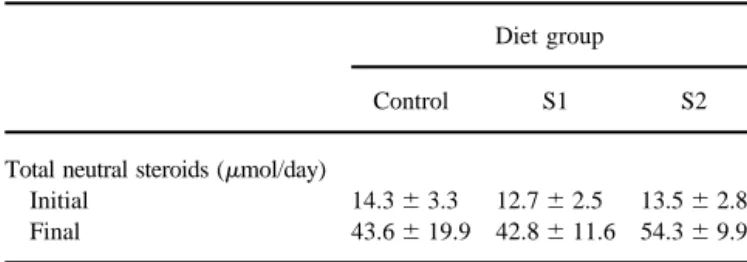
At the beginning of the experiment, there were no obvious differ-ences across groups. However, fecal excretion of neutral steroids increased after animals had ingested the cholesterol-rich diet. The excretion of neutral steroids in the S1 and S2 groups tended to be higher than in the control group, although it did not differ signif-icantly across groups at the end of the experiment (Table IV).
DISCUSSION
In this study, soymilk powder was added to the experimental diet, and lipid metabolism was studied in rats fed a cholesterol-rich diet. According to the results of this study, soymilk inhibited the in-crease of plasma total cholesterol and triacylglycerols, even with a high-cholesterol diet. The data of the control group were similar to those of previous studies.1Plasma concentrations of total
choles-terol and low-density lipoprotein cholescholes-terol in the control group increased significantly, whereas those in the S1 and S2 groups decreased. Clinical and animal experiments have shown that soy-bean protein has a cholesterol-lowering effect.24,25In 1999, the
FIG. 1. Effects of different amounts of soymilk on plasma concentrations (mM/L) of total cholesterol (a), triacylglycerol (b), HDL cholesterol (c), and LDL cholesterol (d) in Sprague-Dawley rats. Vertical bars represent the mean⫾ standard deviation (n ⫽ 10/group). *Significantly different from the control group at the same time (P⬍ 0.05). HDL, high-density lipoprotein; LDL, low-density lipoprotein; open circles, S1 group; solid circles, control group; triangles, S2 group.
TABLE III.
EFFECTS OF DIFFERENT AMOUNTS OF SOYMILK POWDER ON LIVER TOTAL CHOLESTEROL AND TRIGLYCERIDE
CONCENTRATIONS IN SD RATS* Diet group Control S1 S2 Total cholesterol mol/g liver 23.9⫾ 5.1 18.8⫾ 6.0 21.7⫾ 4.3 mol/liver 601.0⫾ 123.1a 423.3⫾ 121.5b 480.7⫾ 67.7b Triglyceride mol/g liver 20.3⫾ 2.9 19.7⫾ 2.3 21.7⫾ 3.0 mol/liver 509.3⫾ 113.1 452.7⫾ 80.7 475.8⫾ 57.7 * Data are expressed as the mean⫾ SD (n ⫽ 10); and values in a row with different superscript letters significantly differ (P⬍ 0.05) as ana-lyzed by one-way analysis of variance test.
U.S. Food and Drug Administration approved a claim that soy products decrease the risk of coronary heart disease;26the health
claim does not specify a requirement for the presence or quantity of the non-protein constituents such as saponins, phytate, trypsin inhibitors, and isoflavones that influence plasma cholesterol.
The present data confirmed the cholesterol- and triacylglycerol-lowering effects of soymilk in rats. The results showed that addi-tion of soymilk significantly decreased blood lipids and inhibited hepatic fat accumulation; however, there were no significant dif-ferences between the S1 and S2 groups, in which 20% and 30% casein, respectively, were replaced. The data suggested that in-creasing soybean protein in feed does not have an additional lipid-lowering effect. Recently, many scientists have become in-terested in the clinical effects of soybean on lipid metabolism. The recommended intake of soybean protein for humans is 25 g,26
which is equivalent to 5% of the daily total food intake of 500 g of dry weight. The converted daily soybean protein intake for rats is 1 g based on 5% of daily feed intake (mean, 20 g). Therefore, we used the ratio of 15% soymilk powder in this study. In addition, to consider the application to daily life, we replaced casein with 20% to 30% soybean protein to observe its hypolipidemic effect. It may be difficult to include such a tremendous soybean protein intake in daily life, but a suitable soybean protein intake may prevent cardiovascular diseases. This study investigated whether lipid me-tabolism would be affected when animal protein in the diet was replaced with plant protein. We also considered its application to daily life.
Studies citing the protective effects of soybeans for cardiovas-cular diseases have been in the literature since the 1940s. It is still unclear what component of soybean has a beneficial effect on plasma lipids, but studies have suggested that the lipid-lowering effect is related to soy isoflavone.25,27 However, Nestel et al.28
reported the administration of genistein (45 mg/d) had no signif-icant effect on blood lipid concentrations over a 5- to 10-wk period. Further, Sirtori et al.29found a marked decrease in plasma
cholesterol in hypercholesterolemic patients who consumed isoflavone-poor soybean protein. Based on extrapolation of the data in the U.S. Department of Agriculture Iowa State University Isoflavone Database, the isoflavone concentrations in the experi-mental diets in this study were rather low (84g/g diet for the S1 group and 126g/g diet for the S2 group). Therefore, the effect of isoflavones in our study was ignored.
The minor components of soybean, such as oligosaccharides (stachyose and raffinose), phytosterols, saponin, and phytate, may also affect lipid metabolism. Dietary fibers have been reported to decrease plasma cholesterol by binding bile acids and decreasing their recycling through the enterohepatic circulation. In addition, certain fibers may delay the digestion and absorption of fat. To observe the changes in blood lipids and fecal excretion of steroids, Kikuchi-Hayakawa et al.2found that adding 30% soymilk powder
in the feed has hypolipidemic effects in hamsters. Further, there was an inverse relation between plasma levels of very low-density
lipoprotein plus low-density lipoprotein cholesterol and bile acid excretion in the feces. In general, fermentation may increase the release of aglycons from isoflavonoid glucosides, but Kikuchi-Hayakawa et al.2showed that the antiatherogenic effect of soymilk
is not diminished by prefermentation.
Soymilk may enhance the excretion of neutral steroids, result-ing in a long-term effect of decreasresult-ing blood lipids from fecal neutral steroids. We speculate that the major mechanisms by which soymilk decreases plasma cholesterol are to inhibit cholesterol absorption and to stimulate cholesterol excretion. The data sug-gested that the hypolipidemic effect of soymilk occurs through the inhibition of cholesterol absorption. However, we found no in-crease in neutral steroids in the feces. The excretion of neutral steroids in the feces collected for 2 d did not significantly differ, suggesting that the effect of dietary factors on the excretion of neutral steroids was long term instead of short term.
The triacylglycerol-lowering effects of soybean protein or its hydrolysate on the liver are ubiquitous not only in animal but also in human studies. Iritani et al.30indicated that plasma
triacylglyc-erols differed as a consequence of dietary patterns. They also pointed out that a deficiency or imbalance of specific amino acids in the diet could decrease plasma levels of triacylglycerol due to the decrease of very low-density lipoprotein synthesis in the liver. Several studies have indicated that the amino acid composition of proteins is involved in their effects on plasma cholesterol. How-ever, the relation between specific amino acids and plasma lipid profile has not been conclusive.8,31,32A previous study reported
that intact plant proteins are more hypolipidemic than their corre-sponding amino acid mixtures,33 a report that has been
confirmed.34
In this study, plasma concentrations of total cholesterol and triacylglycerol were markedly lower in the S1 and S2 groups. We suspect that the hypolipidemic effect was due to high concentra-tions of soymilk powder in the experimental diet. Chen et al.1
suggested that the pepsin-undigested fraction of soybean protein has an effect on fecal excretion of steroids or bile acids, which, as a consequence, may influence cholesterol metabolism. The undi-gested fragments in soybean protein can inhibit cholesterol diffu-sion in the gastrointestinal tract. Huff et al.35indicated that
hyper-cholesterolemia could be decreased by replacing 25% casein of total protein with soybean protein. The hypolipidemic components of soybean protein have not been identified. The hydrophobic domain of the high-molecular-weight protein particle could com-bine with cholesterol and bile acids to further decrease the absorp-tion of cholesterol and bile acids. Sugano et al.36reported that only
the soybean protein hydrolysate, which has a molecular weight greater than 5000 Da, has a hypolipidemic effect. In addition, Iwami et al.37 indicated that the hydrophobic character of the
protein was related to its hypocholesterolemic property. The re-sults showed that approximately 15% to 22.5% soymilk decreased plasma concentrations of total cholesterol and triacylglycerol com-pared with the control group. It may be that soymilk disturbs the absorption of lipids, resulting in the decreased synthesis of liver lipoproteins such as very low-density lipoprotein. The metabolism of very low-density lipoprotein was also decreased; hence, plasma triacylglycerol concentration also decreased38. In the present
study, we believe that there was more lipid accumulation in the liver of the control group, and the addition of soymilk powder might have inhibited fat deposits, thus decreasing the formation of fatty liver. Moreover, the extra lipids can be used to form lipopro-teins or stored in the liver. Therefore, the liver plays a crucial role in the mediation of plasma lipid profiles.
The detailed mechanisms for the hypocholesterolemic effect of soymilk require further study. It is hypothesized that non-absorbed nitrogen-containing substances are correlated with the lipid-lowering effect. Short-term intake of soymilk might not signifi-cantly affect plasma lipid profiles, but the hypolipidemic effect was observed after a 4-wk intake of soymilk.
TABLE IV.
LEVELS OF TOTAL NEUTRAL STEROIDS IN FECES OF RATS FED DIFFERENT DIETS*
Diet group
Control S1 S2
Total neutral steroids (mol/day)
Initial 14.3⫾ 3.3 12.7⫾ 2.5 13.5⫾ 2.8 Final 43.6⫾ 19.9 42.8 ⫾ 11.6 54.3 ⫾ 9.9 * Data are expressed as the mean⫾ SD (n ⫽ 10).
REFERENCES
1. Chen JR, Chiou SF, Shieh MJ, Yang SC. The effects of soybean protein-derived hydrolysate on lipid metabolism in rats fed a high cholesterol diet. J Food Biochem 2002;26:431
2. Kikuchi-Hayakawa H, Onodera N, Matsubara S, Yasuda E, Shimakawa Y, Ishikawa F. Effects of soya milk and Bifidobacterium-fermented soya milk on plasma and liver lipids, and faecal steroids in hamsters fed on a cholesterol-free or cholesterol-enriched diet. Br J Nutr 1998;79:97
3. Balmir F, Staack R, Jeffrey E, Jimenez MDB, Wang L, Potter SM. An extract of soy flour influences serum cholesterol and thyroid hormones in rats and hamsters. J Nutr 1996;126:3046
4. Anderson JW, Johnstone BM, Cook-Newell ME. Meta-analysis of the effects of soy protein intake on serum lipids. N Engl J Med 1995;333:276
5. Carroll KK, Kurowska EM. Soy consumption and cholesterol reduction: review of animal and human studies. J Nutr 1995;125:594
6. Ho SC, Woo JL, Leung SS, Sham AL, Lam TH, Janus ED. Intake of soy products is associated with better plasma lipid profiles in the Hong Kong Chinese popu-lation. J Nutr 2000;130:2590
7. Sirtori CR. Risks and benefits of soy phytoestrogens in cardiovascular diseases, cancer, climacteric symptoms and osteoporosis. Drug Saf 2001;24:665 8. Kritchevsky D. Dietary protein, cholesterol and atherosclerosis: a review of the
early history. J Nutr 1995;125:589
9. Sirtori CR, Lovati MR, Manzoni C, Monetti M, Pazzucconi F, Gatti E. Soy and cholesterol reduction: clinical experience. J Nutr 1995;125:598
10. Chiechi LM, Secreto G, D’Amore M, Fanelli M, Venturelli E, Cantatore F, et al. Efficacy of a soy rich diet in preventing postmenopausal osteoporosis: the Menfis randomized trial. Maturitas 2002;42:295
11. Fleming RM. The effect of high-, moderate-, and low-fat diets on weight loss and cardiovascular disease risk factors. Prev Cardiol 2002;5:110
12. Potter SM. Overview of proposed mechanisms for the hypocholesterolemic effect of soy. J Nutr 1995;125:606
13. Horigome T, Cho YS. Dietary casein and soybean protein affect the concentra-tions of serum cholesterol, triglyceride and free amino acids in rats. J Nutr 1992;122:2273
14. Carroll KK. Review of clinical studies on cholesterol-lowering response to soy protein. J Am Diet Assoc 1991;91:820
15. Hodgson JM, Croft KD, Puddey IB, Mori TA, Beilin LJ. Soybean isoflavanoids and their metabolic products inhibit in vitro lipoprotein oxidation in serum. J Nutr Biochem 1996;7:664
16. Roberts WC. Preventing and arresting coronary atherosclerosis. Am Heart J 1995;130:580
17. Reeves PG, Nielsen FH, Fahey GC. AIN-93 purified diets for laboratory rodents: final report of the American Institute of Nutrition ad hoc writing committee on the reformulation of the AIN-76A rodent diet. J Nutr 1993;123:1939
18. Allain CC, Poon LS, Chan CSG, Richmond W, Fu PC. Enzymatic determination of total serum cholesterol. Clin Chem 1974;20:470
19. Mcgowan MW, Artiss JD, Strandbergh DR, Zak BA. A peroxidase-coupled method for the colorimetric determination of serum triglycerides. Clin Chem 1983;29:538
20. Lindgren FT, Silvers A, Jutaglr R, Layshot L, Bradley DD. A comparison of simplified methods for lipoprotein quantification using the analytic ultracentri-fuge as a standard. Lipids 1977;12:278
21. Folch J, Lees JM, Solane-Stanley GH. A simple method for the isolation and purification of total lipids from animal tissues. J Biol Chem 1957;226:497 22. Soloni FG. Simplified manual micromethod for determination of serum
triglyc-erides. Clin Chem 1971;17:529
23. Carlson SE, Goldfarb S. A sensitive enzymatic method for the determination of free and esterified tissue cholesterol. Clin Chim Acta 1977;79:575
24. Tovar-Palacio C, Potter SM, Hafermann JC, Shay NF. Intake of soy protein and soy protein extracts influences lipid metabolism and hepatic gene expression in gerbils. J Nutr 1998;128:839
25. Anderson JW, Johnstone BM, Cook-Newell ME. Meta-analysis of effects of soy protein intake on serum lipids in humans. N Engl J Med 1995;333:276 26. Food and Drug Administration. Food labeling: health claims; soy protein and
coronary heart disease; final rule. Fed Reg 1999;64:57699
27. Ren MQ, Kuhn G, Wegner J, Chen J. Isoflavones, substances with multi-biological and clinical properties. Eur. J Nutr 2001;40:135
28. Nestel PJ, Yamashita T, Sasahara T, Pomeroy S, Dart A, Lomesaroff P, et al. Soy isoflavones improve systemic arterial compliance but not plasma lipids in meno-pausal and premenomeno-pausal women. Arterioscler Thromb Vasc Biol 1997;17:3392 29. Sirtori CR, Lovati MR, Manzoni C, Gianazza E, Bondioli A, Staels B, Auwerx J. Reduction of serum cholesterol by soy protein. Metab Cardiovasc Dis 1998; 8:334
30. Iritani N, Suga A, Fukuda H, Katsurada A, Tanaka T. Effects of dietary casein and soybean protein on triglyceride turnover in rat liver. J Nutr Sci Vitaminol 1988;34:309
31. Kern M, Ellison D, Marroquin Y, Ambrose M, Mosier K (2002) Effects of soy protein supplemented with methionine on blood lipids and adiposity of rats. Nutrition 18:654
32. West CE, Beynen AC, Terpstra AHM, Scholz KE, Carroll KK, Woodward CJH. The nature of dietary protein and serum cholesterol. Atherosclerosis 1983;46:253 33. Huff MW, Carroll KK. Effects of dietary proteins and amino acid mixtures on
plasma cholesterol levels in rabbits. J Nutr 1980;110:1676
34. Tasker TE, Potter SM. Effects of dietary protein source on plasma lipids, HMG CoA reductase activity, and hepatic glutathione levels in gerbils. J Nutr Biochem 1993;4:458
35. Huff MW, Hamilton RMG, Carroll KK. Plasma cholesterol levels in rabbits fed low fat, cholesterol-free semipurified diets: effects of dietary proteins, protein hydrolysates and amino acid mixture. Atherosclerosis 1977;28:187
36. Sugano M, Goto S, Yamada Y, Yoshida K, Hashimoto Y, Matsuo T, Kimoto M. Cholesterol-lowering activity of various undigested fractions of soybean protein in rats. J Nutr 1990;120:977
37. Iwami K, Kitagawa M, Ibuki F. Effect of dietary proteins and/or their digestive products on intestinal taurocholate absorption. J Nutr Sci Vitaminol 1990;36:141 38. Huang S, Koba K, Horrobin DF, Sugano M. Interrelationship between dietary protein, cholesterol and n-6 polyunsaturated fatty acid metabolism. Prog Lipid Res 1993;32:123