0040-6090/04/$ - see front matter䊚 2003 Elsevier B.V. All rights reserved. doi:10.1016/S0040-6090(03)01081-2
Abstract
Titania-containing polyimide (PI) hybrid films with homogeneous and flexible properties have been fabricated via sol–gel
process. Various contents of titania are added to three different PI systems by using acetylacetone to reduce the reaction rate and to prohibit gelation. The thermal, electrical and mechanical properties of the hybrid films will be measured and compared to pure PI. Results indicate that the metal-containing PI possesses lower thermal expansion and resistivity than pure PI. Incorporation of small amount of titania enhances mechanical properties of the hybrid films at both low and elevated temperature. The relationship between the effect of titania concentration, structure and properties will also be discussed.
䊚 2003 Elsevier B.V. All rights reserved.
Keywords: Polymers; Titanium oxide; Metal
1. Introduction
Metal-containing polymers(MCPs) have been widely
studied in recent years due to the unique combination of advantageous properties from each component w1–4x. Polyimide(PI) is a promising candidate for the matrix,
because of its outstanding electrical, mechanical prop-erties and high thermal stability w5–7x. Metal-containing PI was first reported by Angelo, who added organome-tallic complexes to several types of PI w8x. Taylor and co-workers have studied PI films containing in-situ generated metalymetal oxide particles w9–11x. The main
goal of these production techniques is the formation of small aggregate and the control of their size to tailor their properties. Specific modified PI would improve their properties, such as enhanced electrical, magnetic, thermal and adhesive properties w12,13x. Because of its high refractive index, titania has been attracted much attention to be used as interference filters, antireflective coatings, protective layers and optical waveguides w14– 17x.
In this study, a polyamic acid (PAA) was used as a
matrix, because it transforms into PI at a curing temper-ature that is compatible with the titania formation temperature. Three PI systems were chosen for
modifi-*Corresponding author. Tel.: 886-9530-79970; fax: 886-9430-19564.
E-mail address: [email protected](P.-C. Chiang).
cation by the titania precursor. PIymetal hybrid films
used in this study are listed in Table 1. The primary aim of the work reported here will attempt to describe the structureyproperties relationships of metal-containing
PI. The effect of titania concentration upon film prop-erties will be demonstrated. Elevated temperature, mechanical properties and electrical data of hybrid films will also be discussed.
2. Experiment
2.1. Materials
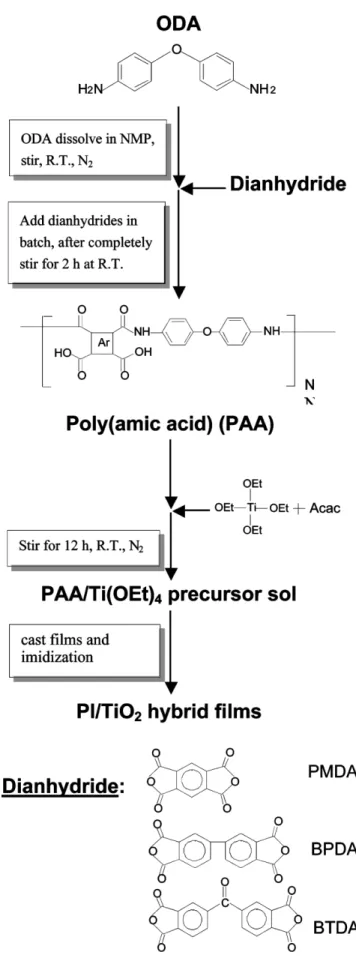
4,49-diaminodiphenylether(ODA, 98%) was obtained from Aldrich Chemical Co. and vacuum dried overnight at 70 8C prior to use. The monomers and modifiers used are shown in Fig. 1. 3,39,4,49-benzophenonetetracarbox-ylic acid dianhydride(BTDA) which was obtained from TCI, recrystallized from acetic anhydride and vacuum dried at 120 8C for 24 h. Pyromellitic dianhydride
(PMDA) and 3,39,4,49-biphenyl tetracarboxylic
dianhy-dride (BPDA) were obtained from TCI and Lancaster,
respectively, and used as received. Dimethyl sulfoxide
(DMSO) and 1-methyl-2-pyrrolidinone (NMP) were
obtained from Aldrich Chemical Co. and stored over molecular sieves prior to use. The titania additive was tetraethyl orthotitanate (Ti(OEt) ), obtained from TCI.4
P.-C. Chiang et al. / Thin Solid Films 447 – 448 (2004) 359–364 Table 1
Physical, thermal and mechanical properties of PI-TiO hybrid films2
TiO content2 Color Flexibility CTE(ppmyK)c Tg(8C) from tande Td(8C)f Stress(MPa)g Elongation(%)h Modulus(GPa)i
PMa BPa BTa PM B P B T PM B P B T PM B P B T PM B P B T PM B P B T PM B P B T PM B P B T 0 wt.% Yellow Cb C C 32.5 43.4 45.6 368.1 276.1 305.4 569 590 570 129.1 207.9 134.4 29.4 39.2 25.2 2.1 2.9 2.8 (52.0)c (80.5) (71.1) (70.4) (82.4) (77.5) (37.8) (55.4) (47.3) (1.5) (1.5) (1.8) 1 wt.% Pale brown C C C 27.9 37.8 42.6 388.3 279.3 307.5 564 589 573 132.3 221.0 151.3 18.5 34.1 23.7 2.5 3.1 3.2 (42.5) (68.3) (65.4) (397.5) (390.1) (73.1) (110.7) (79.1) (12.2) (51.6) (31.5) (1.7) (1.7) (1.8) 3 wt.% Brown C C C 20.2 28.6 38.3 429.4 313.4 312.1 547 585 574 103.4 150.7 150.5 3.2 16.4 18.4 2.7 3.2 3.3 (40.5) (57.4) (62.1) (411.0) (414.1) (59.0) (77.1) (86.3) (1.7) (14.7) (27.9) (1.7) (1.9) (2.1) 5 wt.% Deep brown Bb C C 17.3 24.7 33.7 d 332.41 327.6 523 566 560 39.5 112.0 118.4 1.4 2.5 4.5 2.8 3.5 3.5 (34.1) (48.7) (54.1) (412.8) (415.5) (21.6) (69.6) (48.6) (0.7) (7.8) (3.2) (2.3) (2.3) (2.7) 7 wt.% Deep brown BBC d 21.0 29.3 d 350.92 342.3 508 542 551 d 23.1 69.4 d 1.1 1.9 d 3.6 3.9 (45.6) (46.3) (414.2) (416.9) (38.2) (45.3) (1.6) (2.3) (2.4) (3.1) 9 wt.% Deep brown BBC d d 26.1 d d 363.4 490 513 530 d d 51.2 d d 1.5 d d 4.2 (44.5) (419.3) (42.1) (2.1) (3.3)
PM: PMDAyODA; BP: BPDAyODA; BT: BTDAyODA. a
C is abbreviated from creasible refers to films that can be folded and creased twice in a perpendicular fashion without fracturing; Bis abbreviated from bendable refers to films that can be folded but not creased
b
without fracturing.
The first entry was determined over a 50–200 8C range; the entry in parentheses was determined over a 200–300 8C range.
c
The film was too brittle and fragile to obtain satisfactory for measurement.
d
The maxima in tand curve obtained from DMA measurement is used as the definition of glass transition temperature.
e
Temperature at which 5% weight loss recorded by thermogravimetry at a heating rate of 20 8Cymin in nitrogen. f
The first entry was corresponding to load at break at 30 8C; the entry in parentheses was measured at 200 8C.
g
The first entry was corresponding to elongation at a break point at 30 8C; the entry in parentheses was measured at 200 8C.
h
The first entry was corresponding to initial modulus at 30 8C; the entry in parentheses was measured at 200 8C.
Fig. 1. Flow chart of the procedures to prepare the PIyTiO hybrid2 films.
for BPDA in NMP and 22% solids for BTDA in NMP)
under a nitrogen atmosphere. Dianhydride was added into the solution by five portions and after the dissolu-tion of all dianhydride, the PAA mixture was further stirred for 2 h. After this period, modified PAA solutions were made by adding the mixture of Ti(OEt) and acac4
(molar ratio of Ti(OEt) to acac was fixed to 1:4) and4
stirring for at least 12 h. The metal concentration were approximately 1, 3, 5, 7, 9 wt.%, assuming complete imidization, complete conversion of the Ti(OEt) to the4 titania, and no residual solvent.
The freestanding films were made by casting the modified and unmodified PAA solutions onto a dust free glass plate with a doctor blade. The film was then cured under a dynamic air atmosphere at 100, 150 and 200
8C for 1 h each and 300 8C for 12 h. Upon cooling, the
films were removed from the glass plate using a razor blade to lift off the film. The hybrid films have an average final thickness of 35–40 mm.
2.3. Measurements
The coefficients of thermal expansion (CTE) meas-urement of the films were carried out by using a DuPont TMA 2940 at a heating rate of 10 8Cymin.
Thermogra-vimetric analyses (TGA) were obtained with a DuPont TGA 2050 and at a heating rate of 20 8Cymin under a
nitrogen atmosphere. The dynamic mechanical analysis was carried out from 50 8C to 450 8C with a DuPont DMA 2980 at a heating rate of 2 8Cymin, at 1 Hz
frequency. The dielectric constants were measured by the Agilent 4294A at 1 MHz frequency, after coating gold on two surfaces 300 A thick and 5.5 mm diameter.˚ The dielectric constant (k) can be calculated from the
following formula ksCdyA´0, where C; d; A and e0 represent the observed capacitance; film thickness; gold area and free permittivity, respectively. Surface and volume resistivities were measured by employing an Agilent 4339Bat a voltage of 500 V.
3. Results and discussion
Table 1 presents the films that were synthesized and characterized in this study. The expectation is that the inorganic phase, formed via sol–gel process, would uniformly disperse in polyimide (PI) matrix and result
in a tailored effect of the hybrid films without compro-mising other essential PI properties. In this study,
tetra-Fig. 2.(a) the storage modulus and (b) the loss modulus of
PMDA-ODAyTiO hybrid films of at different temperatures.2
ethyl orthotitanate (Ti(OEt) ) was used as a precursor4 to titania in hybridization. To prevent gelation occurring, acetylacetone (acac) was used to reduce the reaction rate through the formation of a complex w18–20x. During thermal treatment of the hybrid films, no phase separa-tion of inorganic component is visually apparent. The color of the hybrid films becomes darker with increase of titania. In the series of PMDAyODA, the films
containing titania of 5 wt.% or more are brittle. How-ever, the hybrid films of BPDAyODA and BTDAyODA
series are still flexible with titania content up to 5 wt.% or more. The results imply that the flexibility of hybrid films have an order of BTDAyODA)BPDAyODA)
PMDAyODA.
From the data in Table 1, there is a marked lowering of the coefficient of thermal expansion(CTE) in hybrid films with small amount of titania. This dramatic decrease in CTE could be due to metals and inorganic materials having lower CTE values. The polyamic acid
(PAA) reacting with the alkoxy group of the sol–gel
precursor would form a bond between the PI and the inorganic phase. The titania domains served as cross-link points could lead to a decrease in the segmental mobility of the PI chain. That is why the CTE of the hybrid films will be changed w21,22x. The CTE of these hybrid films have been measured at both ranges of 50– 200 8C and 200–300 8C. For these two conditions, there is a similar tendency of CTE lowering with increasing the content of titania. The decrease of CTE at elevated temperature is more remarkable, that enhances the reli-ability for applications at high temperature. CTE data for additional hybrid films prepared from BPDAyODA
and BTDAyODA are also shown in Table 1. All
metal-containing PI have lower CTE relative to the pure PI. It is interesting to note that the PMDAyODA series have
much lower CTE than the other two series at elevated temperature. This could result from the glass transition temperature (T ) of BPDAyODA and BTDAyODAg series of approximately 300 8C. Thus, the increase in CTE of the latter two series could be due to the rise of chain mobility at elevated temperature.
The dynamic mechanical properties of PMDAyODA
hybrid films are presented in Fig. 2. From Fig. 2a, the storage modulus (E9) of hybrid films increases with increasing the amount of titania. Specifically, at lower temperature (50 8C), the storage modulus of hybrid films is larger than that of pure PI. At elevated temper-ature (400 8C), the hybrid films have remarkable increase of modulus compared to the pure PI. However, the loss modulus (E99) of the hybrid films decreases
with increasing the amount of titania as shown in Fig. 2b. The decrease of loss modulus could be due to the network structure of the hybrid films, which make the lower interaction force between molecular chains w21x. Therefore, lower loss modulus and lower tand are obtained.
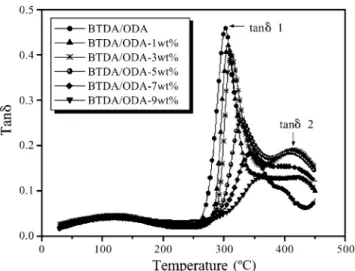
For the three series of hybrid films, the maximum
tand (E99yE9) is defined as glass transition temperature
(T ). T s of all metal-containing PI are higher than theg g
pure PI. This increase may be due to the filler effect of the titania, thereby affording a stiffer hybrid film. How-ever, the cross-linking reaction between PI chains and metal alkoxide would be expected to increase T .g According to Fig. 3 and Fig. 4, the series of BPDAy
ODA and BTDAyODA hybrid films exhibit two obvious
transition peaks in the tand curves, the first peak near 280–350 8C and the second peak in the range of 400– 420 8C. The peaks of tand1 (T 1) and tand2 (T 2) areg g related to PI matrix and inorganic domains, respectively. From Fig. 3 and Fig. 4, both T 1 and T 2 shift to highg g temperature with increasing the content of titania. The shift is resulted from higher cross-linking density leading to a higher hindrance from chain movement, so that the chain movement occurs at higher temperature w21x. However, the extent of representative shifts of T 1 andg
T 2 is different. Based on our experiment, the shift ofg
Fig. 3. The tand curves of series of BPDA-ODAyTiO hybrid films2 at different temperatures.
Fig. 4. The tand curves of series of BTDA-ODAyTiO hybrid films2 at different temperatures.
Fig. 5. The tand curves of series of PMDA-ODAyTiO hybrid films2 at different temperatures.
Fig. 6. Variation of dielectric constants of hybrid films as a function of titania content(wt.%).
predicted that the two peaks would merge into a broad one in a certain range of titania content. Moreover, there is also a reduction in the tand1 peak, when the amount of titania increases. This is presumably due to higher cross-linking density making lower damping of PI chains that depress tand1 value. The lower damping means the network structure decreases the chain friction and chain interaction during chain movement. For the series of
PMDAyODA in Fig. 5, there is only one broad tand
peak. It can be explained that the two tand signals overlap into a broad one, because PMDAyODA has
higher T compared to BPDAyODA and BTDAyODA.g The network structure of hybrid films reinforces the pure PI. From Table 1, the stress, elongation at break and initial modulus of these hybrid films are in the range 23–220 MPa, 1.1–39% and 2.1–4.2 GPa at 30
8C. At elevated temperature, the hybrid films also have
enhanced improvement relative to the pure PI. The variation in maximum stress at break initially increases with titania content at 1–3 wt.%. However, further addition of titania decreases the stress because of increasing brittleness of hybrid film. Values of the modulus, calculated from the initial slopes of the stress– strain curves show increase with increasing titania con-tent. The elongation at break is found to decrease with titania content.
The thermal stability of the hybrid films are listed in Table 1. The introduction of titania causes a decrease in thermal stability of hybrid films. However, the hybrid films still possess good thermal property for the practical application. The decrease in thermal stability of hybrid films could be attributed to the metallic compounds, which can oxidatively degrade polyimide films w23–26x.
Table 2
Surface and volume resistivity of hybrid films
TiO2 PMDAyODA BPDAyODA BTDAyODA
content wt.% Rv(V-cm) Rs(V) Rv(V-cm) Rs(V) Rv(V-cm) Rs(V) 0 5.6=1016 9.1=1015 1.6=1017 4.4=1016 3.2=1017 7.3=1016 1 2.5=1016 5.3=1015 1.4=1017 1.7=1016 2.7=1017 5.8=1016 3 8.9=1015 2.1=1014 5.8=1016 9.0=1015 6.8=1016 8.3=1015 5 1.7=1015 1.6=1014 1.7=1016 8.7=1015 2.5=1016 7.3=1015 7 a a 1.4=1016 4.7=1015 2.2=1016 5.1=1015 9 a a a a 1.8=1016 4.3=1015
The film was too brittle to be measured. a
The dielectric constants of each hybrid films are plotted with titania content as shown in Fig. 6. For each series, the dielectric constant increases with increasing the titania content. The hybrid films possess dielectric constants in the range of 3.2–3.9. Surface and volume resistivities of hybrid films list in Table 2. The series of
PMDAyODA exhibit lower resistivities relative to other
two series. Furthermore, work needs to be carried out of how the dopants affect electrical properties for appli-cations as conductive space films, industrial films and coatings.
4. Conclusion
Polyimide containing titania have been prepared by sol–gel method. Most films are homogeneous and each exhibits good thermal stability. There is an obvious decrease of thermal expansion of the hybrid films at both low and elevated temperatures. Dynamic mechan-ical thermal analysis shows a systematic increase in the glass transition temperature with an increase of titania content. This indicates that the mobility of the polyimide chain was diminished by the inorganic phase and the network structure. At high concentration of titania,T 1g and T 2 will shift to high temperature and graduallyg merge into a broad one. However, there is only one tand peak in PMDAyODA series. Because of its higher Tg than two other series, the peak related to the T 1 hasg been overlapped on T 2. Incorporating titania wouldg cause the surface and volume resistivities to decrease, but the dielectric constant displays the reverse trend.
Acknowledgments
The authors would like to acknowledge the financial support of the National Science Council through project
NSC 91-2216-E-009-013, and Taimide Technology Company.
References
w1x F. Hide, K. Nito, A. Yasuda, Thin Solid Film 240(1994) 157. w2x J. Wen, G.L. Wilkes, Chem. Mater. 8(1996) 1667.
w3x Z. Ahmad, M.I. Sarwar, S. Wang, J.E. Mark, Polymer 38 (1997) 4523.
w4x C.J. Cornelius, E. Marand, Polymer 43(2002) 2385. w5x C.E. Sroog, J. Polym. Sci. Macromol. Rev. 11(1976) 161. w6x K.L. Mittal(Ed.), Polyimide: Synthesis, Characyerization and
Application, Plenum Press, New York, 1984.
w7x M.K. Ghosh, K.L. Mittal(Eds.), Polyimide, Fundamentals and
Applications, Marcel Dekker, New York, 1996.
w8x R.J. Angelo, US Patent 3(1959) 785.
w9x A. Clair, L.T. Taylor, J. Appl. Polym. Sci. 28(1983) (1983)
2393, NASA-Langley Research Center.
w10x M.M. Ellison, L.T. Taylor, Chem. Mater. 6(1994) 990. w11x J.D. Rancourt, G.M. Porta, T.L. Taylor, Thin Solid Films 158
(1988) 189.
w12x J.J. Bergmeister, L.T. Taylor, Chem. Mater. 4(1992) 729. w13x S.A. Ezzell, T.A. Furtsch, E. Khor, L.T. Taylor, J. Polym. Sci,
Polym. Chem. Ed. 21(1983) 865.
w14x M. Yoshida, N.P. Paras, Chem. Mater. 8(1996) 235. w15x B. Wang, G.L. Wilkes, J.C. Hedrick, S.C. Liptak SC, J.E.
McGrath, Macro. 24(1991) 3449.
w16x P. Papadimitrakopoulos, P. Wisniecki, D. Bhagwagar, Chem.
Mater. 9(1997) 2928.
w17x L.H. Lee, W.C. Chen, Chem. Mater. 13(2001) 1137. w18x M. Yoshida, M. Lal, N.D. Kumar, P.N. Prasad, J. Mat. Sci. 32
(1997) 4047.
w19x M. Yoshida, N.P. Paras, Chem. Mater. 8(1996) 235. w20x W. Que, Y. Zhou, Y.L. Lam, Y.C. Chan, C.H. Kam, Thin Solid
Films 358(2000) 16.
w21x M.H. Tsai, W.T. Whang, J. Appl. Polym. Sci. 81(2001) 2500. w22x D.S. Thompson, D.W. Thompson, R.E. Southward, Chem.
Mater. 14(2002) 30.
w23x T. Sawada, S. Ando, Chem. Mater. 10(1998) 3368.
w24x R.K. Boggess, L.T. Taylor, J. Polym. Sci, Polym. Chem. Ed.
25(1987) 685.
w25x J.D. Rancourt, L.T. Taylor, Macromolecules 20(1987) 790. w26x M.H. Tsai, W.T. Whang, Polymer 42(2001) 4197.