Properties of photoluminescence in type-II Zn Te Zn Se quantum dots
T. Y. Lin, D. Y. Lyu, J. Chang, J. L. Shen, and W. C. Chou
Citation: Applied Physics Letters 88, 121917 (2006); doi: 10.1063/1.2189029
View online: http://dx.doi.org/10.1063/1.2189029
View Table of Contents: http://scitation.aip.org/content/aip/journal/apl/88/12?ver=pdfcov Published by the AIP Publishing
Articles you may be interested in
Photoluminescence of bioconjugated core-shell Cd Se Zn S quantum dots J. Vac. Sci. Technol. B 27, 836 (2009); 10.1116/1.3032904
Photoluminescence studies of type-II diluted magnetic semiconductor Zn Mn Te Zn Se quantum dots Appl. Phys. Lett. 89, 263111 (2006); 10.1063/1.2424654
Coexistence of type-I and type-II band lineups in Cd ( Te , Se ) Zn Se quantum-dot structures Appl. Phys. Lett. 89, 123110 (2006); 10.1063/1.2355439
Thermally activated carrier transfer among Cd Te Zn Te self-organized quantum dots Appl. Phys. Lett. 89, 112125 (2006); 10.1063/1.2354028
Formation and activation energy of Cd x Zn 1 x Te nanostructures with different dimensions grown on ZnTe buffer layers
Appl. Phys. Lett. 88, 043111 (2006); 10.1063/1.2168244
This article is copyrighted as indicated in the article. Reuse of AIP content is subject to the terms at: http://scitation.aip.org/termsconditions. Downloaded to IP: 140.113.38.11 On: Thu, 01 May 2014 02:05:21
Properties of photoluminescence in type-II ZnTe/ ZnSe quantum dots
T. Y. Lin,a兲 D. Y. Lyu, and J. Chang
Institute of Optoelectronic Sciences, National Taiwan Ocean University, Keelung, 202 Taiwan, Republic of China
J. L. Shen
Department of Physics, Chung Yuan Christian University, Chung-Li 32023, Taiwan, Republic of China W. C. Chou
Department of Electro-physics, National Chiao Tung University, Hsinchu 30010, Taiwan, Republic of China 共Received 14 October 2005; accepted 6 February 2006; published online 24 March 2006兲 Temperature and time evolution of the photoluminescence 共PL兲 intensity of bimodal ZnTe/ZnSe type-II quantum dots 共QDs兲 were investigated. A particular temperature dependence of PL was observed in large QDs. PL decay of small QDs is composed of a faster initial component and a slower tail component whereas PL decay of large QDs simply comprises a fast component. All phenomena could be understood consistently by considering charge carrier transfer mechanism, band-bending effect, and the existence of nonradiative centers in the bimodal type-II QD array. We show that excitons play an important role in the emission properties of a self-assembled type-II QD system. © 2006 American Institute of Physics.关DOI:10.1063/1.2189029兴
Quantum dots 共QDs兲 have attracted much attention be-cause of their potential applications in optical and optoelec-tronic devices.1–3However, it has been reported that the pho-toluminescence共PL兲 of a QD ensemble quenches when the temperature is increased above a given temperature.4,5This leads to a reduction of the spontaneous emission yield at room temperature for QD-based emitters. By far, research on self-organized QDs was mostly done in a type-I system grown under the Stranski-Krastanov mode.4–7Few reports of type-II II-VI QDs grown under the Volmer-Weber 共VW兲 mode could be found.8,9 Recently, type-II ZnTe QDs in a ZnSe matrix have been grown under the VW mode by mo-lecular beam epitaxy 共MBE兲.9 In this letter, we present a study of the PL quenching of the bimodal type-II ZnTe QD array grown by MBE. Temperature-dependent PL intensity exhibits a particular thermally activated redistribution of charge carriers within the bimodal type-II QD array. It was found that QDs with different size distributions exhibit dif-ferent PL decay processes. All phenomena could be ex-plained by considering the charge-carrier transfer mecha-nism, band-bending effect, and the imperfections in the type-II QD crystal.
Self-assembled ZnTe QDs were grown on a ZnSe buffer layer by a Veeco-Applied-EPI 620 MBE system at 300 ° C. The average coverage of ZnTe for the sample studied here is 2.6 monolayers 共MLs兲.9 The 325 nm line of a He-Cd laser was used to generate the PL spectra. Photoluminescence ex-citation 共PLE兲 spectra were taken with a monochromatic light from a xenon lamp. The time-resolved PL spectra were measured using a GaN diode laser共408 nm兲 with the pulse duration of 50 ps as the excitation source. The collected lu-minescence was dispersed by a grating spectrometer and de-tected with a high-speed photomultiplier tube, followed by a personal computer 共PC兲 plug-in time-correlated counting card. The PL signal is dispersed using a monochromator and a photomultiplier tube is used to collect the emitted light.
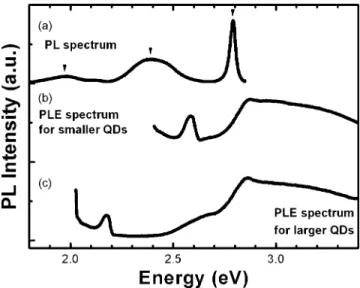
Figure 1共a兲 shows three emission peaks at 2.80, 2.38, and 1.98 eV in the 10 K PL spectrum from the sample. PL emission at 2.80 eV is attributed to the near-band-edge emis-sion from the ZnSe buffer layer. To understand PL results further, PLE measurements were performed. The PLE spec-tra with detection energies set at 2.38 and 1.98 eV are shown in Figs. 1共b兲 and 1共c兲, respectively. In both spectra, beside the steep increase of PLE intensity at around 2.8 eV due to the onset of the ZnSe fundamental absorption, additional peak structures were also detected. There is no absorption corresponding to the ZnTe epilayer共2.4 eV at 10 K兲 in the PLE results. Thus, this implies the absence of wetting layers in the sample. The corresponding peak at 2.59 eV in Fig. 1共b兲 shows a large Stokes shift of 210 meV with respect to PL peak energy at 2.38 eV. Similarly, the Stokes shift be-tween the PLE peak at 2.18 eV and the PL peak at 1.98 eV is as large as 200 meV. By carefully comparing the PL spec-trum with the PLE spectra, the broad structure near 2.38 eV
a兲Author to whom correspondence should be addressed; electronic mail:
FIG. 1. Normalized PL spectrum 共a兲 and PLE spectra 共b兲, 共c兲 of the ZnTe/ ZnSe QD sample at T = 10 K. The detection energies for共b兲 and 共c兲 are 2.38 and 1.98 eV, respectively.
APPLIED PHYSICS LETTERS 88, 121917共2006兲
0003-6951/2006/88共12兲/121917/3/$23.00 88, 121917-1 © 2006 American Institute of Physics
This article is copyrighted as indicated in the article. Reuse of AIP content is subject to the terms at: http://scitation.aip.org/termsconditions. Downloaded to IP: 140.113.38.11 On: Thu, 01 May 2014 02:05:21
is a signature of PL from small ZnTe QDs, while the addi-tional peak near 1.97 eV on the lower energy side of the PL spectrum is believed to be from the large ZnTe QDs. In Fig. 1, it should be emphasized that the PLE peak energy de-creases across the energy gap of ZnTe of 2.4 eV with the increasing dot size, which is unusual for type-I heterostruc-tures. This behavior is explained by the type-II band align-ment in which the transition between the ground level of the bulk ZnSe共conduction band兲 and the top of the valence band of the ZnTe QD is taken into account.10This result is a direct confirmation of the type-II band alignment of the present ZnTe/ ZnSe heterostructure grown under the VW mode based on the PLE and PL measurements.11
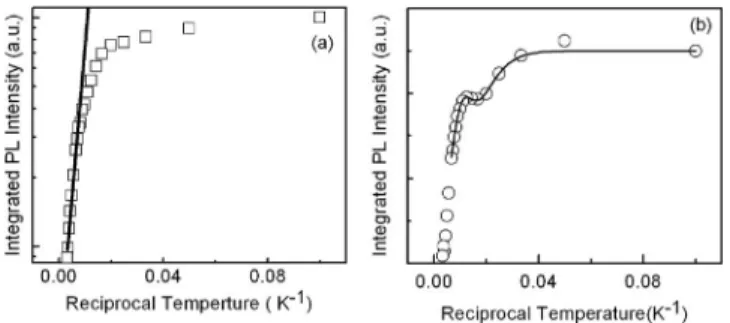
Figures 2共a兲 and 2共b兲 show the temperature dependence of the integrated PL intensity of small QDs and large QDs, respectively. The PL from the small ZnTe QDs becomes dominant 共not shown兲 at room temperature, while the PL from the large ZnTe QDs becomes invisible or convolutes with that from the small ZnTe QDs. Figure 2共a兲 shows a typical behavior for thermally activated nonradiative recom-binations of the small QDs. The activation energy for ther-mally activated nonradiative recombinations can be obtained by the relation, IPL= I0exp共Ea/ kT兲. Here T is the
tempera-ture, k is the Boltzmann constant, I0are constants, and Eais
the activation energy.12 The activation energy obtained by this method is usually considered as the total binding energy,13which includes the confinement energy and the ex-citon binding energy. The total binding energy, which is given roughly by the difference between the energy gap of the ZnSe 共2.8 eV兲 and the PL energy from the QDs 共2.38 eV兲 is around 0.42 eV. However, in our experiment, we found that the activation energy was 33 meV. This en-ergy is an order of magnitude smaller than the above esti-mated total binding energy. Similar results have been found in the ZnTe/ ZnS QDs,14 where the exciton binding energy was attributed to determine the quenching of the PL in the ZnTe/ ZnS system instead of the total binding energy. For the case of ZnTe/ ZnSe here, there is little共or no兲 confinement of the electron in ZnTe due to the type-II band alignment of the system. Thus, the energy required to quench PL is the energy required to break up the exciton. Therefore, this feature re-veals that the exciton binding energy determines the quench-ing of the PL in the type-II ZnTe/ ZnSe heterostructures.
From Fig. 2共b兲, the integrated PL intensity of the large QDs with increasing temperature first decreases above 30 K, then increases between 50 and 80 K, and finally decreases again for T higher than 80 K. It is noticed that the PL quenching of small QDs and the PL increasing of large QDs start simultaneously, when the temperature exceeds 50 K.
Thus, the charge carriers, thermally excited out of the small QDs could be retrapped in the large QDs. As the temperature increases共above about 50 K兲, the charge carriers captured in the ground state of the small QDs are able to be thermally excited out of the QDs. Part of the escaped charge carriers is then recaptured in the large QDs, leading to an increase of the PL intensity of the large QDs between 50 and 80 K. The PL intensity of the large QDs decreases above 80 K because of the onset of the nonradiative recombinations. The previ-ous work by Saint-Girons and Sagnes15reported similar be-haviors of the PL intensity of two QD populations found in the bimodal InGaAs/ GaAs QD array. Accordingly, the acti-vation energy associated with these nonradiative recombina-tions could be deduced from the fit of the experimental data of Fig. 2共b兲 with the rate equation for the PL intensity I1共T兲
of the large QDs at a given temperature T:15
I1共T兲 = I1共0兲 1 关1 + C1exp共− Ea1/kT兲兴2 ⫻
冉
1 + C C2exp共− Ea2/kT兲 1 + C2exp共− Ea2/kT兲冊
, 共1兲where k is the Boltzmann constant, I1共0兲 is the PL intensity of the large QDs at T = 0 K, C is the ratio of the charge carriers in the large QDs to that in the small QDs, C1is ratio
of the nonradiative recombination rate in the large QDs to the radiative recombination rate in the small QDs, C2 is the
ratio between the thermal escape rate of charge carriers out of the small QDs to the barrier and the radiative recombina-tion rate in the small QDs, Ea1is the activation energy of the
nonradiative recombination centers in large QDs, and Ea2is
the activation energy for the carrier escaping out of the small QDs. The solid line in Fig. 2共b兲 shows the best fit to the experimental data with Eq.共1兲. The activation energy for the nonradiative recombination centers in large QDs was found to be 16 meV. It corresponds to the exciton ionization and the possible successive nonradiative recombinations with the centers located in the interfaces, the immediate vicinity be-tween QDs, and the barrier. Thus, the particular temperature dependence of the integrated PL intensity of the large QDs is understood.
The experimental PL decay profiles 共open circle兲 mea-sured at main peaks for the small and the large dots are shown in Figs. 3共a兲 and 3共b兲, respectively. From Fig. 3共a兲, the overall signals of the small QDs were seen to be better fitted by the thermalized stretching exponential line shape16
I共t兲=I1exp共−t/1兲+I2exp共−t/2兲, where I共t兲 is the PL in-tensity at time t, I1and I2are I1共0兲 and I2共0兲, respectively, is the scaling parameter that is related to the dimensionality of the localizing centers, 1 and 2 are the initial lifetimes.
FIG. 2. Experimental共open circles兲 and calculated 共solid line兲 temperature dependence of the integrated PL intensity of small QDs共a兲 and large QDs 共b兲.
FIG. 3. Experimental PL decay共open circles兲 of small QDs 共a兲 and large QDs共b兲 taken at the PL peak energy. The solid lines are calculated results.
121917-2 Lin et al. Appl. Phys. Lett. 88, 121917共2006兲
This article is copyrighted as indicated in the article. Reuse of AIP content is subject to the terms at: http://scitation.aip.org/termsconditions. Downloaded to IP: 140.113.38.11 On: Thu, 01 May 2014 02:05:21
The fitting results are shown in Fig. 3共a兲 with time constants
1 and2 of 0.9 and 21 ns, respectively. The stretching
pa-rameter= 0.6 means that the localized states have spatial extension broader than the Lorentzian form in the energy space.17These results support the staggered lineup model of the ZnTe/ ZnSe QDs inferred by the PLE measurements. Af-ter the excitation, electrons and holes are generated in the ZnSe region followed by a process of hole capturing into the ZnTe dot. A dipole layer is formed between the holes in the ZnTe dots and the electrons attracted from the surrounding ZnSe regions. This field-induced band bending will confine the electron wave function closer to the ZnTe dots. Thus, the faster time constant is attributed to the increased spatial over-lap due to the band-bending-induced electron confinement. When the majority of the carriers have recombined, the band-bending effect18 is negligible and the electron wave function is more spread out into the ZnSe regions. This will lead to a slow radiative recombination process between the holes in ZnTe dots and the electrons in ZnSe regions. The following stretched exponential decay probably shows a manifestation of the type-II excitonic recombination process. While the large QDs关Fig. 3共b兲兴 only show a fast exponential decay with a decay time constant of 0.4 ns, the absence of the slow radiative component in the PL decay of the large dots could be understood if the nonradiative centers located in the immediate vicinity of the large QDs are considered. Some studies report on the presence of this kind of defect,19 which could be associated with the QD formation.20 If only the quantum confinement effect is considered, the reduced spatial overlap is expected in the large QDs due to the re-duced penetration of the hole wave function into the adjacent layers. And this can result in that the large QDs will show a slower decay than that of the small QDs in the recombination processes. In the present case of the large QDs, the strain-induced nonradiative recombination centers are likely to make the physics different. The nonradiative recombination centers first come into play with the carrier trapping, leading to a shorter decay time for the initial radiative recombina-tion. After the faster initial radiative recombination, the pro-cess of slow radiative recombination will compete with the nonradiative recombination via the defect centers. Thus, from the results of the time-resolved PL measurements, we attribute the activation energy, 16 meV, obtained by Eq.共1兲 to the nonradiative recombination activation energy.
In conclusion, temperature dependence and time evolu-tion of the PL intensity of a bimodal ZnSe/ ZnTe QD array were studied. It was found that the large QDs show a par-ticular temperature dependence to the PL in which the PL intensity first decreases slowly, then increases and finally de-creases rapidly. This result could be understood by the mechanism that the charge carriers, thermally ionized and diffusing out of the small QDs could be retrapped in the QDs
with larger size populations. In addition, we have shown that from the study of the quenching of the PL, the breaking up of the exciton is responsible for the quenching of the PL at high temperatures. All phenomena could be understood by consid-ering the charge carrier transfer mechanism, band-bending effect and the nonradiative recombination centers in the bi-modal type-II QD array. Our results shown here are expected to be important for the understanding of the optical proper-ties in type-II semiconductor nanostructures.
This work was supported in part by the National Science Council of Taiwan, Republic of China.
1N. Kirstaedter, N. N. Ledentsov, M. Grundmann, D. Bimberg, V. M.
Ustinov, S. S. Ruvimov, M. V. Maximov, P. S. Kop’ev, Zh. I. Alferov, U. Richter, P. Werner, U. Gosele, and J. Heydenreich, Electron. Lett. 30, 1416共1994兲.
2S. Fafard, K. Hinzer, S. Raymond, M. Dion, J. McCaffrey, Y. Feng, and S.
Charbonneau, Science 274, 1350共1996兲.
3D. Pan, E. Towe, and S. Kennerly, Appl. Phys. Lett. 75, 2719共1998兲. 4J. Bloch, J. Shah, W. S. Hobson, J. Lopata, and S. N. G. Shu, Appl. Phys.
Lett. 75, 2199共1999兲.
5C. M. A. Kapteyn, M. Lion, R. Heitz, D. Bimberg, P. N. Brunkhov, B. V.
Volovik, S. G. Konnikov, A. R. Kovsh, and V. M. Ustinov, Appl. Phys. Lett. 76, 1573共2001兲.
6L. Brusaferri, S. Sanguinetti, E. Grilli, M. Guzzi, A. Bignazzi, F. Bogani,
L. Carraresi, M. Colocci, A. Bosacchi, P. Frigeri, and S. Franchi, Appl. Phys. Lett. 69, 3354共1996兲.
7Y. T. Dai, J. C. Fan, Y. F. Chen, R. M. Lin, S. C. Lee, and H. H. Lin, J.
Appl. Phys. 82, 4489共1997兲.
8M. C. Harris Liao, Y. H. Chang, Y. F. Chen, J. W. Hsu, J. M. Lin, and W.
C. Chou, Appl. Phys. Lett. 70, 2256共1997兲.
9M. C. Kuo, C. S. Yang, P. Y. Tseng, J. Lee, J. L. Shen, W. C. Chou, Y. T.
Shih, C. T. Ku, and M. C. Lee, J. Cryst. Growth 242, 533共1998兲.
10C. S. Yang, Y. J. Lai, W. C. Chou, W. K. Chen, M. C. Lee, M. C. Kuo, J.
Lee, J. L. Shen, D. J. Jang, and Y. C. Cheng, J. Appl. Phys. 97, 033514 共2005兲.
11Nacir Tit, J. Phys.: Condens. Matter 15, 6513共2003兲.
12J. D. Lambkin, D. J. Dunstan, K. P. Homewood, and L. K. Howard, Appl.
Phys. Lett. 57, 1986共1990兲.
13S. Weber, W. Limmer, K. Thonke, R. Sauer, K. Panzlaff, G. Bacher, H. P.
Meier, and P. Roentgen, Phys. Rev. B 52, 14739共1995兲.
14M. C. Harris Liao, Y. H. Change, C. C. Tsai, M. H. Chieng, and Y. F.
Chen, J. Appl. Phys. 86, 4694共1999兲.
15G. Saint-Girons and I. Sagnes, J. Appl. Phys. 91, 10115共2002兲. 16P. Waltereit, O. Brandt, A. Trampert, H. T. Grahn, J. Menniger, M.
Ram-steiner, M. Reiche, and K. H. Ploog, Nature共London兲 406, 865 共2000兲; Y. J. Sun, O. Brandt, S. Cronenberg, S. Dhar, H. T. Grahn, K. H. Ploog, P. Waltereit, and J. S. Speck, Phys. Rev. B 67, 041306共2003兲.
17S. F. Chichibu, T. Onuma, T. Aoyama, K. Nakajima, P. Ahmet, T.
Chikyow, T. Sota, S. P. DenBaars, S. Nakamura, T. Kitamura, Y. Ishida, and H. Okumura, J. Vac. Sci. Technol. B 21, 1856共2003兲.
18C. K. Sun, G. Wang, J. E. Bowers, B. Brar, H. R. Blank, H. Kroemer, and
M. H. Pikuhn, Appl. Phys. Lett. 68, 1543共1996兲.
19C. Lobo, N. Perret, D. Morris, J. Zou, D. J. H. Cockayne, M. B. Johnston,
M. Gal, and R. Leon, Phys. Rev. B 62, 2737共2000兲; A. E. Belyaev, S. T. Stoddart, P. M. Martin, P. C. Main, L. Eaves, and M. Henini, Appl. Phys. Lett. 76, 3570共2000兲.
20C. Walther, J. Bollmann, H. Kissel, H. Kiamse, W. Neumann, and W. T.
Masselink, Appl. Phys. Lett. 76, 2946共2000兲.
121917-3 Lin et al. Appl. Phys. Lett. 88, 121917共2006兲
This article is copyrighted as indicated in the article. Reuse of AIP content is subject to the terms at: http://scitation.aip.org/termsconditions. Downloaded to IP: 140.113.38.11 On: Thu, 01 May 2014 02:05:21