Long-distance strain-induced-grating-based fiber
sensors with erbium-based amplifiers
Chien-Hung Yeh
Industrial Technology Research Institute Information and Communications Research
Laboratories
Chutung, Hsinchu 310-40, Taiwan E-mail: [email protected]
Ming-Ching Lin Bing-Chung Cheng
National Chiao Tung University Department of Photonics and
Institute of Electro-Optical Engineering Hsinchu 300-10, Taiwan
Sien Chi
National Chiao Tung University Department of Photonics and
Institute of Electro-Optical Engineering Hsinchu 300-10, Taiwan
and
Yuan Ze University
Department of Electrical Engineering Chung-Li 320-03, Taiwan
Abstract. We investigate and demonstrate experimentally a two-stage erbium-based amplifier with a larger amplified-spontaneous-emission light source for a long-distance fiber sensor by using strain-induced fiber Bragg gratings in the fiber systems. In a 20-km-long fiber sensor system, the sensor has a maximal ⬇2.28-nm wavelength shift under a 1500-m/m strain. © 2007 Society of Photo-Optical Instrumentation Engineers. 关DOI: 10.1117/1.2746913兴
Subject terms: fiber sensor; EDWA; EDFA.
Paper 060650R received Sep. 6, 2006; revised manuscript received Nov. 24, 2006; accepted for publication Dec. 3, 2006; published online Jun. 25, 2007.
1 Introduction
The fiber Bragg grating共FBG兲 sensor is an important pas-sive component due to its use in multipoint sensing and high signal-to-noise ratio 共SNR兲.1 Spectrally broadband light sources of a light-emitting diode共LED兲 and erbium-doped fiber amplifier 共EDFA兲 have been used in a passive FBG sensor system. Such FBG sensor systems based on fiber laser structures have been reported to be efficient due to their high output power and high SNR.2,3When a strain or a temperature variation is imposed on the FBG, the Bragg wavelength drifts and the lasing wavelength shifts.
Another simple type of fiber laser is the fiber ring laser, and its lasing wavelength also can be determined by an FBG. By inserting a fiber Fabry-Perot tunable filter 共FFP TF兲 into the gain cavity, we can simply implement a tun-able fiber laser for application to an FBG sensor system.4,5 However, the scanning rate of the tunable filter always lim-its the dynamic range of a fiber laser sensor. The lasing power also determines the transmission distance of re-flected light.
In this paper, we report investigating and demonstrating experimentally a two-stage erbium-based amplifier with a larger amplified spontaneous emission 共ASE兲 light source for long-distance strain-induced-grating sensors using FBGs.
2 Fiber Sensor Experiment
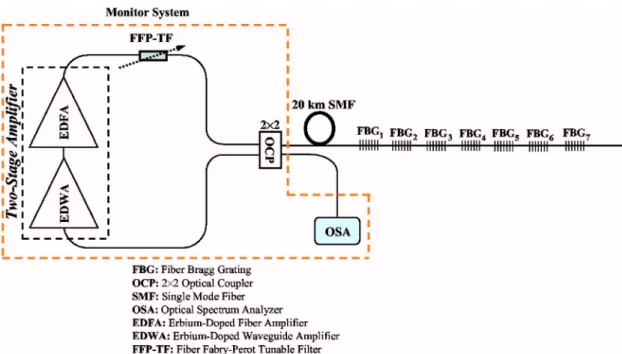
Figure 1 shows the experimental setup of the proposed 20-km-long multiplexed FBG-based sensor system and erbium-based fiber ring laser configuration. The proposed architecture is composed of a two-stage erbium-based am-plifier, an FFP TF, a 2⫻2 optical coupler 共OCP兲, and seven FBGs with different central wavelengths. The proposed fi-ber sensor monitoring system 共MS兲 is shown in the outer dashed box in Fig. 1. The central wavelengths of FGB1 to
FBG7 are 1534.6, 1539.6, 1548.3, 1552.6, 1556.1, 1557.9,
and 1562.2 nm at room temperature, respectively. The re-flectivity and 3-dB bandwidth of those FBGs are nearly 90% and 0.4 nm.
The FFP TF is an all-fiber device having a widely tun-able range, low insertion loss 共⬍0.5 dB兲, and low polarization-dependent loss共PDL兲 of ⬇0.1 dB. This filter, having a free spectral range 共FSR兲 of 44 nm and a 3-dB bandwidth of 0.4 nm, can provide wavelength selection in the ring laser cavity on applying external voltage 共⬍12 V兲 to the piezoelectric transducer 共PZT兲 of the FFP filter. The optical outputs are observed by an optical spec-trum analyzer共OSA兲 with 0.05-nm resolution.
The proposed two-stage erbium-based fiber amplifier, which consists of an erbium-doped waveguide amplifier 共EDWA兲 and a cascaded 共EDFA兲, is also shown in Fig. 1. The first stage is the EDWA and the second is the EDFA. The EDWA, which is manufactured via a two-step ion-exchange process, has the advantage of inheriting the known properties of the EDFA, such as low noise figure, slight polarization dependence, and no crosstalk between
0091-3286/2007/$25.00 © 2007 SPIE
Optical Engineering 46共6兲, 064401 共June 2007兲
Optical Engineering 064401-1 June 2007/Vol. 46共6兲
wavelength-division multiplexing 共WDM兲 channels. All optical performance is measured when the laser pump di-ode current equals 440 mA at ambient temperature. The second EDFA stage consists of a 10-m-long EDF length, a 980-nm pump laser, a 980 to 1550-nm WDM coupler, and an optical isolator共OIS兲. The pump power of the 980-nm laser is 10 mW. Figure 2 shows the ASE spectra of the EDWA, EDFA, and two-stage amplifier, respectively. The retrieved ASE of the two-stage amplifier has a higher and flatter power level than the EDWA and EDFA used. The flatter ASE is due to the gain saturation effect. Based on the proposed ASE source and fiber laser scheme, the lasing lightwave can be transmitted in a long-distance single-mode fiber共SMF兲 for a fiber sensor.
The proposed fiber laser configuration containing the two-stage erbium-doped gain section is a loop reflector which operates in a unidirectional manner due to the inclu-sion of an isolator. The other cavity reflection point is pro-vided by one of a series of FBG elements at different nomi-nal wavelengths. The FBG elements serve as the sensors and can be connected as part of the cavity via a single-mode fiber link 20 km long. Because of the inclusion of the wavelength filter within the loop reflector, lasing of the system occurs only when the filter transmission passband is aligned in wavelength with one of the Bragg elements. The scanning speed of FFP TF is about 200 ms, and the scan-ning wavelength range is 44 nm over C band in this experi-ment. That is to say, the wavelength ranges of FBGs are required to be within the operating range. Furthermore, to obtain a larger scanning sensor range, one needs a broad-band light source and a larger FSR of the FFP TF in the sensor system.
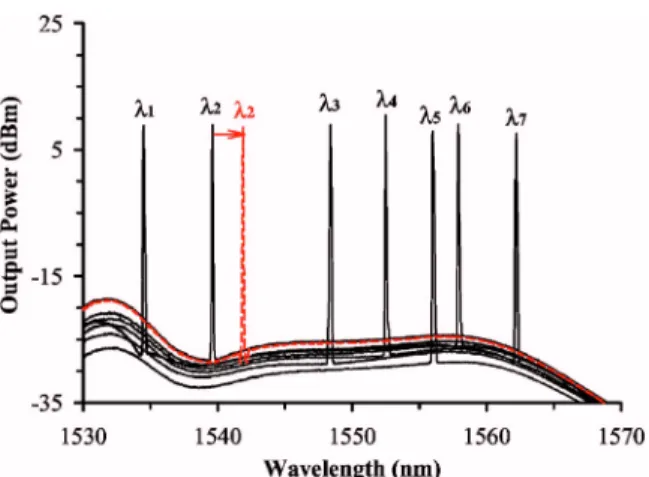
Figure 3 shows the optical output spectra of the sensor system for the case where the FFP TF is tuned to sequen-tially address each FBG. As can be seen, the fiber ring laser is forced to lase at a series of wavelengths, as determined
by each central wavelength of the FBG. The SNRs of the seven lasing wavelengths are larger than 40 dB. From Fig. 3, the output powers of the seven lasing wavelengths are larger than 7.4 dBm, and their power variation of is below 0.5 dB. Thus, the proposed grating sensor system can ob-tain larger reflected power and smaller power variation.
When external strain is applied to one FBG, the lasing central wavelength will shift. In the strain measurement, the tuning voltage of the FFP TF was manually adjusted to optimize the output power, and it tracked the FBG wave-length shift. In the experiment, we use applied strains from 0 to 1500m / m. Therefore, Fig. 3 also shows the lasing wavelength spectra observed at the output port when the maximal strain 共1500m / m兲 was applied to the FBG2
Fig. 1 Experimental setup of the proposed 20-km-long multiplexed FBG-based sensor system and erbium-based fiber ring laser configuration.
Fig. 2 ASE spectra of the EDWA, the EDFA, and the proposed two-stage amplifier.共The pumping current of the EDWA is 440 mA, and the EDFA operates at 10-mW pumping power with a 10-m-long EDF.兲
Yeh et al.: Long-distance strain-induced-grating-based fiber sensors…
Optical Engineering 064401-2 June 2007/Vol. 46共6兲
共dashed line in Fig. 3兲. The shift of the reflected wavelength is nearly 2.28 nm when the maximum strain is applied to the FBG.
3 Conclusion
In summary, we have investigated and demonstrated ex-perimentally a two-stage erbium-based amplifier with a larger amplified spontaneous emission light source for a long-distance fiber sensor by using strain-induced fiber Bragg gratings in the proposed fiber systems. In a 20-km-long fiber sensor system, the strain-induced fiber sensor has a maximal⬇2.28-nm wavelength shift under a 1500-m / m strain.
Acknowledgment
This work was supported in part by the National Science Council 共NSC兲 of Taiwan 共ROC兲 under grants NSC 95-2221-E-155-059 and NSC 95-2221-E-155-072.
References
1. A. D. Kersey, T. A. Berkoff, and W. W. Morey, “Multiplexed fiber Bragg grating strain sensor system with a fiber Fabry-Perot wave-length filter,” Opt. Lett. 18, 1370–1372共1993兲.
2. A. D. Kersey and W. W. Morey, “Multi-element Bragg-grating based fibre-laser strain sensor,” Electron. Lett. 29, 964–965共1993兲. 3. G. A. Ball, W. W. Morey, and P. K. Cheo, “Fiber laser source/
analyzer for Bragg grating sensor array interrogation,” J. Lightwave
Technol. 12, 700–703共1994兲.
4. Y. Yu, L. Lui, H. Tam, and W. Chung, “Fiber-laser-based wavelength division multiplexed fiber Bragg grating sensor system,”
IEEE Photonics Technol. Lett. 13, 702–704共July 2001兲.
5. S. H. Yun, D. J. Richardson, and D. Y. Kim, “Interrogation of fiber grating sensor arrays with a wavelength-swept fiber laser,”
Opt. Lett. 23, 843–845共1998兲.
Chien-Hung Yeh received the BS and MS degrees from the Physics Department, Fu Jen Catholic University, Taiwan, in 1998 and 2000, respectively. He received his PhD degree from the Insti-tute of Electro-Optical Engineering, National Chiao Tung University, Taiwan in 2004. He is working in the Information and Communica-tions Laboratories, Industrial Technology Research Institute, Taiwan. His research interests are optical fiber communications, optical fiber lasers, optical fiber amplifiers, WDM components, and FTTx technologies.
Ming-Ching Lin received the MS degree from the Institute of Electro-Optical Engineering, National Chiao Tung University, Tai-wan, in 2005. His research interests are optical fiber communica-tions, optical fiber lasers, and optical fiber amplifiers.
Bing-Chung Cheng received the MS degree from the Physics De-partment, Fu Jen Catholic University, Taiwan, in 1994. He is a PhD student at the Institute of Electro-Optical Engineering, National Chiao Tung University, Taiwan.
Sien Chi received his PhD in electrophysics from the Polytechnic Institute of Brooklyn, New York, in 1971, and joined the faculty of National Chiao Tung University, where he is currently a professor of electro-optical engineering. From 1972 to 1973 he chaired the De-partment of Electrophysics; from 1973 to 1977 he directed the Insti-tute of Electronics; from 1977 to 1978 he was a resident visitor at Bell Laboratories, Holmdel, New Jersey; from 1985 to 1988 he was the principal adviser with the Hua-Eng Wires and Cables Company, the first manufacturer of fibers and fiber cables in Taiwan, develop-ing fiber-makdevelop-ing and cabldevelop-ing technology; from 1988 to 1990 he di-rected the Institute of Electro-Optical Engineering; and from 1998 to 2001 he was the vice president of the university. He was the sym-posium chair of the International Symsym-posium of Optoelectronics in Computers, Communications, and Control in 1992. From 1993 to 1996 he received the Distinguished Research Award sponsored by the National Science Council, Taiwan. Since 1996 he has been the chair professor of the Foundation for Advancement of Outstanding Scholarship. His research interests are optical fiber communica-tions, optical solitons, and optical fiber amplifiers. He is a fellow of the Optical Society of America and the Photonics Society of Chinese-Americans.
Fig. 3 Optical output spectra of the sensor system for the case where the FFP TF is tuned to sequentially address each FBG. The dashed line shows the wavelength shift of FGB2when the external strain is applied. 共FBG1 to FBG7 are at 1534.6, 1539.6, 1548.3,
1552.6, 1556.1, 1557.9, and 1562.2 nm, respectively, at room temperature.兲
Yeh et al.: Long-distance strain-induced-grating-based fiber sensors…
Optical Engineering 064401-3 June 2007/Vol. 46共6兲