國立交通大學
資訊科學與工程研究所
碩 士 論 文
在基於非揮發性隨機存取記憶體系統上提供改
善作業系統效能的機制
Operating System Support on NVRAM-Based Systems
研 究 生:蕭智文
指導教授:張瑞川 教授
在基於非揮發性隨機存取記憶體系統上提供改
善作業系統效能的機制
學生:蕭智文 指導教授:張瑞川教授
國立交通大學資訊科學與工程研究所
論 文 摘 要
硬碟效能長久以來一直是電腦系統中一個主要瓶頸,根據 Moore’s Law,處 理器的效能以每年 60%的速度增進;而硬碟的效能僅以每年 10%的速度增進,因 此在處理器和硬碟之間產生了極大的效能差距。非揮發性記憶體(Non-volatile RAM)是最近幾年新興的一項記憶體技術,其具有非揮發性的特性可以有效改善 系統效能。由於傳統緩衝快取以及確保檔案系統資料一致性的設計都是建立在揮 發性記憶體上,因此我們在非揮發性記憶體性統上提出三種機制,來進一步增加 緩衝快取的效能以及減少確保資料一致性的負擔。第一,我們在 VFS 和一般檔 案系統之間加入一層 Ram-based 檔案系統來暫時的存放新建立檔案,其目的為延 遲檔案分配給檔案系統的時間以避免檔案零碎的情形以及減少不必要的 IO。第 二,我們修改原本以檔案為單位的寫回策略,而進一步的考慮寫回的區塊在磁碟 上的相對應位置,讓較連續且較鄰近的資料一起寫回,以減少寫回的時間;另外, 我們還確保不要寫回最近剛被更新過的頁面。最後,我們提供了一個簡單機制可 同時確保檔案系統的一致性而不需要額外的磁碟 IO 負擔。實驗結果顯示我們的 機制之效能優於 Ext2 大約 76%;優於 Ext3 大約 94%。Operating System Support on NVRAM-Based
Systems
Student: Chih-Wen Hsiao Advisor: Prof. Ruei-Chuan Chang
Computer Science and Engineering College of Computer
Science
National Chiao Tung University
Abstract
Disk performance has become the major bottleneck of most computer systems for a
long time. Following the Moore’s Law, the performance of processors improves by
about 60% per year. However, the performance improvement of disks is only about
10%, resulting in an increasing performance gap between processors and disks.
Non-volatile memory is an emerging technology in recent years and the characteristic
of non-volatile can improve the performance of system. Because the traditional buffer
cache management and guaranteeing file system consistent are based on volatile
memory, we propose three mechanisms on non-volatile system to improve further the
performance of buffer cache and reduce the overhead of consistency. First, we put
Ram-based file system between VFS and file system to temporarily store all new files.
Its main purpose is delay allocation for all new files to avoid the file fragmentation
and reduce the redundant IO traffic. Second, we modify the original file-by-file write
back policy and write back the contiguous or neighbor dirty blocks to reduce the seek
guarantee the file system consistent without any overhead of disk IO. The
experimental results show that the performance of our mechanisms is superior to Ext2
致謝
感謝我的指導老師 張瑞川教授以及 張大緯教授,兩位老師對我的論文所做的
指導,感謝在系統實驗室上所有的學長和同學對我的幫助和建議,另外還要感謝
張大緯教授兩年來不遲辛苦的和我們遠端視訊做討論,真的很辛苦他。
TABLE OF CONTENTS
論文摘要………...…..…i Abstract……….…ii 致謝………...………iv Table of Contents………...……….v List of Figures……….vii List of Tables……….………...ix Chapter 1 Introduction……….………...1 1.1 Motivation………...……….1 1.2 Our Mechanisms……….……….21.3 Structure of the Thesis……….…………4
Chapter 2 Related Work……….……….5
2.1 System Recovery……….5
2.2 NVRAM as Storage Device……….6
2.3 NVRAM as Buffer………...7
2.4 Transaction Support……….9
Chapter 3 Design and Implementation……… 11
3.1 Background……….11
3.1.1 Temporary-File File System………..11
3.1.2 Intelligent Write-Back Policy………15
3.1.3 Transaction Support on File System Operations………...18
3.2 Implementation and Integration of the Approaches………...22
3.2.1 Implementation of Three Mechanisms………..22
3.2.2 Integration of Three Mechanisms………..28
4.1 Experimental Environment and Configurations……….29
4.2 The Performance Results of TempFFS………...32
4.3 The Performance Results of Intelligent Write-Back Policy………...37
4.4 The Performance Results of Transaction Support on Ext2………41
4.5 Put it all Together………45
Chapter 5 Conclusions………...51
LIST OF FIGURES
Figure 3.1 Architecture of the Temporary-File File System……….13
Figure 3.2 Transformation Steps………..14
Figure 3.3 the Zone Information Table……….17
Figure 3.4 Zone with Different Average Segment Length………...18
Figure 3.5 the Main Data Structure of Journaling………20
Figure 3.6 the Core Functions of Journaling ………...20
Figure 3.7 Pseudo Code of Segment/Zone Algorithm……….25
Figure 3.8 Implementation of the Transaction API (Pseudo Code) ………27
Figure 3.9Integration of the TempFFS, Intelligent Write Back and File Operation Transaction Support ………28
Figure 4.1 Performance Improvements of TempFFS (Bonnie++)……..………32
Figure 4.2 Performance Improvements of TempFFS (Untar and Compile Linux Kernel)………33
Figure 4.3 Performance Improvements of TempFFS (Postmark)………34
Figure 4.4 Rations of Files Deleted in TempFFS (Postmark)………..34
Figure 4.5 Reduction of IO Traffic with TempFFS……….35
Figure 4.6 Average File Distance (Postmark)……….35
Figure 4.7 Performance Comparison of the Write Back Polices (Bonnie++)……….37
Linux Kernel)………..38
Figure 4.9 Performance Comparison of the Different Locative Write Back Polices...39
Figure 4.10 Performance Comparison of the Write Back Polices (Postmark)……….39
Figure 4.11 Accumulate Inter-requests Distance (Postmark)………...40
Figure 4.12 Repeated Write Back Blocks (Postmark)………...………….…..41
Figure 4.13 Performance of the Transactions Support Mechanism (Bonnie++)…..…41
Figure 4.14 Performance of the Transactions Support Mechanism (Untar and Compile
Linux Kernel)………..43
Figure 4.15 Performance of the Transactions Support Mechanism (Postmark)…….44
Figure 4.16 Performance Results of Different Combinations (Bonnie++)………….46
Figure 4.17 Performance Results of Different Combinations (Linux Kernel Untarring
and Compilation)………47
Figure 4.18 Performance Results of Different Combinations (Postmark, 512-10K
bytes)……….……..48
Figure 4.19 Performance Results of Different Combinations (Postmark, 512-2M
LIST OF TABLES
Table 1.1 MRAM and DRAM Characteristic………3
Table 4.1 Evaluation Environment………...30
Table 4.2 Experimental Configurations………31
Table 4.3 Memory Overhead of the Transaction Support Under Different
Chapter 1 Introduction
1.1 Motivation
The speed of processor is double every eighteen months by Moore’s Law, but the
performance of the computer system grows slowly due to the slow I/O. The disk I/O
time is mainly dominated by seek time and rotation delay. Because data in volatile
memory (DRAM) is not persistent, system must periodically write back dirty data to
the disk for avoiding data loss due to the power failure. Therefore, performance of
disk IO is worse.
With the well advances in non-volatile memory (NVRAM) technologies, many
kinds of non-volatile RAM such as MRAM [9] (Magnetoresistive RAM), FeRAM
(Ferro Electric RAM), PRAM (Phase-change RAM) and OUM (Ovonics Unified
Memory) [10] have been proposed. NVRAM is an emerging technique to solve the
problem to the slow disk IO. As semiconductor technology makes progress, we can
anticipate NVRAM to become a common component of computer systems. Since
MRAM among them is comparable with DRAM in terms of capacity, speed and cost,
MRAM is considered as the potential replacement of DRAM as the main memory for
computer systems. Therefore, we can regard data in memory as persistent and exploit
some approaches about NVRAM to improve performance of disk IO.
There are some problems in traditional DRAM-based system if the main memory is
NVRAM. Firstly, according to some research [37][38][46], many small files are
short-lived. Once the file is created in file system, file system must do some disk IO
operations, such as reading metadata of the file. Even many files are deleted soon
after created, they also need perform disk IO. Besides, after these files are deleted, it
when power outages. But there are two disadvantages: first, the dirty pages per file
maybe distributed far in the disk. It must spend many seek time and rotation delay on
writing back these dirty pages. Second, if it writes back all dirty pages of a file,
system can not make sure whether it does not write back recently-updated pages.
According to time locality, recently-updated pages may be re-accessed and
re-modified recently. Therefore, if it writes back recently-updated pages, it wastes the
disk IO operations. Lastly, the file system consistency has been an important issue
recently. Many file systems use the technique to support data consistency such as
journaling, but it needs extra journaling IO to write logs into the disk earlier.
Therefore, on the basis of three problems, we propose three mechanisms
corresponding three problems to improve performance of the file system.
1.2 Our Three Mechanisms
In this thesis, we propose the Buffer Cache management and transaction support on
file system operations in NVRAM systems. We have two mechanisms temporary-file
file system (TempFFS) and intelligent write back policy (WB) in Buffer Cache
management and one mechanism for transaction support on file system operations
(trans) for maintaining file system consistency.
Firstly, we add TempFFS between VFS and file system to apply delayed allocation
simultaneously on all existing file systems. Different from file system specific
implementations that maintain newly-created files on their own, such as XFS[47], and
Ext4, TempFFS maintains newly-created files for all the file systems. Upon memory
pressure or sync operations, the files are transferred to their original file systems and
block allocation of these files takes place. Therefore, an existing file system can enjoy
Secondly, due to the data in NVRAM is persistent; we modify original write back
policy which is file-by-file and does not consider recency. We consider the location of
dirty pages in the disk and write back contiguous or neighbor dirty pages to reduce the
seek time and rotation delay of the disk. Besides, we consider recency that we do not
write back the recently-updated dirty pages.
Lastly, our transaction support mechanism can ensure both file system consistency
without inducing any extra disk I/O. Since the data in NVRAM is persistent, it needs
not write journaling IO before. We only make sure the file operation is atomic. In
order to achieve atomic, we duplicate all data and metadata before they are modified
in the file operation into undo logs. Once the file operation has finished successfully,
the undo logs can be removed immediately. If the crash happens in the progress of the
file operation, the undo log can be used to restore to the consistent state. Since our
undo logs are placed in NVRAM and deleted later, it needs not any extra disk I/O.
We implement our three mechanisms in Linux 2.6.12. Since large capacity MRAM
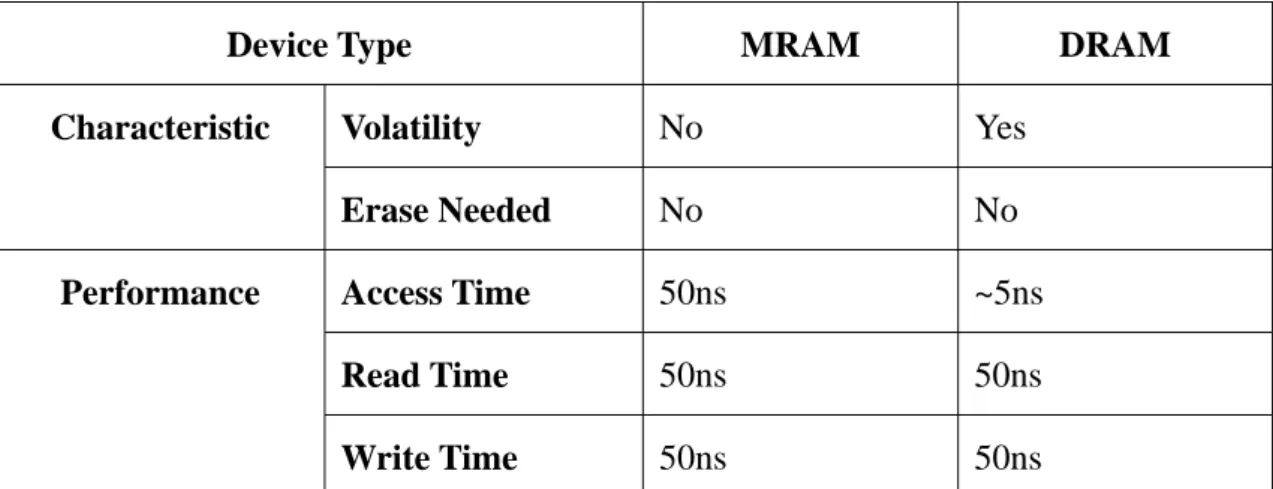
is not generally available in the market, and the performance characteristics of DRAM
and MRAM are comparable and shown in Table 1.1, we use DRAM to emulate
MRAM.
Table 1.1 MRAM and DRAM Characteristic
Device Type MRAM DRAM
Volatility No Yes Characteristic Erase Needed No No Access Time 50ns ~5ns Read Time 50ns 50ns Performance Write Time 50ns 50ns
Operation Power Supply 1.8V 1.8-5V According to our experimental results, the performance improvement of our
TempFFS is about 35% compared to Ext2, the performance improvement of our
intelligent write-back is about 65% compared to Ext2 and the performance
improvement of our transaction support is about 80% compared to Ext3. Lastly, the
performance improvement of the combinations of three proposed mechanisms is
about 90% compared to Ext3.
1.3 Structure of the Thesis
The remainder of this thesis is organized as follows. Chapter 2 describes the related
work about NVRAM. Chapter 3 presents the design and implementation details of the
proposed mechanisms. The performance results are shown in Chapter 4. Finally, we
Chapter 2 Related Work
In this chapter, we introduce some researches about NVRAM. In Section 2.1, we
introduce some researches exploiting NVRAM to recover system when system
crashes. In Section 2.2, some researches use NVRAM as storage device to improve
the performance of file system. In Section 2.3, some researches use NVRAM as
buffer to reduce disk IO, especially write operation. In Section 2.4, we introduce
researches about providing file system consistency.
2.1 System Recovery
Ren Ohmura [33] in Keio University exploits the characteristic of NVRAM in
system recovery. They propose a scheme to recovery the state of peripheral devices in
NVRAM systems so that the system can resume its execution after an unpredictable
power failure. They record all messages between CPU and devices in NVRAM and
system re-sends messages recorded in memory to recovery devices into previous state
when power failure.
Harp [25] records all updates of files in server nodes. Files in individual node can
survive after the failure because file operations are logged in memory at several nodes.
The Recovery Box [2] stores the state of system in NVRAM and protects the region
of storing the system state to not overwrite when system crashes. After the system
crashes, it uses the protected system state to recover system.
Rio [8] enables the data in memory to survive operating system crashes and power
outages. It uses write protections to protect files in file cache and does not
accidentally overwrite the file cache while system is crashing. Therefore, the files in
2.2 NVRAM as Storage Device
Because the flash is cheap and has the characteristic of non-volatile, the more and
more file systems which are designed for flash memory are proposed, such as JFFS2 [44] and Microsoft Flash [24] and so on. However, the flash memory has some limits:
firstly, flash must erase the block before writing it. Secondly, the block in flash has
finite number of erase-write cycles. Therefore, the flash system usually writes data by
using non-in-place update and it makes the number of erase-write cycles in each block
are similar by using wear leveling technique.
In order to speed up the writing in flash system, eNVy [45] uses a small amount of
battery-backed SRAM as write buffer and uses copy-on-write technique to copy
corresponding data in flash into SRAM, then modifies data in SRAM. Lastly, it writes
back data into flash memory when the amount of SRAM is full. Hwan Doh [11] also
exploits non-volatile memory to enhance the performance of flash file system. They
propose a flash-based file system that stores all metadata in NVRAM and stores all
file data in flash memory. The advantages of using NRAM as a metadata store are the
mount time of flash is reduce to the minimum and access all metadata is speeder than
before.
MRAMFS [12] is a prototype in-memory file system to put all data/metadata in
NVRAM. However, the amount of NVRAM may be not enough containing of a large
number of files. Therefore, they use the compression method to reduce occupied
space and use the different compression method to compress metadata and data
because metadata often has the fixed format. In metadata they can save about 60%
space and save about 40%~60% space for file data.
HeRMES file system [31] and Conquest file system [42]. HeRMES considers that the
metadata is frequently modified in the file system requests. Therefore, they suggest
that use of compression techniques in order to minimize the amount of memory
required for metadata and place all metadata in NVRAM to improve the performance
of file system requests. Conquest assumes that the system is in the sufficient amount
of NVRAM. Therefore, it stores all small files and metadata in NVRAM and disk
holds only the data content of remaining large files. The advantages are that it can
avoid the overhead of accessing small file and metadata because metadata and small
files are placed in NVRAM and it can optimize the arrangements of large files to
reduce the fragmentation in disk because there are only large files in disk.
The above works have some disadvantages. Firstly, they almost place all metadata
in NVRAM but the occupied space of metadata/data is constantly increasing as users
create files at all times. Secondly, although the metadata is frequently accessed in file
system, it is not that all metadata are frequently accessed. Therefore, they place all
metadata in NVRAM such that there is some non-recently-used metadata occupied
the NVRAM space resulting in performance decreases.
2.3 NVRAM as Buffer
In addition to storage device, the general purpose of NVRAM is as the write buffer.
eNVy [45] mentioned in Section 2.2 uses a small amount of battery-backed SRAM as
write buffer to improve the performance of write operations in flash. Mark Baker [1]
proposes that if they provide a NVRAM as write buffer, it can reduce disk access by
about 20% on most of file systems, and by about 90% on one frequently-accessed file
system.
provides two benefits: some writes will be avoided because dirty blocks will be
overwritten in the cache, and physically contiguous dirty blocks can be grouped into a
single I/O operation. They also present some write back strategies, such as least
recently used (LRU), shortest access time first (STF) and largest segment per track
(LST) to manage non-volatile write buffer and find that write buffer can reduce a
large number of write requests to improve the performance of system.
Robert Y. Hou [20] exploits non-volatile memory to improve the performance of
RAID5. In each write request, RAID5 needs to execute “read-modify-writes” which
means that single-block writes require the old data block and old parity block to be
read, modify them to generate the new parity block, and then the new data and new
parity can be written to their respective locations. Read-modify-writes can reduce the
performance of RAID5 arrays because it needs four disk accesses in each write
request. Therefore, they use non-volatile memory as the write buffer of RAID5 to
improve the performance of write operations.
Above researches are also about using write buffer to improve write operations,
Alex Batsakis [3] mentions read operations may depend upon write operations
because buffering dirty pages will occupy the memory for read caching. They address
this problem by separately allocating memory between write buffering and read
caching and by writing dirty pages to disk opportunistically before the operation
system submits them for write-back. They also write back dirty pages which are
almost adjacent, but they do not consider whether the dirty pages are not
recently-updated.
Due to the capacity of MRAM is increasing continuously, it maybe replace DRAM
as the main memory of computing system in the future. We not only use the technique
improve the performance of file operations.
2.4 Transaction Supporting
Traditionally, file system consistency has been maintained by using synchronous
writes to restrict the proper ordering of metadata updates, but this approach degrades
the performance of file system because the proceeding of metadata updates is
dominated by the disk speed. Soft updates [30] eliminates the need for synchronous
disk I/O. Soft updates is an implementation mechanism that enforces the
dependencies of metadata updates and allows the metadata caching for write back.
Log-structured file system [39] proposed by Mendel Rosenblum treats the file
system as a segmented log and always writes all modified data blocks and metadata
into the end of the log. File system changes are buffered in the cache and then written
into the disk sequentially in single disk IO operation. Therefore, it can improve the
performance of write operation but it can not write all related metadata in single write
operation since if crashes happen in the progress of disk operation, the file system
remains an inconsistent state.
Journaling [35][44][47] is nowadays a widely-used technique for file system
consistency. It logs metadata and data updates into a stable storage before the updates
are performed on the disk. Hence, it produces the extra journaling IO traffic that is
critical impact on the system performance.
Kevin M. Greenan [17] introduces two approaches to reliably storing file system
structures in NVRAM. Firstly, they strengthen memory consistency by using
page-level write protection and error correcting codes. Secondly, it periodically calls
online consistency checker to replay all transaction logs for checking file system
state of file system. However, it needs to periodically replay all transaction logs even
if the file system is normal and does not have any failures.
Henry Mashburn [40] proposes recoverable virtual memory (RVM) that is simple
user-lever library to handle atomic file operation and data persistence. Firstly, it
copies the range of memory which will be updated to the undo log in memory, then
updates data, and lastly writes the updated data to the redo log in disk. Therefore, it
needs three copy operations for each file operation.
Vista [27] proposed by David Loweel is simple user-library runs on Rio mentioned
in Section 4.1. Because Rio protects the files in memory to be persistent, Vista can
eliminate the redo log to speed up disk operations and it only uses undo log to make
sure the file operation is atomic. However, it must be based on Rio and because it is
user-level library, Vista is not user-transparent.
We propose a simple lightweight transaction support on file system operations in
NVRAM environment and it only needs to add only about 40 line-codes in kernel and
about 300 line-codes in implementation. It also provides the same strength of
Chapter 3 Design and Implementation
In this chapter, we describe the design and implementation of the proposed
mechanisms. In Section 3.1, we first introduce the three mechanisms for improving
the performance and ensuring the consistency of file systems on NVRAM based
computer systems, namely Temporary-File File System (TempFFS), intelligent
write-back policy, and transaction support on file system operations. In Section 3.2,
we show the details of implementing and integrating the mechanisms and provide an
analysis on the integration of the mechanisms.
3.1 Background
In this section, we describe the proposed NVRAM-based buffer cache management
mechanisms, which include Temporary-File File System and intelligent write-back
policy. Both mechanisms aim at improving the file system performance based on the
non-volatility feature of main memory. Moreover, we also describe a lightweight
transaction support mechanism on file system operations, which takes advantage of
the non-volatility feature of main memory for ensuring the consistency and data
integrity of the file system.
3.1.1 Temporary-File File System (TempFFS)
The first goal of TempFFS is to reduce the fragmentation of the underlying file
systems. With numerous and concurrent file creation/deletion/appending activities, a
file system is easy to become fragmented, which leads to performance degradation.
Moreover, according to the previous studies [37][38][46], many files are short-lived,
meaning that they are deleted soon after their creation. Allocating disk space for these
To reduce the file system fragmentation and the unnecessary disk IO operations,
some advanced file systems such as XFS [47]and ext4 support delayed allocation,
which delays the disk block allocation of a newly-created file until the data is needed
to be flushed back to the disk due to memory pressure or sync operations. However,
the delayed allocation feature is not shared among all file systems. Only the file
systems that implement the feature can benefit from it.
Instead of integrating the delayed allocation feature into a specific file system, we
implement a RAM-based file system named TempFFS in order to apply the feature
simultaneously on existing file systems such as ext3 and NTFS. Based on the concept
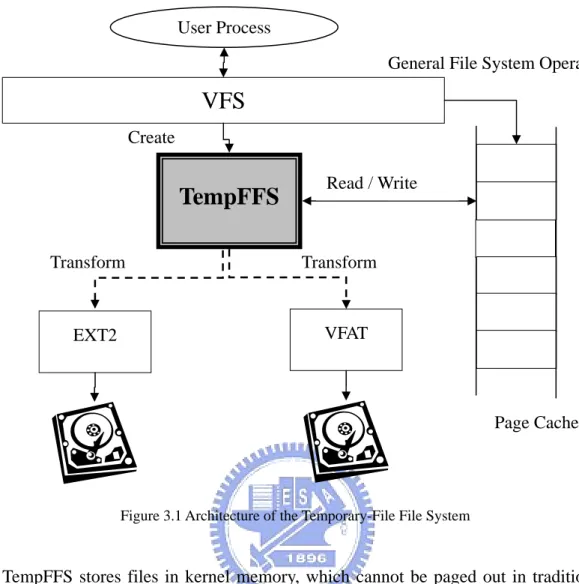
of stackable file systems, TempFFS sits between VFS (virtual files system) and file
system implementations and is transparent to the latter, as shown in Figure 3.1. All
new files are initially written to TempFFS and associated with their original file
systems when they are created. TempFFS uses page cache as the file store, and the
files are transferred into their corresponding file systems upon memory pressure or
sync operations. In this way, existing file systems can benefit from delayed allocation
without code modifications. Note that a file can stay for a long time in TempFFS. This
raises the risk of data loss if the main memory is volatile. On systems with
non-volatile main memory, however, memory data can survive power failures. The
implementation of TempFFS was achieved by modify the code of an existing RAM
Figure 3.1 Architecture of the Temporary-File File System
TempFFS stores files in kernel memory, which cannot be paged out in traditional
UNIX operating systems (including Linux). Upon memory pressure, an OS usually
writes back the dirty pages that belong to the buffer cache or user processes to the
storage device so as to release more memory space. In this situation, TempFFS checks
if its size is larger than a specific threshold. If it is, TempFFS shrinks its size by
evicting pages of the least recently used files. All the evicted files are transformed into
their original file systems so that the corresponding data can be written back. In
addition, we transform files whose sizes are larger than a specific threshold (currently,
1MB) due to the following two reasons. First, according to previous research
[37][38][46], most short-lived files are small ones, if it puts short-lived files in
TempFFS, it can reduce some IO traffics. Second, creating a huge file may cause the
transform of a large number of short-lived small files before they are deleted, Transform Transform Create
General File System Operation
VFS
TempFFS
User Process VFAT Page Cache Read / Write EXT2reducing the benefit of delay allocation.
We manage the files in TempFFS in a LRU list. The number of pages that should be
evicted from TempFFS, say N, is proportional to the number of pages in TempFFS.
Specifically, N is calculated according to the following equation:
N = NR_WB * NR_TempFFS / NR_Dirty,
where NR_WB represents the target number of pages that need to be written back,
NR_TempFFS represents the number of (dirty) pages in TempFFS, and NR_Dirty
represent the number of dirty pages in the system. As shown in Figure 3.2,
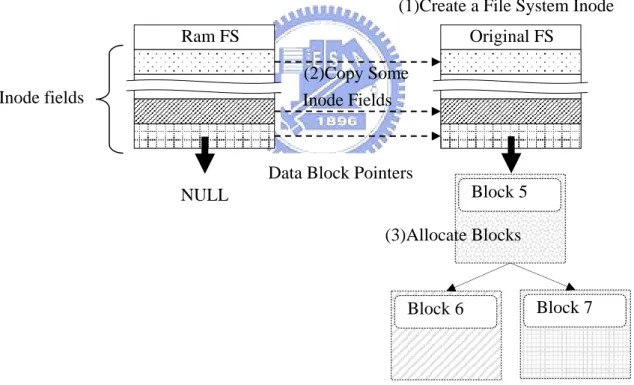
transforming a file involves the following three steps.
Figure 3.2 Transformation Steps
First, the file create operation of the original file system is invoked to produce the
metadata (inode) of the file. Second, several inode fields such as timing information,
access rights and file size, are copied to the new inode. Third, a sequence of disk
block allocation operations of the original file system are invoked for allocating the Ram FS Block 5 Block 6 Block 7 Original FS (2)Copy Some Inode Fields (3)Allocate Blocks Data Block Pointers
(1)Create a File System Inode
NULL Inode fields
disk space for the file. Because the operations are invoked consecutively, the resulting
data blocks tend to be contiguous. After the allocation, the data is associated with the
allocated blocks and the metadata in the TempFFS is deleted.
3.1.2 Intelligent Write-Back Policy
Modern operating systems write back dirty pages periodically or when the number of free pages is below a specific threshold (i.e., memory pressure). On systems with
non-volatile main memory, dirty pages are already persistent and thus need not to be
written back into the disk periodically. Instead, they need to be written back only
under memory pressure or sync operations. Currently, Linux utilizes a file-by-file
write back policy, which scans the list of dirty inodes and submits the dirty pages of
each inode to the IO subsystem. The rationale behind this policy is to reduce the
numbers of non-up-to-date files when power outages or system crashes. Assume that
100 files are updated and each file has 10 dirty pages in memory. If the system
crashes after 500 dirty pages are written back to disk, it would be better to write all
the dirty pages of 50 files than write 5 dirty pages of all the files.
However, this policy may write back recently-updated pages, which has two
drawbacks. First, writing back such pages can not help to release the situation of
memory pressure since these pages will not be reclaimed by the page replacement
policy. One purpose of writing back dirty pages is to reclaim the page so as to
maintain a reasonable number of free pages in the system. In Linux, all pages
belonging to user processes and page cache are grouped into two lists, the active list
and the inactive list. The former includes pages which have been accessed recently
while the latter contains pages that have not been accessed for a period of time. The
are used recently. Second, according to time locality, these pages will be marked dirty
soon after their write back. Thus, writing back such pages is of little use. The pages
may need to be written back again soon. Some UNIX systems like Solaris do not have
such problem. They only write back dirty pages that are not used recently.
The common problem of the write back policies of the existing UNIX operating
systems (including Linux) is that they ignore the disk location of the dirty pages when
submitting the pages to their IO subsystems. Although an IO subsystem can sort the
requests submitted to it, there may still a significant amount of seek and rotation delay
among the dirty pages.
In this paper, we propose an intelligent write-back policy, which considers the
recency as well as the disk locations of the dirty blocks to reduce the IO traffic, seek
time and rotation delay. To reduce the IO traffic, the proposed policy recency only
writes back dirty pages in the inactive list.
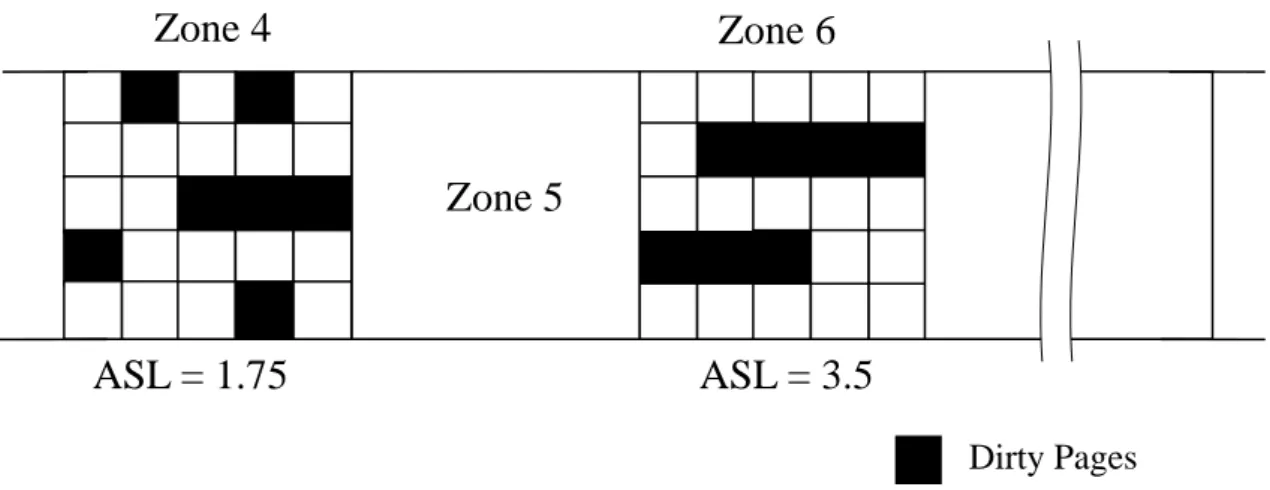
To reduce the seek time, we divide a disk into a number of zones, which is a set of
continuous blocks on the disk, and write back dirty pages in a zone-by-zone manner.
The dirty page information is recorded in a set of identical data structures called zone
information tables, each of which correspond to a zone. When a page becomes dirty
and inactive, we record the page in the corresponding zone information table
according to the disk block number of the page.
Each time the write-back procedure is invoked, the proposed policy selects a zone
and writes back dirty pages in that zone. This reduces the seek time because the disk
blocks of the written-back dirty pages are close. In order to further reducing the
rotation delay, the policy selects a zone with the maximum Average Segment Length
blocks in a zone, and there is generally no rotation delay between two continuous
blocks. Therefore, this policy tries to select a zone which contains more continuous
dirty pages to reduce both the seek time and the rotation delay of the IO traffic caused
by dirty page write back.
Average Segment Length (ASL) = Number of Dirty Pages in the Zone/Number of Segments in the Zone _________________________________________Equation 1
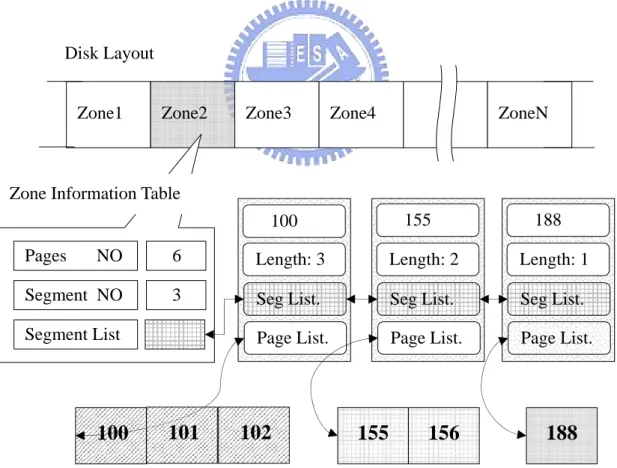
The zone information table, which is shown in Figure 3.3, it records some
information such as, dirty pages numbers, segment numbers, segment list which
contains of all segment in the zone, page list which includes all dirty pages of the
inactive list in the zone, and length (Average Segment Length).
Figure 3.3 the Zone Information Table
Zone1 Zone2 Zone3 Zone4 ZoneN Disk Layout Pages NO Segment NO Segment List 6 3
100
155
188
Seg List. Page List. Length: 3 Seg List. Page List. Length: 2 Seg List. Page List. Length: 1 100 155 188101
102
156
Figure 3.4 Zone with Different Average Segment Length
Figure 3.4 shows an example of the zone selection. The dirty pages of zone 4 and
zone 6 are both 7, but the dirty pages of zone 6 are more continuous (i.e., with a larger
value of ASL) than zone 4. Therefore, zone 6 is selected to be written back.
As mentioned before, this policy only writes back pages in the inactive list in order
to reduce the write back IO traffic. Therefore, only the dirty pages in the inactive list
are recorded in the zone information tables. To accomplish this, we need to insert or
remove the information about a dirty page when it becomes inactive or active.
Specifically, when a dirty page becomes inactive (i.e., moves from the active list to
the inactive list), we record it in the corresponding zone information table. When the
page becomes active again or clean, the recorded information is removed. This allows
us to write back only inactive dirty pages.
3.1.3 Transaction Support on File System Operations
Journaling is a widely-used technique for guaranteeing file system consistently. It
logs metadata and data updates that are completed in memory into a stable storage
Zone 5
Zone 4
Zone 6
Dirty Pages
ASL = 1.75
ASL = 3.5
before the updates are performed on the disk. When the system crashes, the log is
replayed to restore the status of the file system. Therefore, journaling ensures file
system consistency by using a redo log. The overhead of journaling is that it requires
additional disk I/O operations for logging. On non-volatile memory based computing
systems, one straightforward approach for eliminating such I/O operations is to place
the log in the memory instead of disk. However, the drawback of simply placing logs
in memory is that it occupies a large memory space. For example, it typically needs
256MB memory space as journaling space. Additionally, to minimize the IO overhead,
a journaling file system usually writes the updates to the log in batches with size
about 16 to 64 MB. A significant amount of updates might be lost if the system fails
before the updates are written to the log.
To address the problems mentioned above, we design a lightweight transaction
mechanism on systems with non-volatile main memory. The mechanism not only
ensures file system consistently but also eliminates the need of large memory space
and extra disk I/O.
The basic idea of the mechanism is undo log. Because the data in NVRAM does
not lose, we need not write journaling logs into the disk before. We only need make
sure that each file operation is atomic. To ensure the atomicity of each file operation,
we duplicate the data and metadata in the undo log before they are modified. Once a
file operation has finished successfully, the duplicated data and metadata can be
removed immediately. If the system crashes, the content in the undo log (i.e., the
original values of the metadata and data of the uncompleted operations) is used to
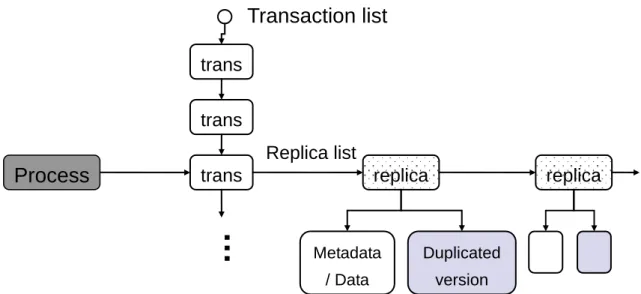
recover the file system state. The main data structure of our lightweight transaction
Figure 3.5 Main Data Structure of Transaction Support
In order to make sure the atomicity of the updates involved in a file operation, all
metadata and data modified by the file operation are collected into a transaction and
recorded in a data structure called trans. When metadata or data is going to be
modified by a file operation, the original content is copied to a memory area pointed
by a data structure called replica, which is then attached to trans. The replica also
records the addresses of the metadata/data that are under update. This allows the
metadata/data to be recovered by the original content if necessary.
Figure 3.6 Core Functions of Transaction Support Read block bitmap & group descriptor
Modify metadata
Duplicate metadata Transaction_start
Transaction_stop
Access Metadata Modify data
Duplicate data
Write
trans replica replica
Replica list trans trans
Transaction list
…
Metadata / Data Duplicated versionProcess
We implemented the transaction support in a file system independent manner and
provide a transaction API by which file systems can leverage to achieve file operation
atomicity. Figure 3.6 shows an example usage of the transaction API. Before each file
operation, the file system firstly invokes the transaction_start() function, which
initializes the trans data structure for the current process and inserts the trans data
structure into the global transaction list. Then, the file system calls duplicate() which
duplicates the data and metadata before they are going to be updated. It initializes a
replica data structure and copies the original values of the metadata/data into a temporally-allocated area, then maps the area to its replica. The replica data structure
will be inserted into the replica list of the corresponding trans. Lastly, after the file
operation, the file system calls transaction_stop() which terminates the transaction. It
removes all duplicated data and metadata of corresponding this trans without
affecting data integrity and file system consistency because all metadata/data in the
file operation have already finished upgrading. Therefore, the transaction support
mechanism can have the same strength as the journal mode of ext3 because it
duplicates data and metadata before they are updated. Moreover, it causes little
overhead in file system because it deletes all replicas of data and metadata once file
3.2 Implementation and Integration of the Approaches
In this section, we describe the detailed implementation and integration of the three
approaches.
3.2.1 Implementation of Three Mechanisms
As mentioned before, we implement TempFFS by modifying an existing RAM file
system called Ram-FS (Resizable simple ram File System), and then insert it between
VFS and file system implementations. We intercept the invocation of the VFS file
create function (i.e., vfs_create()) and direct the invocation to the file create function
in RamFS. After the creation, operations on the file will use the file operations in
RamFS because the file now is placed in RamFS not in file system, such as Ext2.
Upon memory pressure or the size of file is over the threshold, we transform files in
Ram-FS into the file system. The detail steps of transform are shown in Section 3.1.1.
After transforming, the file is belong to the file system, we only use the original file
operations in file system to access it.
To implement the intelligent write-back policy relo (recency and location), we
record the information of a page in a zone information table, which is shown in Figure
3.3. When the page becomes dirty and inactive, we record this dirty page into the
corresponding zone information table. To achieve this, we invoke a function
add_to_zone() in two situation. First, when it calls the function that marks the page
dirty (i.e., set_page_dirty()), we check the active flag (PG_active) of the page. If this
dirty page is in the inactive list (i.e., PG_active flag is not set), we invoke a function
add_to_zone() for set_page_dirty() function. Second, when it calls the function that
moves the page form the active list into the inactive list (i.e.,
add_page_to_inactive_list()), we check whether the page is dirty or not. If this page is
The pseudo code of the add_to_zone() function is shown in Figure 3.7(a). First, we
get the block number of the page, and calculate the zone corresponding to this page
(i.e., block number of page divides block number per zone). Second, numbers of dirty
pages in zone information table increases by one. If the former block and latter block
of this page do not record in zone information table, it means that this page stands
alone. If this page is recorded in the zone information table, it produces a new
segment (contiguous dirty pages). Therefore, segment numbers of zone information
table increases by one. Lastly, we calculate the ASL (average segment length) as a
basis of selecting the zone to write back.
When the dirty page is clean or active, we also need to remove the information of
the page from the zone information table. To achieve this, we invoke a function
remove_from_zone() in two situation. First, when it calls the function that clears dirty
of the page (i.e., clear_page_dirty_for_io()), we invoke a function
remove_from_zone() for each call of the clear_page_dirty_for_io() function. Second,
when it calls the function that moves the page form the inactive list into the active list
(i.e., add_page_to_active_list()), we invoke a function remove_from_zone() for each
call of the add_page_to_active_list() function. The pseudo code of the
remove_from_zone() function is shown in Figure 3.7(b). First, we also get the block
number of this page to calculate the corresponding zone. Second, the dirty page
numbers decreases by one. If the former block and latter block of this page do not
record in zone information table, when it removes this page, it reduces a segment.
Therefore, segment numbers of zone information table decreases by one. If the former
block and latter block of this page both record in zone information table, when it
removes this page, the original segment divide into two segments. Therefore, segment
In Linux, when the system writes back the data in memory into the disk, the system
wakes up the Pdflush thread to call background_writeout(). In background_writeout(),
we change the original function (writeback_inodes()) into writeback_segment_zone()
which selects a zone to write back. It is shown in Figure 3.7(c). First, we select the
zone with largest average segment length. Second, we traverse all page lists recorded
in zone information table to write back all pages. Lastly, if the number of written-back
pages is greater than or equal to the number of demand for write-back pages, it
finishes. If not, it selects the next zone to write back.
Figure 3.7 Pseudo Code of Segment/Zone Algorithm
/* Adding a page to the zone info. table */ add_to_zone( page ){
get page’s block number;
zone_number = page_block_number / pages_per_zone; zone_information_table[zone number].dirty_pages++;
if (a new segment is created for this page) zone.segment++;
ASL = zone. dirty_pages / zone.segment }
(a)
/* removing a page from the zone info. table */ remove_from_zone( page ){
get page’s block number;
zone_number = page_block_number / pages_per_zone; zone_information_table[zone number]. dirty_pages --; if (a segment is deleted due to the removal of the page) zone.segment--;
if (a new segment is produced due to the removal of the page) zone.segment++;
ASL = zone. dirty_pages / zone.segment }
(b)
/* Segment-zone writeback algorithm*/
writeback_segment_zone(writeback_control wbc){ begin : select the zone with largest average segment length;
traverse the all segment’s page list of the zone to writeback all pages; if (number of pages written back >= wbc.nr_to_write)
finish; else writeback_segment_zone( wbc ); goto begin; } (c)
As mentioned in Section 3.1.3, we provide a transaction API for file systems the
require transaction support. Figure 3.8 shows the pseudo code of the major function
implementations, transaction_start(), transaction_stop() and duplicate(), in the API.
Transaction_start() firstly creates a transaction data structure trans, links this trans
into current process. Lastly, it inserts this trans into the global transaction list.
Transaction_stop() firstly gets a transaction data structure trans from current process,
clears the pointer of current process that points to this tans. Lastly, it frees all
duplicated data (replica) of this trans, and removes this trans form global transaction
list. Duplicate() firstly also gets a transaction data structure trans from current process,
creates a replica data structure to store the duplicated data, and inserts this replica into
corresponding trans. Lastly, it duplicates the data into this replica.
To demonstrate the effectiveness of the API, we augmented the ext2 file system to
leverage the API. We inserted the function pair transaction_start() and
transaction_stop() in all ext2 file system operations such as ext2_create(), ext2_link(), ext2_mkdir(), ext2_unlink(), ext2_rmdir(), etc. Moreover, we inserted the invocation
of duplicate() in functions that modify metadata and data such as ext2_new_inode(),
ext2_free_inode(), ext2_new_block() and ext2_free_blocks(), etc. We ensure the
invocation of the duplicate() function is right before the modification of metadata or
Figure 3.8 Implementation of the Transaction API (Pseudo Code)
/* Creating a transaction and inserting it to the transaction list */ transaction_start( ){
create a transaction data structure; link this trans into current process; insert this trans into transaction list; }
(a)
/* removing a transaction from the transaction list */ transaction_stop( ){
get a trans from current->journal_info; // journalling filesystem info set current->journal_info as NULL;
free all replicas in this trans; free this trans from transaction list; }
(b)
/* duplicate metadata or data*/
duplicate(buffer_head *bh, size_t size){ get a trans from current process; create a replica data structure;
insert this replica into replica list of trans; copy data from buffer_head *bh to this replica; }
3.2.2 Integration of Three Mechanisms
Three mechanisms can operate independently, and also can combine the
corresponding both of three mechanisms, even can integrate three mechanisms
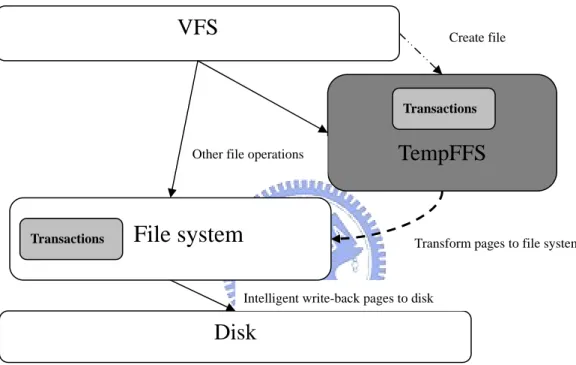
together. We integrate the proposed three approaches in Linux 2.6.12. The overall
structure of three approaches is shown in Figure 3.9.
Figure 3.9Integration of the TempFFS, Intelligent Write Back and File Operation Transaction Support
We create all files in TempFFS, the other file operations, such as read, write, and
delete use the file operations of Ramfs if this file is placed in TempFFS and use file
operations of original file system if this file is transformed into the file system. When
it needs flush the dirty pages into the disk, it uses intelligent write back policy (relo).
Moreover, we inserted the invocation of the transaction API into both ext2 file system
and TempFFS to maintain their consistency.
The performance results of different combinations of the three approaches are
shown in Chapter 4.
TempFFS
Disk
Intelligent write-back pages to disk
Transform pages to file system Other file operations
Create file
VFS
File system
Transactions
Chapter 4 Performance Evaluation
In this chapter, we evaluate the performance of the three proposed mechanisms.
Section 4.1 describes the experimental environment and all the configurations under
performance comparison. Section 4.2 presents the performance improvements of
TempFFS. In Section 4.3, we compare the performance of various write-back policies
mentioned in Section3.1.2. Section 4.4 shows the performance and memory overhead
of the lightweight transaction support mechanism on file system operations. Finally,
we present the performance results of all combinations of the three proposed
mechanisms in Section 4.5.
4.1 Experimental Environment and Configurations
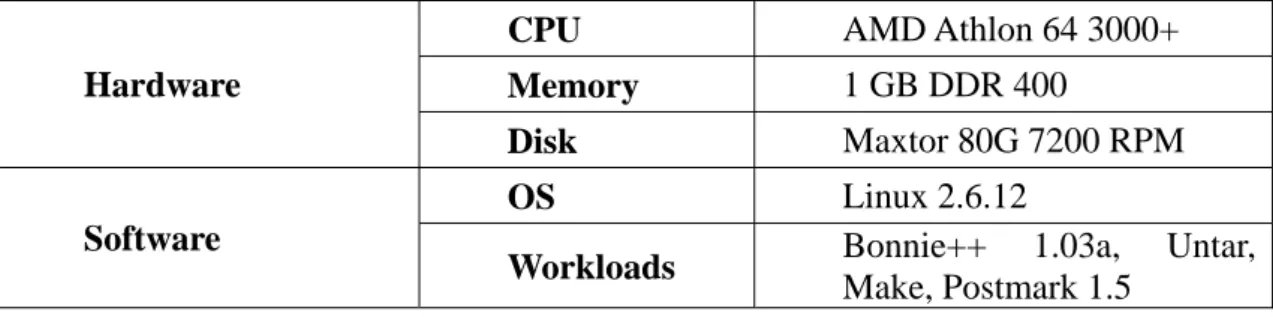
Table 4.1 shows the experimental environment. Since large capacity MRAM is not
generally available in the market, and the performance characteristics of DRAM and
MRAM are comparable, we use DRAM to emulate MRAM. We evaluate the
performance of the proposed mechanisms under two popular benchmarks.
Bonnie++ [5] is a micro-benchmark that measures the performance of single file
access. Three kinds of tests in Bonnie++ are performed, character_write, block_write,
and rewrite. The character write test writes a 2GByte file sequentially in a
character-by-character manner. The block write test writes a 2GByte file in a (several
bytes per block) block-based way. The rewrite test reads the existed block of file and
modifies it, then writes file by block-based. Postmark [22] is a macro-benchmark that
emulates the access pattern of an email server. It creates many files whose size
between Max. Size and Min. Size which are defined by users, and then operates the
assigned number of transactions which may be create/delete or read/append, lastly
files from 5k to 30k and the file size ranging form 512 bytes to 10 Kbytes. For the
other parameters, we use the default settings of Postmark.
Moreover, we also measure the performance under the execution of real application
such as untarring and compiling Linux kernel. We untar a package that contains the
source code and object files of Linux 2.6.12, and then compiling the kernel.
Table 4.1 Evaluation Environment
CPU AMD Athlon 64 3000+
Memory 1 GB DDR 400
Hardware
Disk Maxtor 80G 7200 RPM
OS Linux 2.6.12
Software
Workloads Bonnie++ 1.03a, Untar,
Make, Postmark 1.5
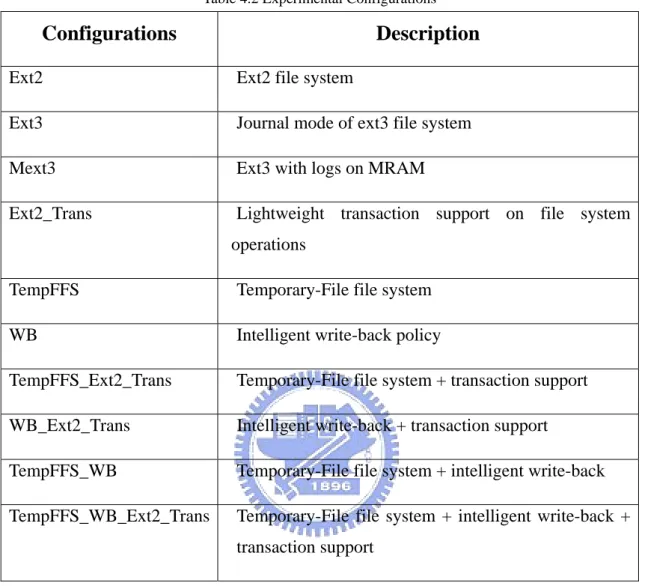
Table 4.2 shows all the experimental configurations under performance comparison.
In the first two configurations, the original ext2 and ext3 file systems are used. For
ext3, we use the Journal mode since it is the only one that provides data integrity. The
mext3 configuration is the same as ext3 except that it improves the performance of
ext3 by placing the logs in a ramdisk residing on MRAM. The last seven
configurations represent various ways of combinations of the three proposed
Table 4.2 Experimental Configurations
Configurations Description
Ext2 Ext2 file system
Ext3 Journal mode of ext3 file system
Mext3 Ext3 with logs on MRAM
Ext2_Trans Lightweight transaction support on file system operations
TempFFS Temporary-File file system
WB Intelligent write-back policy
TempFFS_Ext2_Trans Temporary-File file system + transaction support
WB_Ext2_Trans Intelligent write-back + transaction support
TempFFS_WB Temporary-File file system + intelligent write-back
TempFFS_WB_Ext2_Trans Temporary-File file system + intelligent write-back + transaction support
4.2 The Performance Results of TempFFS
0
5000
10000
15000
20000
25000
30000
35000
character
write
block write
rewrite
Thr
oughput
(
K
byt
es
/s
ec
)
Ext2
Ext2 with
TempFFS
Figure 4.1 Performance Improvements of TempFFS (Bonnie++)
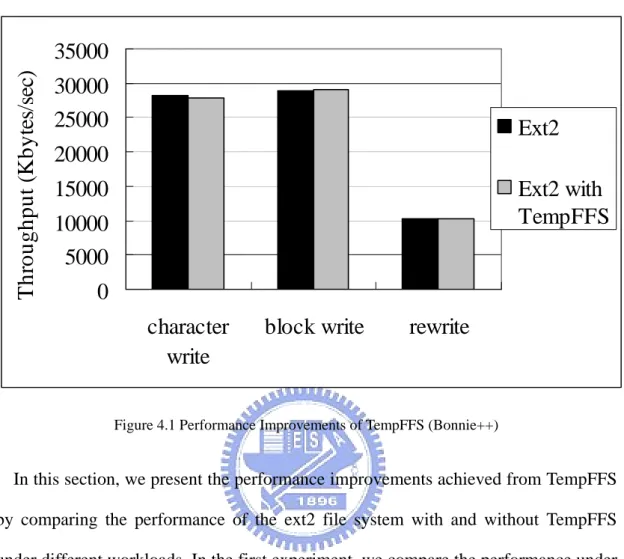
In this section, we present the performance improvements achieved from TempFFS
by comparing the performance of the ext2 file system with and without TempFFS
under different workloads. In the first experiment, we compare the performance under
Bonnie++. The values of the parameters, including the file size and the block size, are
the same as those in Section 4.1.
Figure 4.1 shows the results. From the figure, we can see that TempFFS does not
result in noticeable performance improvements. This is mainly because the size
limitation of a file in TempFFS. As mentioned in Section 3.1.1, a file in TempFFS is
transformed to it original file system if its size exceeds the size limitation (currently,
1Mbytes). Thus, the 2GByte file is transformed to ext2 soon after its creation and
0
20
40
60
80
100
120
140
untar
make
E
x
ecu
ti
o
n
t
im
e (secs)
Ext2
Ext2 with
TempFFS
Figure 4.2 Performance Improvements of TempFFS (Untar and Compile Linux Kernel)
In the second experiment, we measure the performance of TempFFS under Linux
kernel untarring and compilation. Figure 4.2 shows the results. From the figure, we
can see that TempFFS degrades the performance of ext2 by 18% under the untar
workload. Although untaring Linux kernel produces a significant number of small
files, they are never be deleted. Therefore, the files are just first placed in TempFFS,
and then transformed to their original file systems. No IO traffic can be saved.
Moreover, the file creation does not result in a large degree of fragmentation, and thus
TempFFS can seldom help in this workload. Instead, it degrades the performance due
to the file transformation overhead.
For the make workload, the presence of TempFFS does not have a noticeable
impact on the performance of ext2. This is because the workload is CPU-bound.
Therefore, make needs not produce I/O operations to create object files because our
0
50
100
150
200
250
5000
10000
15000
20000
25000
30000
Files
Exe
cut
io
n t
im
e (
se
cs
)
0%
10%
20%
30%
40%
50%
60%
70%
80%
Pe
rf
or
m
anc
e I
m
pr
ove
m
en
t
Ext2
Ext2 with TempFFS
Figure 4.3 Performance Improvements of TempFFS (Postmark)
0% 20% 40% 60% 80% 100% P er ce n ta ge s of Fi le s ( % ) 5000 10000 15000 20000 25000 30000 Files
Deleted in TempFFS Deleted in Ext2
0 10000 20000 30000 40000 50000 60000 70000 80000 90000 5000 10000 15000 20000 25000 30000 Files IO T ra ffi c (re qu es ts ) 0% 20% 40% 60% 80% 100% 120% R educ tion o f IO T ra ff ic
Ext2 Ext2 with TempFFS Reduction of IO traffic
Figure 4.5 Reduction of IO Traffic with TempFFS
0
2000
4000
6000
8000
10000
12000
14000
5000 10000 15000 20000 25000 300
00
Files
A
v
er
ag
e F
il
e S
p
an
(
b
lo
ck
s)
Ext2
Ext2 with
TempFFS
Figure 4.6 Average File Span (Postmark)
In this experiment, we measure the performance improvements of TempFFS under
Postmark. In this experiment, 200k transactions were performed and the file size
ranges from 512 bytes to 10 Kbytes. We measured the performance under various
improves the system performance. Specifically, the performance improvement ranges
from 34% to 69%. This is because a number of files have been deleted before they are
transformed to the file system, reducing both the I/O traffic and the degree of file
fragmentation. We demonstrate this in the following experiments.
As mentioned before, Postmark deletes all the files at the end of its execution.
Figure 4.4 shows the percentage of the number of files deleted in TempFFS and ext2,
with the presence of TempFFS. As shown in the figure, at least 44% of the files are
deleted in TempFFS. In the cases of 5000 and 10000 files, all files are deleted in
TempFFS because the capacity of TempFFS is enough to contain all the files. When
the number of files increases further, a number of files are transformed to ext2,
because of memory pressure, and finally deleted in ext2. For each file deleted in
TempFFS, all its file operations are done in memory and involve no disk IO. Figure
4.5 shows the reduction of IO traffic with the presence of TempFFS. In the cases of
5000 and 10000 files, nearly 100% of the IO traffic can be eliminated since almost all
file operations are done in TempFFS. For the other cases, about 31% of the IO traffic
can be eliminated. Moreover, we show that TempFFS can reduce the degree of file
fragmentation, which is evaluated by using the file span, the distance between the first
block and the last block of a file. During the execution of Postmark, we record the file
span of each file upon the deletion of the file. Figure 4.6 shows the average file span
of all the files. As shown in the figure, the degree of file fragmentation is largely
reduced. Especially, in the cases of 5000 and 10000 files, the average file span is zero
because all the files are deleted in TempFFS and do not have corresponding blocks on
4.3 The Performance Results of Intelligent Write-Back Policy
In this section, we compare the performance of the four write-back policies, file,
recency, location, and relo. The file policy is the file based policy used in Linux. It
scans the list of dirty files and writes back the dirty pages of each dirty file. The
recency policy only writes back dirty pages in the inactive list of the Linux page
cache. The location policy selects the zone with the maximum ASL value and writes
back the dirty pages within the selected zone. Finally, the proposed relo policy
combines the location and the recency policies and writes back the inactive dirty
pages in the selected zone.
0
5000
10000
15000
20000
25000
30000
35000
40000
45000
character
write
block write
rewrite
T
hr
oughput
(
K
byt
es
/s
ec
)
file
recency
location
relo
Figure 4.7 Performance Comparison of the Write Back Polices (Bonnie++)
From Figure 4.7 shows the performance comparison of the four policies under the
Bonnie++ benchmark. The values of the parameters, including the file size and the
block size, are the same as those in Section 4.1. As shown in the figure, the
the original write back policy in Linux. As mentioned in Section 3.1.2, this is because
the Linux write back policy does not consider the recency and disk location
information of the dirty pages, resulting in more redundant page write traffic and
longer seek and rotation delay. The proposed relo policy considers both the recency
and the disk location information and outperforms the original Linux policy by 31%
to 34% under the Bonnie++ benchmark.
0
20
40
60
80
100
120
untar
make
Exe
cut
ion t
im
e (
se
cs
)
file
recency
location
relo
Figure 4.8 Performance Comparison of the Write Back Polices (Untar and Compile Linux Kernel)
Figure 4.8 shows the performance comparison of the four write back policies under
Linux kernel untarring and compilation. As shown in figure, all the latter three
policies perform better than the original one in Linux, and the proposed relo policy
achieve the best performance among the four. Specifically, relo outperforms the file
policy by 23% in the untar workload. In the make workload, the performance
0 20 40 60 80 100 120 140 160 5000 10000 15000 20000 25000 30000 Files Ex ec ut io n t im e (s ec ) 0% 10% 20% 30% 40% 50% 60% 70% Pe rf or m anc e Im pr ov em en t
file zone segment zone_segment
zone/file segment/file zone_segment/file
Figure 4.9 Performance Comparison of the Different Locative Write Back Polices
Figure 4.9 shows three different locative write back policies, zone-based which writes back a region of disk and segment-based which writes back a longest
contiguous blocks of disk and zone/segment-based which mentioned in Section 3.2.
The performance improvement of zone/segment-based has about 58% and is best. The
zone-based is better than segment-based because zone-based can save the seek time of
disk and segment-based can save the rotation delay.
0 20 40 60 80 100 120 140 160 5000 10000 15000 20000 25000 Files Exe cut io n t im e ( se cs ) 0% 10% 20% 30% 40% 50% 60% 70% 80% P erfo rm an ce Im p ro v em en t
file recency location relo recency/file location/file relo/file
Figure 4.10 shows the performance comparison of the four write back policies
under Postmark. In this experiment, 200k transactions were performed and the file
size ranges from 512bytes to 10Kbytes. We measured the performance under various
numbers of files. In this figure, the bars denote the execution time of the Postmark
and the curves denotes the performance improvements of the latter three policies over
the file policy.
As shown in the figure, the performance improvements of the recency, location,
and relo policies are about 62%, 58% and 67%, respectively, as the file numbers are
lager than 15000. In the case of 5000 files and 10000 files, there is no obvious
performance difference among the four policies. This is because the working set is
smaller than the memory size, and hence the write back procedure is seldom
triggered. 0 200 400 600 800 1000 1200 1400 15000 20000 25000 30000 Files A cc u m u la te In te rre q u es ts D is ta nc e ( m il li on b loc ks )
file zone segment zone_segment(location) recency relo
Figure 4.11 Accumulate Inter-requests Distance (Postmark)
Figure 4.11 shows the accumulate inter-requests distance which is the accumulate
blocks of all inter-requests. The less of accumulate inter-requests distance means the
more contiguous write-back blocks. The zone/segment-based has the least accumulate
0 10000 20000 30000 40000 50000 60000 70000 15000 20000 25000 30000 Fils R epe at ed W ri te ba ck B loc ks
file location recency relo
Figure 4.12 Repeated Write Back Blocks (Postmark)
Figure 4.12 shows the total number of repeated write back blocks. In this
experiment, the recency and relo has the less repeated write back blocks because they
avoid write back the blocks which used recently.
4.4 The Performance Results of Transaction Support on Ext2
0
5000
10000
15000
20000
25000
30000
35000
character
write
block write
rewrite
T
hr
oughput
(
K
byt
es
/s
ec
)
Ext3
Mext3
Ext2
Ext2_Trans
transaction API to support atomic file operations. In this Section, we compare the
performance of the augmented ext2 with that of ext3. For ext3, we use the journal
mode since the augmented ext2 can ensure both file system consistency and data
integrity. Moreover, we use two versions of ext3. One places the log in a 256 MB disk
partition (ext3), while the other places the log in a 256 MB ramdisk (mext3). Finally,
the performance of the original ext2 is also presented for the evaluation of the runtime
overhead of the transaction API. Note that ext2 supports neither file system
consistency nor data integrity.
Figure 4.13 shows the performance comparison under the Bonnie++ benchmark. As
shown in the figure, ext2 with transaction support results in the best performance
among the three file systems that ensure file system consistency. This is because it
only duplicates data and metadata in memory during the file operations and does not
involve any disk I/O. It outperforms the ext3 by 63% and the mext3 by 31%. The
performance of ext3 is the worst since the journal mode of Ext3 logs both metadata
and data updates on the disk, it requires a significant number of extra disk IO. Mext3
eliminates some journaling IO traffic. However, the journaling IO traffic is still
required once the journal space is full. Besides, the in-memory journal space of mext3
also occupies the 256MB capacity of the main memory such that the physical memory
decreases a lot. The performance results between ext2 and ext2 with transaction
support are almost the same because our transaction support does not produce I/O
0
20
40
60
80
100
120
140
untar
make
E
x
ecu
ti
o
n
ti
m
e (secs)
Ext3
Mext3
Ext2
Ext2_Trans
Figure 4.14 Untar and Compile Linux Kernel in transaction support
Figure 4.14 shows the performance comparison under Linux kernel untarring and
compilation. Similar to the results in Figure 4.10, ext2 with transaction support
always results in the better performance than ext3 and mext3. For the untar case, the
performance difference is smaller than that under Bonnie++. This is because untarring
the Linux kernel creates many files but does not modify and delete them later, and
then it produces journal data less than Bonnie++ or Postmark. Therefore, ext2 with
transaction support outperforms the ext3 by 17% and the mext3 by 9%. Besides, the
execution time of ext2 transaction is greater than the ext2 a little. For the make case,
since make application is CPU-bound, the performance results of them are almost the