Anisotropic magnetoresistance of La 0.7 Ca 0.3 Mn O 3 thin film biepitaxial step
junctions
S. F. Chen, W. J. Chang, C. C. Hsieh, S. J. Liu, J. Y. Juang, K. H. Wu, T. M. Uen, J.-Y. Lin, and Y. S. Gou
Citation: Journal of Applied Physics 100, 113906 (2006); doi: 10.1063/1.2390545
View online: http://dx.doi.org/10.1063/1.2390545
View Table of Contents: http://scitation.aip.org/content/aip/journal/jap/100/11?ver=pdfcov Published by the AIP Publishing
Articles you may be interested in
Low-field magnetoresistance in nanocrystalline La 0.7 Sr 0.3 Mn O 3 films J. Appl. Phys. 98, 114318 (2005); 10.1063/1.2140081
Spin-polarized quasiparticles injection in La 0.7 Sr 0.3 Mn O 3 Sr Ti O 3 Nb heterostructure devices Appl. Phys. Lett. 86, 122505 (2005); 10.1063/1.1886258
Superconductivity in thin-film YBa 2 Cu 3 O 7 / La 0.7 Ca 0.3 MnO 3 bilayers Appl. Phys. Lett. 80, 4196 (2002); 10.1063/1.1480888
Enhanced room temperature magnetoresistance in La 0.7 Sr 0.3 MnO 3 / Sm 0.7 Sr 0.3 MnO 3 nanocomposites J. Appl. Phys. 91, 7406 (2002); 10.1063/1.1448301
Large low-field magnetoresistance of phase-separated single-crystalline Pr 0.7 Pb 0.3 MnO 3 Appl. Phys. Lett. 80, 3367 (2002); 10.1063/1.1477940
Anisotropic magnetoresistance of La
0.7Ca
0.3MnO
3thin film
biepitaxial step junctions
S. F. Chen, W. J. Chang, C. C. Hsieh,a兲 S. J. Liu,b兲 J. Y. Juang, K. H. Wu, and T. M. Uen
Department of Electrophysics, National Chiao Tung University, Hsinchu 300, Taiwan
J.-Y. Lin
Institute of Physics, National Chiao Tung University, Hsinchu 300, Taiwan
Y. S. Gou
Department of Physics, National Taiwan Normal University, Taipei, Taiwan
共Received 10 July 2006; accepted 19 September 2006; published online 12 December 2006兲 The angular dependence of magnetoresistance共MR兲 of the La0.7Ca0.3MnO3thin film biepitaxial step
junction共BSJ兲 shows a simple sin2共兲 dependence in the in-plane high-field magnetoresistance, with
being the angle between the applied field and current. This behavior is similar to the spin-orbit
coupling-induced anisotropic magnetoresistance 共AMR兲 commonly observed in transition
ferromagnetic metals, except for two salient features. First, the maximum MR in the present case occurs at an oblique angle between the applied field共H兲 and electric current 共I兲, while it is usually observed to occur when H储I. Second, the AMR in the plane perpendicular to the film surface displays a remarkable value共⌬/⬃8%兲, which is about an order of magnitude larger than that of the in-plane AMR. Such a large AMR cannot be solely explained by spin-orbit coupling effect. We suggest instead that the metallic and ferromagnetic inhomogeneous granules existing in the BSJ region might have acted as the source of spin-polarized scattering giving rise to the enhanced AMR when the colossal magnetoresistance was measured across the biepitaxial step boundaries. © 2006 American Institute of Physics.关DOI:10.1063/1.2390545兴
I. INTRODUCTION
The grain-boundary magnetoresistance 共GBMR兲 have
been drawing much attention since the discovery of colossal magnetoresistance 共CMR兲 in granular manganites.1,2 From technological point of view, it is always attractive if practical MR ratio can be routinely obtained without resorting to the more complicated structure such as multilayer junctions
commonly used in giant MR 共GMR兲 or tunneling MR
共TMR兲 devices.3
For this application purpose, the single layer artificial GBMR devices are of potential importance. Fundamentally, however, the understanding of the basic mechanisms giving rise to the observed fascinating GBMR remains unsettled.4–10 For instance, in most artificial GB junctions where the current-voltage characteristics 共IVCs兲 were nonlinear,6,8,11the low-field MR 共defined as MR mea-sured at fields below the magnetization saturation, which is typically 0.1 T for relevant manganites兲 of the GB junctions has been attributed to the spin-polarized tunneling via insu-lating GB regions between ferromagnetic grains, whereas, for those displayed Ohmic IVCs, the spin-polarized scatter-ing between ferromagnetic grains has been proposed to ac-count for the large low-field MR.1,9,10 Moreover, as the field increases beyond 0.1 T, the MR continues to decrease with applied field. This high-field MR has been consistently ob-served in most types of the GB junctions and is almost inde-pendent of temperature below the ferromagnetic transition
temperature. Both the polarized tunneling and spin-polarized scattering models predict that the resistance should remain unchanged once the magnetization of ferromagnetic grains saturates. Thus, both are inadequate to explain the appearance of the high-field MR.
On the other hand, the anisotropic magnetoresistance 共AMR兲 of GBs has also been extensively discussed11–15
ow-ing to the importance of AMR effect on the operation of conventional magnetoresistive read heads used in magnetic storage devices. Fundamentally, the high-field AMR effect is a well known inherent property of ferromagnets originated
from the local spin-orbit scattering of conduction
electrons.16,17 In ferromagnetic metals, such as iron, cobalt, and nickel, the AMR is directly related to the magnetization and leads to a direct dependence on the square of the mag-netization component transverse to the current direction, pro-vided that the applied field is much larger than the coercive field. The angular dependent MR can be described fairly well by the relation R共兲/R共0兲=1+A⫻sin2共兲, where is the
angle between the magnetization and the electric current, and A is the amplitude of AMR. Thus, in a saturated ferromagnet, the resistivity should have an angular dependence on the direction of current flow that is temperature and field inde-pendent. Furthermore, it should vanish as the temperature is increased to TC and above. Based on this concept, Ziese et al.6,18 have investigated the AMR in various types of the GBMR junctions and suggested that electron tunneling be-tween the highly spin-polarized ferromagnetic grains through magnetic manganese atoms in the insulating GB region dominates the high-field MR. However, as mentioned above, tunneling-related mechanisms seem to be inconsistent with a兲Electronic mail: [email protected]
b兲Present address: Department of Material Science, Mingchi University of
Technology, Taishan, Taipei County 243, Taiwan.
0021-8979/2006/100共11兲/113906/5/$23.00 100, 113906-1 © 2006 American Institute of Physics [This article is copyrighted as indicated in the article. Reuse of AIP content is subject to the terms at: http://scitation.aip.org/termsconditions. Downloaded to ] IP:
the Ohmic IVCs found in some cases,4,9,10where it is indica-tive that the extent of magnetic order in the GB regions may have played a role in high-field MR. It is thus desirable to conduct investigations that link these seemingly related phe-nomena to provide a deeper insight into these materials of emerging importance.
In this paper, we report results obtained from measuring the angular dependence of MR on the La0.7Ca0.3MnO3
共LCMO兲 biepitaxial step junctions 共BSJs兲 obtained by depos-iting LCMO film onto SrTiO3共100兲 substrate partially
buff-ered with a layer of anatase TiO2共001兲.10The BSJ shows an
unusually large AMR ratio and the maximum MR occurs at an angle of 50° between the electric current and applied field, indicating that the boundary region, when magnetized at relatively high fields, may still be rather inhomogeneous. This is consistent with the conjectures of attributing the high-field MR to polarized spin scattering through the inhomoge-neous metallic and ferromagnetic granules existent within the boundary regions.10It is noted that recent microstructure analyses on manganite films by Soh et al.19,20 also gave di-rect evidences of strain-induced magnetic inhomogeneities in the vicinity of grain boundaries.
II. EXPERIMENT
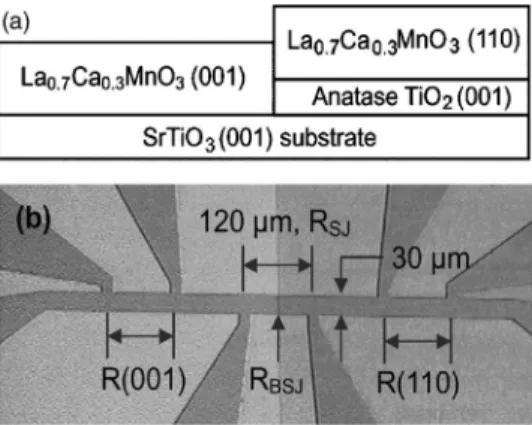
The cross sectional structure of the BSJ sample is sche-matically illustrated in Fig. 1共a兲. Detailed description of the
fabrication process of the BSJs has been reported
previously.10Briefly, the LCMO films grown on the region of bared SrTiO3 substrate and that covered by the TiO2 buffer
layer are 共001兲 and 共110兲 oriented, respectively. The lattice constants of LCMO 共assuming cubic兲 calculated from both 共001兲 and 共110兲 are 0.3859 and 0.3856 nm, respectively. Since the difference is only about 0.07%, we presume that the distortion is not significant and the transport results to be discussed below may not be much relevant to effects arising from lattice distortion. The samples were patterned into bridge using wet etching method to produce a BSJ. Figure 1共b兲 shows the microscopic image of the patterned biepi-taxial sample. The BSJ indicated by the arrow, thus, forms a misoriented GB junction across the boundary separating
共001兲 and 共110兲 regions. The contact pads at each side of the BSJ are used to perform the four-probe resistance measure-ments of the patterned bridge with and without crossing the BSJ. In this way, the BSJ resistance RBSJcan be obtained by
subtracting the resistance of the segment in 共001兲 region, R共001兲, and that in 共110兲 region, R共110兲, from the resistance of the whole segment RSJ. The magnetotransport
measure-ments were carried out in a Quantum Design PPMS® system with the angular resolution being better than 1°.
Previously, we have demonstrated some important fea-tures of GBMR exhibited by this type of BSJ bridges.10They exhibit prominent low-field MR共LFMR兲 behaviors that are typical to most of other types of GB junctions, namely the resistance peaks at the coercive field 共Hc兲 of the
magnetiza-tion hysteresis loop with a MR ratio of about 20%. The field-dependent MR change normalized to resistance at Hcis also
found to be proportional to the square of global magnetiza-tion, suggesting that either magnetic inhomogeneity-induced scattering9 or intergrain spin-polarized tunneling2is respon-sible for the results. However, the fact that the high-field MR 共HFMR兲 deviates significantly from expected linear depen-dence in H 共Refs. 5 and 10兲 and the linear current-voltage characteristic9,10has led us to propose that the magnetotrans-port in this artificial structure may be dominated by polarized spin scattering across the boundary region, instead of attrib-uting it to various types of tunneling mechanisms.4–8
III. RESULTS AND DISCUSSION
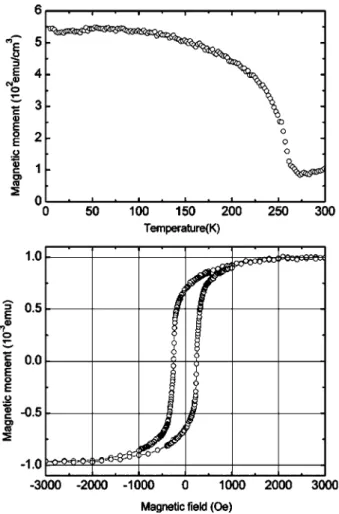
Figure 2共a兲 shows the typical temperature-dependent magnetization for the entire biepitaxial film prior to BSJ bridge patterning. There appears to be only one Curie tem-perature around 260 K for both the共001兲- and 共110兲-LCMO films. The result indicates both the quality and homogeneity of the film. Figure2共b兲displays the M-H curve of the film at 5 K, showing that 90% of magnetization moment saturates at about 1000 Oe. The typical hysteresis loop further indicates that both LCMO共110兲 and LCMO共001兲 have the same coer-cive field Hc⬇250 Oe. Although the above observations
may merely reflect the isotropic nature of LCMO manganite, they, nevertheless, imply that the effects to be discussed be-low should be predominately due to the step junction.
Figure3shows the angular-dependent MRs of the BSJ at 75 and 150 K with a field of 3 T applied in the plane per-pendicular to the film surface. The applied fields used in the measurements were sufficiently larger than the coercive field so that the saturated magnetization is presumed to align with the field. The zero-degree angle 共= 0兲 was defined as the angle when the applied field was perpendicular to the current flow direction. Because the angular configuration is different from the usual equation关R共兲/R共0兲=1+A⫻sin2共兲兴 used for describing the spin-orbit interaction-induced AMR, we add a constant cinto the sin2共兲 term and replace R共0兲 with the
minimum resistance Rmin. The AMR equation, thus, becomes
R共兲/Rmin= 1 + A⫻sin2共−c兲. The circles in the figures are
the experimental data, whereas the solid lines are the fittings using the above equation with A and c being the only
ad-justing parameters. As is evident from Fig. 3, the fits to the data are fairly satisfactory, suggesting that it might have
FIG. 1. 共a兲 The cross-sectional schematics of the biepitaxial sample. The La0.7Ca0.3MnO3共LCMO兲 film grown on the SrTiO3substrate exhibits共001兲 orientation, whereas the LCMO film grown on the TiO2buffer layer is共110兲
oriented.共b兲 The top-view microscopic image of the patterned biepitaxial sample shown in共a兲. The R共001兲, R共110兲, and RSJrepresent the resistances
of the respective segments.
113906-2 Chen et al. J. Appl. Phys. 100, 113906共2006兲
originated from the same spin-orbit interaction prevailing in conventional ferromagnetic materials. Nonetheless, we note that the AMR ratio 共⬃8%兲 is remarkably large and appears to be increasing at lower temperatures. The enhancement of AMR with decreasing temperature is a common feature in the granular manganite films.12 Since the applied magnetic field was well above the saturation field, this large AMR ratio cannot be caused by the demagnetization effect. On the other hand, Ziese and Sena21 have estimated the spin-orbit
interaction-induced AMR and concluded that in
La0.7Ca0.3MnO3 films it should be less than 1%, which ap-parently cannot account for the large AMR effect observed in the current BSJ either. Since the high-field AMR is inti-mately related to the magnetization and the current direction, the current observation implies that significant magnetic an-isotropy might be existent in the BSJ region. This could be
due to the existence of preferential magnetization
orientations.9 In such scenario, the present results indicate that it is more difficult to align the magnetization in the BSJ along the orientation perpendicular to the film plane than that in the plane. In order to further elaborate the possible under-lying mechanism, it is instructive to briefly revisit some of the previous experimental observations on these films.
As has been described previously,10the magnetization of the biepitaxial sample saturates at a field of about 0.1 T,
which is also the field used to separate the low-field and high-field regimes in discussing the MR of the BSJ. The
ferromagnetic transition of the LCMO 共001兲 and LCMO
共110兲 films, which serve as the two electrodes of the present BSJ, occurs at the same temperature 共about 260 K兲 共Fig.2兲, and below this temperature, the resistance of the entire BSJ starts to exhibit a sharp decrease in the low-field regime.10 This resistance drop is indicative of switching of magnetic domains in the applied field. The low-field MR of the BSJ increases with decreasing temperature and reaches about 20%, a value comparable with many other types of artificial GB junctions.5,6
It is apparent that direct access to the information at the length scale of the GB regions is essential for understanding GBMR. However, a direct magnetic measurement of the GBs has not been achieved so far. Although the coexistence of insulatinglike and metalliclike phases at nanometer scale
in a La0.67Ca0.33MnO3 film have been evidently
demonstrated22by scanning tunneling microscopy, it is very difficult to locate the BSJ region exactly. As a result, it is not clear how phase separation in the vicinity of GB accounts for the complexity of the resistance behaviors in manganites. The study of AMR, however, is directly associated with the BSJ region, and thus, may serve as an alternative probe for extracting the magnetic properties within the step junction.
The results of angular-dependent MR at low temperature 共10 K兲 with various applied fields are illustrated in Fig.4. At this temperature, a maximum AMR is expected in the granu-lar films. As can be seen in the figure, the AMR can be well fitted by sin2共兲 at 1 T with slight deviation at high fields.
Based on the assumption of the isotropic magnetization in the film plane, this AMR should arise from the same mecha-nism as in ferromagnetic metals. Indeed, the anisotropy mag-nitude is comparable to that expected from the spin-orbit scattering effect. However, it is striking to note that the angle of the MR maximum, i.e., the minimum in R共兲/Rmin,
dra-matically shifted to the lower angle. The fitted cvalues are
55.9°, 55.5°, and 52.2° for the applied fields of 1, 3, and 8 T,
FIG. 3. The angular-dependent MR for the BSJ at 75 and 150 K with the applied field of 3 T. The field was applied in the plane perpendicular to the film surface. The circles are the experimental data, whereas the solid lines are the AMR fitting result.
FIG. 2. 共a兲 The temperature-dependent magnetization, M共T兲, and 共b兲 the M-H curve measured at 10 K of the biepitaxial LCMO films. The results indicate that both共001兲- and 共110兲-LCMO have the same Curie temperature and coercive field without a noticeable impurity phase.
respectively. To further identify this peculiar behavior, we calculate the angular-dependent MRs of the LCMO 共110兲 plus LCMO共001兲 films in the same plane.
As discussed above, the BSJ resistance is extracted by using the two pairs of measuring contact pads nearest to the BSJ. Similarly, the sum of the segment resistances belonging to the LCMO共001兲 and 共110兲 films, which are indicated as R共001兲 and R共110兲 as shown in Fig.1 can also be identified separately. This resistance sum, however, mostly reflects the angular-dependent MR of the LCMO共110兲 film because the resistance of the LCMO共110兲 film is more than one order of magnitude larger than that of the LCMO 共001兲 film. This angular-dependent MR of the resistance sum is illustrated in Fig.4. Although the experimental data can be fitted very well by sin2共兲, the fitted parameter
chas the value of about 104°
and is independent of magnetic field. The 14° difference ac-counting for the angle between the magnetization and ap-plied field direction, though may be due to the experimental misalignment, is more likely an intrinsic contribution from the LCMO共110兲 film. Nonetheless, the angular difference of about 50° between the resistance minima in the BSJ and LCMO clearly needs further discussion.
Recently, Blamire et al.8 has found a similar effect in La0.7Ca0.3MnO3 bicrystal junctions, in that the maximum
MR occurs when the applied field is directed at an angle of 22° with respect to the GB. They attributed this deviation to the magnetocrystalline anisotropy. However, we noted that this anisotropy scenario probably could not be applied to the BSJ results shown above because the AMR was obtained with a very large applied field and the coercive fields of the
LCMO 共001兲 and 共110兲 films in our BSJ sample are the
same. Since the high-field AMR effect is mainly associated with the magnetization and transport current in ferromag-netic metals, the resistance minimum occurring at an essen-tially arbitrary angle may have resulted from magnetization
inhomogeneity. That is, the magnetization in the BSJ region is not as easy to align with the applied field as that in the epitaxial regions. This magnetization inhomogeneity is inher-ent to the BSJ region because within it the crystal axis rotates from共001兲 to 共110兲 orientation, and hence, may accompany a large strain field. As has been pointed out by Belevtsev et al.,11 such a large strain field may lead to significant aniso-tropic properties in La1−xCaxMnO3 films. As can be seen in
the present AMR results, the BSJ exhibits the feature of AMR, thus, it is suggestive that there could be a certain degree of magnetic order existent in the BSJ region. In ad-dition, the magnitude of the AMR monotonically decreases with increasing magnetic field up to 8 T共Figs.4and5兲. This is consistent with the monotonic decrease of the high-field resistance of the BSJ.10The fact that both the angular depen-dence of the large AMR effect and the high-field MR of the present BSJ can be consistently explained by the magnetic inhomogeneity in the GB region, further indicates that the magnetotransport properties of various artificial manganite junctions are dominated by the polarized spin scattering rather than tunneling mechanisms.
In summary, we have measured the AMR of the BSJ and found that the MR of the BSJ reaches maximum at an angle of 50° between the applied field and the electric current. The magnitudes of AMR, however, suggest that the conventional spin-orbit coupling effect, though may explain the in-plane anisotropy, is inadequate to account for the perpendicular anisotropy. The fact that the BSJ is metallic and displays a certain degree of magnetic order indicates that the AMR arises primarily from the inhomogeneity induced by the tre-mendous strain existent in the step region. Within this sce-nario, the MR of the BSJ can be consistently described by
the spin-polarized scattering mechanism previously
conjectured.
FIG. 4. The angular-dependent MR for the BSJ at 10 K with the various applied fields. The field was applied in the plane of the film surface. Angle zero is defined as the field perpendicular to the electric current. The circles are the experimental data, whereas the solid lines are the AMR fitting results.
FIG. 5. The angular-dependent MR for the LCMO共110兲+LCMO 共001兲 film BSJ at 10 K with various applied fields. The field was applied in the plane of the film surface. Angle zero is defined as the field perpendicular to the electric current. The circles are the experimental data, whereas the solid lines are the AMR fitting results.
113906-4 Chen et al. J. Appl. Phys. 100, 113906共2006兲
ACKNOWLEDGMENTS
This work was supported by the National Science Coun-cil of Taiwan, ROC, under Grant Nos. NSC 95-2112-M-009-035–MY3 and NSC 95-2112-M-009-038–MY3.
1A. Gupta et al., Phys. Rev. B 54, R15629共1996兲.
2H. Y. Hwang, S.-W. Cheong, N. P. Ong, and B. Batlogg, Phys. Rev. Lett.
77, 2041共1996兲.
3J. Z. Sun, Philos. Trans. R. Soc. London, Ser. A 356, 1693共1998兲. 4R. Mathieu, P. Svedlindh, R. A. Chakalov, and Z. G. Ivanov, Phys. Rev. B
62, 3333共2000兲.
5J. E. Evetts, M. G. Blamire, N. D. Mathur, S. P. Isaac, B.-S. Teo, L. F.
Cohen, and J. L. Macmanus-Driscoll, Philos. Trans. R. Soc. London, Ser. A 356, 1593共1998兲.
6M. Ziese, Phys. Rev. B 60, R738共1999兲.
7K. Steenbeck, T. Eick, K. Kirsch, H.-G. Schmidt, and E. Steinbeiß, Appl.
Phys. Lett. 73, 2506共1998兲.
8M. G. Blamire, C. W. Schneider, G. Hammerl, and J. Mannhart, Appl.
Phys. Lett. 82, 2670共2003兲.
9X. W. Li, A. Gupta, G. Xiao, and G. Q. Gong, Appl. Phys. Lett. 71, 1124
共1997兲.
10S. F. Chen, W. J. Chang, S. J. Liu, J. Y. Juang, J.-Y. Lin, K. H. Wu, T. M.
Uen, and Y. S. Gou, Physica B 336, 267共2003兲.
11B. I. Belevtsev, V. B. Krasovitsky, D. G. Naugle, K. D. D. Rathnayaka, A.
Parasiris, S. R. Surthi, R. K. Pandey, and M. A. Rom, Phys. Status Solidi A 188, 1187共2001兲.
12J. N. Eckstein, I. Bozovic, J. O’Donnell, M. Onellion, and M. S.
Rzchowski, Appl. Phys. Lett. 69, 1312共1996兲.
13J. O’Donnell and J. N. Eckstein, Appl. Phys. Lett. 76, 218共2000兲. 14M. Ziese, C. Srinitiwarawong, and C. Shearwood, J. Phys.: Condens.
Matter 10, L659共1998兲.
15V. S. Amaral et al., J. Appl. Phys. 87, 5570共2000兲.
16E. D. Dahlberg and K. Riggs, J. Appl. Phys. 63, 4270共1988兲. 17T. R. McGuire and R. I. Potter, IEEE Trans. Magn. 11, 1018共1975兲. 18M. Ziese, G. Heydon, R. Hohne, P. Esquinazi, and J. Dienelt, Appl. Phys.
Lett. 74, 1481共1999兲.
19Y. A. Soh et al., J. Appl. Phys. 91, 7742共2002兲.
20Y. A. Soh, G. Aeppli, C.-Y. Kim, N. D. Mathur, and M. G. Blamire, J.
Appl. Phys. 93, 8322共2003兲.
21M. Ziese and S. P. Sena, J. Phys.: Condens. Matter 10, 2727共1998兲. 22S. F. Chen, P. I. Lin, J. Y. Juang, K. H. Wu, T. M. Uen, Y. S. Gou, and J.
Y. Lin, Appl. Phys. Lett. 82, 1242共2003兲.