and Kluwer Academic Publishers, Dordrecht (2004)
0133-1736/2004/US$ 20.00. © Akadémiai Kiadó, Budapest. All rights reserved.
RKCL4450
COMPARISON OF THE PROMOTING EFFECTS OF GALLIUM AND ALUMINIUM ON THE n-BUTANE ISOMERIZATION ACTVITY OF
SULFATED ZIRCONIA
Chong-Jiang Caoa, Xi-Zhi Yua,b, Chang-Lin Chen*a, Nan-Ping Xua, Yan-Ru Wanga and Chung-Yuan Mouc
a College of Chemistry and Chemical Engineering, Nanjing University of Technology, Nanjing
210009, P.R. China
b
Anqing Branch, SINOPEC, Anqing, Anhui, P.R. China
c Department of Chemistry, National Taiwan University, 1 Roosevelt Road, Section 4, Taipei 106,
Taiwan
Received November 10, 2003 In revised form February 18, 2004
Accepted February 23, 2004
Abstract
Sulfated zirconia catalysts promoted by gallium or aluminium were prepared and tested for n-butane isomerization. Both elements increase and stabilize the isomerization rate.Characterization results showed that the promoting mechanism of gallium was different from that of aluminium.
Keywords: Gallium, aluminium, sulfated zirconia, n-butane isomerization
INTRODUCTION
The isomerization of light paraffins to branched isomers is an important process in refining industry. n-Butane, which is undesirable for gasoline, can be converted to iso-butane by means of strong acid catalysts. Iso-butane is also a valuable precursor for the production of MTBE and alkylated gasoline.
Numerous investigations on sulfated zirconia (SZ) were carried out [1] since Arata and co-workers [2] reported that SZ catalysts were active for n-butane isomerization at moderate temperature. Although SZ displays good initial activity,
_______________________
*Corresponding author. Fax: +86-25-83300345 E-mail: [email protected]
its fast deactivation prevents industrial application. To enhance its stability and activity, extensive research has been done to search for promoters which could increase and stabilize the catalytic activity. For example, the addition of a small amount of Pt to the catalyst has been recommended to increase the lifetime of SZ catalyst [3]. Transition metals (such as Fe, Mn and Cr) were proposed for doping of SZ catalysts [4,5]. Unfortunately, these transition metals promoted SZ catalysts also exhibit rapid deactivation. Recently, Al or Ga was incorporated into SZ system to enhance substantially the catalytic activity and stability [6-9] of n-butane isomerization.
Much work has been done to study the relationship between physico-chemical characterization and catalytic properties of SZ. Although earlier studies supported super acidity as the primary source of catalytic activity, there is growing evidence that this may not be the case [10]. Davis and co-workers put forward a bi-functional mechanism combining a metallic redox site and an acid site in close proximity to explain the catalytic properties of SZ [11].
In this work, Al and Ga promoted SZ catalysts were prepared. The physico-chemical characterization was carried out using various methods. The catalytic activity of the GSZ and ASZ catalysts was examined in n-butane isomerization and the reasons for the enhancement in activity and stability were discussed based on the experimental results.
EXPERIMENTAL
Zirconium hydroxide was impregnated with an aqueous solution containing the required amounts of Ga2(SO4)3 or Al2(SO4)3. After impregnation, it was
dried at 120oC and calcined in static air at 700oC for 3 h. In order to investigate the influence of the promoters content on the catalytic properties, a series of catalysts with nominal Ga2(SO4)3 or Al2(SO4)3 contents in the precursor between
1% and 5% were prepared. As reference systems, SO42-/ZrO2 (SZ) was prepared
in the same way except that zirconium hydroxide was impregnated with a solution of (NH4)2SO4. The precursor of SZ has nominal sulfate loading of
(NH4)2SO4/Zr(OH)2 = 9 mol%. These catalysts were labeled as SZ, GSZ-X and
ASZ-X (X: mol % of Ga2(SO4)3 or Al2(SO4)3).
XRD measurements were carried out using a Bruker D8 Advance instrument with CuKα radiation. The measurements of the specific surface area of the samples were conducted by BET method on a Micromeritics ASAP 2010 using nitrogen as the analysis gas at liquid nitrogen temperature. Sulfur content in the sample was detected by a chemical method. The sulfate was turned into BaSO4
and determined by gravimetric method. NH3-TPD and H2-TPR were carried out
using a Micromeritics AutoChem 2910 instrument. A 0.1 g sample was used for each TPD or TPR experiment. Prior to experiment, the sample was pretreated at
450oC in flowing air (30 mL/min) for 1 h. In NH3-TPD experiment, NH3
adsorption was carried out at 100oC. After the saturation adsorption of NH3, the
carrier gas He (40 mL/min) flowed over the sample at 100oC for 0.5 h. The NH3-TPD was started at 100
o
C and continued to 800oC at 10oC/min. H2-TPR
was carried out in flow of 30 mL/min 10% H2 in He. The NH3-TPD and H2
-TPR processes were monitored with a Quadruple Mass Spectrometer (Thermo ONIX, ProLab).
Catalytic reaction was tested using a flow-type fixed-bed reactor at atmospheric pressure. 1.0 g catalyst was used. Prior to the reaction, the sample was pretreated in flowing dry air (40 mL/min) at 450oC for 3 h, then cooled to the desired reaction temperature. A gas mixture of n-butane and H2 (1:10 v/v)
was passed over the catalyst bed. The weight hour space velocity (WHSV) of n-butane was 0.3 h-1. Reaction products were analyzed on an on-line Shimadzu GC-14C gas chromatograph equipped with FID detector.
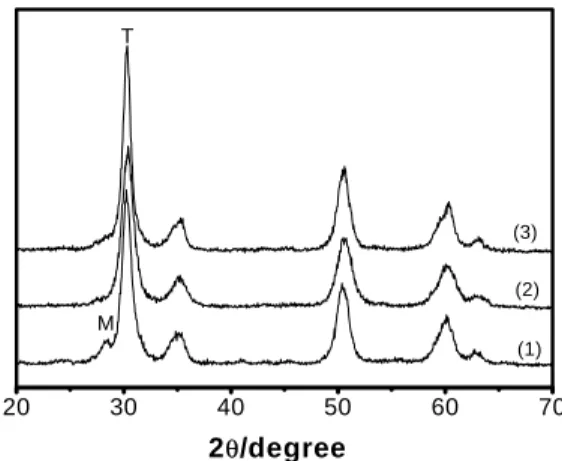
20 30 40 50 60 70 T M (1) (3) (2) 2θ/degree
Fig. 1. XRD patterns of (1) SZ; (2) GSZ-3; (3) ASZ-3. (T: tetragonal phase; M:
monoclinic phase)
RESULTS AND DISCUSSION
The XRD patterns of SZ, GSZ-3 and ASZ-3 are shown in Fig. 1. A certain amount of the monoclinic phase was present in the SZ sample along with the tetragonal phase. For GSZ-3 and ASZ-3 samples, only pure tetragonal phase of sulfated zirconia was detected. XRD results showed that both aluminium and gallium retarded the transformation from the tetragonal phase to the monoclinic phase. For alkane isomerization, the tetragonal phase of SZ shows a higher catalytic activity than that of the monoclinic phase[12]. The preservation of
tetragonal phase in Al- or Ga-promoted samples is probably partly responsible for the enhancement of its catalytic activity in n-butane isomerization.
Table 1
Surface area, sulfur content and catalytic activity of various samples
Conversionb (%) Sample ZrO ) (SO M 2 3 4 2 (mol%) SBET (m2g-1) Sulfur (wt.%) Initial (5 min) Steady state (360 min) SZ - 112 1.01 17.1 15.1 GSZ-1 1 101.8 1.05 45.7 33.7 GSZ-3 3 117.3 1.24 59.2 51.7 GSZ-5 5 139.3 1.32 59.5 47.8 ASZ-1 1 104.3 1.16 35.8 35.0 ASZ-3 3 126.0 1.45 43.6 43.5 ASZ-5 5 141.2 1.56 40.3 40.5 a
M2(SO4)3: Ga2(SO4)3 or Al2(SO4)3; b
Reaction at 220oC
The surface areas and sulfur contents of the various catalysts are listed in Table 1. For the promoted catalysts, an increased in nominal Gaand Al doping led to increase surface area as well as the sulfur content. In comparison to SZ catalyst, the promoted SZ developed more sulfur content. When the samples with the same nominal sulfate loading in the precursors were calcined at 700oC, the sulfate contents in catalysts decreased in the order of ASZ-3 > GSZ-3 > SZ. This sequence suggests that promotion with Ga and Al had a favorable effect on sulfate retention relative to SZ.
To understand the effect of promoters on the acid strength of SZ catalyst, the NH3-TPD technique was employed to measure the acidic characteristic of these
catalysts. The ammonia fragment ion m/z = 16 selected to characterize ammonia is displayed in Fig. 2. A broad NH3-desorption peak from 200 to
600oC was observed over SZ catalyst. For Ga-promoted SZ catalyst, a similar desorption peak was obtained. The profiles in Fig. 2 showed that there was no obvious difference in acidity between the GSZ-3 and SZ catalyst. In contrast, the Al-promoted catalyst shows a higher NH3-desorption peak than SZ catalyst.
It is proposed that the addition of aluminium had a promotional effect on the acid properties in ASZ. Previously, Gao et al. [13] reported that aluminium doping led to an increased number of acid sites. Here, we observed a similar result.
100 200 300 400 500 600 700 800 900 (3) (2) (1) NH 2 + in te n s ity (a .u ) Temperature (oC)
Fig. 2. NH3-TPD profiles of (1) SZ; (2) GSZ-3; (3) ASZ-3
100 200 300 400 500 600 700 800 (1) (2) (3) H2 Consum pt ion ( a .u .) Temperature (oC)
The TPR profiles of these catalysts are shown in Fig. 3. Obviously, SZ and ASZ-3 samples have a similar TPR plot. Comparison to SZ and ASZ-3, H2
consumption peak observed over GSZ-3 sample shifted to lower temperature at about 500oC, showing an enhancement of the redox properties. According to the TPR results, it seems that the promoting effect of gallium on sulfated zirconia is different from that of aluminium. Previously, Gao et al. [13] attributed the catalytic promotion effect of aluminium on SZ to an increase of acid sites. Here, we find that the addition of gallium had no effect on acid properties according to NH3-TPD results. However, the reduction peak of Ga-promoted catalyst is
shifted to a lower temperature, indicating that gallium doping had affected the sulfate species on zirconia and so that it impacted redox properties of the catalyst. 0 60 120 180 240 300 360 0 10 20 30 40 50 60 70 (3) (2) (1) n-B u ta n e con ver si on ( % )
Time on stream (min)
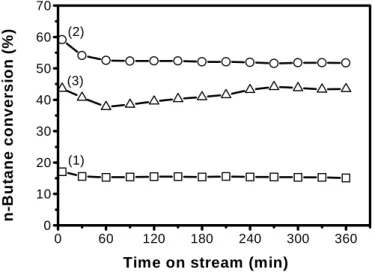
Fig. 4. Conversion of n-butane isomerization at 220 oC over (1) SZ; (2) GSZ-3; (3) ASZ-3
The major product of n-butane isomerization was isobutane, and the main byproducts were propane and isopentane. The selectivity to isobutane for all the catalysts was above 90%. The conversion-time curves obtained at 220oC over the nonpromoted and promoted catalysts are compared in Fig. 4. The SZ catalyst exhibited the lowest activity. Both the Al- and Ga-promoted catalysts exhibited much higher catalytic activities than that of the original SZ. The activity of aluminium promoted catalyst agreed with the results reported previously [14]. Over the gallium promoted catalyst, the initial conversion was as high as 60%. The steady conversion of the reaction tended to 51% .
The effect of nominal sulfate loading on n-butane conversion was studied by varying Ga2(SO4)3 and Al2(SO4)3 content in the range from 1 to 5 mol%. As is
shown in Table 1, the catalytic activity of ASZ catalysts increased with the Al2(SO4)3 content up to 3 mol% and then decreased slightly when it increased to
5 mol%. The same trend was observed over GSZ catalysts. The data of Table 1 also showed that the activity of Ga-promoted catalysts was higher than that of Al-promoted catalysts. In particular, a maximum catalytic activity was observed at a loading of 3 mol% Ga2(SO4)3 and the steady conversion maintained at 51%
which is close to the equilibrium conversion [15].
n-Butane conversions at various temperatures over GSZ-3 and ASZ-3 were studied. When the reaction temperature was 200oC, the steady conversion over ASZ-3 was only 5%. It is considered that most of active sites on the catalyst surface were not activated at this temperature. When the reaction temperature was 220oC, the steady conversion over ASZ-3 increased to 43%. Over GSZ-3 catalyst, the steady conversion was above 30% at 200oC, and 52% at 220oC. These are very different from the ASZ-3 catalyst.
Previously, Poncelet [16] and coworkers, working with Ga-promoted SZ on the isomerization of hexane, have concluded that the presence of promoters contributed to the improved of the redox behavior of the catalysts. The particular activity of the GSZ catalysts was found not due to the increased acidity, but instead to a modification of its electron acceptor ability. In this paper, we further compare the acidity and redox properties of GSZ and ASZ on the simpler isomerization of butane to show the contrast. Although, Al and Ga are neighbors in the periodic table and apparently they both show good promoting effect in the catalysis of isomerization of alkanes, the mechanism of the promotional effect is very different. Aluminium promotes the isomerization by increasing the acid sites, but gallium seems to promote the dehydrogenation step in the bimolecular mechanism of butane isomerization. This can be confirmed by the ease of hydrogen uptake and the evolution of more hydrogen sulfide in our TPR experiment. Ga also stabilizes the catalytic action at moderate temperature. Generally, coking on catalytic sites is the main mechanism of deactivation of catalytic isomerization by strong solid acids. Apparently, the promotional effect of Ga is not too strong to form cokes. There is a fine balance between the promotion of dehydrogenation and the subsequent acid catalysis of isomerization by bimolecular mechanism.
Acknowledgements. Financial support by the Science and Technology Department of Jiangsu Province (Project BG2002017) and Key Laboratory of Materials-Oriented Chemical Engineering of Jiangsu Province are gratefully acknowledged. CYM thanks the support of a MOE Research Excellency grant.
REFERENCES
1. X. Song, A. Sayari: Catal. Rev. Sci. Eng., 38, 329 (1996).
2. M. Hino, S. Kobayashi, K. Arata: J. Am. Chem. Soc., 101, 6439 (1979).
3. F. Garin, D. Andriamasinoro, A. Abdulsamad, J. Sommer: J. Catal., 131, 199 (1991). 4. C.Y. Hsu, C.R. Heimbuch, C.T. Armes, B.C. Gates: J. Chem. Soc. Chem. Commun., 1645
(1992).
5. C.X. Miao, W.M. Hua, J.M. Chen, Z. Gao: Catal. Lett., 37, 187 (1996). 6. Z. Gao, Y.D. Xia, W.M. Hua, C.X. Miao: Topics Catal., 6, 101 (1998). 7. J.A. Moreno, G. Poncelet: J. Catal., 203, 453 (2001).
8. C.-L. Chen, T. Li, S. Cheng, N.-P. Xu, C.-Y. Mou: Catal. Lett., 78, 223 (2002). 9. W. Wang, C.-L. Chen, N.-P. Xu, C.-Y. Mou: Green Chem., 4, 257 (2002)
10. V. Adeeva, J.W. Hann, J. Jänchen, G.D. Lei, V. Schünemann, L.J.M. van der Ven, W.M.H. Sachtler, R.A.J. van Santen: J Catal., 151, 364 (1995).
11. K.T. Wan, C.B. Khouw, M.E. Davis: J. Catal., 158, 311(1996). 12. R.A. Keogh , B.H. Davis: Catal. Lett., 57, 33 (1999).
13. W. Hua, Y. Xia, Y. Yue, Z. Gao: J. Catal., 196, 104 (2000).
14. P. Canton, R. Olindo, F. Pinna, G. Strukul, P. Riello, M. Meneghetti, G. Cerrato, C. Morterra, A. Benedetti: Chem. Mater., 13, 1634 (2001).
15. S.T. Sie, in: G. Ertl, H. Knözinger, J. Weitkamp (Eds.), Handbook of Heterogeneous
Catalysis, Vol. 4, p. 1998. Wiley-VCH, Weinheim 1997.
16. V. Pârvulescu, S. Coman, V.I. Pârvulescu, P. Grange, G. Poncelet: J. Catal., 180, 66 (1998).