
Merging Multilingual Information Retrieval Results Based on Prediction of Retrieval Effectiveness
7
0
0
全文
(2) Proceedings of NTCIR-4, Tokyo, April 2003 - June 2004. estimated by the portion of overlap between the original query and the ideal query constructed from the top ranked documents. The experimental results showed that feedback merging had little impact. Lin and Chen [9, 10, 11] proposed several merging strategies to integrate the result lists of document collections in different languages. We assume that the importance of each intermediate run depends on their retrieval performance. Three factors affecting the retrieval effectiveness, i.e., the degree of translation ambiguity, the number of unknown words and the number of relevant documents in a collection for a given query, were introduced. We proposed normalized-by-top-k merging to avoid the drawback of normalized-score merging. Translation penalty and collection weight are also considered during merging result lists. Experimental results showed that the performances of the proposed merging strategies were similar to that of raw-score merging and were better than that of normalized-score and round-robin merging in single IR system environment. In this paper, we extend our past works and modify the methods for computing translation penalty and collection weight to improve merging performance. The rest of this paper is organized as follows. Section 2 describes our merging strategies. Section 3 describes the indexing method and query translation process. Section 4 shows the experiment results. Section 5 concludes the remark.. 2. Merging strategies. We aim to include as more relevant documents as possible in the final result list and to make relevant documents have higher ranks during merging. We assume that the importance of each intermediate run depends on their retrieval performance. If a result list contains many relevant documents in the top ranks, i.e., it has good performance, the top ranked documents should be included in the final result list. On the other hand, if a result list has few or even no relevant documents, the final result list should not contain many documents from this list. Thus, the higher performance an individual run has, the more important it is. However, without the priori knowledge of a query in advance, it is challenging to predict the performance of an individual run for each document collection. The similarity score between a document and a query is one of a few clues that are common used. The basic idea of our merging strategies is adjusting the similarity scores of documents in each result list to make them more comparable and to reflect the confidence in retrieval effectiveness. In our previous works [9, 10, 11], we proposed normalized-by-top-k to normalize the similarity scores of documents. The original similarity score of. each document in a result list reported from a text collection for a query is divided by the average score of top k documents in the result list. Translation penalty and collection weight are proposed to predict the retrieval effectiveness of intermediate runs. For a result list of an intermediate run, the similarity scores are adjusted by the following formula. 1 Sˆ ij = S ij × × Wi S ik. (1). where Sij is the original similarity score of the document at rank j in the ranked list of query qi, Sˆij is the adjusted similarity score of the document at rank j in the ranked list of query qi, S ik is the average similarity score of top k documents in the ranked list of query qi, and Wi is the merging weight of query qi in the intermediate run. The merging weight Wi of an intermediate run is determined by translation penalty and collection weight which are discussed in the following subsections.. 2.1 Translation penalty Similarity score reflects the degree of similarity between a document and a query. A document with higher similarity score seems to be more relevant to the desired query. However, if the query is not formulated well, e.g., inappropriate translation of a query, a document with high score may still not meet user’s information need. When the result lists are merged, those documents that have high, but incorrect scores should not be included in the final result list. Thus, the effectiveness of each individual run has to be considered in the merging stage. When query translation is used to deal with the unification of language usages in queries and documents, queries are translated into target language and then the target language documents are retrieved. We could predict the multilingual retrieval performance based on the translation quality. Intuitively, using Chinese query to access Chinese collection is expected to have better performance than using it to access document collections in other languages. Similarly, using a bilingual dictionary of more coverage is expected to be better than that of less coverage. Less ambiguous queries have also higher tendency to achieve better translation than more ambiguous queries. Two factors, i.e., the degree of translation ambiguity and the number of unknown words, are used to model the translation performance. Given a query, we compute the average number of translation equivalents of query terms and the number of unknown words in each language pair, and use them to compute the.
(3) Proceedings of NTCIR-4, Tokyo, April 2003 - June 2004. translation penalty of each cross-lingual run. The following formula is proposed to determine translation penalty of an intermediate run. nui ⎡ ⎛ ⎞⎤ wut ⎟⎥ ⎜ ∑ ⎢ ⎡ ⎛ 51 − Ti ⎞ ⎤ ⎢ ⎟⎥ (2) Wtpi = c1 + ⎢c2 × ⎜ ⎟ ⎥ + c3 × ⎜1 − t =1 ⎜ ni ⎟⎥ ⎝ 50 ⎠ ⎥⎦ ⎢ ⎢⎣ ⎜ ⎟⎥ ⎢ ⎝ ⎠⎦ ⎣ 2. where Wtpi is the translation penalty of query qi in a cross-lingual run, Ti is the average number of translation equivalents of query terms in query qi, wut is the penalty weight of an unknown word, nui is the number of unknown words in query qi, ni is the number of query terms in query qi, and c1, c2 and c3 are tunable parameters. The importance of query terms in different syntactic categories should be different in CLIR. For example, if a proper noun in a query is not translated, the retrieval performance could be poor. On the other hand, if the unknown word is a preposition, it has little impact on retrieval performance. Therefore, proper nouns should be more important than prepositions. We divide query terms into three classes and assign different weights to each class. The first class is named entities including person names, location names and organization names. These named entities are very important and assigned the highest weight. The second class contains nouns and verbs. Nouns and verbs are useful content words, but are not as important as named entities. The words in other syntactic categories belong to the third class which has lowest weight. The penalty weight of an unknown word Cuj is determined in the following way: if Cuj is a person name, a location ⎧1.5 name or an organzation name ⎪⎪ (3) wuj = ⎨ 1 if Cuj is a noun or a verb ⎪ ⎪⎩0.5 otherwise The best case of query translation is that each query term has only one translation, that is, the average number of translation equivalents is 1, and the number of unknown words is 0. In such a case, query will be translated correctly, thus the value of translation penalty is 1. As the number of unknown words or the average number of translation equivalents increases, the translation quality and retrieval performance are more likely to be worse. Therefore, the value of merging weight is decreased to reduce the importance of this intermediate run.. 2.2 Collection weight of individual document collection. How many relevant documents there are in a document collection for a given query is also an important factor for predicting retrieval effectiveness. If a document collection contains more relevant documents, it could have more contribution to the final result list. Callan, Lu and Croft [3] proposed CORI net to rank distributed collections of the same language for a query. Moulinier and Molina-Salgado [13] used collection score to adjust the similarity score between a document and a query. In our approach, we try to estimate the proportion of possible relevant documents of a query in a document collection. If the proportion of relevant documents is high, they have more chance be retrieved. Therefore, a document collection with higher portion of relevant documents is assigned higher weight. Given a query qi, the collection weight of a document collection Dm is estimated by the following formula. CWim =. avg _ DFim Nm. (4). where CWim is the collection weight of document collection Dm corresponding to query qi, avg_DFim is the average document frequency of query terms in query qi, and Nm is the number of documents in collection Dm. Combining translation penalty and collection weight, the merging weight Wi is measured by the following formula. Wi = Wtpi + c 4 × CW im. (5). where c4 is a tunable parameter.. 3. Indexing and query translation. The document set used in NTCIR-4 MLIR task consists of Chinese (C), Japanese (J), Korean (K), and English (E) documents [8]. The participants can use two types of multilingual document collections, i.e., CJKE and CJE collections, as the target language sets. We used CJE collection in the experiments. Okapi IR system was adopted to index and retrieve documents. The weighting function was BM25 [17]. The <HEADLINE> and <TEXT> sections were used for indexing. For English, the words in these sections were stemmed, and stopwords were removed. Japanese documents were segmented by ChaSen [12]. Chinese documents were segmented by a word recognition system [6]. All words in the above two sections were used as index terms. In the experiments, the Chinese queries were used as source queries and translated into target languages, i.e., English and Japanese. First, the Chinese queries were segmented by a word recognition system, and tagged by a POS tagger. Name entities were then.
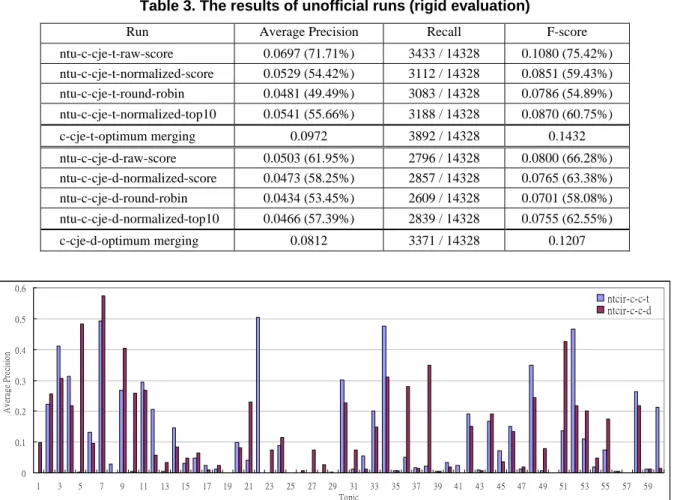
(4) Proceedings of NTCIR-4, Tokyo, April 2003 - June 2004. identified [6]. For each Chinese query term, we found its translations by looking up bilingual dictionaries. The Chinese-English bilingual dictionary is integrated from four resources, including the LDC Chinese-English dictionary, Denisowski's CEDICT 1 , BDC Chinese-English dictionary v2.2 2 and a dictionary used in query translation in MTIR project [1]. The ChineseJapanese bilingual dictionary is Dr.eye dictionary3. For each query term, we used the first-twohighest-frequency method to select appropriate translations. The first two translations with the highest frequency in the target language document collection are considered as the target language query terms.. 4. Experiment results. In NTCIR-4 MLIR task, we submitted four CÆCJE multilingual runs. Two runs use <TITLE> field of topics to construct queries. The other two runs use <DESC> field only. The source Chinese queries and the translated English and Japanese queries were used to retrieve Chinese, English and Japanese documents, respectively. Then, we merged these three result lists. The details of the four runs are described as follows. 1. NTU-C-CJE-T-01 This run used <TITLE> section only. Formula (1) was used to adjust the similarity score of each document. We used the average similarity score of top 10 documents for normalization. The merging weight Wi was determined by formula (5), i.e., combining translation penalty and collection weight. The values of c1, c2, c3, and c4 were set to be 0, 0.2, 0.5, and 0.3, respectively. After adjusting similarity score, all results were put in a pool and sorted by the adjusted score. The top 1000 documents were selected as the final results. 2. NTU-C-CJE-T-02 This run used <TITLE> section only. The merging strategy is similar to run NTU-C-CJET-01 except that the merging weight Wi was determined by translation penalty only. The values of c1, c2 and c3 were set to be 0, 0.4 and 0.6, respectively. 3. NTU-C-CJE-D-01 This run used <DESC> section only. The merging strategy used in this run is the same as run NTU-C-CJE-T-01. 1 The dictionary is http://www.mandarintools.com/cedict.html. available. at. 2 The BDC dictionary is developed by the Behavior Design Corporation (http://www.bdc.com.tw) 3 The Dr.eye dictionary is developed by Inventec Corporation. (http://www.dreye.com). 4.. NTU-C-CJE-D-02 This run used <DESC> section only. The merging strategy used in this run is the same as run NTU-C-CJE-T-02. The results of our official runs are shown in Table 1. Table 2 shows the unofficial evaluation of intermediate monolingual (i.e., Chinese to Chinese) and cross-lingual runs (i.e., Chinese to Japanese and Chinese to English). The rigid relevant set was used to evaluate the performances. The performance of Chinese-Japanese cross-lingual run is poor. One of the reasons is that many query terms have no Japanese translation. In contrast, most query terms have English translations, thus the performance of Chinese-English cross-lingual run is better. The performance of Chinese monolingual run is not good enough. This is probably because that only 14 topics (Topics 001 - 014) are original in Chinese. Figure 1 shows the average precision of each topic in Chinese monolingual runs. The performances of Topics 001 014 are better than that of remaining Topics. In Topic 001 - 014, there are 9 and 8 topics which average precision is higher than 0.1 in run ntu-c-c-t and ntu-c-c-d, respectively. In the remaining 46 topics, only 13 and 16 topics have an average precision higher than 0.1 in run ntu-c-c-t and ntu-c-cd, respectively. In order to compare the effectiveness of different merging strategies, we also conducted several unofficial runs using the following merging strategies. 1. ntu-c-cje-t-raw-score/ ntu-c-cje-d-raw-score We used raw-score merging to merge result lists. 2. ntu-c-cje-t-normalized-score/ ntu-c-cje-dnormalized-score The result lists were merged by normalizedscore merging strategy. The maximum similarity score was used for normalization. 3. ntu-c-cje-t-round-robin/ ntu-c-cje-d-round-robin We used round-robin merging to merge result lists. 4. ntu-c-cje-t-normalized-top10/ ntu-c-cje-dnormalized-top10 In this run, we used normalized-by-top-k merging. The average similarity score of top 10 documents was used for normalization. The average precision of optimal merging proposed by Chen [4] was regarded as an upperbound, which was used to measure the performances of our merging strategies. Given the relevance judgments of documents, optimal merging can produce the best merging result under the constraint that the relative ranking of the documents in the individual ranked lists is preserved. The performances of the unofficial runs are shown in Table 3. We used the rigid relevant set to evaluate the unofficial runs. The performance relative to optimal merging is enclosed in parentheses..
(5) Proceedings of NTCIR-4, Tokyo, April 2003 - June 2004. Table 1. The results of official runs Run. Scoring Mode Rigid Relax Rigid Relax Rigid Relax Rigid Relax. NTU-C-CJE-T-01 NTU-C-CJE-T-02 NTU-C-CJE-D-01 NTU-C-CJE-D-02. Average Precision 0.0640 0.0838 0.0629 0.0809 0.0521 0.0625 0.0519 0.0609. Recall 3411 / 14328 5916 / 24688 3386 / 14328 5765 / 24688 2874 / 14328 4837 / 24688 2858 / 14328 4739 / 24688. F-score 0.1009 0.1242 0.0994 0.1202 0.0827 0.0948 0.0824 0.0925. Table 2. The performances of intermediate runs (rigid evaluation) Run ntu-c-c-t. # Topic 59. Average Precision 0.1158. Recall 622 / 1318. F-score 0.1860. ntu-c-j-t. 55. 0.0399. 1214 / 7137. 0.0646. ntu-c-e-t. 58. 0.1303. 3006 / 5866. 0.2078. ntu-c-c-d. 59. 0.1273. 733 / 1318. 0.2072. ntu-c-j-d. 55. 0.0319. 1268 / 7137. 0.0541. ntu-c-e-d. 58. 0.1061. 2412 / 5866. 0.1687. Table 3. The results of unofficial runs (rigid evaluation) Run. Average Precision. Recall. F-score. ntu-c-cje-t-raw-score ntu-c-cje-t-normalized-score ntu-c-cje-t-round-robin. 0.0697 (71.71%) 0.0529 (54.42%) 0.0481 (49.49%). 3433 / 14328 3112 / 14328 3083 / 14328. 0.1080 (75.42%) 0.0851 (59.43%) 0.0786 (54.89%). ntu-c-cje-t-normalized-top10. 0.0541 (55.66%). 3188 / 14328. 0.0870 (60.75%). c-cje-t-optimum merging. 0.0972. 3892 / 14328. 0.1432. ntu-c-cje-d-raw-score ntu-c-cje-d-normalized-score ntu-c-cje-d-round-robin. 0.0503 (61.95%) 0.0473 (58.25%) 0.0434 (53.45%). 2796 / 14328 2857 / 14328 2609 / 14328. 0.0800 (66.28%) 0.0765 (63.38%) 0.0701 (58.08%). ntu-c-cje-d-normalized-top10. 0.0466 (57.39%). 2839 / 14328. 0.0755 (62.55%). 0.0812. 3371 / 14328. 0.1207. c-cje-d-optimum merging. 0.6. ntcir-c-c-t ntcir-c-c-d. Average Precision. 0.5 0.4 0.3 0.2. 0.1 0 1. 3. 5. 7. 9. 11. 13. 15. 17. 19. 21. 23. 25. 27. 29. 31 Topic. 33. 35. 37. 39. 41. 43. 45. 47. 49. 51. 53. Figure 1. The average precision of each topic in Chinese monolingual runs. 55. 57. 59.
(6) Proceedings of NTCIR-4, Tokyo, April 2003 - June 2004. 0.6. NTU-C-CJE-T-01 ntu-c-cje-t-raw-score. Average Precision. 0.5 0.4 0.3 0.2 0.1 0 1. 3. 5. 7. 9. 11. 13. 15. 17. 19. 21. 23. 25. 27. 29. 31 Topic. 33. 35. 37. 39. 41. 43. 45. 47. 49. 51. 53. 55. 57. 59. Figure 2. The average precision of each topic in run NTU-C-CJE-T-01 and ntu-c-cje-t-raw-score. 0.3. NTU-C-CJE-D-01 ntu-c-cje-d-raw-score. Average Precision. 0.25 0.2 0.15 0.1 0.05 0 1. 3. 5. 7. 9. 11. 13. 15. 17. 19. 21. 23. 25. 27. 29. 31 Topic. 33. 35. 37. 39. 41. 43. 45. 47. 49. 51. 53. 55. 57. 59. Figure 3. The average precision of each topic in run NTU-C-CJE-D-01 and ntu-c-cje-d-raw-score From Table 1, the performance of run NTU-CCJE-T-01 is slightly better than that of run NTU-CCJE-T-02. Similarly, run NTU-C-CJE-D-01 is slightly better than run NTU-C-CJE-D-02. It shows that the contribution from collection weight is limited. The performances of the runs using title field are better than that of the runs using description field. When using title field, raw score merging performs best. Normalized-by-top-k merging with translation penalty and collection weight is slightly worse than raw-score merging. The performances of normalized-score and round-robin merging are worse than raw-score merging and our approaches. In the experiments that using description field, normalizedby-top-k merging with translation penalty and collection weight performs better than raw-score merging. However, the difference is not significant. We further analyze the performances of our approaches query by query. There are 32 and 30 topics that Normalized-by-top-k merging with translation penalty and collection weight performs better than raw-score merging when using title and description field, respectively. In contrast, there are 27 and 25 topics that raw-score merging performs better. Figures 2 and 3 show the average precision of each topic in title and description experiments, respectively. For many queries, the difference in average precision between these two approaches is large. We found that if the performance of a topic in. Chinese monolingual run is good, normalized-bytop-k merging with translation penalty and collection weight is likely better than raw-score merging. Take Topic 005 as an example. When using description field, the average precision of Chinese-Chinese, Chinese-Japanese and Chinese-English runs are 0.4820, 0.0161 and 0.1755, respectively. The performance of normalized-by-top-k merging with translation penalty and collection weight (0.0952) is better than that of raw-score merging (0.0489). This is because that the similarity scores of Chinese documents are smaller than that of English and Japanese documents. Raw-score merging will prefer English and Japanese documents, thus irrelevant documents are placed in higher rank. In run NTU-CCJE-D-01, similarity scores are normalized, and the merging weight of Chinese monolingual run is higher than that of cross-lingual runs. Therefore, Chinese documents are preferred. On the other hand, if the performance of Chinese monolingual run is poor, and either cross-lingual run performs well, raw-score merging performs better. As described above, the similarity scores of Chinese documents are smaller, thus they are placed in lower ranks when using raw-score merging. Since monolingual run does not have translation penalty, its merging weight is high. Chinese documents result in higher ranks in our approach..
(7) Proceedings of NTCIR-4, Tokyo, April 2003 - June 2004. 5. Concluding Remarks. Merging problem is critical in distributed multilingual information retrieval. This paper proposed several merging strategies to integrate the result lists of collections in different languages. The prediction of retrieval effectiveness is used to determine the merging weight of each intermediate run. We modify the methods for computing translation penalty and collection weight to improve merging performance. The experimental results showed that the performance of normalized-by-top-k with translation penalty and collection weight was better than that of normalized-score merging and round-robin merging, and is similar to that of raw-score merging. When the performance of monolingual intermediate run is good, normalized-by-top-k with translation penalty and collection weight tends to be better than rawscore merging. When the performance of monolingual run is poor, the merging weight is overweighted. How to estimate the merging weight of monolingual run more precisely will be further investigated.. Acknowledgements The research was supported in part by National Science Council, Taiwan, under project number NSC 93-2752-E-001-001-PAE.. References [1] Bian, G.W. and Chen, H.H. Cross Language Information Access to Multilingual Collections on the Internet. Journal of American Society for Information Science, 51(3): 281-296, 2000. [2] Braschler, M., Göhring, A. and Schäuble, P. Eurospider at CLEF 2002. In Peters, C., Braschler, M., Gonzalo, J., and Kluck, M. (Eds.), Advances in Cross-Language Information Retrieval - Third Workshop of the Cross-Language Evaluation Forum, CLEF 2002. Lecture Notes in Computer Science, Vol. 2785. Springer, 2003 (pp. 164-174). [3] Callan, J.P., Lu, Z. and Croft, W.B. Searching Distributed Collections With Inference Networks. In Fox, E.A., Ingwersen, P. and Fidel, R. (Eds.) Proceedings of the 18th Annual International ACM SIGIR Conference on Research and Development in Information Retrieval. ACM Press, 1995 (pp. 21-28). [4] Chen, A. Cross-language Retrieval Experiments at CLEF-2002. In Peters, C., Braschler, M., Gonzalo, J., and Kluck, M. (Eds.), Third Workshop of the CrossLanguage Evaluation Forum, CLEF 2002. Lecture Notes in Computer Science, Vol. 2785. Springer, 2003 (pp. 28-48). [5] Chen, H.H., Bian, G.W. and Lin, W.C. Resolving translation ambiguity and target polysemy in crosslanguage information retrieval. In Proceedings of 37th Annual Meeting of the Association for Computational Linguistics. Association for Computational Linguistics, 1999 (pp. 215-222).. [6] Chen, H.H., Ding, Y.W, Tsai, S.C., and Bian, G.W. Description of the NTU System Used for MET2. In Proceedings of 7th Message Understanding Conference. 1998. [7] Kando, N., Oyama, K. and Ishida, E. (Eds.). Proceedings of the Third NTCIR Workshop on research in information Retrieval, Automatic Text Summarization and Question Answering. Tokyo, Japan: National Institute of Informatics, 2003. [8] Kishida, K., Chen, K.H., Lee, S., Kuriyama, K., Kando, N., Chen, H.H., Myaeng, S.H., and Eguchi, K. Overview of CLIR Task at the Forth NTCIR Workshop. In this volume. [9] Lin, W.C. and Chen, H.H. Description of NTU Approach to NTCIR3 Multilingual Information Retrieval. In Kando, N., Oyama, K. and Ishida, E. (Eds.), Proceedings of the Third NTCIR Workshop on research in information Retrieval, Automatic Text Summarization and Question Answering. Tokyo, Japan: National Institute of Informatics, 2003. [10] Lin, W.C. and Chen, H.H. Merging Mechanisms in Multilingual Information Retrieval. In Peters, C., Braschler, M., Gonzalo, J., and Kluck, M. (Eds.), Advances in Cross-Language Information Retrieval Third Workshop of the Cross-Language Evaluation Forum, CLEF 2002. Lecture Notes in Computer Science, Vol. 2785. Springer, 2003 (pp. 175-186). [11] Lin, W.C. and Chen, H.H. Merging Results by Predicted Retrieval Effectiveness. In Peters, C. (Ed.), Results of the CLEF 2003 Cross-Language System Evaluation Campaign. 2003. [12] Matsumoto, Y., Kitauchi, A., Yamashita, T., and Hirano, Y. Japanese Morphological Analysis System ChaSen version 2.0 Manual. Technical Report NAIST-IS-TR99009, Nara Institute of Science and Technology Technical Report, 1999. [13] Moulinier, I. and Molina-Salgado H. Thomson Legal and Regulatory experiments for CLEF 2002. In Peters, C., Braschler, M., Gonzalo, J., and Kluck, M. (Eds.), Advances in Cross-Language Information Retrieval Third Workshop of the Cross-Language Evaluation Forum, CLEF 2002. Lecture Notes in Computer Science, Vol. 2785. Springer, 2003 (pp. 155-163). [14] Oard, D. and Diekema, A. Cross-Language Information Retrieval. Annual Review of Information Science and Technology, 33:223-256, 1998. [15] Peters, C. (Ed.). Results of the CLEF 2003 CrossLanguage System Evaluation Campaign. 2003. [16] Peters, C., Braschler, M., Gonzalo, J., and Kluck, M. (Eds.). Advances in Cross-Language Information Retrieval - Third Workshop of the Cross-Language Evaluation Forum, CLEF 2002. Lecture Notes in Computer Science, Vol. 2785. Springer, 2003. [17] Robertson, S.E., Walker, S. and Beaulieu, M. Okapi at TREC-7: automatic ad hoc, filtering, VLC and interactive. In Voorhees, E.M. and Harman, D.K. (Eds.), Proceedings of the Seventh Text REtrieval Conference (TREC-7). National Institute of Standards and Technology, 1998 (pp. 253-264). [18] Savoy, J. Report on CLEF 2002 Experiments: Combining Multiple Sources of Evidence. In Peters, C., Braschler, M., Gonzalo, J., and Kluck, M. (Eds.), Advances in Cross-Language Information Retrieval Third Workshop of the Cross-Language Evaluation Forum, CLEF 2002. Lecture Notes in Computer Science, Vol. 2785. Springer, 2003 (pp. 66-90)..
(8)
數據

相關文件
好了既然 Z[x] 中的 ideal 不一定是 principle ideal 那麼我們就不能學 Proposition 7.2.11 的方法得到 Z[x] 中的 irreducible element 就是 prime element 了..
volume suppressed mass: (TeV) 2 /M P ∼ 10 −4 eV → mm range can be experimentally tested for any number of extra dimensions - Light U(1) gauge bosons: no derivative couplings. =>
For pedagogical purposes, let us start consideration from a simple one-dimensional (1D) system, where electrons are confined to a chain parallel to the x axis. As it is well known
The observed small neutrino masses strongly suggest the presence of super heavy Majorana neutrinos N. Out-of-thermal equilibrium processes may be easily realized around the
incapable to extract any quantities from QCD, nor to tackle the most interesting physics, namely, the spontaneously chiral symmetry breaking and the color confinement..
(1) Determine a hypersurface on which matching condition is given.. (2) Determine a
• Formation of massive primordial stars as origin of objects in the early universe. • Supernova explosions might be visible to the most
The difference resulted from the co- existence of two kinds of words in Buddhist scriptures a foreign words in which di- syllabic words are dominant, and most of them are the
