JOURNAL OF CATALYSIS 122, 1-9 (1990)
Preparation and Characterization of Bimetallic Oxides of Chromium
and Titanium
SOOFIN C H E N G 1 AND S H E N G - Y U A N C H E N G
Department o f Chemistry, National Taiwan University, Taipei, Taiwan, Republic o f China
Received October 19, 1988; revised February 22, 1989
Mixed oxides of Cr(III) and Ti(IV) were prepared by the hydrothermal method in basic solutions (pH > 12). With NaOH as base, the resultant materials had a layered structure. After exchange with NH~ ions and calcination at 623 K, the layered structure was converted to the anatase phase. When the calcination temperature was raised to 723 K and higher, a portion of the anatase phase was converted to the rutile phase for samples of high Cr(III) content. The latter also contained a small amount of CrzO3 structure. When the 2-propanol decomposition reaction was carried out, the mixed oxides demonstrated both acidic and basic sites on the surfaces. Furthermore, both BrCnsted and Lewis acid sites were found on the surface of the bimetallic oxides, based on IR spectra of the adsorbed pyridine. The BrCnsted acid sites were identified as C r O - H groups. When the bimetallic oxides were used as catalysts in oxidative dehydrogenation of ethane, activity was found to be a function of Cr content. The C r - O species were proposed to be the active sites for formation of both ethylene and CO2. Titanium served as a diluent. © 1990 Academic Press, Inc.
INTRODUCTION
Oxides of silicon and aluminum are well- known acid catalysts because of their capa- bility in proton transfer and are widely used as catalysts in modern chemical industry. On the other hand, oxides of transition and post-transition metal elements are widely used in redox reactions because of their ability to take part in the exchange of elec- trons. In addition, highly dispersed metallic catalysts are usually supported over metal oxides to expose their effective surface areas. Typical catalyst supports in common use are A1203, SiO2, zeolite, and active car- bon. In the 1970s a TiO2-based catalyst was first applied commercially in air pollution control equipment and became the subject of many scientific studies. Because TiO2 is easily reduced to form various stoichio- metric and nonstoichiometric lower oxides, some distinguishing catalytic properties are expected when it is used as catalyst sup- port. Indeed, the so-called strong metal- support interaction (SMSI) was first re-
To whom correspondence should be addressed.
ported for noble metals supported on TiO2 (1). The TiOz-based catalyst was found to be the best catalyst for the selective cata- lytic reduction of NOx with NH3 (2), and for partial oxidation of benzene to maleic anhydride (3).
Compared to commonly available A1203 and SiO2, titania has relatively low acidity and very few acidic sites on the surface (4). To improve the acidity, Shibata et al. (5) synthesized a series of binary metal oxides containing titanium by the coprecipitation method. The resultant oxides were found to show higher acid strength than each com- ponent oxide. Tanabe et al. (6) proposed a hypothesis to explain the formation of those acid sites; however, the materials themselves were not well characterized due to the amorphous nature of the solids. Since substitution with cations of lower oxidation states is expected to generate BrCnsted acid sites, a series of titanium ox- ides doped with Cr(III) have been prepared in this experiment. For the purpose of cor- relating catalytic behavior to structure, the bimetallic oxides were synthesized by the coprecipitation method followed by hydro-
0021-9517/90 $3.00 Copyright © 1990 by Academic Press, Inc. All rights of reproduction in any form reserved.
2 CHENG AND CHENG thermal treatment to obtain crystalline ma-
terials. The technique used has been widely applied to prepare ZSM-like molecular sieves (7). A structure of high thermal sta- bility was expected to be prepared by this technique. The acid/base properties of the resultant materials were characterized by infrared spectroscopy, temperature-pro- grammed desorption (TPD) of ammonia, and 2-propanol decomposition reaction. Redox activity was examined by carrying out the oxidative dehydrogenation reaction of ethane.
METHODS
Reagents. Reagent-grade chemicals were used without further purification. TiCI4 was purchased from Merck. Cr(NO3) • 9H20 was from Riedel-dehan. NH3 gas for the TPD experiment was dried by passing it through a three-stage cold trap at 263 K and a N a O H column at room temperature.
Catalyst. A 5 M TiOC12 solution was pre- pared by dissolving TiCI4 in 1 N HCI solu- tion. It was used as the source of Ti(IV) in the following experiment. A powder of Cr(NO3)3 • 9H20 was dissolved in 5 N N a O H solution. TiOCI2 solution was then added dropwise into the solution with vig- orous stirring. The final pH of the solution was adjusted to be higher than 12. The amorphous precipitate obtained was stirred for another 3 h, followed by hydrothermal treatment in a sealed polypropylene bottle at 373 K for 7 days. The green solid was filtered and washed with deionized water until it was free of C1- ions. The BrCnsted acidic sites were formed by exchanging the incorporated Na ÷ ions with an excess amount of NH~- ions in I M NH4C1 solution. The latter process was repeated three times at room temperature to achieve complete ion exchange, followed by washing and cal- cination at 623 K. The Cr(III) content was varied from 1, 5, 9, 15, 20, to 33% based on the starting Cr/(Ti + Cr) mole ratios. Com- ponent oxides of Ti(IV) and Cr(III) were also prepared separately for comparison in similar procedures.
Apparatus. X-ray powder diffraction pat- terns were obtained using a Philips 1792 X-ray diffractometer with CuKa radiation. Infrared spectra were obtained with a Perkin-Elmer 983 spectrometer and a Bo- men DA 3.02 FT-IR spectrometer. The wafers used for examining the stretching modes of surface hydroxyl groups and chemisorbed pyridine were 0.01 g/cm 2 thick. Measurement of surface area of the catalysts was based on the physical adsorp- tion of nitrogen at liquid N2 temperature us- ing a volumetric system.
Procedures for TPD of NH3. A 0.2-g por- tion of the catalyst was packed in a U-shape stainless-steel reactor. A thermocouple well was fixed at the center of the catalyst bed to register the temperature in the reac- tion zone. The catalyst was preheated un- der a dried N2 atmosphere at 623 K for 1 h. NHs adsorption was carried out by passing dried NH3 gas through the catalyst bed for 10 rain at room temperature, followed by purging with N2 gas for 30 min to drive ex- cess NH3 out the system. The TPD profile was obtained by heating the catalyst bed to 873 K at a heating rate of 10°K/min, and the amount of NHs desorbed was determined with a TCD detector.
Catalytic activity. The acid/base behav- ior of the catalysts was examined by carry- ing out the 2-propanol decomposition reac- tion in an ordinary plug-flow-type reactor at atmospheric pressure. Prior to the reaction, the calcined catalyst was reduced in a hy- drogen stream at 623 K for 12 h to ensure that the catalyst had the chromium in the Cr(III) state. The rest of the procedures were same as those mentioned in a previous article (8). Redox activities of the catalysts were examined with the ethane oxidative dehydrogenation reaction in a plug-flow- type reactor at atmospheric pressure. The catalyst was preoxidized with air at reac- tion temperature, 723 K, for 12 h. A mix- ture of air/ethane in the ratio of 2/1 was used as reactant. The products were separated with a Porapak S col- umn.
B I M E T A L L I C C H R O M I U M - T I T A N I U M O X I D E S 3 ( A ) d f , l l I i I i i i 40 30 20 I0 28
ratios varied as (a) 0%, (b) I%, (c) 5%, (d) 9%, (e)
I (B)
, i i 1 i I i i i
5 0 /40 3 0 2 0 1 0
2 0
Fzo. 1. XRD patterns of Cr-Ti oxides before (A) and after (B) calcination at 823 K. Cr/(Ti + Cr) 15%, and (f) 20%.
RESULTS AND DISCUSSION
X-ray powder diffraction patterns
showed that the synthesized bimetallic ox- ides had rather low crystallinities (Fig. 1A). Broadening peaks were observed at 20 = 25, 37, and 48 °, in addition to a peak at 20 = 9 ° (d spacing = 9.8/~). The latter became more obvious as the Cr(III) content was de- creased. After calcination at 823 K for 4 h, the XRD patterns showed that crystalline phases were formed (Fig. 1B). The pattern
could be assigned to NaxTiO2 bronze (9), except for peaks at 20 = 25.2, 37, 37.8, and 48 °, which were assigned to the anatase form of the TiO2 phase.
Figure 2A shows the XRD patterns of samples after NH~-/Na + ion exchange. The crystallinity was found to remain low. However, the peak originally observed at low diffraction angle had shifted from 20 = 9 ° to 20 = l0 °. Accordingly, the d spacing was found to shorten from 9.8 to 9.0 ,~. After calcination at 623 K, anatase was the
(AI / k a , i ~ i i i i 50 40 30 20 i0 28
[
( B ) i i i i i L i i 50 40 30 20 i0 2 OFzo. 2. XRD patterns of Cr-Ti oxides after NH+/Na + ion exchange before (A) and after (B) calcina- tion at 623 K. Cr/(Ti + Cr) ratios varied as (a) 0%, (b) 1%, (c) 5%, (d) 9%, (e) 15%, (f) 20%, and (g) 100%.
4 CHENG AND CHENG
VL
_A 5O (A) a b k ~ _ e j i i t , i 30 20 10 20 (B) a - i b , i , t , i , i , 50 40 30 20 10 20FIC. 3. XRD patterns of Cr-Ti oxides after N H ~ / N a + ion exchange calcinated at (A) 723 K and (B) 943 K. Cr/(Ti + Cr) ratios varied as (a) 0%, (b) 1%, (c) 5%, (d) 9%, (e) 15%, (f) 20%, and (g) 100%.
only crystalline phase observed for samples with a Cr(III) content lower than 15%. As Cr(III) content was increased, a Cr203 phase was observed in addition to the ana- tase phase. Furthermore, the crystallinity obviously decreased as the Cr(III) content was increased. Calcining the samples at
temperatures higher than 723 K induced formation of the rutile form of TiO2 (Fig. 3). The latter was more obvious on samples with high Cr(III) content.
Figure 4 shows the infrared spectra of samples before and after N H ~ / N a ÷ ion ex- change. NH~ incorporation was indicated
i d
4000 3000 2000 1500 I000 500 4000 3000 2000 1500 1000 500
(cm -I ) (cm -I)
FIG. 4. IR spectra of Cr-Ti oxides before (A) and after (B) NH~-/Na + ion exchange. Cr/(Ti + Cr) ratios varied as (a) 0%, (b) 1%, (c) 5%, (d) 9%, (e) 15%, (f) 20%, and (g) 100%.
BIMETALLIC CHROMIUM-TITANIUM OXIDES 5 by the additional peaks that appeared at ca.
1400 and 3300 c m -1 o n the exchanged sam- ples. These peaks, which corresponded to the bending and stretching modes of N - H bonds, respectively, disappeared when the samples were calcined at 623 K.
The shift of the X-ray diffraction peak at low angle with the NH~-/Na + ion-exchange process indicated that the synthetic bime- tallic oxides were layered structures, A se- ries of layered titanates have been reported as inorganic ion exchangers (10). Izawa et
al. (11) claimed that layered trititanate of
the formula NaxHE-xTi307 does not contain interlayer water and had interlayer dis- tances that varied in the range 8.08-8.54 .~. Since those are smaller than what we have obtained, the structure of trititanate is ruled out. The other possible layered structure is tetratitanate. Sasaki et al. (12) studied the Na+/H + ion-exchange process on hydrous tetratitanate. Compounds with the formula
N a x H 2 - x T i 4 0 9 • 3.3HzO had an interlayer distance of 11.2 .A. The partially dehy- drated form, NaHTi409 • H20, had an inter- layer distance of 8.4 A. The latter decom- posed into a mixture of phases of sodium
h e x a t i t a n a t e ( N a 2 T i 6 O i 3 ) and anatase after heat treatment at 873 K. Since our samples have a d spacing of 9.8 _A, it is suspected that interlayer water molecules are more than 1 but less than 3 per formula. Further- more, because layered titanates contain ox- ygen atoms of low coordination numbers
(10), infrared spectra shall show Ti-O
stretching at higher frequencies than that from anatase or rutile. Indeed, Fig. 4 shows that the IR spectra of the synthesized ox- ides have a rather sharp peak at 906 cm -1 near the Ti-O stretching band, which be- comes negligible after the layered structure is collapsed through calcination.
The NH~- tetratitanate is believed to re- lease NH3 on heating and transform to H2Ti409 at rather low temperatures. The thermal decomposition of the latter com- pound has been well characterized by Izawa et al. (II). The reaction was proposed
to be a dehydration reaction followed by phase transfer in the sequence of
523 K <773 K
H 2 T i 4 0 9 ~ H 2 T i s O | 7 '
TiO2(B)
-H2o -n20
773-1073 K
, TiO2 (anatase) where TiO2(B) has the same host lattice as that of NaxTiO2 bronze. Since the anatase phase was observed after the synthetic bi- metallic oxides were calcined at 623 K, the phase transition processes on our samples seemed to occur at temperatures lower than that reported by Izawa et al. Furthermore, Cr(III) was considered to be incorporated into the lattice of anatase structure, es- pecially when the Cr/Ti ratios were low. The lattice, however, was destabilized by Cr(III) substitution for Ti(IV) because the crystallinity decreased with the increase in Cr(III) content and a separate Cr203 phase was formed for samples of high Cr(III) con- tent.
The BET surface areas of the synthe- sized oxides are tabulated in Table 1. Calci- nation caused the surface areas to shrink from ca. 200 m2/g to ca. 110 m2/g at 623 K, and to less than 75 m2/g at 723 K. On the other hand, the surface areas are larger for samples of higher Cr(III) content. These phenomena can be correlated with the vari- ation in crystallinity.
T A B L E 1
BET Surface Areas of the Catalysts after N H ~ / N a + Ion Exchange Cr/(Ti + Cr) (%) B E T surface area (m2/g) Before Calcination calcination 6 2 3 K 7 2 3 K 9 4 3 K 0 256 95 65 58 1 185 106 - - 32 5 187 118 43 50 9 195 117 71 65 20 218 166 75 70 100 - - 54 42 - -
C H E N G A N D C H E N G TABLE 2
Kinetic Data of 2-Propanol Decomposition over Cr-Ti Oxides ~
Cr/(Ti + Cr) RJRa (cm3/g • rain) E~ E~
(%) (kcal/mol) (kcal/mol) 493 K 523 K 553 K 583 K (cm3/g • min) 0 0.42/-- 1.83/ 0.15 13.3 / 0.74 48.0/ 1.97 30.4 26.5 1 - - 0.25/ 0.21 1.76/ 1.26 13.4/ 5.70 40.2 33.4 5 0.26/0.56 0.78/ 1.55 5.67/ 7.89 33.0/27.3 31.4 25.2 9 0.35/1.06 1.36/ 3.40 16.7 /12.4 88.6/48.7 36.2 24.2 20 0.26/1.64 1.71/ 5.42 9.72/14.2 65.3/42.8 34.9 20.6 100 3.07/7.72 15.4 /21.2 31.8 /29.4 89.3/70.4 21.2 13.5 "Rp = rate of propylene formation; Ra = rate of acetone formation; E,p = activation energy of propylene formation; E~ = activation energy of acetone formation.
Both propylene and acetone were ob- tained as products when 2-propanol was de- composed over the synthesized oxides. This implies that the oxides contain both acidic and basic sites. The kinetic data were analyzed according to first-order kinetics in a plug-flow reactor. Table 2 lists the calcu- lated rate constants for the formation of propylene and acetone, respectively, over the samples of various Cr(III) content after calcination at 623 K. Among them, pure chromium oxide demonstrated the highest activities in both dehydrogenation and de- hydration reactions. On the other hand, pure titanium oxide shows fair activity in dehydration reaction, but the lowest activ- ity in dehydrogenation reaction. Moreover, the selectivity to propylene was found to be affected by the Cr(III) content, as illus- trated in Fig. 5. The products contained more than 92% ethylene over pure titanium oxide. The value dropped sharply when a very small quantity of Cr(III) was doped into the catalyst. Therefore, it is proposed that the basic sites are associated with Cr(III) ions, which substitute for Ti(IV) ions in the anatase lattice.
The surface acid strength of the mixed oxides was determined by temperature-pro- grammed desorption of ammonium (Fig. 6). The NH3 molecules desorbed at tempera- tures lower than 473 K are considered due
to physical adsorption on the surface. Pure titanium oxide shows another desorption maximum at 558 K. Pure chromium oxide has a maximum at 638 K. While the sample with 1% Cr(III) has only one maximum at 493 K, the rest of the Cr/Ti bimetallic ox- ides show two maxima: one at ca. 493-513 K and the other at ca. 573-583 K. Accord- ingly, pure chromium oxide has the strong- est acidic sites and the sample with 1% Cr(III) has the weakest acidic sites. The ac- tivation energies calculated for 2-propanol dehydration reaction (Table 2) were found to vary in a similar trend.
Infrared spectra in the O - H stretching region of the calcined samples are illus-
~o 60 : X 40+ X O_ 20+ ~,,,o, , ... ---..:___.~ +p " . . . . ~ < 0"0~_~_0_ 10 410 610 ~0 1 O0 Cr/(Cr+Ti) (%)
F I 6 . 5 . Selectivities of propylene over total conver- sion in 2-propanol decomposition reaction over Cr-Ti oxides as a function of Cr/(Ti + Cr) ratio. O, 523 K; Q, 553 K; A, 583 K.
BIMETALLIC CHROMIUM-TITANIUM OXIDES 7
/ / ~ - - . . .
_.'.L-.--..>.. :.."
. . . . b. . . . . ° .
2 7 3 373 473 573 673 773 873
Temperature (I<)
FIG. 6. Temperature-programmed desorption pro- files of NH3 over Cr-Ti oxides• Cr/(Ti + Cr) ratios varied as (a) 0%, (b) 1%, (c) 5%, (d) 9%, (e) 20%, and (f) 100%.
a
I I l
4 0 0 0 3 8 4 0 3 6 8 0 3 5 2 0
(cm -I )
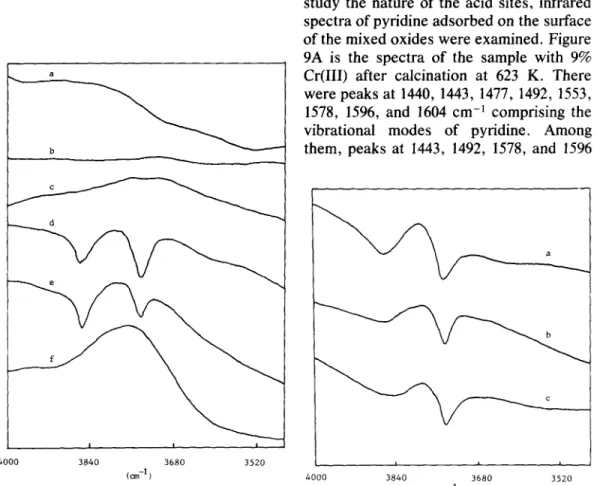
FIG. 7. FT-IR spectra of Cr-Ti oxide wafers after evacuation at 623 K for I h. Cr/(Ti + Cr) ratios varied as (a) 0%, (b) 1%, (c) 5%, (d) 9%, (e) 20%, and (f) 100%.
trated in Fig. 7. Two peaks were observed at 3749 and 3855 cm -1, respectively, on the samples of Cr(III) content 9 and 20%. The rest of the samples showed negligible ab- sorption in this region. Judging from the charge density of the lattice cations, the peak at 3749 cm -1 is assigned to T i O - H stretching and 3855 cm -~ to C r O - H stretch- ing. Parkyns summarized the IR frequen- cies of surface hydroxyl groups on titania reported by several authors
(13).
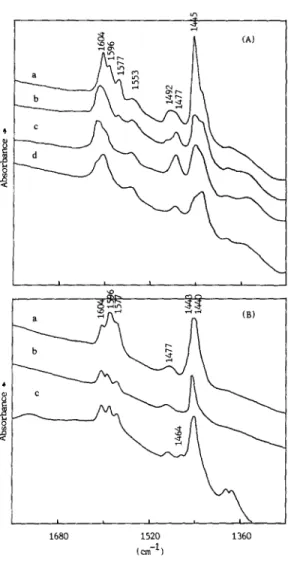
T i O - H stretching frequencies ranged from 3668 to 3740 cm -~ depending on the heat treatment and the crystalline phases. The values are close to the 3749 cm -~ observed on our samples• On heating to 723 K and 943 K, the peak at 3855 cm -~ became weaker while that at 3749 cm-I was retained (Fig. 8). To study the nature of the acid sites, infrared spectra of pyridine adsorbed on the surface of the mixed oxides were examined. Figure 9A is the spectra of the sample with 9% Cr(III) after calcination at 623 K. There were peaks at 1440, 1443, 1477, 1492, 1553, 1578, 1596, and 1604 cm -~ comprising the vibrational modes of pyridine. Among them, peaks at 1443, 1492, 1578, and 1596a
I i I
4 0 0 0 3840 3680 3520
(cm -1)
F;G. 8. FT-IR spectra of Cr-Ti oxides with Cr/(Ti + Cr) ratio of 9% after evacuation at (a) 623 K, (b) 723 K, and (c) 943 K.
8 CHENG AND CHENG ~ r - - I I D l i I a ~ l J
i
I i I i I N 1680 1 5 2 0 1360 (era -1 )FIG. 9. FT-IR spectra of pyridine adsorbed on calcined Cr-Ti oxide (Cr/(Ti + Cr) = 9%) after evacu- ~ ation at (a) RT (b) 423 K, (c) 523 K, and (d) 623 K. The .o calcination temperatures were (A) 623 K and (B) 723 g.
K. g
cm -~ were weakened after evacuation at 423 K, and almost disappeared after evacu- ation at 523 K. According to Kung and
Kung
(14),
this set of absorption peaks canbe assigned to hydrogen-bonded pyridine. On the other hand, a new peak appeared at 1613 cm -~ on heating. That and the rest of peaks survived even at an evacuation tem- perature of 623 K. Connell and Dumesic
(15)
indicated that peaks at 1553 and 1613 cm -1 were the characteristic peaks of pyri- dinium ions, which were formed on the BrCnsted acid sites. The other set of ab-sorption peaks at 1440, 1477, and 1604 cm -~ was contributed by pyridine coordinatively bonded to Lewis acid sites. Figure 9B shows the IR spectra of pyridine adsorbed on the same sample calcined at 723 K. Peaks attributed to hydrogen-bonded pyri- dine at 1443, 1492, 1577, and 1596 cm -1 were observed in addition to those from Lewis acid sites at 1440, 1477, and 1604 cm -1. We conclude that both BrCnsted and the Lewis acid sites exist on the surface of the bimetallic oxides after calcination at 623 K, but the bimetallic oxides lose the BrCnsted acid sites after calcination at 723 K. T i O - H groups are still observed on the latter compounds, which implies that the T i O - H groups do not contribute to the BrCnsted acidity. In other words, the BrCnsted acid sites are the C r O - H groups. Figure I0 demonstrates the redox activi-
20 16 '12 8 4 0 z 20 i(s) f6 t2
il,
( A ) o - --o.- -...o- - -o.- - - o - - - - o - ~ , ,
,----6 conversion Selectivity e--..e CzH4" o---o co= l i l , l l I o--o-.,o-,,o- - - - o - - - , o - - - - o . - - , - o - ~ - , - o l = I ~ t ~ I I 20 -(cj 16 12 8 4 0 i - 2
O-'O- - - ' O - - - - O - . j ..O'- - "O.. L ~ --o IO0 80 6 0 4 0 20 0 - 2 0 t 0 0 8 0 ~ ,-e 6 0 ~ 40 > g 20 ~ 0 ,20 100 8 0 60 4 0 2O o -20 0 4 8 Time (hr)
Fro. 10: Activities of Cr-Ti oxides in ethane oxida- tive dehydrogenation reaction. Catalysts had Cr/(Ti + Cr) ratios of (a) 100%, (b) 20%, and (c) 5%.
BIMETALLIC CHROMIUM-TITANIUM OXIDES 9 ties of the bimetallic oxides in the oxidative
dehydrogenation of ethane. Besides the de- sired product, ethylene, carbon dioxide was obtained as a major product through complete oxidation of ethane or ethylene. The conversion was found to be propor- tional to the Cr content of the oxides. Pure chromium oxide gave the highest activity. The total conversion of ethane was ca. 14 mol%. However, only 4 mol% of the prod- ucts was ethylene. On the other hand, the selectivity of ethylene was found to be in- dependent of Cr content. It is therefore pro- posed that the active sites for the formation of ethylene and CO2 are the same and may have to do with surface C r - O species. Ti(IV) served more as a diluent.
CONCLUSIONS
Cr(III)/Ti(IV) bimetallic oxides prepared by the hydrothermal method in basic solu- tion were found to have layered structures. After NH~-/Na + ion exchange and calcina- tion, the tetratitanate was converted to ana- tase-forrn TiO2 structure. Cr(III) ions were proposed to substitute for the Ti(IV) ions in the lattice. As a result, the crystallinity of the anatase phase decreased with the in- crease in Cr(III) content. A separate
Cr203
phase was also observed on samples of high Cr(III) content. Over pure titanium oxide, propylene was the predominant product ob- tained in the 2-propanol decomposition re- action. Selectivity decreased sharply when a very small quantity of Cr(III) was doped into the oxide. Since both propylene and acetone were obtained in the products, it was concluded that the synthetic bimetallic oxides contain both acidic and basic sites. Furthermore, there were two kinds of acid sites on the bimetallic oxides--BrCnsted
and Lewis. The BrCnsted acid sites were determined to be the C r O - H groups on the surface. The C r - O species were also pro- posed to be the active sites for the oxidative dehydrogenation of ethane to ethylene and for complete oxidation to CO2.
A C K N O W L E D G M E N T
Financial support from the National Science Coun- cil of the Republic of China is gratefully acknowl- edged.
REFERENCES
1. Tauster, S. J., Fung, S. C., and Garden, R. L., J.
Amer. Chem. Soc. 100, 170 (1978).
2. Matsuda, S., Takeuchi, M., Hishinuma, T., Naka- jima, F., Narita, T., Watanabe, Y., and lmanati,
M., J. Air Pollut. Control Assoc. 28, 350 (1978).
3. Inomata, M., Miyamoto, A., and Murakami, Y.,
J. Chem. Soc. Chem. Commun., 223 (1980).
4. Matsuda, S., and Kato, A., Appl. Catal. 8, 149 (1983).
5. Shibata, K., Kitagawa, T., Sumiyoshi, T., and Tanabe, K., Bull. Chem. Soc. Japan 46, 2985 (1973).
6. Tanabe, K., Sumiyoshi, T., Shibata, K., Kiyoura, T., and Kitagawa, J., Bull. Chem. Soc. Japan 47, 106 (1974).
7, Gbelica, Z., Derouane, E. G., and Blom, N., in
"Catalytic Materials," Chap. 12. Amer. Chem. Soc., Washington, DC, 1984.
8. Cheng, S., and Lee, J.-C., J. Chin. Chem. Soc. 35,
19l (1988).
9. Marchand, R., and Brohan, L., Mater. Res. Bull.
15, 1129 (1980).
10. Izawa, H., Kikkawa, S., and Koizumi, M., Poly-
hedron 2, 741 (1983).
11. Izawa, H., Kikkawa, S., and Koizumi, M., J.
Phys. Chem. 86, 5023 (1982).
12. Sasaki, T., Watanabe, M., and Fujiki, Y., Bull.
Chem. Soc. Japan 58, 3500 (1985).
13. Parkyns, N. A., in "Chemisorption and Cataly- sis" (P. Hepple, Ed,). Elsevier, Amsterdam, 1970.
14. Kung, M. C., and Kung, H. H., Catal. Rev.-Sci.
Eng. 3, 425 (1985).
15. Connell, G., and Dumesic, J. A., J. CataL 105, 285 (1987).