行政院國家科學委員會專題研究計畫 成果報告
最佳停止問題與套利
研究成果報告(精簡版)
計 畫 類 別 : 個別型
計 畫 編 號 : NSC 100-2115-M-009-006-
執 行 期 間 : 100 年 08 月 01 日至 101 年 07 月 31 日
執 行 單 位 : 國立交通大學應用數學系(所)
計 畫 主 持 人 : 許元春
計畫參與人員: 碩士班研究生-兼任助理人員:呂竺晏
碩士班研究生-兼任助理人員:林紹鈞
碩士班研究生-兼任助理人員:胡涴晴
碩士班研究生-兼任助理人員:趙彥丞
博士班研究生-兼任助理人員:張明淇
博士班研究生-兼任助理人員:蔡明耀
公 開 資 訊 : 本計畫可公開查詢
中 華 民 國 101 年 08 月 29 日
中 文 摘 要 : 複合選擇權是一種賦予持有方買或賣該標的選擇權權利的商
品。在本文裡,我們要探討永續美式複合權在跳躍擴散模型
的假設下的評價問題。從 Gapeev 和 Rodosthesnous 的研究可
得知,在跳躍擴散模型的假設下,這種起初是雙重最佳停止
時間的問題能被分解成一連串的單一最佳停止問題。利用處
理單一最佳停止問題常用的平均方法,我們推導出永續美式
複合選擇權在雙重指數型跳躍擴散模型下的顯解。
中文關鍵詞: 永續美式複合選擇權、最佳停止問題、雙重指數型跳躍擴散
模型
英 文 摘 要 :
英文關鍵詞:
Pricing perpetual American compound options under a
jump-diffusion model
Ming-Chi Chang, Yuan-Chung Sheu and Ming-Yao Tsai
Department of Applied Mathematics
National Chiao Tung University
Hsinchu 30010, Taiwan
Abstract
A compound option gives the holder the right to buy or sell the underlying option. In this paper, we consider the pricing problem of perpetual American compound options when the underlying dynamics follow a jump-diffusion process. Following Gapeev and Rodosthenous, the initial two-step optimal stopping problems are decomposed into sequences of one-step problems for the underlying jump-diffusion process. Using the averaging approach for the usual one-step optimal stopping problems, we give explicit solutions to the perpetual American option pricing problems in the double-exponential jump-diffusion model.
1
Introduction
The one-step optimal stopping problems we consider in this paper will be of the form
V (x) = sup τ∈TE
x(e−rτg(Xτ)) (1.1)
where X = {Xt : t ≥ 0} under Px is a L´evy process started from X0 = x. Further, g is a
measurable function, r ≥ 0 and T is a family of stopping times with respect to the natural filtration generated by X,F = {Ft: t≥ 0}. The optimal stopping problem consists of finding the
optimal stopping time τ∗such that V (x) = supτ∈T Ex(e−rτg(Xτ)) =Ex(e−rτ ∗
g(Xτ∗)). Also we
need to find the corresponding optimal reward (the value function): V (x) =Ex(e−rτ ∗
g(Xτ∗)).
In the literature, there are many different approaches for solving the problem (1.1). In particular, Surya [16] proposed an averaging approach for solving the optimal stopping problem (1.1) in a general setting. His approach does not appeal to a free boundary problem associated to the optimal stopping problem. Instead he first introduced an averaging problem for a given reward function g. Then he showed that an explicit optimal solution can be founded if there is a solution to the averaging problem that has certain monotonicity properties. Recently, when the
process X is a jump-diffusion process of the form in (2.8), Sheu and Tsai [15] presented explicit solutions to the averaging problems for a class of the American call type reward functions and hence solved the corresponding optimal stopping problem (1.1).
A compound option is a standard option with another standard option being the underlying asset. There are four basic types of compound options: a call on a call, a put on a call, a call on a put, and a put on a put. Consider, for example, a call on a put of European type. On the first exercise date T1, the holder of the compound option is entitled to pay the first
strike price, K1, and receive a put option. The put option gives the holder the right to sell the
underlying asset for the second strike price, L2, on the second exercise date, T2. The compound
option will be exercised on the first exercise date only the value of the option on that date is greater than the first strike price. In the Black-Scholes framework, European-style compound options can be valued analytically in terms of integrals of the bivariate normal distribution(see, for example, Geske [7]). For more general underlying dynamics, either explicit solutions do not exist or the integrals become difficult to evaluate. On the other hand, in the literature, many researchers considered the compound options of American type. In Chiarella and Kang [5], the authors formulated the pricing problem for American compound options as the solution to a two-step free boundary problem which is solved numerically via a sparse grid approach. In [6], Gapeev and Rodosthenous considered the pricing problem of perpetual American compound options when the underlying dynamics follow the geometric Brownian motion. By solving the associated sequence of one-sided free boundary problems and the martingale verification, they obtained explicit pricing formulas for all four types of perpetual American compound options. In this paper, we consider the pricing problem of perpetual American compound options when the underlying dynamics follow a jump-diffusion process. Following Gapeev and Rodosthenous [6], the initial two-step optimal stopping problems are decomposed into sequences of one-step problems for the underlying jump-diffusion process. In the double-exponential jump-diffusion model, using the results obtained in Surya [16] and Sheu and Tsai [15], we give explicit solutions for the associated optimal stopping problems and, hence obtain the explicit pricing formula for the perpetual American option pricing problems. By our approach, we also recover results obtained in Gapeev and Rodosthenous [6].
2
Preliminaries
Let X = {Xt : t ≥ 0} be a real-valued L´evy process defined on a filtered probability space
(Ω,F, {Ft}, P) such that X0 = 0 a.s. A L´evy process starts from X0= x is simply defined as
x + Xtfor t≥ 0 and we denote its law by Px. Denote by Ex the expectation with respect to
the probability measurePx . For convenience we shall writeP for P0and E for E0. The
of X and is given by the formula ψ(u) = iau−1 2b 2u2+ ∫ R (eiux− 1 − iux1{|x|<1})Π(dx). (2.1) Here a∈ R, b ≥ 0 and Π is a measure on R\{0} such that∫R1∧ x2Π(dx) <∞.
Throughout this paper, we denote by er an exponential random variable with parameter r > 0, independent of the process X. In addition, we denote by
Mr= sup
0≤s≤er
Xs and Ir= inf
0≤s≤er Xs,
the supremum and the infimum of the L´evy process X killed at the independent exponential random time er. Recall the following well-known Wiener-Hopf factorization formula,
EeiuXer = r
r− ψ(u) = ψ
+
r(u)ψr−(u) (2.2)
where ψ+
r(u) =E(eiuMr) and ψr−(u) =E(eiuIr).
Theorem 2.1 Given a reward function g with H≡ {g > 0} = (ba, ∞) for some ba < ∞. Suppose that eQg is a continuous function on H that satisfies the following averaging property
E ( e Qg(x + Mr) ) = g(x) (2.3)
for every x > ba. We assume further that there exists bx ∈ H such that eQg(bx) = 0, eQg(x) is non-decreasing for x >bx and eQg(x)≤ 0 for ba < x < bx. Then the value function to the optimal stopping problem (1.1) is given by the formula V (x) =Ex(e−rτ
∗
g(Xτ∗)). Here x∗ is the largest root of eQg(x) = 0 in (ba, ∞) and τ∗= inf{t > 0 : Xt> x∗}. Moreover, we have for every x ∈ R, V (x) =E ( e Qg(x + Mr)1{x+Mr>x∗} ) .
Example 2.2 (Perpetual American call option). Consider the function g(x) =∑Mm=1hmeθmx. Simple algebra shows that the function
e Qg(x) = M ∑ m=1 hmeθmx ( ψr+(−iθm) )−1 (2.4)
satisfies the averaging property (2.3) for all x. (Here we assume that E(eθmMr) < ∞, 1 ≤ m ≤ M.) In particular, if g(x) = ex− K, then eQg(x) = ex
(
ψ+r(−i)
)−1
− K. Denote by x∗c the unique value such that ex∗c = ψ+
r(−i)K. Then we have V (x) = Ex(e−rτ ∗ g(Xτ∗)) = E ( e Qg(x + Mr)1{x+Mr>x∗c} ) , where τ∗= inf{t > 0 : Xt> x∗c}.
Theorem 2.3 Given a reward function g with H ≡ {g > 0} = (−∞, ba) for some ba > −∞. Suppose that ePg is a continuous function on H that satisfies the following averaging property
E ( e Pg(x + Ir) ) = g(x) (2.5)
for every x < ba. We assume further that there exists bx ∈ H such that ePg(bx) = 0, ePg(x) is non-increasing for x < bx and ePg(x) ≤ 0 for bx < x < ba. Then the value function to the optimal stopping problem (1.1) is given by the formula V (x) =Ex(e−rτ
∗
g(Xτ∗)), where x∗ is the smallest root of ePg(x) = 0 in (−∞, ba) and τ∗ = inf{t > 0 : Xt< x∗}. Moreover, we have for every x∈ R, V (x) = E ( e Pg(x + Ir)1{x+Ir<x∗} ) .
Proof. We first write bg(x) = g(−x) and bH := {bg > 0} = (−ba, ∞). Set eQbg(x) = ePg(−x) for x >−ba and cMr:= sup0≤t≤er−Xt. Observe that eQbgis a continuous function on bH that satisfies
the averaging property (2.3) for cMr and bg on bH. Also, by assumption, there exists −bx ∈ bH
such that eQbg(−bx) = 0, eQbg(x) is nondecreasing for x >−bx and eQbg(x)≤ 0 for −ba < x < −bx. Set Yt=−Xt. By Theorem 2.1, we observe cW (y) := supτEy[e−rτbg(Yτ)] =Ey[e−rτ
∗
bg(Yτ∗)], where τ∗= inf{t > 0 : −Xt>−x∗} and −x∗ is the largest root of eQbg(x) = 0 in (−ba, ∞). Also, note
that V (x) = supτEx[e−rτg(Xτ)] = supτE[e−rτg(x+Xτ)] = supτE[e−rτbg(−x−Xτ)] = cW (−x).
Therefore, if we set y =−x and y∗=−x∗then we have
V (x) = cW (y) =Ey [ e−rτ∗bg(Yτ∗) ] =E [ e−rτ∗bg(y + Yτ∗) ] =E [ e−rτ∗g(−y − Yτ∗) ] =E [ e−rτ∗g(x + Xτ∗) ] =Ex [ e−rτ∗g(Xτ∗) ] and V (x) = cW (y) =E [ e Qbg(y + cMr)1{y+cM r>y∗} ] =E [ e Pbg(−y − cMr)1{−y−cM r<−y∗} ] =E [ e
Pbg(−y + Ir)1{−y+Ir<−y∗}
] =E [ e Pbg(x + Ir)1{x+Ir<x∗} ] ,
as required. The proof is complete.
Remark 2.4 Given a reward function g with {g > 0} = (−∞, ba). Set bg(y) = g(−y) and
c
Mr := sup0≤t≤er−Xt and assume that eQbg satisfies the averaging property (2.3) for cMr and
bg(i.e., bg(y) = E [
e
Qbg(y + cMr)
]
for all y >−ba). Write ePg(x) = eQbg(−x) for x < ba. Then we have g(x) =bg(−x) = E [ e Qbg(−x + cMr) ] =E [ e Qbg(−x − Ir) ] =E [ e Pg(x + Ir) ] , x <ba. (2.6)
Therefore, ePg(x) satisfies the averaging property (2.5) for Ir and g on x <ba.
Example 2.5 (Perpetual American put option). Consider the function g(x) =∑Mm=1hmeθmx. Then the function
e Pg(x) = M ∑ m=1 hmeθmx ( ψr−(−iθm) )−1 (2.7)
satisfies the averaging property (2.5). (Here we assume that E(eθmIr) <∞, 1 ≤ m ≤ M.) In particular, if g(x) = K− ex, then eP
g(x) = K− ex
(
ψr−(−i) )−1
. Denote by x∗p the unique value
such that ex∗p= ψ−
r(−i)K. Then we have V (x) = Ex(e−rτ ∗ g(Xτ∗)) =E ( e Pg(x+Ir)1{x+Ir<x∗p} ) , where τ∗= inf{t > 0 : Xt< x∗p}.
From now on, we consider the jump-diffusion process X of the form Xt= X0+ at + bWt+ Nλ t ∑ n=1 Yn− Ntµ ∑ k=1 Zk, t≥ 0. (2.8)
Here, a∈ R\{0} , b ≥ 0, W = (Wt, t≥ 0) is a standard Brownian motion, Nλ = (Ntλ; t≥ 0)
and Nµ = (Ntµ; t ≥ 0) are Poisson processes with rate λ > 0 and µ > 0, respectively. Also,
Y = (Yn, n∈ N) and Z = (Zk, k∈ N) are sequences of independent random variables with the
identical matrix-exponential distribution given by
dF(+)(x) = p1(x)dx = 1{x>0} v1 ∑ k=1 nk ∑ j=1 ckjβkjx j−1 (j− 1)! e −βkxdx and dF(−)(x) = p2(x)dx = 1{x>0} v2 ∑ p=1 ℓp ∑ m=1 ecpmαmpxm−1 (m− 1)! e −αpxdx,
respectively. Here, the parameters ckj, βk,ecpm, and αp can in principle take complex values,
but if we order αpand βk by their real parts then α1and β1must be real, while the others may
be complex with 0 < β1<Re (β2)≤ · · · ≤ Re (βv1) and 0 < α1<Re (α2)≤ · · · ≤ Re (αv2).
The random variable W, Nλ, Nµ, Y and Z are assumed to be independent. Note that the
characteristic exponent of X is given by
ψ(z) = iaz−b 2z2 2 + λ [∑v1 k=1 nk ∑ j=1 ckj ( iβk z + iβk )j − 1 ] + µ [∑v2 p=1 ℓp ∑ m=1 ecpm( −iα p z− iαp )m − 1 ] . (2.9)
Denote by −ieρ1,· · ·, −ieρµ2,−iρ1,· · ·, −iρµ1 the roots of r− ψ(z) = 0 with Re (eρµ2)≤ · · · ≤
Re (eρ1) ≤ 0 < Re (ρ1) ≤ Re (ρ2) ≤ · · · ≤ Re (ρµ1). Note that −ieρ1 and −iρ1 are purely
imaginary. Moreover, if v1 ≥ 1, then 0 < ρ1 < β1 and if v2 ≥ 1, then 0 < −eρ1 < α1. We
assume further that all roots are simple. We observe that the distribution of Ir has the form
fIr(y)dy = 1{a>0,b=0}de0δ0(dy) + 1{µ2≥1}
[∑µ2
η=1
e
dηeρηe−eρηy1{y<0}dy
] (2.10) where ed0= ∏µ2 j=1(−eρj) ∏v2 k=1α−ℓk k and e dj=− v2 ∏ k=1 ( eρj+ αk αk )ℓk ∏µ2 m=1,m̸=j eρm −eρj+eρm , for 1≤ j ≤ µ2. (2.11)
Also the distribution of Mr is given by the formula
fMr(y)dy = 1{a<0,b=0}d0δ0(dy) + 1{µ1≥1}
[∑µ1 j=1 djρje−ρjy1{y>0}dy ] (2.12) where d0= ∏µ1 j=1ρj ∏v1 k=1β−n k k and dk = v1 ∏ j=1 ( βj− ρk βj )nj ∏µ1 i=1,i̸=k ρi ρi− ρk , for 1≤ k ≤ µ1. (2.13)
Definition 2.6 We write g ∈ π0 if the function g :R → R is continuously differentiable and
for v1 ≥ 1, there exist A1> 0, A2 > 0 and θ∈ (0, β1) such that |g(x)| ≤ A1+ A2eθx,∀x ≥ 0.
We write g∈ π1 if the function g :R → R is continuously differentiable and for v2 ≥ 1, there
exist A1> 0, A2> 0 and θ∈ (0, −α1) such that|g(x)| ≤ A1+ A2e−θx,∀x ≤ 0.
For any g∈ π0, we define the function Qg(x) by the formula Qg(x) = 1{µ2≥1} µ2 ∑ η=1 e dηeρη r { v 1 ∑ k=1 nk ∑ j=1 j ∑ ℓ=1 −λ(βk)jckj (βk− eρη)ℓ(j− ℓ)! eβkx ∫ ∞ x (y− x)j−ℓg(y)e−βkydy − ( (a +b 2eρ η 2 )g(x) + b2 2g ′(x))} +1{a>0,b=0}de0 r { v 1 ∑ k=1 nk ∑ j=1 −λ(βk)jckj (j− 1)! e βkx ∫ ∞ x (u− x)j−1g(u)e−βkudu +(λ + µ + r)g(x)− ag′(x) } . (2.14)
On the other hand, if g∈ π1, the function Pg is define by the formula Pg(x) = v2 ∑ p=1 ℓp ∑ m=1 m ∑ k=1 −µ(αp)mecpm r(m− k)! × [( 1{µ1≥1} µ1 ∑ j=1 djρj (αp+ ρj)k + 1{a<0,b=0}1{k=1}d0 ) ∫ 0 −∞ (−t)m−kg(t + x)eαptdt ] + [ 1{µ1≥1}b 2 2r (∑µ1 j=1 djρj ) − 1{a<0,b=0}adr0 ] g′(x) + [ 1{µ1≥1} µ1 ∑ j=1 djρj r (a + b2ρ j 2 ) + 1{a<0,b=0} d0 r (λ + µ + r) ] g(x). (2.15)
Remark 2.7 (a) Given two reward functions g andbg. If g = bg on [x, ∞), then Qg(x) = Qbg(x). If g =bg on (−∞, x], then Pg(x) = Pbg(x). (b) Consider the function g(x) =
∑M
m=1hmeθmx. If θm< β1 for all m, then we have Qg(x) =
∑M m=1hme θmx ( ψ+ r(−iθm) )−1
. On the other hand,
if−θm< α1 for all m, then we have Pg(x) =
∑M m=1hmeθmx ( ψr−(−iθm) )−1 .
Proposition 2.8 Given a reward function g. If g∈ π0, then the function Qg(x) given in (2.14) satisfies the averaging property (2.3) for all x. On the other hand, if g∈ π1, then the function
Pg(x) given in (2.15) satisfies the averaging property (2.5) for all x.
Proof. The first statement was proved in Sheu and Tsai [15]. The second statement follows
by using the fact that Pg(−x) = Qbg(x) where Qbg is given in (2.14) forbg(x) = g(−x) and the
3
American compound option
In this section, we consider the pricing problem of the perpetual American compound options. The perpetual American compound option have two strikes prices. For example, the call-on-call option gives its holder the right to buy at an random time τ for the strike price K1a call option
with the strike price K2 and the exercise time ζ, where ζ ≥ τ. The compound option will be
exercised on the first random time τ only the value of the option on that date is greater than the first strike price. The rational prices of perpetual American options can be formulated by the values of the optimal stopping problems
(call-on-call) V1(x) = sup τ Ex [ e−rτH1+(Xτ) ] . (3.16) (call-on-put) V2(x) = sup τ Ex [ e−rτH2+(Xτ) ] . (3.17) (put-on-call) V3(x) = sup τ E x [ e−rτH3+(Xτ) ] . (3.18) (put-on-put) V4(x) = sup τ E x [ e−rτH4+(Xτ) ] . (3.19)
Here the reward functions Hj(x), j = 1, ..., 4, are given by
H1(x) = W (x)− K1, H2(x) = U (x)− K1, H3(x) = L1− W (x), H4(x) = L1− U(x)
(3.20) for all x∈ R. Also, W (x) and U(x) denote the rational prices of the perpetual American call and put options with the strike prices K2 and L2, respectively and are given by
W (x) = sup η Ex [ e−rη(eXη− K 2)+ ] and U (x) = sup η Ex [ e−rη(L2− eXη)+ ] (3.21) where the suprema are taken over the stopping times η of the process X.
From now on, we assume that {Xt}t≥0 is the form in (2.8) with nk = 1, ℓp = 1, ck1 > 0, βk > 0,ecp1 > 0 and αp > 0, for 1≤ k ≤ v1 and 1≤ p ≤ v2. For simplicity, we assume that
b̸= 0. In this case, µ1= v1+ 1, µ2= v2+ 1 and all roots are are simple and purely imaginary.
Also they satisfy the conditions
0 < ρ1< β1< ρ2<· · · < βµ1−1< ρµ1 (3.22)
and
0 <−eρ1< α1<−eρ2<· · · < αµ2−1<−eρµ2. (3.23)
We assume further that ρ1> 1 and −eρ1> 1. Recall that fMr(y) =
∑µ1
j=1djρje−ρjy1{y>0}and fIr(y) =
∑µ2
η=1deηeρηe−eρηy1{y<0}, where dk = v1 ∏ j=1 βj− ρk βj µ1 ∏ i=1,i̸=k ρi ρi− ρk , for 1≤ k ≤ µ1. (3.24)
and e dη =− v2 ∏ k=1 eρη+ αk αk µ2 ∏ m=1,m̸=η eρm −eρη+eρm , for 1≤ η ≤ µ2 (3.25)
From these, we observe ψ+
r(u) = ∑µ1 k=1 dkρki u+iρk and ψ − r(u) =− ∑µ2 η=1 e dηρeηi u+ieρη. Also if H is in π0, we have QH(x) =− v1 ∑ k=1 µ2 ∑ η=1 e dηeρηλβkck1 r(βk− eρη) eβkx ∫ ∞ x H(y)e−βkydy − µ2 ∑ η=1 e dηeρη r (a + b2eρ η 2 )H(x)− µ2 ∑ η=1 e dηeρηb2H′(x) 2r . (3.26) If H is in π1, we have PH(x) =− v2 ∑ p=1 µ1 ∑ j=1 djρjµαpecp1 r(α + ρj) ∫ 0 −∞ H(t + x)eαptdt + µ1 ∑ j=1 djρj r (a + b2ρj 2 )H(x) + µ1 ∑ j=1 djρjb2H′(x) 2r . (3.27) Set g1(x) = ex− K2. Then Qg1(x) = e x ( ψ+ r(−i) )−1
− K2. Denote by x∗c the unique value
such that ex∗c = ψ+
r(−i)K2. Then the function W (x) in (3.21) is given by the formula
W (x) = 1{x≥x∗ c}(e x− K 2) + 1{x<x∗c} µ1 ∑ j=1 djK2eρj(x−x ∗ c) ρj− 1 . (3.28)
By (3.22) and (3.24), we obtain that dk > 0 for all k. Hence, W (x) is a strictly increasing
function with limx→−∞W (x) = 0 and limx→∞W (x) = ∞. On the other hand, set g2(x) =
L2− ex. Then Pg2(x) = L2−
(
ψr−(−i) )−1
ex. Denote by x∗
p the unique value such that e x∗p = ψ−r(−i)L2. The value function U (x) in (3.21)is given by the formula
U (x) = 1{x≤x∗ p}(L2− e x) + 1 {x>x∗ p} µ2 ∑ η=1 − edηL2eρeη(x−x ∗ p) 1− eρη . (3.29)
By (3.23) and (3.25), edη < 0 for all η and so U (x) is a strictly decreasing function with
limx→−∞U (x) = L2 and limx→∞W (x) = 0.
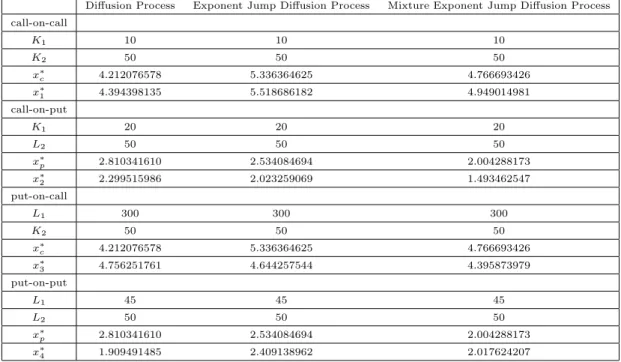
(Call-on-Call Option ). We consider the call-on-call option. The reward function H1(x)
is given by H1(x) = W (x)− K1= 1{x≥x∗ c}(e x− K 1− K2) + 1{x<x∗ c} (∑µ1 j=1 djK2eρj(x−x ∗ c) ρj− 1 − K1 ) . (3.30)
Clearly, H1(x) is a strictly increasing function with limx→−∞H1(x) =−K1and limx→∞H1(x) =
∞. Hence there exists a unique ba1>−∞ such that {H1> 0} = (ba1,∞). Note that H1∈ π0
and QH1(x) = e x ( ψ+ r(−i) )−1
that QH1(x∗1) = 0, QH1(x)≤ 0 for ba1 < x < x∗1 and QH1(x) is non-decreasing on (x∗1,∞) then
by Theorem 2.1, we deduce that V1(x) =Ex(e−rτ ∗ 1H1(Xτ∗ 1)) = ∫∞ x∗1−xQH1(x + m)fMr(m)dm, where τ1∗= inf{t > 0 : Xt> x∗1}.
(Call-on-Put Option). We consider the call-on-put option. Then we have
H2(x) = U (x)− K1= 1{x≤x∗p}(L2− K1− ex) + 1{x>x∗p} (∑µ2 η=1 − edηL2eρeη(x−x ∗ p) 1− eρη − K 1 ) . (3.31)
Clearly, H2(x) is a strictly decreasing function with limx→−∞H2(x) = L2−K1and limx→∞H2(x) =
−K1. Hence {H2 > 0} = (−∞, ba2) for some ba2 < ∞(for this compound option, we always
assume that L2 > K1). Notice that H2 ∈ π1 and PH2(x) = L2 − K1− e
x
(
ψr−(−i) )−1
.
for all x ≤ x∗p. Furthermore, if there exists x∗2 such that PH2(x∗2) = 0, PH2(x) ≤ 0 for
x∗2 < x < ba2 and PH2(x) is non-increasing on (−∞, x∗2) then by Theorem 2.3, we conclude
that V2(x) =Ex(e−rτ ∗
2H2(Xτ∗
2)) =
∫x∗2−x
−∞ PH2(x + y)fIr(y)dy, where τ2∗= inf{t > 0 : Xt< x∗2}.
(Put-on-Call Option). We consider the put-on-call option. The payoff function is given by H3(x) = L1− W (x) = 1{x≥x∗ c}(L1+ K2− e x) + 1 {x<x∗ c} ( L1− µ1 ∑ j=1 djK2eρj(x−x ∗ c) ρj− 1 ) . (3.32)
Clearly, H3(x) is a strictly decreasing function with limx→−∞H3(x) = L1and limx→∞H3(x) =
−∞. Hence {H3 > 0} = (−∞, ba3) for some ba3 < ∞. Notice that H3 ∈ π1 and PH3(x) =
L1− ∑µ1 j=1 djK2eρj (x−x∗c ) ρj−1 ( ψr−(−iρj) )−1
for all x≤ x∗c. Furthermore, if there exists x∗3such that
PH2(x∗3) = 0, PH3(x)≤ 0 for x3∗ < x < ba3 and PH3(x) is non-increasing on (−∞, x∗3) then by
Theorem 2.3, we conclude that V3(x) =Ex(e−rτ ∗
3H3(Xτ∗
3)) =
∫x∗3−x
−∞ PH3(x + y)fIr(y)dy, where τ3∗= inf{t > 0 : Xt< x∗3}.
(Put-on-Put Option). We consider the put-on-put compound option. Then we have
H4(x) = L1− U(x) = 1{x≤x∗ p}(e x+ L 1− L2) + 1{x>x∗ p} ( L1− µ2 ∑ η=1 − edηL2eρeη(x−x ∗ p) 1− eρη ) . (3.33)
Clearly, H4(x) is a strictly increasing function with limx→−∞H4(x) = L1−L2and limx→∞H4(x) =
L1. Hence{H4 > 0} = (ba4,∞) for some ba4>−∞(for this option, we assume that L1< L2).
Note that H4∈ π0and QH4(x) = L1−
∑µ2 η=1 − edηL2eρη (x−x∗e p ) 1−eρη ( ψ+ r(−ieρη) )−1
for all x≥ x∗p. Fur-thermore, if there exists x∗4 such that QH4(x∗4) = 0, QH4(x)≤ 0 for ba4< x < x∗p and QH4(x) is
non-decreasing on (x∗4,∞) then by Theorem 2.1, we deduce that V4(x) =Ex(e−rτ ∗ 4H4(Xτ∗ 4)) = ∫∞ x∗4−xQH4(x + m)fMr(m)dm, where τ4∗= inf{t > 0 : Xt> x∗4}.
4
Verification of optimality
Recall that the jump-diffusion process X is of the form in (2.8). To prove the optimality, we assume further that {Yiβ : i = 1, 2, ...} and {Zjα : j = 1, 2, ...} are sequences of independent
exponentially distributed random variables with parameters β and α, respectively. First, recall that g1(x) = ex− K2and W (x) = 1{x≥x∗ c}(e x− K 2) + 1{x<x∗ c}( d1K2 ρ1−1e ρ1(x−x∗c)+d2K2 ρ2−1e ρ2(x−x∗c)),
where x∗c is the unique value satisfying ex∗c = ψ+
r(−i)K2. In addition, g2(x) = L2− ex and
U (x) = 1{x≤x∗ p}(L2−e x) + 1 {x>x∗ p} ∑2 η=1− e dηL2eρη (x−x∗e p ) 1−eρη , where x ∗
pis the unique value satisfying ex∗p= ψ−
r(−i)L2.
(Call-on-Call Option). Note that H1(x) = W (x)−K1= 1{x≥x∗ c}(e x−K 1−K2)+1{x≤x∗ c} ( d1K2 ρ1−1e ρ1(x−x∗c)+ d2K2 ρ2−1e ρ2(x−x∗c)− K1 ) and QH1(x) = ( ed1eρ1 r · −λβ β− eρ1 +de2eρ2 r · −λβ β− eρ2 ) eβx ∫ ∞ x H1(y)e−βydy −[ ed1eρ1 r · (a + b2eρ1 2 ) + e d2eρ2 r · (a + b2eρ2 2 ) ] H1(x)− [ b2 2r( ed1eρ1+ ed2eρ2) ] H1′(x). (4.34) We show that the rational price of the call-on-call option is the rational price of the perpetual American call option with the strike price K1 + K2. That is V1(x) = Ex(e−rτ
∗ 1H1(Xτ∗ 1)) = 1{x≥x∗ 1}(e x− K 1 − K2) + 1{x<x∗1}(d1(Kρ1+K2) 1−1 e ρ1(x−x∗1)+ d2(K1+K2) ρ2−1 e ρ2(x−x∗1)). Here x∗ 1 is the unique solution of ex(ψ+
r(−i))−1− K1− K2 = 0 and τ1∗ = inf{t > 0 : Xt > x∗1}. (Note that
x∗1> x∗c.)
Case 1: ex∗c− K
1− K2≤ 0. Our result follows from the fact that H1+(x) = (ex− K1− K2)+.
Case 2: ex∗c− K
1− K2 > 0. In this case we have{H1 > 0} = (ba1,∞) for some ba1< x∗c. For
ba1< x < x∗c, we have eβx ∫ ∞ x H1(y)e−βydy =eβ(x−x ∗ c) ( d1K2 (ρ1− 1)(ρ1− β) + d2K2 (ρ2− 1)(ρ2− β) +ψ + r(−i)K2 β− 1 − K2 β ) − d1K2eρ1(x−x ∗ c) (ρ1− 1)(ρ1− β) − d2K2eρ2(x−x ∗ c) (ρ2− 1)(ρ2− β) −K1 β .
Plugging this into (4.34) gives
QH1(x) = ( ed1eρ1 r · −λβ β− eρ1 +de2eρ2 r · −λβ β− eρ2 ) × [ eβ(x−x∗c) ( d1K2 (ρ1− 1)(ρ1− β) + d2K2 (ρ2− 1)(ρ2− β) +ψ + r(−i)K2 β− 1 − K2 β ) − d1K2eρ1(x−x ∗ c) (ρ1− 1)(ρ1− β)− d2K2eρ2(x−x ∗ c) (ρ2− 1)(ρ2− β)− K1 β ] −[ ed1eρ1 r · (a + b2eρ1 2 ) + e d2eρ2 r · (a + b2eρ2 2 ) ]( (d1K2 ρ1− 1 eρ1(x−x∗c)+ d2K2 ρ2− 1 eρ2(x−x∗c))− K1 ) − [ b2 2r( ed1eρ1+ ed2eρ2) ]( d1ρ1K2 ρ1− 1 eρ1(x−x∗c)+d2ρ2K2 ρ2− 1 eρ2(x−x∗c) ) . (4.35)
Notice that d1K2 (ρ1− 1)(ρ1− β) + d2K2 (ρ2− 1)(ρ2− β) +ψ + r(−i)K2 β− 1 − K2 β = d1K2 (ρ1− 1)(ρ1− β) + d2K2 (ρ2− 1)(ρ2− β) + ( K2 β− 1)( d1ρ1 ρ1− 1 + d2ρ2 ρ2− 1 )−K2 β = K2 β(β− 1) ( d1ρ1 ρ1− β + d2ρ2 ρ2− β ) = 0. (4.36)
Also, using the Wiener-Hofp factorization formula, we have that
r r− ψ(−iz) = r(β− z)(α + z) − [ b2z2 2 (β− z)(α + z) + az(β − z)(α + z) + λz(α + z) − µz(β − z) ] + r(β− z)(α + z) = ρ1ρ2(β− z) β(ρ1− z)(ρ2− z) 2 ∑ k=1 e dkeρk z− eρk . (4.37)
Evaluating both sides of (4.37) at z = β gives
2 ∑ k=1 e dkeρk β− eρk = r(ρ1− β)(ρ2− β) −λρ1ρ2 . (4.38)
Also, by multiplying both sides of (4.37) by z2 and letting z→ ∞, we see that 2 ∑ k=1 e dkeρk = rβ b2 2ρ1ρ2 . (4.39)
Moreover, it follows from (a) and (c) in Lemma 3.1 of [15] that e d1eρ1 r · (a + b2eρ 1 2 ) + e d2eρ2 r · (a + b2eρ 2 2 ) = 1 r ( − r − λ ed1eρ1 β− eρ1 − λ ed2eρ2 β− eρ2 ) . (4.40)
Taking account (4.35)-(4.40) we have that forba1< x < x∗c, QH1(x) =e ρ1(x−x∗c) d1K2 ρ1− 1 [ −β(ρ2− β) ρ1ρ2 + 1−(β− ρ1)(β− ρ2) ρ1ρ2 − β ρ2 ] + eρ2(x−x∗c)d2K2 ρ2− 1 [ −β(ρ1− β) ρ1ρ2 + 1−(β− ρ1)(β− ρ2) ρ1ρ2 − β ρ1 ] − K1 =− K1. (4.41)
For x > x∗c, we have H1(x) = ex− K1− K2 and, hence, QH1(x) = QHe1(x), where eH1(x) =
ex− K
1− K2. By (2.4), QHe1(x) = e
x(ψ+
r(−i))−1− K1− K2. Denote by x∗1 the unique solution
of ex(ψ+
r(−i))−1− K1− K2= 0. Clearly, we have x∗1> x∗c, QH1(x∗1) = QHe1(x
∗ 1) = 0, QH1(x) = QHe 1(x) < 0 on (x ∗ c, x∗1) and QH1(x) = QHe1(x) is increasing on (x ∗ 1,∞). By Theorem 2.1, V1(x) =Ex(e−rτ ∗ 1H1(Xτ∗ 1)) = ∫∞ x∗1−xQH1(x + m)fMr(m)dm = ∫∞ x∗1−xQHe1(x + m)fMr(m)dm = 1{x≥x∗ 1}(e x−K 1−K2) + 1{x<x∗1}(d1(Kρ11−1+K2)eρ1(x−x ∗ 1)+d2(K1+K2) ρ2−1 e
ρ2(x−x∗1)). This completes the
proof.
(Call-on-Put option). Note that H2(x) = U (x)−K1= 1{x≤x∗
p}(L2−K1−e x)+1 {x>x∗ p} (∑ 2 η=1− e dηL2eρη (x−x∗e p ) 1−eρη −
K1 ) and PH2(x) = ( d1ρ1 r · −µα α + ρ1 +d2ρ2 r · −µα α + ρ2 ) e−αx ∫ x −∞ H2(y)eαydy + [ d1ρ1 r · (a + b2ρ1 2 ) + d2ρ2 r · (a + b2ρ2 2 ) ] H2(x) + [ b2 2r(d1ρ1+ d2ρ2) ] H2′(x). (4.42)
We show that the rational price of the call-on-put option is the rational price of the perpetual American put option with the strike price L2− K1. That is V2(x) = Ex(e−rτ
∗ 2H2(Xτ∗ 2)) = 1{x≤x∗ 2}(L2− K1− e x) + 1 {x>x∗ 2} ∑2 η=1 − edη(L2−K1)eρη (x−x∗e 2 ) 1−eρη . Here x ∗
2 is the unique solution of
L2− K1− ex(ψ−r(−i))−1 = 0 and τ2∗= inf{t > 0 : Xt< x∗2}. (Note that x∗2< x∗p.)
Case 1: L2− K1≤ ex
∗
p. Our result follows from the fact that H+
2(x) = (L2− K1− ex)+.
Case 2: L2− K1> ex
∗
p. In this case, we observe{H
2> 0} = (−∞, ba2) for someba2 > x∗p. For x∗p< x <ba2, we first observe that e−αx ∫ x −∞ H2(u)eαudu =e−α(x−x ∗ p) [ e d1L2 (α +eρ1)(1− eρ1) + de2L2 (α +eρ2)(1− eρ2) +L2 α − ex∗p α + 1 ] + e−eρ1(x∗p−x) − ed1L2 (α +eρ1)(1− eρ1) + e−eρ2(x∗p−x) − ed2L2 (α +eρ2)(1− eρ2) −K1 α (4.43) Also, since L2− ( ψr−(−i) )−1 ex∗p= 0 and ψ− r(−i) = e d1eρ1 1−eρ1 + e d2eρ2 1−eρ2, we have e d1L2 (α +eρ1)(1− eρ1) + de2L2 (α +eρ2)(1− eρ2) +L2 α − ex∗p α + 1 = −L2 α(α + 1) ( ed1eρ1 α +eρ1 + de2eρ2 α +eρ2 ) = 0. This together with (4.42) and (4.43) yields that for x∗p< x <ba2,
PH2(x) = ( d1ρ1 r · −µα α + ρ1 +d2ρ2 r · −µα α + ρ2 )[ − ed1L2e−eρ1(x ∗ p−x) (α +eρ1)(1− eρ1) +− ed2L2e −eρ2(x∗p−x) (α +eρ2)(1− eρ2) +−K1 α ] + [ d1ρ1 r · (a + b2ρ 1 2 ) + d2ρ2 r · (a + b2ρ 2 2 ) ][ − ed1L2e−eρ1(x ∗ p−x) 1− eρ1 +− ed2L2e −eρ2(x∗p−x) 1− eρ2 − K1 ] + [ b2 2r(d1ρ1+ d2ρ2) ][ − ed1eρ1L2e−eρ1(x ∗ p−x) 1− eρ1 +− ed2eρ2L2e −eρ2(x∗p−x) 1− eρ2 ] . (4.44)
In addition, applying similar arguments as in (4.38)-(4.40), we obtain that
d1ρ1 α + ρ1 + d2ρ2 α + ρ2 = r(eρ1+ α)(eρ2+ α) −µeρ1eρ2 (4.45) 2 ∑ j=1 djρj = rα b2 2eρ1eρ2 (4.46) and d1(aρ1+ b2ρ2 1 2 ) + d2(aρ2+ b2ρ2 2 2 ) = r + µ ( d1ρ1 α + ρ1 + d2ρ2 α + ρ2 ) (4.47)
Plugging (4.45)-(4.47) into (4.44), we obtain that for x∗p< x <ba2 PH2(x) = − ed1L2eρe1(x−x ∗ p) 1− eρ1 [ α(eρ2+ α) eρ1eρ2 + 1−(eρ1+ α)(eρ2+ α) eρ1eρ2 + α eρ2 ] +− ed2L2e e ρ2(x−x∗p) 1− eρ2 [ α(eρ1+ α) eρ1eρ2 + 1−(eρ2+ α)(eρ1+ α) eρ1eρ2 + α eρ1 ] − K1 =− K1 (4.48)
Because H2(x) = L2− K1− ex for x < x∗p, we have PH2(x) = PHe2(x) for x < x
∗ p, where e H2 = L2− K1− ex. By (2.7), PHe 2(x) = L2− K1− e x(ψ−
r(−i))−1. Denote by x∗2 the unique
solution of L2− K1− ex(ψ−r(−i))−1 = 0. Then we have x∗2 < x∗p. By Theorem 2.3,V2(x) =
Ex(e−rτ ∗ 2H2(Xτ∗ 2)) = ∫x∗2−x −∞ PH2(x + z)fIr(z)dz = ∫x∗2−x −∞ PHe2(x + z)fIr(z)dz = 1{x≤x∗2}(L2− K1− ex) + 1{x>x∗2} ∑2 η=1− e dη(L2−K1)eρη (x−x∗e 2 ) 1−eρη .
(Put-on-Call option). Note that H3(x) = L1−W (x) = 1{x≥x∗
c}(L1+ K2−e x) + 1 {x≤x∗ c}(L1− K2(ρ1d−11 e ρ1(x−x∗c)+ d2 ρ2−1e ρ2(x−x∗c))) and PH3(x) = ( d1ρ1 r · −µα α + ρ1 +d2ρ2 r · −µα α + ρ2 ) e−αx ∫ x −∞ H3(y)eαydy + [ d1ρ1 r · (a + b2ρ1 2 ) + d2ρ2 r · (a + b2ρ2 2 ) ] H3(x) + [ b2 2r(d1ρ1+ d2ρ2) ] H3′(x). (4.49) Case 1: L1+ K2− ex ∗
c ≤ 0. In this case, we have {H3 > 0} = (−∞, ba3) for some ba3 < x∗ c
and, hence, PH3(x) = L1−
∑2
j=1
djK2(ψr−(−iρj))−1eρj (x−x∗c )
ρj−1 for all x < ba3. Note that PH3(x)
is strictly decreasing with limx→−∞PH3(x) = L1 and limx→ba3PH3(x) < 0(???). Hence, there
exists unique x∗3 <ba3 < x∗c such that PH3(x∗3) = 0. By Theorem 2.3, we deduce that V3(x) =
Ex(e−rτ ∗ 3H3(Xτ∗ 3)) = ∫x∗3−x −∞ PH3(x + z)fIr(z)dz, where τ3∗= inf{t > 0 : Xt< x∗3}. Case 2: L1+ K2− ex ∗
c > 0. In this case we have{H3> 0} = (−∞, ba3) for some x∗
c <ba3. For
x∗c < x <ba3, direct calculation gives
e−αx ∫ x −∞ H3(u)eαudu =e−α(x−x∗c) ( − d1K2 (ρ1− 1)(ρ1+ α) − d2K2 (ρ2− 1)(ρ2+ α) + ( d1ρ1 ρ1− 1 + d2ρ2 ρ2− 1 ) K2 α + 1− K2 α ) − ex α + 1 + L1+ K2 α =K2e −α(x−x∗ c) α(α + 1) (− d1ρ1 ρ1+ α − d2ρ2 ρ2+ α )− e x α + 1 + L1+ K2 α . (4.50)
In addition, by similar approach as in (4.38)-(4.40), we have that
d1ρ1 α + ρ1 + d2ρ2 α + ρ2 =r(eρ1+ α)(eρ2+ α) −µeρ1eρ2 , (4.51) 2 ∑ j=1 djρj = rα b2 2eρ1eρ2 , (4.52) and d1(aρ1+ b2ρ2 1 2 ) + d2(aρ2+ b2ρ2 2 2 ) = r + µ ( d1ρ1 α + ρ1 + d2ρ2 α + ρ2 ) . (4.53)
Therefore, by (4.49) and (4.50)-(4.53), we have that for x∗c < x <ba3, PH3(x) = ( d1ρ1 r · −µα α + ρ1 +d2ρ2 r · −µα α + ρ2 )[ K2e−α(x−x ∗ c) α(α + 1) ( − d1ρ1 ρ1+ α − d2ρ2 ρ2+ α ) − ex α + 1+ L1+ K2 α ] + [ 1 +µ r ( d1ρ1 α + ρ1 + d2ρ2 α + ρ2 )] (L1+ K2− ex)− [ b2 2r(d1ρ1+ d2ρ2) ] ex = µK2 r(α + 1) ( d1ρ1 α + ρ1 + d2ρ2 α + ρ2 )2 e−α(x−x∗c) + [ − 1 − µ r(α + 1) ( d1ρ1 α + ρ1 + d2ρ2 α + ρ2 ) −b2 2r(d1ρ1+ d2ρ2) ] ex+ L1+ K2. (4.54)
From the identity above, we see that PH3(x) is decreasing on (x∗c,ba3) and
lim x→(x∗c)+PH3(x) =L1+ K2+ µK2 r(α + 1) ( d1ρ1 α + ρ1 + d2ρ2 α + ρ2 )2 − [ 1 + µ r(α + 1) ( d1ρ1 α + ρ1 + d2ρ2 α + ρ2 ) +b 2 2r(d1ρ1+ d2ρ2) ] ex∗c. On (−∞, x∗c), PH3(x) = L1− ∑2 j=1 djK2(ψ−r(−iρj))−1eρj (x−x∗c ) ρj−1 is decreasing on (−∞, x ∗ c). Notice
that limx→−∞PH3(x) = L1 and limx→ba3PH3(x) < 0(???). Hence, there is an unique x∗3 <ba3
such that PH3(x∗3) = 0. (Note that if limx→(x∗c)+PH3(x) < 0, then x∗3 < x∗c and the optimal
boundary and the rational price are identical to that for Case 1; otherwise, x∗3 ≥ x∗c.) By
Theorem 2.3, we deduce that V3(x) =Ex(e−rτ ∗ 3H3(Xτ∗ 3)) = ∫x∗3−x −∞ PH3(x + z)fIr(z)dz, where τ3∗= inf{t > 0 : Xt< x∗3}.
(Put-on-Put option). Note that H4(x) = L1−U(x) = 1{x≤x∗p}(ex+ L1−L2) + 1{x>x∗p}
( L1− ∑µ2 η=1 − edηL2eρη (x−x∗e p ) 1−eρη ) and QH4(x) = ( ed1eρ1 r · −λβ β− eρ1 +de2eρ2 r · −λβ β− eρ2 ) eβx ∫ ∞ x H4(y)e−βydy −[ ed1eρ1 r · (a + b2eρ 1 2 ) + e d2eρ2 r · (a + b2eρ 2 2 ) ] H4(x)− [ b2 2r( ed1eρ1+ ed2eρ2) ] H4′(x) (4.55)
Case 1: ex∗p+ L1− L2 ≤ 0. We have {H4 > 0} = (ba4,∞) for some ba4 > x∗
p and QH4(x) =
L1−
∑2
η=1− e
dηL2(ψr+(−ieρη))−1eρη (x−x∗e p )
1−eρη for all x > ba4. Notice that QH4(x) is increasing with
limx→∞QH4(x) = L1and limx→ba4QH4(x) < 0(???). Hence, there exists an unique x∗4>ba4such
that QH4(x∗4) = 0. By Theorem 2.1, we see that V4(x) =Ex(e−rτ ∗ 4H4(Xτ∗ 4)) = ∫∞ x∗4−xQH4(x + m)fMr(m)dm, where τ4∗= inf{t > 0 : Xt> x∗4}.
Case 2: ex∗p+ L1− L2 > 0. For this case, we get{H4 > 0} = (ba4,∞) for some ba4 < x∗ p. For
ba4< x < x∗p, we have eβx ∫ ∞ x H4(y)e−βydy =eβ(x−x∗p) ( ex∗p 1− β + L2 β + − ed1L2 (1− eρ1)(eρ1− β) + − ed2L2 (1− eρ2)(eρ2− β) ) − ex 1− β + L1− L2 β =L2e β(x−x∗p) β(β− 1) ( − ed1eρ1 β− eρ1 +− ed2eρ2 β− eρ2 ) − ex 1− β + L1− L2 β . (4.56)
Plugging (4.56) into (4.55)and using (4.40) gives forba4< x≤ x∗p, QH4(x) = ( ed1eρ1 r · −λβ β− eρ1 +de2eρ2 r · −λβ β− eρ2 )[ L2eβ(x−x ∗ p) β(β− 1) ( − ed1eρ1 β− eρ1 +− ed2eρ2 β− eρ2 ) − ex 1− β + L1− L2 β ] + [ 1 + λ r ( ed1eρ1 β− eρ1 + de2eρ2 β− eρ2 )]( ex+ L1− L2 ) − [ b2 2r( ed1eρ1+ ed2eρ2) ] ex = λL2 r(β− 1) ( − ed1eρ1 β− eρ1 + − ed2eρ2 β− eρ2 )2 eβ(x−x∗p) + [ 1 + λ r(1− β) ( ed1eρ1 β− eρ1 + de2eρ2 β− eρ2 ) −b2 2r( ed1eρ1+ ed2eρ2) ] ex+ L1− L2. (4.57)
By using (4.38), (4.39) and the fact that βρ1ρ2> βρ1+ βρ2− β, we obtain that
1 + λ r(1− β) ( ed1eρ1 β− eρ1 + de2eρ2 β− eρ2 ) − b2 2r( ed1eρ1+ ed2eρ2) =1− βρ1+ βρ2− β − ρ1ρ2 ρ1ρ2(β− 1) > 0.
This together with (4.57) leads to the facts that QH4(x) is increasing on (ba4, x∗p) and
lim x→(x∗ p)− QH4(x) = λL2 r(β− 1) ( − ed1eρ1 β− eρ1 +− ed2eρ2 β− eρ2 )2 + [ 1 + λ r(1− β) ( ed1eρ1 β− eρ1 + de2eρ2 β− eρ2 ) − b2 2r( ed1eρ1+ ed2eρ2) ] ex∗p+ L1− L2 (4.58) As noted before,QH4(x) is increasing on (x∗p,∞). Also, notice that limx→∞QH4(x) = L1 and
limx→ba4QH4(x) < 0. Hence, there exists an unique x4∗ > ba such that QH4(x∗4) = 0. (Note
that if limx→(x∗p)QH4(x) < 0, then x∗4 > x∗p and the optimal boundary and the rational
price are identical to that for Case 1; otherwise, x∗4 ≤ x∗p.) By Theorem 2.1, we see that V4(x) =Ex(e−rτ ∗ 4H4(Xτ∗ 4)) = ∫∞ x∗4−xQH4(x+m)fMr(m)dm, where τ4∗= inf{t > 0 : Xt> x∗4}.
Next, we consider the compound options for diffusion processes and assume that Xt = at + bWt. In this case, d1 = 1, ed1=−1 and eρ1< 0 < ρ1 are solutions of ax +12b2x2− r = 0.
Recall that g1(x) = ex− K2 and W (x) = 1{x≥x∗c}(ex− K2) + 1{x<x∗c}dρ1K2
1−1e
ρ1(x−x∗c). Here x∗c is the unique value satisfying ex
∗ c = ρ1K2 ρ1−1. In addition, g2(x) = L2− e x and U (x) = 1{x≤x∗p}(L2− ex) + 1{x>x∗p}− ed1L2e e ρ1(x−x∗p ) 1−eρ1 , where x ∗
p is the unique value such that ex ∗
p= −eρ1L2
1−eρ1 .
(Call-on-Call option). Notice that H1(x) = 1{x≥x∗ c}(e x−K 1−K2)+1{x≤x∗ c} ( d1K2 ρ1−1e ρ1(x−x∗c)−
K1 ) and QH1(x) =− e d1eρ1 r (a+ b2ρe1 2 )H1(x)− b2de1eρ1 2r H ′
1(x). First, notice that if ex
∗
c−K1−K2≤ 0,
then H1+(x) = (ex− K
1− K2)+ and hence the rational price of the call-on-call option is the
rational price of the perpetual American call option with the strike price K1+K2. Next, consider
the case ex∗c− K
1− K2> 0. Then {H1 > 0} = (ba1,∞) for some ba1 < x∗c. By using the facts
that d1= 1, ed1=−1, de1reρ1(a +b
2ρe 1
2 ) =−1 and −
b2
2reρ1ρ1= 1, , we see that forba1< x < x∗c QH1(x) =− e d1eρ1 r · (a + b2eρ1 2 ) ( d1K2 ρ1− 1 eρ1(x−x∗c)− K1 ) −b2 2r( ed1eρ1) ( d1ρ1K2 ρ1− 1 eρ1(x−x∗c) ) =−K1.
For x≥ x∗c, we have H1(x) = ex− K1− K2 and QH1(x) = e
x− K
1− K2− e
x
ρ1. By the same
argument as for the jump-diffusion processes, the rational price of the call-on-call option is the rational price of the perpetual American call option with the strike price K1+ K2. That
is V1(x) = 1{x≥x∗1}(ex− K1− K2) + 1{x<x∗1}
d1(K1+K2)
ρ1−1 e
ρ1(x−x∗1). Here x∗
1 is the unique value
satisfying ex∗1 = ρ1(K1+K2)
ρ1−1 .
(Call-on-Put option). Notice that H2(x) = 1{x≤x∗
p}(L2−K1−e x)+1 {x>x∗ p} ( − ed1L2eρ1(x−x∗e p ) 1−eρ1 − K1 ) and PH2(x) = d1ρ1 r (a + b2ρ1 2 )H2(x) + b2d1ρ1
2r H2′(x). First, notice that if L2− K1− ex
∗ p≤ 0
then H2+(x) = (L2− K1− ex)+ and the rational price of the call-on-put option is the rational
price of the perpetual American put option with the strike price L2− K1. Next, consider the
case in which L2− K1 − ex
∗
p > 0. Then {H
2 > 0} = (−∞, ba2) for some ba2 > x∗p. Taking
account of the facts that d1 = 1, d1rρ1(a + b
2ρ 1
2 ) = 1 and −
d1ρ1ρe1
2r = 1, we have that for
x∗p < x < ba2, PH2(x) = L2eρ1(x−x∗e p ) 1−eρ1 − K1+ 1 (−eρ1) e ρ1L2eρ1(x−x∗e p )
1−eρ1 = −K1. Also, for x ≤ x
∗ p, we have H2(x) = L2− K1− ex and PH2(x) = (−1 + 1 e ρ1)e x+ L
2− K1. By the same argument
as for the jump-diffusion processes, the rational price of the call-on-put option is the rational price of the perpetual American put option with the strike price L2− K1. That is V2(x) =
1{x≤x∗ 2}(L2− K1− e x) + 1 {x>x∗ 2} − ed1(L2−K1)eρ1(x−x∗e 2 ) 1−eρ1 , where x ∗
2 is the unique value such that
ex∗2 =−eρ1(L2−K1)
1−eρ1 .
(Put-on-Call option). Note that H3(x) = 1{x≥x∗
c}(L1+K2−e x)+1 {x≤x∗ c}(L1− d1K2 ρ1−1e ρ1(x−x∗c)) and PH3(x) = d1ρ1 r · (a + b2ρ1 2 )H3(x) +b 2 2r(d1ρ1)H ′
3(x). First, notice that if L1+ K2≤ ex
∗ c, then {H3 > 0} = (−∞, ba3) for some ba3 < x∗c and H3(x) = L1− dρ11K−12eρ1(x−x
∗
c). It follows from
(2.7) that PH3(x) = L1−
d1K2(ψr−(−iρ1))−1eρ1(x−x∗c )
ρ1−1 . Clearly PH3(x) is strictly decreasing with
limx→−∞PH3(x) = L1and limx→ba3PH3(x) < 0(???). Therefore, there exists an unique x∗3< x∗c
such that PH3(x∗3) = 0. By Theorem 2.3, we deduce that V3(x) =
∫x∗3−x
−∞ PH3(x + z)fIr(z)dz.
Next, consider the case L1+ K2 > ex
∗
c. We have {H3 > 0} = (−∞, ba3) for someba3 > x∗ c.
Using the facts d1= 1, d1rρ1(a +b
2ρ 1
2 ) = 1 and −
d1ρ1ρe1b2
2r = 1, we get that for x∗c ≤ x < ba3,
PH3(x) = d1ρ1 r (a + b2ρ 1 2 ) [ L1+ K2− ex ] −d1ρ1b2 2r e x= L 1+ K2+ ( 1 eρ1 − 1)ex. (4.59)
On the other hand, for x < x∗c, PH3(x) = L1−
d1K2(ψ−r(−iρ1))−1eρ1(x−x∗c )
decreasing function on (−∞, ba3) and lim x→(x∗c)+PH3(x) = L1+ K2+ ( 1− eρ1 eρ1 )ex∗c = L1− eρ1− ρ1 eρ1(ρ1− 1) K2. (4.60)
If L1 < ρe1eρ(ρ1−ρ1−1)1 K2, then there is only one x∗3 < x∗c such that PH3(x∗3) = 0, i.e., eρ1x
∗
3 =
L1eρ1ρ1e(ρ1−1)x∗c
e
ρ1−ρ1 . Therefore, by Theorem 2.3, we deduce that x
∗
3 is the optimal boundary and for
x≥ x∗3, V3(x) = ∫ x∗3 −∞ PH3(u)fIr(u− x)du = ∫ x∗3 −∞ [ K2eρ1(u−x ∗ c) ρ1− 1 ( − 1 +ρ1 eρ1 ) + L1 ] (−eρ1)e−eρ1(u−x)du =eρe1(x−x∗3) ( K2e−ρ1(x ∗ c−x∗3) 1− ρ1 + L1 ) =−1 eρ1 ex∗c· eρe1(x−x3∗)· eρ1(x∗3−x∗c)
Also, for x < x∗3, we have V3(x) = L1−d1K2e
ρ1(x−x∗c ) ρ1−1 .
On the other hand, if L1≥ ρe1eρ(ρ1−ρ1−1)1 K2, then there is only one x∗3≥ x∗csuch that PH3(x∗3) = 0,
that is ex∗3 = eρ1(L1+K2)
e
ρ1−1 . By Theorem 2.3, we deduce that x
∗
3 is the optimal boundary and the
value function is given as follows. For x > x∗c, we have
V3(x) = ∫ x∗c −∞ PH(u)fIr(u− x)du + ∫ x∗3 x∗c PH(u)fIr(u− x)du =eρe1(x−x∗c) ( ex∗c+ ρ1K2 1− ρ1 ) + eρe1(x−x∗3) ( L1+ K2− ex ∗ 23 ) =eρe1(x−x∗3)e x∗3 −eρ1 . (4.61) For x < x∗c, V3(x) = L1−d1K2e ρ1(x−x∗c ) ρ1−1 and for x ∗ c ≤ x ≤ x∗3, V3(x) = L1+ K2− ex.
(Put-on-Put option). Notice that H4(x) = 1{x≤x∗p}(ex+L1−L2)+1{x>x∗p}
( L1−− ed1L2e e ρ1(x−x∗p ) 1−eρ1 ) and QH4(x) =− e d1eρ1 r ·(a+ b2ρe 1 2 )H4(x)− b2de 1ρe1 2r H ′
4(x). First, notice that if e
x∗p+L
1−L2≤ 0, then
{H4> 0} = (ba4,∞) for some ba4> x∗4and H4(x) = L1−− ed1L2e
e
ρ1(x−x∗p )
1−eρ1 . It follows from (2.4) that
QH4(x) =
L2eρ1(x−x∗e p )
1−eρ1 (−1+
e
ρ1
ρ1)+L1. Hence there exists an unique x
∗
4> x∗psuch that QH4(x∗4) =
0. By Theorem 2.1, x∗4 is the optimal boundary and V4 =
∫∞
x∗4−xQH4(x + m)fMr(m)dm,
where fMr(m) = d1ρ1e−ρ
1m1
{m>0}. Next, consider the case ex∗p+ L1 − L2 > 0. Then we
get {H4 > 0} = (ba, ∞) for some ba < x∗p. By using the facts that d1 = 1, ed1 = −1, e d1eρ1 r · (a + b2ρe1 2 ) =−1 and − b2
2reρ1ρ1= 1, we see that forba < x ≤ x∗p QH4(x) = e x+ L 1− L2+ ex (−ρ1) = (1− 1 ρ1 )ex+ L1− L2 (4.62) and for x > x∗p QH4(x) = L1− L2eeρ1(x−x ∗ p) 1− eρ1 + eρ1L2e e ρ1(x−x∗p) ρ1(1− eρ1) = L2e e ρ1(x−x∗p) 1− eρ1 (−1 + eρ1 ρ1 ) + L1. (4.63)
Therefore QH4(x) is an increasing function on (ba, ∞) with
lim x→(x∗p)− QH4(x) = ( ρ1− 1 ρ1 )ex∗p+ L 1− L2= (eρ1− ρ1)L2 ρ1(1− eρ1) + L1. (4.64)